Welcome! Here are the website rules, as well as some tips for using this forum.
Click here to Find a Contractor in your area.
If our community has helped you, please consider making a contribution to support this website. Thanks!
Condensate Drain Pan Overflow

Hi there, Customer has a vertical ground source heat pump with an internal drain pan under the fan and coil. Every winter, the trap (which is a formed vinyl tube integral to the unit) dries out. So when AC kicks on, condensate won't drain (due to air being pulled in the line under suction) and eventually water overflows the pan into the base of the HP and onto the floor.
A few years ago, I installed a float switch in the pan in series with the Y wire (which is also in series with the switch on the condensate receiver/pump). But the problem persists. Easy service call to mop up water every spring and prime the trap, but I want the overflow switch to work. Discovered (by plugging the drain hole and filling up the pan with a cup) that the float does't rise high enough to open the switch and stop the compressor before overflow occurs. (Switch breaks continuity when I lift the float with my finger.) Float is positioned as low as it can possibly go inside the drain pan (bottomed out).
- Need recomendation for a different type of condensate detection (other than a float switch) that I can put in the circuit.
- Also, is there any way to pipe condensate exterior to the HP so it will be less likely to dry out in the first place? Currently, pIping elbows down 18 in. and horizontally about 12 in. No other trap or vent — works fine once trap is primed.
BTW, home owner is elderly and can't easily open the cabinet to prime the trap annually himself. There are battery-operated water detection alarms in the base of the HP and on the floor, but he seems to forget what it means when they sound off — besides the spill over has happened by then.
Thanks for your help.
Comments
-
you could give them a tee with a plug in it before the trap that they can unscrew and pour water in the trap.
I suppose with some creativity you could put a trap primer on the outlet side with a tee above the bend to dribble water in to the trap.
0 -
https://www.supplyhouse.com/EZ-Trap-83113-EZT-113-Economy-Trap-Kit-without-Brush?utm_source=google_ad&utm_medium=Shopping_HVAC&utm_campaign=Shopping_X_HVAC_X_SSC_Hybrid&utm_campaignid=22357738680&utm_adgroupid=176148031665&utm_targetid=pla-2438113616355&utm_product_id=83113&utm_matchtype=&utm_keyword=&utm_adtype=pla&utm_category=HVAC&gad_source=1&gad_campaignid=22357738680&gbraid=0AAAAAD_WAyvl-jwGlG8l9aJWqc35V3hgO&gclid=Cj0KCQjwlqTRBhCBARIsANrkrxgLcI221c61vB5TY5gynL6h3zH-cK2sqH47O2jdrVOOpcQToAxsy8EaAi83EALw_wcB
 1
1 -
or the imitation tupperware.
0 -
after the first time is stops and the tsunami of condensate rushes out of the pan the trap should be primed granted it would be nice to get there without getting everything wet.
0 -
What about getting rid of the trap inside the unit and putting a real trap farther down the line?
Make the trap as deep as you like and it will not dry out over the winter. It will also make the trap accessible.
0 -
Good thoughts about adding a trap external. I will consider that, especially if I can make it deeper and thus contain more water volume that might not dry out so consistently each winter. Expecting this HO to prime the trap is a stretch.
As far as a safety lockout, I know some equipment uses a single-conductor terminated in a little probe just at the high water mark in the drain pan. I don't think the board I have supports that, but I'm trying to think how to make my own: Two bare wires (24VAC) with a bit of conductor showing secured 1/4" apart just below the lip of the drain pan. In this circuit is a relay between Hot and Com that kills the Y call. What do you think? Will it short out and blow my transformer fuse or worse?
{I had an AHU overflow with condensate because of a plugged drain line. Did damage to the ceiling on the floor below. Why didn't the cooling shut off? Well it had intermittently for a long while, but being immersed in water caused the single-conductor sensor probe to deteriorate. My fix was to cut off the corroded probe, strip back to some clean wire and crimp on a random connector suspended to the right level in the drain pan. Worked. And unpluggd the line of course.}
Are those condensate probes typically seeing lower than 24 VAC? Or just DC?
0 -
those in most cases are some sort of solid state sensing circuit. water isn't very conductive and the conductivity varies widely. they also need to be isolated in case the medium they are sensing is grounded. They could be ac or dc but for a lot of practical reasons related to building the circuit they are probably dc or maybe even just a pulse. there are ways you could do it with electromechanical controls but those wouldn't be off the shelf parts. you could possibly do it with a solid state relay but the possibility of false positives or negatives is great there.
the problem with your earlier example is that you need that switch to latch so the equipment shuts down and you know there is a problem you need to fix, not to just have it come back on when the partially plugged condensate line eventually drains.
i wonder if there is a way you could arrange a trap to be filled with mineral oil that won't evaporate but let water pass through without floating the oil out of the trap. mercury would work if you gave it enough height above the trap to overcome the weight of the mercury other than the obvious problems.
you don't want it double trapped, if you add an external trap you need to remove or straighten the internal trap.
it sounds like part of the problem is that the owner maybe isn't quite firing on all cylinders anymore, otherwise you could tell them just to prime an external trap in the spring.
0 -
A ground source heap pump trap will dry out over the winter.
Here we prime the traps with propylene glycol during fall maintenance.
The trap in my home dries out but with short run cycles in the spring it primes in one or 2 cycles.
0 -
Thanks for the feedback, guys. mattmia2's referral to the Dwyer WD3-LP-D2 seems like just the ticket. It's adjustable lower than existing float switch. It's DPDT, so I'll break Y (to stop cool call) and G (to stop fan if happens to be set to continuous at t'stat) so suction will stop and condensate can drain out — this will prime the trap for me the first use in the summer. It resets automatically. Oddly, with TradeMaster discount at Supply House, the model "A" was $10 less than the model with no audible alarm. I'll probably get a call when that 85 dB alarm goes off, but I'll just remind the HO to wait a bit and it should go away when the water drains. Maybe will take a few cycles per pecmsg
0 -
you could probably attach your own probes to the electrodes if you needed something else and you could probably open it up and disconnect the alarm if you needed to. dwyer may have other stuff on their web site too. i think they will sell direct off their web site.
0 -
The problem isn't the trap drying out, it's that when it does the surface tension of the dry sides of the pipe is too much for the water to overcome before the pan overflows. If the trap were further below the tray it would create some pressure to push the water through the trap. Even a few inches more head is going to make a difference.
It can be frustrating to get water to flow when you want it to!
0 -
Glycol will evaporate in time. In my experience, when it does it leaves a sticky residue that can lead to clogs.
0 -
this is a system where the blower is after the evaporator so it is pulling air through the evaporator and the evaporator is at a bit of a negative pressure. without the water seal in the trap it pulls air in through the trap and this airflow pushes the condensate away from the drain. as soon as the blower stops the pressure equalizes and wave of condensate held back by the airflow levels off and drains out.
0 -
That's why you need a deeper trap.
The inlet to a trap and outlet from a trap the inlet only needs to be slightly higher. The trap can be a 1/2" deep or 10' deep but it needs to be deep enough so the fan suction can't break the trap seal.
0 -
A deeper trap and a larger diameter pipe leading to the trap. If the pipe attaches to the tray with a tee and is open at the top air pressure won't be able to keep water out.
0 -
the higher air pressure in the surrounding room keeps the water in the drain pan.
i don't know where you want to put a tee but it will range from not helping to defeating the purpose of the trap depending on where you put it.
0 -
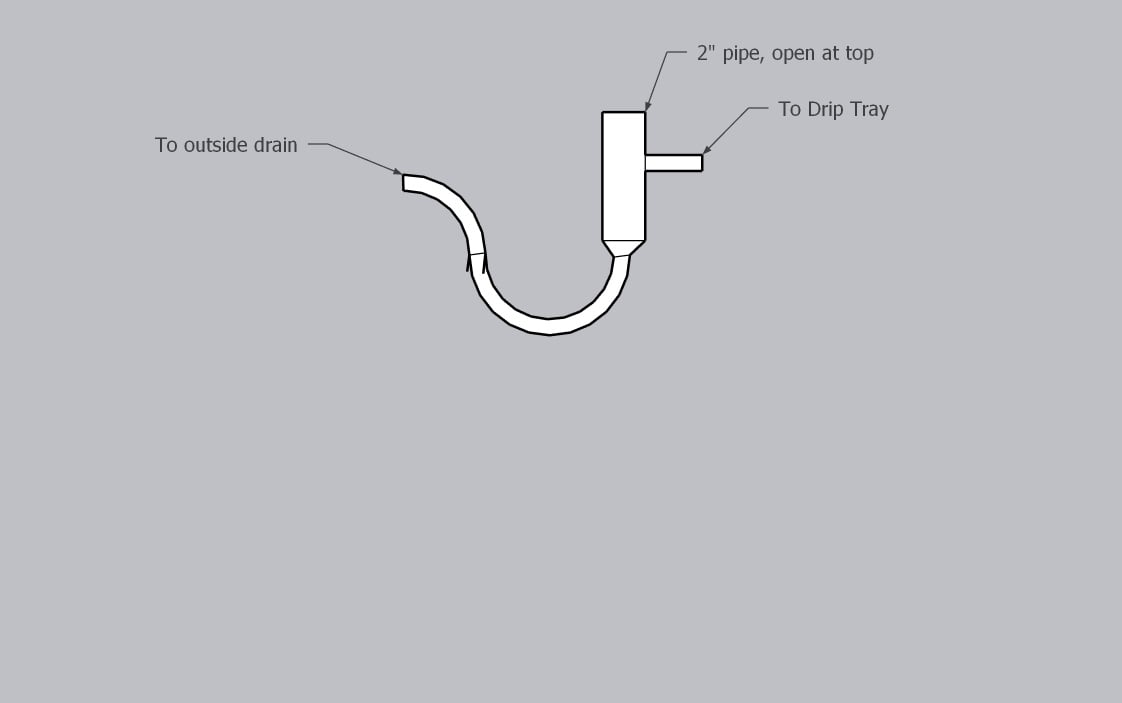
OK, here's a crude diagram. Except for the 2" pipe everything is 3/4". The 2" pipe causes whatever air is blowing in to slow down, the opening at the top prevents pressure from building at the drip tray when water blocks the pipe coming off the drip tray.
You can test the design by vacuuming out the trap with a shop vac and then running the fan and pouring water in.
 0
0 -
that open tee will do noting but defeat the trap, it will pull air in there all the time and the pan won't be able to drain. normally the weight of the water in the trap pulls up a little but does not allow air through so there is no air flowing in to the pan keeping the water from being able to drain because the air being sucked in pulls the condensate with it.
0 -
The open tee is no more open than the drip tray. It just gives air an alternate route to the outlet on the drip tray.
0 -
you don't want air coming in to the drip pan. the air rushing in to the drip pan is what prevents the condensate from being able to drain. this problem only happens on air handlers where the coil is on the inlet side of the blower. those types of air handlers must have a trap on the drip pan.
0 -
If it doesn't drain while the system is running, but drains so fast the drain can't handle all the draining when the fan shuts off, you've got air flow issues.
If the factory drain tubing is clear, there's a P trap (not a run trap) at or near the factory drain connection, and the drain line after the trap is clear and pitched properly, then there shouldn't be any drain issues.
If its a high static pressure system, venting the drain after the trap can help. If you've got an EZ-Trap, just stick a 12" piece of 3/4" PVC in the outlet side of the trap. But I would do a SPT anyway.
0 -
DiversiTech WS-1 is one of our gotos. I always break the R with float switches because an overflow is a critical fault that can cause a lot of damage if we run water everywhere. Note that this particular switch is manual reset. A DiversiTech CC-1 might work better for you, and being a simple float should be auto resetting.
Another solution might be to extend the outlet of the trap far enough that the resistance to airflow drops the air velocity enough that the weight of the water can overcome it. At that point, it becomes self-priming.
0


Categories
- All Categories
- 87.8K THE MAIN WALL
- 3.3K A-C, Heat Pumps & Refrigeration
- 60 Biomass
- 430 Carbon Monoxide Awareness
- 133 Chimneys & Flues
- 2.2K Domestic Hot Water
- 6K Gas Heating
- 124 Geothermal
- 170 Indoor-Air Quality
- 3.9K Oil Heating
- 79 Pipe Deterioration
- 1.1K Plumbing
- 6.7K Radiant Heating
- 397 Solar
- 16.1K Strictly Steam
- 3.5K Thermostats and Controls
- 56 Water Quality
- 51 Industry Classes
- 51 Job Opportunities
- 18 Recall Announcements