Commercial Kitchen / Community Center DHW Design — Indirect vs Tankless vs TurboMax

Hi everyone, I need advice on a commercial domestic hot water (DHW) system for a community center kitchen.
The building already has a ~380 Mbh propane boiler that is currently used for in-floor heating.
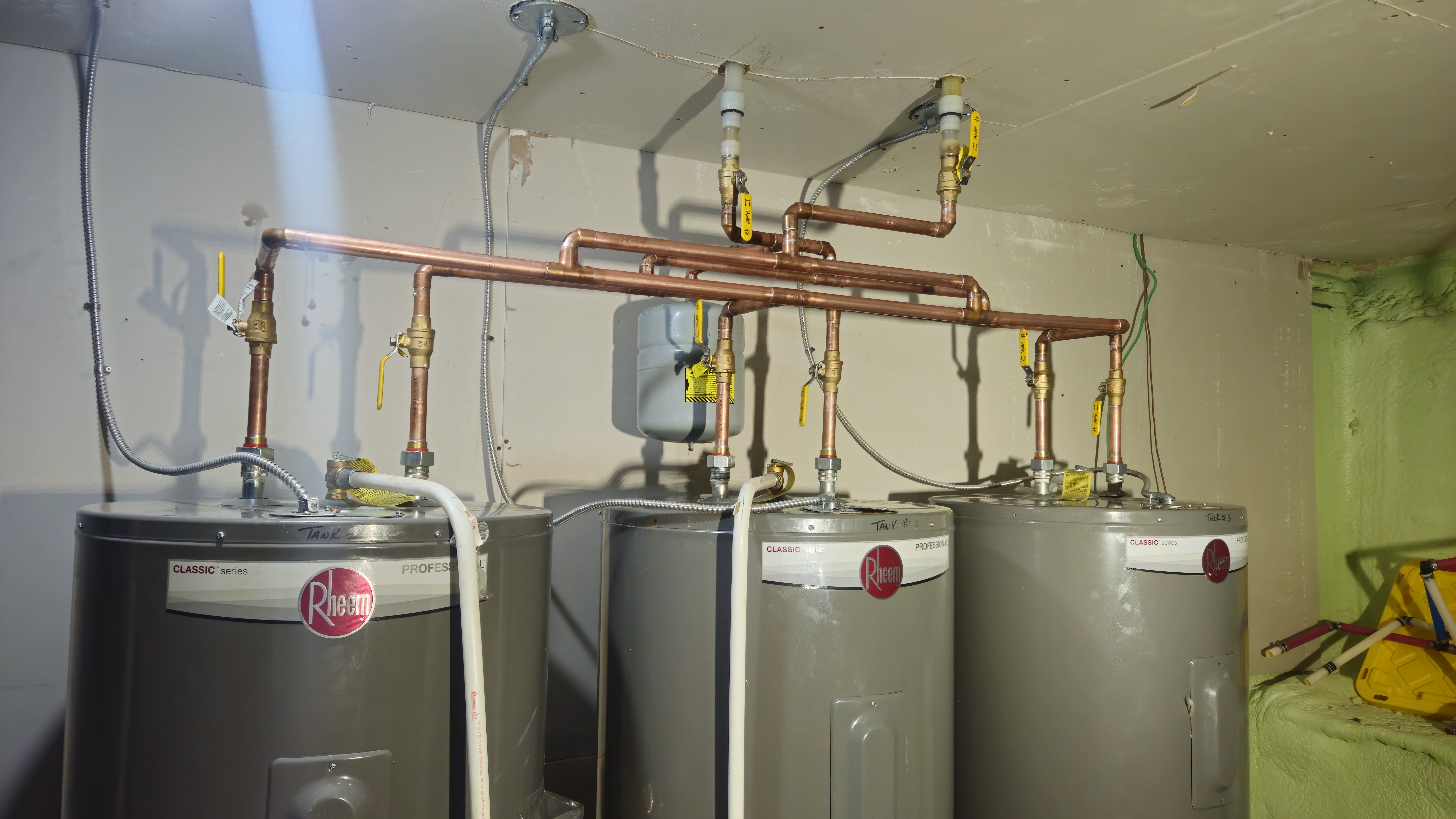
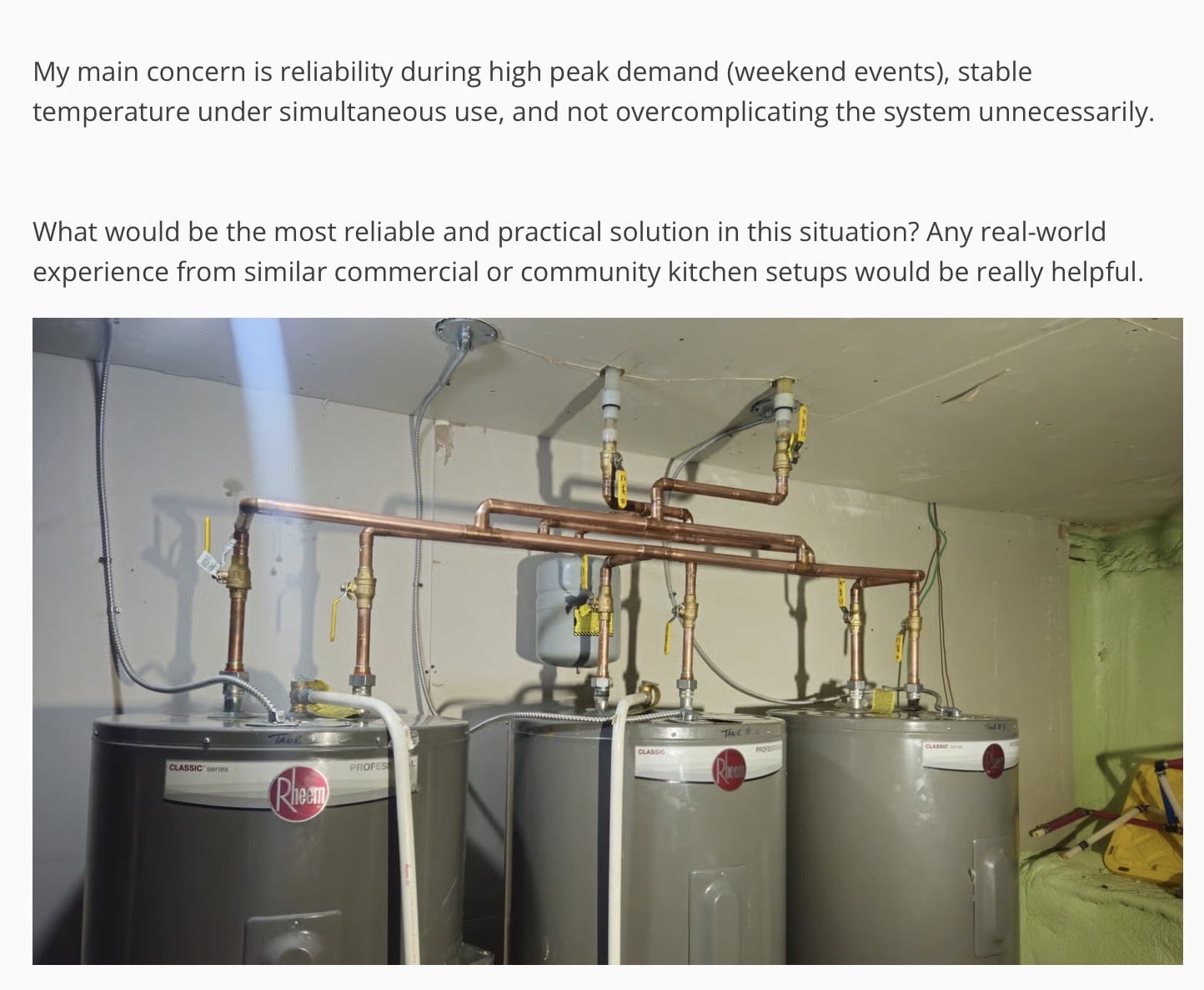
For hot water, there are only three 60-gallon electric tanks installed in parallel. This setup works okay during weekdays or low demand periods, but it is not able to keep up during peak usage.
On weekends or during events when the community center is full, the system struggles badly and we end up getting lukewarm water when multiple fixtures are running at the same time (kitchen sinks, prep areas, 4-5 washrooms , 6-7 handwashing stations etc.).
I am trying to decide the best upgrade option and I’m getting mixed opinions:
1. Install multiple commercial tankless water heaters
2. Add a separate boiler dedicated to DHW with a large indirect storage tank
3. Connect DHW to the existing 379MBH boiler using a TurboMax or high-recovery indirect system with DHW priority
4. Add more storage tanks in parallel to increase capacity
My main concern is reliability during high peak demand (weekend events), stable temperature under simultaneous use, and not overcomplicating the system unnecessarily.
What would be the most reliable and practical solution in this situation? Any real-world experience from similar commercial or community kitchen setups would be really helpful.
Comments
-
FIrst: what about "taming the beast" i. e. the hot water use? Implement some flow restriction at ALL of those washrooms and handwashing stations. Check the settings on all of the upper and lower thermostats in the water heaters and make sure that ALL of the elements (and thermostats) are good. Since there are no tempering valves, you don't have to check those. Then…let the discussion about "upgrading" the DHW production begin.
 1
1 -
Commercial falls under different codes.
Here domestic water heaters do not have the recovery capacity to meet those demands. That's why commercial equipment is used, much higher recovery rates for the larger demands.
0 -
I would avoid multiple water heaters — of any flavour — arranged in parallel. There is simply no way that you can arrange them without using some VERY expensive valves so that they will actually operate in parallel — one or another of them will always take most of the load and the others will just sit there. If I were a gambling man, I would wager good money that if you actually put meters on those three heaterrs, you would find that one of them was doing most of the work.
So…
My first suggestion is to determine the actual loads of the various fixtures. "Taming the beast" sounds vaguely attractive, but as @pecmsg points out this is a commercial application, and you may find that the applicable health codes (we're not into plumbing so much) require both a minimum flow and a minimum temperature on some of the uses — particularly if there is a dishwasher or pot washer involved. That said, you may also find that the various usages have widely different required flows and temperatures.
Until you have that information in hand, you really can't decide between you options 1 2, and 3; option 4 is out of the question. Just don't even think about it.
At first glance, particularly if the usages are in somewhat separate places, I'm kind of leaning to option1, with tempering valves — and carefully sized to the usage.
Br. Jamie, osb
Building superintendent/caretaker, 7200 sq. ft. historic house museum with dependencies in New England 1
1 -
It would be good to get a handle on how much the peak demand is. You can rent a clamp on ultrasonic flow meter, monitor it for a month.
Groups of tankless seem to be what most all of the hotel chains are using these days. They cover that wide occupancy swing best. The tankless manufacturers have header assemblies to make the install easy.
However, you would need to confirm you have enough gas supply to run a group of tankless, and the boiler
You already have a heat source, if the load is a dump load. Add a high recovery indirect and circulate an electric tank or two that you already have as your dump storage. A small gallon capacity multi coil Turbomax is a good option, lots of exchanger in those copper coil tanks.
How’s your water quality. Add a provision to delime the coils occasionally in a reverse indirect
Bob "hot rod" Rohr
trainer for Caleffi NA
Living the hydronic dream0 -
We have used single, or multiple natural gas fired residential and commercial water heaters. We have also used many single or multiple indirect tanks, sometimes with a common circulator, other times with individual circulator. We have installed racks of natural gas fired tankless units as well.
The large residential tank type worked well, and were very easy (and inexpensive) to replace. This was for a public swim club,
We have used single and often two commercial tank types. They varied from 100,000btu input all the way to 1.5Mbtu. They are very expensive, heavy, and often require specialized burners and safety controls. They do work, but the return on investment is not great. They are basically throw away items at restaurants, and hotels. At other locations, such as apartment buildings and schools they hold up better.
Indirect tanks work very well as far as performance goes. This is especially true when you have large heating boilers (often oversized) and you can harness that horsepower for the indirect tanks. These tanks typically last much longer than the direct fired commercial units. As far as reverse indirect tanks go, these are the "Cadillac" of tanks. They are expensive and heavy, but they last a long time and deliver massive amounts of dhw when hooked up to larger boilers.
The rack systems we installed were for large apartment buildings. They worked fantastic and came with common headers for gas, water and electric. Common venting can be a little tricky. These units performed flawlessly for the one year warranty we had to cover. Not one callback.
I agree with others in determining the actual peak load. In my opinion, you cannot cheat like some do with heating loads. If I turned your heat off for ten minutes, my guess is no one would notice. If I turned off your dhw while you were in the shower or washing dishes, I bet you would notice.
 1
1 -
I would think tankless water heaters would put a strain on the gas supply for sure.
To be sure calculating the DHW load is the first thing to do and also check to see if you existing boiler has extra capacity
I would thing a few in directs would be the best bet. If one failed you would still have DHW.
The more water you store the smaller the boiler you need to drive the indirects. The less water you store the larger the boiler.
So you need to take a good look at the load.
2 -
Hi, I'm all about load reduction first. This can be accomplished somewhat by low-flow fixtures, but even better to right-size the plumbing and then go with the low-flow fixtures. Even Appendix M over-sizes the pipes. With less water between fixture and heat source, hot water delivery is quicker, while saving water and energy.
Another thing to look at is a a drain water heat exchanger. Sharc makes on that uses a heat pump: www.sharcenergy.com . This can take care of most of the load, if it's given adequate storage.
One more thing to consider is solar thermal for preheating if you're in a sunny area. A simple system can be built for far less than what you'd expect.
Yours, Larry
1 -
To go back a little to something I said above. Whatever, keep firmly in mind that this is a commercial application with a food service component. That means that the Department of Health having jurisdiction is going to have some very definite ideas about minimum flows and minimum temperatures for at least some, if not all, of the points of use — and they may be widely different.
Second, also keep in mind that if at all possible you need to provide "fail operational" redundancy, as the failure of some critical use can and will shut the operation down Right Now. There are a number of ways this can be provided — it doesn't necessarily mean dual heaters for the dishwasher, for instance, provided there is a way to use the pot washer heater for the dishwasher or vice versa in a pinch — but it does need to be considered (in theory you have that with the present setup, as I note that it is possible to valve off one water heater of the three for repair if required).
Br. Jamie, osb
Building superintendent/caretaker, 7200 sq. ft. historic house museum with dependencies in New England0 -
the Department of Health having jurisdiction is going to have some very definite ideas about minimum flows and minimum temperatures
exact!0 -
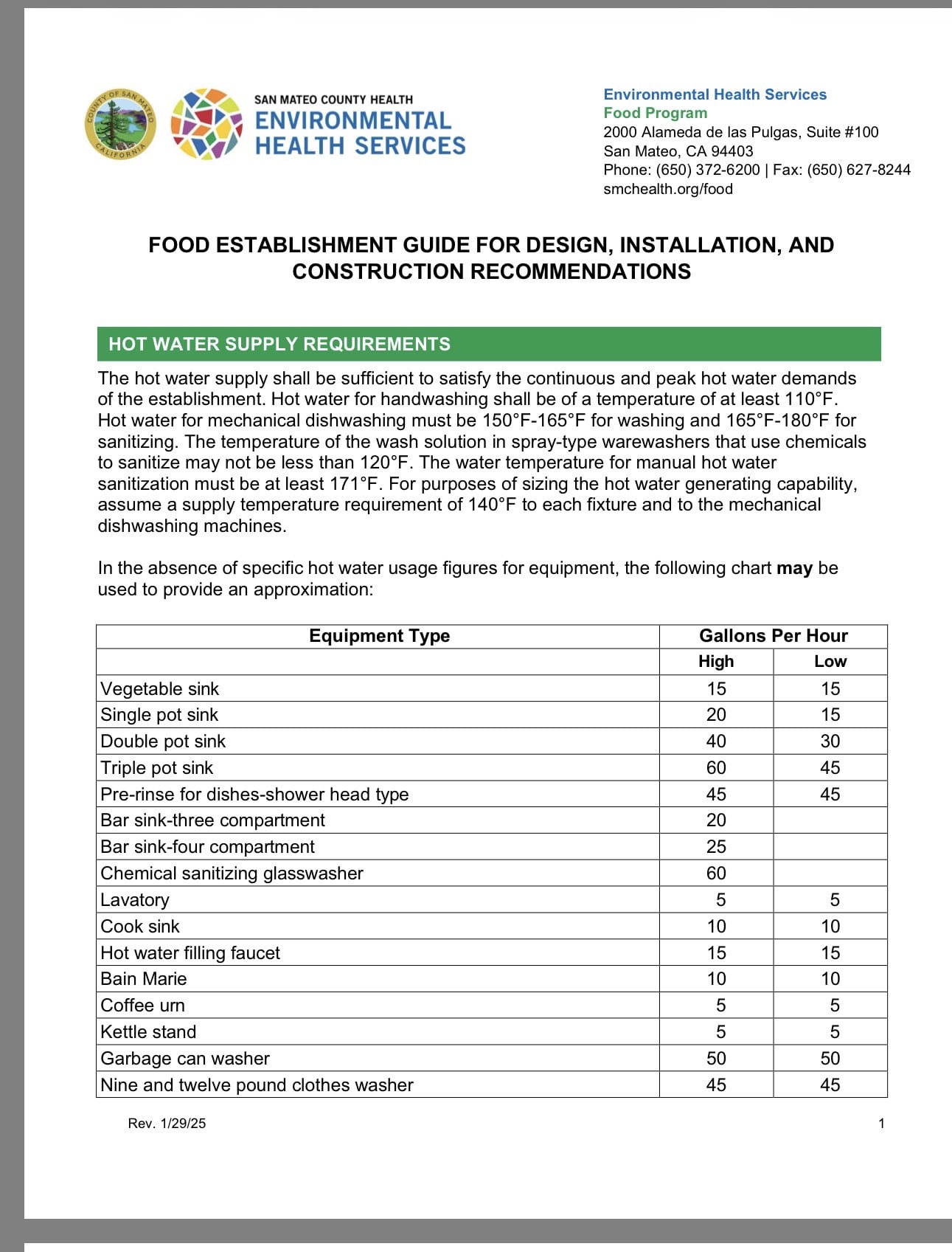
those don’t look like commercial tanks. Any idea what temperature they run? Depending on the type of kitchen, they may need in excess of 170f to dishwashers?
Typically you would also see a mix station for the rest or the DHW, hand sinks, etc.
Your country probably has a guide like this.
It is not uncommon to see health department stickers or numbers on commercial kitchen hw supply equipment
 Bob "hot rod" Rohr
trainer for Caleffi NA
Living the hydronic dream0 -
it seems likely with the indirect option when you have the building full of people and cooking that you are far below your heat loss design conditions (unless it is all going up a vent hood).
probably a way to do preheating with an hx from the boiler during the high demand periods.(which is kind of what the "reverse indirect" is)
if the boiler is the energy source for the dhw then you only need a gas supply big enough for it. if you have a few tankless water heaters then you need a much larger gas supply.
your demand may not be that large if the parallel piping means you essentially have one 60 gallon electric tank. breaking them up to different loads may solve your proble but electric tanks have extremely slow recovery, the capacity you get is pretty much what is already hot in the tank.
0 -
3 tanks with a 4500W element running in each, is 13,500W X 3.41= 46,035 btu.
A high output 50 gallon gas, 60,000 btu input is about the same btu.
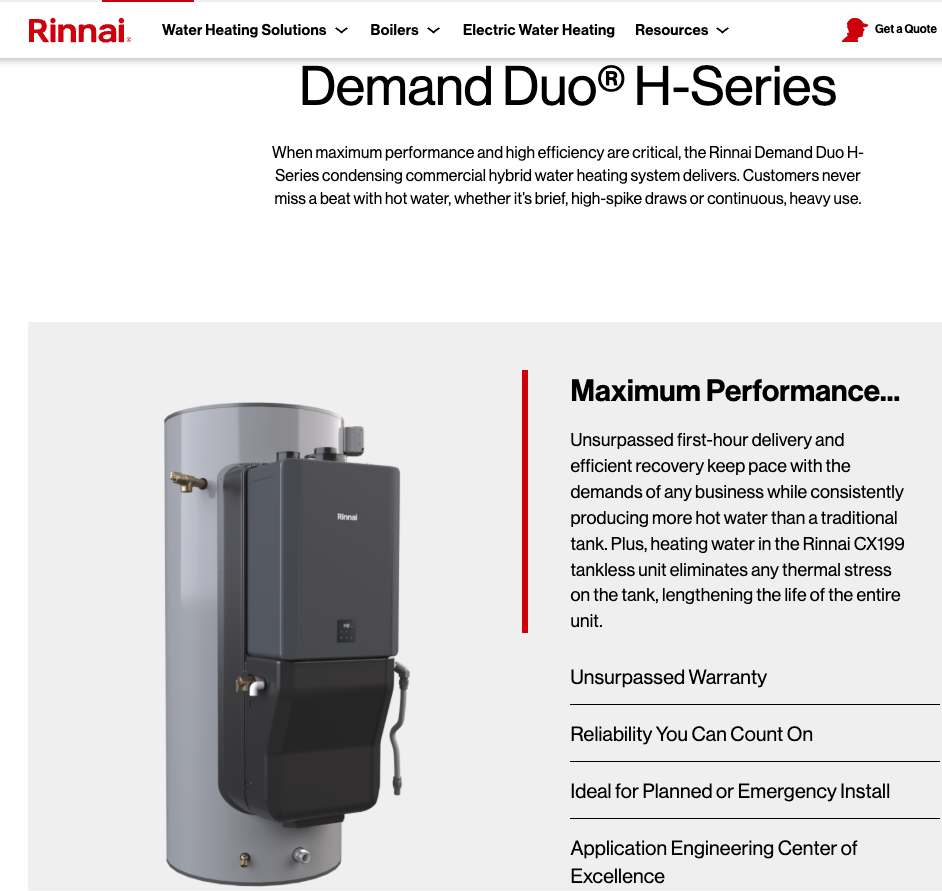
A single commercial (180°) tankless at 199,999 btu X 86% or more efficiency would be around 172,000 btu/hr. More that 3-1/2 times the btu power you have now.
But without knowing even an approximate load everyone is spitballing.
These tankless Duos are designed for those high dump load applications.
 Bob "hot rod" Rohr
trainer for Caleffi NA
Living the hydronic dream0 -
but electric water heaters are more or less about the amount of hot water they store, they have essentially no recovery so the element wattage tells you little about the current demand, just that it is more than ~40 gallons per event.
0 -
you could connect the tanks in series, then you'd get around 150 gallons instead of around 40 gallons of hot water.
0 -
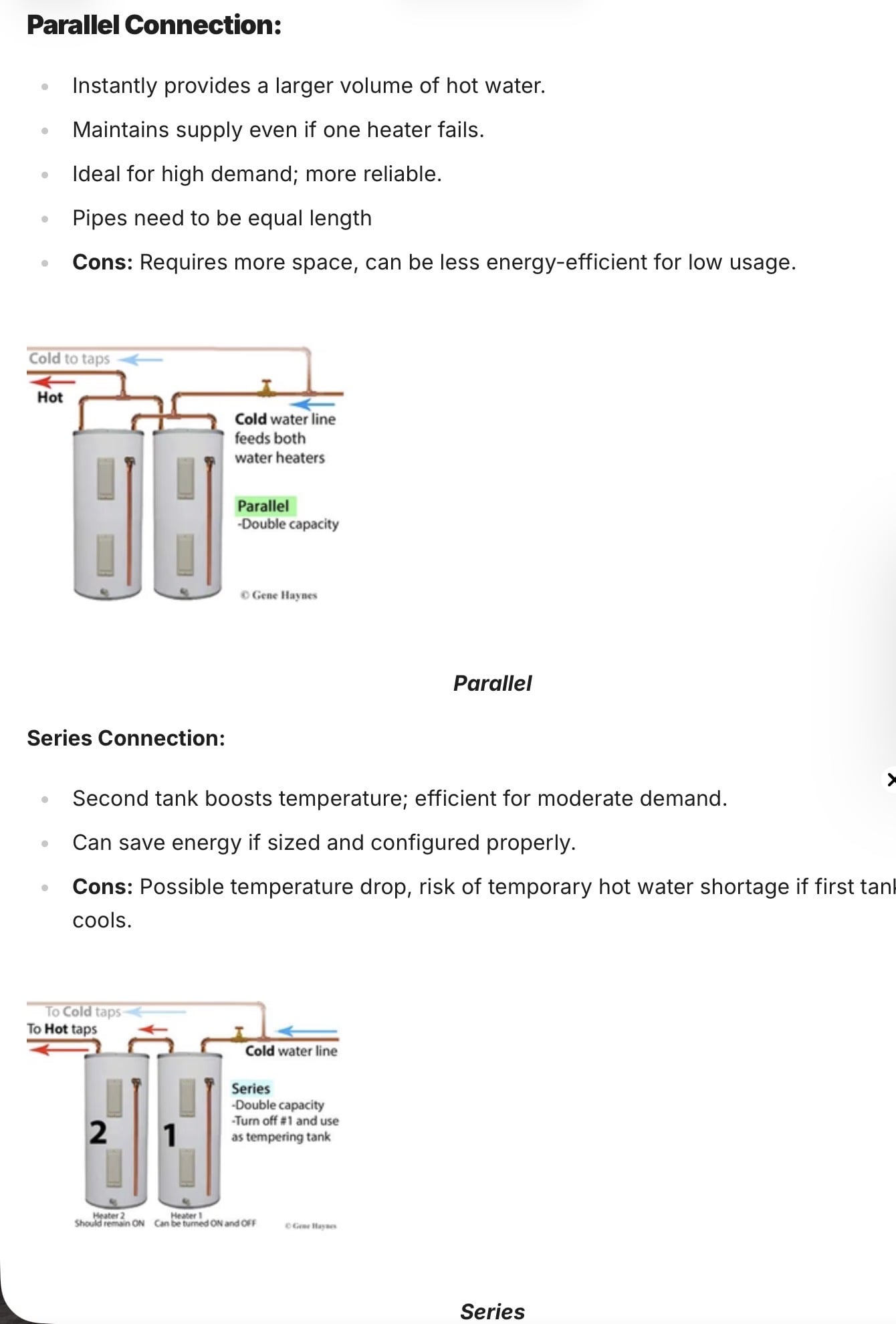
they look to me to be properly parallel piped. Which is the better option for this application. Their main concern is high demand, so “on demand” properly sized are a good option.
Or use the power or the large boiler. 322,000 boiler connected to a plate HX, ala the EK system should give him 15 gpm or more continuously
 Bob "hot rod" Rohr
trainer for Caleffi NA
Living the hydronic dream0 -
Well… I wiil agree that a parallel design can work. Sometimes. The one in your photo is actually not all that bad, but I'll bet that analysis of the heating duty cycle will show that the centre tank is taking more of the load — and that the delivered temperature droop comes when the centre tank runs out of hot water.
To make parallel flow work well, it really needs to have a very low loss header on both the cold water feed and the hot water supply, and the connections from those headers to the various tanks must be EXACTLY equal. Same length, exactly the same fittings for each one.
Br. Jamie, osb
Building superintendent/caretaker, 7200 sq. ft. historic house museum with dependencies in New England0 -
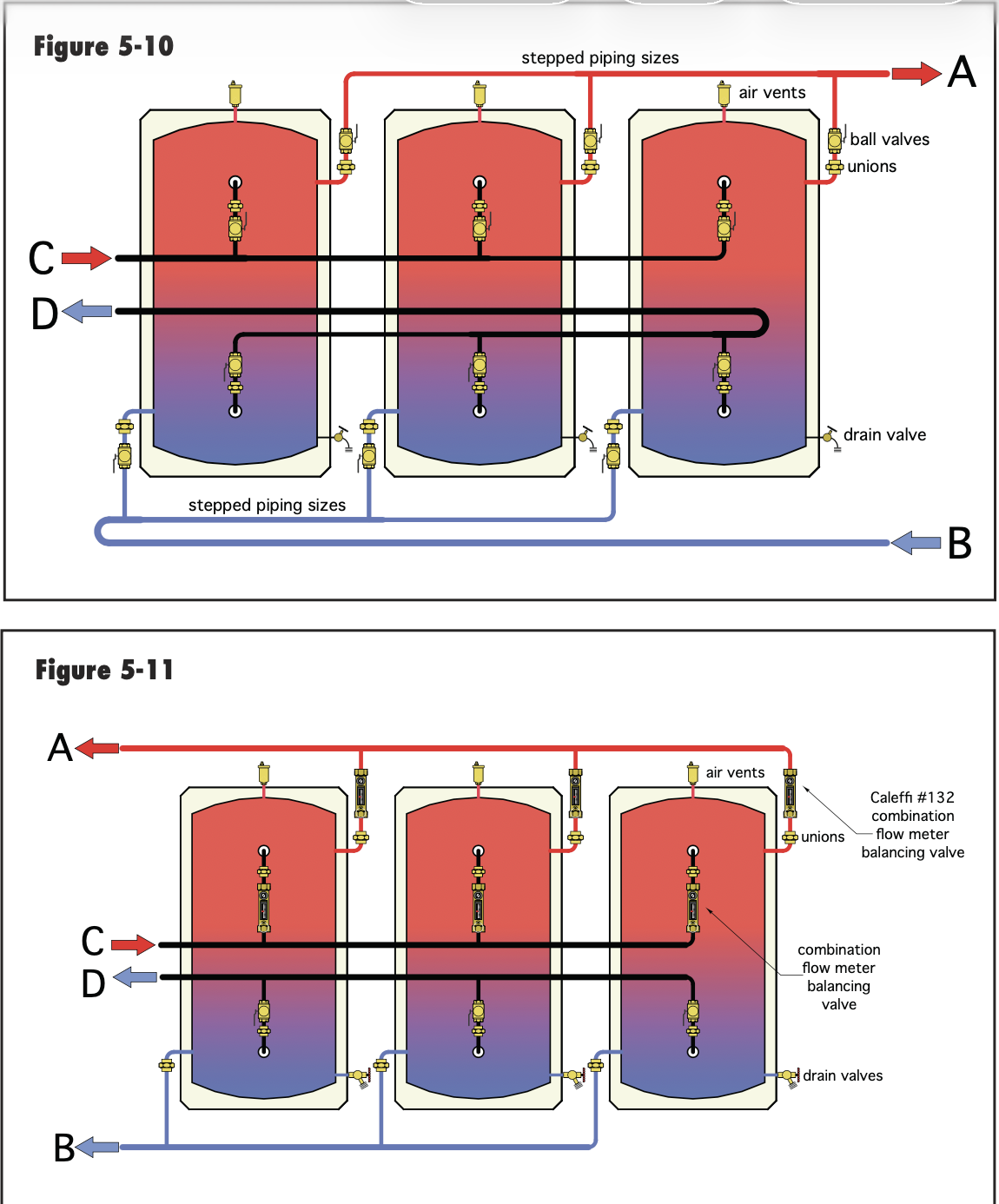
Reverse return or simpler yet, put a balance valve like a 132 Caleffi on each tank.
These indirects are flow balanced on the coils and the tanks themself.
 Bob "hot rod" Rohr
trainer for Caleffi NA
Living the hydronic dream0 -
is the dividing of flow linear? like their issue is that the recovery is measured in hours and they have someone using a faucet or 2 somewhere almost continuously rather than someone is using 15 gpm of hot water. the flow is probably more like 0-2 or 3 gpm over 3 or 4 hours. will that still divide evenly if you set it up with balancing valves?(i have a similar question for a valve to control flow of the mix in a shower head or faucet). i think the resistance is linear so it should stay in the same proportion with varying flow. sizing the pipe diameter from each tank to the manifold to the actual flow would also probably help. does the fluid dynamics, the interaction of the fluid with itself and with the surface of the pipe change the resistance between say 1gpm and 8 pm?
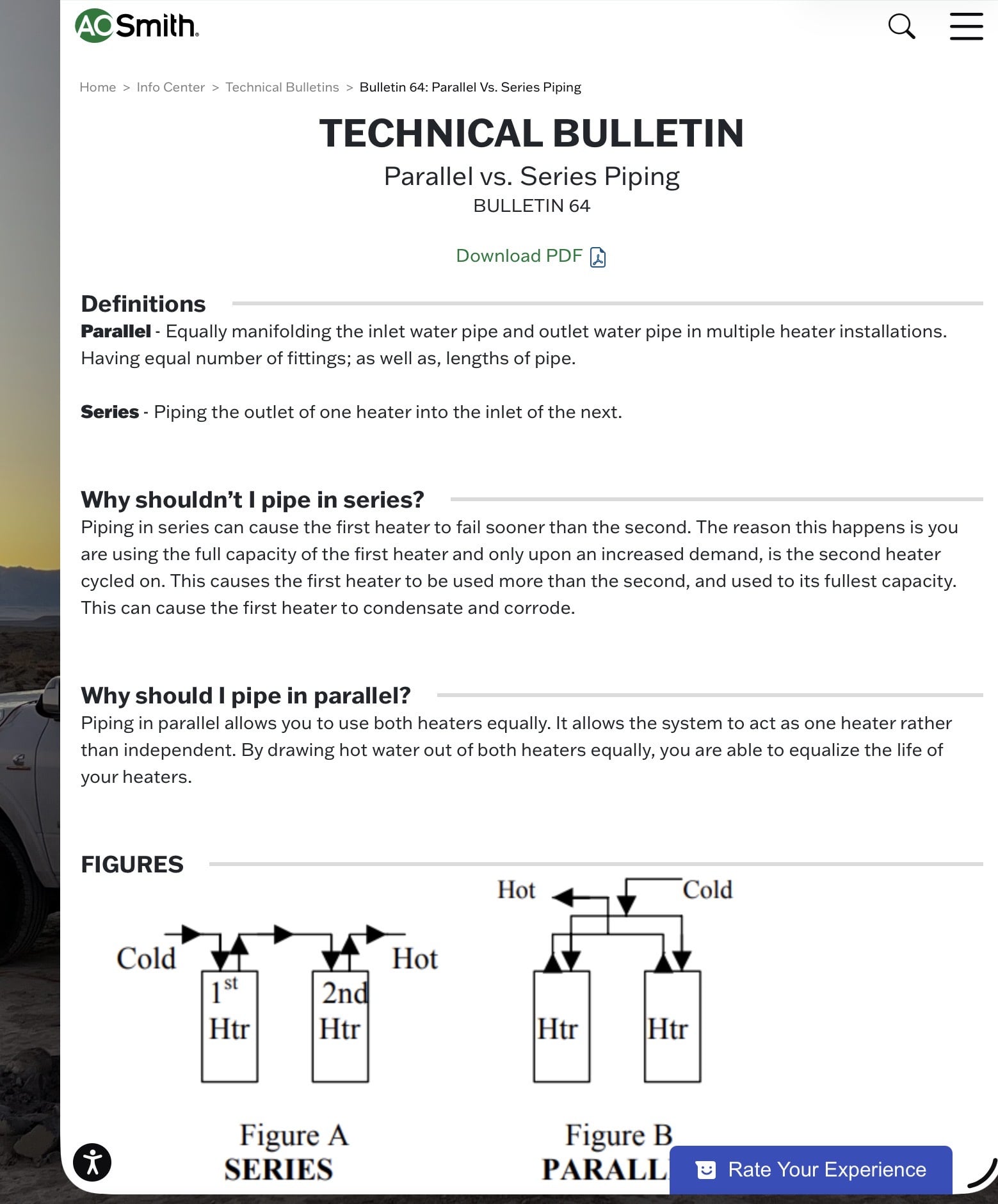
in a series system i don't see how the tank piped to the distribution system tank can run out of hot water before the whole system runs out, the hot water from the second and 3rd tanks are supplying that tank with hot water and the cold water enters at the 3rd tank.
0 -
the balance valve with the flowmeters attached, or a typical balance valve with PT ports would allow you to “see” how the flow is split among the tanks.
I know that Christmas tree piping that water heater manufacturers show in installation manuals has been shown and utilized for years. You would need to gauge up all that tanks to get an exact answer to your question.
 Bob "hot rod" Rohr
trainer for Caleffi NA
Living the hydronic dream0 -
i really want to know about the fluid dynamics part of it, if you balance them at a low flow rate do they stay balanced at a large flow rate. simple flow resistance theory says yes but does that ignore parasitic components that are important here.
the series causing shorter life is probably less of an issue with electric water heaters. i'm suggesting there may be fixes for their current setup, not that a bunch of tank type water heaters is the way to go for a redesign.
0 -
Problem is that thought of simply, one would think that if one got a balance at low flow it would stay that way at high — but, sadly, it isn't quite so simple. First place, flow resistance is related to the 1.83 power of the velocity — neither linear nor exactly squared. Worse, different fittings or valve settings will not even be that simple. Which is why I said above that the only really reliable way is to ensure that you have a large diameter low less header on both inlet and outlet, and that the piping from each water heater to the header has exactly the same total length and number and type of fittings It can be done, but the piping may get to look slightly crazy!
But then, for the gearheads in the crowd, take a look at the tuned exhaust headers on some street legal drag tuned cars or funny cars…
Br. Jamie, osb
Building superintendent/caretaker, 7200 sq. ft. historic house museum with dependencies in New England0 -
Gosh @mattmia2 how close is close enough?? If one tank gets 1/2- 1 gpm more that another I think all will be fine.
On your next 3 tank job put Quicksetters on the tanks and you can watch for discrepencies.
Elements in electric tanks fail due to the mineral build up on them. In hard water conditions, with lots of water passing through the tank, as maybe this job has, I imagine you replace elements more often than you would replace a gas tank?
Testing hardness of the water is always a good idea, especially if they go tankless.
I piped two or three tanks in series on the big custom vacation homes. When unoccupied except for housekeeping maintenance run just the last tank. When a dozen people arrive take 2 & 3 off vacation setting. So there is a place for series, I just don't think this job is the place.
Bob "hot rod" Rohr
trainer for Caleffi NA
Living the hydronic dream0 -
with gas tanks with maybe 25,000 btu/hr getting in to the water from the burner a 30% or 50% imbalance is probably fine. with standard electric tanks where the recovery is maybe half that you have to use all of stored water.
0 -
It seems that when the place is busy on weekends there would not be much demand for the floor heat.
Assuming it is tubing in concrete, the flywheel effect could take care of the heating requirements as the heat need would drop with busy use of the building.
So I would look into an indirect tank or 2 fed by the existing boiler. Then that water could connect to the existing WH tanks. If the tanks were connected with the reverse return design (not sure if that is the terminology), then they would be used more efficiently.
It might take a few simple controls for this but not rocket surgery.
1




Categories
- All Categories
- 87.8K THE MAIN WALL
- 3.3K A-C, Heat Pumps & Refrigeration
- 59 Biomass
- 430 Carbon Monoxide Awareness
- 132 Chimneys & Flues
- 2.2K Domestic Hot Water
- 6K Gas Heating
- 124 Geothermal
- 170 Indoor-Air Quality
- 3.8K Oil Heating
- 79 Pipe Deterioration
- 1.1K Plumbing
- 6.7K Radiant Heating
- 396 Solar
- 16.1K Strictly Steam
- 3.5K Thermostats and Controls
- 56 Water Quality
- 51 Industry Classes
- 51 Job Opportunities
- 18 Recall Announcements