Welcome! Here are the website rules, as well as some tips for using this forum.
Click here to Find a Contractor in your area.
If our community has helped you, please consider making a contribution to support this website. Thanks!
Heat flow visualizer

It seems that many of the problems homeowners come here with involve mismatches between boiler output, radiation, and/or building heat loss. This morning there's yet another post here from someone whose boiler is short cycling. Various pros here asked the usual questions and made the usual suggestions, all good.
That got me thinking about how to visualize heat flows from the boiler into the building, and the image of three buckets flowing into each other in series popped into my head. I'm sure I'm not the first person to draw this analogy, but since it helped me make sense of how heating systems work, I drew some sketches to illustrate various problems that people come here with.
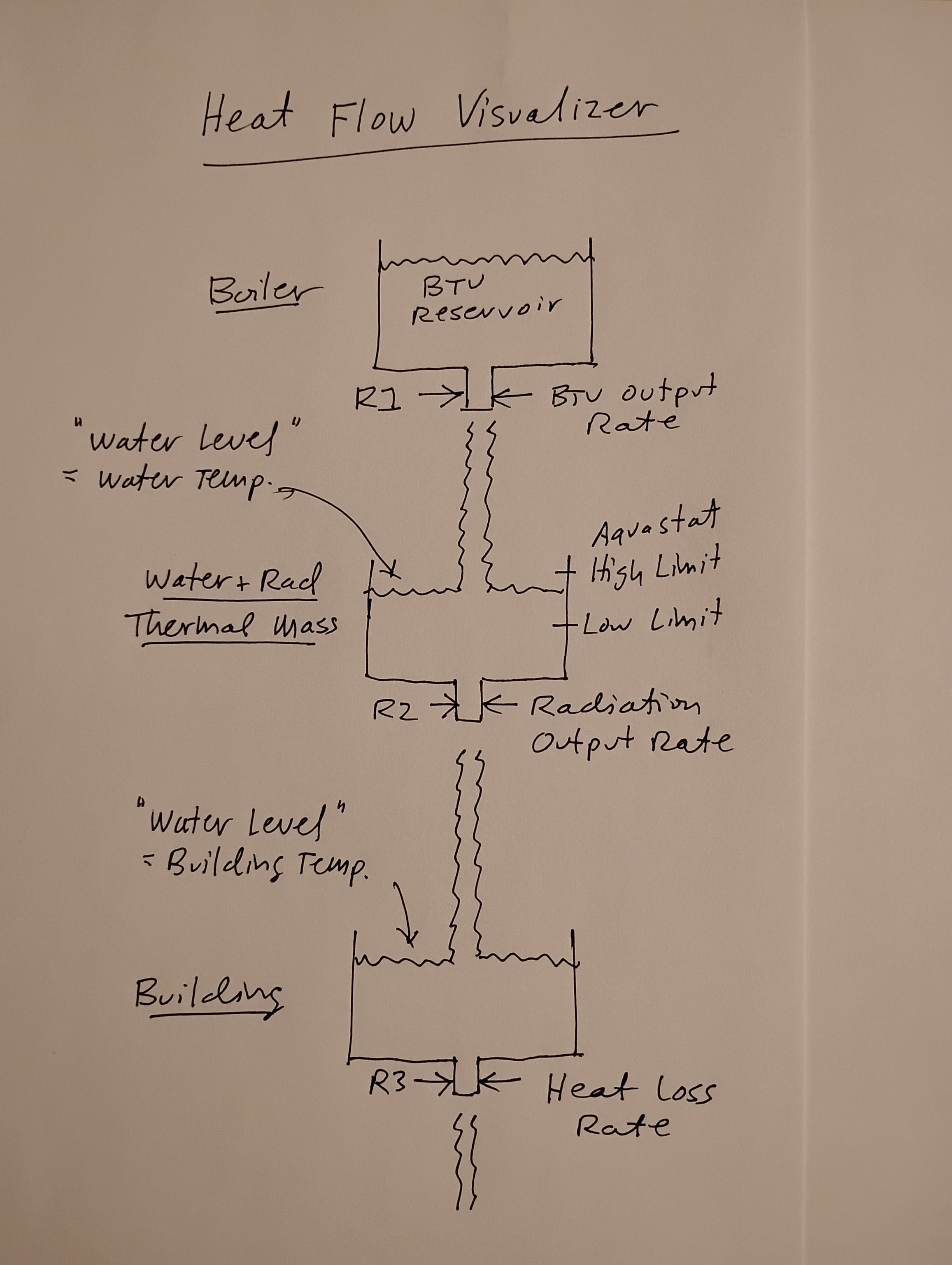
The boiler is illustrated by the first "bucket," which is a BTU "reservoir" whose output rate R1 is represented by the diameter of the output pipe at the bottom of the bucket.
The thermal mass of the water and radiators is illustrated by the second bucket, and the radiation output rate R2 is represented by the diameter of its output pipe.
The building is represented by the third bucket, with its heat loss rate R3 represented by the diameter of its output pipe.
The water flowing between buckets represents the flow of heat (BTU's). If BTU's flow into a bucket faster than they flow out, the temperature (water level) in the bucket rises.
The size of the thermal mass bucket in the middle of the series matters, because a small thermal mass "bucket" will fill very quickly, with high water temps causing short cycling. Conversely, a large thermal mass bucket (like a gravity conversion system) will fill very slowly, keeping water temps low.
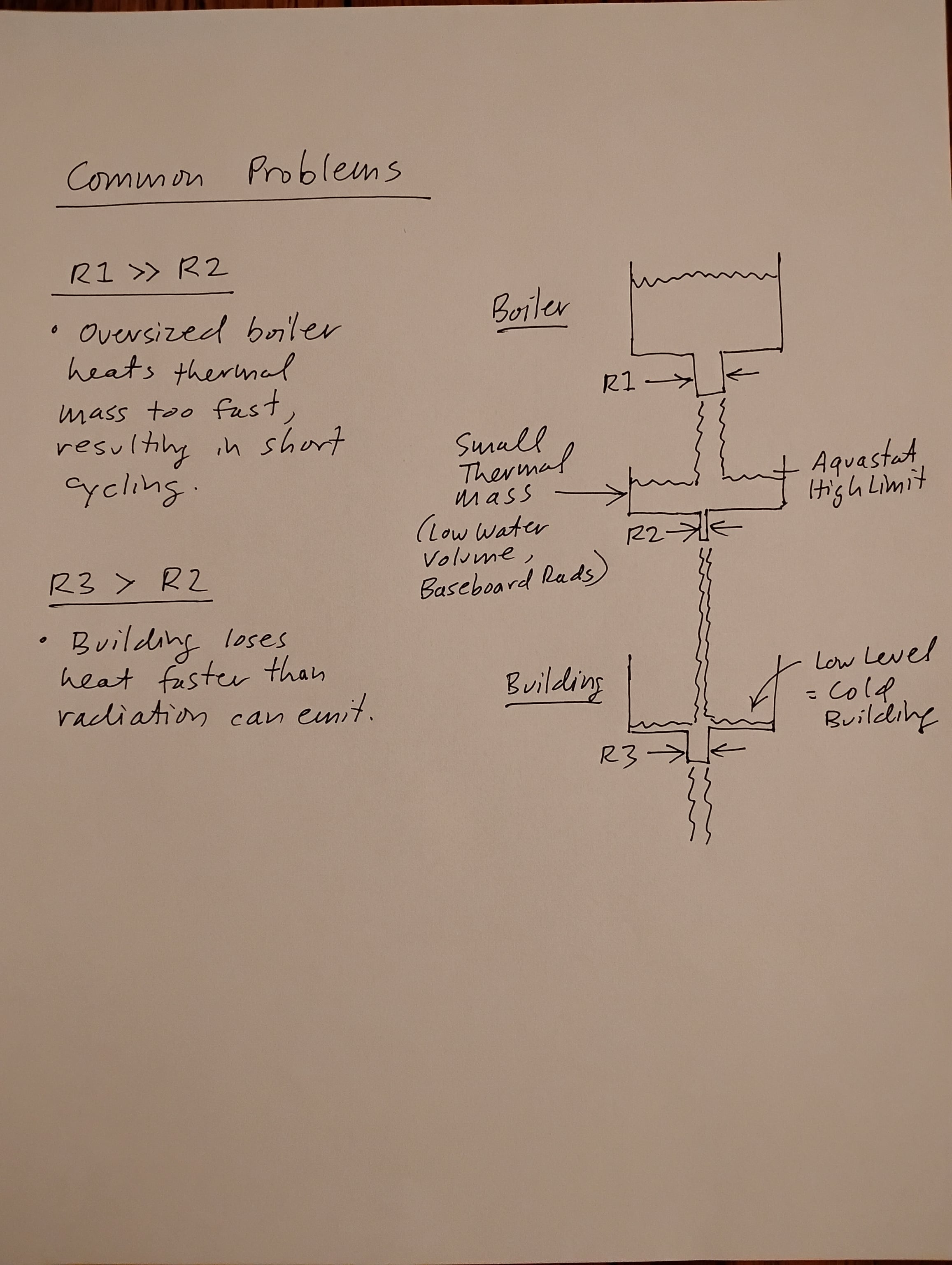
Common problems seen here at HH happen when R1> >R2, when an oversized boiler heats a small thermal mass too fast, resulting in short cycling, and when R3 > R2, meaning the building loses heat faster than insufficient radiation can emit.
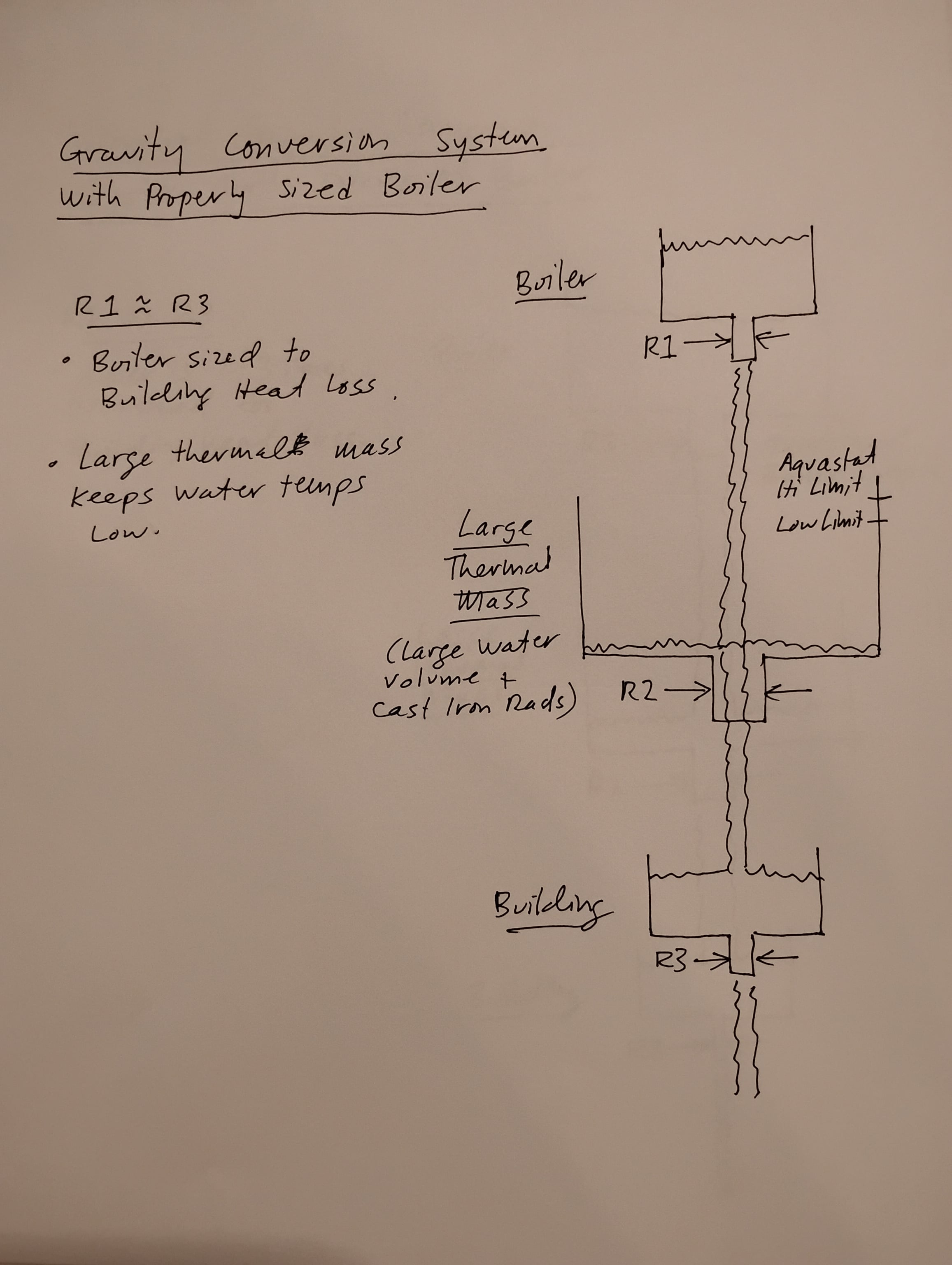
In the case of gravity conversion systems, the thermal mass "bucket" is relatively large, meaning the "water" (temperature) level rises slowly. If the boiler is correctly sized to the building heat loss, R1 and R3 are roughly equal, and the large thermal mass and large EDR (R2) means the water temperature stays low.
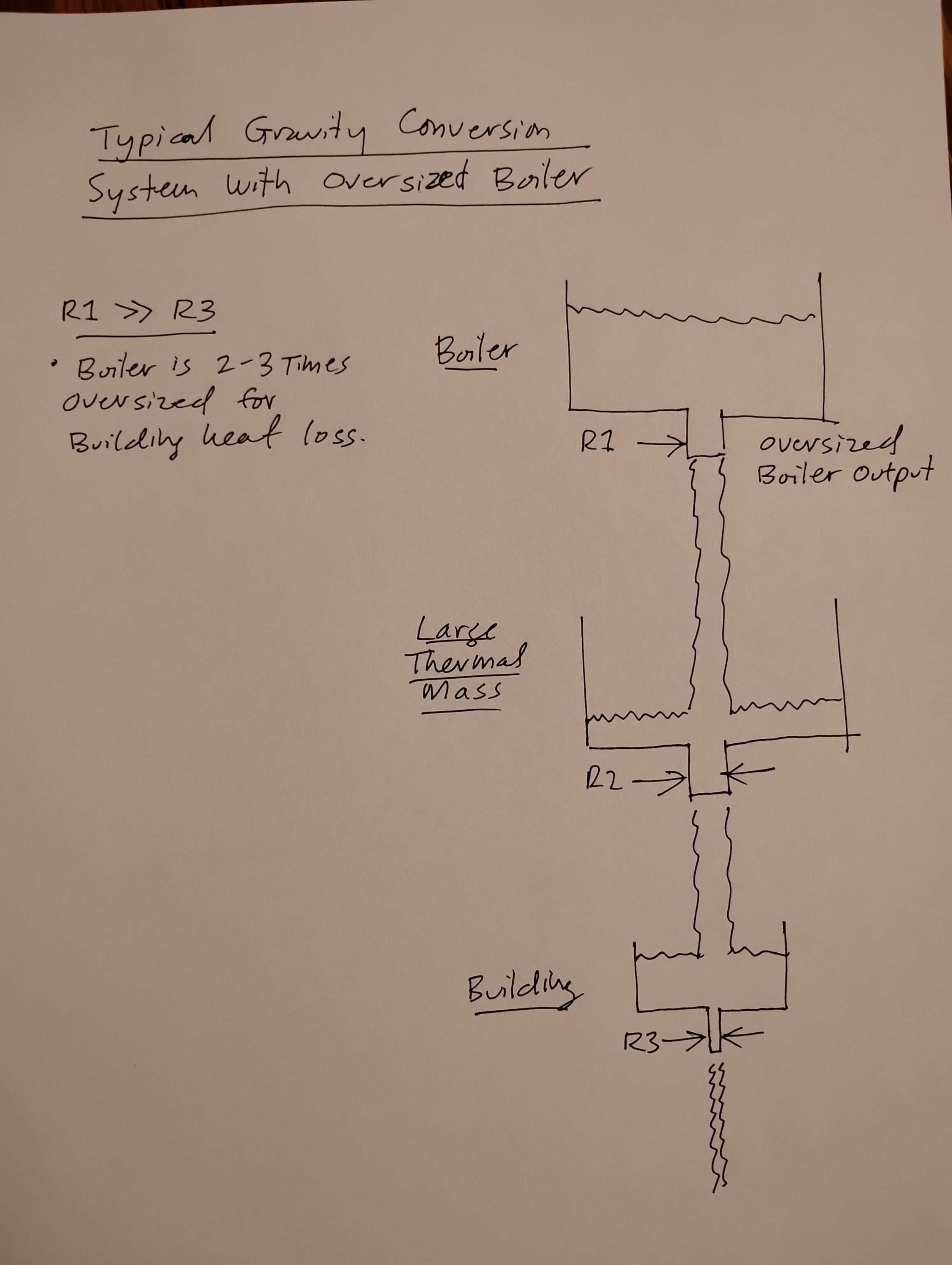
But commonly we see gravity conversion systems with massively oversized boilers. This is the case in my 4-unit condo building. Here we have R1> >R3, where the boiler output rate is 2-3 times the building heat loss rate.
All analogies are imperfect, and I'm sure I'm not the first one to think of the bucket analogy, but it helped me make sense of the various flow rate imbalances that often show up as problems here at HH.



Comments
-
Anything that helps visualise or understand is wonderful! Thank you, @jesmed1 !
Of course step 1 is to realise that the heating system is a system in the first place, and nut just a bunch of isolated components!
Br. Jamie, osb
Building superintendent/caretaker, 7200 sq. ft. historic house museum with dependencies in New England2 -
Good graphic of the concept.
The issue with typical CI boilers is even when properly sized, 80% or more of the heating season they are oversized. On mild days they are grossly over-sized.
The heat load of a building is dynamic, the boiler output is static. So it is a mismatch not easily resolved.
Multi, staged boilers can help, modulating boilers and modulating pumps are a better answer to dynamic load matching.
Bob "hot rod" Rohr
trainer for Caleffi NA
Living the hydronic dream1 -
Please forgive me.
The issue with typical CI boilers is even when properly sized, 80% or more of the heating season they are oversized. On mild days they are grossly over-sized.
How oversized are they on a 95 degree day when they are used to heat water 20 degrees in an indirect?
Edit: I didn't want to make a new post for this:
Please check my math, honestly I could be way off here:50 gallon tank * 20 degree increase in temp = 1000 BTU, is that right? I'm considering the typical case of an aquastat set to heat at 120F and shut off at 140F
NJ Steam Homeowner.
See my sight glass boiler videos: https://bit.ly/3sZW1el1 -
For those of us stuck with the fixed-firing-rate cast iron boilers we inherited, the graphic shows how important the size of the second "bucket" (thermal mass) is. Mismatches between an oversized CI boiler and small thermal mass can be helped by adding a buffer tank (making the second bucket bigger).
My sister just bought a house with a (surprisingly) proper size CI gas boiler. But the house is ridiculously micro-zoned, with limited baseboard radiation. So the boiler runs 24/7, short cycling and bouncing off the high limit every few minutes. But her gas bills this winter weren't bad, which surprised me. The half of the unfinished basement that contains the boiler is the warmest room in the house.
Still, her short cycling could be fixed with a buffer tank and fewer zones.
0 -
well if the indirect is piped and pumped to handle all the boilers output, it is not oversized for that load.
Is it the most efficient way to heat dhw? Debatable
Its the boilers with tankless coils that seem to be most inefficient
Bob "hot rod" Rohr
trainer for Caleffi NA
Living the hydronic dream 1
1 -
I'm a bit ambivalent to this specific subject, but wouldn't it stand to reason if the the single stage CI boiler were piped and pumped to deliver full load to the DHW at max demand that it would be oversized for the DHW when just maintaining temperature in the tank? Our "bucket" in the graphic would be different sizes depending on the DHW demand, from a solo cup size when just maintaining temp, to an appropriate sized bucket at steady DHW use, or max draw.
0 -
You size, mor should size, a boiler to the largest load. Sometimes that is the indirect, depending on it's expectations.
Suppose you have a new energy efficient 1000 sq ft home, 12 btu/ft load. A family with two teenagers wants lots of dhw for tubs and showers from an 80 indirect.
What size boiler? You will want more that a 12,000 btu/hr boiler if a basic DHW tank is 35K or more.
I imagine most indirects are not piped to their maximum performance. It seems all, or most can handle at least 100,000 btu/hr. Often the recovery tables are based on 180- 200° SWT.
Bob "hot rod" Rohr
trainer for Caleffi NA
Living the hydronic dream0 -
Aren't radiators in a hot water system typically sized close to the boiler's output?
The way you worded that, sounds like a boiler is never oversized for the load regardless of how warm it is out?
Unless I misunderstood?
Single pipe 392sqft system with an EG-40 rated for 325sqft and it's silent and balanced at all times.
0 -
I always picture cast iron radiators as acting like capacitors to smooth the bursts of heat out.
But a reservoir of water works too, I like it.
Single pipe 392sqft system with an EG-40 rated for 325sqft and it's silent and balanced at all times.
0 -
In an ideal hydronic design, the radiators or any heat emitters, are sized to the load, hopefully a accuratly calculated load.
Then the boiler sizes to the heat emitters at the design temperature and flow condition. Or if you have a huge DHW load the boiler sizes to that.
But with a big mismatch between DHW and heat requirements, maybe a separate DHW option is better than over-sizing a boiler for that dhw load. There is no one "right" answer.
Based on years of observation here, many if not most older boilers are oversized. Some grossly oversized is building upgrades have been made.
Bob "hot rod" Rohr
trainer for Caleffi NA
Living the hydronic dream1 -
From ethicalpaul -
Please check my math, honestly I could be way off here:
50 gallon tank * 20 degree increase in temp = 1000 BTU, is that right? I'm considering the typical case of an aquastat set to heat at 120F and shut off at 140F
Not that this will alter the discussion here, but the calculation for BTU requirement is not gallons X delta T, but Pounds of water X delta T. That means the formula for the indirect is 50 gallons X 8.33 pounds /gallon X 20F delta = 8,330 BTU.
So if you can take 1 hour to do that, that is 8,330 BTU/H, but if you want to heat that tank back up in 10 minutes, that would be 8,330 X 6 (60 min / 10 minutes) which is 49,980 BTU/H output.
 2
2


Categories
- All Categories
- 87.8K THE MAIN WALL
- 3.3K A-C, Heat Pumps & Refrigeration
- 60 Biomass
- 430 Carbon Monoxide Awareness
- 133 Chimneys & Flues
- 2.2K Domestic Hot Water
- 6K Gas Heating
- 124 Geothermal
- 170 Indoor-Air Quality
- 3.9K Oil Heating
- 79 Pipe Deterioration
- 1.1K Plumbing
- 6.7K Radiant Heating
- 397 Solar
- 16.1K Strictly Steam
- 3.5K Thermostats and Controls
- 56 Water Quality
- 51 Industry Classes
- 51 Job Opportunities
- 18 Recall Announcements