Welcome! Here are the website rules, as well as some tips for using this forum.
Click here to Find a Contractor in your area.
If our community has helped you, please consider making a contribution to support this website. Thanks!
Radiators may need flushing..or?

Hi,
I have a 30's Arco Model K vapor system. It's worked well since it was properly vented and adjusted by Steamhead and Gordo perhaps 15 years ago.
System always cycles off on temperature. Pressure stays at a max of about 3.5 ounces.
I would say that 12 out of the 16 radiators in this house remain cool at the lower half. And this is with orifices and valve stems wide open.
Any idea of why my lower halves remain cool?
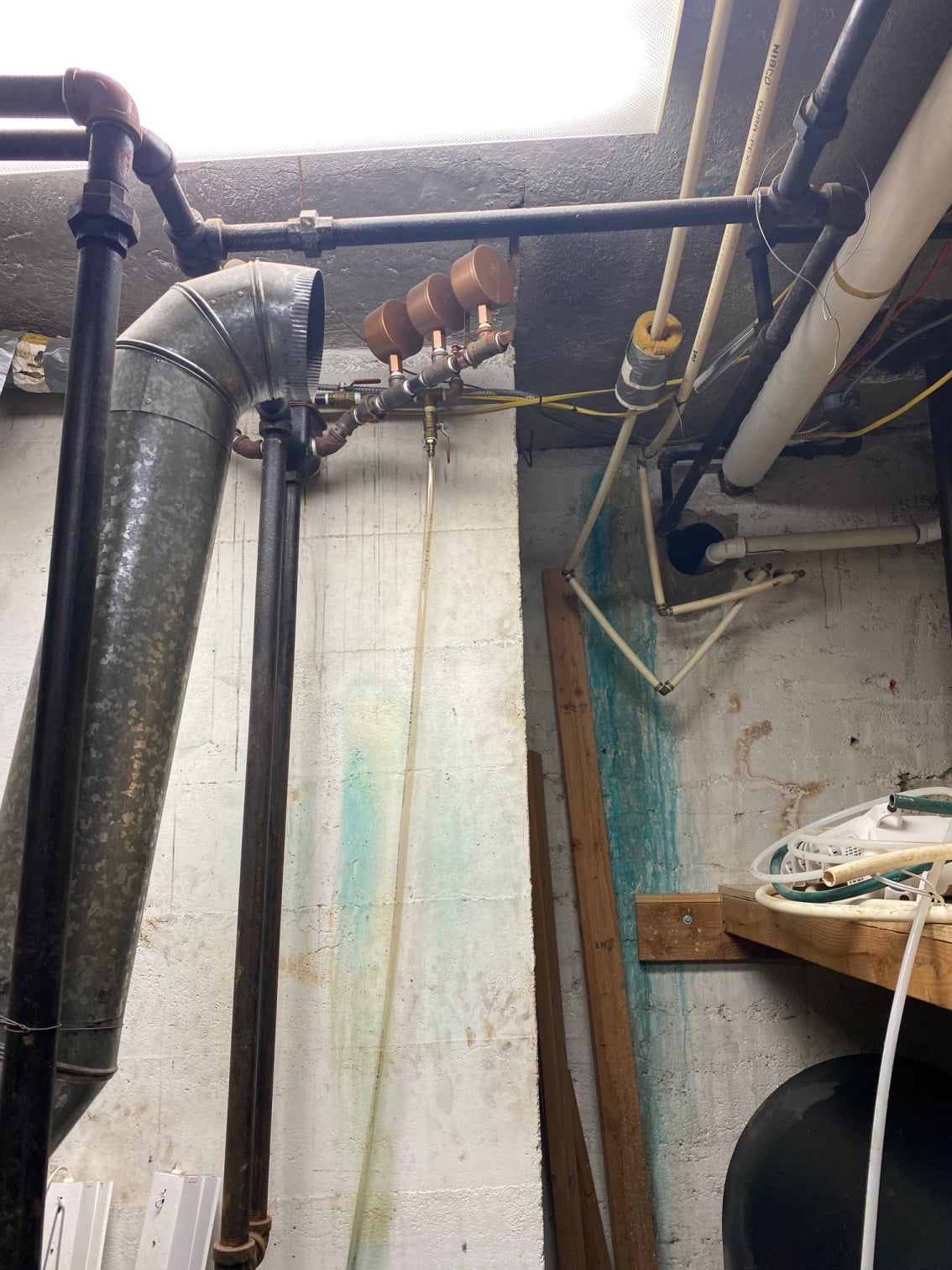
The three Gorton #2's at the end of the system (sorry I forgot what it's called) always remain open.
So..I am always able to get the house to a comfortable temperature. But when I crank up the temp as an experiment, say to 76 degrees, and the radiators remain cool on the bottom isn't this abnormal?
I'm concerned from the standpoint of efficiency.
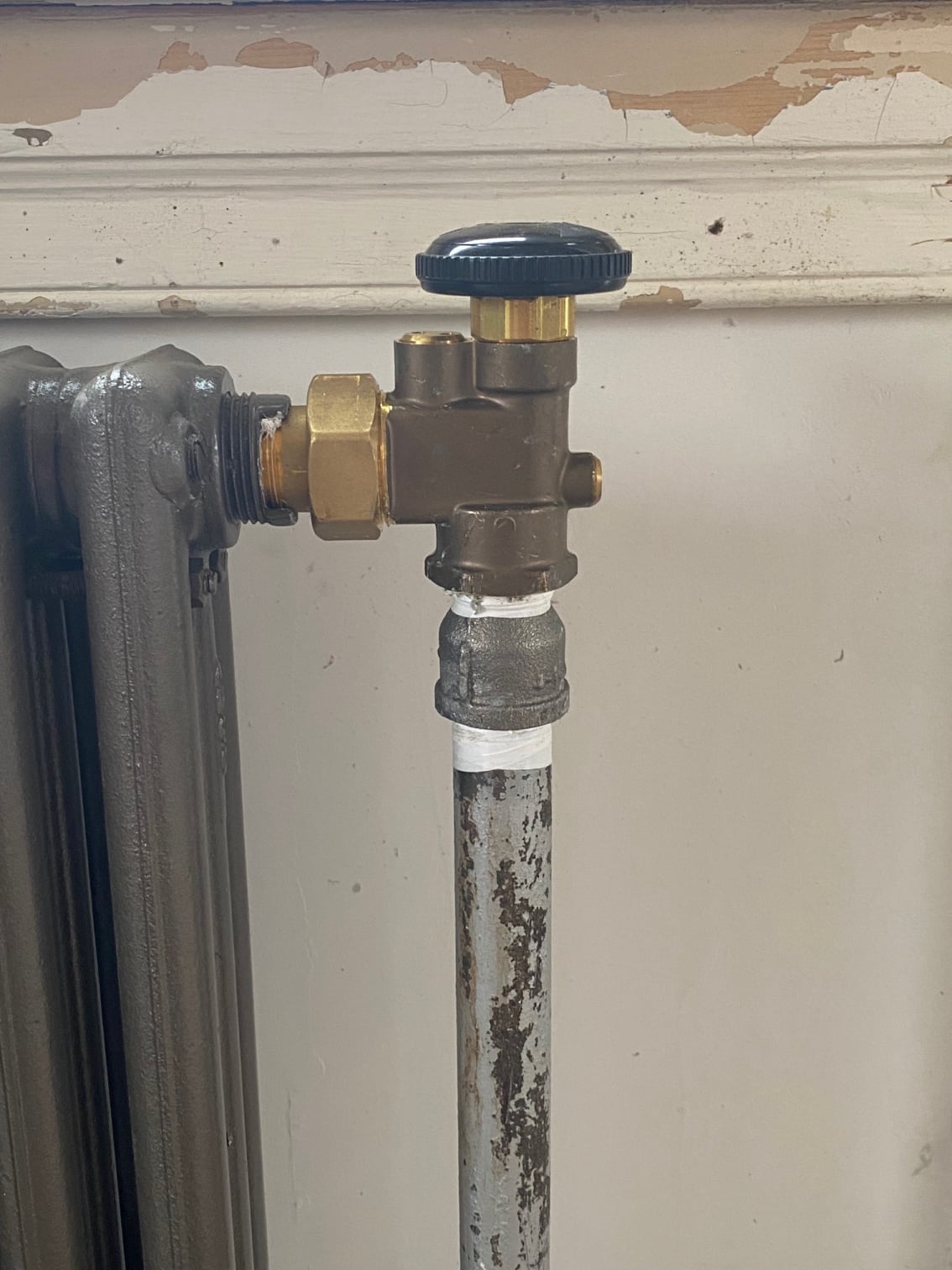
Note: 15 years ago I rebuilt all the old valves in the system. Now, a bunch of them are failing again and I am replacing them with Mepco SWRF-B's that have an adjustable orifice..
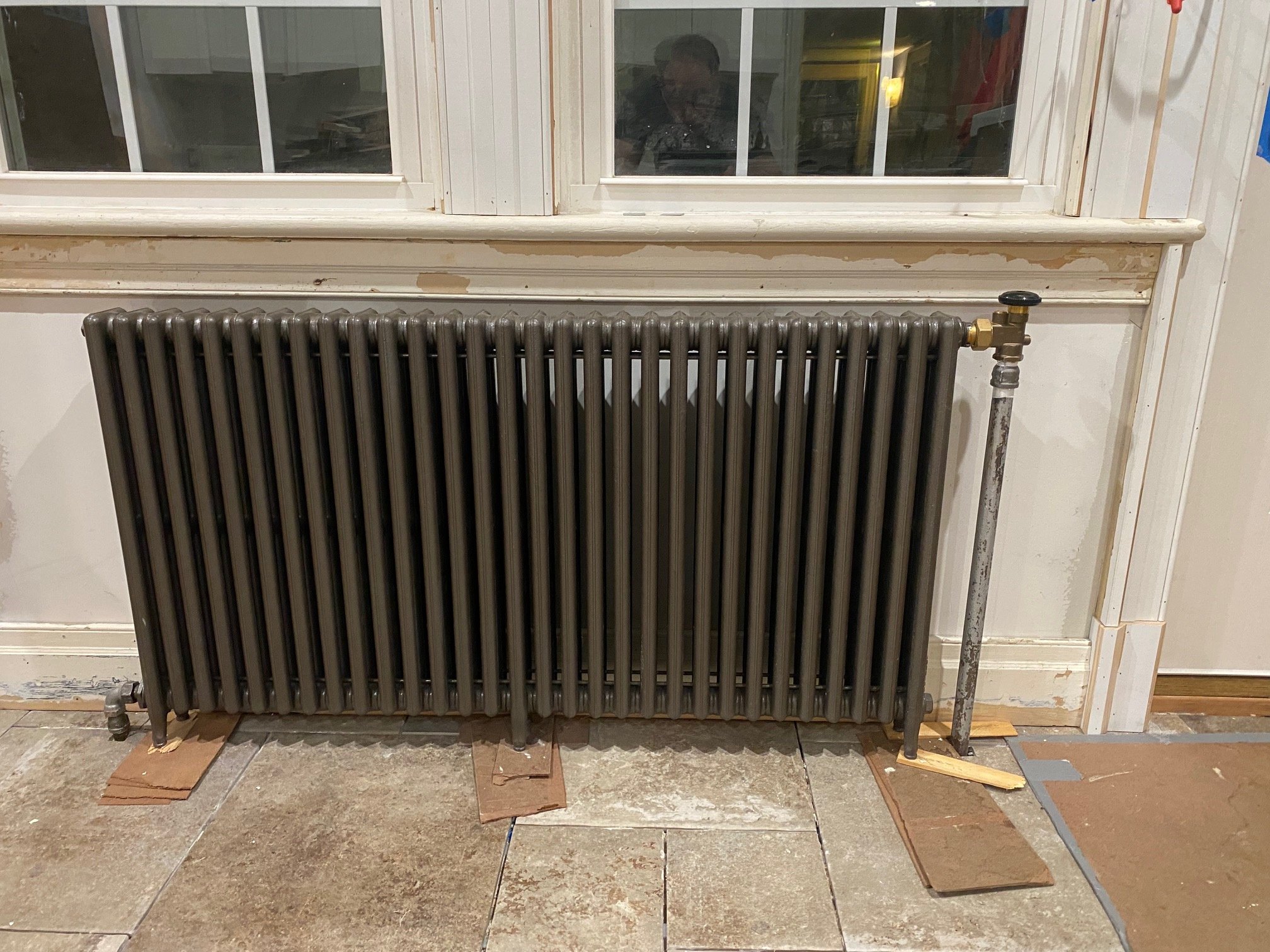
This radiator was recently removed, sandblasted and painted as it is going into a re-modeled kitchen. It will be removed again while the kitchen remodel is finished. Just wanted to re-fit it with new valve to make sure it works OK..
thanks,
Todd
Comments
-
The question isn't whether the radiators heat to the bottom — they often don't — but is whether the spaces are warm enough. Radiators are often bigger than really needed for the space…
But if the heat is even, or the way you like it… not to worry.
Br. Jamie, osb
Building superintendent/caretaker, 7200 sq. ft. historic house museum with dependencies in New England 1
1 -
But then why when they jack the thermostat up to a high level do they still not completely fill with steam and stay stuck at that same partial fill at the top?
@tmw is this how it worked even 15 years ago after it was worked on, regarding the partial fill on the radiators, and also regarding the Gorton #2 vents never closing?
0 -
Looking from the windows they look to be newer replacements.
You have also does some weatherization too I bet…
System was designed to work w/ a less "tight" house.
if you are comfortable dont sweat it.
0 -
maybe you need to dial down on the adjustable orifii, and give steam more time to fill the rad, before hitting the trap, wide open may not be your best fill rate,
or, are other traps elsewhere passing steam and closing the 1/2 full rads from the return?
known to beat dead horses0 -
@tmw , glad to hear it's been working well. This is at "Knockbawn", right?
0 -
Thanks for the comments everyone. And yeah Steamhead, this is at Knockbawn. Been a while and enjoyed the time we spent together all those years ago.
Jamie: The spaces heat up OK. But cycle off on temp and then cool down pretty quickly. Thermostat is not ideally located which may be part of the problem. Also noting that some rooms are getting cold pretty quickly. All the while thermostat will stay at 68 as it's positioned in a hallway.
Captain W: that is my question as well. Why do they not fill all the way after temp is jacked up high. Thing is, I cannot remember if this is the way it worked back then. But I seem to remember that many of them did heat all the way to the return. So I would have to throttle the orifices down to make sure steam was not getting into the returns.
kcopp: yes, it is a very old, formerly uninsulated farmhouse. This new kitchen is now insulated as we did a gut renovation And yes, the windows are replacements. The two rads in that room (one is pictured) put out 20,000 BTU per the Arco handbook I have. The room is 400 s.f. So 50 BTU per s.f of floor space was probably OK in that formerly uninsulated room. Right now, those two rads are not throwing a lot of heat with wide open orifices and valves.
neilc: this is a trapless system.
May need to find out if Steamhead is doing a NE tour this summer..
0 -
neilc: sorry, not understanding some of what you are saying. I'm a layman who read a few of Dan's books years ago. But I've forgotten a lot. So please excuse the ignorance.
0 -
Several thoughts. Well, more like a jumble….
Trapless system? Then it is critical that the pressure be kept down. Also, it leaves the only control on fillling the radiators — or not — to the orifices or valves. Which is fine, but needs to be considered.
It also eliminates pretty well one thought I had about the partially heated radiators — that the traps on those were malfunctioning and not allowing condensate to escape easily (and, yes, it is possible for a typical radiator trap to fail that way — though not common; the float can fail so it doesn't float, but with the thermostatic element still keeping steam where it belongs).
I'm sure you've already figured that the rooms that heat OK but then cool off faster are suffering from excess heat loss, relative to other spaces. That's not really a radiator problem — could be more infiltration in those rooms? The only thing I can think of off-hand is to change the thermostat settings so that you run more often, but shorter cycles. Not sure how feasible that is.
Br. Jamie, osb
Building superintendent/caretaker, 7200 sq. ft. historic house museum with dependencies in New England0 -
Thanks Jamie. And yeah, more of a heat loss issue. Will look into the thermostat settings.
Thing is….it is a vapor system. Designed so that steam flow is limited at the orifices to prevent steam from hitting the returns. Why is steam not hitting the returns when thermostat is set to 76 degrees snd orifices are wide open? And again, pressure remains at 3.5 ounces so system never cycles off on pressure
0 -
Ah. Vapour systems are fascinating. But the answer to why steam is not hitting the returns lies in pressure, not run time nor thermostat setting.
What happens is that the orifice — or metering valve in other vapour systems — limits the flow rate (so and so many pounds per hour) of steam into the radiator, depending on the pressure. The radiator, in turn, will condense steam at the rate of so and so many pounds per hour per square foot of radiation (our familiar 240 BTUh per hour per square foot). The radiator area is, of course, fixed. but so is the flow rate if the pressure remains where it should be. So — if the radiator has enough, or more than enough, area to condense the steam that can get in through the orifice or valve, there will never be excess steam in the radiator to pass through. The boiler can run all day — but if the pressure stays down, the radiator will heat just so much and no more.
And, other than making the boiler run longer thermostat just isn't part of the picture.
And also why, on a properly calibrated vapour system, you may not need traps — and even if you do have them (many systems do) they are never called on to close.
And also why we are fussy about limiting pressure to what looks like insanely low values — and also part of why some vapour systems (e.g. Hoffman Equipped) have ingenious systems to limit that pressure difference between the main and the dry return (that's what the Hoffman Differential Loop really does, for instance).
As a result of all of which, if you have a space which is too chilly, but where the radiator isn't heated all the way to full capacity, you can balance that space in relation to where the thermostat is better by using a slightly larger orifice or cracking the metering valve a bit further open.
Br. Jamie, osb
Building superintendent/caretaker, 7200 sq. ft. historic house museum with dependencies in New England0 -
So you are saying the boiler is undersized for the total EDR of all the radiators including any uninsulated mains and near boiler piping? That should be easy enough to check/verify @tmw
0 -
Captain: "So you are saying the boiler is undersized for the total EDR of all the radiators including any uninsulated mains and near boiler piping? That should be easy enough to check/verify @tmw
No, I am not saying that at all. Steamhead and Gordo would have alerted me to that all those years ago. And the mains and near boiler piping is insulated.
Jamie: "As a result of all of which, if you have a space which is too chilly, but where the radiator isn't heated all the way to full capacity, you can balance that space in relation to where the thermostat is better by using a slightly larger orifice or cracking the metering valve a bit further open."
Spaces heat up OK. Some of them cool too rapidly. This is just the way the house is constructed. If I were to keep the doors open in the upstairs rooms where there is the most obvious heat loss I'd probably be able to make them less cool.
0 -
Jamie: "As a result of all of which, if you have a space which is too chilly, but where the radiator isn't heated all the way to full capacity"
But again..what is the reason that I cannot get these rads to push steam to the returns with orifices wide open..
0 -
Here's my original thread on this job, fortunately the pics are still attached:
0 -
OK Frank-question: What is the purpose of the Gorton #2's at the end of the returns? Is it a failsafe?
0 -
And what's your take on my not being able to get the rads to fully heat with T-stat set high and orifices wide open?
0 -
The Gortons handle the air leaving the radiators. If the air can't get out, the steam can't get in.
If they are working and the rads still don't heat well, check the boiler. If the fire-side is full of soot, the heat isn't reaching the water.
0 -
And I was thinking scale could have accumulated, reducing heat transfer to the water as well?
0 -
OK thanks
0 -
i only read this thread, not the original thread, but in a 2 pipe system the boiler only needs to be large enough to cover the heat loss, it does not need to be large enough to mostly fill all the radiators with steam. it is likely you threw the system out of balance when you replaced some of the vapor valves with mepco metering valves and you need to close those valves down some also feel the return and make sure those radiators are not heating all the way to the returns, if they are you are likely getting steam in the returns that is keeping other radiators from heating as much as they should.
if it were me i would repair the original valves again and keep them at their current setting.
0 -
reading this in the original thread
"The system now vents its steam mains on about an ounce of pressure, thanks to several Gorton #2 vents installed on newly added thread-o-lets. From there the pressure slowly rises to four ounces and then holds steady. The Vaporstat never trips unless someone shuts radiators off.
"
it sounds like the boiler is smaller than the connected edr so the radiators won't heat all the way to the return.
somewhere there is a story about the type k valves but i can't find it right now.
0 -
Mepco's are orifice valves as are the original model K's. They both are adjustable. If the Mepco orifices are adjusted to keep steam out of the returns I don't understand how they can throw the system out of balance. Or why they would differ, if adjusted correctly, in any way from the originals.
And as I've been saying throughout this thread, the radiators are NOT heating all the way to the returns. With the originals or Mepco's.
And the system has been acting like this well before I added 2 Mepco's to it. The rest are original valves that I will replace with the Mepco's as they fail. I'm just not in a rebuilding mood anymore…
0 -
Also, you are mentioning "Mepco metering valves". I think those are just standard valves, no?
I am using these: they have an adjustable orifice like the Model K's. You need a special tool to adjust the internal orifice. In this way you can close the valve throat all the way if you'd like to…
https://www.mepcollc.com/product/swrf-b-regulator/
0 -
the adjustment is the metering. you adjust a needle that meters a specific amount of steam in to the radiator (in the k type valves)based on constant pressure. the mepco valves might just have a stop that limits the travel of the stem like some balancing valves.
if the new valve is adjusted to let more steam in than the old vale was then that radiator will heat more. it may not heat to the return but if it is getting more steam than it was before then that radiator will heat more and the other radiators will heat less since there is the same amount of steam. You have to have them adjusted to the same effective orifice size to meter the same amount of steam in for the system to behave the same.
of course you may have need to do some balancing before that.
when was the last time the boiler was cleaned? if it wasn't cleaned regularly and adjusted to fire at the same rate then the output of the boiler could have changed.
0 -
Let's back up a bit here.
First off, Mepco valves are perfectly good vapour steam system valves. No problem there.
Now. That out of the way. When did you notice this problem with radiators not heating all the way down? And, perhaps more important, is it a problem? Or is it more of an I think it should work this way and it doesn't, why? type question.
If you can identify when the concern showed up, assuming it is new, the next thing is: what changed? ON the other hand, if it has sort of always been that way, is it even a concern? I'm not trying to dodge the question here, butI'm not actually sure that we are chasing a problem, or asking a question about how some vapour systems work.
Br. Jamie, osb
Building superintendent/caretaker, 7200 sq. ft. historic house museum with dependencies in New England0 -
it sounds like they need to do some balancing to push more heat to the colder rooms. if that is a new problem or not is the question and it may not matter a whole lot because the solution is the same regardless.
0 -
Hi Jamie, thanks for clearing up the confusion and reaffirming what I know, that the Mepco SWRF-B is a perfectly good valve for a vapor system.
"When did you notice this problem with radiators not heating all the way down? And, perhaps more important, is it a problem? Or is it more of an type question".
Honestly, I haven't paid much attention the last several years. Pulling out two rads while building a new kitchen is what started all this. When they were reinstalled I noticed they weren't heating all the way down with orifices and valve stem wide open. Then cranked the T-stat to 76 and went around the house and noticed the same thing on most of the radiators. So yeah it's as you say "I think it should work this way and it doesn't, why?"
But, as Steamhead says, check for soot. This boiler hasn't been cleaned in over 10 years and I'm guessing it's a mess down there. I'll have someone come out and clean it when heating season ends.
I also saw that much of the insulation behind the metal boiler cover is missing. I'm probably getting plenty of heat loss from that as well.
The cold rooms heat up pretty well. But get cold pretty quickly after the rads cool. This is obviously a house issue and not a heating issue. I'm just realizing it now.
0 -
oil boilers need to be serviced by a good oil burner tech every year. maybe 2 or 3 on a modern burner that is set up right
0 -
it is also a heat issue, you might have to give those rooms more heat. the temp will vary more but at least they won't be cold. you could also as @Jamie Hall said shorten the cycles by adjusting the anticipator or the cycle per hour setting on the thermostat.
0 -
If I can figure out how to make this 15 year old Honeywell T-stat increase it's cycles I may give that a shot.
0 -
you want to shorten the cycle times. if it is a digital t-stat you'd increase the cph, cycles per hour in the installer menu.
0 -
-
Honeywell TH5110D 1006
It's those digital menus that drive me nuts
0 -
Here's the manual, and I think this link will land you on the first page of the section you need:
Once you enter Installer Setup, go to the next page in the manual. You want parameter #5, "Heating Cycle Rate". I bet it is set to 5- try setting 3 and see how that works.
1 -
Great thread! Interesting system. I bet you'll see a difference after the boiler is cleaned. Ten years is a long time. Plenty of time to fill the combustion chamber with junk and maybe even partially block a section or two.
Miss Hall's School service mechanic, greenhouse teacher, dog walker and designated driver
0 -
Thanks Steamhead! I also need to reinsulate the boiler. Last time (several years ago) I had to pull a few of the panels off I noticed all the insulation was gone.
Boiler is a 64 y.o. Weil McClain commercial unit. And I know that a Burnham is probably in my near future.
0 -
The two rads that I've been most concerned about in terms of not heating enough are at the end of the mains. They both have new Mepco SWRF-B's set to wide open orifices and valves stems wide open. They're just not getting hot enough. And now I'm thinking my uninsulated dirty boiler is just not generating enough heat…
Now remembering back a few years and that room used to get warm enough that I had to throttle the adjustable orifices to keep steam out of the returns. This was about 10-15 years ago when I last worked on this system. I'm getting old and my memory stinks..
0 -
Steamhead-
I adjusted parameter #5 to 3. And you are right it was set to 5.
Can you tell me if parameter #1 should be set to O or 2? Does it matter?
thanks
0 -
Wow, I can't imagine my single pipe steam system on 3 cycles per hour. I tend to run a duty cycle (burner % on time) of around 24% to 38%, although my boiler may be admittedly a bit overpowered and I don't keep the thermostat setting very high. That would mean though that my on time could be as little as 5 minutes, which wouldn't be enough time for the radiators to get much steam after the air is pushed out of the mains and runouts. I could only imagine the thermostat would figure that out and bump up the duty cycle to heat the house which would cost me more.
PS: I know you have 2 pipe vapor system which may function more efficiently and your boiler is currently most definitely not overpowered at least if we are on the right track in our analysis.
0 -
my guess is that your boiler is underfired because it hasn't been serviced in a decade. The insulation under the jacket should make little difference in the output. if it has refractory in the combustion chamber and that is deteriorating that can have a big effect.
has the thermostat you're adjusting been there since @Steamhead and @Gordo worked on it?
 1
1





Categories
- All Categories
- 87.8K THE MAIN WALL
- 3.3K A-C, Heat Pumps & Refrigeration
- 60 Biomass
- 430 Carbon Monoxide Awareness
- 133 Chimneys & Flues
- 2.2K Domestic Hot Water
- 6K Gas Heating
- 124 Geothermal
- 170 Indoor-Air Quality
- 3.9K Oil Heating
- 79 Pipe Deterioration
- 1.1K Plumbing
- 6.7K Radiant Heating
- 397 Solar
- 16.1K Strictly Steam
- 3.5K Thermostats and Controls
- 56 Water Quality
- 51 Industry Classes
- 51 Job Opportunities
- 18 Recall Announcements