Heat transfer in an indirect water heater

Hi All, I currently have a combi and am planning to add an indirect water heater where the DHW is supplied via the coil with the large volume of water being heated by the FHW side of the boiler. I am planning to discontinue the use of the DHW portion of the combi. The large source is going to be used as a buffer tank for my radiant system. My question is not about this architecture as that's a whole other discussion.
My question is how to calculate the ability to transfer heat from the large water volume to the coil water?
The tank I have is a Lochinvar Squire 50gal. It's specs say at 180F boiler water and with 58F DW in it can provide 210gal of DHW continuous out at 135F.
Is there a relatively easy way to know how many gallons it can be provide out of the coil at 115F with the large volume at 135F?
Comments
-
you should be asking how much power it can transfer and you seem to be asking how much energy has been transferred. unfortunately calculating the power transfer of a heat exchanger isn't simple and irt is kind of hit or miss if the manufacturer of the indirect even gives you the specifications needed to do the calculation.
you would need to know the hot side and cold side temps and something like the transfer rate of the hx and you would get power in usually btu/hr or watts in the rest of the world.
the first hour or gallons per hour rating that the manufacturer gives you is not the operating conditions of your system, it is at a specific boiler size and incoming water temp, it isn't a super useful number other than for comparing 2 tanks.
maybe @Larry Weingarten has a method to calculate wha you need (also what are you trying to calculate exactly)?
0 -
Less than 2 GPM, and it may not actually work well.
To get 115° outlet temperature from a heat-transfer coil submerged in a 135° tank of water, that tank temperature cannot be allowed to drop much below 135° or the heat transfer will fall off quickly.
With only about a 20° temperature difference between the tank water and the outlet water, the coil will struggle to transfer enough heat.
To reliably produce 115° water with 58° inlet water, you would be better off keeping the tank temperature higher — around 145° or more — and using a mixing valve to temper the domestic hot water.
Edward Young Retired
After you make that expensive repair and you still have the same problem, What will you check next?
0 -
Thanks for both your comments. I obviously was worried that heat transfer would likely not be adequate. My plans for my system are described on this other thread https://forum.heatinghelp.com/discussion/203641/using-an-indirect-water-heater-as-a-buffer-tank#latest
So it's seems my possible solutions are
- Using a higher tank temperature maybe 145F with some loss of efficiency but guaranteed unlimited hot water. I'm thinking I might have to go hotter than 145F to avoid short cycling, but maybe I can ignore this as short cycling due to the DHW side of a combi seems a given.
- Continue to use the DHW side of the boiler and solve DHW capacity and temperature fluctuation issues using maybe a small seperate tank. A benefit would be on the FHW side the big tank could follow the outside with an ODR .
I'm thinking option 1 is probably my simplest solution. If you have any strong reservations let me know so I can factor them into my thinking.
0 -
you could supplement the coil in the tank or just use an electric water heater as a storage tank and use a brazed plate hx designed for the close approach temp you want. i don't know how your system is planned so i don't know if you need another circulator for circulation through the hx. you could possibly use the hx in the combi for a similar purpose to heat the water in the tank.
if you are storing boiler water in the closed system in the tank a standard steel electric water heater tank should last decades.
0 -
If you are talking about a reverse indirect where the tank is boiler water and the coil is the DHW?
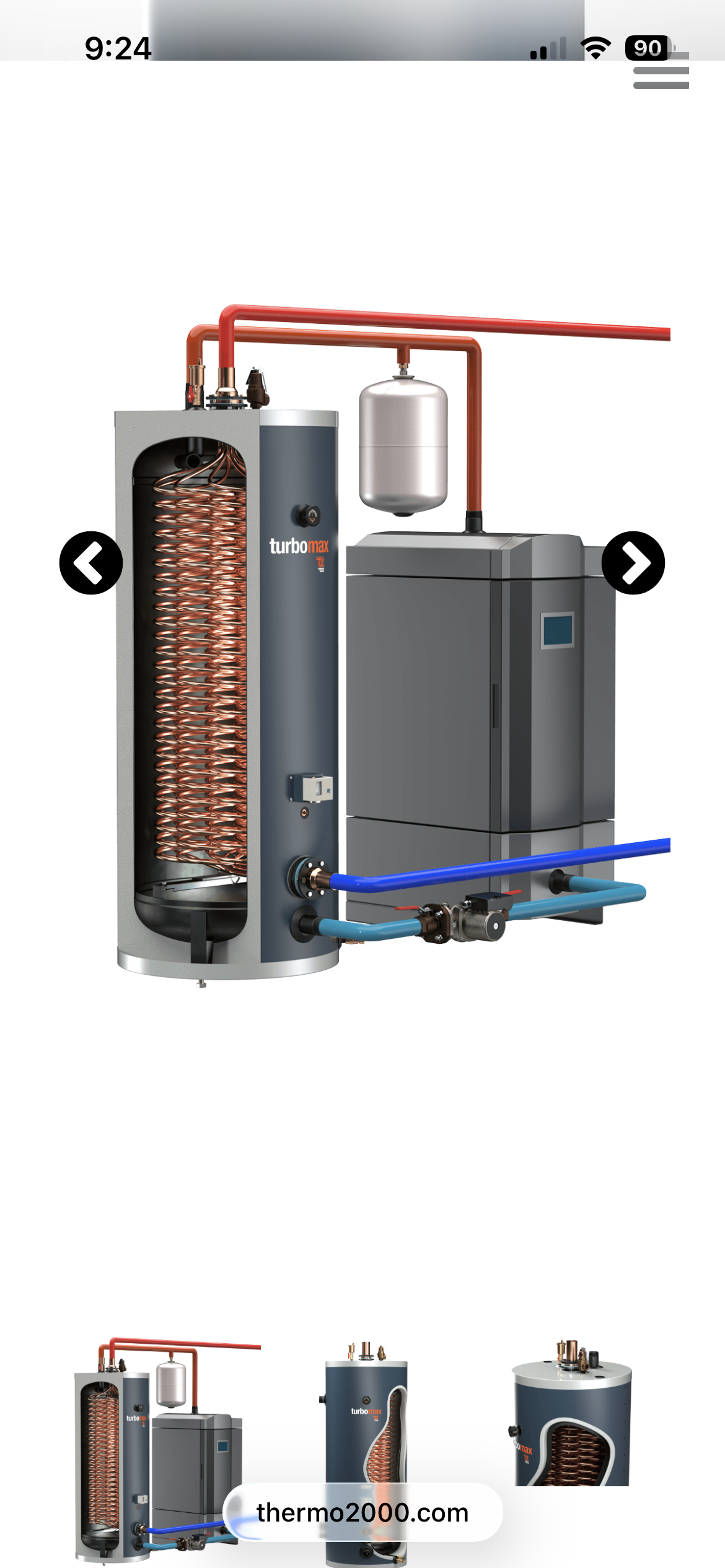
It takes a massive amount of coil surface area for that to work. Even with all this copper in the TurboMax they still need 180 or hotter to perform
 Bob "hot rod" Rohr
trainer for Caleffi NA
Living the hydronic dream0 -
Hi Bob @hot_rod so I'm assuming heat transfer specs are symmetrical meaning with my tank at 180F it would give me 135F at 210GPM through the coil. Is my assumption wrong about it being symmetrical? Do you feel 145F tank water would not given me enough DHW at 115F?
0 -
energy transfer is measured in power, not temperature.
0 -
I see where a have used GPM in my comments I meant GPH
0 -
it would be in btu/hr or watts.
0 -
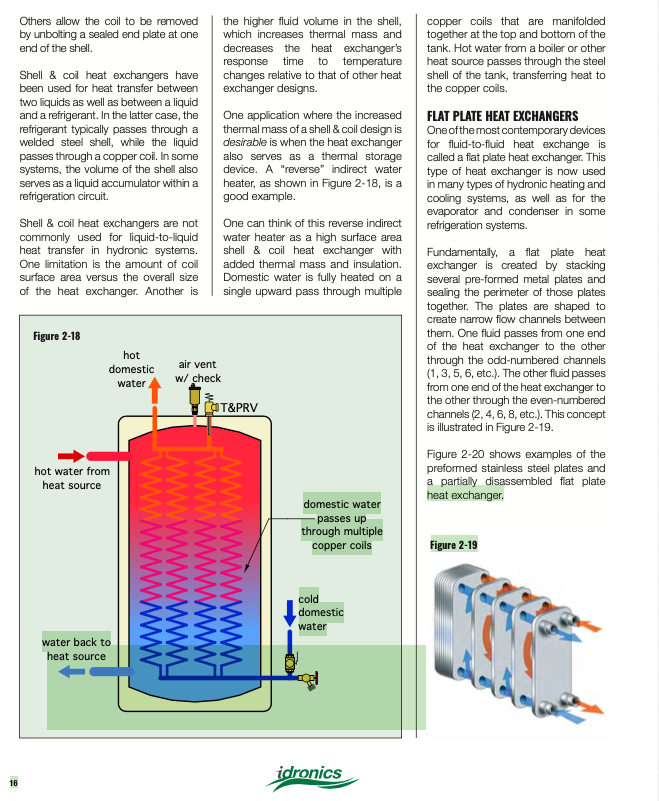
An indirect WH tank is basically a tube and shell, or AKA shell and coil, heat exchanger. To get efficient, or quick recovery requires a lot of surface area exposed to the transfer fluid. Also having two moving flows greatly increases the heat transfer. That is why flat plat HX are generally 5 times better heat transfer. Lots of surface and two counterflow fluid streams. Everything you want to know about HXers here, and plenty of math to make your eyes water.
 Bob "hot rod" Rohr
trainer for Caleffi NA
Living the hydronic dream
 2
2 -
So are you fellows saying that the best way to get the most heat exchange out of a lower temperature in the boiler is to use a plate exchanger and a storage tank instead of an indirect containing its own coil / heat exchanger?
0 -
if you want a low approach temp (low difference in temp between the hot side and the cold side of the hx), yes.
 1
1 -
You are not the first person to want to do this. Your approach is novel, but you do not need to reinvent the wheel here. There are other tried-and-tested ways to get what you are looking for.
To be clear, you have a combi boiler that is wall-hung and uses gas, operating at above 90% efficiency as a result of condensing the flue gas and keeping exhaust temperatures below 200°F. Is that correct?
What is the brand and model number of your combi?
And you want to:
- Use the low-temperature return water from the radiant system during the call for heat to maximize the efficiency of the modulating gas burner input.
- You have a Lochinvar indirect and were hoping to use this to facilitate the project with that indirect water heater.
- Add additional closed-system volume with a buffer tank. Hopefully, the Lochinvar indirect can serve as that buffer tank.
- I believe you are calling the space-heating heat emitters the “radiant system,” but I would like to clarify that this radiant system is in your floor: PEX tubing of some type, whether staple-up, embedded within a gypcrete or a concrete pour, or some other design of radiant floor heating.
Does that sum it up?
Edward Young Retired
After you make that expensive repair and you still have the same problem, What will you check next?
0 -
you can do a reasonable job creating dhw with a coil type indirect. Mainly because you gave cold incoming water into the tank and a high temperature 180f or more in the coil. So you have a large delta t working for you
If you want 120f from a coil in a tank of 145f water you will need a large transfer surface, better yet with two flows moving. That is not what a typical indirect is designed to do
The best way to use the tank as a buffer is to let the boiler heat it to the desired radiant temperature on ODR
Use the combi function for dhw as it was designed
Bob "hot rod" Rohr
trainer for Caleffi NA
Living the hydronic dream 2
2 -
Reinventing the wheel is something I try to avoid. An indirect water heater is made for heating DHW from 58° to something above 115°. That is how you are supposed to use it. If you want to do something else then look for the proper pieces to make that happen.
(says the guy that took a center flue 40 gallon hot water tank from a gas automatic and put it on the top of a small metal trash can with an oil burner combustion chamber on it. Slapped a Riello oil burner on the side of the trash can and connected it to my above ground pool filter pump. no limit, no relief valve, no idea of what GPH to fire the burner) 🤣
Edward Young Retired
After you make that expensive repair and you still have the same problem, What will you check next?
3 -
seems like you could have just grabbed a used but good boiler you tore out of somewhere
0 -
I'll give it a crack...
Given the information you provide, and assuming the coil heat transfer is constant through its length, and confirming some info from Lochinvar
210GPH =3.5 gpm
Heat transfer is capable of 135,000 BTU/hr temp rise of 58F to 135F at 3.5 gpm (77F x 500 x 3.5gpm)With this max heat transfer scenario, I assume the average temp in the coil is 170F with the flow through coil at 14 gpm (info from https://assets.lochinvar.com/damroot/Original/10014/LOC_T_SIT_BR_1006_2022.pdf)
The average temp in the tank would be halfway between 135 and 58F or 96.5. The deltaT between average coil temp and average tank temp is 73.5F.
The coil is able to transfer 135000 BTU/hr when the delta temp is 73.5. or 1837 BTU/hr per a delta of 1 degree F
Now, the scenario you suggest, the average tank temp is 130 F (ASSUMPTION, based on 135 entering at the top, unknown lower temp exiting the bottom, this average temp can be easily adjusted up or down by changing flow rate through the tank/boiler)
The average coil temp is 86.5 F (half way between entering water temp of 58F and exiting water goal temp of 115F).DeltaT between tank and coil is 43.543.5 x 1837 BTU/hr = transfer rate of 80,000 BTU/hr.
80,000 ÷ 57 ÷ 500 = 2.8 gpm This is the expected max flow to maintain output of 115F.
2.8 gpm or 168 gph
I would say it's a bit less due to the coil being located in the bottom of the tank rather than evenly spaced through the vertical tank. And practically speaking there will be some time delay in the boiler meeting the call for heat when the tank drops below set point.
0 -
transfer from a coil ln a tank of water is complicated because as the tank warms the delta t drops and so does heat transfer
Recovery starts out quickly with a cold tank, but slows considerably as it nears setpoint temperature
Plus the unknown rate of stratification affects the heat exchange. Tall skinny tanks stratify easily and quickly. The top could be 20 degrees hotter at the end of the cycle
On a dhw indirect if you have a recir pump running, heat transfer goes up, but you also lose any stratification if the pump runs constantly
Plate HXers are more predictable as you input know temperature, temperature drop and flow rates
Bob "hot rod" Rohr
trainer for Caleffi NA
Living the hydronic dream2 -
So you're trying to use an indirect as a reverse indirect? Or am I misunderstanding the idea here? If so, just sell it and buy a real reverse indirect or keep it and add an actual buffer tank to the system.
0 -
Pardon me if I muddy the water of the OP question, but I think the original discussion is fairly over/wrapped up.
My situation is different than the OP, in fact, possibly the reverse. I don't want to get too far into the weeds with it, but what I'm looking to do is have a storage tank for potable water in order to replace my tankless coil system in my boiler. I know there are various kinds of indirects but I don't know the exact differences so I use the term indirect only as it makes sense to me. My goal is to purge the boiler as much as possible after the call to the indirect, and store all that hot water in a better insulated place than my boiler, and not get a low limit call just because someone decides to wash the dishes on a summer day and have the whole system fire up for a few degrees.
0 -
Sounds like you are trying to copy the EK System 2000 approach, purge excessive boiler heat into a dhw vessel?
It doesn't matter if you use and indirect with a coil or a separate plat HX as EK does.
I believe the separate flat plate on a storage tank would be the most efficient. You have two turbulent flows through a low mass HX to scrub as much excessive heat as possible.
It's as much about the control to operate it as the type of HX method you use.
I think Robert posted a picture of their tank HX package available to purchase separate, recently?
Bob "hot rod" Rohr
trainer for Caleffi NA
Living the hydronic dream0 -
you want an aquabooster. you can just use a stainless or bronze pump and an electric water heater as a storage tank. you can even run it as an electric water heater in the summer if you want to.
you would in some manner control it off the t-stat in the electric water heater.
0 -
Is the OP trying to eliminate the tankless coil completely (a wise move) and use an indirect?
 Bob "hot rod" Rohr
trainer for Caleffi NA
Living the hydronic dream0 -
Yes in this post Roger explains it quite well, although I don't recall any links but I need to look at his previous replies to my posts. I think I have all the info, (maybe twice now) 😞 guess I'm getting old and forgetful!
0 -
There are a lot of ways you can do it but keep in mind changing from having the boiler hot 24/7/365 to just when you need to replenish the tank is going to make a big change in efficiency. If you use the coil in an indirect or the tankless coil or a brazed plate hx, although some with transfer more heat than others, the difference in efficiency with having to fire the boiler a little bit longer or shorter period of time with each choice will be small so it is likely the least expensive option to implement will be the most cost effective.
If you aren't making enough hot water now then you should consider that in sizing the tank or using a brazed plate hx sized to move more heat than the tankless coil, but your major savings will come from making the boiler cold start.
0 -
Thank you, all - I'll chime in here to provide some additional thoughts.
@RascalOrnery , Energy Kinetics offers an indirect tank with a plate heat exchanger, along with the required bronze circulator and either a zone circulator or zone valve with end switch. The "energy saver relay" can be used to make the boiler cold start, but it will not thermally purge (see below). This system will seamlessly integrate if the boiler is upgraded to an Energy Kinetics boiler with thermal purge.
Thermally purging to this hot water system or other tanks with cast iron boilers is difficult as there is too much heat energy left in the boiler at the end of the thermostat call, which can/will cause overheating. You cannot purge all heating zones and the hot water zone to the tank or the tank will overheat. What works is a low mass boiler that anticipates and purges to the last zone that called; this last zone can be a heat zone or hot water.
You will get some good efficiency gains from cold starting a "maintain temperature" boiler (especially a tankless coil boiler that maintains very high temperature), but the boiler will finish hot over many heat and hot water cycles in a day which still wastes energy. Cold starting plus cold finishing with thermal purge is the way to much greater savings.
Best,
Roger
President
Energy Kinetics, Inc.0 -
So in short, the best purge will come from using a plate exchanger and a bronze pump running the potable water thru the plate exchanger DIRECTLY instead of piping in a heat exchanger internal coil type like a zone?
0 -
A plate heat exchanger connected to a stratified tank is the best way for hot water purging.
President
Energy Kinetics, Inc.1 -
I beg of you and all homeowners regardless of type of boiler, or fuel used, to investigate how little it actually costs to heat the domestic water for the home per year, even using the least cost-effective water heater, the electric resistance water heater, then compare that to the installation cost of any kind of indirect.
We are talking about $600 dollars per year
Your boiler will be very efficient all summer when you turn it off
NJ Steam Homeowner.
See my sight glass boiler videos: https://bit.ly/3sZW1el0 -
Too many variables to quote a number for resistance DHW cost per year.
How many gallons, temperature rise, Kwh cost.
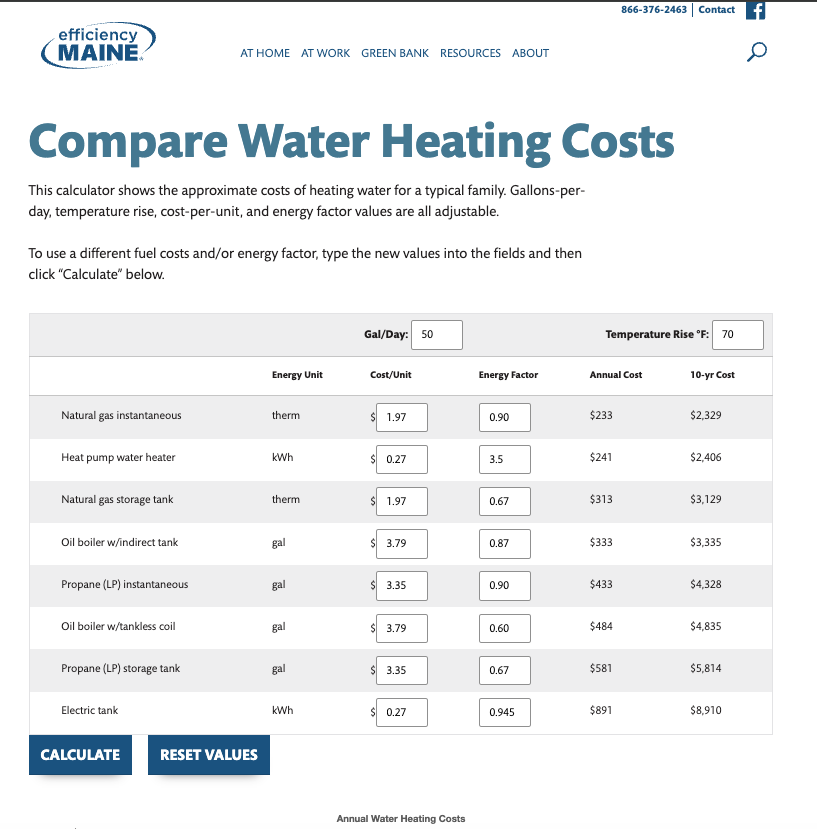
This calculator can tighten the numbers. Try it with a 80° rise which would be accurate in cold climates where water is stored above ground.
https://www.efficiencymaine.com/at-home/water-heating-cost-comparison/?
50 gallons at .27 Kwh is closer to 900 bucks a year
But look at the HPWH annual cost!
 Bob "hot rod" Rohr
trainer for Caleffi NA
Living the hydronic dream0 -
I was going by Energy Star (my recollection of which admittedly might be a little out of date).
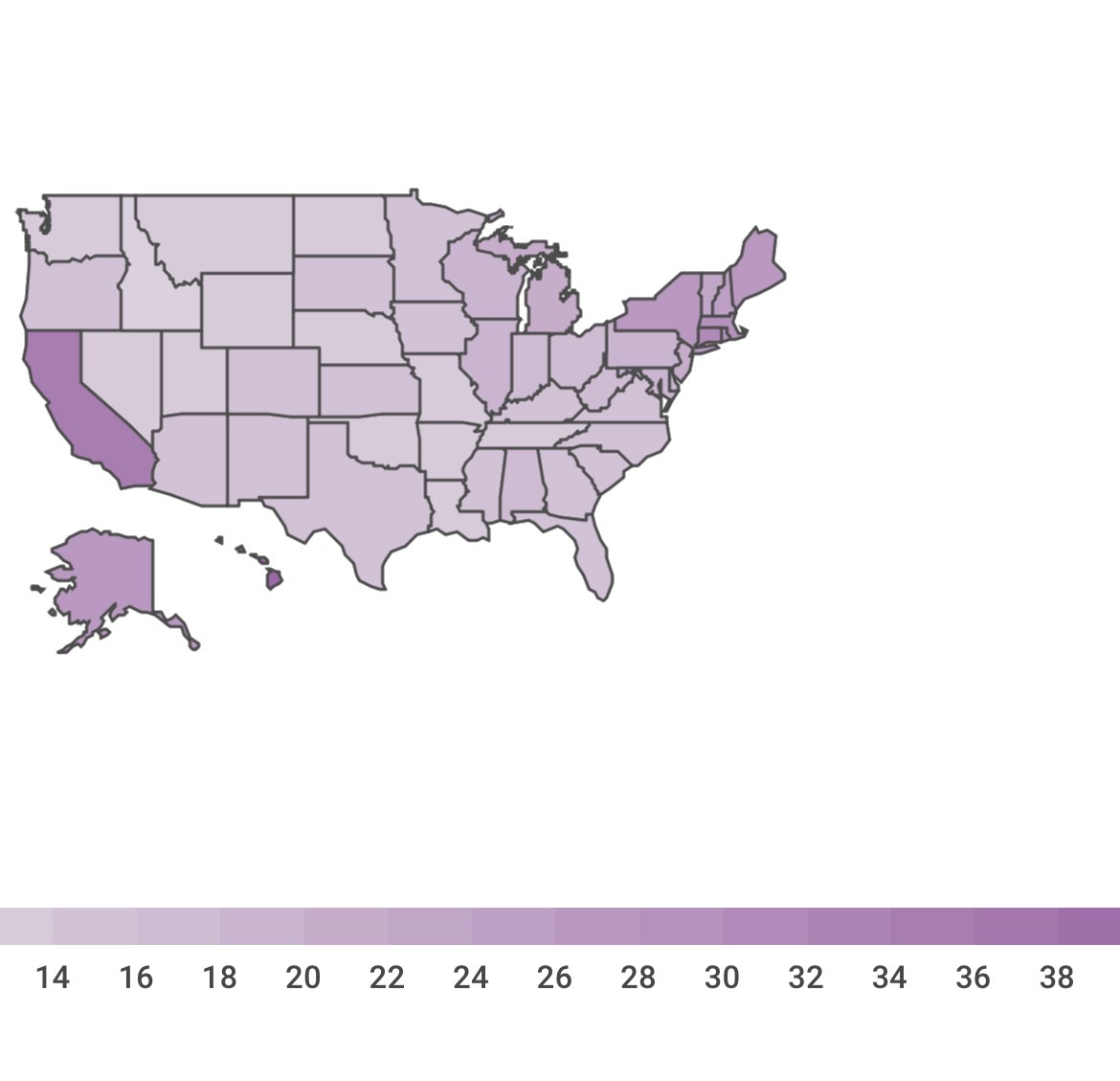
Your .27 is pretty much the highest rate in the US (except for Hawaii) so you are showing basically the worst case scenario.
And I agree with you that heat pump water heating is the absolute champion.
How much is a worst case scenario for Indirect parts and installation?
NJ Steam Homeowner.
See my sight glass boiler videos: https://bit.ly/3sZW1el0 -
An indirect is a very good solution if there is a boiler. Installing an indirect with a plate heat exchanger sets the stage for the best efficiency with thermal purge for a future boiler upgrade.
The efficiency of a heat pump water heater is deceptive. At the energy factor of 3.5 that @hot_rod referenced, that's one unit of electricity heating the water and 2.5 units of air conditioning the space - not something anyone should strive for cold climates during the heating season. This has been covered here before, here is a heat pump water heater article that goes into greater detail about common issues that need to be resolved before widespread use; this originally appeared in the ASHRAE Journal last year. It is worth a read if you are installing or considering the installation of a heat pump water heater.
The authors have identified the following issues:
- Inadequate heating capacity compared to advertised specifications.
- Real-world efficiency significantly lower than rated efficiency.
- Moisture-related damage and mold growth.
The authors believe these issues generally trace back to two primary causes:
- Insufficient access to the thermal resources inside the building.
- Improper handling of cold exhaust air.
President
Energy Kinetics, Inc.0 -
the average costs in the US is .17. More and more areas hitting the high .30’I think @Jamie Hall pays in the mid .30’s?
AI and crypto farms will continue to drive electricity costs up.
30% increase in electricity costs since 2020
As with any heating/ dhw device proper selection , installation and customer wants are part of the reason there are so many choices.
An oversized high mass CI boiler might be a good option for a HPWH, discharge vented outside Especially if rebates pay most of the cost😉
 Bob "hot rod" Rohr
trainer for Caleffi NA
Living the hydronic dream0 -
As little as it pertains to the function discussion (which is why I didn't bring it up prior) it greatly pertains to the cost discussion, I burn anthracite coal.
My boiler runs 24/7, and in the summer it holds unnecessarily high temps for the tankless coil, if I plumb in an indirect then I the summer I can purge the heat out of the boiler and keep my basement a few degrees cooler and make the boiler work a bit less, more importantly not cycle simply because someone ran the shower a little long. It will store way more water than my tankless setup.
This may sound crazy and old fashioned, but it is winning for me. My cost to heat my home has been a third if not better compared to my neighbors burning oil and propane. No natural gas here.
Plus, my basement is a bit damp so it keeps it dry. (I would have to run a dehumidifier otherwise)
I didn't think this very useful to the general conversation but maybe that helps shed light on the peculiarity of my questions. Coal boilers suffer when left stone cold (as in switching to a hot water heater in the summer) as the fly ash in the flue pipe reacts with moisture in the air and rusts things out at a pretty rapid pace.
My goal would be to purge it down to about 155 after a call from the indirect. I do this in my baseboard zone with great success all winter.
0


Categories
- All Categories
- 87.8K THE MAIN WALL
- 3.3K A-C, Heat Pumps & Refrigeration
- 59 Biomass
- 430 Carbon Monoxide Awareness
- 132 Chimneys & Flues
- 2.2K Domestic Hot Water
- 6K Gas Heating
- 124 Geothermal
- 170 Indoor-Air Quality
- 3.8K Oil Heating
- 79 Pipe Deterioration
- 1.1K Plumbing
- 6.7K Radiant Heating
- 396 Solar
- 16.1K Strictly Steam
- 3.5K Thermostats and Controls
- 56 Water Quality
- 51 Industry Classes
- 51 Job Opportunities
- 18 Recall Announcements