Radiator valve issues... not the one that is always asked about.

Hi all,
Big thanks in advance, have found this place so helpful. So jumping right into it, the vents on my single pipe steam radiator system open for really long periods of time letting out what I can only assume is a lot of steam (we've been having to add water every few days, more when we had that super cold snap recently - I also held a glass up to the vents and it definitely is at least some steam coming out).
Here's the catch, they open when the radiators are completely up to heat (they are very hot and its across the entire radiators), so not at the beginning when the system is warming up, and it isn't just one, its many different radiators that do it. I have replaced the valves with many different types and openings.
I've called the company around me in north jersey who is highly recommended as a steam heat expert and here is all the things they've tried.
- Replaced all the valves (again) with their recommended brand and opening, and rebalancing the radiators.
- Swapped the main valves from 1's to 2's, (there are two main valves).
- Drained, skimmed, and serviced the radiator.
- Cleaned the pigtail and reset and tested the pressure gauge.
They mentioned we can try adding another main valve to one of the lines which doesn't have one (I think) and maybe that would work? But I'm a little hesitant because in addition to already spending a chunk of change on this if the radiators are all heating up, isn't that showing that air isn't the problem? There also isn't a lot of banging or anything. And why would it take so long for them to close then?
A bit more info, it's an old house (1885) and the system isn't the prettiest. There can be a lot of surging in the site glass, and the water is pretty dirty especially at the beginning of the season.
Thank you all in advance for your help!

Comments
-
If there is actual steam coming out of a vent on a radiator, there are only two possibilities: the vent has failed open or you are running excessive pressure. And the latter — excessive pressure — will cause the former in time.
Br. Jamie, osb
Building superintendent/caretaker, 7200 sq. ft. historic house museum with dependencies in New England0 -
I'm not an expert, but I'll ask the obvious question. What pressure is the boiler cutting out at, and are you sure it's cutting out at the right pressure? The pressuretrol can be set correctly, but if it's out of calibration, it won't actually cut out at the set pressure. A number of steam users here have noted in past that their pressuretrols were out of calibration.
0 -
There are different parts of a one pipe steam system that often are improperly named when describing a problem. by using the incorrect name, that sends the professionals in the wrong direction for problem solving. Here are some names of common parts that often are called something that they are not.
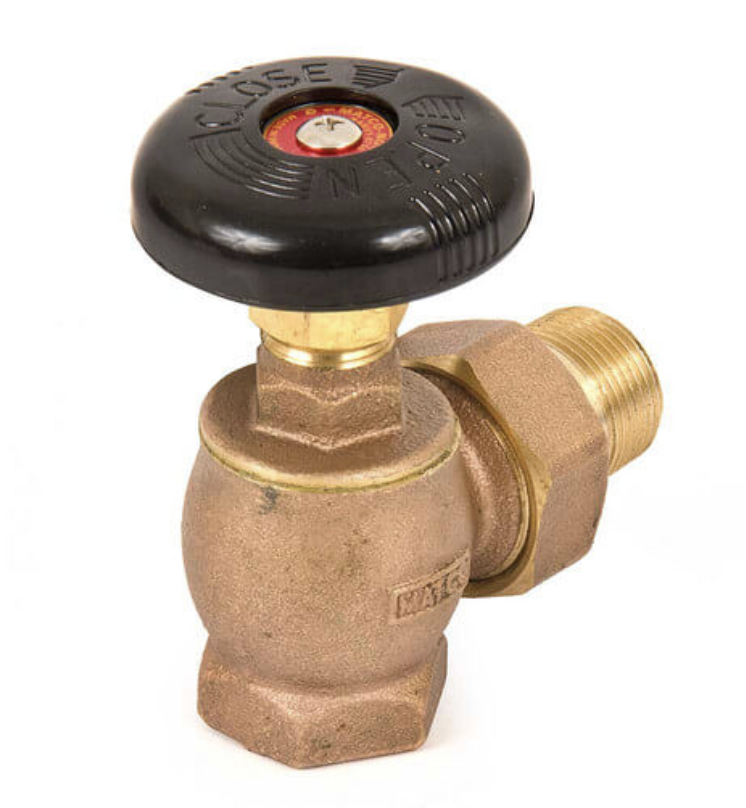
Radiator Valve: This is an actual valve with a handle that you turn to open and close. It is installed on the steam pipe that just at the entrance to the radiator. On a one pipe system, it must be either fully open or fully closed. There is no throttling of the valve at some midpoint in order to reduce the steam to a lesser amount that full open. Doing that will often block the returning condensation from the radiator to the piping system.
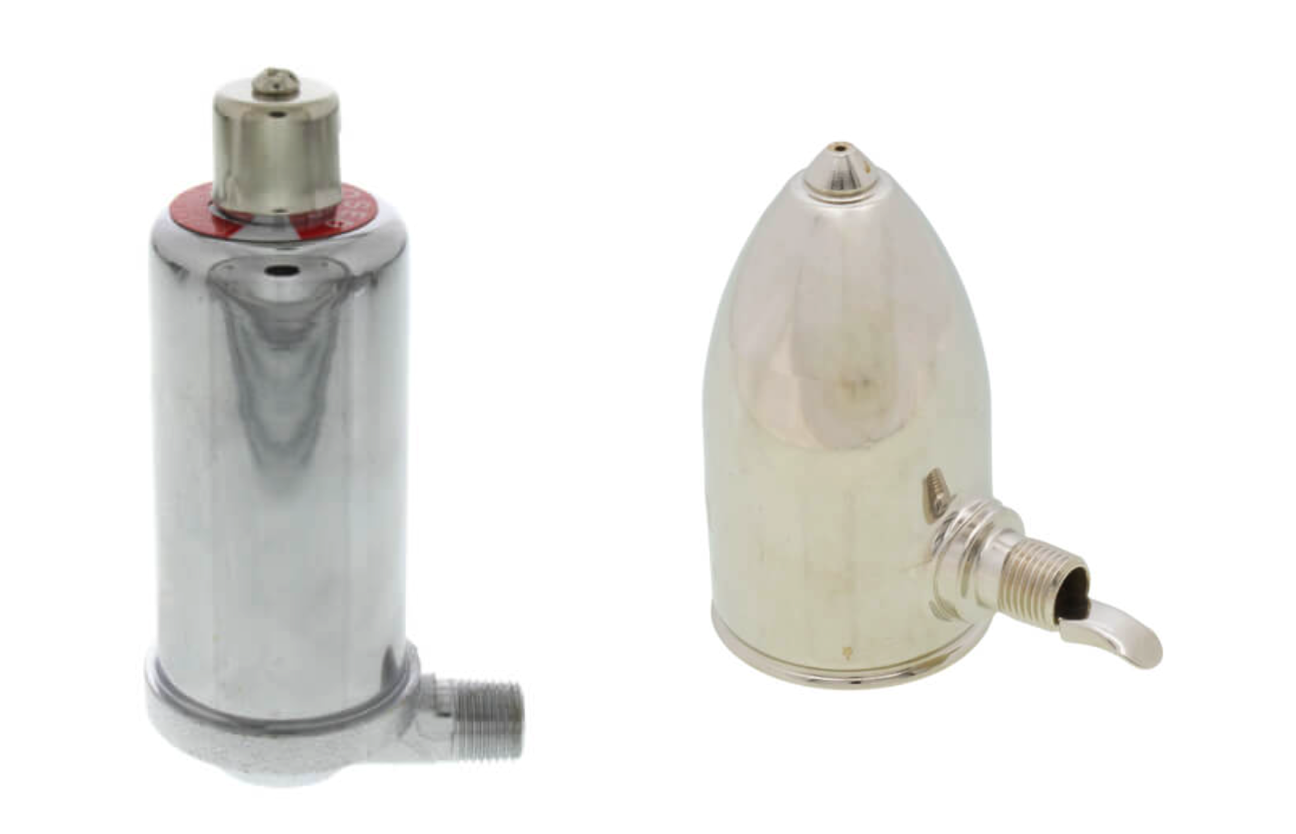
Radiator Vent. Here are two typical radiator vents one is adjustable and the other is a fixed orifice. the idea of this part is to allow air to leave the radiator so steam can enter the radiator. Where there is air there is no steam, so removing the air is an important factor in getting the radiator hot. once the steam is in the radiator, the vent should close as a result of the high steam temperature.
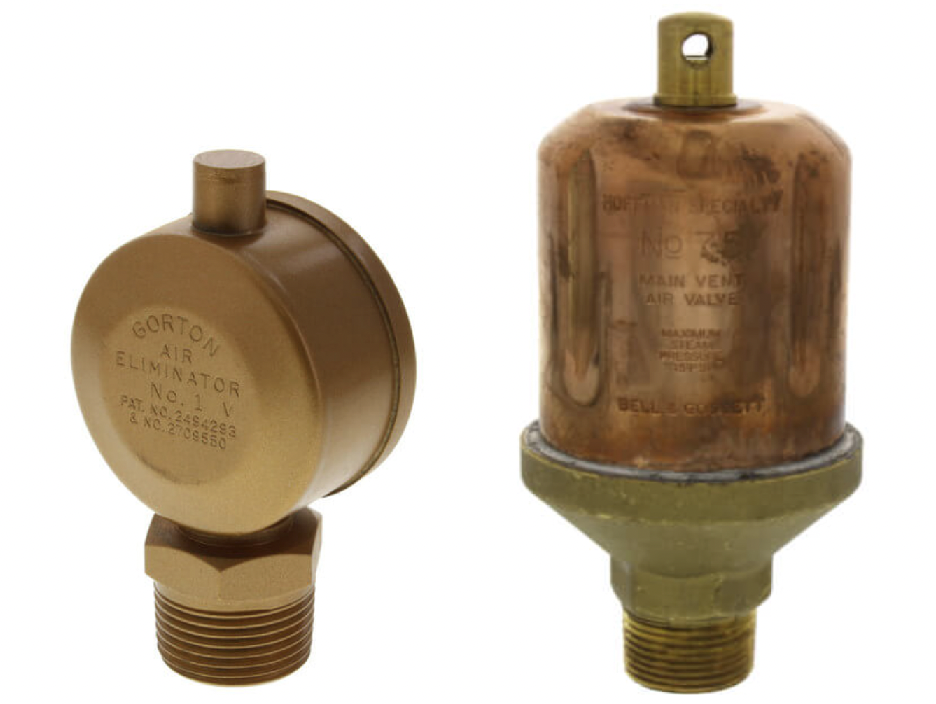
Main Vent. These vents are located at the end of a main steam pipe after all the branches to the radiators. The idea of this vent is to remove all the air in the steam main out so the radiators can all get steam from the main at the same time. In some larger systems you may find more than one of these vents on a tee fitting at the end of the steam main, just before it turns down to the condensation return piping
We often find some non professionals calling a steam vent a valve for one reason or another. when this happesn we look at the wrong end of the radiator where the actual valve is located for an answer to a vent question. Can you see how this can be confusing? I was wondering if you might restate you problem with this new information?
Edward Young Retired
After you make that expensive repair and you still have the same problem, What will you check next?
0 -
these things are what you say are already done:
- Replaced all the valves (again) with their recommended brand and opening, and rebalancing the radiators.
- Swapped the main valves from 1's to 2's, (there are two main valves).
- Drained, skimmed, and serviced the radiator.
- Cleaned the pigtail and reset and tested the pressure gauge.
I believe you ment that
- Replaced all the VENTS with their recommended brand and opening and rebalancing the radiators
- Swapped the main VENTS from 1's to 2's (there are two main VENTS)
- Drained, skimmed and serviced the BOILER
- Cleaned the pigtail and tested the pressure CONTROL
Does this soung correct?
Edward Young Retired
After you make that expensive repair and you still have the same problem, What will you check next?
0 -
Yes, sorry for the wrong terminology, that is exactly what I meant!
 1
1 -
Thanks for the reply, it's set to 1.5 but not sure if it is working / cutting out at that. Any way to test that? I asked them to check it when they did all the work and they said it was working, but it seems to set off the vents only after firing for awhile, which might mean the pressure has built up?
0 -
you can add a low pressure gauge in line with the pressuretrol to see the actual pressure, like a 0-3 psig or 0-5 psig gauge. sometimes they are calibrated in oz/in^2 instead of psi.
some have claimed that steam with a lot of carryover can cause vents to not get hot enough to close.
if the main vents are inadequate and/or if the boiler is very oversized the velocity of the air in the radiators could be propelling particles of rust in to the seat of the vent.
do the vents fail to seal immediately after yo replace them or does t take a few days or weeks. if you screw in a brand new name brand vent and fire up the boiler for a long cycle, do you see steam leaking out the vent on that first cycle?
you can also try boiling the vents in vinegar and rinsing them out, i'd try one and see if it makes a difference before doing all of them
0 -
Replaced all the valves (again) with their recommended brand
Are you hiding the brand from us? 😅
NJ Steam Homeowner.
See my sight glass boiler videos: https://bit.ly/3sZW1el0 -
Ha, no, Gortons :) which I know not everyone loves, But its literally nine of them so can't imagine all 9 would fail, I've also tried the Home Depot brand and varivalve… same problem.
 1
1 -
The failed to seal the very first time, and the radiators are super hot, even at the end of the line, so can't imagine the steam isn't hot enough, but who knows…. thanks for any help!
0 -
Check your failed varivalves to see if you can blow through them and if they rattle when you shake them. There is a whole thread on them that you might chime in on. If you were getting any amount of carryover into your radiators you would have been fully aware of it with varivalves because they don't have a float and they are prone to spitting.
0 -
Yes, as @mattmia2 said, you can put a 0-3 psi gauge inline with the pressuretrol and see what the pressure is when the boiler cuts out. The fact that you say all new vents leak immediately after install, and that all rads get very hot, still suggests that the pressuretrol may be letting the pressure get too high.
 1
1 -
Thanks so much, do you think if I knocked the setting on the pressuretrol down to say 1 or .5 it would help?
0 -
I'm not a steam expert, so I'll leave it to the experts to suggest what lower settings to try on the pressuretrol. @Jamie Hall may have some suggestions. In theory though, you could start low, then gradually step up until you (hopefully) reach the point where all the radiators get hot but the vents don't blow steam.
0 -
Somewhere up there there is a comment that the pressuretrol is set to 1.5. Problem: there are several types of pressuretrol. If this is the type with just one scale, that is the cutin pressure, and the cutout will be that plus the differential which is found on the circular wheel inside.
And if it is 1.5 it is too high. Try setting that down to 0.6 or thereabouts, and make sure the differential is set to 1..
Now. That won't hurt. It might help. But there is also the comment that you should get a low pressure gauge — 0 to 3 psig — to see what is really happening, and I agree. If at all possible, mount it somewhere other than the pigtail for the pressuretrol, although if you are sure that the pigtail and the openings into the boiler are really clean the same pigtail will do.
When I see a situation like this, where every single one of the vents is giving trouble, I'm rather inclined to suspect that there is a root cause other than the vents, and it may be pressure.
Br. Jamie, osb
Building superintendent/caretaker, 7200 sq. ft. historic house museum with dependencies in New England

 3
3 -
I would disagree with that. You should start low and stay low. You don't need anything higher than the lowest setting on any pressuretrol to fully provide steam to every radiator in any residential steam system.
If they aren't getting hot it's for some other reason (typically that air isn't allowed to escape—due to venting, or that steam isn't allowed to enter—due to bad pitch in supply piping)
NJ Steam Homeowner.
See my sight glass boiler videos: https://bit.ly/3sZW1el1 -
Thanks, it is a one scale one, and set to 1.5. I'll try to lower it when I get home. Any hints or things to look out for on setting it or pretty straightfoward? Thanks again!
0 -
Go to the bottom gently, but don't go past that or push it against the bottom. Use the flat adjustment screw on top of the gray box. Lefty lowers, righty raises.
if the boiler after that refuses to start up, then slightly raise it
NJ Steam Homeowner.
See my sight glass boiler videos: https://bit.ly/3sZW1el 3
3 -
In the event you did not know, the Heat Timer Varivalves do not completely shut. In their closed position they still pass about a #5 rate (0.200CFM). When fully open they are larger than a #1 (1.130CFM). These are at 3oz. pressure.
0 -
These will give you more information on vent valves.
1


Categories
- All Categories
- 87.8K THE MAIN WALL
- 3.3K A-C, Heat Pumps & Refrigeration
- 59 Biomass
- 430 Carbon Monoxide Awareness
- 132 Chimneys & Flues
- 2.2K Domestic Hot Water
- 6K Gas Heating
- 124 Geothermal
- 170 Indoor-Air Quality
- 3.8K Oil Heating
- 79 Pipe Deterioration
- 1.1K Plumbing
- 6.7K Radiant Heating
- 396 Solar
- 16.1K Strictly Steam
- 3.5K Thermostats and Controls
- 56 Water Quality
- 51 Industry Classes
- 51 Job Opportunities
- 18 Recall Announcements