Expansion Tank - Banging Issue

Hi Guys - after resolving this 2 zone hot water issue recently
for the last 4-5 days there's a new problem. When either zone shuts down there's a big Wham bang bang bang in the system that sounds like the pipes are rattling. By the boiler it's very quiet but in the living spaces it's loud enough to wake us up at night. This morning it dawned on me that maybe it's the expansion tank. I pushed the schrader valve and only got air. I checked with a pressure gauge and it fizzled out as if that was the last air. No water came out.
I have to get a bike pump and get it back to 12PSI to match the regulator pressure, but two questions:
1. Since the system is self filling, I imagine it has taken in more water over time as the air pressure has dropped and the diaphragm expanded to the air side. So what happens when I pump up the pressure to 12PSI - won't the diaphragm be pressurized but the tank still full of too much water? If so, how do I get the excess water out?
2. This fix is needed regardless, but does it make sense as a solution to the banging issue or would that be something else?
Thank you!
Comments
-
You need to drop the water pressure in the system first to recharge the expansion tank ..
When has this noise problem first start ?
There was an error rendering this rich post.
0 -
Noise - 4-5 days ago.
Drop the pressure how?
0 -
Well, ideally you would isolate the expansion tank from the system completely — good installations have a valve specifically for that purpose — and disconnect it physically and make sure it is drained completely, then pump it up to your desired system pressure and wait a bit to make sure it held, then reconnect it and open the valve.
That is probably optimistic.
Alternatively you can drain the system down using the drain valve which, hopefully, exists near the boiler for the purpose (make sure the system is turned off!). You can then recharge the tank to the desired system pressure and refill the system. You may (probably will) have to purge air out of the heating loops.
What you CAN"T do is correctly recharge the tank while it is connected to the system.
Now on the banging. It is possible it is related to the expansion tank having lost its charge — but much more likely to be a zone valve closing too fast. That may take some detective work to find.
Br. Jamie, osb
Building superintendent/caretaker, 7200 sq. ft. historic house museum with dependencies in New England0 -
Shut the boiler feed valve and open a purge or a drain valve to allow water pressure to drop as you pump up and expand the bladder displacing the water in the system ..
There was an error rendering this rich post.
0 -
@Jamie Hall and @Big Ed_4 - two different opinions on filling the tank.
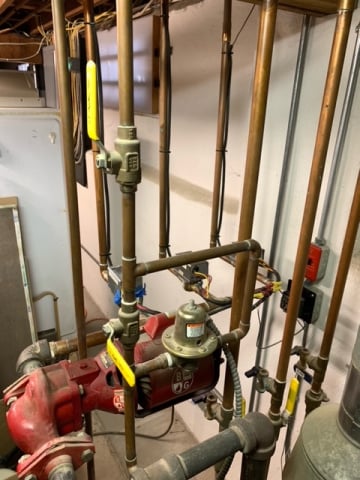
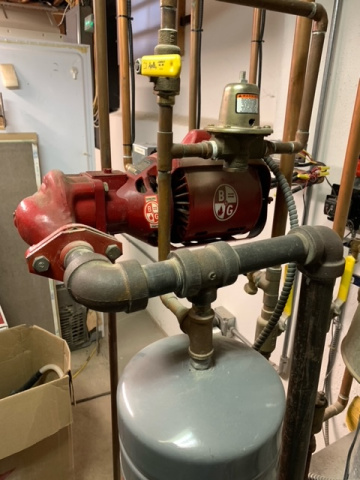
There is no complete isolation of the tank. I can isolate the fresh water feed, but not the system from draining back through the main supply from the boiler to the pump.Further thoughts?
 0
0 -
I don't like it, but there is a chance that you can get the expansion tank more or less charged if you drop the system pressure below the target pressure and then pump up the tank to the target pressure, then recharge the system. In theory doing that should ensure that the tank has no water in it after you have pumped up the air pressure — which is what you want.
It sometimes works.
Br. Jamie, osb
Building superintendent/caretaker, 7200 sq. ft. historic house museum with dependencies in New England0 -
@Jamie Hall Wouldn't that be backflowing boiler water into the potable water supply? We have a code-required backflow preventer to prevent such things, but I don't see a backflow preventer on the OP's system, though there could be one outside the photo.
The other option is to isolate the feed water, crack open the drain valve (there should be one at the boiler) and then re-charge the system while allowing the excess water to drain from the boiler valve. When the expansion tank is fully drained, any more air added to the tank will start increasing the pressure. At that point you know the tank is fully drained. Close the boiler drain valve, pressurize the tank to 12 psi, open the feed water and you're done. But the boiler drain valve is likely to leak afterwards, so before you try this, be sure to get a valve cap first to put on the drain valve outlet.
0 -
I certainly didn't mean to try and drop the system pressure by backflowing into the domestic water. First place, the heating pressure is likely to be a good deal less than the domestic…
I would have thought that using the boiler drain to drop the pressure (having closed the valve from the domestic feed) was obvious. Silly me.
Br. Jamie, osb
Building superintendent/caretaker, 7200 sq. ft. historic house museum with dependencies in New England0 -
@Jamie Hall Sorry if I misunderstood. You did suggest using the boiler drain valve in your first post. I thought you were suggesting an alternative method for draining the tank in your second post. I wouldn't be surprised if someone has tried it…
0 -
FYI - there is a backflow preventer and a boiler drain valve.
I'm not clear on 1 part now:
The expansion tank is below the the pipe that exits the boiler to the pump. Isn't the only way to clear water from the expansion tank to pressurize it with air to push the water up and out?
The expansion tank says it has a max of 100PSI working pressure, so can't I use like 40PSI to push the water out of the tank, then drop the pressure back to 12PSI?0 -
Don't pressurize the tank until you've opened a valve somewhere to drain the excess water, and keep the drain cracked open while you add air to the tank. If you don't first open the drain valve, and then you pressurize the tank to 40 psi, you'll pop the pressure relief valve on the boiler, which you don't want to do.
If you're going to use boiler drain valve, it probably hasn't been used since it left the factory and will likely leak after you close it. So if you're going to use the boiler drain valve to drain the excess water, get a valve cap first with a washer on it so you can seal the leaking valve afterwards.
Once you've closed the feed water and opened the boiler drain valve, then yes, you can pressurize the tank to drive the excess water out of the tank. But don't go crazy and don't exceed 20 psi or so, as you don't want to accidentally trip the boiler pressure relief which is likely set at 30 psi.
Once you know the tank is empty of water, close the drain valve and set the tank air pressure where you want it. Then open the feed water valve. If you've pressurized the tank to 12 psi with air, and if the feed regulator was already set to 12 psi, they should balance, and you should have a tank full of 12 psi air and no water. If the system pressure creeps up slightly after you open the feed water valve, it means the feed regulator was set slightly higher and you got a little water back in the tank, but if it only increased 1-2 psi, not a big deal.
0 -
Hi, As long as you're going to the effort, why not put a shut off and drain between the tank and system? After that, future service will be simple. 😸
1 -
I agree with @Larry Weingarten
The fact that the tank lost its air charge may mean you need a new tank. Sometime in the future you will.
Shut off the city water
Your going to have to drain the boiler and then fill and rebleed the system.
I don't see valve to isolate the boiler from the system so you may have to drain everything.
When drained take the tank off it may be heavy if it is waterlogged. When you get the tank off repressure it.
Install a 1/2" close nipple and a 1/2" threaded ball valve on the existing tee. Then put another 1/2" close nipple in the ball valve with another 1/2" tee. Put the expansion tank on the new tee. Put a 1/2" boiler drain valve in the new tee.
See attached drawing.
 1
1 -
Thanks for all the help here. This is what happened:
I locked out the boiler to minimize draining, then drained some water. I filled the tank with 20 PSI but the schrader valve was leaking. I unscrewed it and only half came out. That left me no alternative but to remove the tank. I fished out the other half, replaced the valve and filled it with 13.5 PSI because my boiler pressure gauge is stuck on 15PSI. I reinstalled the tank, filled and bled the system, checked for leaks, then ran the heat. The banging is gone and a small bang when the system starts is gone too. I guess we didn't realize that wasn't normal since its been doing it all season.
I realize the tank is old, but money's tight so this got us quiet heat for hopefully the rest of the season. If the banging comes back, I know what I need.
Also, I didn't install a valve because I would have had to cut pipe and do a bunch of changes to fit one in, even though it's a good idea.
Great forum - I really appreciate the help!0 -
Glad you got it working that is a + in the winter.
0


Categories
- All Categories
- 87.8K THE MAIN WALL
- 3.3K A-C, Heat Pumps & Refrigeration
- 59 Biomass
- 430 Carbon Monoxide Awareness
- 133 Chimneys & Flues
- 2.2K Domestic Hot Water
- 6K Gas Heating
- 124 Geothermal
- 170 Indoor-Air Quality
- 3.8K Oil Heating
- 79 Pipe Deterioration
- 1.1K Plumbing
- 6.7K Radiant Heating
- 396 Solar
- 16.1K Strictly Steam
- 3.5K Thermostats and Controls
- 56 Water Quality
- 51 Industry Classes
- 51 Job Opportunities
- 18 Recall Announcements