Can't stop the cycling!
Comments
-
I did the push-the-rocker-arm-down test after the boiler stopped firing multiple times and it sure does seem to be the pressuretrol shutting it off. There is a second high pressure safety cutoff that I have not tested. Am I correct that if that one tripped then a red button press would be needed to make the boiler fire again?
0 -
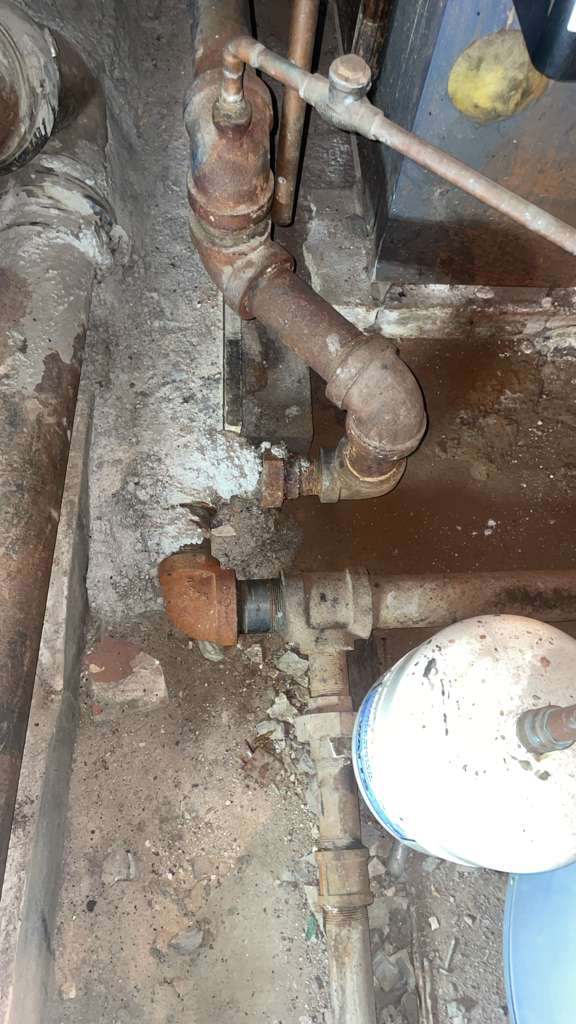
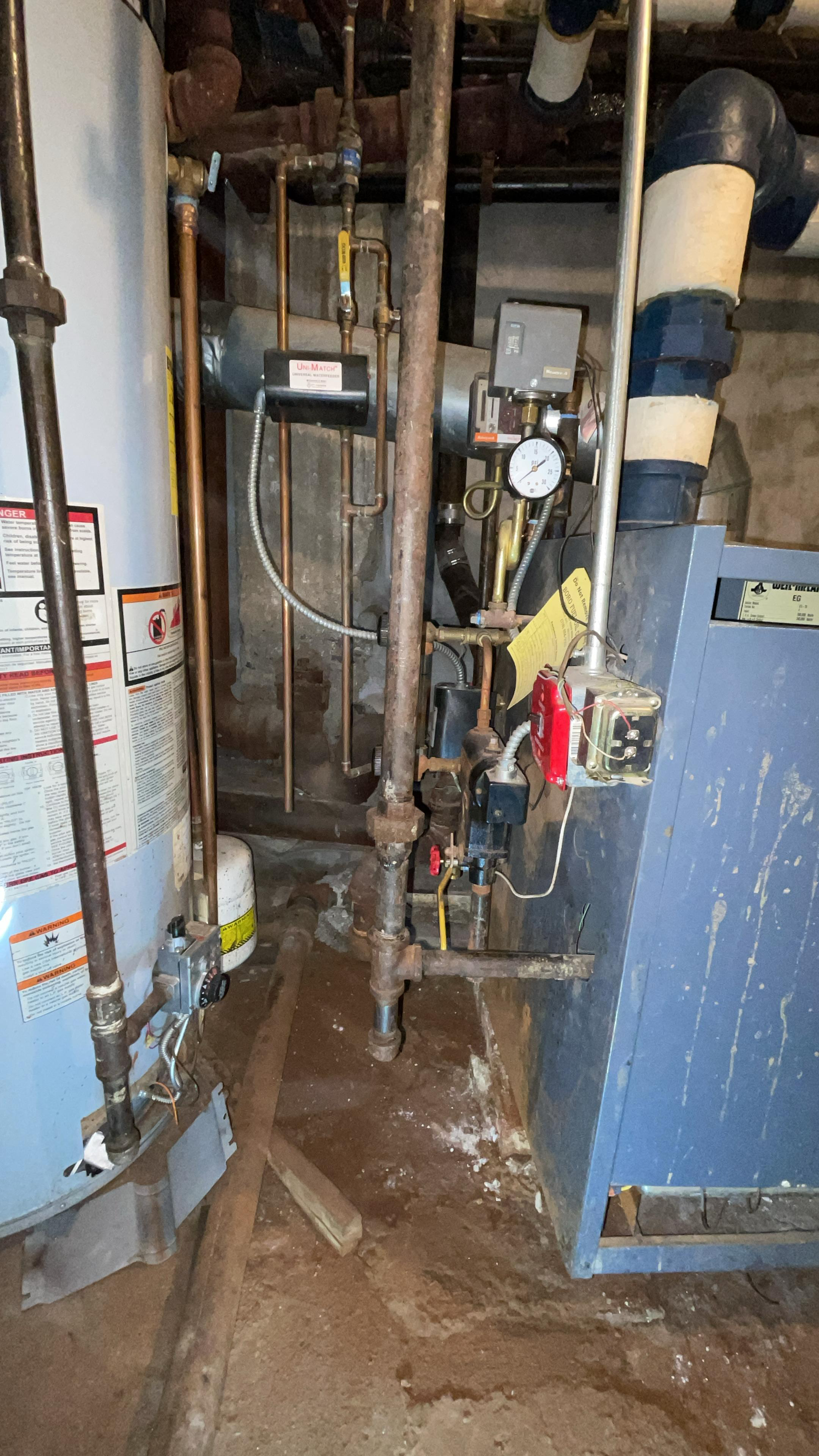
I’ve been looking for a drain valve on the return line to see if the return lines have accumulated sludge. But, I don’t see any drain valves.
See below. Some of the drain pipe is encapsulated in concrete.
 0
0 -
 0
0 -
Not a bit surprised.. It's doing exactly what it is supposed to do — control the system pressure to a reasonable level. Technically what is happening is that the boiler is producing a little more steam than the system can condense, so the pressuretrol just shuts it off now and then to let the system catch up.
Now the one with the red button — yes, you need to press that button to get it to turn back on again. Like anything else with a red button, though, you need to find out why the pressure got high enough to trip it before you reset it. Obviously the operating — control — pressuretrol didn't shut the system off when it should have — so the next question is why?
Br. Jamie, osb
Building superintendent/caretaker, 7200 sq. ft. historic house museum with dependencies in New England0 -
when you flood the boiler to look for leaks above the water line in the boiler, you look under the boiler for water leaking out.
buried wet returns commonly leak without being noticed so your returns under the floor could be leaking.
0 -
I need to go a little slower please.
1) The larger, red-button pressure control does not trip (that is, the button has never needed to be pressed.
2) My push-the-lever-down test was supposed to prove that the pressuretrol was NOT shutting off the boiler.
3) If the above is true, then we are back to the LWCO shutting it down, which seems to make sense to me and is the current direction of exploration. that is, to determine whether there is a leak or a failure in the return lines.
Is my understanding incorrect or misguided?
Thank you!
0 -
if the water is leaving and later coming back, tripping the lwco, it is not a leak and probably not clogged returns though that is a possibility. it is more likely that the boiler is throwing liquid water in to the mains with the steam.
0 -
'll give you full marks for persistence. However. You need to find out if that control pressuretrol is tripping on pressure. You haven't yet.
I really think you need to go back to basics here. There's been a lot of fog in this thread!
There are, on your boiler, apparently three active controls: the thermostat, the control pressuretrol, and the low water cutout.
The cycle behaviour which you describe of perhaps 20 minutes on, then a 1 minute shutdown, then running again. is almost certainly either the control pressuretrol or the low water cutout doing what it is supposed to do. If it is the control pressuretrol, stop worrying about the cycling. It's quite normal. If it's the low water cutout, you should be able to veryify that by observing the water level in the sight glass. Where is it when the boiler cuts out, and where is it when the boiler cuts back in?
Check the control pressuretrol with a multimeter. The jiggle the lever doesn't tell you anything useful. When the pressure is below the cutout, the multimeter will read zero voltage across the terminals. If the pressure is above, the multimeter will read voltage across the terminals (it may be 24 volts AC — but be caution: on some systems it may be 120 volts AC).
Now if it turns out to be the low water cutout — which you can verify by observing the sight glass — there are things involving slow returns which can be done to eliminate or at least reduce the problem.
But at least find out what's turning off the boiler before fussing about anything else…
Br. Jamie, osb
Building superintendent/caretaker, 7200 sq. ft. historic house museum with dependencies in New England0 -
How "cold" is cold in "starts from cold?" If I shut it for an hour will that be cold enough for this test?
Is it a sufficiently valid test to check which gets hot first: The returns or the mains at the edges of the basement (where the main vents are)?
0 -
off long enough for the returns to feel cold or cool at least. if they get as hot as the boiler early in the cycle it is probably throwing water in the mains
0 -
Please tell me which control is actually cycling the boiler… please…
Br. Jamie, osb
Building superintendent/caretaker, 7200 sq. ft. historic house museum with dependencies in New England 1
1 -
I would truly love to — I very very much appreciate your patience and help.
I'm not onsite until next week and the guy I have there probably can't follow the instructions of using the multimeter.
I thought that putting downward pressure on the pressuretrol rocker arm was a good test, but I now understand (well, i don't understand, but I believe) that it is not.
In the past 48 hours the boiler has been behaving much better, with longer off times, and water level in the sight glass that returns to a nice level during those off times. I don't know how diagnostically value that info is.
So, I am still unsure if the boiler is stopping because of the pressuretrol or the LWCO.
Right now (just as an example), the boiler has not been firing for 30 minutes (outdoor temp is about 43* F).
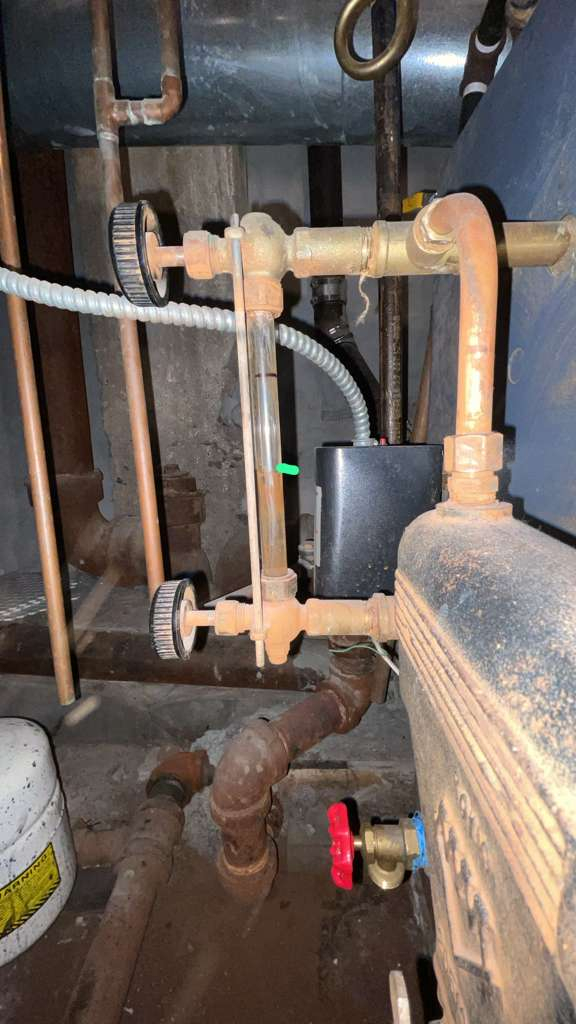
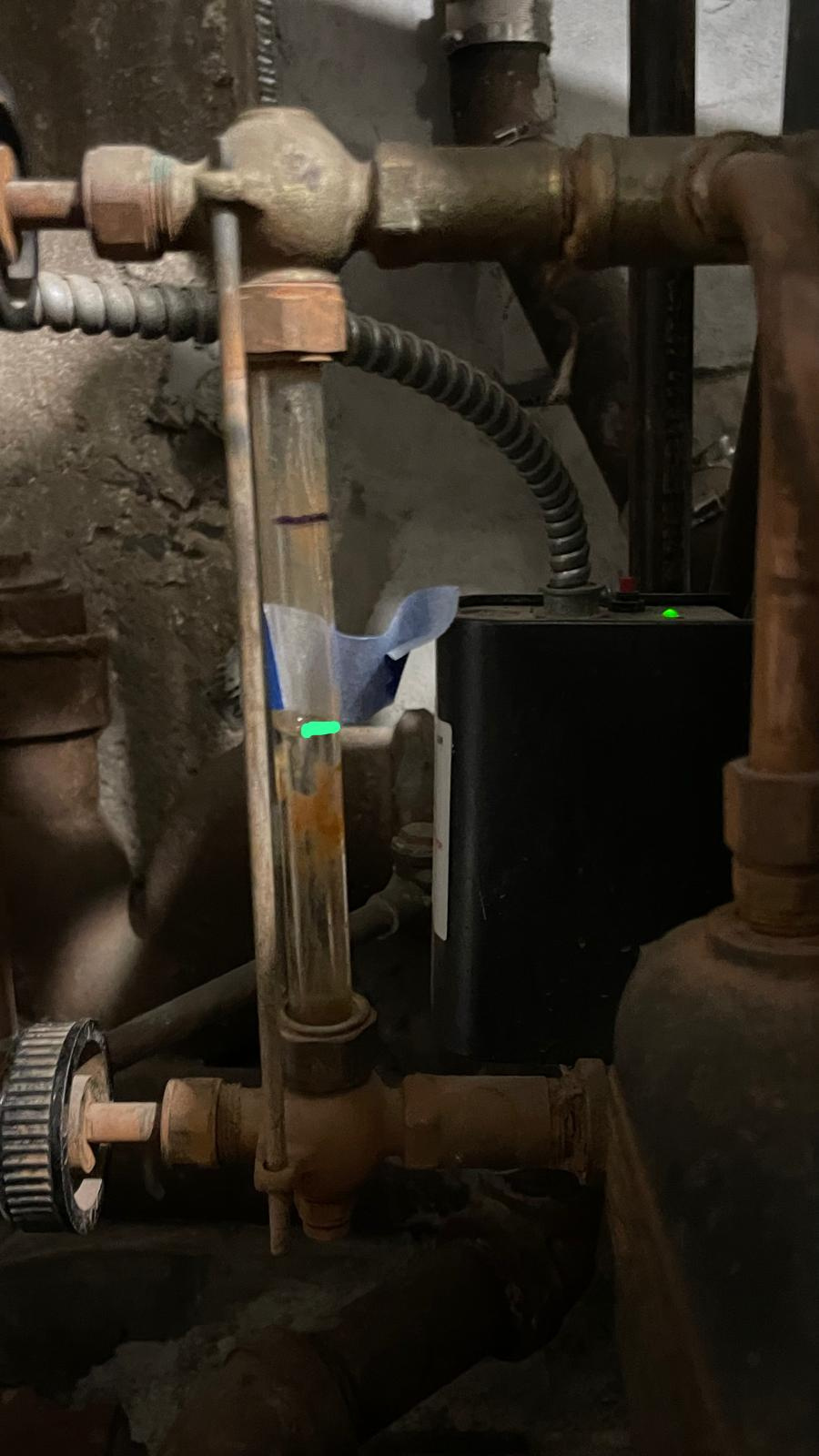
The image below shows the water level now (after not firing for 30 minutes). Green marks the current water level with the boiler not firing but moderately hot. Water has not been manually added in at least 48 hours (maybe 72).
 0
0 -
Thank you! The reason pressing on the lever in the pressuretrol is not really a good test is that while it does say that the switch works — which is nice to know! — is that it doesn't say, reliably, whether that is the control which is doing the cycling.
Looking at the water levels, I do wonder now if it may not be the low water cutoff — or cutoffs. From the photo it looks as though there is also a float type LWCO. That green line is very close to where the control gets unhappy. Since you are not adding outrageous amounts of water, it doesn't seem that you have a serious leak (you may still have one, but let's worry about that down the road here). So… try adding water manually, with the system cool (it doesn't have to be cold) to that black mark on the sight glass. Some systems may have slow returns, but not so slow as to be a problem, and are just happier running with a higher cold water level. It won't hurt anything to try!
I remain baffled by the pressure. If that valve is the boiler feed, it should raise the level in the sight glass — but that has almost no effect on the pressure. But… I notice that there is what almost looks like a compression tank hanging above the boiler. Is there, by any chance, a hot water heating loop connected to this thing as well as the steam?
Br. Jamie, osb
Building superintendent/caretaker, 7200 sq. ft. historic house museum with dependencies in New England0 -
Pressuretrol: My thinking (obviously incorrect) was that by manually ensuring the microswitch is not tripped, the boiler will start to fire again immediately if and only if the reason it stopped was because of pressure exceeeded the threshold.
Low water: More evidence that I know just enough to be problematic — I did not realize that I had 2 LWCO. I understand now that the there is rectangular box box which (I think) is a probe type as well as the big iron odd shaped one with a handle to drain drain water which (I think) is a float type. I assume both are wired in effect in series so that if either detects a low water condition then that one can shut down the boiler, correct?
The black mark was made several days ago by my "handiman" at my instruction when I told him to fill the water 3/4 of the way up. So, I think I ran the test you suggest, but I certainly don't fully understand it. You can now see that the water level has dropped and stabilized at the current level just above the unhappiness level. But, as my memory loses in the fight yet another day to age, I believe that the raising of the water to the black level was done prior to finding 2 more spitting vents — so it is possible that the water loss is due to that.
I can instruct him to raise the water to the black mark today and we can see if the water remains at that level of drops on it's own now to "just happy." Should I do that?
Thank you!
0 -
Do raise it and see what happens. As I say, it won't hurt at that level.
The big iron odd contraption is a low water cutoff — and may also control an automatic feeder, if you have one. The joker in that deck is that in order to make sure it is operating properly it should be drained from the valve on the bottom of it once a week or at least twice a month, to make sure the float inside is free. Then, of course, refill the boiler to where it belongs…
Br. Jamie, osb
Building superintendent/caretaker, 7200 sq. ft. historic house museum with dependencies in New England0 -
will do.
Should I shut off the valve that would otherwise allow the water feeder to feed the boiler?
my thinking is that that way we can better monitor water loss?
I can have it monitored closely.0 -
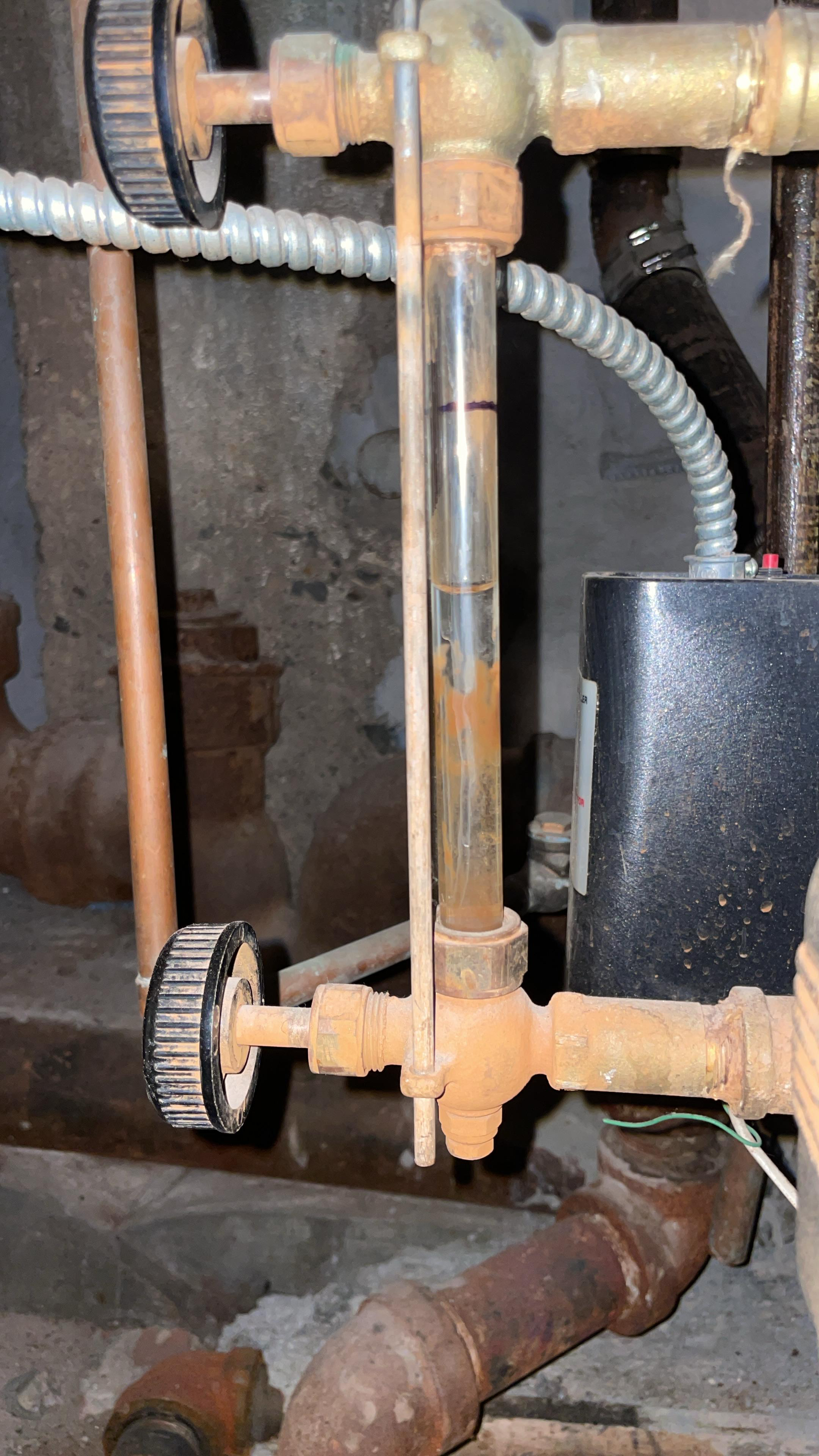
boiler was not firing now and water level is as shown, which I think is a healthy level.
 0
0 -
If the boiler is running okay now, maybe a first test would better be to simply shut the valve on the feeder and watch the water level. That way, I can see how much water it is losing in a period of time.
0 -
if someone is checking it, first a couple times a day, then daily, then longer depending on how much if any it is losing, go ahead and turn off the water feed and see what happens to the level with the boiler off.
the 2 LWCOs could be wired several ways, they could be in series, the float type one could be wired to the feeder only, it could be wired to nothing. you'd have to look at how it is wired. one could be wired to the line voltage side and one could be wired to the low energy side.
0 -
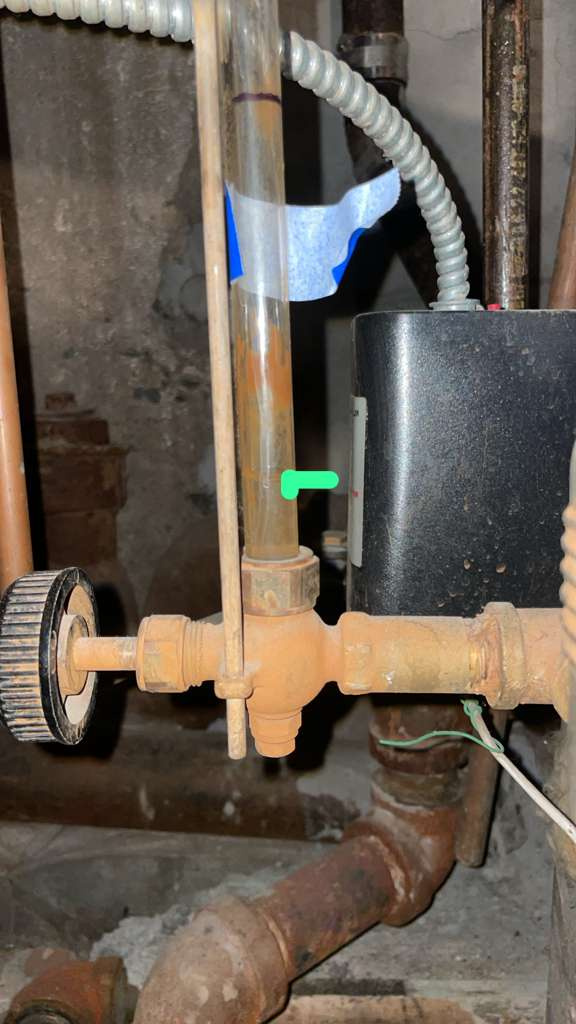
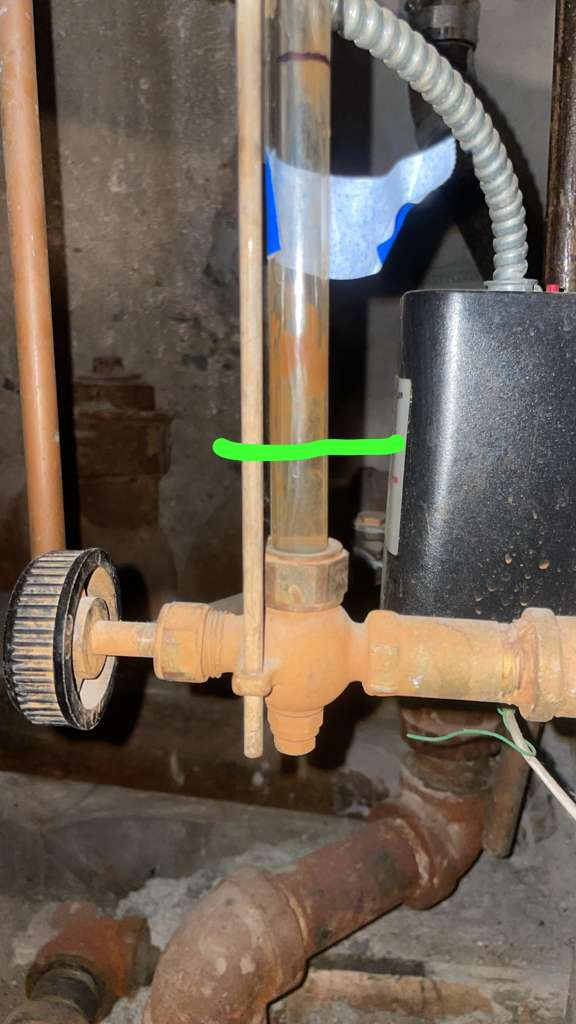
Update: On Monday at 9:45am I had the water feeder valve shut off. The water level was as shown in the photo. The boiler was not running and hadn't been for at least 15 minutes. Nothing else was changed.
At 2:00pm (4:15 later), the boiler not firing and was calling for water. The water level was as shown in the photo. I don't know with certainly how much the boiler ran in those 4 hours, but at 2pm the header pipes feel warm to hot.
At 4:00pm (6:15 later), the boiler was firing for a while and then stopped to call for water (which it's not getting because valve is still off). Water is a 2 to 3" lower than when it's when boiler is or just has been firing.
At 4:20(after about 20 minutes of not firing), the water level rose back to about 1 to 1.5" below the 9:45am level.
Analysis?
 0
0 -
Given that limited test duration it seems there is a leak and the returns may be slow.
The wet return leak test, water level over the Hartford loop level and boiler not running. Would need time to see if the water level drops.
National - U.S. Gas Boiler 45+ Years Old
Steam 300 SQ. FT. - EDR 347
One Pipe System0 -
So it's a reasonable test to run, but needs to be run longer?
I was unwilling to leave the valve off overnight out of concern for the boiler.
I don't like shooting in the dark, but I am considering just replacing all the buried-in-concrete returns (leaving them exposed and several inches above the existing lines in concrete). Is that silly?
0 -
"I don't like shooting in the dark, but I am considering just replacing all the buried-in-concrete returns (leaving them exposed and several inches above the existing lines in concrete). Is that silly?"
not a bit silly. And you can use copper for wet returns.
Br. Jamie, osb
Building superintendent/caretaker, 7200 sq. ft. historic house museum with dependencies in New England 1
1 -
i mean it would be better to fill the boiler above the hartford loop and mark it then wait a few hours with the boiler off to see if the level falls first. also flood he boiler and see if water drips out underneath if this hasn't been done yet
1 -
Update:
Having installed the make up water meter over a week ago, I have some data.
From January 13 through Jan 20 (7.5 days), the boiler was fed 29 gallons of water — that's 3.85 gallons/day.
I know now, having learned here, that 3.85 gallons/day is extremely high.
I have investigated this for days, replacing radiator valves and vent and inspecting every visible heating system pipe.
The only thing left that I can figure out is the ~15' of return line buried in concrete. I was going to replace it yesterday, but the temp outside is too cold.
Is there anything else I do to figure out where the water is going?
0 -
if the water level drops while the boiler isn’t running, it’s the buried line
At 4 gallons per day it won’t be a long test
NJ Steam Homeowner.
Free NJ and remote steam advice: https://heatinghelp.com/find-a-contractor/detail/new-jersey-steam-help/
See my sight glass boiler videos: https://bit.ly/3sZW1el0 -
Have you flooded the boiler yet or examined the exhaust vapor leaving the chimney, to see if the water is going up the chimney ?
National - U.S. Gas Boiler 45+ Years Old
Steam 300 SQ. FT. - EDR 347
One Pipe System2 -
- No to flooding boiler
- Chimney exhaust tested and no visible vapor (completely clear, warm air)
- Continued searching has found no leaks
- Tomorrow guy is coming to replace buried return lines (and make sure there is a drain valve at the lowest level of the returns, near the boiler)
I'm nervous about doing this in the middle of the Winter, but also nervous about not doing it.
0 -
OK . . . I would do the testing and just not replace things on a maybe. As @ethicalpaul stated 4 gallons a day should be noticeable.
National - U.S. Gas Boiler 45+ Years Old
Steam 300 SQ. FT. - EDR 347
One Pipe System1


Categories
- All Categories
- 87.6K THE MAIN WALL
- 3.3K A-C, Heat Pumps & Refrigeration
- 59 Biomass
- 429 Carbon Monoxide Awareness
- 124 Chimneys & Flues
- 2.2K Domestic Hot Water
- 5.9K Gas Heating
- 119 Geothermal
- 168 Indoor-Air Quality
- 3.8K Oil Heating
- 78 Pipe Deterioration
- 1K Plumbing
- 6.6K Radiant Heating
- 394 Solar
- 16K Strictly Steam
- 3.5K Thermostats and Controls
- 56 Water Quality
- 50 Industry Classes
- 50 Job Opportunities
- 18 Recall Announcements