Oil guy couldn't fill my tank today

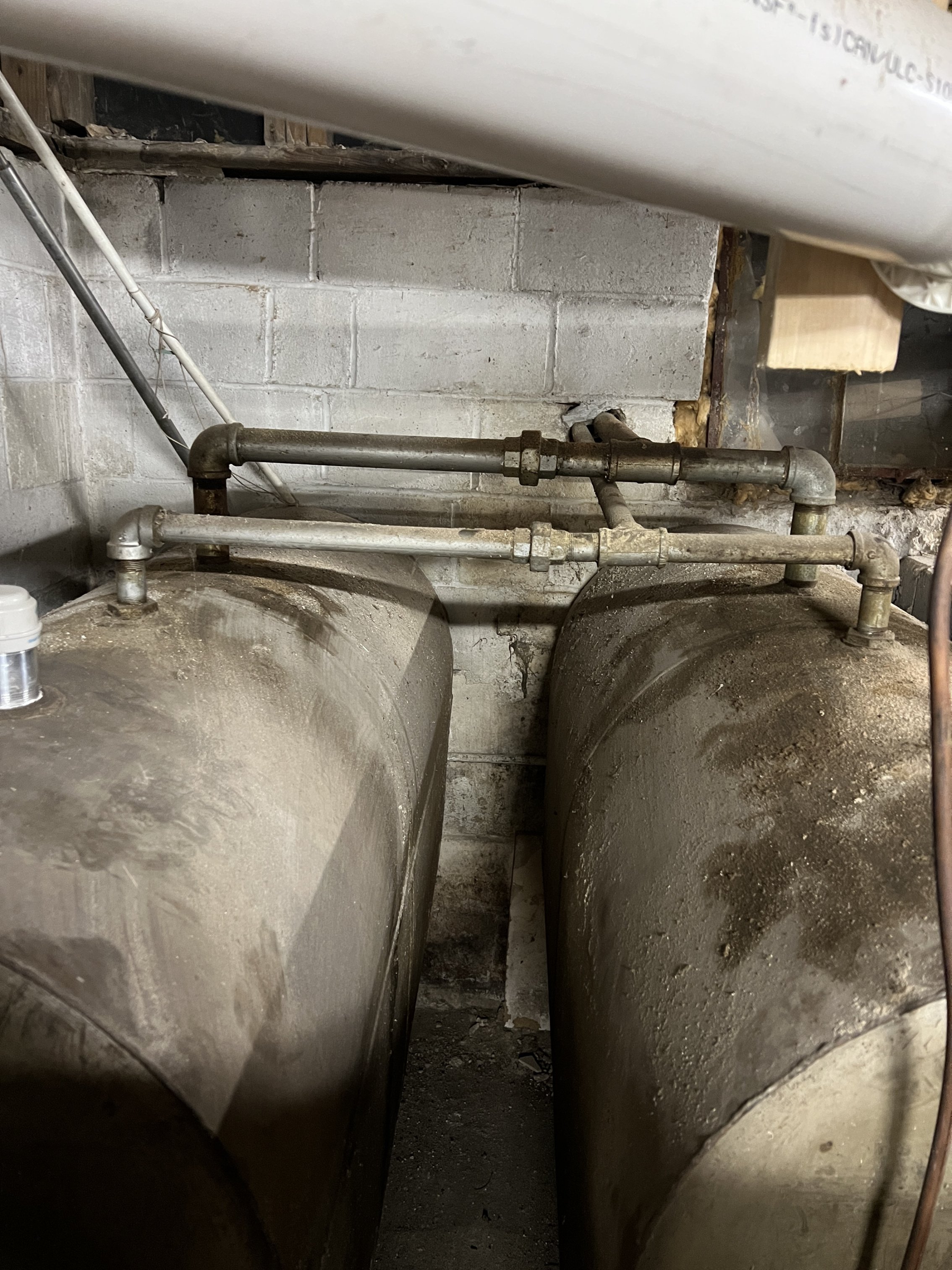
I have two 250g tanks and they have been there for probably decades untouched, but the oil guy couldn't get the airflow on the air vent side. The two tanks are connected by a T for inflow and by a T for vent. The oil guy said it is filling the one side first and clogging the outflow. This has been there for a long time without issue, but they say the plumbing is wrong. The furnace and install is over 20 years old and it looks like it. What is going on? How can it create back flow and not vent correctly? Repeat, it enters on one pipe and has a "T" and then it vents with a "T" on both tanks. I DID make a change as I put in a wifi gauge, but that should be okay. The float wasn't on the old gauge anymore, so that IS floating in there somewhere.
Comments
-
Are they in conditioned space?
0 -
-
They are inside.
0 -
Potentially very dangerous. Don’t press your luck.
The possibility of overfilling one tank or the other is pretty height as time goes by. The easiest repair is to separate the fill pipes and keep the vents ganged together, if both vent alarms are working.
Actually I don’t even see vent alarms, so it appears they will need to be added.
Virtually ever oil companies insurance policies deny any spill claim where no working vent alarm is present.
 1
1 -
Those tanks look like 550 gallon tanks not 275 gallon tanks
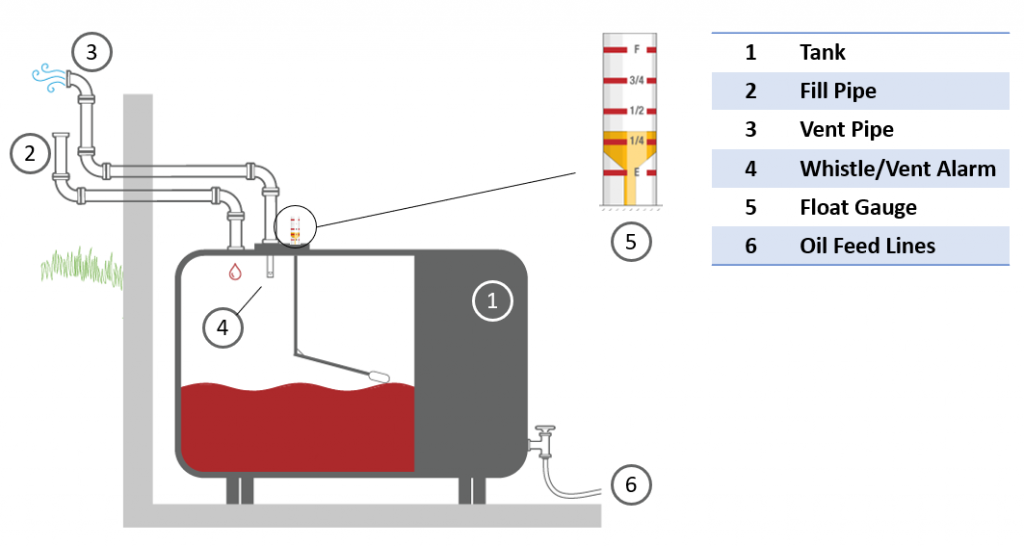
The distance for the oil to flow to the tank on the right is shorter than the one on the left and the oil will go there first and affect the flow to the other tank as the air in the tanks cannot escape through the whistle vent fast enough.
The fuel tank truck has a high flow pump delivery system and it is the main reason the driver cannot put fuel in the tanks as the air cannot escape quickly through the single vent pipe.
If it were me, I would have those tanks pumped out and removed and replace them with a one Highland petro hopper tank of 1,000 gallon capacity and run dual oil lines from the petrohopper tank to your burners if you have two oil burners.
The petrohopper tanks are a steel tank within a tank design that allows them to used anywhere as the outer tank acts as a containment tank in the event of a leak.
You can have the two tanks separated and add a second set of fill pipes and vent whistle pipe or hope the oil company still has a low flow tank truck if you do not want upgrade the tanks to a single tank like a petro hopper with two lines if you have two oil burners.
If you have an oil spill in your basement your insurance and the fuel dealers insurer may deny a claim caused by the spill with your tanks set up as they are due to the split connections for the single oil fill and single vent piping.
Physics and atmospheric pressure strike again.

 0
0 -
Those tanks are piped illegally. They always were illegal. That was never an approved way to pipe two tanks.
Ok what is wrong:
- No vent alarm whistles on either tank
- You can use 1 vent for two tanks but not piped like that. The 2 vents are not hooked together properly. and the vent pipes need pitch
- The fill pipes are all wrong. You either need a separate fill to each tank (the best way) or you run the fill to one tank and pipe a separate crossover pipe which must be 2" The fill pipes also need pitch
- Since you have to repipe it anyhow the fill and vent have to be the same size.
- You can use 1 1/4 or 1 1/2 or 2" pipe but everything has to be the same size. A cross over if used must be 2"
Since those tanks are obviously very old I would replace them at the same time.
This is not the oil company's fault. They have insurance and are libel for a spill, but the HO is libel for a spill if the tank fails
There is a chance your old float is blocking the vent
 1
1 -
When was the last fill ? Bee's nest in the vent ?
National - U.S. Gas Boiler 45+ Years Old
Steam 300 SQ. FT. - EDR 347
One Pipe System0 -
Vent is clean. We did check that.
0 -
Thanks.
0 -
Wow, what is going to be the cost of this do you think? This home is killing me if people only knew. It was just one horrible purchase. I am not sure if I should just change over to propane? I like my oil, but if I am replacing the tanks and all that, what the heck am I doing? My furnace is 20 years old, but a Carrier in good shape; ]
I'm over $100K over budget. This home keeps giving. Wow. Thanks again though. I need to know the situation.
0 -
Well there is no way of getting a huge 1,000 gal tank in my basement. I can get the same tanks in there with my 30" opening to outside.
They don't leak. Hoping for a less expensive solution. Would be great to someday have good news on the money pit.. Geez. It used to fill fine and they have been there forever. Maybe the float is stuck in there somewhere and that is why?
0 -
I wonder if the float is blocking the valve? I'll bet it is. I mean this has been working for over 20 years I suspect. I changed the gauge and boom the whole thing is a mess.
0 -
They’re 275's. Most of everything else you said makes me think you’re a homeowner and don’t have much experience.
Petro hopper tank, 1000g, and in a basement are simply ridiculous and not practical or logically capable.There are double wall tanks much more affordable and proper for this situation.
0 -
Do you really need both 275 gallon tanks or can you get by with one?
What you could do is disconnect the tank farthest from the wall. Leave the fill and vent as is, (make sure the vent is clear) and plug the two tees with pipe plugs and add a vent whistle to the remaining tank.
Shut the valve that feeds oil to the burner from the tank near the wall and burn the outer tank down low so it can be removed. Then shut off the outer tank , disconnect and plug the burner line and remove that tank.


 6
6 -
I do not know what is more frightning.
The piping or it has been filled like that for years and no one has picked up on it till this very day.
0 -
Just yesterday I worked on a pair of 275's that were "twinnned" together, with only a common vent and common fill. The fuel company "red tagged" it — "DO NOT FILL". I took one tank "off line" and left it in place. This was on a house with 5 apt. units. This was an illegal set-up. The fuel co. will be visiting this house more often now.
0 -
I am a homeowner that has restored a lot of homes over the years, but you're correct in that I have no experience with oil heat. The oil delivery guy made me think I could fix this issue, but I am going to leave it to the pros. I'm in the Uniontown, PA area if anyone knows of a place. I do have one call in, but they have't returned my call yet and they are at least a week out for installers.
Thanks for your help to at least give me ideas of options.
0 -
There is a lot of things in this house that are pretty frightening. I've rewired it all for starters.
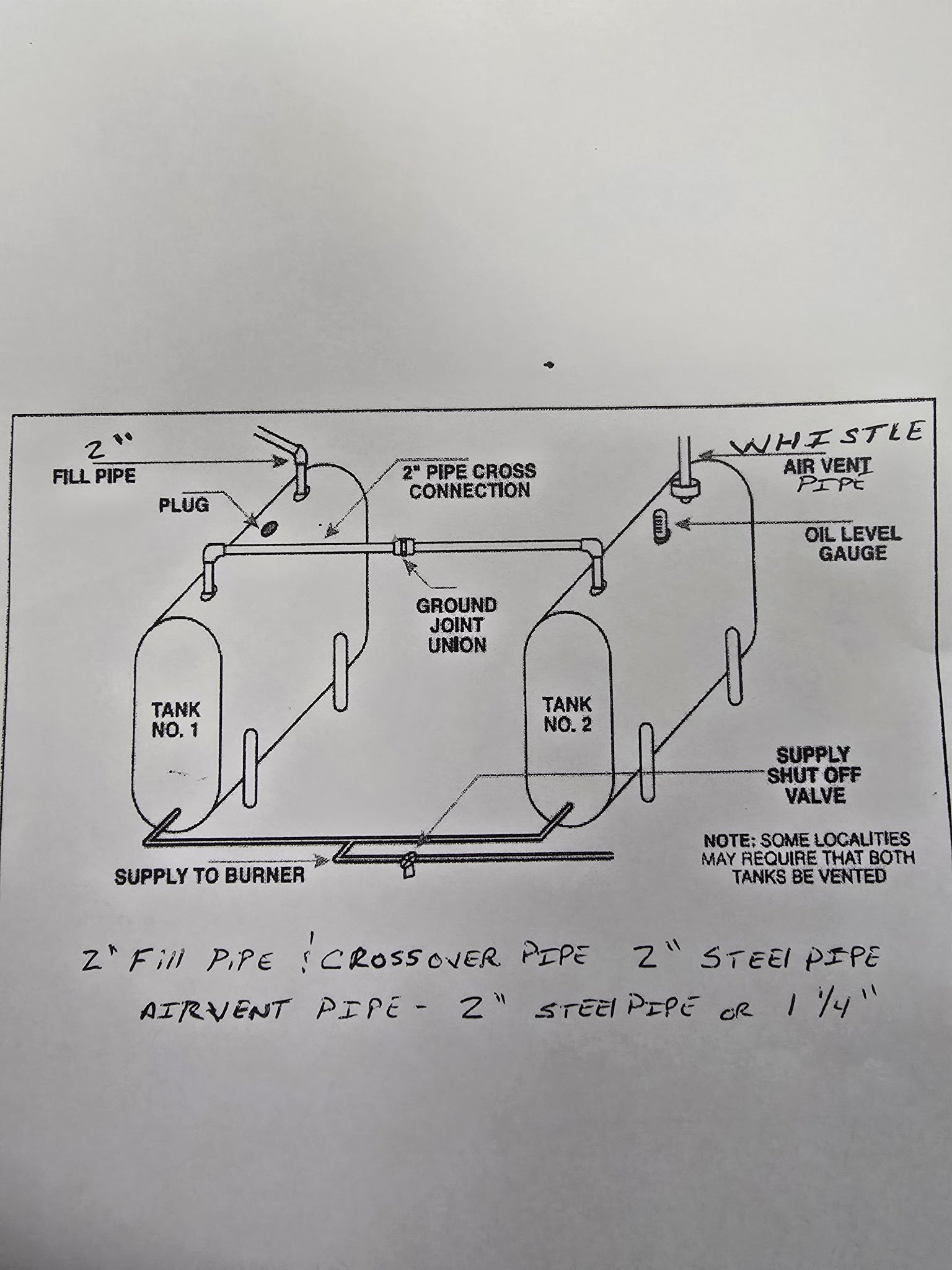
I am hoping they can just do some plumbing on the top side and fix it for now like that. The oil guy sent me this photo of how it should be set up.
 0
0 -
275g isn't really enough. Pretty big house to be filling one tank up all the time. Thanks though.
0 -
What's Pretty Big?
How often do you refill both tanks?
0 -
A Highland petrohopper tank is designed to be left outside, you do not have to have a tank inside.
0 -
I have an oval 275 gallon tank that is 26 years old and it looks nothing like those tanks.
I never said the Highland Petrohopper would go in the basement; they are ment to be left outside. There is nothing improper about a petrohopper oil tank used for heating fuel.
A 500 or 1,000 gallon petrohopper could be used effectively here as the existing fill pipe and vent pipe could be removed and the oil delivery line installed in its place. A tiger loop could be added to improve its delivery efficiency as it would be a top fed system. The wifi oil level monitor could be used in it too.
I guess my being a rural homeowner for 47 years dealing with and depending on oil heat and "the lack of it" and having suburban propain let me run out of fuel 3 times in the middle of winter when their tank truck driver is on vacation and listening to their manager whine and say, I have to call my driver back from vacation makes me unqualified to offer a comment doesn't it?
I cancelled my "gold service contract" with them after their burner tech almost broke my commercial oil filter by cross threading it as well as him spending half his time talking to his wife about their upcoming vacation.
I heat my home with a coal stoker boiler and I do not run out of fuel, nor do I burn through a tank of oil a week anymore either.
It is going to be case of buy once, cry once, no matter what he does. Having a larger tank would enable him to pay less money per gallon for fuel most likely as well.
0 -
I wasn't replying to your comment in this post but to another responder who constantly gives wrong information..
 2
2 -
@leonz I'm sorry that your wrong and you had a bad experience with one oil company. Those are 275 gallon oil tanks. Virtually no one uses those petro hopper tanks for residential…NO ONE. They are a commercial grade tank. Not a residential oil tank.
Stick with your coal. When there's a coal question, chime in.
If you want to whine incorrectly about Hydrostats or how steel expansion tanks are great, just remind people you are a homeowner with no practical experience.
I starting to see why my buddy got frustrated with this site and stopped coming here.
 3
3 -
The drawing he gave you he is correct that the crossover pipe has to be 2" Pipe.
But the fill and the vent have to be the same size. They can be 1 1/4, 1 1/2 or 2" but they both have to be the same size.
Tell him to look at the NFPA code #31 section 8.9 for cross connected tanks.
 1
1 -
4 bedroom 3 bath and built in the 30's, so a little drafty in some areas that I haven't gotten to yet.
I filled both 3-4 times a season when I didn't live here full time, but now I do. Having more capacity gets me a better price and just less hassle.
I have a call into one company, but I might call two for this one.
Thanks for your help.
0 -
Ah, got it. Thanks. Yeah when someone spins it into coal and a story, I moved on. Just want to get my tanks going correctly. Odd it worked for so long without issue, but now it doesn't. I did put a different wifi gauge on the tank and the float didn't come out. That is the only difference from last year, so it just seems that may be the problem. Not saying I won't want to fix this situation correctly however. I want it corrected.
Thanks for your help. This place is great.
0 -
@HydronicMike We don't always have to agree here, but we do have to be respectful of one another. If you've found that another forum member is providing information that you deem inaccurate, you can respectfully disagree and share why without belittling them. We are all here to learn from and help one another.
-Andrew
Forum Moderator
0 -
So I did try and remove the union on the vent pipe to see if I can see if it is blocked by the float, but you must need a beast of a wrench for that. Hoping someone calls me back.
I'm in Uniontown area in western PA if anyone knows someone that can fix me up.
Thanks for all the help here.
0 -
I would not do what is suggested here. For the first part, those two tanks are basement obround type 275 gallon oil tanks. Many codes have a maximum indoor fuel storage capacity of 660 gallons. You need to check with the AHJ in your area for that info. There are other inaccurate statements also.
Edward Young Retired
After you make that expensive repair and you still have the same problem, What will you check next?
0 -
You should be more concerned with non professionals (or non-knowledgeable people) providing inaccurate information. That information is available to anyone who stumbles onto the site. Without the reader knowing they are getting inaccurate information only hurts the websites credibility, and can really be harmful or even dangerous.
In my first comment to him I did point out he was incorrect as have others over his other posts. He continues dig in with his incorrect answers He thinks the answer to every oil tank is a $10,000 commercial replacement, Hydrolevels are horrible (because he had a bad one), 100 year old steel expansion tanks are the only solution over bladder style tanks and micro reabsorber air elimination.
I'm just a guy volunteering my expertise for free. People like me are what keep people coming to your website. More clicks=more traffic=more ad revenue for you. If people start/keep getting bad information, they may stop coming here.0 -
I am not a fan of the 2" crossover design, although that is a recommended piping design in the NFPA 31 code book. I have delivered to many fuel oil customers that have 2 tanks in the basement. I like the two separate fill pipe design myself.
Edward Young Retired
After you make that expensive repair and you still have the same problem, What will you check next?

 5
5 -
@gg1 , for what it's worth, Roth offers a 400 gallon tank that can be set on a concrete slab outside. Roth does recommend single pipe with a Tiger Loop.
I dont think you mentioned exactly when the last fill was. Has it been years? And how many "decades" old are the tanks? If you go through the trouble of piping them correctly, then next year one starts dripping, now what?
What provides domestic hot water?
0 -
@EdTheHeaterMan I agree. Never liked the crossover. Why risk stressing the first tank?. I don't know why they change things around. In MA it was always 2" fill to EACH tank and and 1 1/4 vent which could do multiple tanks.
Some guys used 1 1/2 for the fill and because its 2" OD the Fire Dept never knew the difference. Never had an issue as long as they were pitched a little.
Those tanks were never piped right but it worked somehow I suspect the missing float is in the vent pipe and there is no whistle.
Around here we are allowed (4) 275s or 1100 gallons indoors. I think NFPA allows this as well.
0 -
I really don't want a tank outside if I can help it. The H20 tank is electric and new. I did have the tanks checked and the installer from a heating company said they were in good shape. Hoping to fix the plumbing for now if I can get someone to come here. If not, I am going to just do it with a plumber friend via the diagram provided. I would prefer to get a pro here however.
My last fill of these tanks was last winter around late March I believe.
0 -
If I did have two fill pipes, would they still balance the level of the oil because they are connected at the bottom? I mean I can still just have one fuel gauge on one of the tanks, correct?
My last fill of these tanks was last winter around late March I believe.
0 -
It is safer to have a separate fill pipe, vent pipe, whistle and gauge for each tank to prevent a possible rupture of the fuel tank being filled first.
Having one gauge in each tank provides you with an accurate oil level reading at all times and tell you if the one of the bottom draw pipes may have a blockage from sludge in the bottom of the tank and bacterial.
The reason the fuel truck driver could not continue filling your tanks is because of the back pressure creating enough resistance to close the tank filling nozzles check valve.
I am not trying to bore you with more information but I have attached files describing how an oil tank works and the Scully fuel delivery systems for residential heating fuel.
0 -
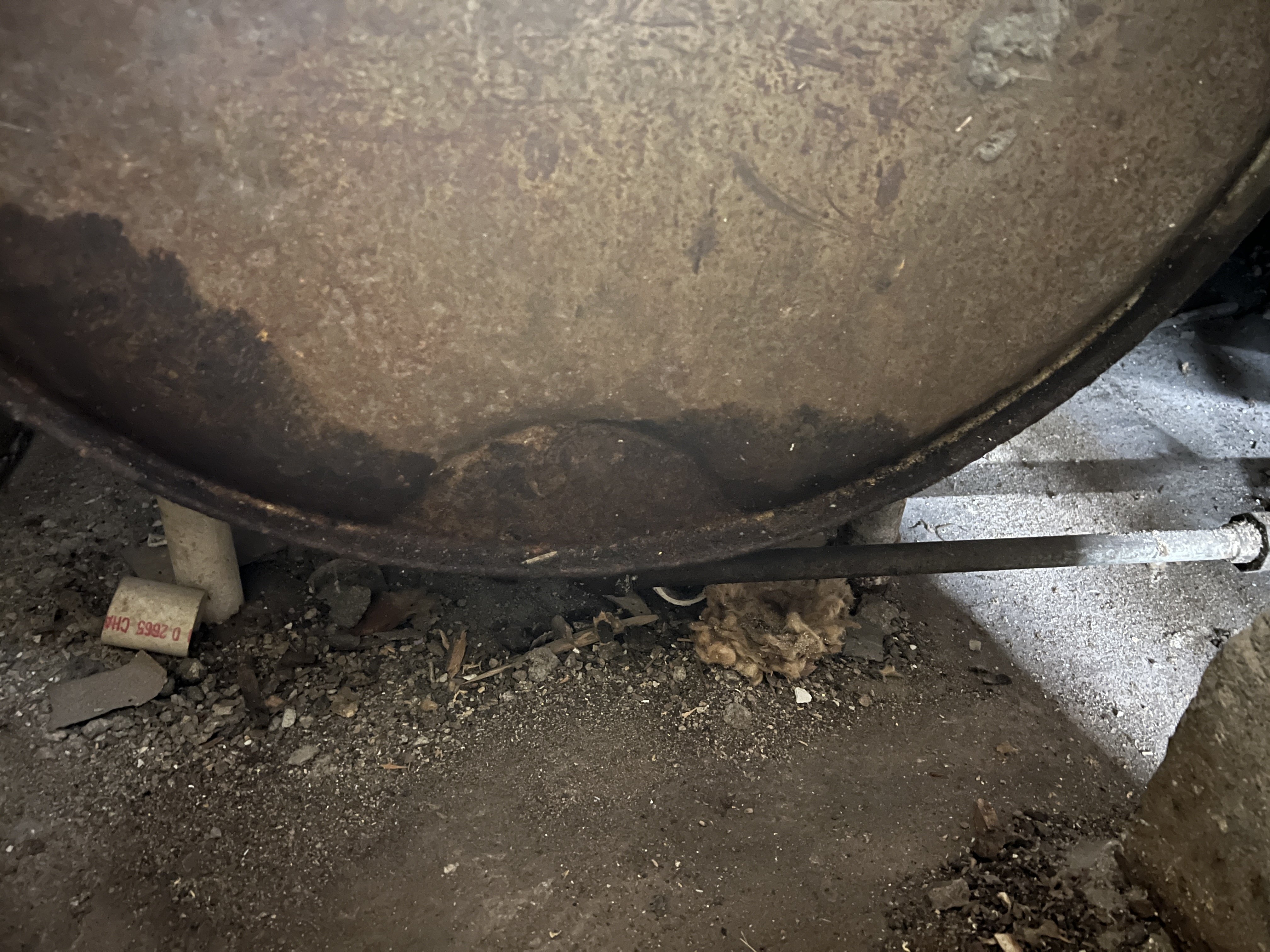
Oh you are not boring me at all. So I was taking apart the vent pipe to see if I can get to the clog and I decided to really have a close look at my old tanks. Not looking good. I am not getting prices on replacing the tanks and I want them where the old ones are. Here is a picture of the worst tank. I guess I really didn't want that expense right now.
 0
0 -
Hello and good morning gg1,
The sludge waste created by the bacteria in your fuel tanks has been consuming the sheet steel in the tanks and that is never good😓.
Over time the sludge that is created by the bacteria in fuel oil or kerosene in a residential storage tank can cause pinholes to form in the sheet steel the tanks are made of. The pin holes are essentially sealed by the sludge created by the bacteria that grows in a heating oil tank.
Most all of the double wall tanks designed and welded together for residential heating oil market have double wall ends to protect them to some extent from impact damage, these tanks do not have a secondary envelope shell to protect them unless one is specifically designed for this protection.
The Roth tanks use a vinyl secondary liner to protect the tank shell from an oil leak.
The previous owner of your home probably never added a fuel treatment like HEET or Diesel 911 to the fuel in the tanks before they were filled.
Did the fellow that came to look at your tanks use an ultrasound tester to check the steel thickness of your tanks or did he tap them with a thick welding rod??
I spent a great deal of time as a machinery oiler pumping diesel fuel and hydraulic oil at the underground mine where I used to work while I worked on the surface and underground and I am very familiar with petroleum diesel fuel and hydraulic oil delivery systems.
I want to help you with this if you will allow me to.
0 -
If it was my house I would recipe the tanks with separate fill pipes. You can use 1 vent pipe for 2 tanks. The tanks will still equalize. Put whistles and gauges on both tanks.
Any plumber can do this. The fill pipes outside need to be 2' away from any window or door. The vent pipe outside needs to end above the fill pipe.
The fill pipes and vent pipes can all be 1 1/4" pipe or larger but you can't mix sizes. So all 1 1/4. or all 1 1/2 or all 2"
The fill and vens have to pitch down towards the tank or no worse than level. Any backward pitch is bad
0



Categories
- All Categories
- 87.8K THE MAIN WALL
- 3.3K A-C, Heat Pumps & Refrigeration
- 59 Biomass
- 430 Carbon Monoxide Awareness
- 133 Chimneys & Flues
- 2.2K Domestic Hot Water
- 6K Gas Heating
- 124 Geothermal
- 170 Indoor-Air Quality
- 3.8K Oil Heating
- 79 Pipe Deterioration
- 1.1K Plumbing
- 6.7K Radiant Heating
- 396 Solar
- 16.1K Strictly Steam
- 3.5K Thermostats and Controls
- 56 Water Quality
- 51 Industry Classes
- 51 Job Opportunities
- 18 Recall Announcements