Bundling 1/2" pex through joists and traversing drywall

I have a project where 5 pairs of heating PEX will need to traverse mid-floor joists in one direction, and 3 pairs the opposite direction. The joist bays will ultimately have blown-in insulation.
Instead of a separate hole per PEX, I am thinking of bundling the supplies though one large hole (size TBD) and the returns through another large hole.
- Thoughts on the bundling (vs individual holes) and cross-pex heat-loss, if they're serving separate zones?
- Is there a way for the pex runs to/from the manifolds to traverse the drywall as a bundle (versus individually) and still remain IRC compliant.
Additional Background:
I have a number of baseboard style radiators I'm going to be installing in good sized rental-type area being built out. Half the area will be above the technical garage (as defined by IRC). The project will be inspected, but the AHJ doesn't care explicitly about hot water heating.
All but two rads will each have a home run off the two manifolds (already installed). Between the bedroom, bathroom, living room, large closet and stairwell, there will 10 emitters running as a mid-temp system with outdoor reset.
I'm planning out the use of the 10" joist space currently, as I have other utilities to run (SER, plumbing, Mini-split bundles, electrical, drains, gas, etc)
Note: The primary area pex is running will be above an area not technically the garage, but some home runs will eventually run into the garages joist space
Comments
-
I'd be concerned about making sure it can expand and contract without making noise so it needs to slide through whatever is supporting it and have some space to move lengthwise at the ends of runs but there is so little contact between 2 tubes next to each other and pex isn't particularly conductive, I wouldn't be worried about significant heat conduction.
1 -
make sure the tube you use has the extra layer over the EVOH, or it will squeak where the runs touch one another.
Bob "hot rod" Rohr
trainer for Caleffi NA
Living the hydronic dream 2
-
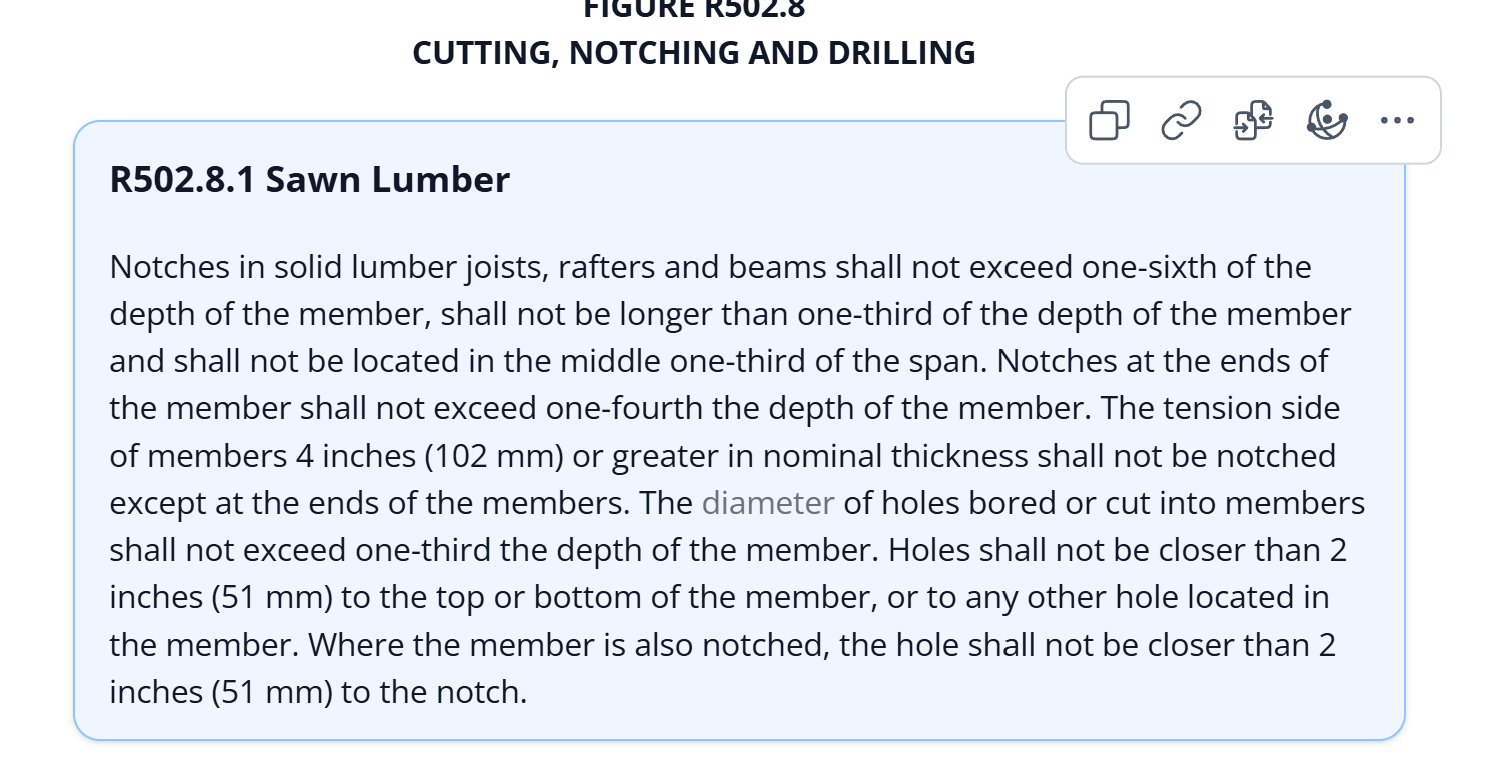
I'm much more concerned by the size of the hole… Holes in the middle of joist spans are not, generally, a brilliant idea, but if the hole can be kept to less than about a sixth of the total depth of the joist, and placed on the centre line of the joist, they may be acceptable. It might be wise to consult with a structural engineer…
Br. Jamie, osb
Building superintendent/caretaker, 7200 sq. ft. historic house museum with dependencies in New England 2
-
I pretty much did that. Used 5 layer PERT which is easier to run as is more flexible than pex. It also has the extra layer over the oxygen barrier so it won't squeak.
For holes, check your local codes. This is probably in the ballpark:
https://www.finehomebuilding.com/2026/07/21/notching-and-drilling-joists
Big hawg style hole saws and beefy drill are your friend here.
0 -
Well, these are very good points and thank you for that. I'm using uponor hepex, so I don't know if the barrier qualifies for the same 'extra layer' but rubbing the oxygen barrier isn't good, so I should probably see if I can make it work/fit within joist boring requirements with individual holes.
@Jamie Hall - It's a worthy discussion . IRC and the forestry industry are explicit on this topic, without the need to consult an engineer. Holes are allowed up to 1/3 the depth of the joist with a spacing minimum of 2 diameters between holes, 2" from the top and bottom edges. Obviously, you don't want to load it up, but holes in the middle are not a issue, and they are better not in the outer two feet. For sure, less holes are better, but when you're only holding up floor, the IRC prescription is reasonable. Because top and bottom of members are in tension and compression at the bottom and top of the joist, notches are not allowed within the middle 1/3 of the member.
Anyone know if someone makes a simple protective sleeve you can put over the tubing that acts as a slip barrier (or 1/4" poly pipe insulation?… I've only seen 1/2" and thicker)?
I suppose for the pass-through drywall element, I need to add blocking and swiss cheese it, then mud/tape/something ugly where the drywall fell apart. I'm not sure the inspector would allow a bundle going through.
Is there a case for using 3/8" when feeding individual rads?
0 -
you can make the hole oval in line with the joist so it is longer and not very tall, that does a lot less to compromise the joist.
you need to figure the flow you need to cover the load of an emitter but 3/8" is sufficient in most cases.
generally the inspector only cares abut penetrations if they are in a fire rated assembly or in the firestopping between different cavities.
0 -
I guessing most AHJ would require an engineer sign off on that.
0 -
sign off on what?
0 -
I'm just mentioning that IRC 502.8.1 only permits circular holes. I believe you'd be required to have an engineer's approval to use oval holes.
I'll check into what flowrate I need for my deltaT and BTU demand. In some cases there are two rads, for instance to be under the two windows and their individual demand is not massive. 3/8" sure would be easier to work with than 1/2".
At least here, I think inspectors are particular about having transitions from conditioned space into joist space without airgaps for fire safety reasons.
0 -
Here I'd be having a losing battle with an inspector on that one because of the word diameter, but your jurisdiction might be more flexible.
1 -
obviously if there is material within the allowed amount to be removed that has not been removed that would also be allowed.
0 -
looking at the code for fireblocking, it only applies to the penetration through the floor or the blocking separating the wall from ceiling cavity or wall cavity between floors, not just passing in to the cavity from the room.
0 -
You are probably right on the penetration, though my gut says that because it goes into a joist space the inspector could give me a tough time. All this said, given the manifolds live under a stairway (in a closet) and it would breach that required drywall surface near the upper corner, I don't think they will allow it. I know, that's not something I mentioned before. There's actually a massive hole there now for pipes serving some long decommissioned hot water solar panels. This garage addition from 1980 never got its final inspection.
Maybe the safe thing to do is add 2x blocking to the joist bay 18" from the drywall it will penetrate and then turn 90 and go through the joists. That would limit spread of any fire, which is ultimately what they're after.
I follow your rationale on the ovals, but still think IRC doesn't protect it, and here is why. When you bore a hole with a bit, hole saw, etc, it turns out uniform, and generally smooth. Predictable - there aren't notches, overcuts, etc. It is unlikely that the average tradesman is going to make perfect ovals and not overnotch or cut somewhere in the process. Once the edge isn't uniform, and any overcuts or notches are present, you get notch sensitivity where the stress concentration goes up dramatically. IRC tends to write stuff that minimizes the arguments and keeps simplicity. Anyhow, that's what's going through my head, though you may be right.
0 -
I have zero intention to sidetrack this, but… an interesting rabbit hole to wander down for anyone who is interested is looking at just how loads are carried in a beam, and why the restrictions which @mattmia2 quoted (thank you!) and @rossn's last paragraph (again, thank you!) are the way they are. Fascinating stuff, and often hard to wrap one's head around! Structural engineers take whole courses in it…
Fortunately for us, the code type restrictions for sawn timber are very conservative. They are nowhere near as conservative for modern LVL or "TrusJoist" and similar lumber, however — so if that is what you are dealing with it's well to pay attentiono…
Also its worth noting that particularly in older construction one may not be limited in the ways modern codes are written — most modern work is more concerned with deflection than either moment or shear, which in older work — particularly post and beam — the limit will be moment or shear.
Br. Jamie, osb
Building superintendent/caretaker, 7200 sq. ft. historic house museum with dependencies in New England0


Categories
- All Categories
- 87.9K THE MAIN WALL
- 3.3K A-C, Heat Pumps & Refrigeration
- 60 Biomass
- 430 Carbon Monoxide Awareness
- 134 Chimneys & Flues
- 2.2K Domestic Hot Water
- 6K Gas Heating
- 124 Geothermal
- 170 Indoor-Air Quality
- 3.9K Oil Heating
- 80 Pipe Deterioration
- 1.1K Plumbing
- 6.7K Radiant Heating
- 397 Solar
- 16.1K Strictly Steam
- 3.5K Thermostats and Controls
- 56 Water Quality
- 51 Industry Classes
- 51 Job Opportunities
- 18 Recall Announcements