Noisy 007-F5 circulator

Hi,
I wonder if anyone can identify what is wrong with this circulator from the audio:
There is also a diagram and more information in the video.
Background. The system is about 20 years old. It has 4 007-F5 circulators.
3 have never had an issue and are quiet. One has been replaced 3 times. The one in the video was replaced in 2023 and was quiet until this fall. This circulator has a long loop compared to the others. It still produces heat. This is baseboard heating with3/4 copper.
Reading other posts it seems options are a failing circulator or air in the system that is causing cavitation? Do those sound different?
I guess I'm wondering what is wrong at this point and why does that circulator have trouble?
Thanks for your help!
Comments
-
You have a failing circulator/cartridge, you need to change it. The two TACO's I had made noise and the B+G NRF 25 I just changed out was worn out made no noise and I did not catch it sooner.
1 -
Thanks Leonz.
0 -
what kind of system is it? is it a gravity conversion? is it all copper? is it an older black iron pumped system? is it part pex or some other plastic tubing? is that tubing oxygen barrier? is the pressure high enough to keep it from cavitating?
0 -
That is unusual to replace 3 circs in the time periuon. Could be that zone never gets air free? Is there a central air purger?
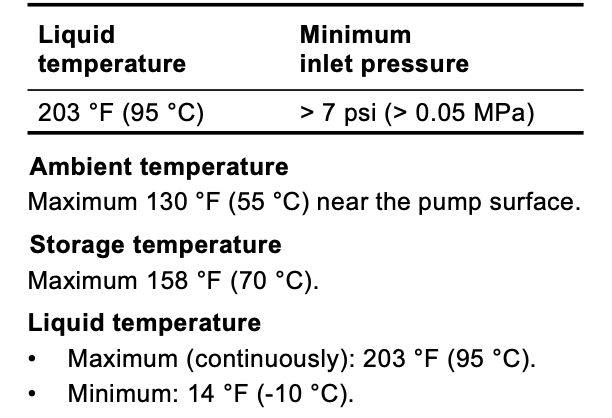
You need at least 5 psi at the circulator inlet. It is a temperature/ pressure relationship to prevent cavitation. If for some reason the boiler runs hot, maybe 203°, you need about 7 psi at the pump suction.
Dirty fluid takes out bearings also.
Is the motor mounted vertically by chance?
 Bob "hot rod" Rohr
trainer for Caleffi NA
Living the hydronic dream 1
-
mattmia2, Thanks for the question.
It is a baseboard copper system, 3/4 copper pipes. I updated the description.
hot_rod, Thanks for you questions as well. There is a diagram in the video of the system. Hopefully that video link is working for people.
Here is that diagram.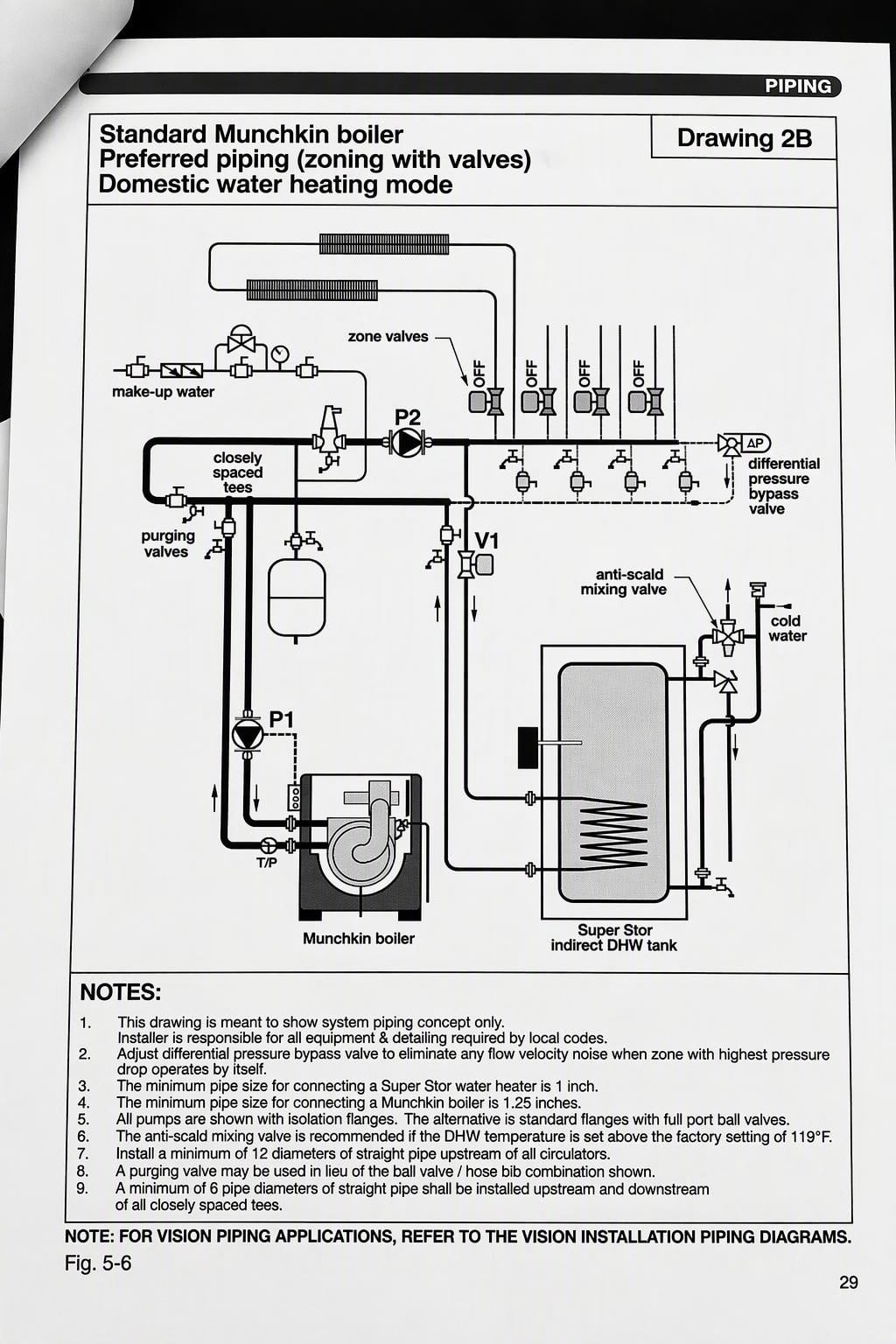
In real life:
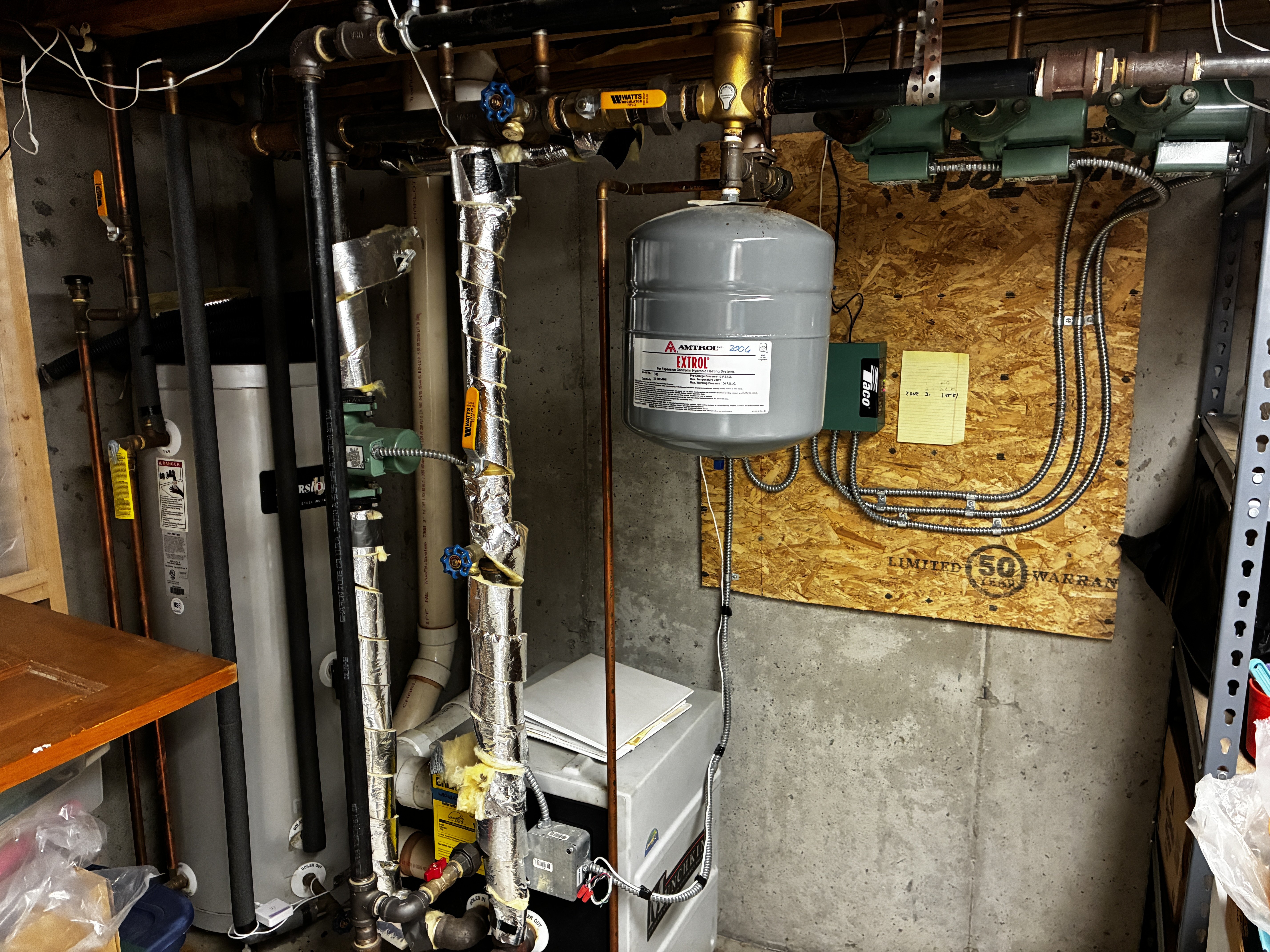
To your questions:
Could be that zone never gets air free? Is there a central air purger?
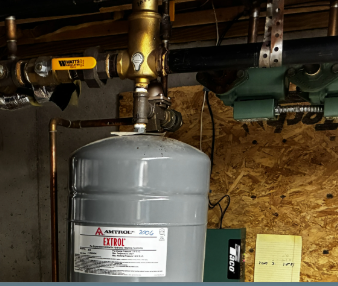
If I understand your question, I think that is the Spirovent Junior Air Eliminator above the Amtrol EXTROLHydronic Expansion Tank (Model 30, 12 P.S.I.G)You need at least 5 psi at the circulator inlet. It is a temperature/ pressure relationship to prevent cavitation. If for some reason the boiler runs hot, maybe 203°, you need about 7 psi at the pump suction.
I am not sure about this. I think so. Here is the boiler meter. Temps ~175 when hot, pressure at the boiler is ~20. I can't measure what the pressure is at the inlet to the circulators, but because the expansion tank is between the boiler and circulators, I think 12 PSI? One thing to note is the other circulators, which I would think have the same inlet pressure, don't have an issue.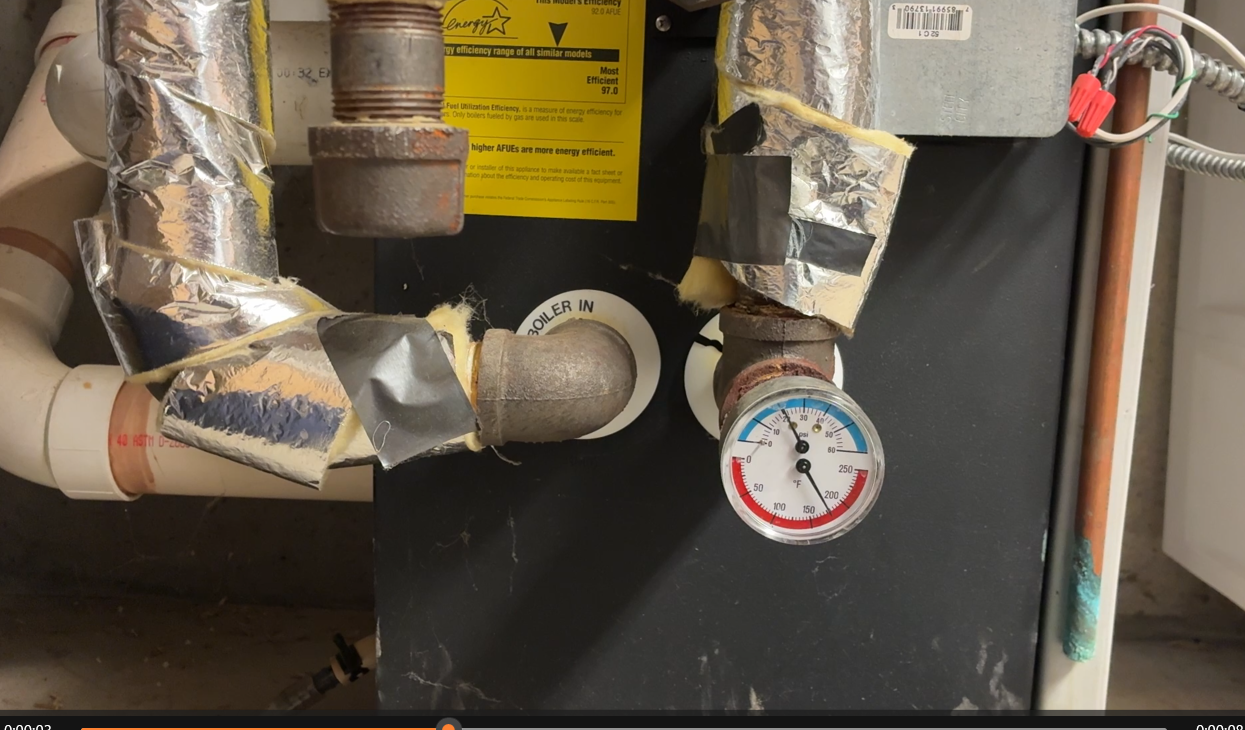
Dirty fluid takes out bearings also.I wonder about this. The Spirovent collects particulate in theory, but there is no other filter. Should there be?
Is the motor mounted vertically by chance?
See the photo - I would call them horizontally mounted? "Horizontal" refers to the orientation of the motor shaft? And Horizontal is parallel to the floor?
Thanks again.0 -
you might try a different circulator. Maybe a 3 speed or one of the ECM versions.
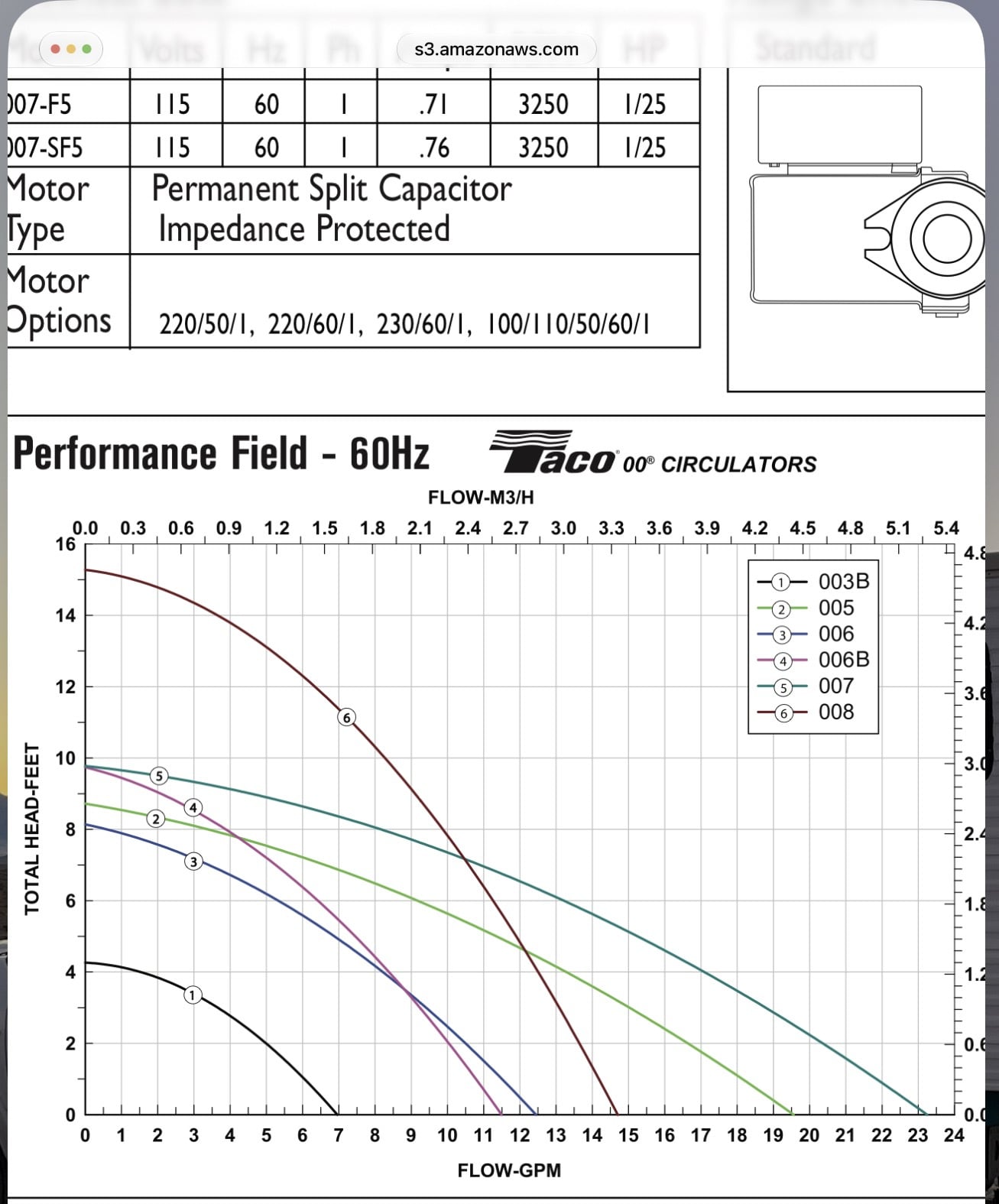
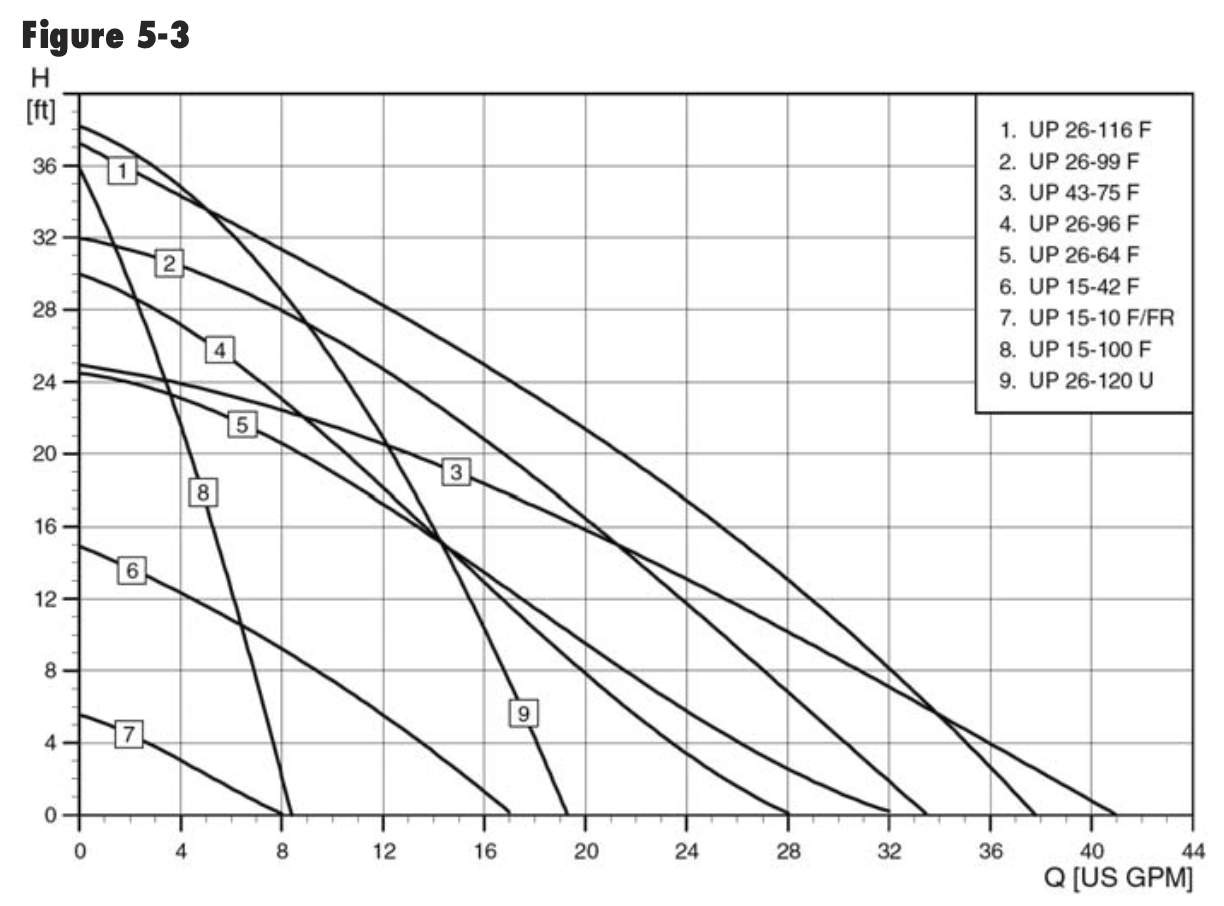
Typical zone pumped system. A circ on a zone probably needing just a few gpm. Typical 3/4 fin tube specs show 1-4 gpm.
So the pump is running way off to the left of curve. It would like to be running near the middle 1/3 of the curve. I’d guess the others are in a similar condition?
Amazing run for that Munchkin at 175F? A bit discoloration on the PVC exhaust
 Bob "hot rod" Rohr
trainer for Caleffi NA
Living the hydronic dream0 -
Thanks Bob,
Options for a replacement are the 0015e ($229 Amazon) and the 0018e ($330 SupplyHouse) . I kind-of like the idea of seeing how the system is performing with the bluetooth app, but adds more complexity. Any thoughts on which is better/more reliable?
Your comment on the Muchkin suggests I should be thinking of replacing it soon? It has never had an issue to date other than occationally having to reset the controller after a power failure.0 -
I have not used either of those models.
I have this one on my system, their Grundfos GO app is very handy and easy to use.
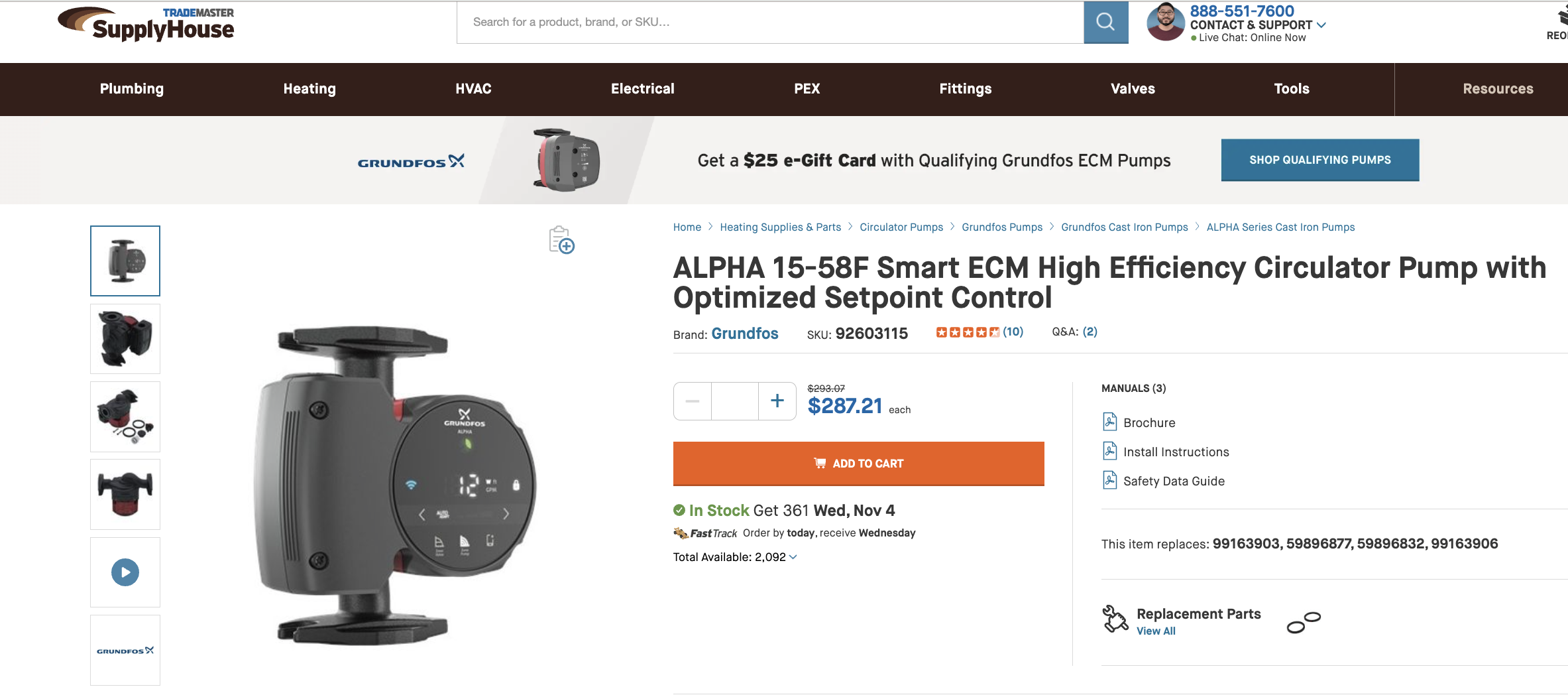
The 15-58E is a less feature version, here is a Home Depot price
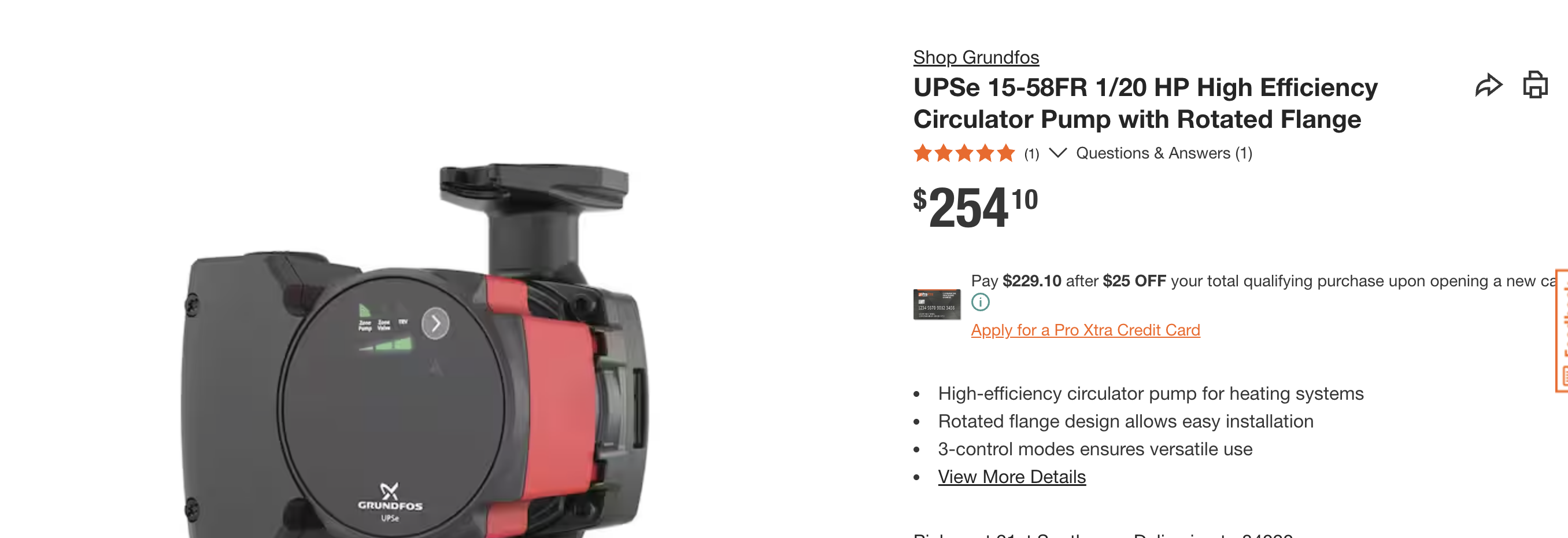
If you put FR at the end of any Grundfos model the flange orientation matches the Taco. Notice the differance?
Bob "hot rod" Rohr
trainer for Caleffi NA
Living the hydronic dream0 -
Bob,
Thanks. I'll check those out.
I noticed that Taco has a '2 flange / Universal flange' option - that has both orientations on one part - I don't know why they offer anything else!0 -
many of the isolation flanges rotate in any position also. So you can turn the circulator to any position.
Looks like you might have adequate room to use either type?
Bob "hot rod" Rohr
trainer for Caleffi NA
Living the hydronic dream0 -
Yes, i think so.
0 -
Since the same zone has gone through three circulators I'd inspect the old pump cartridge for signs of debris or bearing wear before fitting another one. If you find magnetite or sludge then a magnetic dirt separator might help prevent the same problem returning. I'd also check the actual flow requirements of that longer loop before choosing an ECM replacement as an oversized circulator could be part of the problem.
0 -
Thanks Peter, good points.
0 -
I am wondering where you came up with 9 ft head? on a long run you might be talking about 150 feet of strait pipe + a factor for fittings to give you and equivelant length of 225. That's a long zone. with a taco 007 you could be moving about 4 GPM according the the pump curve.
Also I believe you selected the zone valve diagram and you should have selected the zone pump diagram below. This is the one in the video.
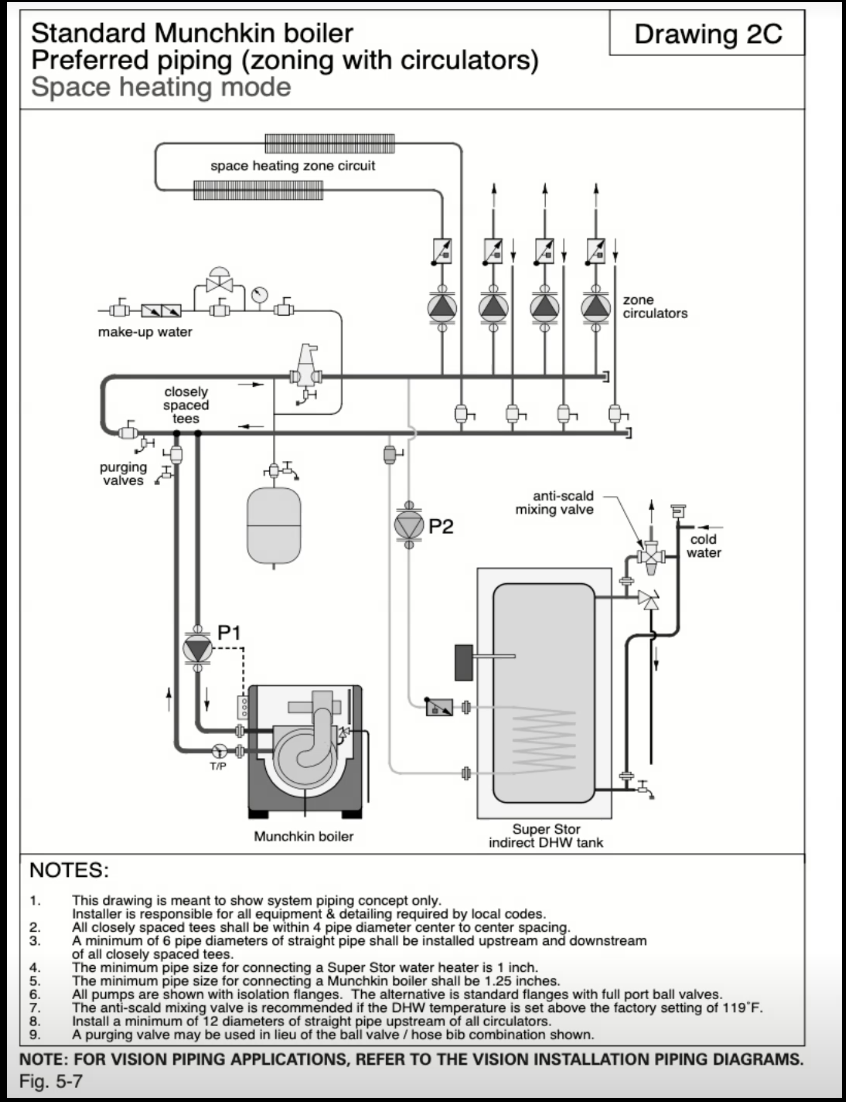
One more question… are you using external Flo-check or Flo-control valves or Internal Flo Check valves (IFC) in the circulators. That noise could be the cast iron flow control valve. to determine that you would use the screw on top of the Flow Control Valve to open the valve completely while you hear the noise and see if the noise goes away.
Edward Young Retired
After you make that expensive repair and you still have the same problem, What will you check next?
0 -
Thanks EdTheHeaterMan,
You are right to question that…
I recalculated that last night.
It's a about a 20,000 BTU load (2 GPM, 20 degree delta-T)
There is ~300ft of 3/4 copper pipe, type M. ~35, 90 degree bends or equivalently, a total of ~370 feet of pipe.
a Taco 219 Flow check valve and a Taco shutoff valve in the loop. (There should be no additional check valve in the 007, but that is something to check.)
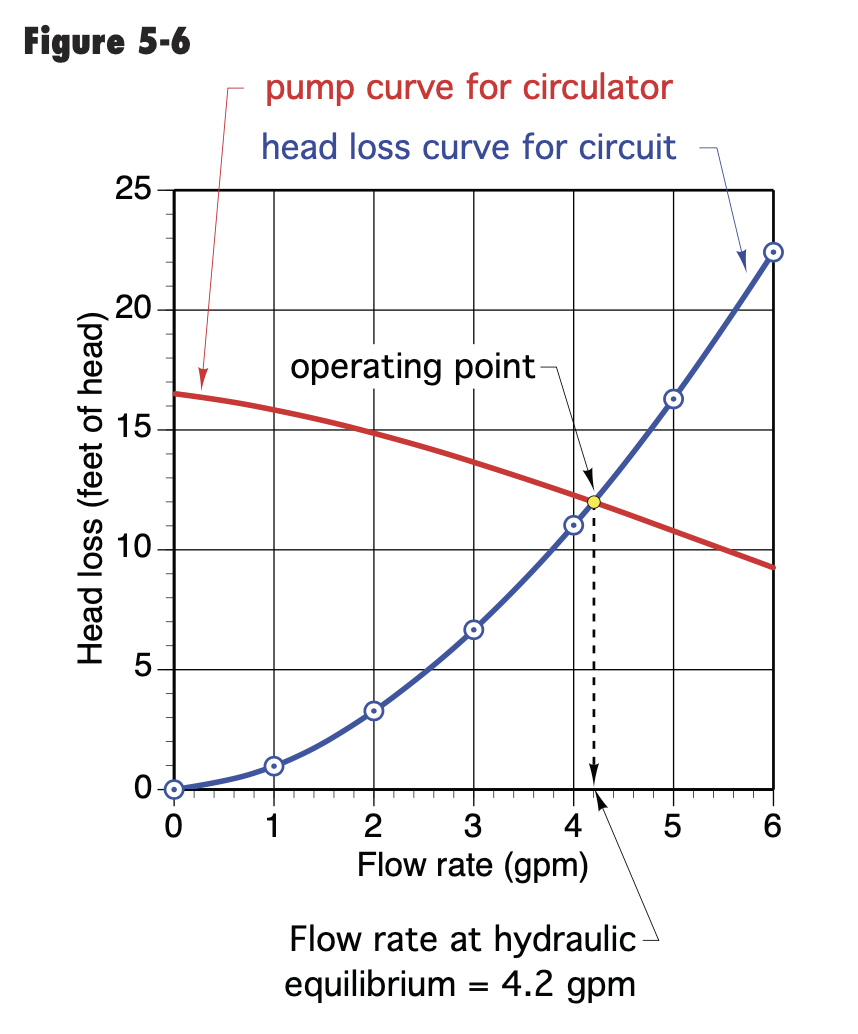
That looks like it crosses the taco pump curve around 2.9GPM? Where the head is ~9.5 or so if I did that right.
Folks above suggest that operating over on the left of the curve may be an issue? Also grit/particulate could be an issue. I have a Spirovent Junior air eliminator, but understand that isn’t a dedicated dirt separator.0 -
Those weighted plug flo checks hit you pretty hard for pressure drop, if that is the type you have?
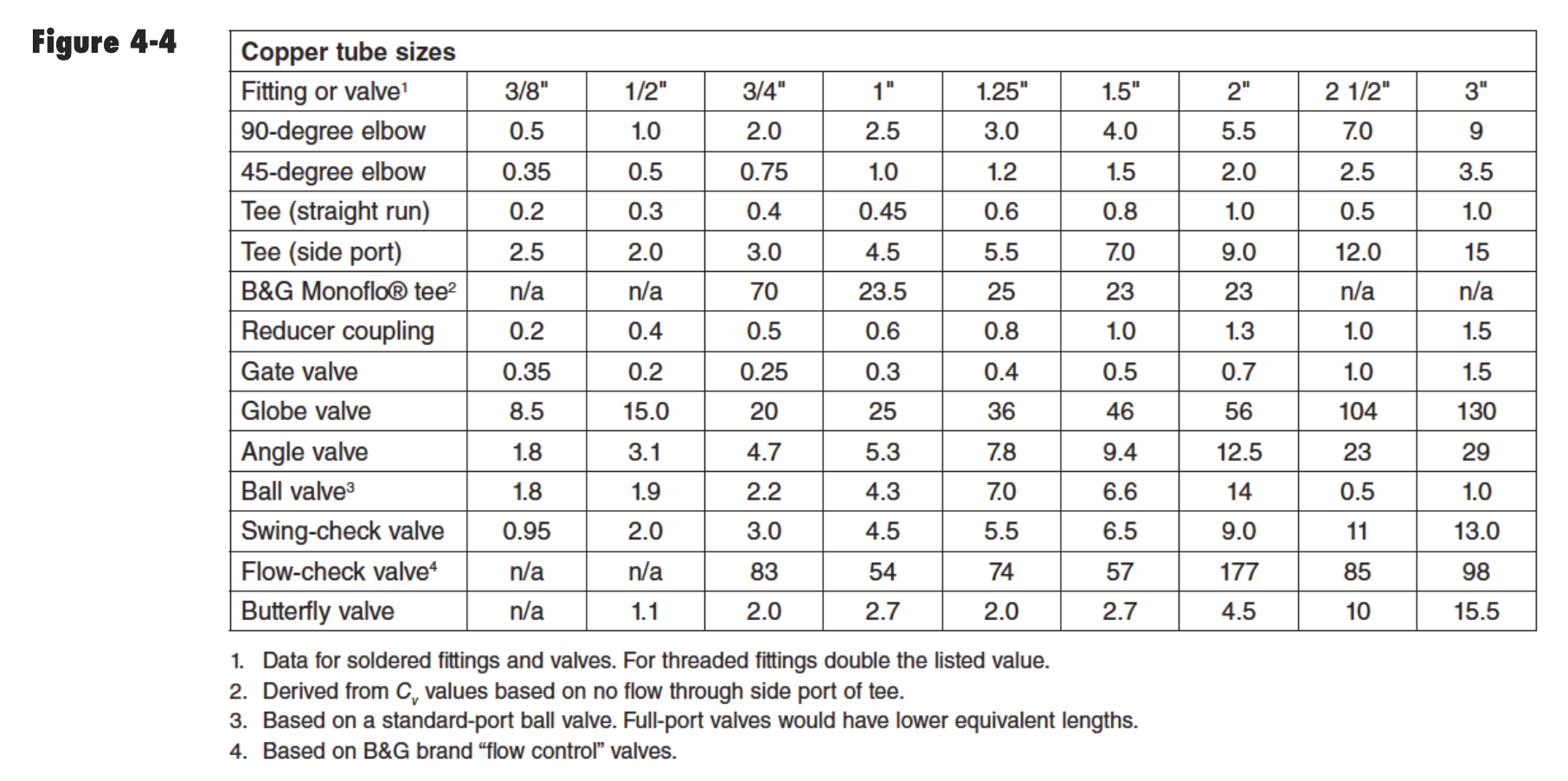
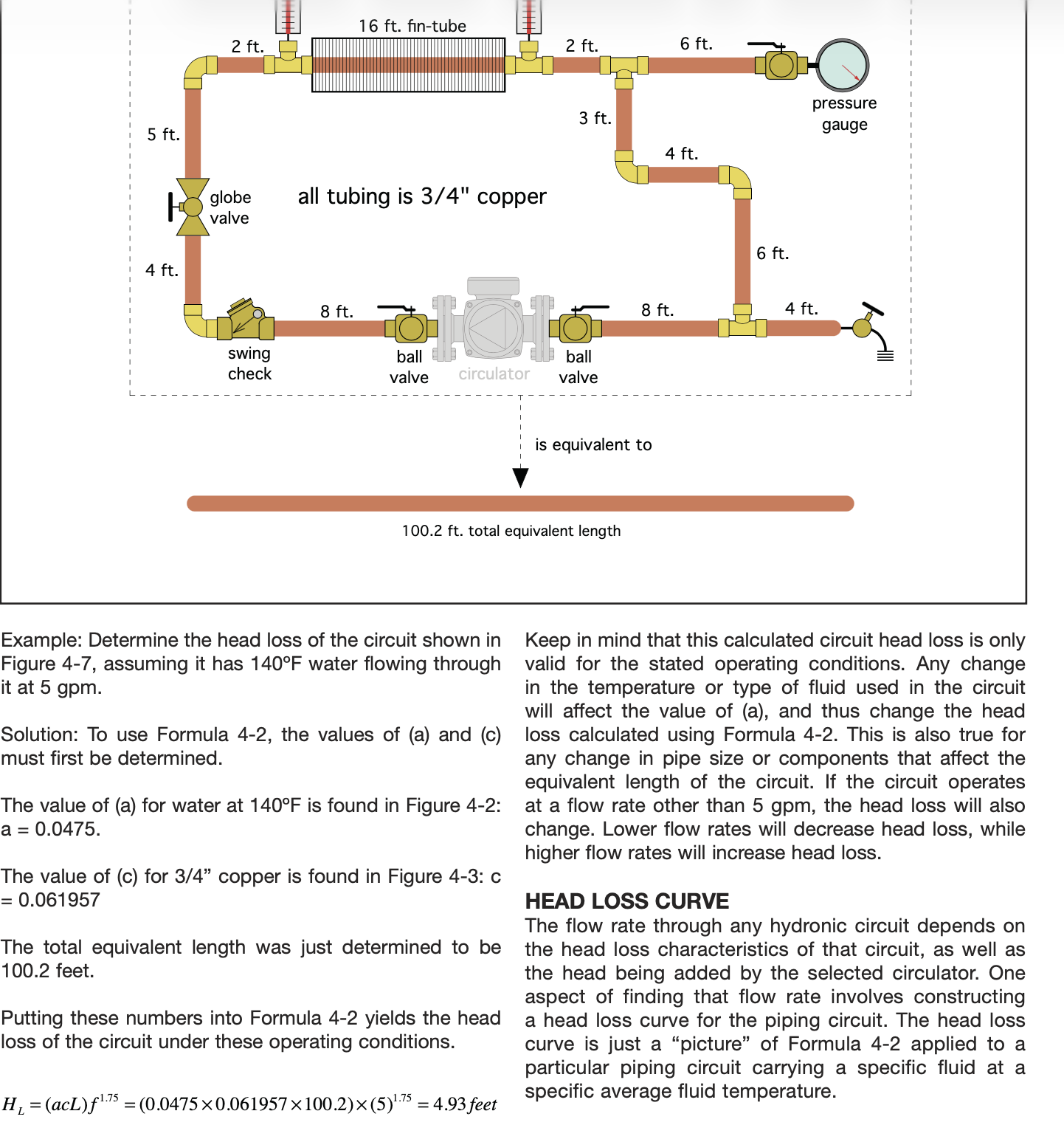
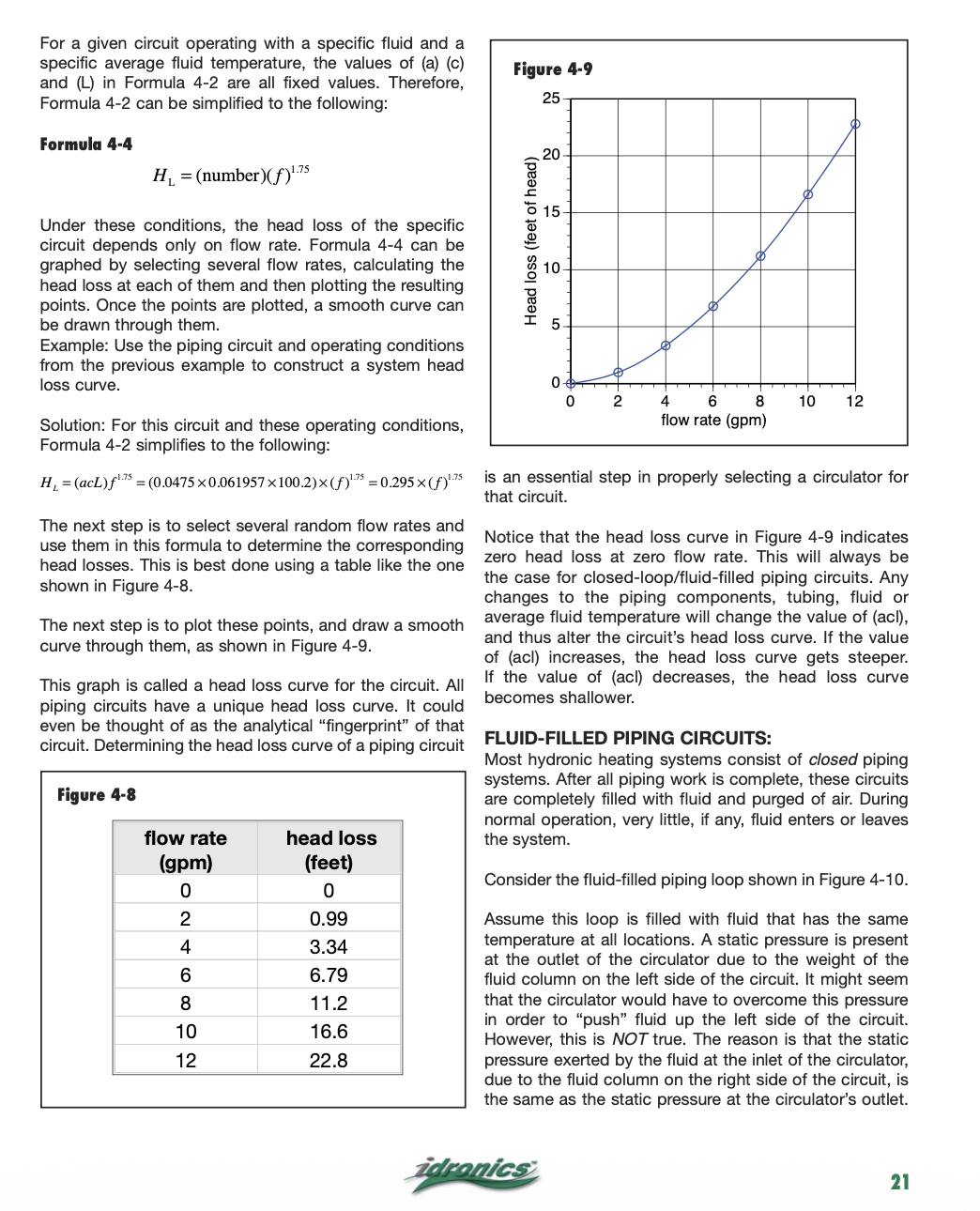
The next step would be to develop a system curve on top of the pump curve. Then you know the operating point of the circ. Ideally you want to be in the mid 1/3 of the curve.
 Bob "hot rod" Rohr
trainer for Caleffi NA
Living the hydronic dream0 -
Thanks Bob,
It's a Taco 219, which I guess is a weighted disk as you describe.
Taking it out is probably not in the cards for this fix, but I do notice that most circulators now come with an integral flow check. Is that the way to go in the future?0 -
With a zone that long the check is likely not needed and is compounding the problem. Almost definitely a plumbing issue and not a circulator brand issue. There may be a sticking check or a restriction that only gauges will show….
0 -
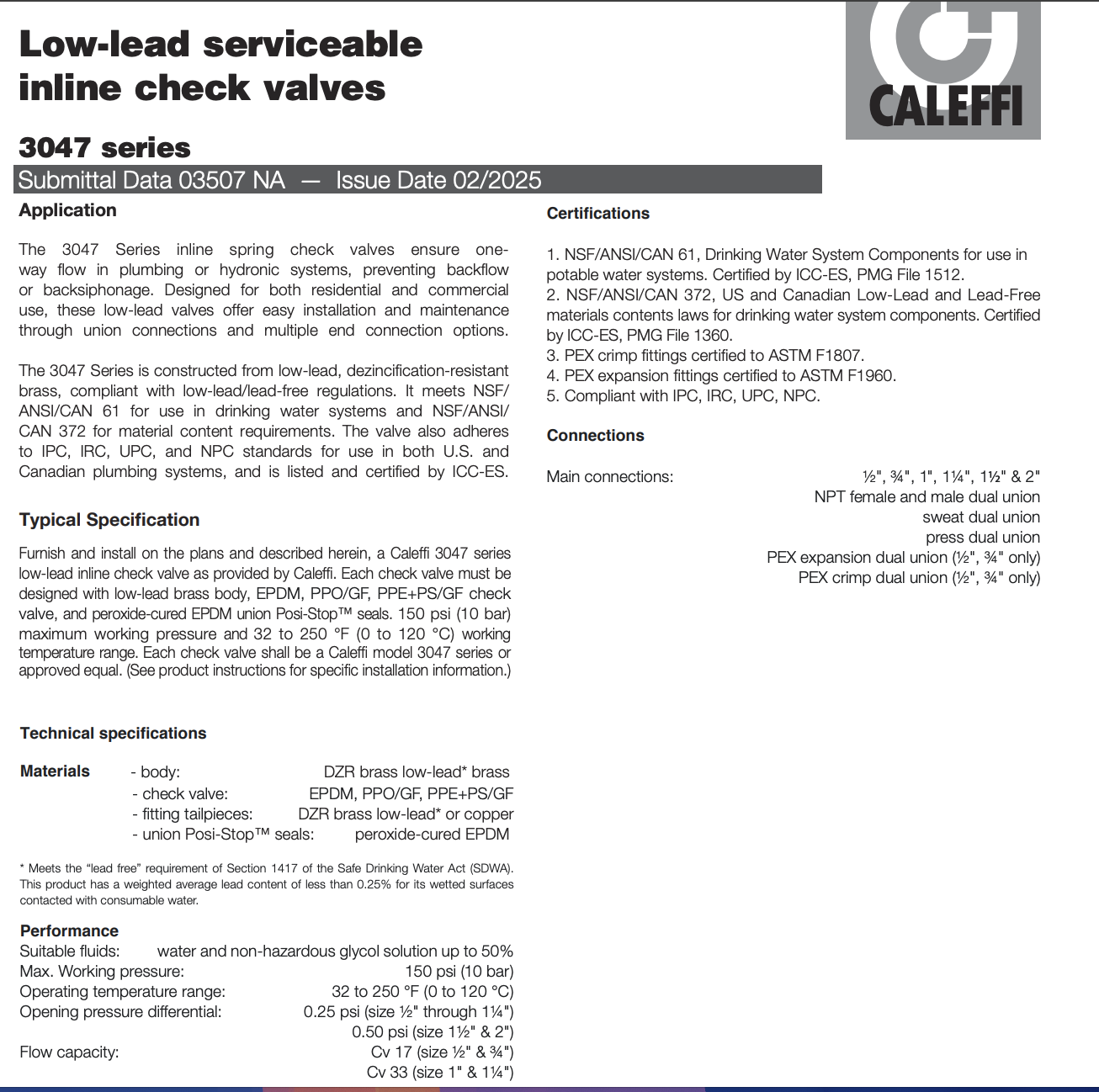
The very best IMO is a hydronic specific spring check 6" or more downstream of the circ.
.25 psi pop is a good number for the small checks and circulators
I'm not a huge fan of checks right at the pump discharge. I guess they solve more problems that they create.
 Bob "hot rod" Rohr
trainer for Caleffi NA
Living the hydronic dream0 -
Thanks for all the helpful information. Here is an update.
I replaced the 007 with a Taco 0015e (I had ordered it before Bob's suggestion…).
It runs quietly.
The 0015e has a bluetooth interface that lets you see how it is doing.
I set it to 2 GPM. To get that requires 12.7 feet if head, 21W of power, 4022 rpm. More than the 10 ft I estimated.
When the plumber bled air out of the system due to the swap (note, the original plumber did not install shutoffs at each circulator), the flushed water was murky… see photo.
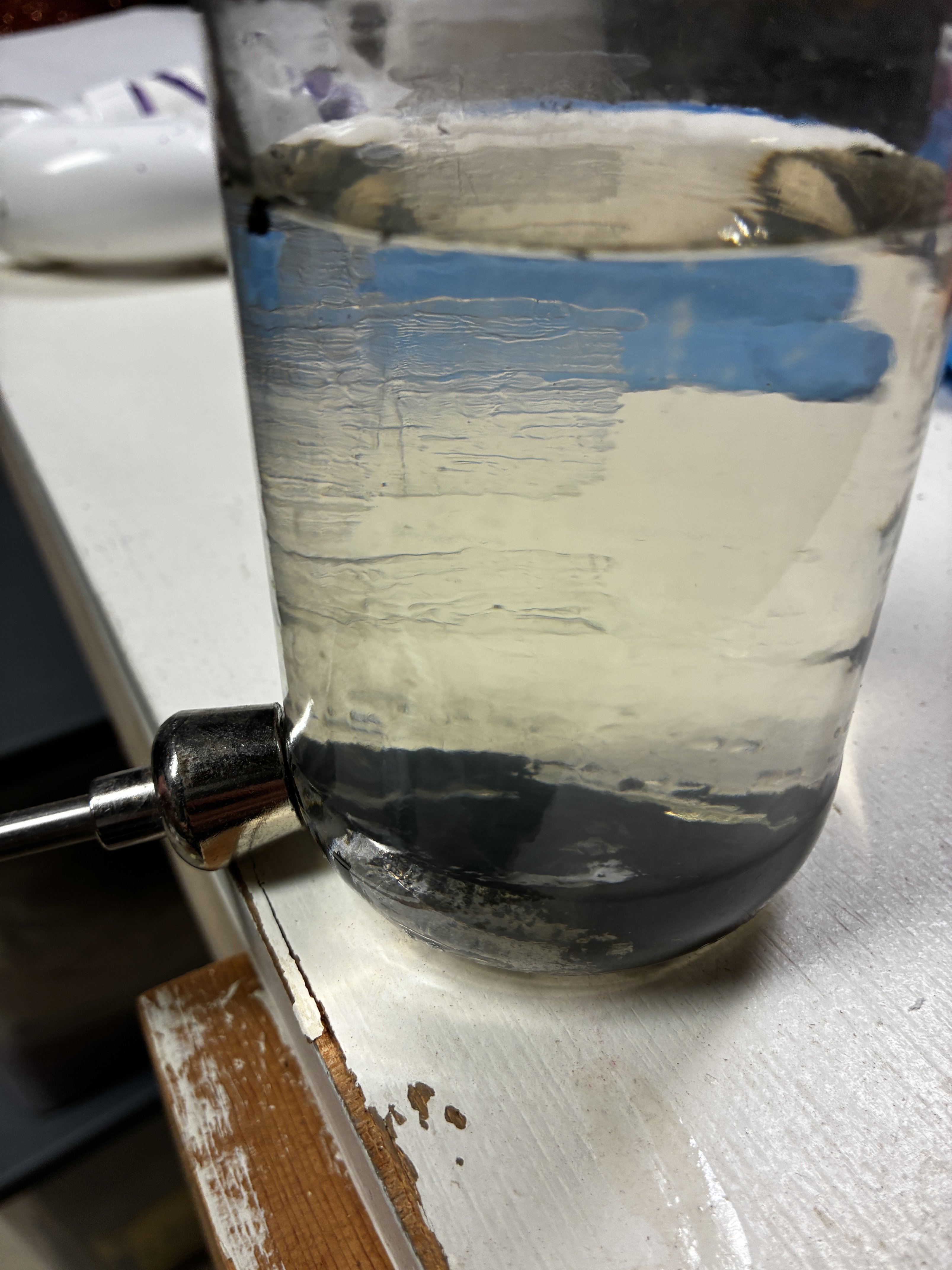
The sediment follows a magnet, so I'm guessing this is iron and this level of particulate is ruining the circulators?
Note, the only steel in the system is the boiler loop and manifold. The rest is copper. (Reading the install manual, that loop should have been copper as well…)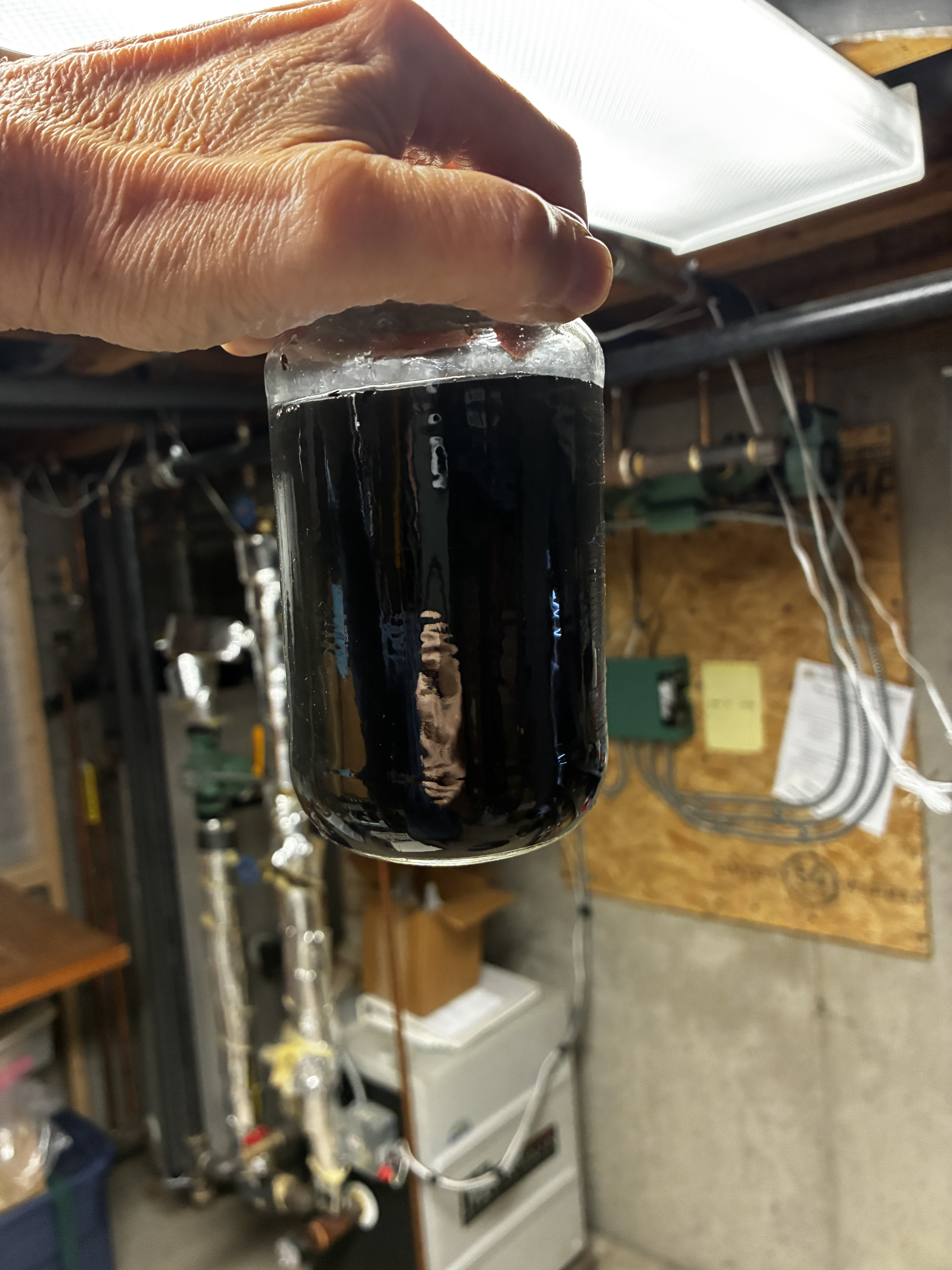
 0
-
I highly recommend a magnetic separation device on that system.
Currently your new 0015 is the magnetic separator!
There is no issue with mixed metal systems. Ferrous metals corrode due to oxygen in the system. Unless fill water is added, or you have non barrier tube, the system may become O2 free at some point. But it is almost impossible to keep O2 out 100%.
The gunk, magnetite that you have is a result of ferrous metal breaking down, which consumes the O2 in the system.
Some hydronic conditioner after a good flush is another recommendation. Fernox, Rhomar Sentenial, etc.
Bob "hot rod" Rohr
trainer for Caleffi NA
Living the hydronic dream1 -
Thanks Bob,
I'm under the assumption that had the boiler loop been copper, there would be no ferrous metal in the system? (Thinking ahead to the next system)
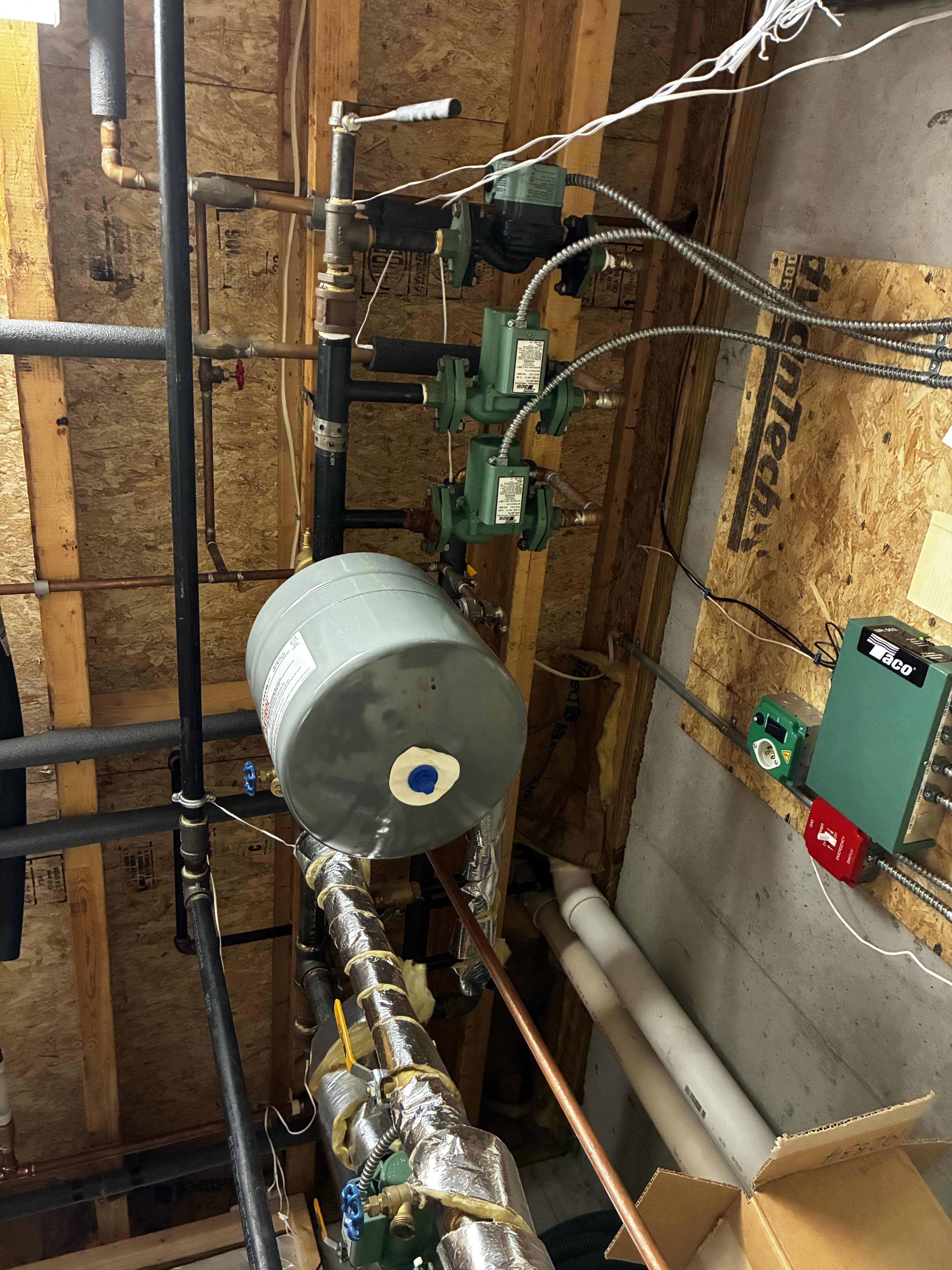
The 0015 literature claims the bronze 'bio barrier' makes the permanent magnets in the motor 'invisible'? Just marketing?A magnetic separation device sounds exactly right.. but, most of the system is hanging from the ceiling (see photo) rather than on a board on a wall the way I see so many photos in this forum. Adding a separator seems fairly major as I think it goes in the main 1-1/4 loop. I think it would involve moving the returns or supply lines.
As the system is now 20 years old, maybe time for a whole new system?
Sadly, Winter in New England is nigh. A couple days without heat would be tough - though that is also true if it fails!
Alternately, can a magnetic separator be installed on one of the heating loops? That seems very doable (by a plumber!).
I read a flush can add O2 to the system. So it's good to remove some ferrous material, but bad in that it accelerates the reaction? But, I guess a worthwhile exchange in my case. Is there any concern with a conditioner being compatible with the heat exchanger? (stainless I believe).
I guess a final question is, if you put in a separator, do you do the flush? or let the separator do its work?Thanks again!
 0
-
The circulators you have, all of them are wet rotor type. The fluid in the system cools and lubes the pump innards.
Boiler ink is what the industry calls that black colored water you removed. The black is magnetite at a .05 micron size particle. While barriers and seal help, they are not a 100% solution.
Your system has cast iron pumps, steel expansion tank, even if piped in all copper.
The process goes like this, new fresh water contains some O2. Within days that O2 contacts ferrous metals and is "consumed" in the corrosion process. What you should end up with is "dead" water. Oxygen starved water.
Mother nature hates any imbalance. If there is an O2 starved condition, O2 will try to get in and balance that. Valve stem, seals, pump flange gaskets, expansion tank membrane all allow O2into the system. In your system you are looking at years worth of breakdown.
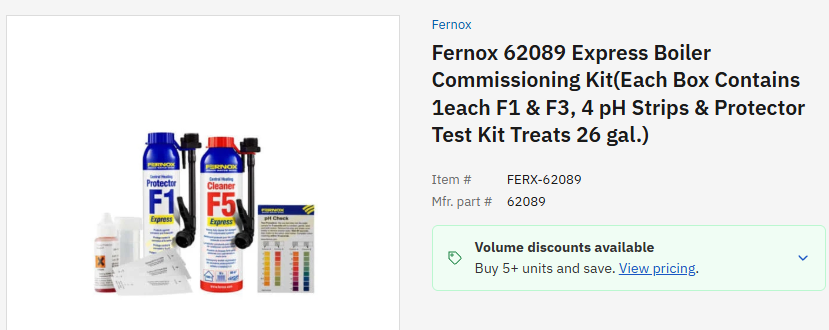
Knowing this I always recommend a hydronic conditioner. It protects the system with O2 scavengers, ph buffers, and film providers to coat the metals.
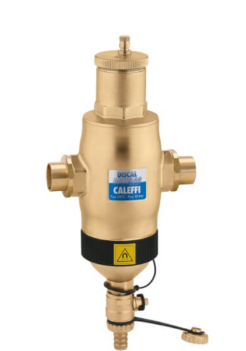
An option for the upgrade is to remove the Spirovent and install a combi unit there. You have isolation close by and someone with a press tool could do this in an hour or so. A Megapress does steel pipe. Remove the magnetic band, and drain a cup or two.
Maybe blow down a cup or so every month at first. Do not add the conditioner until a few blow downs to assure most gunk has been removed. Once it runs gray, check it only yearly. At some point the conditioner stops ongoing corrosion.
Fernox and others have user friendly kits.
 Bob "hot rod" Rohr
trainer for Caleffi NA
Living the hydronic dream0 -
Sample of a couple, but I ran my ECM pumps for about a decade without a mag filter on a gravity conversion. Water was about the same color as yours.
Those pumps are still running, now with a mag filter though.
0 -
Thanks Kaos,
That's a useful datapoint. I appreciate your input.0 -
Bob, Thanks again for your explainations.
The air filter is a pretty busy spot and the pipes look pretty rusty?
The fill pipe comes in behind as well.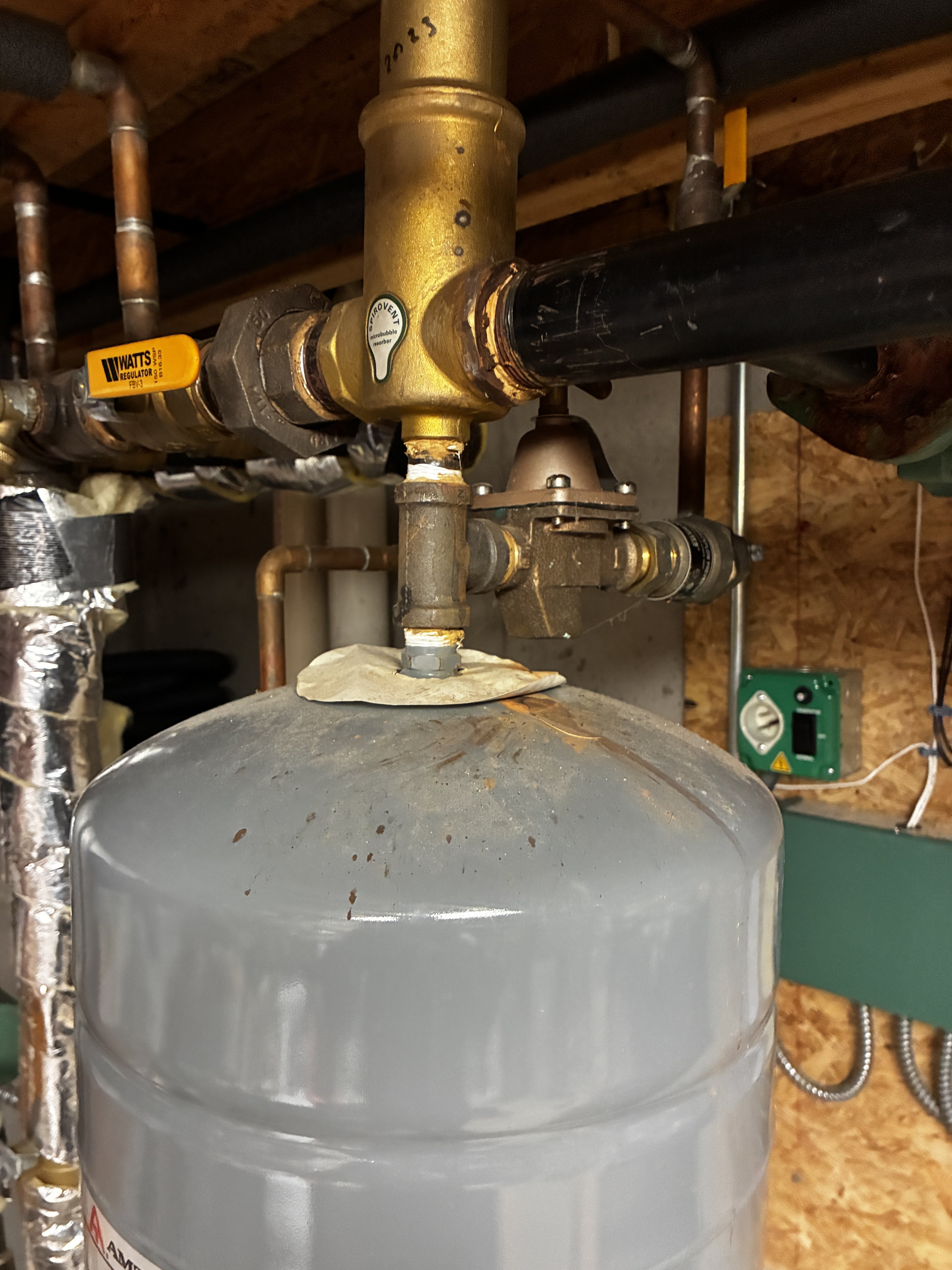
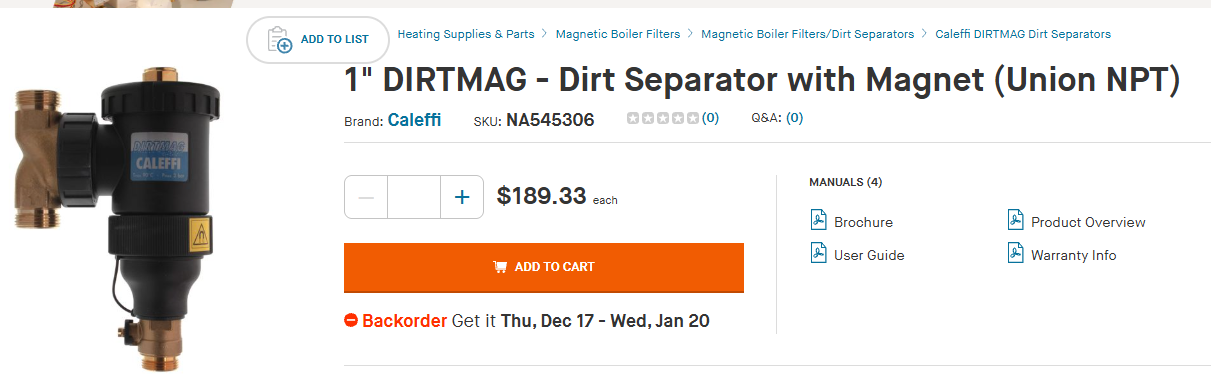
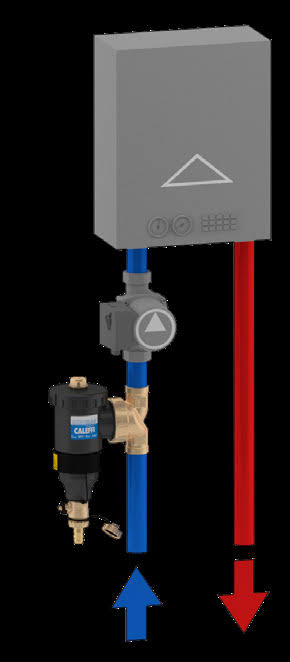
How about leaving that and adding something like the Caleffi NA545395 on the return line of the big loop? That circulator does the bulk of the heating in the house so I would assume the water in the system will pass through that nearly as often as it would in the main loop.0 -
sure, anywhere in the piping is fine. It is a multi pass device, so it eventually will see all the system fluid, even on primary secondary piping.
That Spiro looks like an 1-1/2, so a Discaldirtmag would not be an option with the limited space.
Bob "hot rod" Rohr
trainer for Caleffi NA
Living the hydronic dream0 -
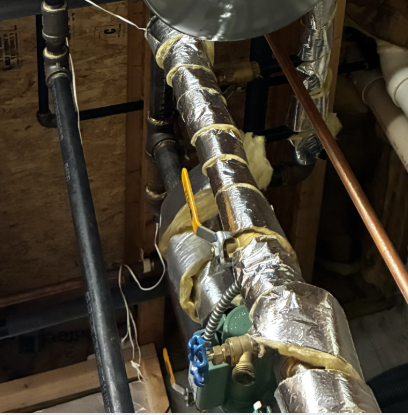
Maybe the boiler piping is steel also? You can get a 1" NPT version.
You have an isolation valve here, at the boiler pump the pump flange is your union to disassemble the piping. Looks like a valve on the other riser also. So an easy access spot.
 Bob "hot rod" Rohr
trainer for Caleffi NA
Living the hydronic dream0 -
Kaos,
Good point. there is plenty of space on that riser.0 -
Bob,
Yes, the boiler loop and manifolds are 1-1/4 steel.
That does seem like the perfect spot. That would need the 1-1/4 Caleffi XF? ($600 vs ~$200 for 3/4).
I do worry about weight. The pipe strap on the left is not taut.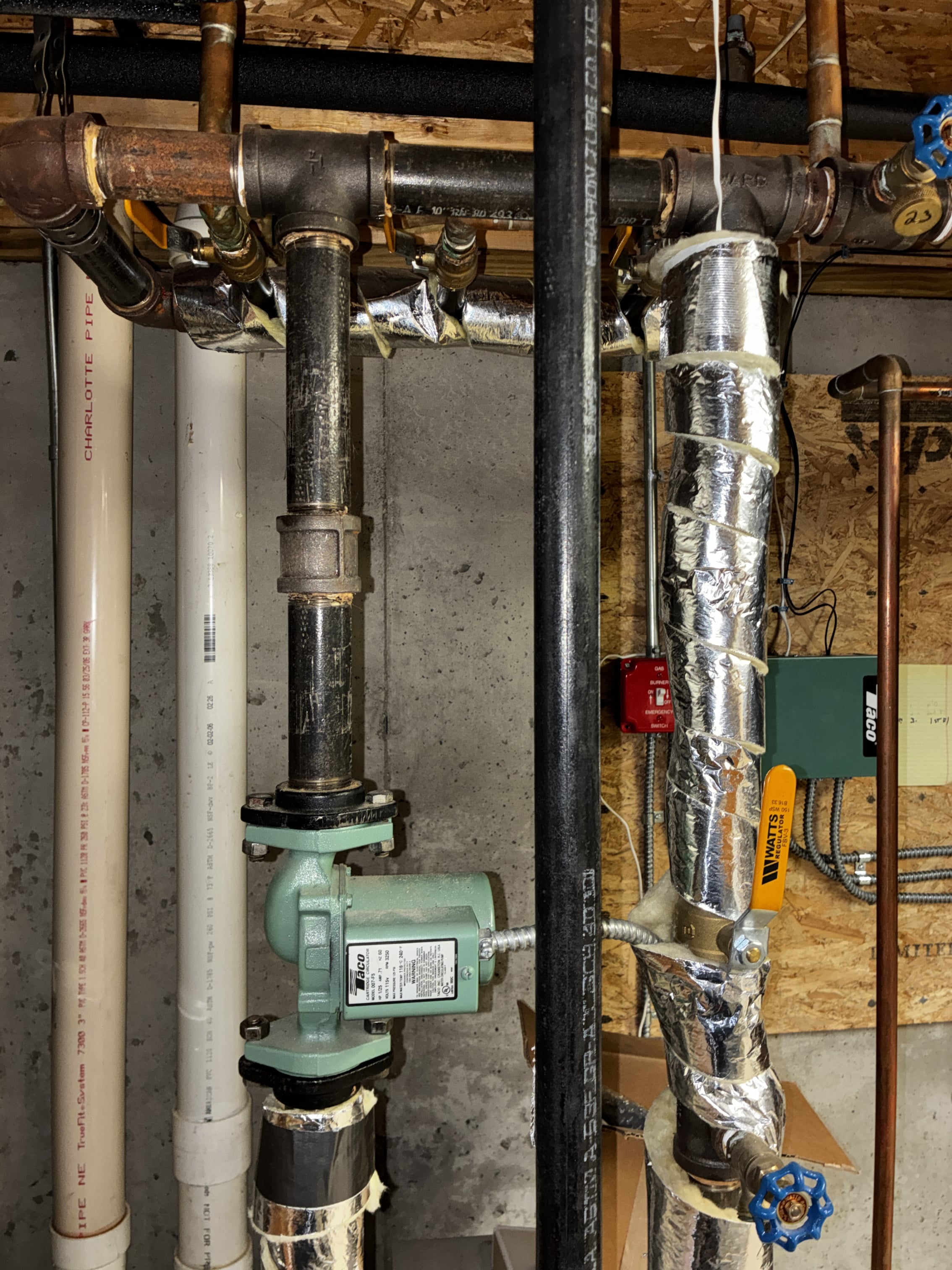 0
-
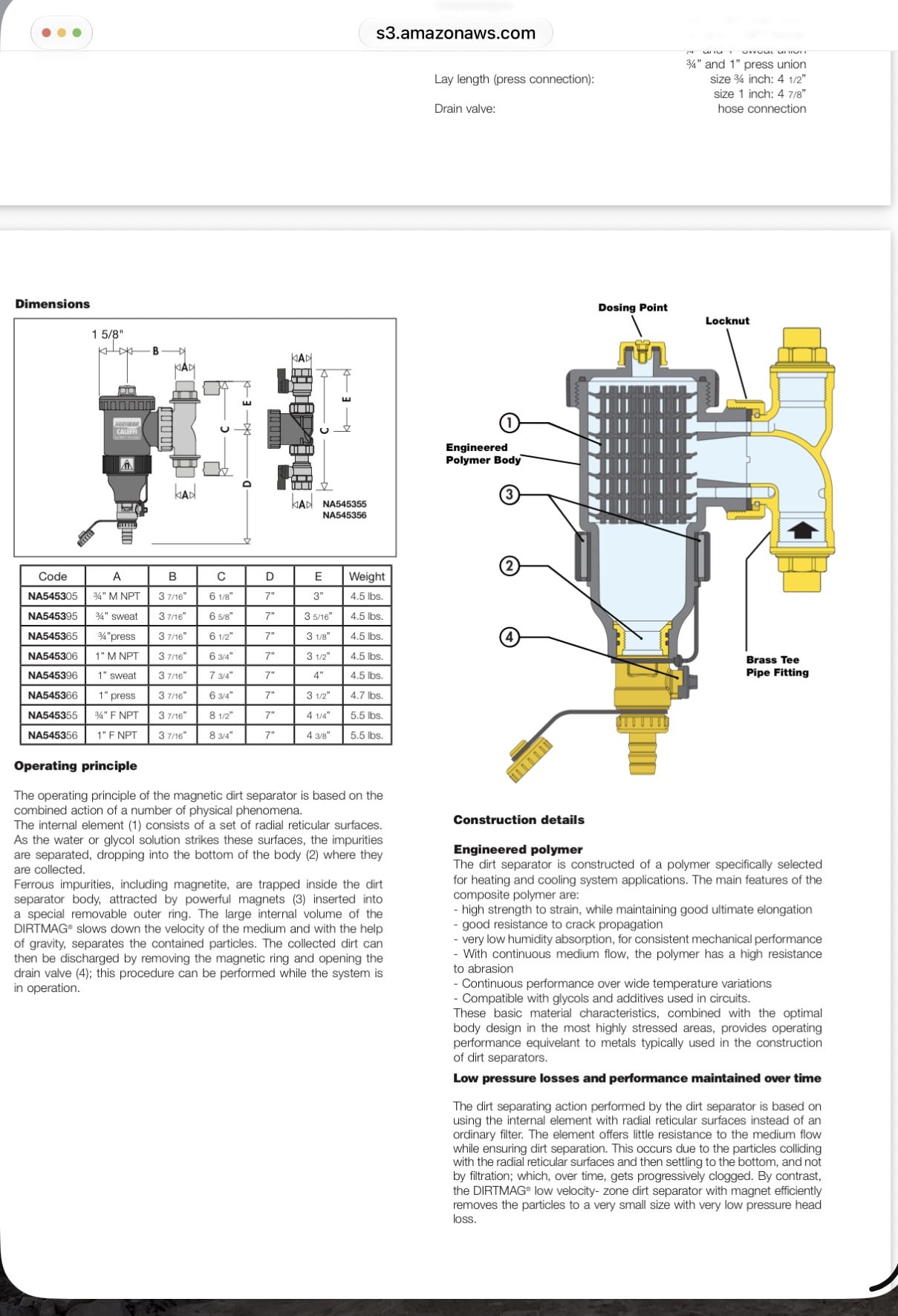
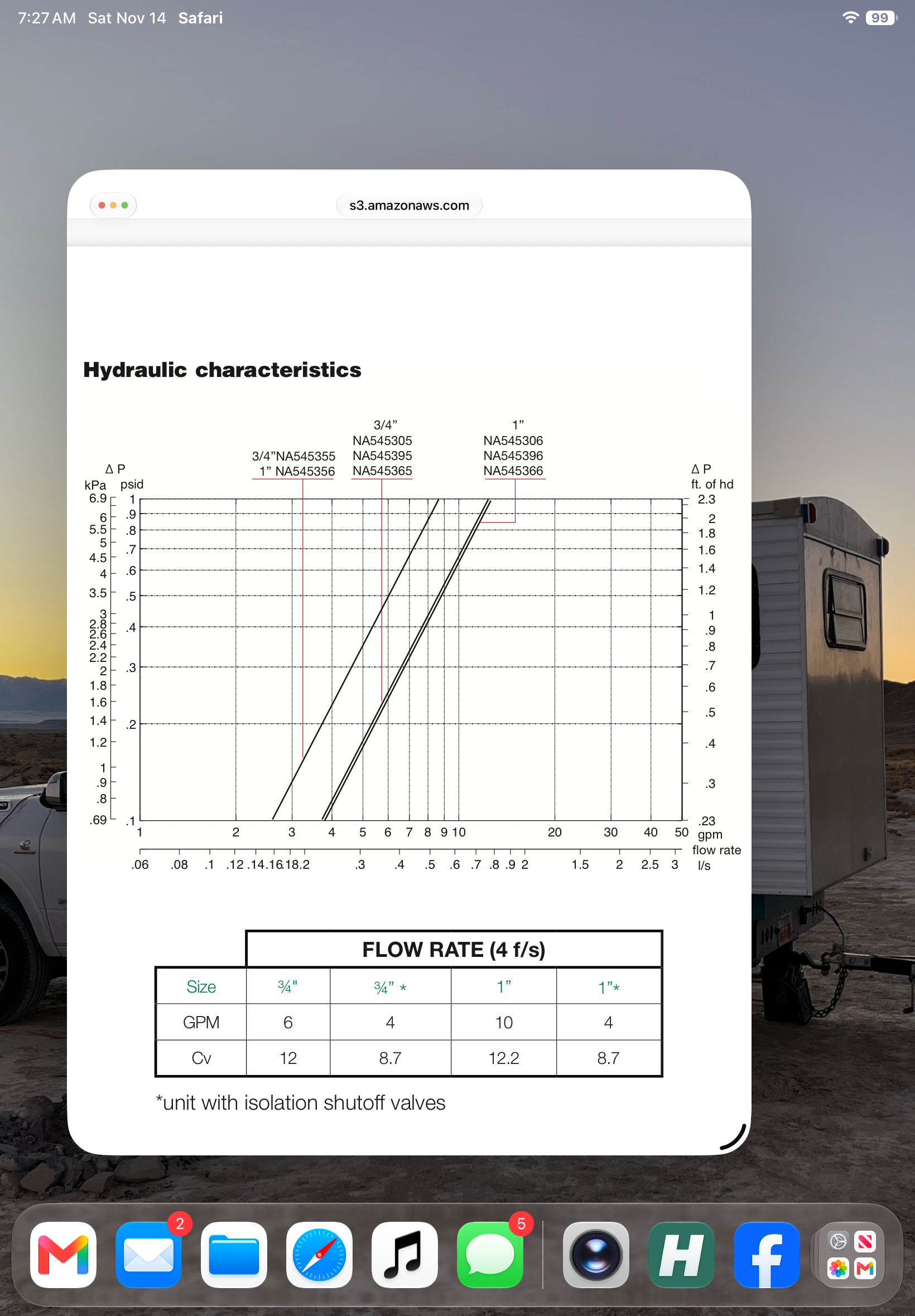
the Caleffi 1” is rated at 12 gpm, what size is that boiler? You may need to find an 1-1/4” model. Not so many choices in 1-1/4 verticals.
 Bob "hot rod" Rohr
trainer for Caleffi NA
Living the hydronic dream0 -
80,000 BTU's.
0 -
To move 80,000 btu at a 20 degree temperature drop requires 8 gpm. So a 1" DirtMag would be adequate.
 Bob "hot rod" Rohr
trainer for Caleffi NA
Living the hydronic dream1






Categories
- All Categories
- 87.9K THE MAIN WALL
- 3.3K A-C, Heat Pumps & Refrigeration
- 60 Biomass
- 430 Carbon Monoxide Awareness
- 136 Chimneys & Flues
- 2.2K Domestic Hot Water
- 6K Gas Heating
- 124 Geothermal
- 170 Indoor-Air Quality
- 3.9K Oil Heating
- 80 Pipe Deterioration
- 1.1K Plumbing
- 6.7K Radiant Heating
- 397 Solar
- 16.2K Strictly Steam
- 3.5K Thermostats and Controls
- 56 Water Quality
- 52 Industry Classes
- 51 Job Opportunities
- 18 Recall Announcements