Questions

With a mod con boiler and cast iron radiators will lowering the output temperature result in less cycling? Or will the boiler go to max fire to reach setpoint? Not sure if I'm asking the question right , my boiler is oversized and I want figure out what's the best way to keep it from cycling. Have not had cold enough temperatures to really know how the system will work.
Comments
-
My radiators math out to around 40 k btu. My boiler is 140k btu I can limit the boiler fire to 50 percent.
0 -
You can limit the firing rate to reduce the cycling, yes. The output temperature, maybe. Being it's still warm-ish out now, the temp can be lower than it will need on the coldest of days but there is a magic number that nobody knows without running calculations. Do you have the outdoor reset set up?
0 -
I plan to set up outdoor reset.
0 -
it depends on the boiler. different mod cons have different output limiting and anti short cycle settings. some can be set to start at a low firing rate and increase firing rate say every 10 minutes if the call isn't satisfied.
0 -
it is not so much the radiators as it is the heat load of the home.
That number is hard to pin down exactly as many factors influence the load.
Best you can do is an accurate heat load “guesstimate” then try to match heat emitters and boiler output to that.
in many areas you are is at maximum heatload less than 10% of the heating season.The current ideal system would be a boiler that turns down to the lowest load. About 15,000 is as low as any boiler goes currently.
So two things, decide what you consider a short cycle, see how often that happens. Most agree a minimum 10 minute run cycle is the target.
It may take a years worth of operation to get this info.
Or run a series of calculations to predict how your system will behave.
IF you do have unacceptable short cycles, what would you spend to correct it? The choices are a right sized boiler, or add some capacitance in the form of a buffer tank.
If you want to number crunch start with a heat load calc.
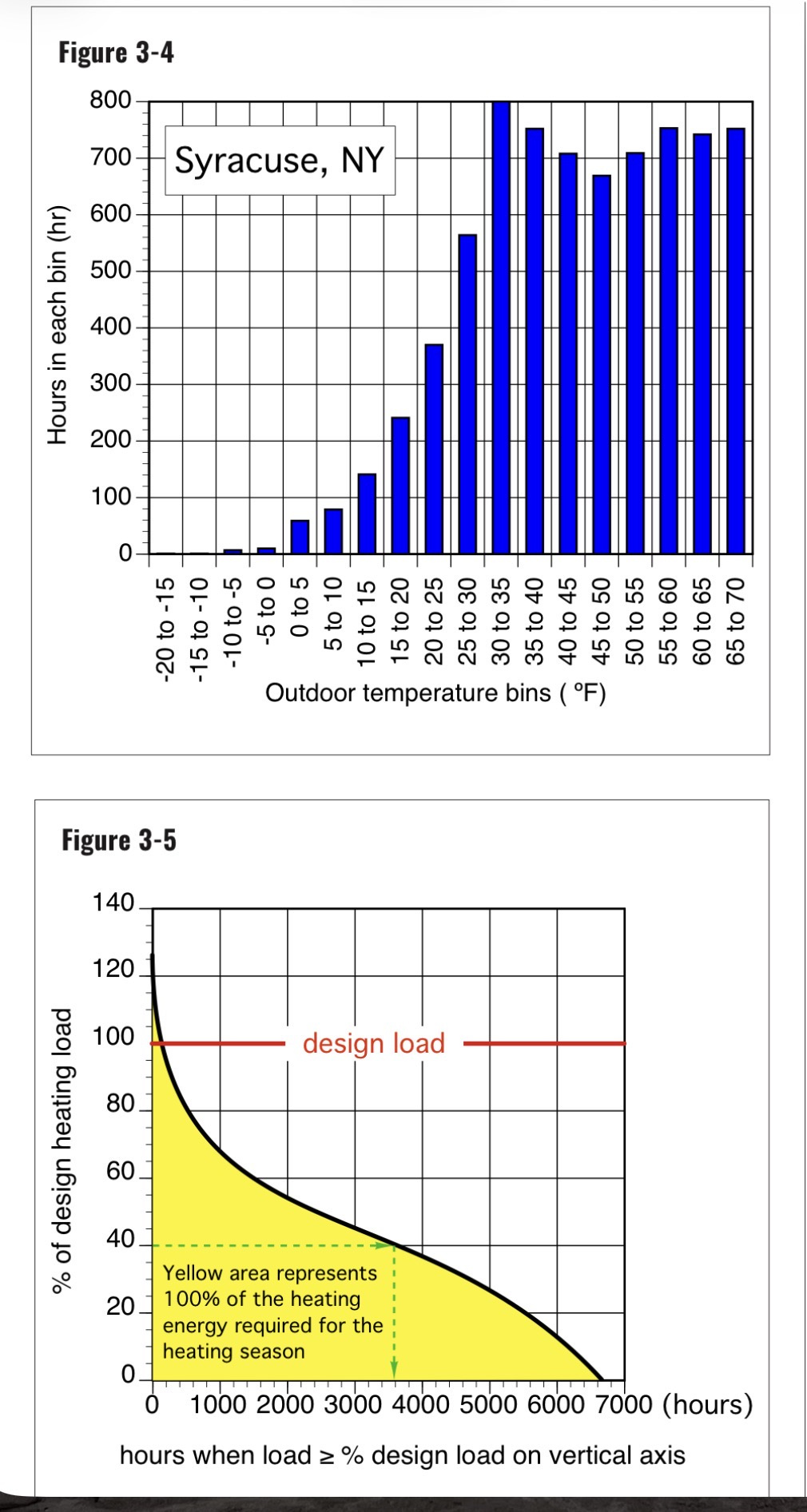
Next go online and pull 20 years worth of temperature data from the nearest weather station.
This example shows Syracuse at design of 5 degrees for 50 or so hours per season. The majority of the season is 30-35 degrees. So your perfectly sized boiler, sized to a design day load,is still oversized!
 Bob "hot rod" Rohr
trainer for Caleffi NA
Living the hydronic dream0 -
Water temperature in the heat emitter determines how much heat the emitter will release.
For example, a radiator with 30 square feet of EDR and an average water temperature of 215°F will release approximately 7,500 BTU/hr into a 65°F room. Lower the average water temperature to 180°F, and the output drops to about 5,400 BTU/hr. At 150°F, the output is approximately 3,600 BTU/hr, and at 120°F, it drops to about 1,700 BTU/hr.
This is where outdoor reset (ODR) comes into play.
As the outdoor temperature rises, the building loses less heat, so the heating system doesn't need to deliver as much heat to maintain the indoor temperature. ODR responds by lowering the boiler's target water temperature. This reduces the output of the heat emitters to better match the building's reduced heat loss.
Ideally, a modulating-condensing (ModCon) boiler will also reduce its firing rate to match the reduced heating load. As the load decreases, the burner modulates down until it reaches its minimum firing rate.
If the building's heating demand falls below the boiler's minimum output, the burner will still have to cycle on and off to maintain the target water temperature. However, operating at a lower water temperature can help reduce temperature overshoot and may result in longer burner cycles, depending on the boiler's controls, water volume, and system load.
The key is matching the boiler's output to the building's heat loss as closely as possible. Outdoor reset adjusts the water temperature to match the demand, while the boiler's turndown ratio determines how far its firing rate can decrease before cycling becomes necessary.
Edward Young Retired
After you make that expensive repair and you still have the same problem, What will you check next?
0 -
What brand and model boiler? Is it new? First winter?
0 -
It's a htp eftc 140w used it the first winter I'm using it.
0 -
This is a problem for combi boilers: in order to provide enough btus to heat domestic water instantly, they’re quite often over-sized for space heating.
As suggested, limiting the firing rate for space heating may be one option.
Another would be adding a buffer tank. If you have standing cast iron radiators, then you already have a substantial amount of buffer built into the system and a buffer tank may not be needed.
If the settings will allow it, try limiting the firing rate for space heating (not domestic) and see how it does.
ODR is good feature, but it can actually cause the boiler to cycle more since the load is being decreased as the weather gets warmer.
Bob Boan
You can choose to do what you want, but you cannot choose the consequences.0 -
Use the outdoor reset. You can manually adjust max supply water temperature, min-max fan speed, min-max firing rate, but with ODR, its automatic. The boiler has supply and return temperature sensors so it should modulate accordingly.
 1
-
Ok, thanks for all the input from ya'll. I'll mess around with different settings and see what kind of results I get.
@Ironman I think I found a thread mentioning you in connection to these htp boilers and combustion chamber corrosion when they condense alot. Is that something I need to be worried about? All the firetubes appear to be clear at the moment and I soaked it with rydym per laars recommendation.
0 -
That thread was probably regarding the old UFT model, not the EFTU.
Any condensing boiler runs the risk of fire side fouling the more it condenses. The UFT had the aluminum fins pressed into the fire tubes which made it more prone to fouling and more difficult to clean.
I’ve installed many EFTU’s (including my own house) and haven’t had any issues yet.
Bob Boan
You can choose to do what you want, but you cannot choose the consequences.0 -
Mine has the aluminum fins pressed in .
0 -
I have the outdoor reset setup and it seems to be working well, How much of a differential should I set up for from boiler setpoint to where it fires the burner again?
0




Categories
- All Categories
- 87.9K THE MAIN WALL
- 3.3K A-C, Heat Pumps & Refrigeration
- 60 Biomass
- 430 Carbon Monoxide Awareness
- 134 Chimneys & Flues
- 2.2K Domestic Hot Water
- 6K Gas Heating
- 124 Geothermal
- 170 Indoor-Air Quality
- 3.9K Oil Heating
- 80 Pipe Deterioration
- 1.1K Plumbing
- 6.7K Radiant Heating
- 397 Solar
- 16.1K Strictly Steam
- 3.5K Thermostats and Controls
- 56 Water Quality
- 51 Industry Classes
- 51 Job Opportunities
- 18 Recall Announcements