Why Hydraulic Separator are made from steel for high header loss condensing boilers?

If sludge/magnetite is a big problem for heat exchangers (and voids warranty) why are so many condensing boilers using hydraulic separators made out of steel? In fact there are only two models made of brass but tiny (.6gal capacity) sold in USA.
Comments
-
If you don't have a bunch of leaks, aren't adding a ton of well water (use a feeder tank) take care of the system fluid, and properly remove air, then the steel won't breakdown and turn to sludge. Basically install and maintain the system correctly and its not an issue.
 1
1 -
magnetite or hematite can only form with oxygen present. So unless O2 is entering the fill water becomes oxygen starved within days.
A quality separator would have a microbubble air eliminator inside to speed air and microbubble removal. A good sep should be high 90% efficient for air removal. As well as other features to protect the system.
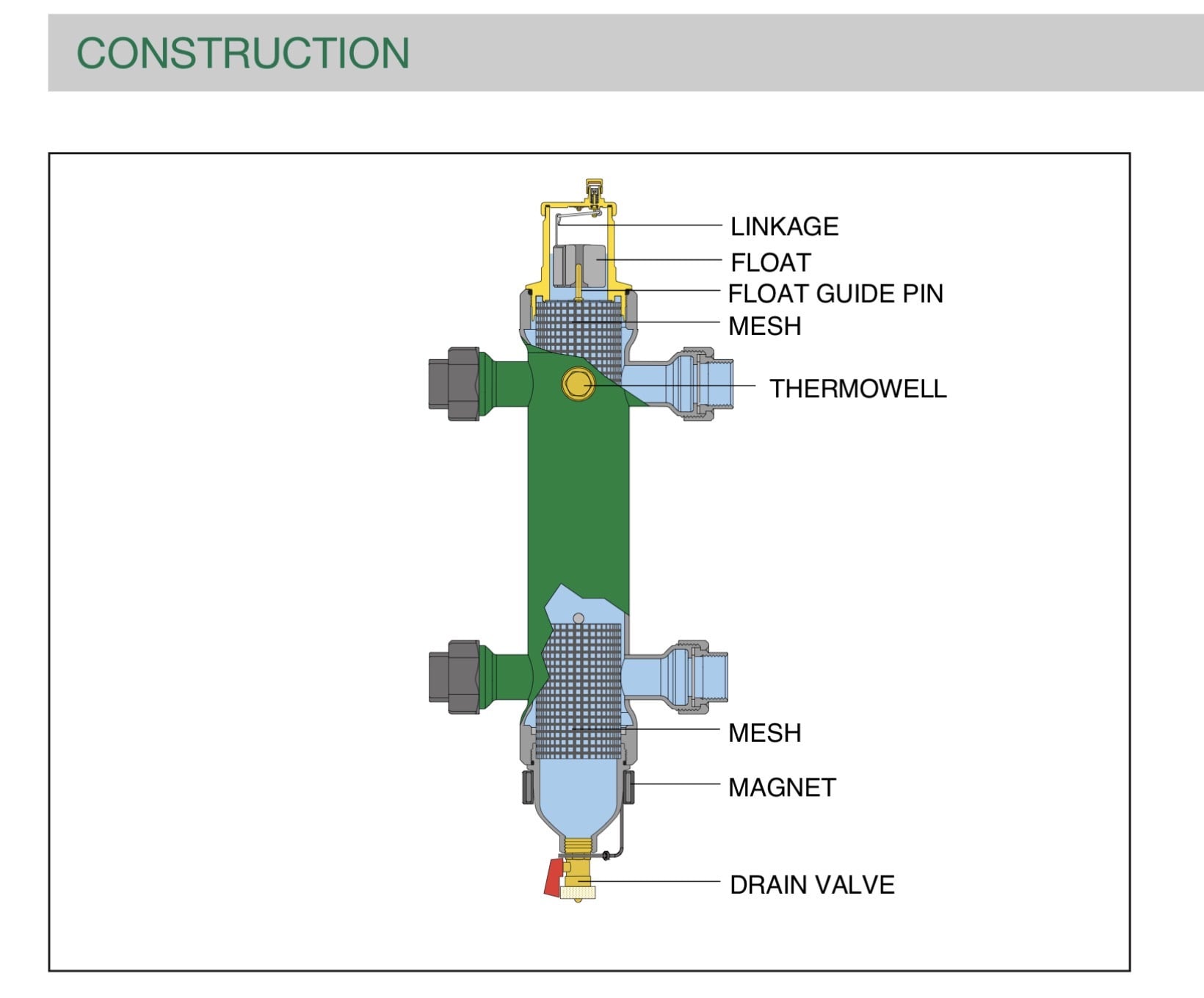
Seperators are sized or should be by the velocity in the center barrel. If you want additional fluid capacity a small buffer tank is an option. We see wall hung buffer tank versions in the 7-21 gallon range available now.
Most hydronic tanks are steel, circulators cast iron.
A hydronic conditioner additive is another good step to protect all the multiple metals in a system, and they include oxygen scavengers.
It is possible to build an entirely non ferrous hydronic system, and is ocassionally done on non barrier hydronic tube systems.
Bob "hot rod" Rohr
trainer for Caleffi NA
Living the hydronic dream0 -
Everyone talks about 'dead water' in a closed loop yet cast iron boiler loops have a lot of sludge in them. Air removing tech has not progressed that much past the air scoop (EDIT:micro bubbles tech is decades old even in US) so I somewhat question reliance on 'dead water' in practice. My personal theory is that we will eventually move on to SS vessels, we are just slow in adopting new tech and tariffs probably do not help. I found a couple of (EDIT:removed brand names) stainless steel hydraulic separators are sold in Canada but I think one is just rebranded AliExpress crap. Then there's question of galvanic corrosion, probably need to use dielectric connections between SS and brass.
@hot_rod Could you explain (or point at a link) why over sizing hydraulic separator is a bad idea? I asked AI and it was talking about stratification but I think that's applicable to truly large cylinders.
EDIT: I checked warranty on carbon steel hydraulic separators and I found it to be 2 to 5 years - so they must be corroding.0 -
oxidation can only occur with o2 and the electrolyte
It is tough to keep O2 out of a closed loop hydronic system
Mother nature hates all imbalances, temperature, pressure , moisture, so if there is a o2 starved condition, it will try to balance that, o2 squeezes in.
The oxygen barrier on hydronic pex only slows oxygen ingress. Same as the EVOH o2 barrier on plastic milk jugs.
Higher fluid temperature attracts more o2 ingress, so 180 degree systems are more prone to oxygen ingress.
The original rubber hydronic tube was an O2 sieve. It could destroy high temperature ferrous systems in a years time, expansion tanks were the first to fail. That’s the sludge in the bottom of your ci boiler 🫢
Oxygen, at the molecular level can enter through pump seals, valve packings, pex tube,
And Im wondering how 02 tight press fittings are???
You see that green fuzz on some press fittings?? Something is going in and out through the o ring causing that?
So my systems get hydronic conditioner like Fernox, cheap insurance in my mind. It has oxygen scavangers, ph balance, snd a film provider to protect all the metals from attact, similar chemicals are in hydronic glycols.
Other than cost I see no reason against an overdized sep,
. A buffer tank can act as a sep. It creates that low velocity zone that is key to separation.
Here is the math on Caleffi seps
The barrel is 9A, nine times the size (area) of the connections, on smaller sizes that is about 3-1, so a 2” sep would have a 6” barrel.
The goal is flow velocity top to bottom near zero.
I have tested some brands of seps that don’t separate ! The barrel size is too small and fluid blasts across.
Have you priced a stainless circulator? That is one reason non ferrous hydronics are not common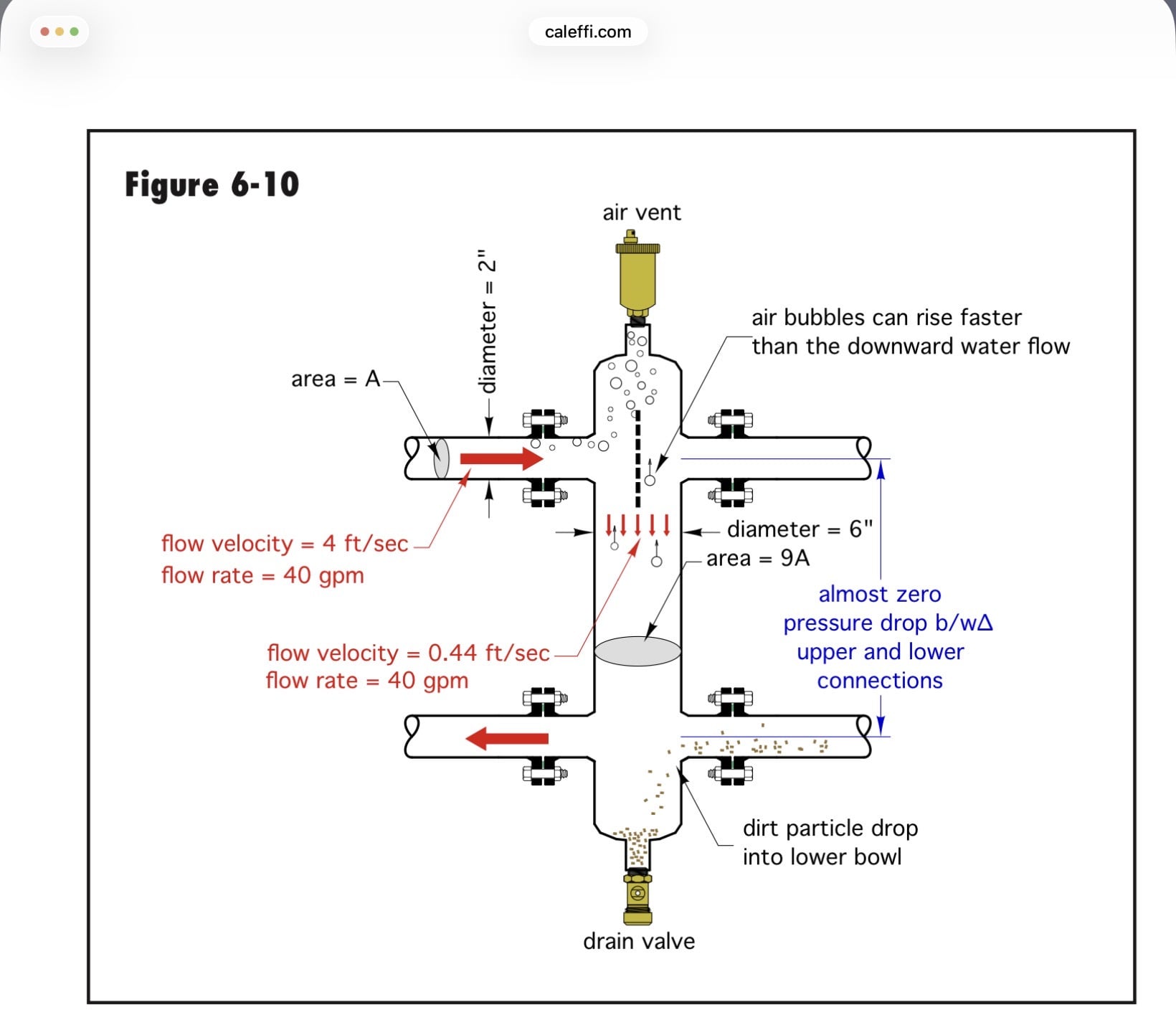 Bob "hot rod" Rohr
trainer for Caleffi NA
Living the hydronic dream1

Categories
- All Categories
- 87.8K THE MAIN WALL
- 3.3K A-C, Heat Pumps & Refrigeration
- 60 Biomass
- 430 Carbon Monoxide Awareness
- 133 Chimneys & Flues
- 2.2K Domestic Hot Water
- 6K Gas Heating
- 124 Geothermal
- 170 Indoor-Air Quality
- 3.9K Oil Heating
- 79 Pipe Deterioration
- 1.1K Plumbing
- 6.7K Radiant Heating
- 396 Solar
- 16.1K Strictly Steam
- 3.5K Thermostats and Controls
- 56 Water Quality
- 51 Industry Classes
- 51 Job Opportunities
- 18 Recall Announcements