Ballcock float valve

All right. So, fair warning up front, this particular one isn't, strictly "strictly steam", but I feel that if there's any audience out there, that would appreciate it, a lot of them are likely to be here.
1929 house. Toilet tanks have no holes in the ceramic bottom of the tank. Instead, threaded pipe comes in, over a notch formed into in the the top lip of the tank, and then dives straight down, into the water. Galvanized pipe. Brass valve. Copper flush valve cage.
So. It turns out, that there's this thing called, "galvanic corrosion".
…And while, naively, you might think that maybe the name might be a bit of a clue, but… no.
So approximately 10:00 at night, having spent the last decade or more dutifully donating its iron to help electroplate… well… every other metal object in the toilet tank, and incredibly, half the plastic parts too… the 90 degree, formerly galvanized elbow in my son's bedroom toilet tank finally decided to spring the kind of leak that shoots water in a 6 foot tall fountain arch all the way to the other side of the bathroom, the moment that you take the tank cover off.
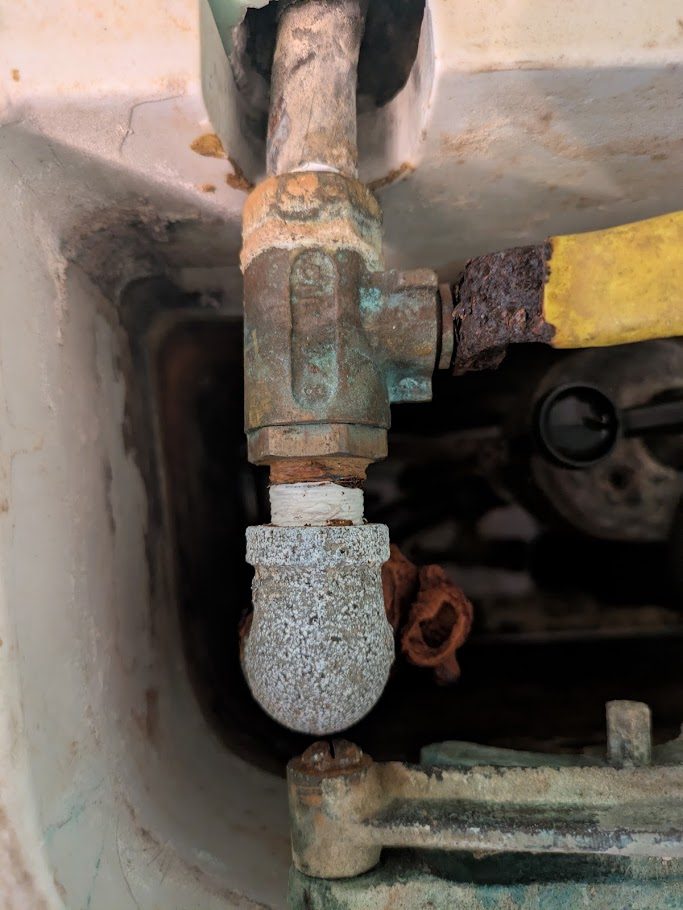
Yeah. Not only is that thing paper thin, but it has a rust brown stalactite hanging off of it that looks like it was transplanted straight off the side of the RMS Titanic.
So. Today I decide that today is the day that my middle school age kid is ready for the talk. It's time he becomes a man.
What? No. Not the "birds and the bees" talk, God, what the hell is wrong with you?
Nope, It's time that he understands toilet repair.
So. we're pointing at parts inside the tank. And I'm, explaining how normally, in a relatively modern house, there would be a valve down here by the baseboards, and there would be a hose, probably plastic, that would go up to a union here, on the bottom of the tank, connecting to a standpipe. And today that's this plastic thing that goes up and down, but back when I grew up, there would be this metal arm, with a rubber float on the end, which would rise with the water level, and shut off the water. All this explanation is going fine.
And finally I say, "And that valve, the one that seals up, when the water level rises, is called a ballcock valve."
And he just starts giggling.
"Dad. Out of all the words in the English language, why would they decide to call that thing, "a ball… cock… valve"?
I tried to visualize the internals of this part, try to explain why that was a mechanically relevant name, and… nah, not really.
Then I tried to figure out how to explain the unique mind of a plumber… and I failed.
What I finally said:
"That's just what the dead men decided to call it."
Comments
-
i would probably use brass or stainless, not steel. the old ballcocks had a plastic or copper float.
does that fill valve have a vacuum breaker built in to it?
i assume that is copper coming out of the wall since it has a compression fitting.
0

Categories
- All Categories
- 87.8K THE MAIN WALL
- 3.3K A-C, Heat Pumps & Refrigeration
- 59 Biomass
- 430 Carbon Monoxide Awareness
- 133 Chimneys & Flues
- 2.2K Domestic Hot Water
- 6K Gas Heating
- 124 Geothermal
- 170 Indoor-Air Quality
- 3.9K Oil Heating
- 79 Pipe Deterioration
- 1.1K Plumbing
- 6.7K Radiant Heating
- 396 Solar
- 16.1K Strictly Steam
- 3.5K Thermostats and Controls
- 56 Water Quality
- 51 Industry Classes
- 51 Job Opportunities
- 18 Recall Announcements