New Testo 310 vs. boiler tech's UEI C161

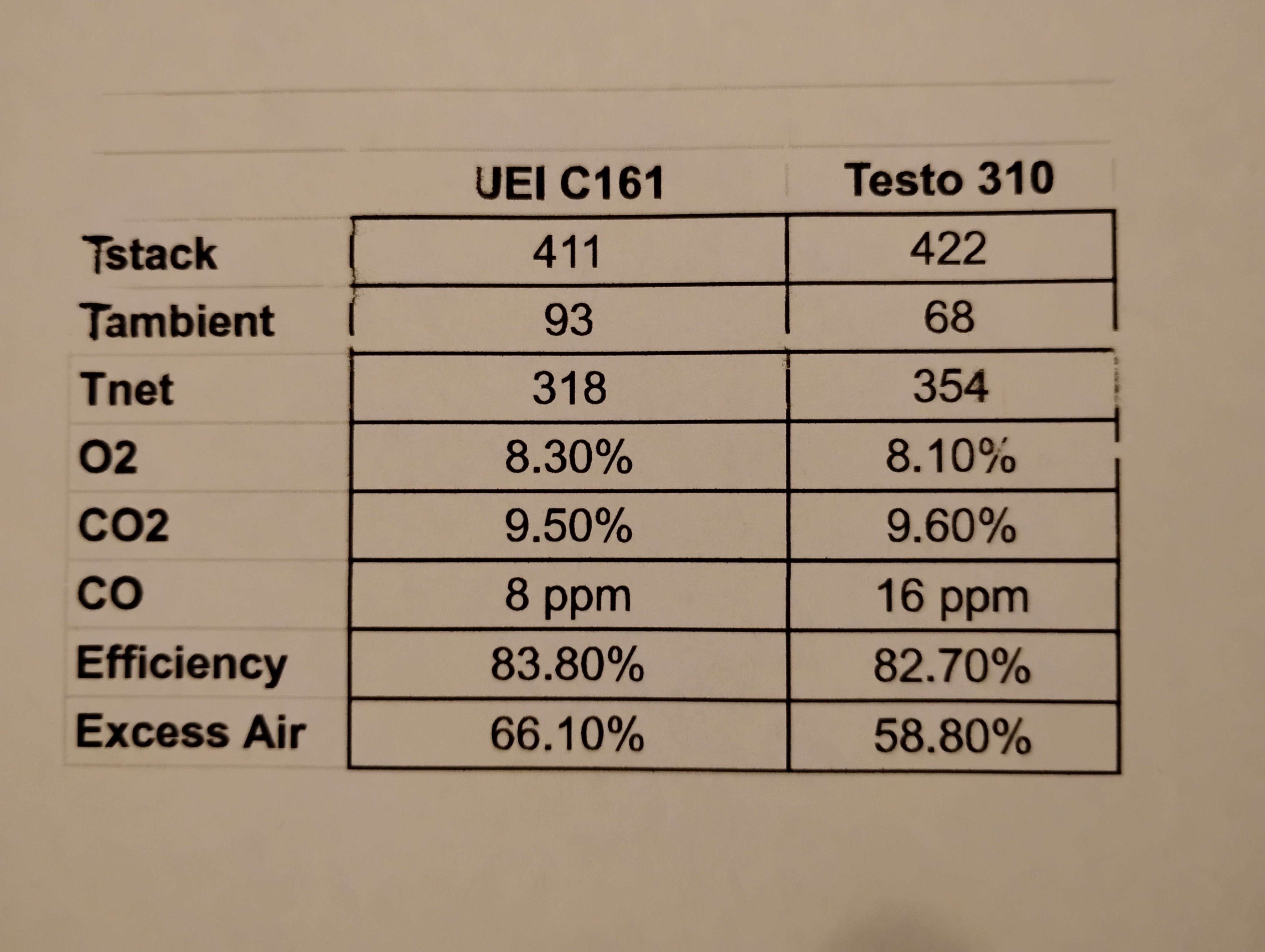
I took the plunge and bought a new Testo 310 which came yesterday. First test was to run flue gas analysis on one of our oil boilers that was serviced last month by our oil company. He left a printout from his UEI C161 analyzer last month, so I have good reference points for comparison.
Agreement between the two devices was quite good on the O2 and CO2. The main difference was CO, where he got 8 ppm and I got 16 ppm. I noticed his printout said "calibration due 1/22/26," which was 9 months ago, so his CO sensor might have been off. My new Testo was factory calibrated 5 months ago.
I also noticed his Tambient was 25 degrees too high, maybe because his probe was too close to the stack when he powered on, or maybe he had measured the draft first and the probe hadn't cooled yet. I made that mistake when I did a second run with the Testo without sufficient cooldown time in between.
Either or both of those discrepancies caused his analyzer to overstate the efficiency by about 1% and the excess air by about 7%. Not a big deal.
Anyway, looks like the new Testo is working fine. I like the phone app it pairs with, because the app saves the reports as pdf's and can export them into my Google drive. So even though I didn't buy the printer, I can print out an official Testo report.
Comments
-
Looks ok except I would think the C02 is a smidge low. Should be able to get 11-12%. I suspect your tech does not like soot.
Other than that, a lot of people get fixated on the #s (not you). They need to understand that draft changes with air temperature, combustion air temp changes, fuel composition and fuel temp changes. All these things affect combustion readings.
I like to think of it as not shooting for an exact # but trying to keep the combustion in a safe range.
1 -
@EBEBRATT-Ed OK thanks. If I were to change nozzles from a 1.0 to a 0.75, could I omit the smoke test? (I don't have a smoke tester but could get one if needed.) Downfiring at the existing air setting should result in even higher excess air, which I would assume means I would start from an assumed zero smoke condition. Then use the Testo to dial down the air to around 10% CO2 to be on the safe side?
0 -
Your excess air is too high, indicating you may be underfired and/or have a z-dimension or head issue. Down firing would make it worse. Your efficiency number isnt really accurate because is calculating based on your stack temperature. Stack temp is heavily influenced by draft and excess air vs. firing rate.
Your actual true burner efficiency, based on net stack and 02% is 67.1%
First you need steady state.
Then you set your over fire draft.
Then you adjust air to true zero smoke.
Then you would adjust your air to drop your CO2 1%.
Any way else is incorrect. And not doing a smoke test is a really bad idea. There is a published method of initially adjusting air based on cad cell readings, but it doesn't always work on all burners. 1
1 -
@HydronicMike Thanks for your thoughts. Our boiler techs are good and I doubt there's a problem with the head. I will of course check the Z dimension if/when I change nozzles. And I will take your advice and get a smoke tester. Thanks also for the correct procedure.
Not sure what you're trying to say about combustion efficiency. As long as the flue gases are sampled at the proper location (right above the boiler and before the barometric damper), the Testo and the C161 will both give correct readings of combustion efficiency, which is basically a measure of how much heat is being lost as hot (dry) flue gas and hot water vapor. I've verified this by doing the hand calculations for both dry gas and latent heat of vapor losses based on flue gas composition and net temperature, and my hand calcs agree with both the Testo and C161 results. It would probably be news to Testo and UEI that both of their combustion analyzers are wrong.
Since the combustion efficiency for fuel oil can be calculated knowing only the CO2, O2, and net temperatures, there are lookup tables already available. Here's one from TSI Incorporated's "Combustion Analysis Basics," page 12. If you look at the bottom line, you'll see those numbers for CO2 and O2 match ours closely, and for a net temp of 360 (close to our 354), the table gives a combustion efficiency of about 83%, very close to the results given by both the Testo and the C161.
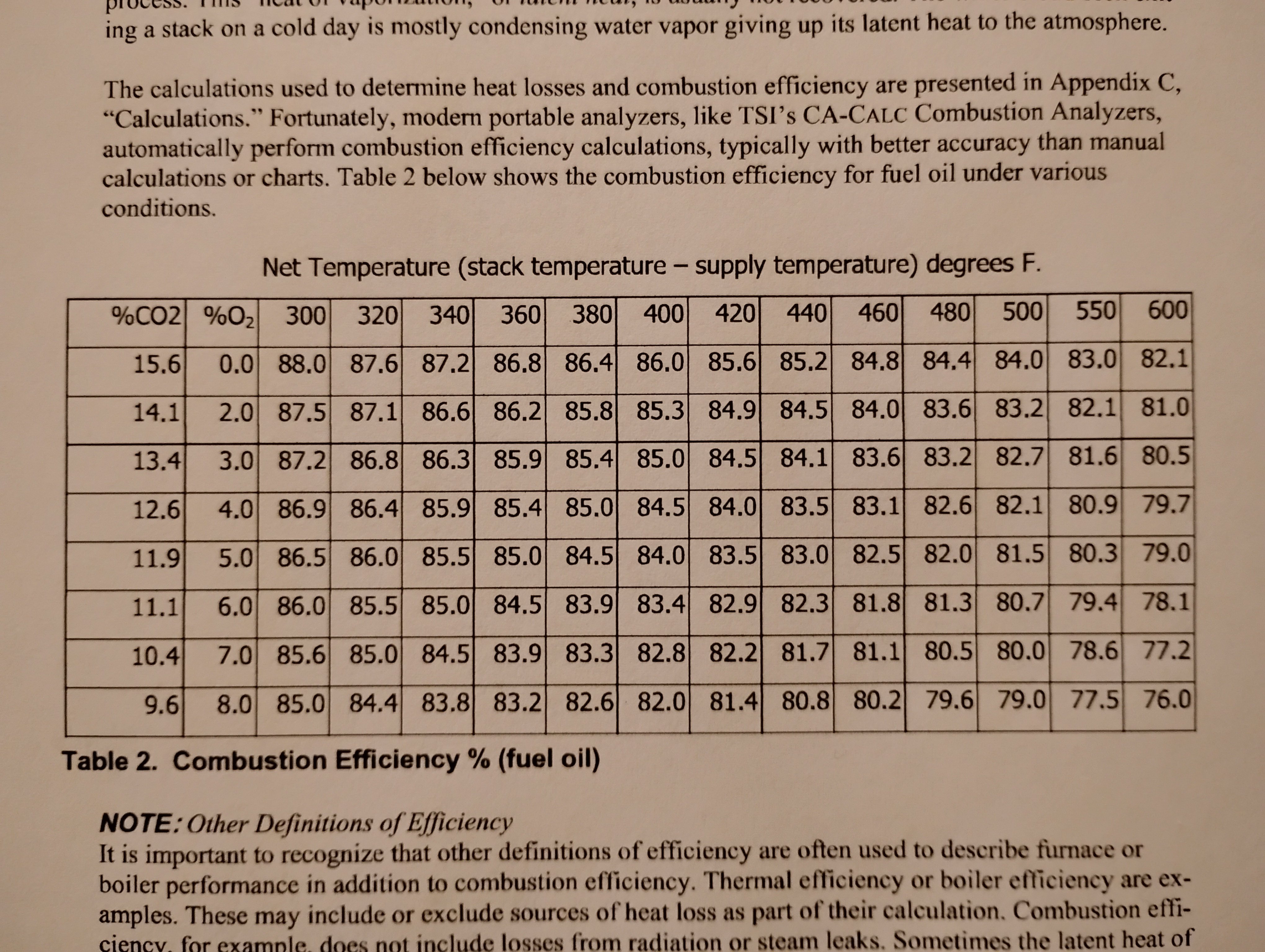
I understand there are other measures of boiler thermal efficiency (such as cycle efficiency), but that's not what we're talking about here, as the Testo and C161 are only measuring combustion efficiency, and are doing so correctly. If and when I try downfiring to a 0.75 nozzle, I will of course run the Testo again and see if combustion efficiency changes, and by how much. I would point out that we're already downfired to 80% of input spec, with no measurable loss of combustion efficiency. Even if we had a spec nozzle, we would still probably be around 83%-85% combustion efficiency.
I do agree that our cycle efficiency is probably in the 60-70% range, but that's mainly because we have massively oversized boilers that have 700+ pounds of cast iron and 10+ gallons of water with a lot of residual heat after the burn, some of which drafts up the chimney. I've addressed this in other posts where I've increased the boiler run times by increasing thermostat swing, and have installed thermal post-purge aquastats that keep the circs running until SWT drops to 90F. Last season we got a measured 9% reduction in oil consumption vs. HDD's from those two changes, but ultimately we still have massively oversized boilers, and downfiring is another strategy for reducing losses by reducing gross stack temps (to within reasonable limits without condensing).
Yes, downfiring could have undesirable effects, but the whole point of having combustion analyzers is to measure those effects in stack temp, flue gas composition, and efficiency. If the effects are undesirable, the analyzer will tell the story. If the effects are positive (little or no loss of combustion efficiency, acceptable flue gas composition, reduced but still acceptable net stack temp), the analyzer will also tell the story. So I'm willing to try downfiring, and let the analyzer show whether the effects are acceptable or not. If the analyzer numbers are good, I'll run the boiler for a year, checking the HX condition for soot, condensation, etc, and measuring oil consumption vs. HDD's, and the numbers will tell the tale. But if the analyzer shows the smaller nozzle won't give acceptable numbers, I'll go back to the 1.0 nozzle.
0


Categories
- All Categories
- 87.8K THE MAIN WALL
- 3.3K A-C, Heat Pumps & Refrigeration
- 59 Biomass
- 430 Carbon Monoxide Awareness
- 133 Chimneys & Flues
- 2.2K Domestic Hot Water
- 6K Gas Heating
- 124 Geothermal
- 170 Indoor-Air Quality
- 3.8K Oil Heating
- 79 Pipe Deterioration
- 1.1K Plumbing
- 6.7K Radiant Heating
- 396 Solar
- 16.1K Strictly Steam
- 3.5K Thermostats and Controls
- 56 Water Quality
- 51 Industry Classes
- 51 Job Opportunities
- 18 Recall Announcements