Condensation: Water dew point vs. Acid dew point

As a non-expert homeowner trying to learn more about oil boiler efficiency, I've been warned repeatedly about the dangers of flue gas condensation if the flue gas temperature gets too low. Experts here have cautioned that 300+ degree flue gas temps are needed to prevent harmful condensation.
That number has puzzled me for years. Water boils at 212 degrees under normal atmospheric conditions. So how can condensation be happening at flue gas temps closer to 300?
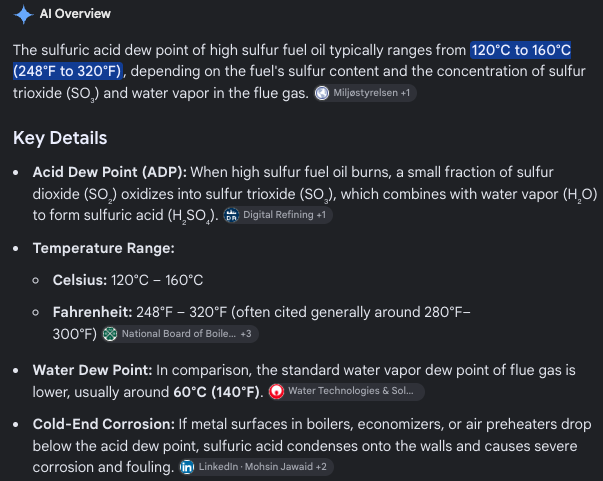
So I asked Google AI. And to my surprise, I learned something. This is a summary of what Google AI said:
"Water Dew Point vs. Acid Dew Point:
The water vapor dew point for heating oil flue gas is typically 115-125 F, while the small amount of sulfuric acid in the flue gas typically has a much higher dew point, typically from 248 to 300 F, which means corrosive liquid can form long before water vapor appears."
I had not heard that explanation before, and finally it all made sense. So it's the high acid dew point that we're trying to avoid.
The AI answer included a link to a useful paper about dew-point corrosion in boilers, which I'll include below.
https://www.nationalboard.org/PrintPage.aspx?ID=196&pageID=164
Comments
-
There are more factors involver regarding flue gas. The design and operating condition of the boiler, Co2 level ad chemistry of the fuel oil. The sulphur content for example. That is why you see different numbers and opinions publushed on acceptable return temperature. 130 for NG, 150 for fuel oil is a common range you see.
I suspect bio blends behave differently also.
 Bob "hot rod" Rohr
trainer for Caleffi NA
Living the hydronic dream1 -
That is to my surprise, too. The sulphur in flue gas is in the form of Suphur Dioxide (SO2), and is a gas — and remains so (boiling point - -10 C at atmospheric pressure. Pure sulphuirc acid is the result of oxidation of suphur dioxide to sulphur trioxide condensing that. It's condensation point at atmospheric pressure is 337 C.
Now where Google may have gone off the rails — though it's always hard to tell where AI has messed up — is that concentrated sulfuric acid solutions in water to have a lower vapour pressure than pure water at any particular temperature — and hence will condense at a higher temperature.
What is important here is that if there is any liquid water present at all, the sulphur dioxide (or sulfur trioxide, if present) will dissolve in it instantly, or as instantly as chemical reactions everr happen!) and form a suphurous or sulfuric acid. This is not a condensation phenomenon at all, but a solution one.
Which, even with very low concentrations of either one, is astonishingly corrosive.
And this is why we now use low, or ultra low suphur fuel oil, and sweet natural gas. If we can get it. It's also why oil fired boilers try to avoid condensing the water vapour, as even ULS fuel oil still contains some suophur (it is possible to strip sulphur from natural gas much more easily).
There is also a more practical reason: operating natural gas and condensing the flue gas can, if the condensation temperature is low enough, yield as much as a 10% improvement in efficiency. Fuel oil, however, is more efficient to begin with — and the improvement from condensing is, correspondingly, much less — about 5% vs. 10%.
Hope this helps.
Br. Jamie, osb
Building superintendent/caretaker, 7200 sq. ft. historic house museum with dependencies in New England1 -
You need to stop this nonsense @jesmed1. You keep learning more stuff like this and you may end up knowing more than I do about your boilers and oil heat in general.
Edward Young Retired
After you make that expensive repair and you still have the same problem, What will you check next?
 2
2 -
It occurs to me at this rather late stage to also clarify just what the term "dew point" refers to. Simply put, it is the temperature of a gas mixture at which the partial pressure of the component of interest (usually water vapour though it doesn't really have to be) is equal to the gas/liquid or gas/solid phase change temperature of that component at that partial pressure.
Br. Jamie, osb
Building superintendent/caretaker, 7200 sq. ft. historic house museum with dependencies in New England0 -
@Jamie Hall I messed about with sulfuric and nitric acids in high school while trying to achieve the tri-nitration of toluene. I ended up with a few grams of yellowish crystals that I hoped was trinitrotoluene, but who really knows. What now terrifies me is the fact that I was boiling large quantities of acid/toluene solution in my parents' garage at age 16 with no respirator, not knowing that toluene is a carcinogen. Oh well, no one lives forever!
Anyway, AI is directly citing the National Board of Boilers paper I linked to above when it says that the dew point of sulfuric acid is around 300 F in flue gases, and that appears to be a commonly-cited number in other references also. Here is another reference from the same guy who wrote the paper I linked to above. Again he says:
"During fuel combustion, sulfur oxidizes to form SO2 and consequently SO3. The free SO3 in the flue gas reacts with moisture to form sulfuric acid (H2SO4). The concentration of H2SO4 depends on the SO3 and the moisture content; hence the acid dewpoint temperature in the flue gas will vary accordingly. The condensation temperature of H2SO4 is approximately 250-300 F and below. The dewpoint of sulfuric acid depends on the exact concentration of sulfur trioxide in the flue gas but is approximately 280 F. "
0



Categories
- All Categories
- 87.8K THE MAIN WALL
- 3.3K A-C, Heat Pumps & Refrigeration
- 59 Biomass
- 430 Carbon Monoxide Awareness
- 133 Chimneys & Flues
- 2.2K Domestic Hot Water
- 6K Gas Heating
- 124 Geothermal
- 170 Indoor-Air Quality
- 3.8K Oil Heating
- 79 Pipe Deterioration
- 1.1K Plumbing
- 6.7K Radiant Heating
- 396 Solar
- 16.1K Strictly Steam
- 3.5K Thermostats and Controls
- 56 Water Quality
- 51 Industry Classes
- 51 Job Opportunities
- 18 Recall Announcements