Downsizing nozzle on wtgo-4 and riello f5

I have a 2800square foot house with a attached unheated garage. This is a split level/raised range style. 2 floors. 1st floor sits on a slab. Garage may get heated one day after it's insulated. The square footage is from wall to wall I did not measure each room individual.
I have three zones. Two for heating and one for a well-mcclain 29 gallon indirect water heater. One zone is 74 feet of baseboard on 2nd floor and the other is 52 feet of baseboard on first floor. This give me roughly 63,000 btu of baseboard. Currently the wtgo-4 is speced out to have a 1.20 nozzel. The btu rating seems to be a lot more then we need. Do you think it's possible to bring it down to the wgo-4 spec of 1.0 nozzel or even smaller.
Figured I would ask the pros on this matter. Thank you in advance for the help.
Comments
-
I think I've said this before... for hot water heating, the boiler should be sized on the basis of what the heat loss for the structure is. So... before you start thinking about possibly down firing that burner -- if it's even possible with the burner and boiler combination -- do a heat loss on the house.Br. Jamie, osb
Building superintendent/caretaker, 7200 sq. ft. historic house museum with dependencies in New England0 -
@Jamie Hall thank you for the feed back. I'll work on the heat loss calculation on the house tomorrow and get back to you.0
-
Don’t down fire it, especially without a full combustion analysis.
The burner is almost always the most efficient based on manufacturer testing and recommendation.
A smaller nozzle might be unstable in an F5. Lower flame temperature can cause too low a flue temperature causing condensing...which causes a number of problems.
Any money you think you’ll save will be wasted via poorer efficiency.
Your boiler is very oversized. Only a properly sized boiler based on a proper heat loss will provide the best opportunity for savings.There was an error rendering this rich post.
0 -
@STEVEusaPA thank you for your thoughts. I understand combustion analysis needs to be performed and that is why I am asking now since I have a service tech scheduled for a annual pm in two weeks. I will work on the heat loss calculation this week. Improvements in insulation and windows have been happening slowly over time. The reason I ask about downsizing to the 1.0 nozzel is because it is in some of well McLain and riello data books for my boiler and burner setup. I know my boiler seems to be way oversized. Unfortunately I bought the house like this 4 years ago so working on getting things worked out. 1972 house with a 2005 boiler. I have attached two documents one from well-mcclain and the other from riello manual. Ideally I would be swapping with a energy Kinects or a burderous but not sure of that's in the budget right now.0
-
It shows a 1.00 GPH input as an option to downfire. That's not the nozzle size, but firing rate. A .85 nozzle is used with adjusted pump pressure to achieve 1.00 GPH.
I never really understood the 3 and 4 section WGO. They are basically the same boiler, dimension wise. The 3 section has a wide middle section that's substituted for two sections to make 4. The 3 actually holds 1.5 gallons more water than the 4 section.0 -
Yes but your chart doesn't show it being downfired. It has a smaller nozzle and increased pump pressure maintaining the same firing rate (and needed for flame stability).
Which is still a better set up and recommended over the 1.20 and 100psi setting.
Just note the change in the pump pressure, air shutter and turbulator. If you don't change all 3 (check, verify with gauges, smoke gun and analyzer) you'll have problems.
Nozzle, not nozzel. Doesn't your spell check let you know? Another guy on this site spells it that way too.
 There was an error rendering this rich post.
0 -
Thank you all for some advice. Let me do the heat loss calculations and then get back to you with what you think would be the best plan of action. Well technically the best plan would be to replace the boiler but that's a whole other topic. I want to narrow a plan down for nozzle size so I can make sure the tech coming can adjust everything as needed and verify the results with me. New service company so it will be a good test to see how they perform. I have no problem doing the work myself, I come from a Diesel engine/turbine background but just don't have all the testing equipment to do it all. If it was me I'd be testing all day with different setups to find the best results but that's not going to happen. Just trying to squeeze the most of it this boiler of possible. Burned about 800 gallons in a year of b20.
Thanks again for all your help.0 -
I wouldn't waste any time with a heatloss until you're sizing a new boiler.
800 gallons for the year? What's your city/state? I could give you a pretty fast/accurate heatloss.
The smallest boiler will still be too big, and downfiring won't help your situation, nor save you any money, but it may create problems like I mentioned above.
Save your money for an EK or smallest triple pass.There was an error rendering this rich post.
0 -
@STEVEusaPA I am in Seaford NY. Thanks for the info.0
-
Your heat loss is approximately 37000 btu's.
There was an error rendering this rich post.
0 -
@STEVEusaPA what size boiler would you recommend then?0
-
If the heat loss is actually 37000, then 37000 BTU...LOL..
However you won't find much smaller than 60k in oil, maybe add a buffer tank.
Another option is to go with an Energy Kinetics, which isn't smaller but different technology.
There was an error rendering this rich post.
0 -
@STEVEusaPA thanks. I find that it's amazing how small a boiler you actually need. And how much bigger my current setup is. I have gas on the block so that's a option. Well if NY approves the new pipe line so they can provide new customers with gas. Only if the electric boilers didn't draw so much darn power. EK will only sell it with a approved installer doing the install. So that raises the cost of install.0
-
Ek's are more expensive than a conventional boiler, but worth every penny. There really isn’t any reason the install costs should be higher.
There was an error rendering this rich post.
0 -
@STEVEusaPA it seems that EK would be an ideal system to make separate zones for rooms.
Right now my 2nd floor zone is 74 feet of basboard with a total 3/4 copper run of 124 feet. My issue currently is the flow hits the bedrooms first and hits the living room last which results in hot bedrooms and cool living room. My plan was to reverse the flow so it hits the living room first then the bedrooms. But then I thought of just splitting it into two zones. One for living room dinning room and one for the bedroom and bathroom. But since my boiler is way oversized this might be an issue.0 -
> @Swilson08 said:
> @HVACNUT so even though the wtgo-3 and 4 are almost identical would you say downsizing to the wtgo-3 spec would be out of the question?
The firing rate on the 3 is .95 GPH. Only .05 less than the downfire 4 section. Yes, out the the question.0 -
Thank your all. I appreciate all the help. I'll stick with what I have now until I can afford to swap it out. Preferably before it goes down. Might need a new tank as well. I believe it's original to the house. Oil company doing a ultrasound sound on it in two week so I'll know then. I'll have the tech set it up for the 1.0 nozzle specs in the book for that unit.0
-
Weil McLain does offer a WGO-2. Not that I recommend it.0
-
Personally I would buy a WGO 2 for a lot of the jobs I have. I have only seen one in the state, which I put it in my neighbors house. It runs great, but is still oversized, but at least it is not way oversized like anything else I can buy. I was told they won't sell it in Alaska because we won't buy it because it is too small. I haven't found an oil boiler yet that is small enough for 95% of the jobs around here.
Rick0 -
> @rick in Alaska said:
> Personally I would buy a WGO 2 for a lot of the jobs I have. I have only seen one in the state, which I put it in my neighbors house. It runs great, but is still oversized, but at least it is not way oversized like anything else I can buy. I was told they won't sell it in Alaska because we won't buy it because it is too small. I haven't found an oil boiler yet that is small enough for 95% of the jobs around here.
> Rick
You are right of course. But pin HX boilers in general are not on my list of recommendations. I would go with something like a Buderus G115-3 piped P/S. This coming from a guy who has a WGO- 3 in the basement.0 -
Just figured I'd give you all a update. Service tech came in did a annual service on it. Boiler was super clean he stated. Nozzle was a .85 so he installed a .85 60 A nozzle back in it. Draft was 2 at fire and 3 in flue. CO was 9.4 efficiency was 84 and stack temp 430. He did not make any adjustments because he said everything is running well.
It ran for a few days then had trouble starting so I had them come out again and they had to make a air adjust on the riello and then it fired normally again.0 -
The WTGO 3R has the same combustion chamber dimensions as the WTGO 4 boiler and a larger water capacity. The rated input of the WGTO 3R is .8 gpm at 140 psi. ( not sure of the nozzle size at 140 psi ) and the rated input of the WGTO 4 is 1 gpm from a .85 nozzle at 140 psi. Maybe I am missing something here but it looks like the WGTO 4 should be able to be fired at .85 gpm with a .75 +/- gpm nozzle at 140psi and the same nozzle shape and angle.
0 -
7 year old post.
0 -
Maybe @BrooklynMike is working in …. S-l-o-o-o-o-w …. M-o-o-o-t-i-o-o-o-o-n .… and just got around to solving this @EBEBRATT-Ed.
Some of us are not as fast as you LOL
Edward Young Retired
After you make that expensive repair and you still have the same problem, What will you check next?
0 -
still good information
Miss Hall's School service mechanic, greenhouse teacher, dog walker and designated driver
0 -
I first saw this discussion on the Main Wall a few weeks back. I did not take note of the dates. I thought it was a current discussion and my comments & questions were & are relevant to the discussion topic. I am expecting and hoping for an answer and comments from the intelligent, professional folks who use this web site. If need be, I will start a new discussion topic to address my specific question.
0 -
Close as I can guess, max firing rate on the 3 section is .95 GPH while the minimum firing rate on the 4 section is 1.00 GPH. What's .05 between friends? Especially when the actual firing rate can be +/- 10% at 100 psi from what the stamp says on the nozzle.
There's obviously more surface area on the fire side of the 4 section (even though it holds less water than the 3 section. Which is a little weird to me), so the pointy heads were probably worried about condensing flue gases at a lower rate.
FWIW, up until last month I had my WGTO-3 with a Riello F5, .60 nozzle at 150 psi for .75 GPH input for 24 years. The boiler ('96) was there when I bought in '02. It had an AFG originally. Rarely needed to be brushed. Stack temperature always around 420° gross. Now the whole thing is at the scrap yard.
0 -
Another "FWIW" tidbit on downfiring WGO's. We have two WGO-5's that are significantly oversized for our building's heat loss. Several years ago I asked our oil company to significantly downfire the boilers to match our building's heat loss. Their service manager called Weil McLain to get their OK, and Weil McLain told them they could downfire to 80% of rated input. So we went from 1.45 gph to 1.2 gph.
So it sounds like Weil McLain's official position is that they will tell service companies it's OK to downfire as low as 80%.
0 -
When we bought this house, the WGTO 4 had a 1.0 GPH nozzle at 140 PSI delivering 1.2 GPH. The boiler rumbled and roared like a turbo jet and had a very high stack temp. I installed a .85 GPH nozzle and the correct head position bar for the Carlin EZ 1 burner. The boiler ran much quieter and the stack temp dropped significantly. But still, this setup is very much oversized for the size house we have. In the ideal world, I would like to get a Budereus G115WS-3 boiler but the payback is too long for us and the4 boiler has been discontinued by Bosch. My next step is to try a .75 GPH nozzle ,same angle and spray pattern and check that the stack temp is above 325 F ( is this a safe number or should it be higher ?)so I have no condensation issues and check the CO2 with an analyzer. If it does not work properly, I will back to the .85GPH nozzle. Any Comments?
0 -
If you were a boiler tech and you asked Weil McLain how low you could downfire a WGO-4, they would probably tell you it was OK to go down to 0.8 gph (from the 1.0 gph spec). That's my speculation based on what Weil McLain told our oil company's service manager when I asked him to downfire even lower. They wouldn't go below 80% of spec, but that doesn't mean it can't be done safely.
I'm not an expert, but I doubt going 0.05 gph lower than Weil McLain would green-light is going to hurt your stack temperature much. Our gross stack temps are 400+ even at 80% downfiring.
0 -
I remember learning about oil burners in the latter half of the 1970s. Back then, there were a lot of large cast-iron boilers with lots of water content that were designed to burn coal. The nozzle size and other settings were done by the seat of our pants. There were some ratings on those old oversized boilers, like the Gross Input and Net Square Foot rating, but for the most part, we would pick a nozzle for the burner and take the stack temperature. If it was over 500°, we would use a smaller nozzle or put some firebricks in the flue passages to baffle the flue gas flow through the boiler. If the stack temperature was lower than 300°, we would install a larger firing-rate nozzle. The sweet spot was between 350° and 500°.
Condensation of flue gas on an oil-fired boiler just meant that you were sucking wet soot out of the boiler at the annual cleanout. Those cast-iron sections were thick and lasted forever. If you had the flue gas condensation problem, then the boiler failed after 40+ years of service. If it didn't have flue gas condensation problems, then the boiler lasted 50+ years. In either case, removing that coal boiler and replacing it with a modern packaged boiler always reduced the fuel consumption.
Often, those replacement boilers were also oversized, and that made for poor performance in many cases. When that happened, I would install a nozzle as low as 60% of the rated firing rate and see what the stack temperature was. If it was 350° or higher, I would leave it there and call it a success. Bottom line is, if you can get it to fire efficiently without flue gas condensation, then you have won the war against fuel waste.
Flue gas condensation is more of an issue with the smaller cast-iron boilers because of the low water content, so you need to make sure you get 135° return water within the first 10 minutes of run time and also have a stack temperature above 300° within the first 5 minutes of operation. If you get that, then you have won the battle.
Where you come to a problem is if there is an insurance company claim and you have made adjustments outside of the manufacturer's recommendations. If it ends up in front of a judge in a courtroom, the person who did not follow the specifications will pay the price. I was that person once, even though the problem happened 4 years after I sold the company and the new company made the mistake.
So, live and learn.
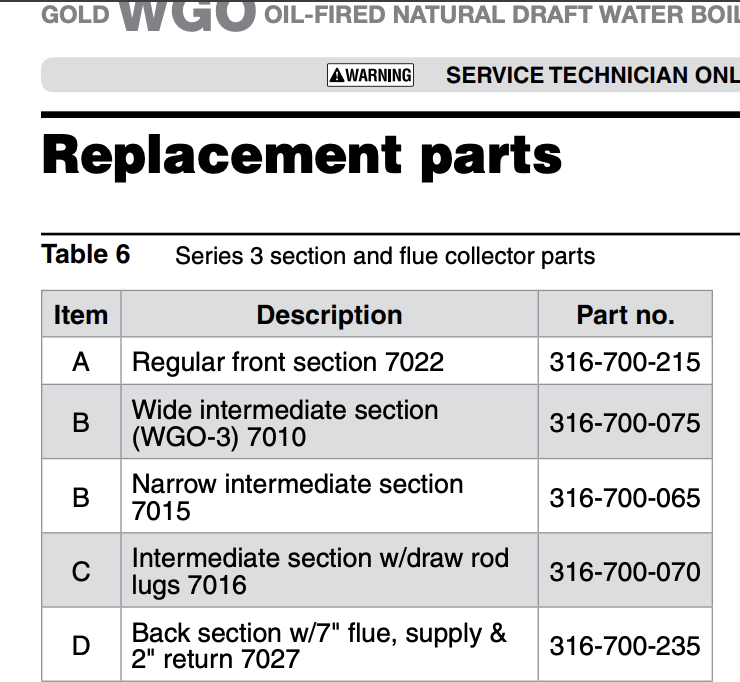
As far as the WTGO 3 and the WTGO 4 is concerned, there is a larger (or thicker) center section on that 3 boiler so it is about the same size combustion chamber as far as the firing rate is concerned, but there is less cast iron in those dimensions so there is more room for water. Looking at the parts list for the WGO-3. there is a different part number for that intermediate section, compared to the standard section on all the other larger sizes
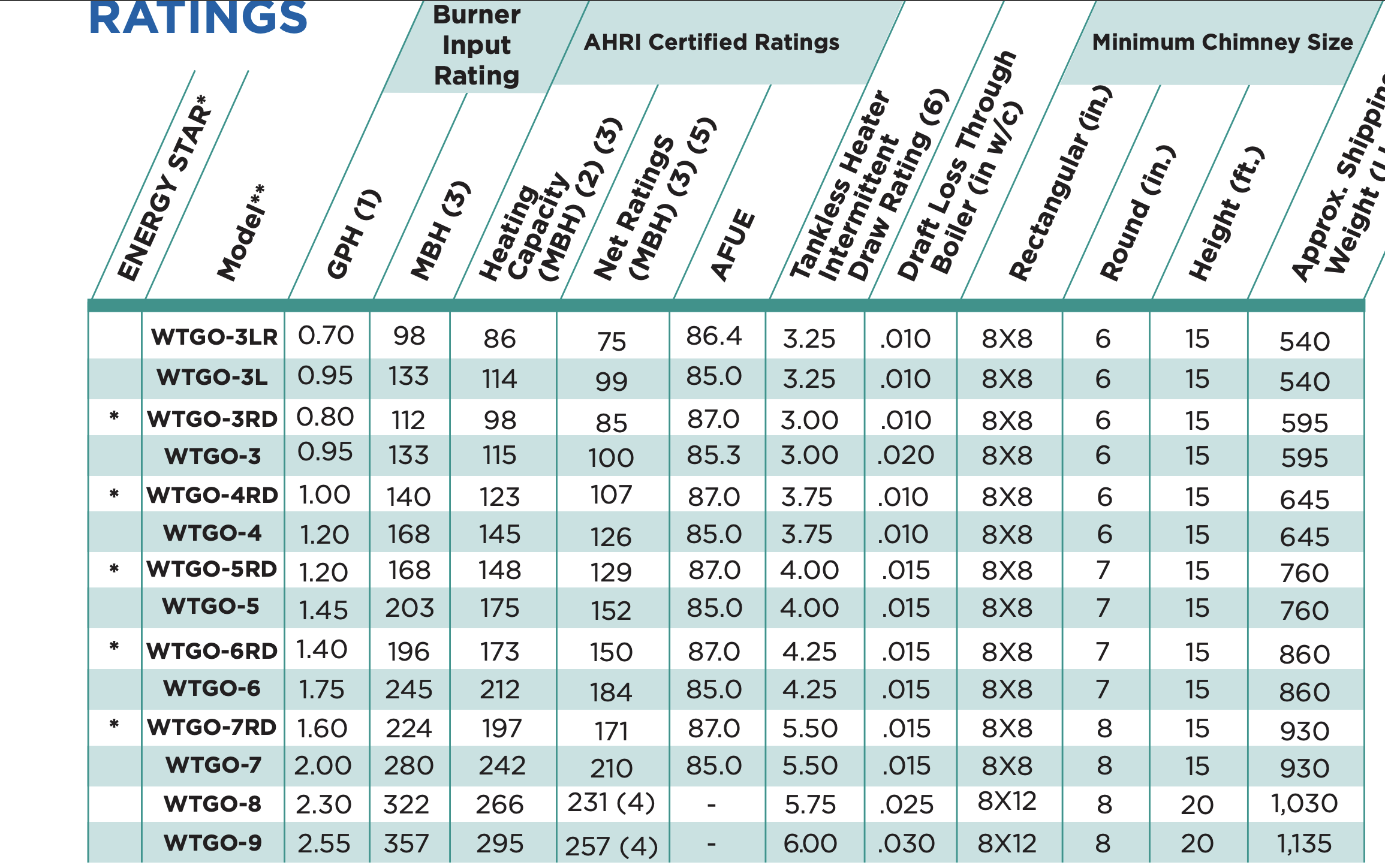
When you look at all the configurations of the WTGO-3 Series 3 Gold boiler, you can fire it as high as 0.95 GPH and as low as 0.70 GPH. That is actually a little more than 20% less than the maximum—more like 26%.
If you happen to get one with a rating plate of WTGO-3LR with a firing rate of 0.70 GPH, you could actually fire it at 0.95 GPH, since Weil-McLain uses that same block of cast iron. However, since the rating plate says 0.70 GPH, you could leave yourself open to a liability issue.
What is stamped on the rating plate supersedes what you can actually do safely.
Edward Young Retired
After you make that expensive repair and you still have the same problem, What will you check next?
 1
1 -
@EdTheHeaterMan said:
"Often, those replacement boilers were also oversized, and that made for poor performance in many cases. When that happened, I would install a nozzle as low as 60% of the rated firing rate and see what the stack temperature was. If it was 350° or higher, I would leave it there and call it a success. "
Ed, this is what I've been trying to get someone to do for us for the last 10+ years. Maybe you can call our service manager and tell him it's OK…
0 -
You might need to do this yourself. I installed an oversized boiler in a home once on purpose. The supply house had this boiler in the warehouse for over 8 years and marked it down so low that it was less expensive than the correct-size boiler.
I put it in and fired it at the proper firing rate for the load. This was new construction, and the job worked great for 8 years. I sold my business, and the technician for the new business owner read the label on the boiler and fired it at the proper nozzle size according to the boiler rating plate. I never left any information to the contrary, so the technician didn't think there was anything wrong with changing the nozzle size.
As a result of the confined-space dimensions for the larger firing rate, and the fact that I had also downsized the exhaust vent connector for the power vent, the burner sooted up the entire house.
The homeowner didn't sue the company that created the soot problem. They sued the company that installed it, and since I used my own name for my corporation name, and since the judge was a personal friend of the homeowner, I lost the case even though I was no longer in business and the company that sold the boiler to the customer had been sold to another business.
My insurance agent was smart enough to include completed operations coverage, and the insurance company paid for most of the damage, but I still needed to come up with $1,700 out of pocket.
The judge would not hear anything I had to say about the corporation that installed the job being separate from me personally. That is what can happen in a small town when you are not politically connected and your customer is.
So me telling your oil dealer to do something that got me in trouble is not going to happen. The fact that it will work just fine that way does not hold up in a court of law. And that is what your oil dealer has to look at.
Edward Young Retired
After you make that expensive repair and you still have the same problem, What will you check next?
0 -
The judge didn't have to listen to you. The installation manual has ⚠️ and 🚫 and ❗️and 💣 all over the place about safety and adhering to manufacturer specs. The corporation was seperate from you, but the installer and alteration maker was you. Own it.
0 -
I don't agree with this, without more data. Calling it 'good' because the stack temp is 350° isn't conclusive. What about excess air, draft, and CO? It's not hard to get any burner to run at 350 stack. The excess air could be 100% and CO could be in the hundreds…not good at all. If someone got sick or died, or some other disaster, you calling it good, will easily cost you in court.
And in the case of an AFG, you probably have the wrong end cone in there.
Downfiring, thinking you are saving oil, by sacrificing efficiency and ignoring manufacturer's specs is not the way to go. If you can't get a small enough boiler you need a buffer. Anything else is unprofessional. The late, great Jim Davis proved this over and over again with real world data.0 -
This is one reason I always carry a labelmaker, and use it to put the nozzle size, type, spray angle, spray pattern and pump pressure on each burner- example from the other day, 0.75X60W, 140 PSI. Doesn't matter what the original spec was, especially since some spec'd nozzles are no longer available (Hago ES or P, Monarch AR etc). Each burner gets a label. That way the next person knows what they're looking at.
0 -
@EdTheHeaterMan Thank you for sharing your hard-earned words of wisdom re downfiring. While I am not a heating pro, as a (now retired) mechanical engineer I also did some things professionally that were, in retrospect, probably not a good idea, but fortunately did not result in me being sued.
I would love to get a Testo and learn how to safely "do it myself," and as I have several years' worth of data on annual oil consumption vs. HDD's, I'm confident I could get good data on, say, a 60% downfired boiler (vs. our current 80%) and prove conclusively whether or not that increased our overall system efficiency. I'm rather surprised that such an important subject of debate (downfiring) has apparently impassioned experts arguing on both sides (some saying it increases efficiency, some saying it decreases efficiency), with apparently very little published data to back either conclusion.
Maybe the right answer is "it depends," as some experts seem to say that in their experience, downfiring has decreased the efficiency of the systems they downfired. @Jim Davis seems to be in that camp. While others say that in their experience, downfiring has increased efficiency. Is it possible both can be right, and the results depend on the particulars of the boiler in question? This debate sounds a bit like the proverbial blind men arguing about whether an elephant is like a tree (from feeling its legs) or like a rope (from feeling its tail).
Unfortunately my own experiments with our "elephant" will have to wait until next heating season.
0 -
@jesmed1 has a point. There are some boilers where a model with a certain number of sections can be fired at different rates from the factory. Here is one example:
https://dunkirk.com/wp-content/uploads/2026/08/700000025-EWC-Dunkirk-Sell-Sheet-08-14-26-WEB.pdfIn this example, firing at a lower rate either makes no difference in efficiency, both thermal and AFUE, or slightly increases it. One would think that if the lower rate resulted in less short-cycling, there would be less wear-and-tear on the unit.
0








Categories
- All Categories
- 87.8K THE MAIN WALL
- 3.3K A-C, Heat Pumps & Refrigeration
- 59 Biomass
- 430 Carbon Monoxide Awareness
- 133 Chimneys & Flues
- 2.2K Domestic Hot Water
- 6K Gas Heating
- 124 Geothermal
- 170 Indoor-Air Quality
- 3.8K Oil Heating
- 79 Pipe Deterioration
- 1.1K Plumbing
- 6.7K Radiant Heating
- 396 Solar
- 16.1K Strictly Steam
- 3.5K Thermostats and Controls
- 56 Water Quality
- 51 Industry Classes
- 51 Job Opportunities
- 18 Recall Announcements