Home boiler losing water when in use

My home heating system: oil-fired Peerless WBV-04-SPL boiler with Beckett AFG series burner. Boiler was installed Jan. 2017 & is a combined hydronic and single-pipe steam system (see attached pics). Steam radiators heat the original 2-story house (built in 1943). Hot water baseboards heat a kitchen-family room on first floor and 1 upstairs bedroom (new addition to house, built 2004). The original asbestos insulation on steam pipes was removed prior to our buying the house in 1990. After doing some reading on steam systems this past year, I will be installing fiberglass insulation on all exposed steam pipes this fall (better late than never!).
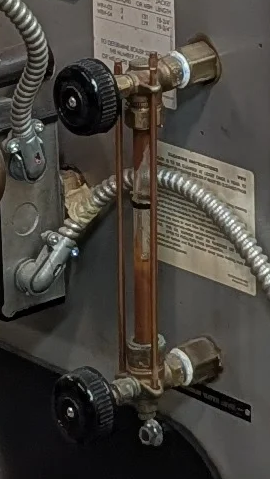
My problem: During last winter's heating season, the boiler was losing water at an alarming rate (~1/2" drop in sight glass every 1~3 days, depending on heating demand). There is NO water on floor under boiler, nor do I see any evidence of leaks (liquid or steam) in the boiler components, exposed pipes, baseboards or radiators. The boiler hasn't lost any water while inactive over the summer. Within the last 3 years, I replaced old main vent valves (visible near top of boiler pics) with Gorton No. 1's. When I'm in the basement (my "office"), I will occasionally hear the valve on the left vent, but not very often. All radiators are fitted with Varivalve vents (Heat-Timer Corp., Fairfieldd, NJ), except for the radiator in the upstairs master bedroom. I fitted that radiator with a Gorton "C" vent, because that radiator was VERY slow to heat.
The only "clues" I have been able to identify as a possible leak in the system are: 1.) The radiator in the upstairs master bedroom stays cold until the boiler has been generating steam for awhile (at least 30-60 minutes, sometimes longer), at which point the Gorton "C" vent valve will (loudly) start venting, after which that radiator gets extremely hot. 2.) The wood flooring around the supply valve to that upstairs master bedroom radiator is discolored (see attached pics).
Could there be a problem with the supply valve to the problematic upstairs master bedroom radiator, or could there be a leak in the connection under the flooring to that valve that would account for the water loss? What would be the best approach to finding the cause of the excessive boiler water loss? I am mindful that having to frequently add water to my boiler may shorten its useful life. (Our town's water is extremely hard - lots of calcium & magnesium.) The necessity of having to top off the boiler water so frequently also makes it problematic to take trips away from home during the heating season! I plan to contact a steam heating contractor recommended on this site for my area (north-central New Jersey), but thought I'd solicit advice through this forum first. Thanks in advance for any tips!
Comments
-
P.S. All supply valves to the steam radiators are fully open, however, many years ago (10? 15?) when I didn't know any better, I partially closed the supply valve to that problematic radiator in the upstairs master bedroom because (ironically), at that time that radiator was supplying too much heat, and I mistakenly thought nearly closing the supply valve would reduce the heat. It operated in a nearly-closed position for at least several months, at which point I replaced the vent valve and then opened the supply valve. Dunno if that could have caused any subsequent problems. Live and learn…
0 -
The fact that the boiler has not lost water while sitting is a good sign. The next thing to do is to completely eliminate the boiler as a cause of leaking.
To do this with the boiler switch shut off add water to the boiler (overfill it) until you feel the supply pipe coming out of the boiler get cold. This indicates that the boiler if filled above the top. Then shut the water down and let it sit overnight if possible. If after this, you see no water in or around the boiler then the boiler is ok. 9 years old it shouldn't be leaking.
If the boiler is not leaking then it is either air vents, supply valve packings or other leaks to search for.
 1
1 -
Well… a half inch drop in two or three days really isn't all that much — though it's more than one would like. However, that is a small enough loss that it's going to be a bit hard to find! You are not likely to find a puddle anywhere — in fact, it's rather likely that you won't even see a drip, since I'm going to bet it's one of two groups of things. First, and most likely, is the radiator valves — the packing has a way of getting tired. Particularly on that upstairs one, it might be worth giving a bit of a twist to the packing nuts.
The second is a vent or vents not really closing all the way — and that can be VERY hard to pin down. Sometimes holding a mirror near the vent when it is supposed to be closed can show some vapour clouding…
On that upstairs radiator — it almost sounds as though there might be condensate pooling in the piping to it. Do you hear any sign of hammer or gurgling?
Br. Jamie, osb
Building superintendent/caretaker, 7200 sq. ft. historic house museum with dependencies in New England0 -
I would close the water loop on the tankless for a week then test.
Here in Jersey are you? That does look like a boiler I looked at in past.0 -
@Jamie Hall: Thanks for the response. Thinking about the water loss a bit more, I may have understated it (1" or more in the sight glass over 1~2 days with boiler operating regularly). The water loss seemed to be accelerating towards the end of the last heating season. I remember I was adding water to the boiler virtually every day or two. (If this condition isn't resolved before the upcoming heating season, I think I'll keep a log.) BTW, the makeup water for the boiler (and hydronic system) is from my hot water heater (with a check valve). Is that bad practice?
Regarding the problematic upstairs radiator (delayed heating): When the addition to the house was being built, the runout and feeder pipe for that radiator was in an outside wall. The addition transformed that to an interior wall. Due to construction exigencies, the plumber replaced the original cast iron takeoff / feeder pipe for that radiator with 1-1/4" IPS copper pipe (see attached photo). The new copper runout/takeoff has an 18" section (with right-angle bend) that has only a very slight pitch. This contrasts with the original 2" cast iron feeder pipes, all of which angle sharply upwards from the main supply pipe. The plumber assured me at the time that the new copper feeder pipe was completely adequate, but within a few years of completion of the addition I noticed occasional gurgling sounds within the wall containing that copper feeder run …also occasional ticking and maybe very slight banging from time to time. The "banging" sounded to me more like a pipe expanding and moving against a strap or other securing hardware. I haven't heard those noises since I installed the Gorton "C" vent on that radiator ~3 years ago.
Interestingly, none of the VariValve vents I installed 10+ years ago on all other radiators have ever made any noise. They are all in the fully open position. Other than the large radiator in the upstairs bedroom, all radiators seem to heat up reasonably fast…it's not a big house.
As I mentioned above, I'll be insulating the mains and other exposed takeoffs in the basement soon…might this help the recalcitrant radiator?
Couple more notes:
1.) I conversed with Gemini and checked my pressuretrol settings. The front cut-in was set to 0.5 PSI (good), but the cutoff was set to 2 PSI. I dialed the cutoff back to 1 PSI. Hope that's correct. Gemini also advised that my pigtail tube for the pressuretrol MIGHT be clogged after 9 years use with very hard water. The existing 0-30 PSI pressure gauge typically reads 1~1.5 PSI when the boiler has steam, but how accurate is that reading? (Not).
2.) Over the past 9 years since this boiler was installed, there have been 2 or 3 instances (that I'm aware of) that the pressure gauge crept up to almost 5 PSI and the system cut out. I have no idea what caused those high pressure events, except they happened when the boiler was running hard.
0 -
@EBEBRATT-Ed : Am taking your advice, filling boiler to brim (can't use the "cold" feel on the fill pipe, as the make-up water comes off my hot water heater…dunno why they installed it that way, I guess it was a legacy thing(?)
0 -
@Snowmelt - Good idea, and will try that after I explore some of the other suggestions made by others. Maybe you have seen my boiler…I used Dixon Energy's annual PM service up until this last spring, when we switched to HOP Energy. I understand all these companies contract out the service work…
 1
1 -
The combination of that relatively small coper pipe (the difference between inch and a half and inch and a quarter is bigger than it seems) which is nearly flat pitch and the large radiator is not doing you any favours at all. Oddly enough, you might actually find that it heated better with a smaller vent. Sounds sort of backwards, but it wouldn't hurt to try it.
It is surely worth looking for other possibilities — but I still have a suspicion that your leak may be a combination of various very small leaks, such as around valve packings, as I suggested. One way to look at it is to remember that one drop of water every minute adds up to about 2 quarts a day — and one drop of water on a steam pipe is not going to be noticeable at all.
Br. Jamie, osb
Building superintendent/caretaker, 7200 sq. ft. historic house museum with dependencies in New England1 -
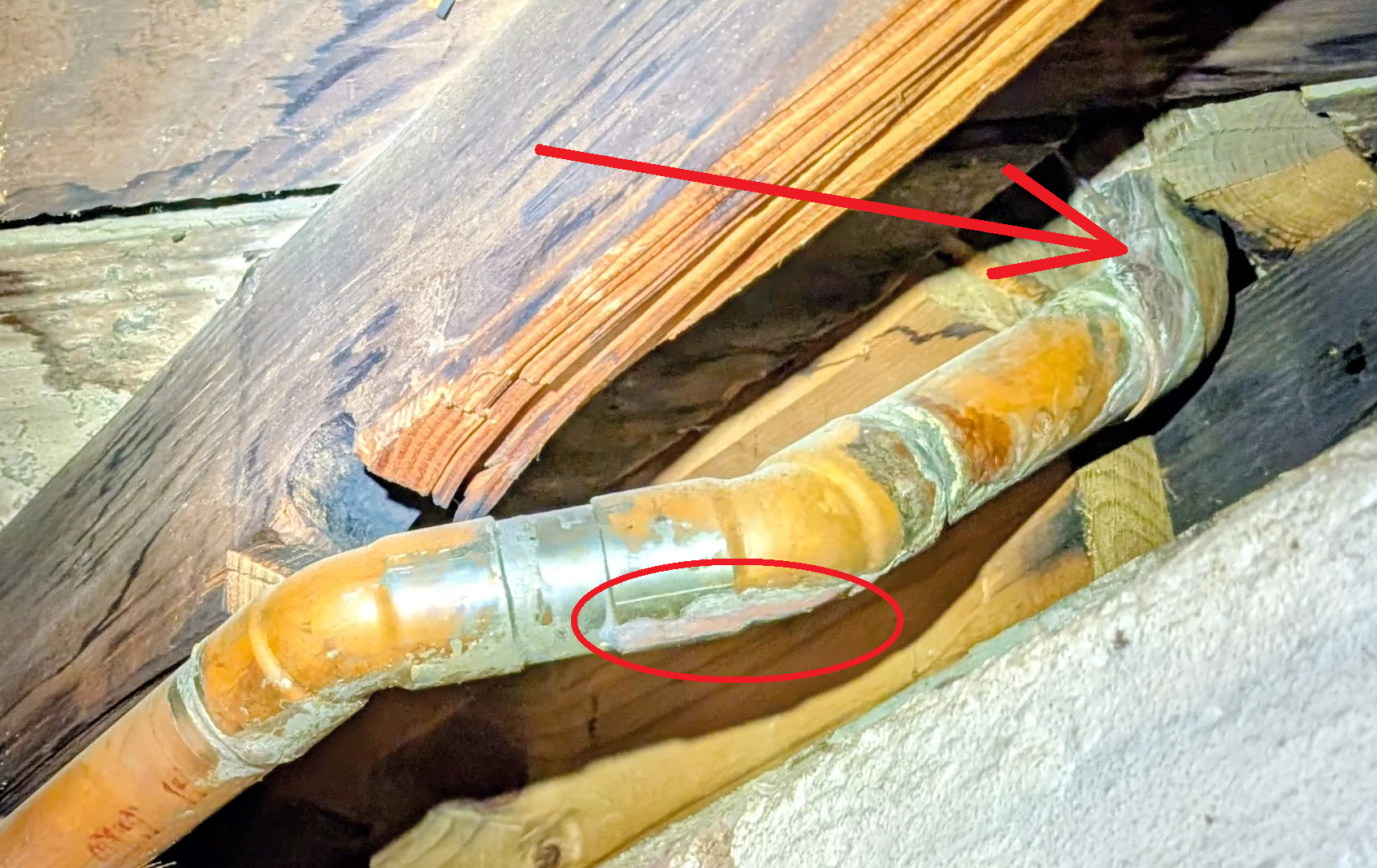
Looks like a leak to me.
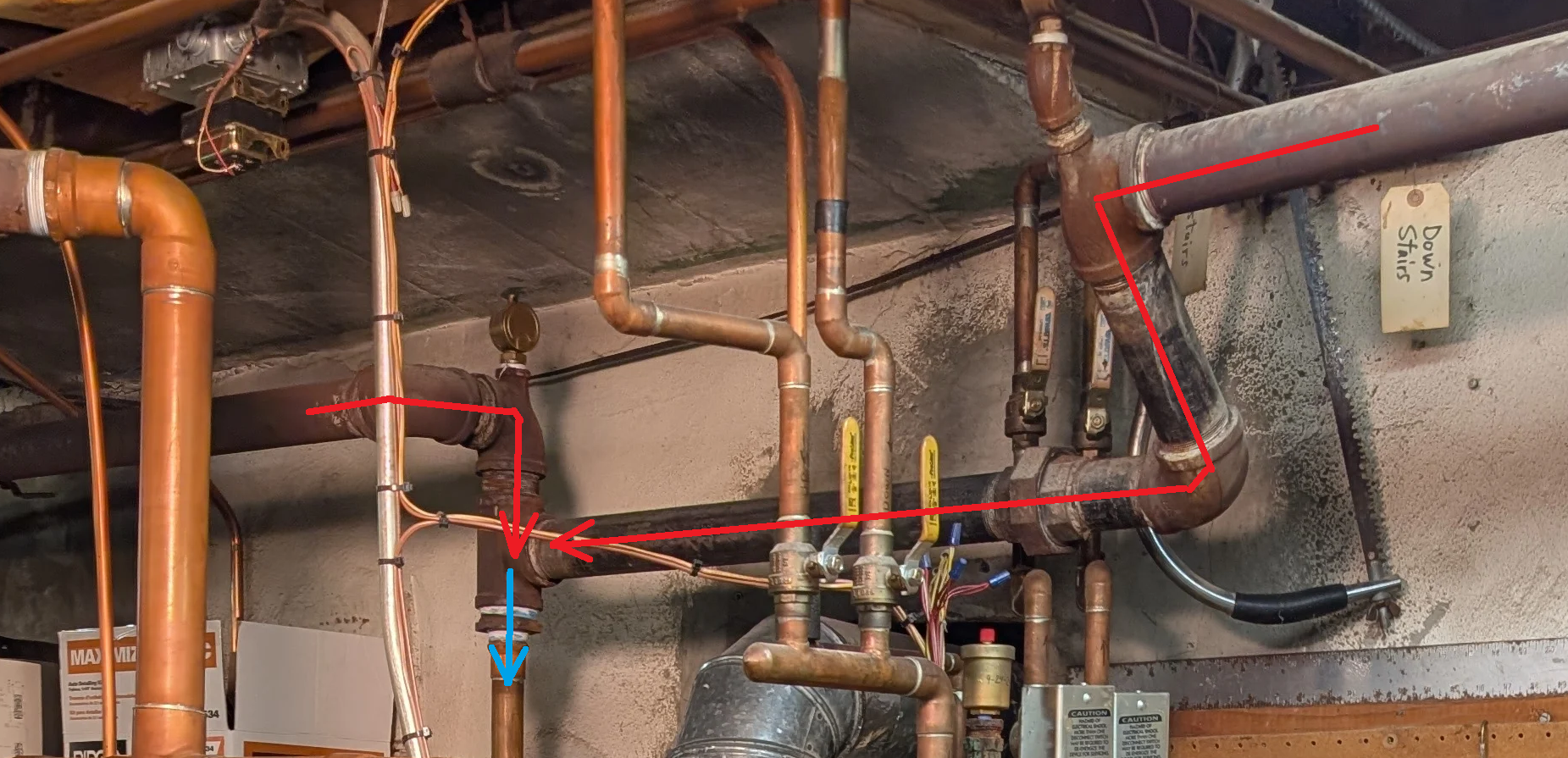
Not fond of this configuration at the end of the Steam mains, it can trap air in one of the mains if the other main is faster and closes both main vents. Then the remaining air has to be bled out of the radiator vents. The Left main drip is OK, the Right main should have its own drip so they are actually connected below the boiler's water line. The two main ends should not be connected above the water line like they are now.
Insulation will help unless you want the heat in the basement. I would insulate the mains (better Steam performance), if you need basement heat maybe use a hydronic loop.
National - U.S. Gas Boiler 45+ Years Old
Steam 300 SQ. FT. - EDR 347
One Pipe System 2
2 -
@109A_5 : Thanks for your observation regarding a leak in that feeder branch for the upstairs bedroom radiator. Thinking back, the plumber for the addition work never leak-tested that re-work of the branch with live steam (unlike the boiler installer). I suspect a connection to the supply valve, where the surrounding wood flooring has mysteriously darkened (see photos accompanying original post). Not looking forward to cutting into flooring to investigate…
Regarding absence of a dedicated drip or the right mains return…the configuration dates from the original house construction (1943), when the boiler was coal-fired…maybe customary?
I'm gonna insulate the mains in the basement. (Maybe turn the basement into a high-capacity seasonal freezer?) If the leak persists and no other culprit than that branch pipe to the upstairs bedroom radiator is found, I reckon I'll have to bite the bullet on some demo work to find and fix. Having to add (very hard) water to the boiler almost daily sucks.
0 -
@109A_5 : From this website: "Fresh water contains lots of oxygen, and oxygen causes corrosion, which shows up as rusty water. Feed water also contains minerals that will settle out when you heat the water. Those minerals (mostly calcium and magnesium) form a rock-hard scale that can quickly clog your return lines. That forces water up into the returns where it meets steam and creates water hammer. The water hammer can dislodge even more corrosion, which eventually washes down to the boiler and discolors the water. When these things begin to happen, dirty water is usually the least of your problems. Find the source of the excess feed water and get rid of it."
My friend, I have been adding so much (very hard) water to this boiler recently there is little wonder that the water is dirty. I am trying to prioritize.
0 -
If possible you may want to go in the same way the plumber installed the copper piping. Especially since the pipe pitch also may be incorrect trapping water and restricting the steam flow " but within a few years of completion of the addition I noticed occasional gurgling sounds within the wall containing that copper feeder run "
That pipe configuration at the end of the mains may be less problematic with Coal, Coal did not have the On-Off cycling like Oil and Gas fired boiler's do, so possibly less air cycling in and out of the system with Coal. Paying for fuel to push out trapped air every cycle that should be quickly purged out by the main venting is not good in my opinion.
Depending on the weather my basement is about 56 degrees in the winter. If I improved the house's envelope it would probably be a bit better. My steam pipes in the basement are about 98% insulated.
National - U.S. Gas Boiler 45+ Years Old
Steam 300 SQ. FT. - EDR 347
One Pipe System0 -
Leaks add up fast. I had a single radiator that would leak steam due to a failed push nipple between two sections. When the boiler made pressure you could hear a slight hiss and maybe see a bubble every now and then. No water made it to the floor.
In the coldest part of the winter I'd be adding 1-1.5 inches of water to the boiler weekly. I fixed the leaking section and now I barely add any water at all.
If it weren't for my old float-style LWCO that requires blow-downs, I'd probably just top it off a few times per season.
And Rectorseal 8-way is going to be your friend for cleaning that boiler up, and keeping it clean.
0 -
Good suggestion regarding where to "break in" to investigate and maybe re-work the suspect branch feeding the upstairs bedroom radiator. That area would be a relatively narrow section of drywall on the first floor (which of course was entirely open to the studs when the plumber installed that feeder pipe, as was the ceiling). Easier to restore drywall as opposed to the hardwood flooring around the radiator supply valve, although - if the issue is the connection to the radiator supply valve, the ceiling below that area might also need to be opened up. Oh joy…
FWIW, I over-filled the boiler last night (to about 6" above the entire boiler casing). No sign of any water on the floor under or near the boiler (it sits on cinder blocks). I don't know how effective this test might be for revealing possible pinhole leaks in the boiler, but I think I'll just let it sit there for another day.
0 -
Sounds like the boiler is fine. A few small leaks in the system can add up. Use a mirror around the air vents and valve packings. If it fogs up steam is leaking. You may not be able to see steam leaks but steam is water loss
0 -
@EBEBRATT-Ed : appreciate the mirror tip. Will do that during breaks shoveling snow, assuming climate change doesn't cancel winter here in NJ. :)
0 -
With the leak evidence at the radiator and in the basement I'd say that is a good sized leak. I'm thinking there is a poor solder connection that failed and is getting worse over time. I'm also thinking your plumber did not do you any favors using copper.
Either the pipe run is made so the expansion and contraction with heating and cooling pulled a joint loose. Or he may have been worried about burning the house down with the torch work, so his craftsmanship suffered. With black pipe you don't have these issues.
National - U.S. Gas Boiler 45+ Years Old
Steam 300 SQ. FT. - EDR 347
One Pipe System0 -
@JerseyBoy To echo what @109A_5 said….copper is not the best material to use as a steam conduit. It is allowable but black pipe is much more durable.
The copper expands and contracts rapidly and the solder joint is usually fail over time. Might last months or years, never know…but we see it here all the time.
Most plumbers and HVAC guys these days are more used to working with copper than black pipe. If you are going to have that section of pipe replaced….consider replacing as much as you can with black pipe.
0 -
@AdmiralYoda & @109A_5 : My Dad always said I had a tendency to learn things the hard way. When we did the addition to the house, I was unaware of steam system basics. FYI, I just placed an order for insulation materials (Owens-Corning 1" thick fiberglass) for all the steam pipes & fittings in the basement ($850, including $95 for shipping - ouch!). Maybe earn that back in a few years via reduced fuel oil consumption - or maybe quicker if the current oil supply shortages persist :( I'll (reluctantly) tackle some small plumbing repair work, but it takes me 5 times as long as a plumber would need to do the job. Frozen fittings and torch work in tight quarters is not my forte. I must say our town's hard well water really shortens the life for hot water taps and valves. I did have that plumber replace some old galvanized pipe with copper and also replace all the compression shutoff valves with ball valves, but even those ball valves are starting to be recalcitrant. arrgh.
0 -
Jersey boy I’m going to leave you an email
0 -
if the tankless coil is leaking it would gain water, not lose it.
also, it is using the tankless coil as a heat exchanger for the hot water loops so not only would the tankless coil have to be leaking but the hot water loops would also have to be leaking and at 0 psig at the boiler which won't happen unless the loop is drained to near the level of the boiler.
 1
1





Categories
- All Categories
- 87.8K THE MAIN WALL
- 3.3K A-C, Heat Pumps & Refrigeration
- 60 Biomass
- 430 Carbon Monoxide Awareness
- 133 Chimneys & Flues
- 2.2K Domestic Hot Water
- 6K Gas Heating
- 124 Geothermal
- 170 Indoor-Air Quality
- 3.9K Oil Heating
- 79 Pipe Deterioration
- 1.1K Plumbing
- 6.7K Radiant Heating
- 397 Solar
- 16.1K Strictly Steam
- 3.5K Thermostats and Controls
- 56 Water Quality
- 51 Industry Classes
- 51 Job Opportunities
- 18 Recall Announcements