Repiping and preparing for new boiler in CI rads 2 unit building

Hi All,
I have an about 1600 SQ ft up/down duplex with a single old boiler system that I'm assuming was originally gravity fed (2" main trunks, very oversized radiators, etc) that is running on a 1/12HP pump now. I pay the gas bill for the building - no separate gas services and I don't really want to go down that rabbit hole of splitting it.
I'd like to repipe the basement to get the giant piping out of the way for future finished space, as well as to gain some more control over the system. This will include moving the boiler to a new location as well.
I was thinking of installing 2 manifolds with flow meters, one for each apartment, piped to a primary/secondary near boiler system following Dan's schematics in Classic Hydronics. This would allow me to possibly control each apartment separately, or just have the option to split them later be much more convenient. I'm also going to be replacing the basement floor and plan to add loops to the new floor for future finished space down there - I want to set up the system with the ability to add that when the time comes (not immediate). It would be part of the 1st floor unit, not a separate unit, but due to the different heating medium, assuming it will need it's own zone.
SlantFin app heat load came in just under 60k BTU (with very conservative estimations for some things - I think it is probably under 50k in reality), not including the basement expansion. Here's a breakdown of the current radiators:
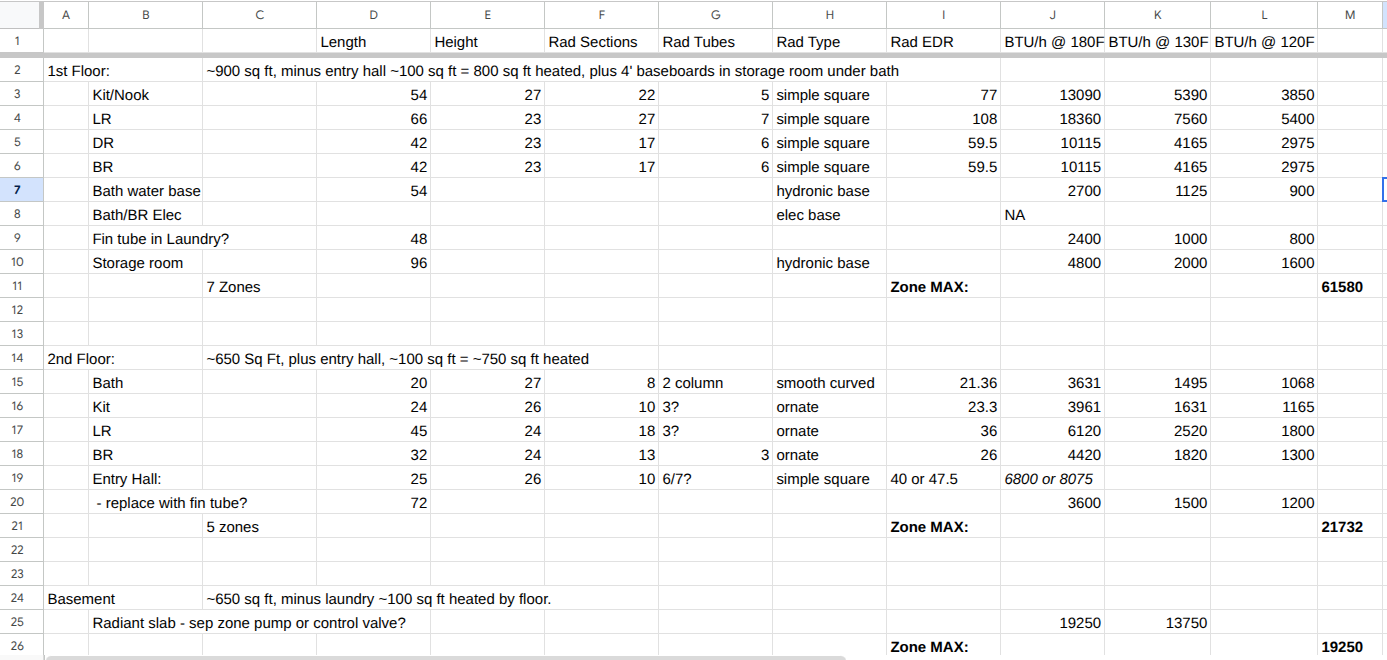
With my large available radiation, it seems like I could design closer to 140 degrees like an old gravity system than 180 degrees. The system short cycles like crazy with the current 100k output boiler.
Hopefully that is enough context, but please ask any clarifying questions…
What I'm looking to do right now is determine if the 2 manifolds setup is a good plan, and start running piping and setting up the manifolds etc to prepare for a boiler replacement/move in the near future.
Do you think a couple of manifolds setup makes sense? If so, are Bluefin manifolds worth considering (I hear they're identical to Rifeng), considering the dramatically lower cost than Caleffi, Uponor, etc? The building is currently pretty evenly heated, with most of it within a 1-2 degree window - would the flow valves be enough to dial it in reasonably well in this new setup with much smaller basement piping/new boiler location? Would 1/2" hepex or pex-al-pex be sufficient (maybe upsizing for the one giant radiator), or do I need to go larger?
What kind of boiler, separators, etc would you suggest for this setup? My interest is to keep maintenance low, system longevity high, and costs (primarily long term costs, but upfront is always a concern as well) reasonable. Not sure what balance to use of new tech bringing higher efficiency vs simple old setups that are a lot cheaper up front and tend to have less issues/last longer, but higher operating costs...
Pump(s)? The longest run would be about 45 feet of pex each way to connect on to existing 3/4" steel risers that go up one floor (about 10' each way) to the 2nd floor LR rad.
Anything else I'm missing ATM, or suggestions of a different route entirely?
Thanks in advance!
Comments
-
This is the current rough layout, if it helps. Main trunks are 2", slowly stepping down as you get away from the boiler.
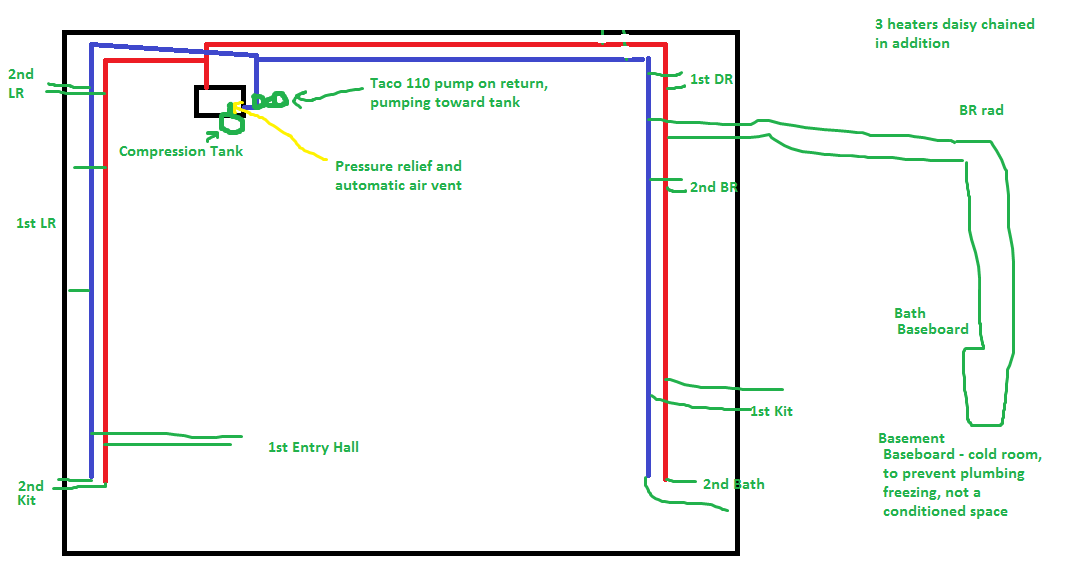
New layout puts the boiler right under the 1st Kit supply/return. I also plan to split the BR rad at right onto it's own loop, then run the bath fintube, followed by basement fintubes, on a separate run - the basement is just to keep the addition area warm enough to not have frozen pipes in the bath above it, and this should be sufficient w/o a separate circuit. This area is slightly colder than the rest of the building, so think that making the bath fintube get full temp water will help balance that better.
The eventual basement additional heated floor zone will be about 3/4 of the main square floor area - all but the bottom right which is a laundry/utilities/storage area that already has a new concrete floor and won't be directly heated. For now, just want to be ready to add this on later w/o changing out controllers and totally repiping the near boiler/main trunks to do it. It likely won't be activated for a few years.0 -
Sounds like the boiler may be at least twice the size you need ?
Those large pipes acted as a buffer tank, if you start zoning and reduce the system volume and steel piping mass, you may run into worse cycling issues. Which can really drive down boiler efficiency and cause cold run cycles
Is there a boiler upgrade in the future?
If you do install some radiant and the current rads could run down to 140, a mod con would be a good match both for modulation and low temperature efficiency
Bob "hot rod" Rohr
trainer for Caleffi NA
Living the hydronic dream0 -
Yes, I think it is about double the size it needs to be for the current load (a little less oversized factoring in the radiant slab future zone in basement).
Yes, def going to lose some volume/buffer. I do indeed plan to replace the boiler - what I'm trying to do right now is get the piping run to the new location and start setting up for the new boiler. The existing one won't be moved. I've been thinking about this project for a long time, and a while back someone suggested an HTP Pioneer to create some volume in the boiler and retain a simple but efficient boiler design. I don't know much about specific boilers, but that seemed like a reasonable line of thought…
I figured if I can get all the piping run to right next to the risers, the manifolds, pumps, separators, refill valve, etc (maybe even boiler itself) all set up, then when it's time to swap over, its a pretty quick and easy job - mostly connect the PEX to the risers and fill up etc. I figured a lot of this is just manual labor that an experienced plumber like me can do, then have a tech do the final hookup/commission the system and save myself a decent amount on labor. Also, that way I can get all the piping exactly where I'll want it to accommodate the future basement finishing.
As far as running temp - I haven't watched recently, but I don't think it ever ran much higher than 150 degrees before cycling off. Given my Rad EDR/BTU estimates and load calc (just under 60k with very conservative estimates in some instances), it seems like I need a little more than the 130 degree outputs for design day - I don't know how to calculate for 140, (I think I pulled those 3 from a chart), but based on the other 3, it seems like it would fall near there. I also understand a lot of gravity systems were designed around 140 degrees, so that may have been the original design even before added insulation in the home?
For the immediate, I wanted to decide on if the manifolds and home runs will work well, so I can start running them in preparation. I'd love to avoid complications like the flow valves, but guessing I'll need a way to reasonably balance the system. Do you think that setup will be effective with the right boiler choice? Would 1/2" o2 pex or PAP be enough for most of my radiators (maybe bump up the one big boy)? I think that would cover it even at 180* with 3/4" for the big one, but I'd love to aim for much lower design temp. I was looking at the Everhot manifolds as well, but they are only rated for 158 degrees, so I would need to be certain I was designing around 140* to go that route. They're significantly cheaper than the Bluefin and seem to be pretty well rated as well.
As far as piping, I assume I shouldn't bother trying a vertical or inverted manifold setup for best function of the flow meters (I know Bluefin and Everhot do not allow for any other orientation, but some manufacturers do - guessing still not advised?) Just do the U-loops and keep them upright? That will add a few feet to all my piping runs, but no big deal.
Any recommendations for O2 Pex vs PAP? I've never worked with PAP, but done miles of pex potable plumbing and some hydronic floors. Main benefit is just that they stay where you put them better, and a little less expansion/contraction? Is it worth the extra cost/hassle?0 -
One other question… I can't seem to find a cost effective way to do balancing w/o a manifold - the individual valves are far expensive than the all in one manifolds. I would be open to building my own manifolds in order to keep things simpler, possibly even w/o any balancing valves given that the system is pretty evenly heating the building now. But if I were to do that, I think I'd want to have a fairly simple/cost effective way to add in valves on some loops if they're overheating to pull them back down. In principle, I like the simplicity of a setup like that, but don't want the reconfiguration to cause me uneven heating problems. I'm just not sure what impact there will be by changing the main trunk piping, and moving the boiler location, etc. I don't need perfect balance or radiator specific control (my experience with TRVs in apartment buildings is almost everyone turns them all the way up and then leaves them there, even if the room is overheating…), just pretty even heating like I currently have. If I can achieve that w/o balancing valves, that's a bonus to me in the simplicity of the system…
Are there any good options like this that I'm just not finding?0 -
Good plan of action.
- what will the finished job look like?
- try to do as little extra piping as possible that needs to be removed in the future stages of the plan
- start on the most urgent part pf the project first
- be ready to slap something temporary together in October if you don't get finished in time
Edward Young Retired
After you make that expensive repair and you still have the same problem, What will you check next?
0 -
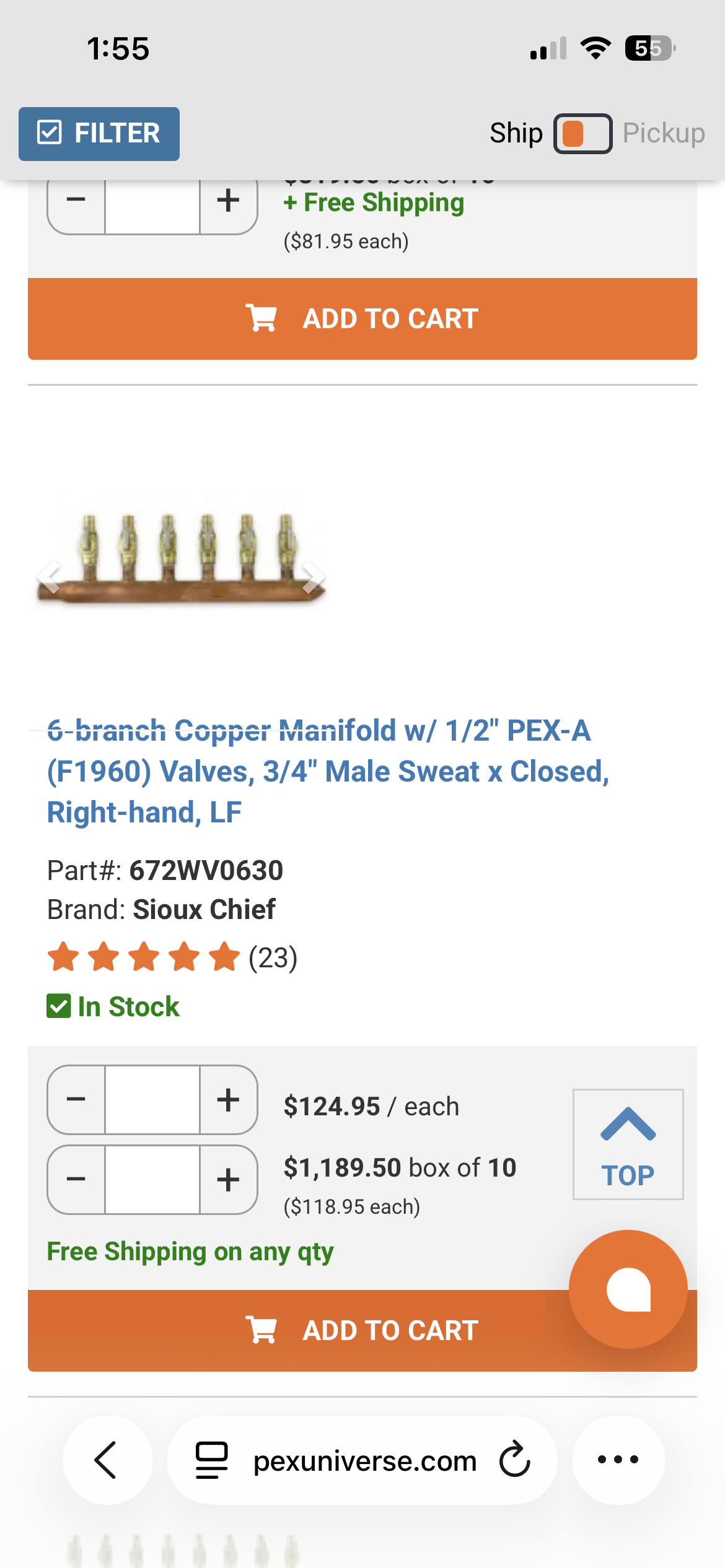
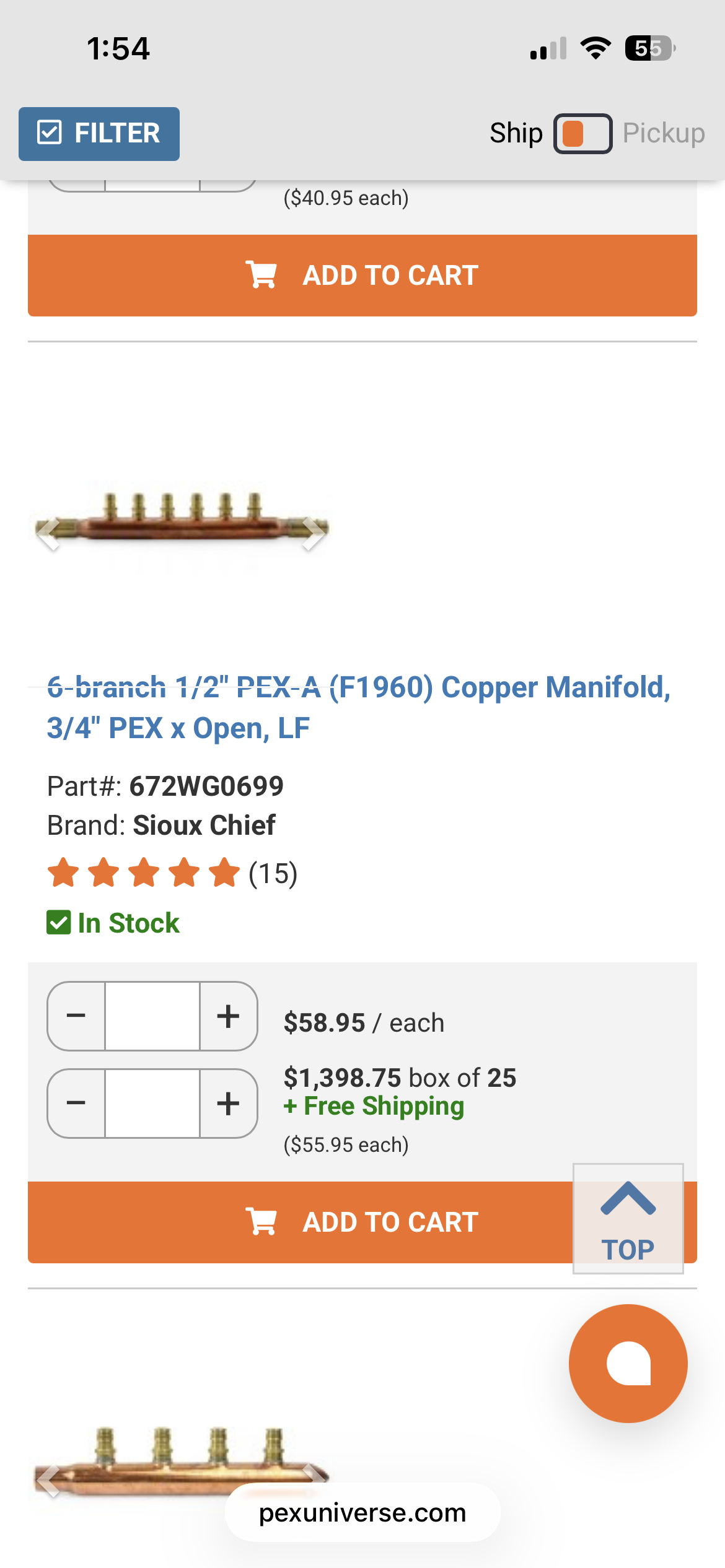
you can buy copper/ oex manifolds, valves on the supply side, just pex adapters on return. That usually works out to be less $$ out
 Bob "hot rod" Rohr
trainer for Caleffi NA
Living the hydronic dream 1
1 -
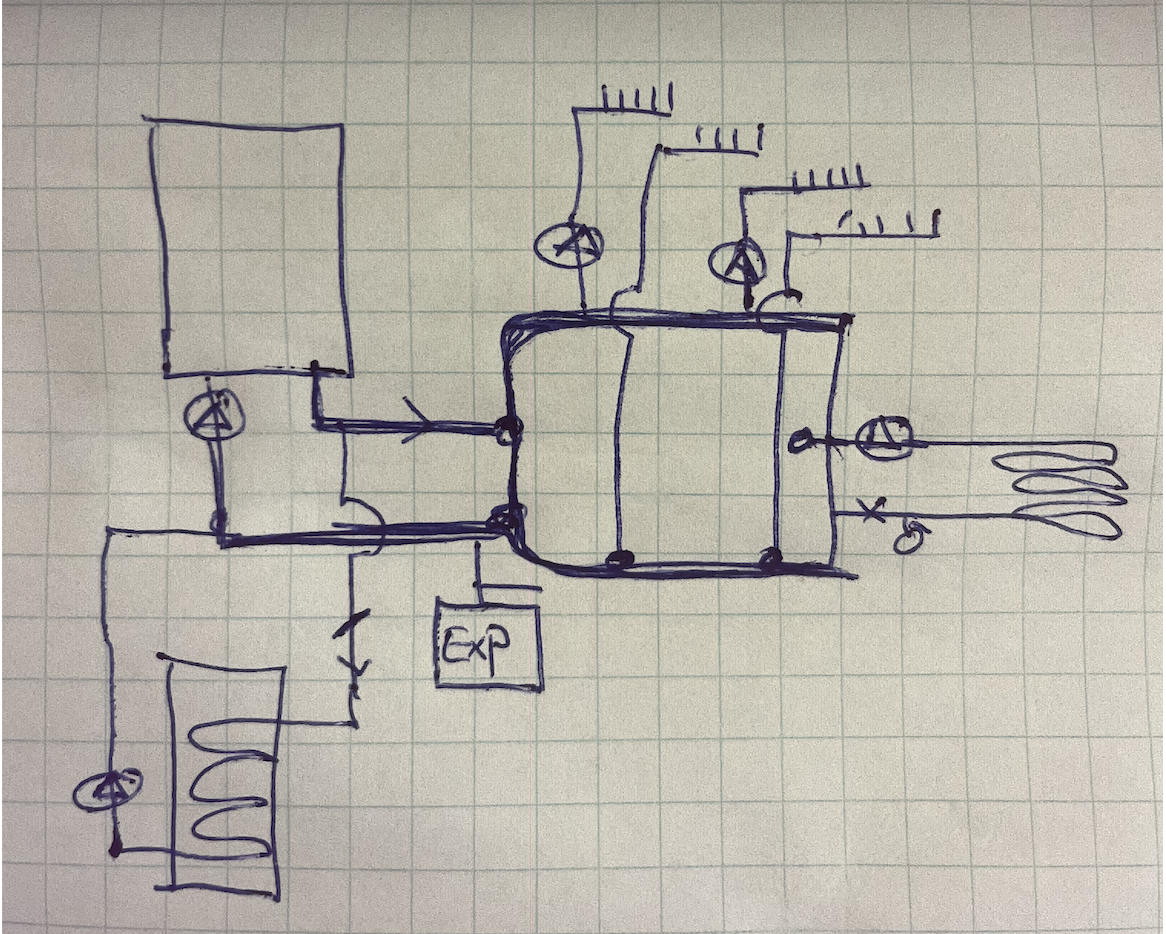
By no means is this what your finished product will look like, but this is a concept of what you mighr look to be doing. after you have this goal then you can implement one stage at time. leaving the existing boiler in place than removing the big pipes and install manifolds for the cast iron radiators
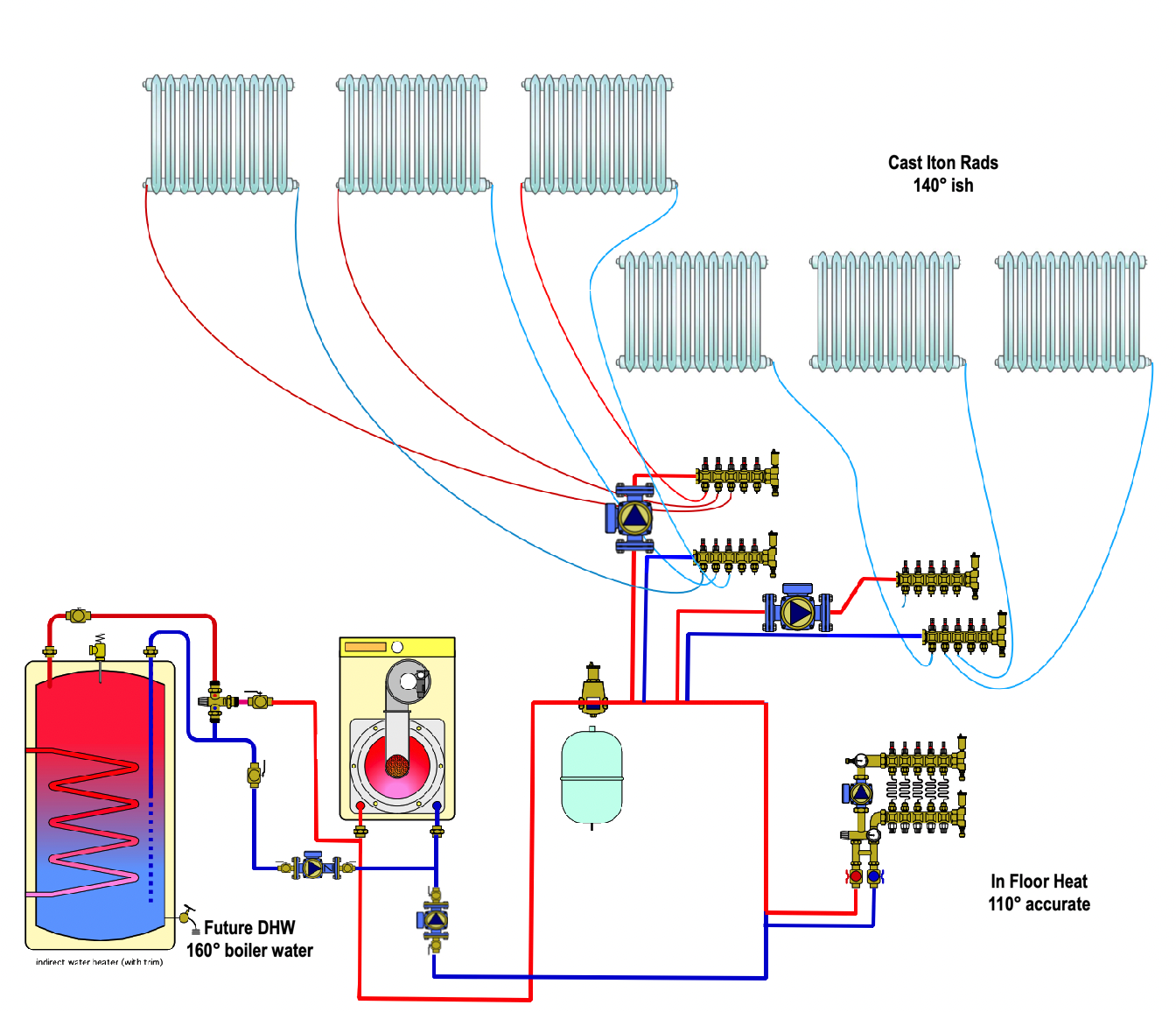
I have used closely spaced tees for hydraulic SEPERATION. There are other ways to design that idea. My idea is that in the future, if you decide to have a indirect water heater on priority the boiler can feed over temperature water to the DHW tank than go back to providing low temperature water when the cal for DHW is complete. the floor heat zone can be more accurately controlled with a mixing pump or mixing valve.
I didn't see the one loop of baseboard hot water heat until my diagram was completed but that is a different kind of radiator altogether and should be on it's own separate zone
Edward Young Retired
After you make that expensive repair and you still have the same problem, What will you check next?
0 -
Thanks Hot Rod. I have used a ton of those for DHW applications (ironically, have one of them at my home leaking now on the factory brazing and considering going to a homemade manifold made out of 1x1/2 tees in a loop arrangement). Do you think there is no real need for balancing in my setup? I'd be thrilled to not deal with flow valves, which I hear tend to be among the least reliable parts in a system like this. Some of my rads have valves on them, some do not… so might be able to do some minor adjustments with those. TBH, I try not to touch them, as I find they leak most times I mess with them and create more problems for me… but could be used as necessary.
Ed, thanks for the schematic. I don't anticipate doing indirect hot water, as I have each unit with it's own electric water heater (they pay for the heating, not me) already. Without splitting to 2 boilers (and adding second gas service), I don't see a value for my situation in doing that. The rest makes sense.Do you have any thoughts on the pipe sizing? Can I get away with 1/2" for all but the big boy radiator? Maybe 3/4 for that one? Or should I do 3/4 and 1"? I'd rather keep the piping smaller if possible, and I think 1/2" has plenty of capacity for all those btu capacities, especially if I'm operating in the 140* range. FWIW, all the existing rads in the house at least end up on 3/4" risers by the end (some start 1" and go down along the run, most are 3/4" the entire way from the main trunks), except the big boy, which is on I think a 1 1/4" set of risers. The house is pretty evenly heated now (other than the 1st BR/BA area being slightly cooler, which I think will be enough just to split those into 2 loops instead of having them in series).
What about O2 pex vs Pex-Al-Pex?
For right now, the most important thing is to start running piping. Next is to start hooking up manifolds and other accessories. I'd like to know what boiler I'm going with, so I can set up the piping best to suit that particular boiler, but less critical. I think I can get just about the entire system set up w/o touching the old system, as it is going in a new location. Then just demo the old pipes and adapt the pex lines (already sitting right there) onto the existing risers, and do the rest of the setup etc. I've even already got a water supply waiting in the new boiler location.0 -
@MTC said: "Do you have any thoughts on the pipe sizing? Can I get away with 1/2" for all but the big boy radiator? Maybe 3/4 for that one? Or should I do 3/4 and 1"? I'd rather keep the piping smaller if possible, and I think 1/2" has plenty of capacity for all those btu capacities, especially if I'm operating in the 140* range. FWIW, all the existing rads in the house at least end up on 3/4" risers by the end (some start 1" and go down along the run, most are 3/4" the entire way from the main trunks), except the big boy, which is on I think a 1 1/4" set of risers. The house is pretty evenly heated now (other than the 1st BR/BA area being slightly cooler, which I think will be enough just to split those into 2 loops instead of having them in series)."
This booklet might be helpful as a quick reference: Zoning Mase Easy. I used it as the Textbook for the one day Hydronics class I used to teach. Iy is good to read it several times in order to get the concepts to sink in. At least that was my experience. There are rule of thumb charts throughout the book and all of them are in the last page. You need to know where the numbers come from and not just use them "because I said so", or "because it is in black and white". The chart about pipe size = BTU comes from some pretty standard stuff but know that those source numbers can change so the chart needs to change.
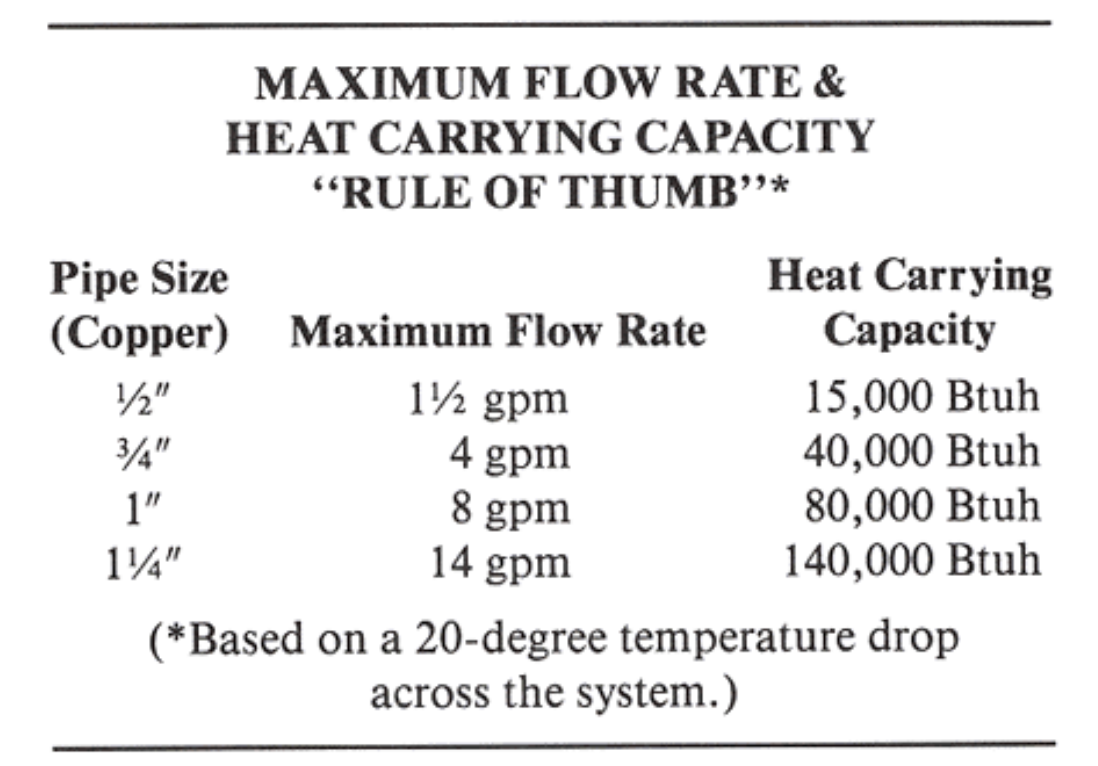
For example in this rule of thumb chart a 1/2" ID pipe cand move about 15,000 BTUh. that is based on a 20° temperature change across the system. If the temperature change is actualy 15° then the BTUh will be different. So you need to understand the charts before you use them as the gospel truth about pipe sizing.
But. to answer your question, a 1" pipe is probably the largest pipe you need in your system since your boiler may not have much more than 80,000 BTUh NET output. That NET number is important ince there are three BTU numbers on a boiler the one you use on the radiator side of the boiler is NET. The one you use on the gas pipe side is Input and the other one in the middle is only there to comapre the boiler efficiency to a furnace (duct work system) efficiency. But that is a whole other class for the afternoon secession not relevant to near boiler and radiator pipe sizes.
The 1/2" pipe can be used for the the runs to each radiator, as long as the radiator is not bigger than a 15,000 BTU output. That would be a pretty big radiator. Also you can
You will want to consentrate on the first few pages of the book for this basic pipe sizing info. However I encourage you to read the entire text for your complete understanding.
Edward Young Retired
After you make that expensive repair and you still have the same problem, What will you check next?
0 -
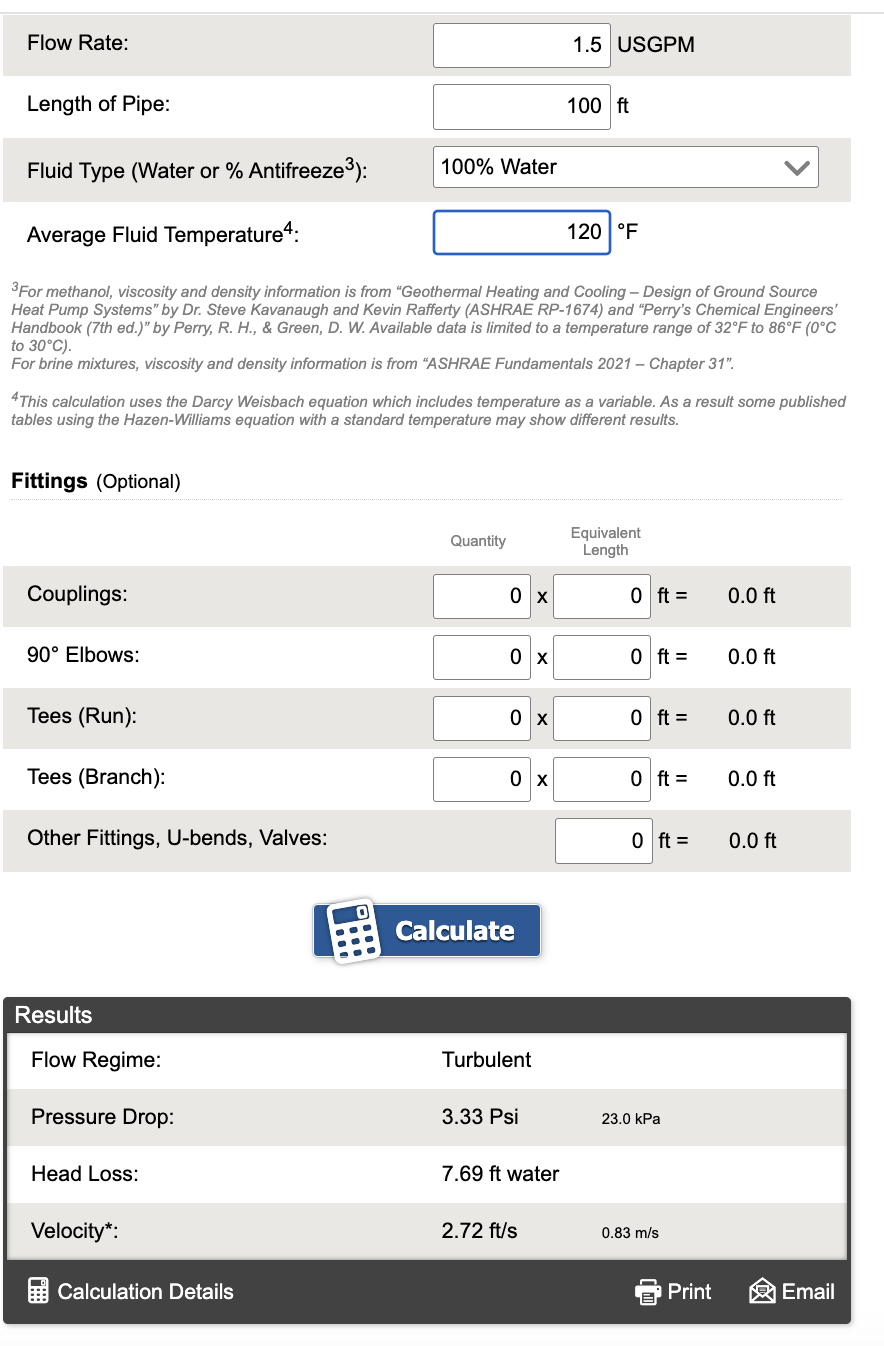
A few more thoughts. Pex ID is a
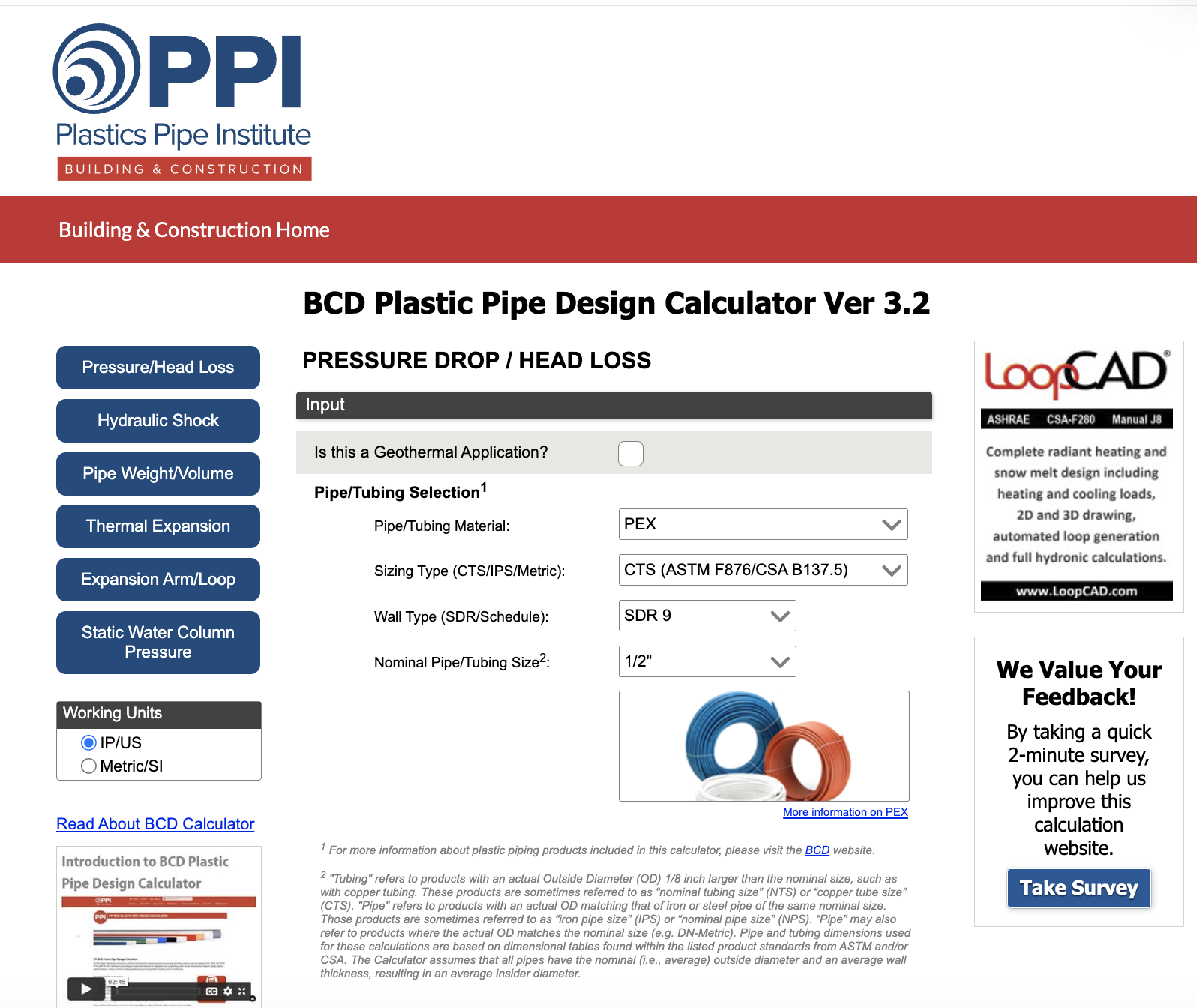
it smaller than copper. Use this free calculator at the PPI website to confirm you numbers. Enter tube, length, and gpm you are considering.
A basic ball valve is fine for minor flow adjustments. If you use an actual $$ flow setter or balance valve you would want some Y strainers to protect them also. Stick with a ball valve pex manifold.
Here is another piping option the Harvey's Horeshoe primartyloop.
This eliminates the series temperature drop and the tricky primary pump size. It takes the boliler out of the primary loop. Loads are parallel so they get the same SWT.
It also puts the indirect directly off the boiler, as a priority and no temperature blending it gets full boiler SWT, and gpm based on it's circulator size.
 Bob "hot rod" Rohr
trainer for Caleffi NA
Living the hydronic dream0 -
Bob "hot rod" Rohr
trainer for Caleffi NA
Living the hydronic dream0 -
I understand that you dont plan on an indirect. I was just using the diagram as an example. you may want to use @hot_rod's Harvey Horseshoe without the option for the DHW. The concept is to get YOUR finished design down on paper and stick to it so you don't end up making something that needs to be completely redesigned as each step of the process is completed.
- Have a plan
- start your piping
- set us the system to run on the old boiler
- next season, replace the boiler
- run the system
- if the baseboard loop is not doing the job then you can look into getting that to work better next season
- run the system
- next season perhaps upgrade the control logic.
- eventually you will have the finished product.
You may use hydraulic separators and not use closely spaced tees (Primary Secondary) piping. Just have a plan and stick to it.
I have just seen myself change a system and completely redesign the the piping based on an idea that was not well thought out in the first place.
Edward Young Retired
After you make that expensive repair and you still have the same problem, What will you check next?
0 -
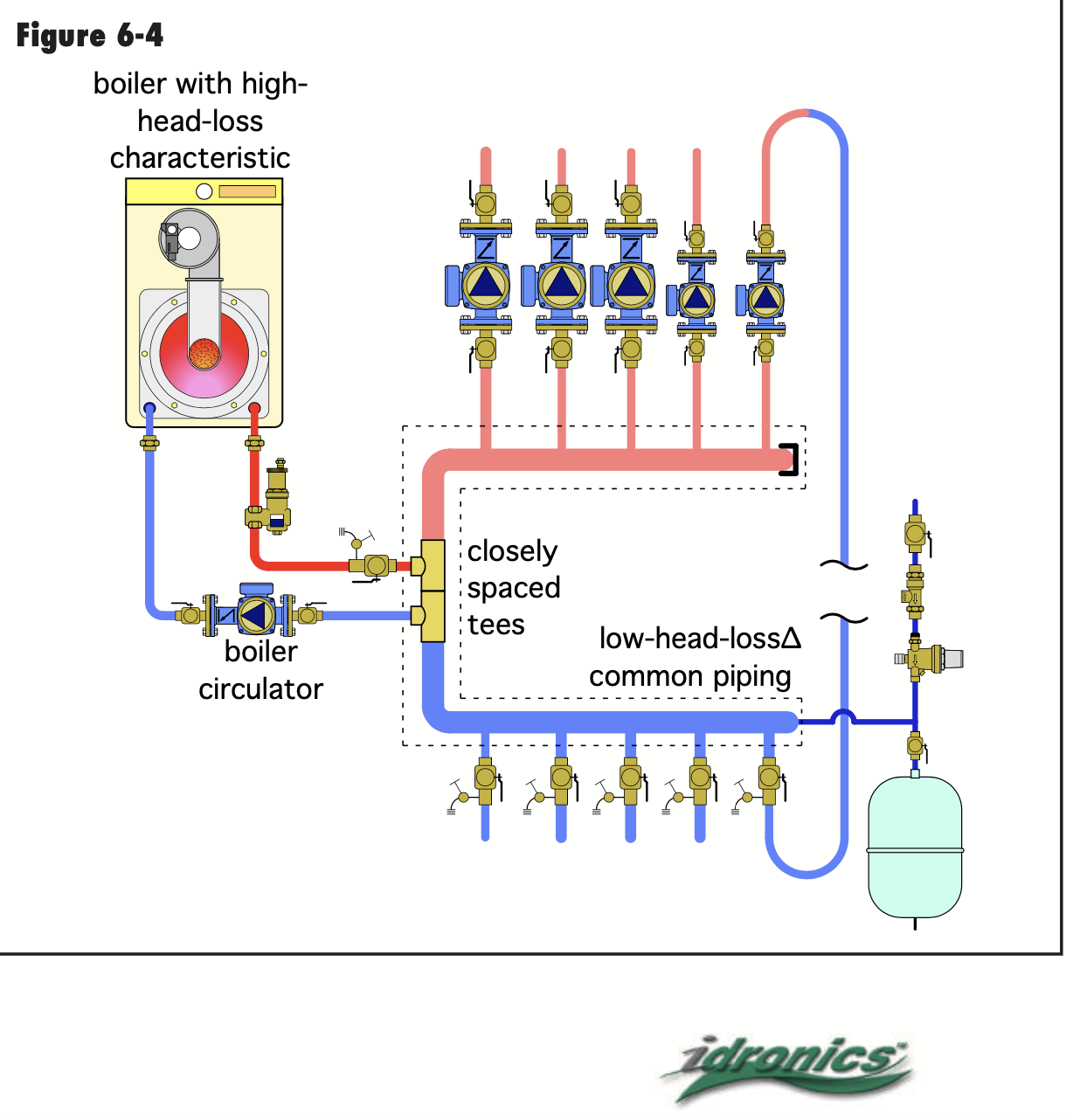
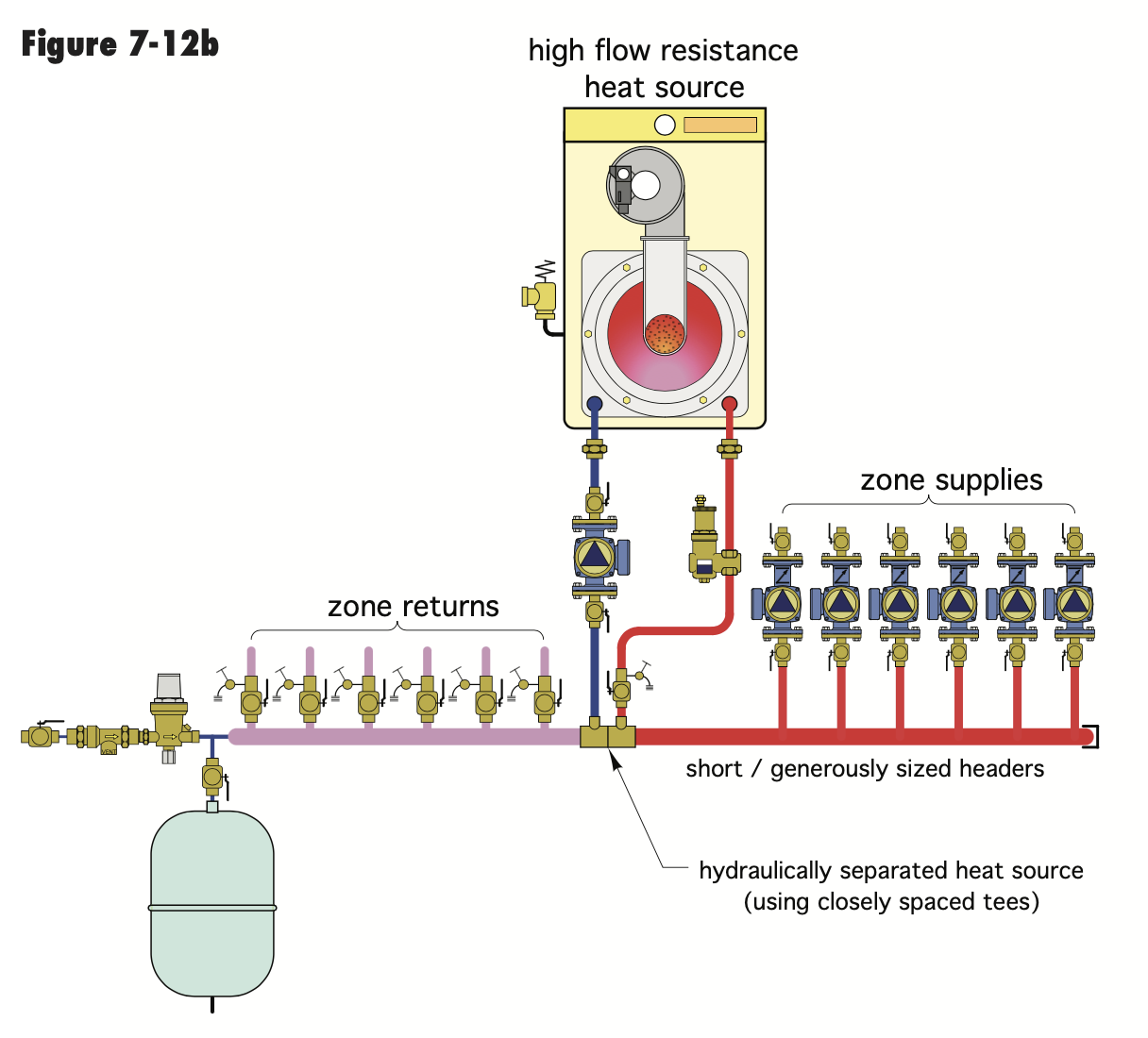
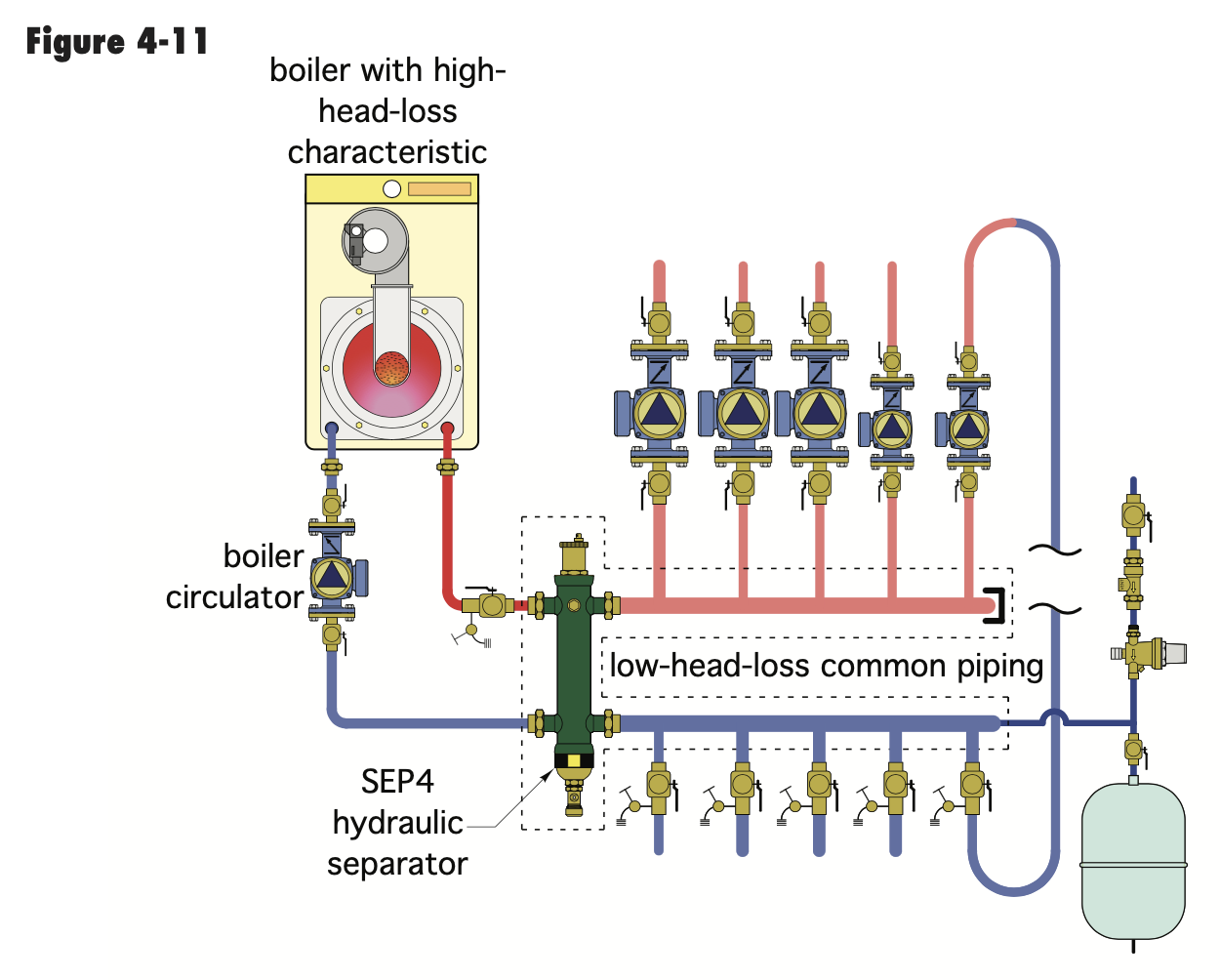
There are any number of ways to pipe the boiler room.
I prefer a hydraulic separator as you get air, dirt, magnetic, and hydraulic separation all in one "box" A nice space saver.
Any of the methods here will allow for future revisions, and protect all the $$ components, and give the system the best shot at high efficiency operation.
 Bob "hot rod" Rohr
trainer for Caleffi NA
Living the hydronic dream0 -
Thanks Ed and Bob!
I think 1/2" will be plenty for all my radiators except the giant one in the first floor LR, which I calculated over 15k but for (but that's at 180 degrees, I don't think I'll get anywhere near that in final design temp, which I'm anticipating to be closer to 140*. It would probably do ok even w/o a larger supply, but since the system seems pretty well balanced now, seems like it would be well worth it to bump that one rad up to 3/4" supply just as a means of helping to maintain the existing balance, since it is like 50% larger supply lines to it currently - especially if not adding flow meters. Mostly 1/2" lines will be much nicer to run/conceal, so that makes me happy.
Any preference on O2 pex vs Pex-Al-Pex? I'm much more familiar and comfortable with traditional pex, have never used the PAP, but if it is better for this task, I would consider it.
Thanks for these schematics Hot Rod… I have to admit, I'm skeptical of series designs that position along the manifold would affect the temp of water reaching each rad… I am more drawn to supply/return manifolds that are in parallel. I like the idea of a quality separator as a hydraulic crossover all in one, and the triple protection that well rated Caleffi model offers - that seems worth the investment to protect these more particular boilers of today - my old beast doesn't care if you send chunks of old radiator rust through it, but doubt many made today will be happy with that.
I LOVE the idea of not needing balancing valves/flow meters, if that is feasible. I know ball valves aren't great at that task, but if the system is pretty well balanced now, I supply even water temp to all rads the way the system does now, and can dial it in a little with some valves, plus be able to zone the 3 floors, that likely will satisfy my needs and with far less finicky parts to go wrong.
I know everyone likes the main trunks to be copper. I am kind of thinking 1 1/4" copper for the main common piping, in the basic design of your last image with the hydraulic separator… then for each of my 3 zones, pull off to a homemade manifold out of 1x1/2 Pex tees - this would allow me to aim the trunk lines as needed, etc, and service any leaks/changes more easily than replacing a whole manifold. I'm a little spooked on the copper manifolds after having the brazed fitting on my home's hot potable water distribution manifold fail on me recently. I plan to replace that one with a loop style manifold for pressure balancing - is that worthwhile on a radiant system to do the loop, or just stick with a straight manifold? I'll add ball valves on all lines for isolation, purging, minor balancing, etc.
If I can just get all my piping run to each emitter, and manifolds installed for now, that would be a big step in the right direction… I'm guessing I'll want to tailor the near piping more based on the specific boiler selected.
One more question - I know the SEP-4 needs to be vertical to operate properly, does it also need to be higher than other components in the system to bleed air properly, or does that not matter? Just thinking about if my manifolds for the radiators can go up at the ceiling (its easily reached in this location) to get them out of the way of the boiler and rest of near boiler piping/pumps/controls/etc? The area I'm working with isn't huge, so space efficiency is of concern.0 -
Regular O2 barrier pex type A is the most user friendly, easy to fing.
The PAP can be tricky to use, if you kink it you end up using couplings to repair. Pex A can be heated if you get a bad kink., to repair.
Can you buy and solder tees cheaper that a factory formed copper manifold? You will have a lot of solder joints. Even pex tees are getting $$.
A air purger can be mounted vertical anywhere.
High point float type air vents are what you use at high points in a system, like radiators.
Bob "hot rod" Rohr
trainer for Caleffi NA
Living the hydronic dream0 -
Thanks again Hot Rod, definitely helpful info. I'll look into manifold options and decide what makes the most sense, but def like the idea of eliminating the flow meters and potential headaches there, and keep it as simple as possible.
I'm definitely interested in the SEP-4, that seems like the kind of setup I would be looking for. Simple but effective, and I like the balanced parallel loops piping arrangement rather than series loops.
I just ran another heat load estimate (as a sanity check, as my manual j skills are limited) for the coldest month of last winter based on gas usage, based on this article's instructions: https://www.greenbuildingadvisor.com/article/replacing-a-furnace-or-boiler
The property is in Pittsburgh PA, and we had a particularly cold month, so this should be nearing the worst case for the building. I took that month's usage, and subtracted the average usage in the summer months (about 1MCF for stoves - water is separate electric heaters), to get about 23MCF, then used 65 degree HDD, 0F design temp, etc to calculate that my building's actual heat load consumption for that month was about 43k BTU/hr. Again, this was a very cold month.
I had gotten a little under 60K using a SlantFin heat load calc app a while back that approximates a Manual J, using pretty conservative estimates.
If I look back to the EDR calcs in the first image I posted in the original post, these numbers pretty well align with the 140F design temp BTU outputs of my existing radiation (I didn't total them on the image, but its about 46k output for the existing radiation). Am I making the correct assumption here that I should be able to design my system around 140 degrees (and therefore a mod/con makes sense) without any real trouble? Maybe bump it slightly higher to account for a cold snap, but that should still give me well under 140 return temps…
Also to take into account - I don't directly heat the basement currently, however a lot of heat is "lost" there now via piping/boiler (largest pipes are insulated, but still losses). This should mostly serve to reduce the additional load from the future radiant floor in the basement, and will likely be reduced losses to the basement with the new system.
For the immediate, I need to run piping. Given these outputs at 140F, should I run all 1/2", or bump the one larger radiator up to 3/4?
BTU/h @ 140F6930
9720
5355
5355
1440
1280
2560
1922
2097
3240
2340
1920
0


Categories
- All Categories
- 87.9K THE MAIN WALL
- 3.3K A-C, Heat Pumps & Refrigeration
- 60 Biomass
- 430 Carbon Monoxide Awareness
- 133 Chimneys & Flues
- 2.2K Domestic Hot Water
- 6K Gas Heating
- 124 Geothermal
- 170 Indoor-Air Quality
- 3.9K Oil Heating
- 79 Pipe Deterioration
- 1.1K Plumbing
- 6.7K Radiant Heating
- 397 Solar
- 16.1K Strictly Steam
- 3.5K Thermostats and Controls
- 56 Water Quality
- 51 Industry Classes
- 51 Job Opportunities
- 18 Recall Announcements