Lochinvar Knight boiler programming for buffer tank

This question grew out of a previous more general thread on how to pipe my sister's new Lochinvar Knight with a buffer tank. After reading the Knight manual and a lot of Google searching, I still can't find an answer to the more specific question of how to program the Knight to run only based on buffer tank temperature, without needing specific "call for heat" inputs from thermostats or zone controllers, so I'm breaking this question out as a separate topic for future reference when other people have the same question.
Background: Sister is getting a new Lochinvar Knight boiler with a buffer tank. I want to make sure it's set up right. We're planning to run it on ODR using the Lochinvar-provided outdoor air temp sensor and tank sensor.
We want it set up so the boiler runs only when buffer tank temp drops below the threshold, which will change based on the reset curve. The boiler and boiler circ should run until the buffer reaches the target temp, then shut off. A zone controller will run the zone valves and the system pump(s) pulling from the buffer, but the zone controller won't be telling the boiler when to run, because that decision should be made by the boiler based solely on buffer tank temp, regardless of whether or not there is a call for heat.
The tank sensor will be wired to the SYSTEM SENSOR (terminals 23 & 24) on the control board. But I've read the manual several times and still can't figure out how to program (or wire) it so that the boiler will run only based on buffer tank temperature. Many setups with this boiler would benefit from using a buffer tank, so it seems strange that Lochinvar wouldn't write at least a simple paragraph in their 84-page manual explaining how to set up the boiler controls so it runs only to maintain buffer tank temp.
Anyone?
Comments
-
You can download the manual for the specific boiler you intend to use. The Service Manual explains settings, as an example
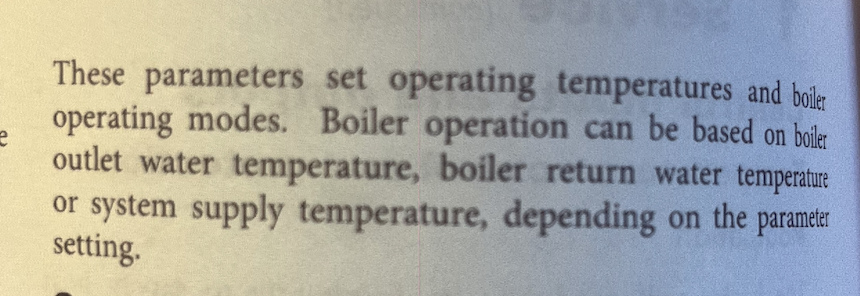
You can also call Lochinvar tech support, but it is good to be at the unit when they help explain how to sdjust parameters.
You can get up to speed on the control before you buy the boiler with the online simulator, here.
To maximize that boiler you really want to get familiar with the control and adjusting. I think i mentioned the Conexus, which allows you to remotely check and make adjustments.
Bob "hot rod" Rohr
trainer for Caleffi NA
Living the hydronic dream 1
1 -
The only question I can't answer is if you jumper a heat call, put the system sensor in the tank… When the tank reaches temperature you would want the boiler pump to stop. I'm not sure if that will be the case on the model and version you end up with.
I don't have the latest touch screen version, so my Knight may not be the exact same control that you will get.
The tech support folks at Lochinvar will know. Generally they will ask for the model and serial number to be sure they give you the correct information. I suspect this has come up before, since they sell buffer tanks, so you might start with a call to Lochinvar.
Bob "hot rod" Rohr
trainer for Caleffi NA
Living the hydronic dream0 -
@hot_rod OK thanks. I have read both the I&O manual and the service manual and neither of them adequately explain how to set the system so the boiler fires only when the buffer tank temp drops below the setpoint and there's no heat call. I will call Lochinvar tomorrow and see if I can get an answer.
Thanks for the link to that online simulator. That is handy. Will play with that tonight.
0 -
You need a process to call for the boiler to initiate a heat demand, which is required of all heating plants. You can old school the system by putting the heat demand on a single set point control that will work based on the outdoor air. This way when the ambient temperature drops below the set point of the outdoor air control it will turn the boiler on. The temperature of the buffer will be based on the algorithm that you set up. If no zones are calling then the buffer tank will eventually reach the setpoint and shut the boiler off. The system sensor can go in the buffer tank
0 -
@pedmec OK thanks. I think @wetcoast and @hot_rod answered the question about how to generate the heat call in a different thread, by jumpering one of the thermostat connections.
The Lochinvar Knight has 3 thermostat connection points they call "Heat/Loop Demands" numbered 1 to 3. So I would jumper, say "Heat/Loop Demand 1" (terminals 1 and 2) and probably put a simple ON/OFF switch on the jumper so that at the beginning of the heating season, I'd turn that jumper circuit ON to activate a continuous heat call on that loop for the entire heating season, only turning the jumper switch OFF at the end of the season. (Boiler power would stay on year-round for periodic exercise of the boiler circ.)
Then with the system temperature sensor placed in the buffer tank, and the outdoor temperature sensor outside, program the ODR setpoints for the "Heat/Loop Demand 1". The boiler should then fire to maintain the target temp in the buffer tank based on the reset curve for that loop, and will stop firing when the system temperature sensor reaches the target temp plus the "SH1 offset" (SH=space heating). Then when the buffer tank water cools and the system temperature sensor reaches the target temp minus the "SH1 differential", the boiler should fire again to begin raising the buffer tank temp.
The factory default for "SH1 offset" is 10 F, and the default for "SH1 differential" is 20 F, so adding those gives a delta T of 30 degrees in the buffer tank. Those parameters can be adjusted for larger or smaller delta T's. Obviously, the larger the delta T, the longer the boiler run time.
That's my understanding so far, which could be incorrect, based on the Lochinvar Knight manuals. I've emailed Lochinvar asking if the above is correct, and will report back if/when I get an answer. (They won't take my calls because I'm just a lowly homeowner).
0 -
just jumper a heat call, the ODR will prevent it from firing below 68f or whatever. No. Need to add another temperature control. I believe 68 is factory ODR set point.
The typical procedure is:
1 the installing contractor has been trained on the control and knows how to set all parameters when he installs it. He needs to have an accurate combustion analyzer and a manometer, to properly set and document the start up settings.
2 the dealer that sells the equipment knows how to set parameters, and helps the installer
3 the local factory rep helps either or both of the above. I know many of the Lochinvar reps across the U.S., they are excellent when it comes to product knowledge. This is about the simplest of the mod con controls you will find
Lastly you go direct to the manufacture, not always a HO option, as you found out.
It should not be tough to figure this out as the boiler is commissioned. If the installer doesn’t understand how to have a buffer initiate a boiler call, he should go through the above steps.
For a hands on owner, or relative it would be good for @jesmed1 to know how to enter the control and fine tune. I wouldn’t expect the installer to make numerous trips to change ODR a few degrees.
At days end the boiler only sees the tank as it’s load, ODR regulates the tank temperature. If it is above 68 degrees, the tank is maintained at some appropriate temperature.
Two wires or a jumper to a heat call terminal, two wires to the ODR sensor on an outside north wall
Between the online Lochinvar Tool Box videos and numerous contractor You Tube videos, learning the control should be as easy as programming your tv remote😏
Bob "hot rod" Rohr
trainer for Caleffi NA
Living the hydronic dream1 -
@hot_rod Thanks, sounds good. It is a fairly simple setup, as you say. Too bad Lochinvar couldn't be bothered to show a single piping (or wiring) diagram that included a buffer tank in the 12 piping diagrams they put in their manual, or to devote a single paragraph to explaining what you just explained. That seems odd considering many of these boilers are probably being piped with a buffer tank, and Lochinvar sells buffer tanks to use with this boiler…🤔
0 -
It comes down to the actual person you speak with.
I find the wholesalers and reps get exposed to more hands on experience, and see more actual in use examples than factory support folks.
The whole concept of a rep is they get paid to support the product in the field, present training to the installers, etc.
@GGross is an example of a wholesaler that takes the time to understands the products he sells and can generate piping and wiring as well as Viessmann troubleshooting. Viessmann tends to hire former contractors for their tech support which is a big plus.
Ideally the person you hire knows this simple control logic. Sounds like he has Lochinvar experience?
You have plenty of info now to ask him questions
Bob "hot rod" Rohr
trainer for Caleffi NA
Living the hydronic dream1 -
True hot rod.
0 -
@hot_rod I trust your answer, but while I wait to hear back from Lochinvar I have a related question about how the boiler decides what firing rate to use.
In my example, with a 30 gallon buffer tank and, say, a buffer tank delta T of 20, that gives us a minimum BTU input of 30 x 8.3 x 20 = 4980 BTU (assuming no zones are calling for heat too). So let's round that up to 5000 BTU.
Now with a Lochinvar Knight 155, output of 120,000 BTU/hr, max turndown of 10 gives output of 12,000 BTU/hr. So at minimum fire, the boiler would take 5000/12000 x 60 = 25 minutes to heat the buffer water by 20 degrees.
Or, at maximum fire, it would take one-tenth that time, or 2.5 minutes. Obviously a huge difference. So how does the boiler decide what rate to fire at? I assume we always want the lowest possible firing rate. How do we program that into the settings, or is there no way to influence that?
0 -
The ODR will control the temperature per a temperature scale you configure. Also there’s typically ramp up and other options to control the SWT.
0 -
@PC7060 I understand the ODR curve, and after reading the Knight manuals I understand how to program those points. I also see the "Ramp delay" parameter explained in the manual, but the explanation is terse at best, and not particularly helpful. And regardless of ramp delay, the manual still doesn't explain how the boiler "decides" on a firing rate, in even the simplest terms.
But let's say I do want to enable "Ramp delay," which allows me to program up to 6 separate firing rate limits, from 15% to 100%, each with its own programmable time delay of 0-40 minutes. What's the best strategy for selecting those limits? Pick an arbitrary time, say 30 minutes, during which I allow the boiler to slowly ramp up to 100% if needed?
0 -
I don't know what I am talking about, but I think the control senses boiler supply and return and modulates the fire to match the load by measuring the TD.
Big TD more fire—-small TD less fire.
0 -
The boiler is always watching it's supply and return temperature.
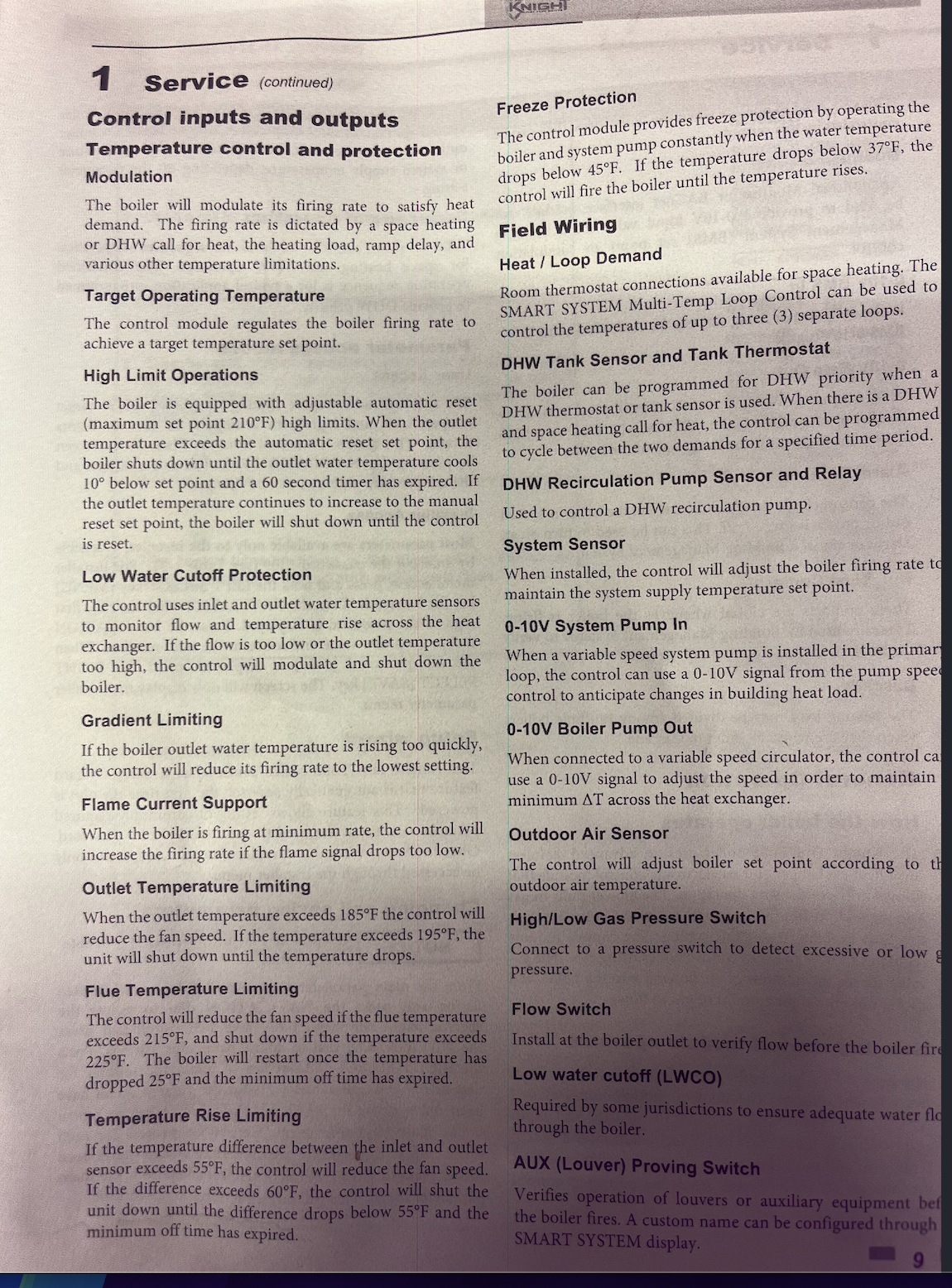
So lets say the tank drops to 120 or whatever lowest temperature you program. The boiler will ramp up to full fire quickly Unless you lock it down with the ramp delay. As it starts heating the tank at full boiler output, full pump speed it is watching S&R. If the delta gets too tight it will start to ramp back the firing rate. If the delta widens the boiler will again adjust.This is explained in the Service Manual
The manual explains this Gradient Limiting function as "If the boiler water outlet is rising too quickly the control will reduce it's firing rate to the lowest setting"
The manual explains Outlet Temperature Limiting "When the boiler outlet exceeds 185F the control will reduce the fan speed (burner modulation) If it exceeds195 the boiler will shut down until temperature drops.
Temperature Rise Limiting "If the difference between inlet and outlet (boiler sensors) exceeds 55° the control reduces fan speed,. If it exceeds 60°it will shut down until the difference drops below 55°
This will control protection conditions be experienced if you do not purge the boiler properly, temperature race up to this protection mode.
The boiler in your case wants to heat that buffer as quickly, but efficiently and safely for the boilers heat exchanger, as possible. Regardless of what ∆ you want to run at the boiler wants to get the tank to setpoint temperature.
It behaves like this in DHW mode also, it will attempt to cover that load as quickly as possible.
Unless you program functions to prevent this behavior.
Now what ramp delay does, and I use it on my system as I have a single zone shop, no buffer. So on a call for heat I keep it at ramp 1(10% firing rate) for 2 minutes, then 1 minute at ramp 2,-6. So basically it will always take 10 minutes to get to 100% fire. If that is ever needed. On a low load condition it may only hit a few ramp levels
My boiler is the WHB 55,000 My shop load is below 30K, so I also locked it down to no more than 30,000
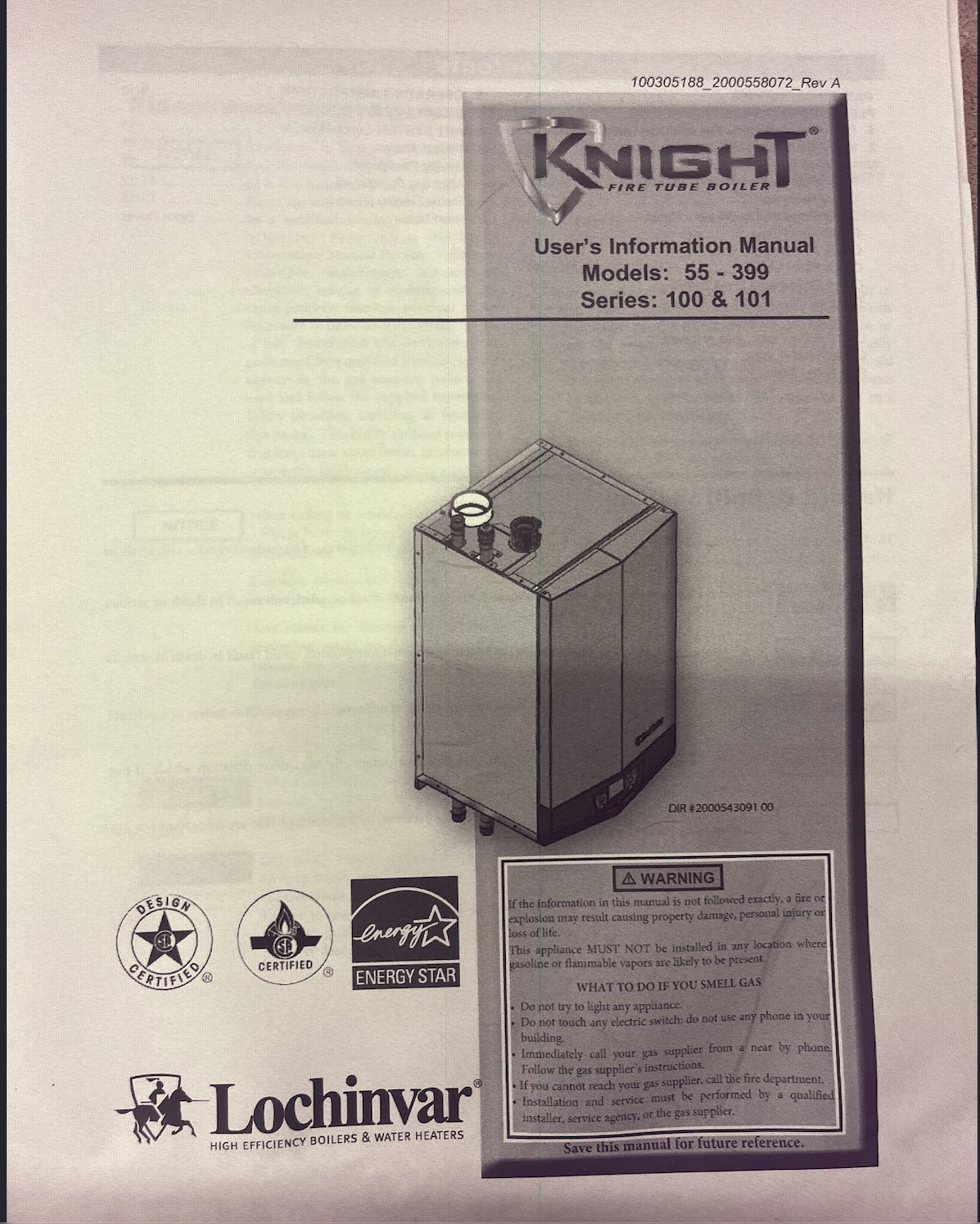
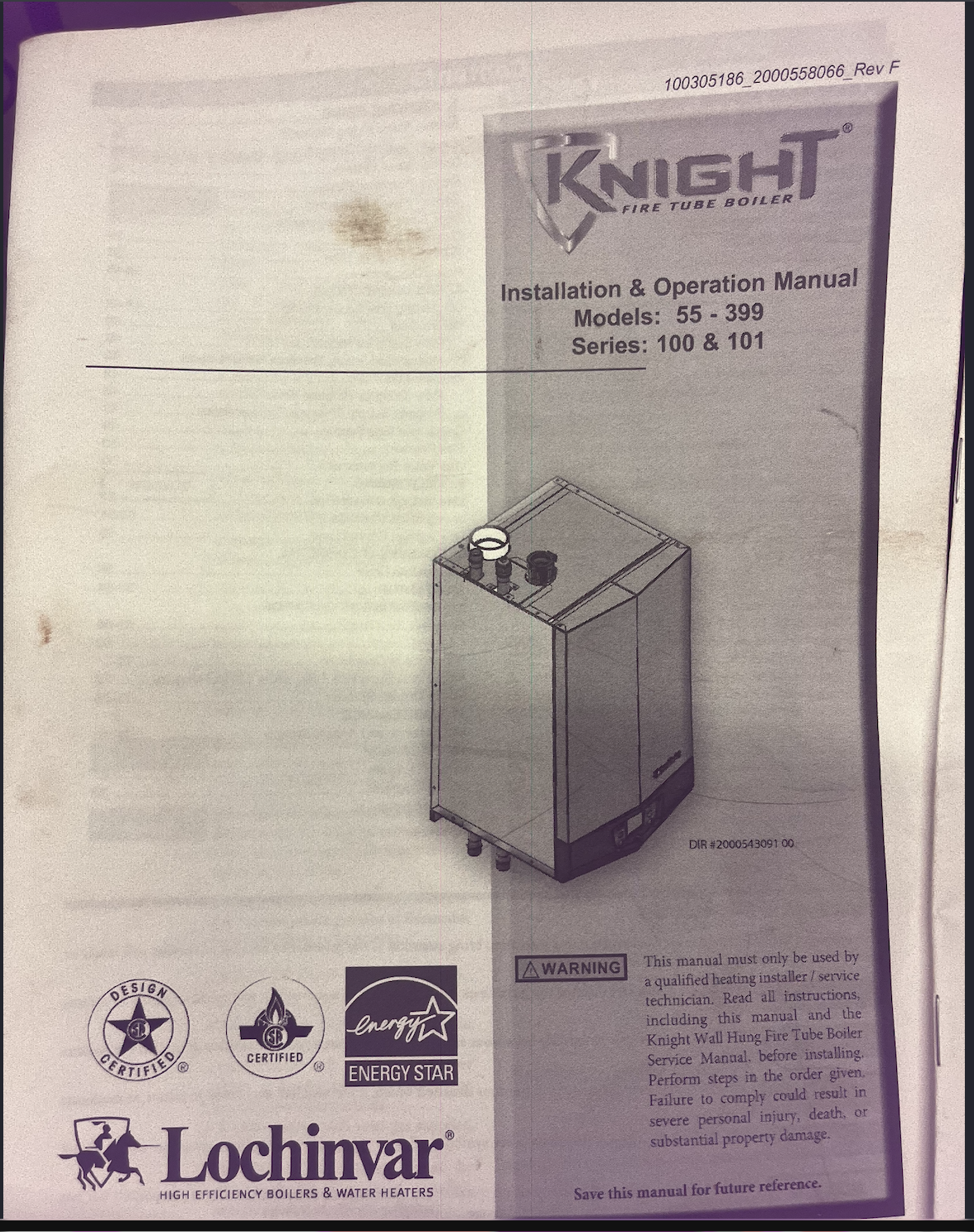
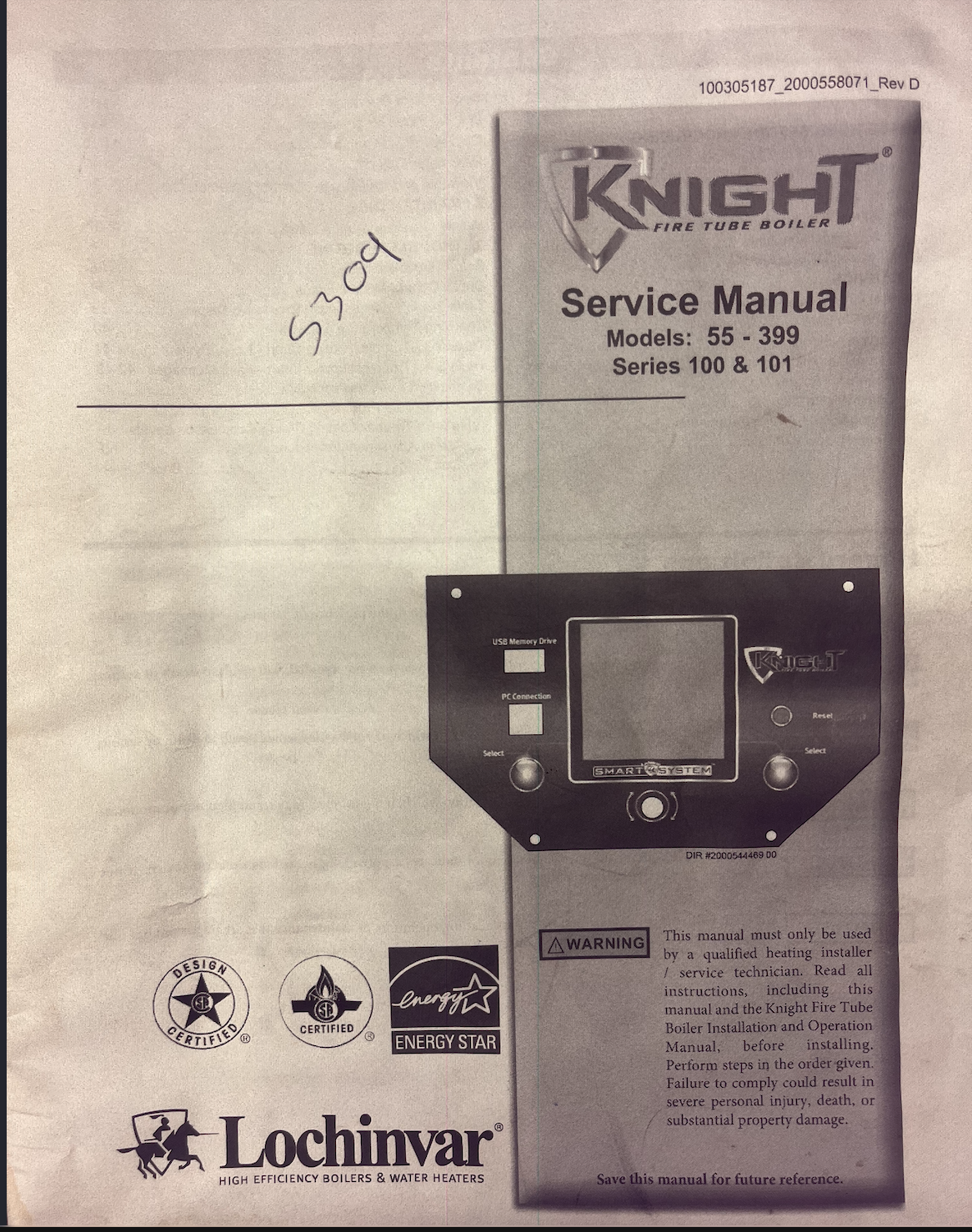
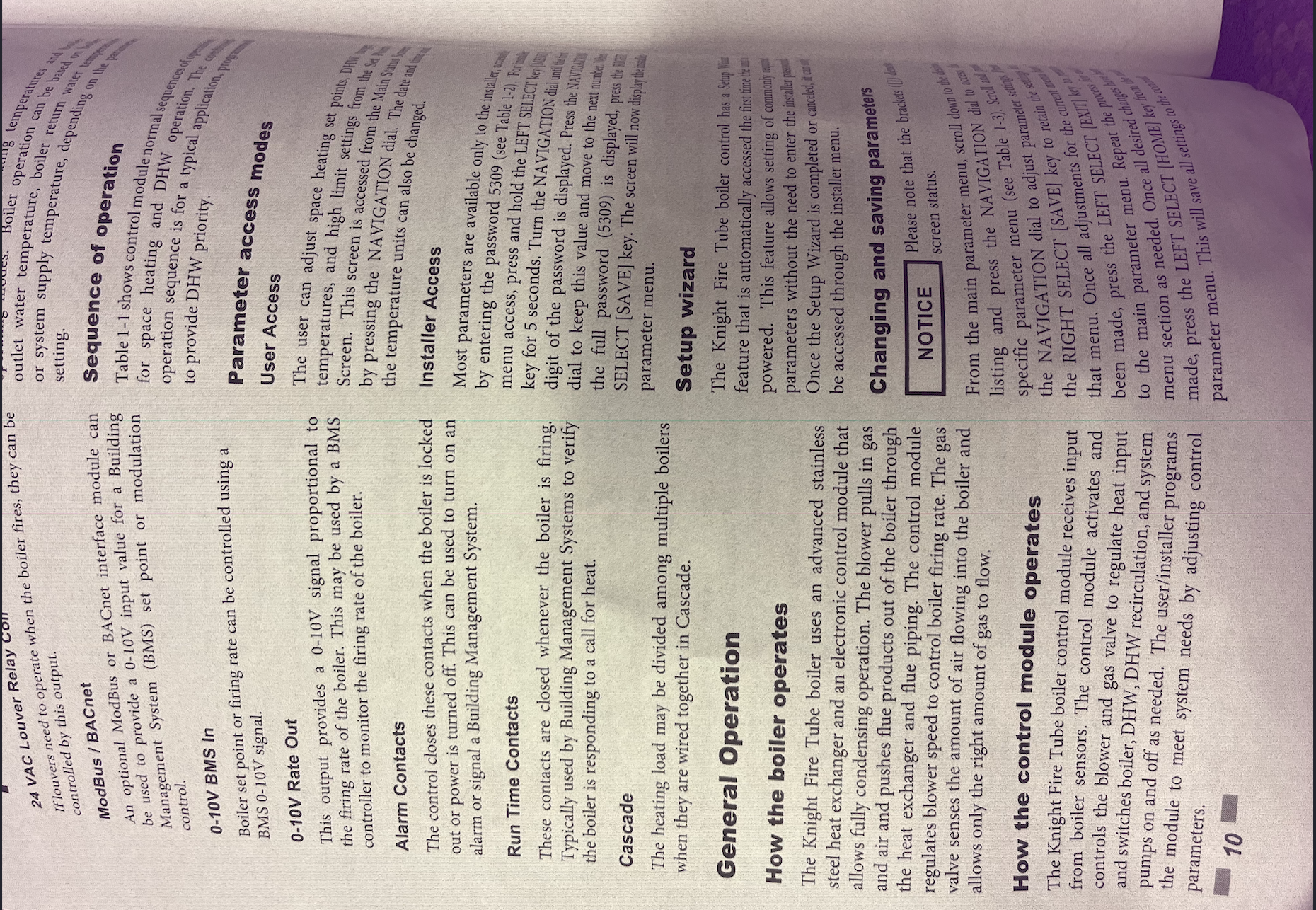
Once you know the model boiler you will get, download ALL the manuals. Read these two pages to get a start.
Yours will be a newer model so it may not be exactly as these pages show.
Should be a I&O, Service Manual, examples below, and a User Info Manual. The Service Manual has the most info on the control.
5309 is the pass code to get into Installer Mode on the control. That is where parameters are adjusted.
 Bob "hot rod" Rohr
trainer for Caleffi NA
Living the hydronic dream2 -
@hot_rod OK thank you. I have downloaded both manuals for the Knight 155 and have read them both several times, but some of the wording is vague.
So you say the boiler wants to reach target SWT as fast as possible. The 155 can output 120,000 BTU/hr max, and the minimum "Boiler Pump Delta T Setpoint" is 15 F across the heat exchanger, which implies a maximum flow rate of 16 gpm. That should be achievable in our 1-1/4" piping primary loop with the Lochinvar-provided ECM pump. So in the example I gave earlier with a 30-gallon buffer tank and a 20 degree delta T in the tank, the boiler would need to provide 5000 BTU, which would take 2.5 minutes with the boiler firing at 100% and the pump providing 16 gpm. That's too short a cycle. So the boiler would presumably always short cycle (in the absence of more load from the zones), unless we program in the "Ramp Delay." (We could of course also increase the delta T in the buffer tank for longer run times. But if we can achieve the same thing using the ramp delay, that lets us have less extreme swings in buffer tank temp).
Since the house's design heat loss of 110,000 BTU/hr is close to the boiler's max output, there are some times when we will need the 100% firing rate, so I wouldn't try to prevent reaching that maximum firing rate in the ramp delay settings. But I would probably want to make the boiler take a long time to reach that 100% firing rate. And since each ramp delay step can be set to run as long as 40 minutes, in theory I could make each of the first 5 steps 40 minutes long, for a total of 5 x 40 = 200 minutes running at lower firing rates before allowing the final step 6 to reach 100% firing rate. That is probably too long for a design day, but I might try starting with 6 minutes per step, so 5 x 6 = 30 minutes before the 100% firing rate is allowed. Worst case, on a design day that allows the house temperature to keep dropping slowly for about half an hour until the 100% firing rate step is reached. If that's too much lag, I can go back and shorten the time per step.
0 -
So I think this is what you will experience. Lets say you want to maintain the tank at 120- 140. The heat zones are calling, when all zones are satisfied, the building load drops off and the boiler wants to now get the tank to setpoint.
BTU move quickly when there is a large ∆. The laws of thermodynamics simply put #1 hot goes to cold always #2 the rate of heat exchange is based on the temperature difference.
So as the boiler heats the tank the delta will start closing, boiler SWT vs the tank temperature. When the control sees the boiler outlet increasing approaching the 185 it will slow the firing rate. Basically the boiler may or will reach that Outlet Limiting Temperature explained in the Outlet Temperature Limiting function.
So as the load drops, the boiler is reaching that 185° "limit" and the control starts ramping the burner down.
Additionally the boiler pump is responding to this ever changing load, firing rate. I'm not 100% clear on how the control modulates that pump speed/ flow, maybe it tracks with firing rate?
So while the boiler "wants" to recover that tank load, it also has some safety fuctions within the control so the boiler does this within safe operating conditions.
It's possible you could use the DHW function. Within that function I believe you can limit the boiler SWT as it recovers DHW. Once again explained in the manual as DHW Boiler Setpoint.
Obviously you do't want to slow recovery too much, should a heat load hit, you want to cover that and the tank load.
As per Chris in Tennessee, the system sensor by itself will turn on the boiler and boiler pump.
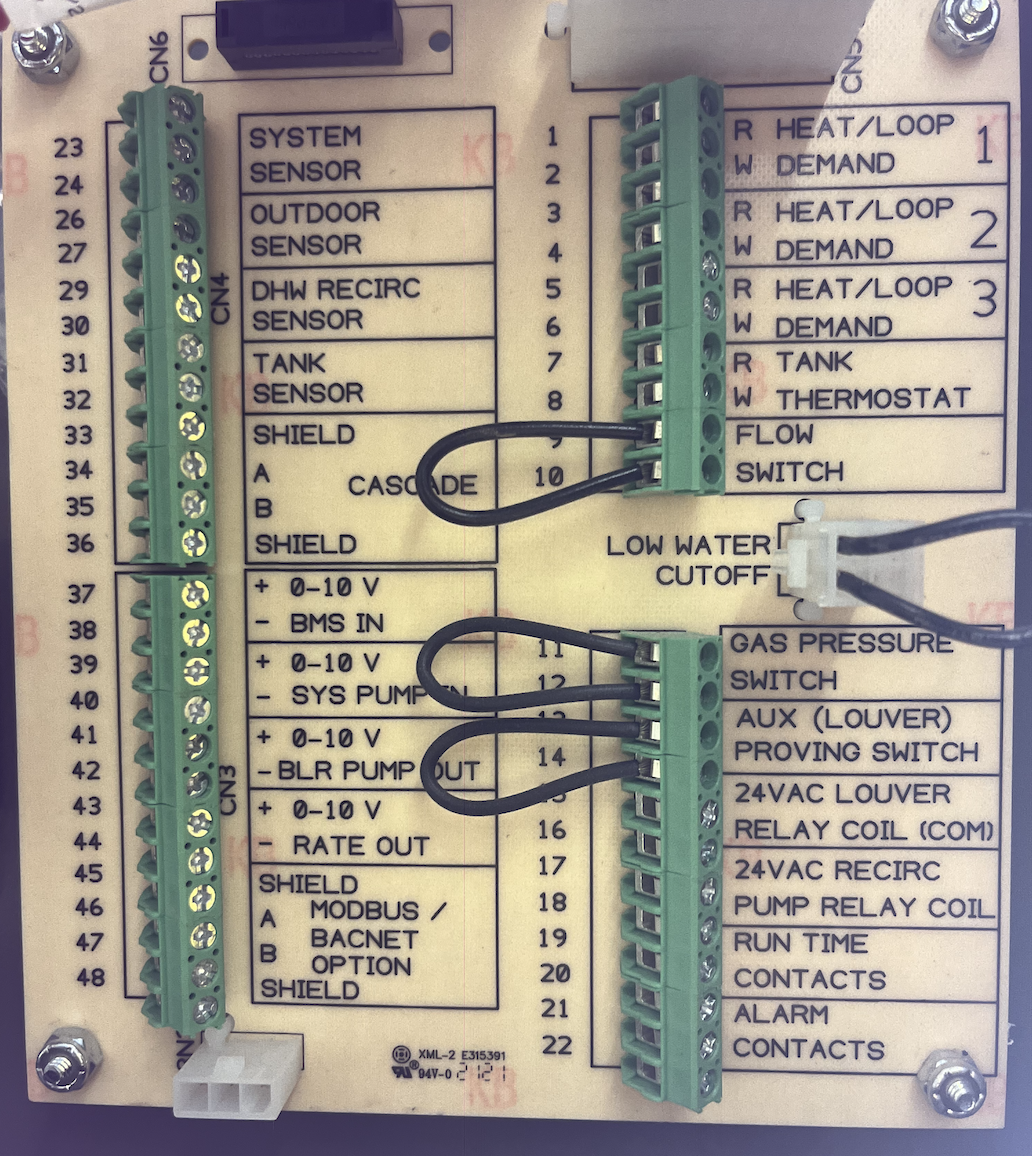
Personally I think the DHW function would also accomplish a buffer tank control. Either the Tank Sensor, or the Tank Thermostat terminals will turn on the boiler. The tank sensor is just a 10K sensor that you put into or against the tank.
I thought the boiler came with a spare sensor, he said no??
As you look at the board you see where to connect sensors for the various functions.
 Bob "hot rod" Rohr
trainer for Caleffi NA
Living the hydronic dream0 -
talking with my son, who worked for a Lochinvar rep. if you use the dhw function you don't have ramp delay or odr.
He suggests the system sensor also, and use ramp delay if needed. However if you ramp delay you want to make sure you have enough output if heat calls start hitting on. He also suggested a post purge to pull all heat from the boiler, also keeps it from kettling when you run the boiler/ tank to high temperatures like 180.
Here is the Catch 22.
Over the years installers and savvy hydronic guys and gals ask for all these unique control functions.
I wonder what % actually understand how to use and program the unique deeper control functions. We see plenty of boilers here at HH that don't even have the ODR sensor wired!
So what you see now are most manufacturers have several levels of mod cons. basic level boilers like the Nobel, less control functions, smaller HX less $$$
In your case, one or more of the control functions will do what you want. Someone needs to spend the time figuring out the best and setting parameters
A conversation with your installer would tell how much he knows about control programming. If no one is willing or able to do that, just install a one speed CI boiler! Let it bang on and off on low load days.
I'm working on getting mine back online today and can try these options
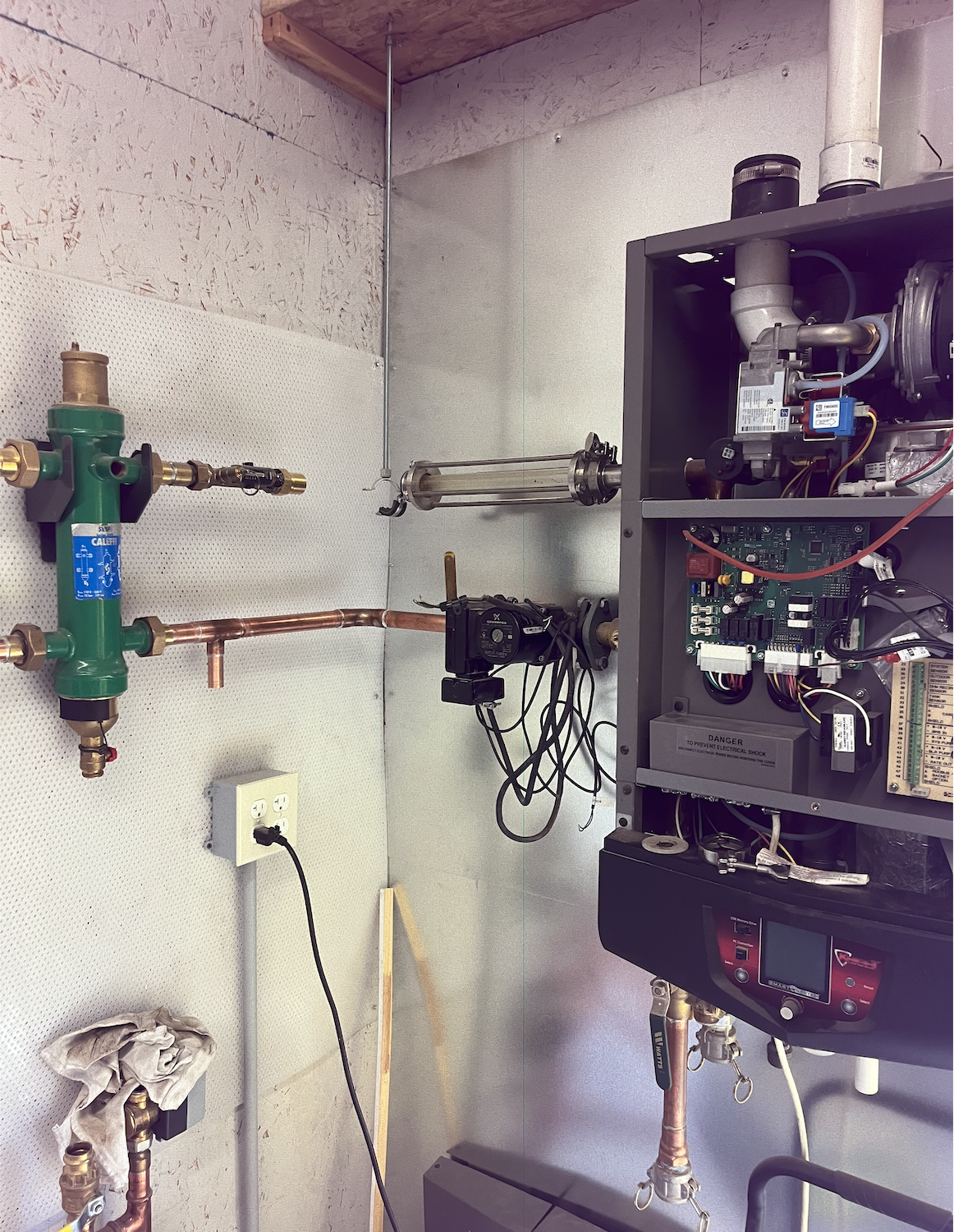 Bob "hot rod" Rohr
trainer for Caleffi NA
Living the hydronic dream1 -
“if you use the dhw function you don't have ramp delay or odr.”
Wow that seems odd especially the ODR. You would think that DHW would be completely independent of SWT.
0 -
@hot_rod Thanks, makes sense. Re post purge, there is a "Boiler Pump Delay" parameter that should serve as post purge, which can be set for up to 40 minutes. So that's a good suggestion.
Re ODR, at my sister's previous house she had a Lochinvar Knight installed about 7 years ago, and I checked it once and realized there was no outdoor temp sensor, and therefore no ODR. What a waste. So this time I want to make sure it's installed and programmed right.
@PC7060 If I understand right, isn't the reason for no ODR or ramp delay on DHW calls that you want DHW to heat as fast/high temp as possible regardless of outside temp? Maybe I misunderstood what you were saying.
0 -
@PC7060 Are you referring to this comment from @hot_rod where he said:
"It's possible you could use the DHW function. Within that function I believe you can limit the boiler SWT as it recovers DHW. Once again explained in the manual as
DHW Boiler Setpoint."Then quoting from the Lochinvar manual, it says:
"DHW Boiler Setpoint: When a DHW call for heat becomes active, the control will
use the DHW boiler set point to determine the firing rate of
the boiler based on the boiler outlet water temperature, or
system temperature when DHW is programmed as a zone. "So you have the option of piping DHW as a separate load, in which case you would set the "Verify DHW Mode" as NORMAL, or piping DHW as a zone off the primary loop, in which case you would set the "Verify DHW Mode" as ZONE. In the first case, the boiler uses the DHW setpoint as the target temp for the boiler output sensor. In the second case, the boiler uses the ODR setpoint as the target temp for the system temp sensor, and the DHW loop gets the same SWT as the other zones based on ODR.
That's from my non-expert reading of the manual.
0 -
This post, first sentence.
I’m certainly not a expect on the Knight and will defer to you and Rod.
0 -
@PC7060 Ah, OK. I think he was saying that I have the choice of taking the Lochinvar "tank sensor" that would normally be installed in an indirect DHW tank and instead installing that in the buffer tank, and wiring/programming the boiler to control the buffer tank temp as though it were an indirect DHW tank. In which case, ODR and the ramp delay couldn't be used, because those don't affect the DHW temperature setpoint.
At least, I think that's what he meant.
 2
2


Categories
- All Categories
- 87.9K THE MAIN WALL
- 3.3K A-C, Heat Pumps & Refrigeration
- 60 Biomass
- 430 Carbon Monoxide Awareness
- 133 Chimneys & Flues
- 2.2K Domestic Hot Water
- 6K Gas Heating
- 124 Geothermal
- 170 Indoor-Air Quality
- 3.9K Oil Heating
- 80 Pipe Deterioration
- 1.1K Plumbing
- 6.7K Radiant Heating
- 397 Solar
- 16.1K Strictly Steam
- 3.5K Thermostats and Controls
- 56 Water Quality
- 51 Industry Classes
- 51 Job Opportunities
- 18 Recall Announcements