Buffer tank control strategy

Meeting this afternoon with sister's GC and HVAC guy to discuss her Burnham 206 gas boiler running a mix of gravity conversion with original large pipe and cast iron rads plus newer baseboard piped in 3/4" copper.
House is 3300 sq ft with 110,000 BTU/hr design heat loss. I did the manual heat loss, informed by actual gas consumption last season. Uninsulated concrete basement is an envelope problem that would benefit from rigid foam board, and I will mention this as an option for improvement.
There are also a number of system improvements that could be made for better efficiency and control. Auto vent damper is one. Buffer tank is another, as boiler is probably short-cycling due to over-zoning (6 total zones, 4 of which on one floor!) And a buffer tank would help solve other problems, such as a cast iron radiator in a distant upstairs bedroom repiped with 3/4" copper, at the end of a gravity conversion loop, so it gets no flow. Only solution I can see is to add a circ to that one 3/4" copper loop, making yet another zone which is worse for efficiency unless we add a buffer tank.
So I'm trying to understand optimum control strategy for a buffer tank, in case that turns out to be an option we decide to pursue. @hot_rod helped with initial tank sizing. 80 gallons looked OK but I decided to do the math for 120 gallons because a larger tank isn't much more expensive and it helps increase run time. So I drew up two different scenarios based on (1) full mixing within a 120 gal buffer tank so that the water inside is always at or close to average temp, and (2) stratified so that hottest water stays on top and coldest on bottom. I understand that stratified is best for radiators, because they will get the hottest possible water from the top of the tank. However, isn't stratified also worse for boiler efficiency, because now the boiler supply temp needs to be higher in order to reach the higher temp at the top of the stratified tank? Note that in the stratified example, boiler SWT has to end at 170 instead of 160 in the fully mixed example.
These two pics illustrate the two different cases, fully mixed tank vs. stratified tank. Both case represent the minimum run time case starting with 120 F avg water temp and ending with 140 F avg water temp, for a total input of 20,000 BTU into the tank from a 9-minute boiler run. So 9 minutes would be the minimum boiler run time. ODR would raise the target average water temp higher than 140 in colder weather, but 140 would be the minimum target temperature in warmer weather. And the boiler would have a thermostatic bypass set to 130 minimum.
So here's my understanding of how that would work.
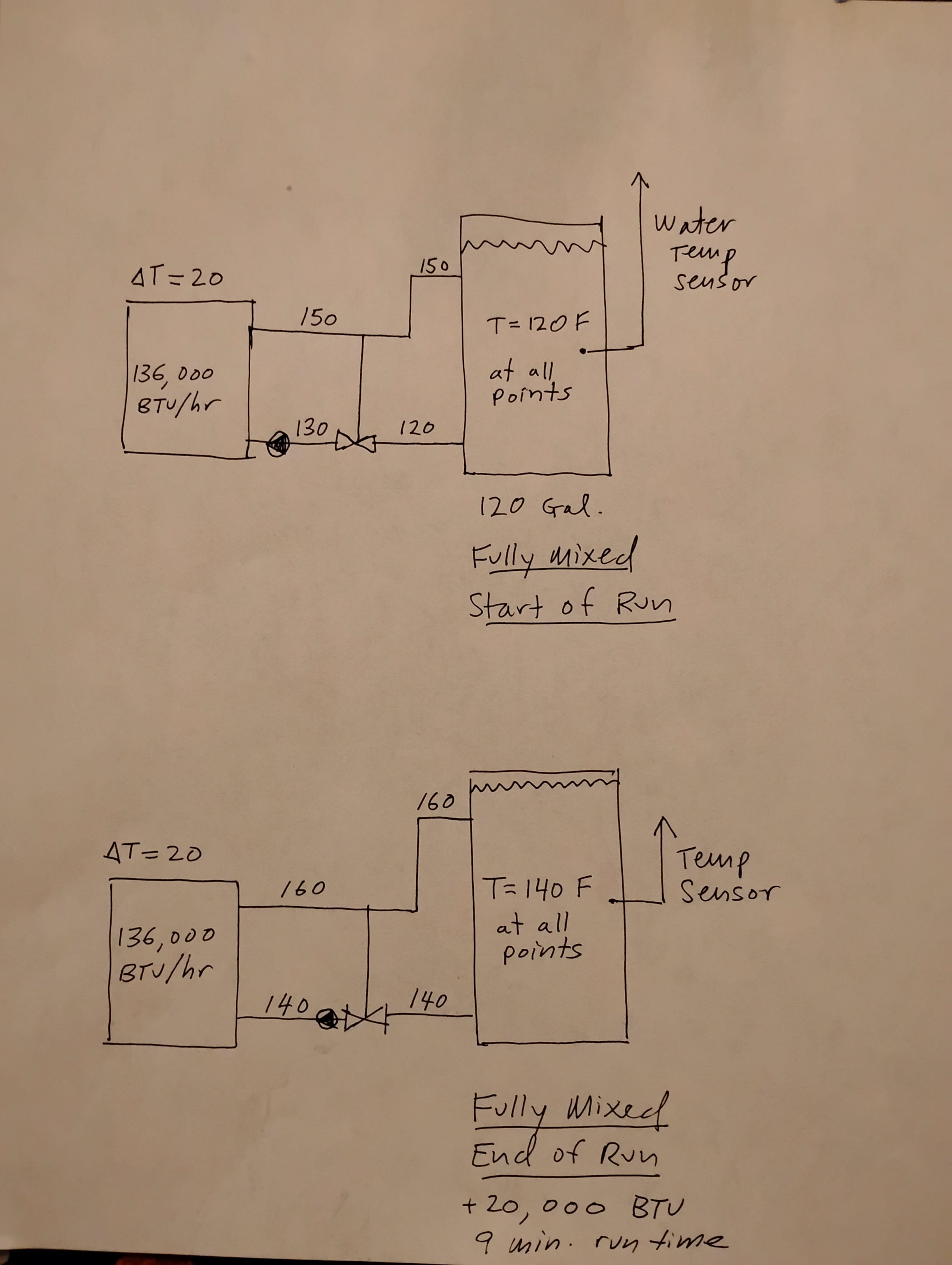
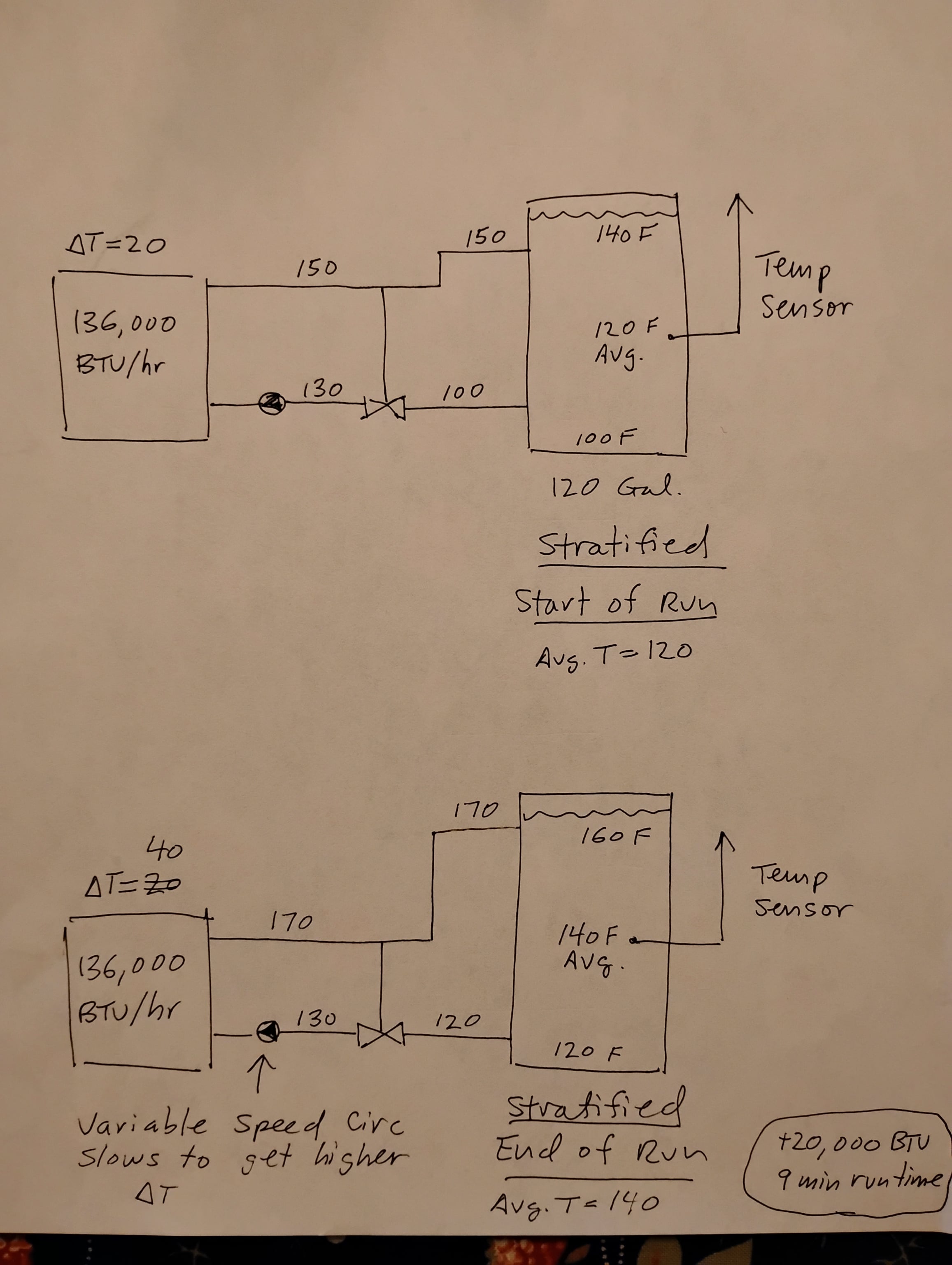
So my questions are:
- Are these schematics more or less correct?
- Which scheme is better in this situation?
- Is the variable speed circ in the second schematic the right way to get higher water temps needed for a stratified tank?
- Is the tank middle the best place for a temp sensor, since it will give a tank average temp regardless of stratification or full mixing?
There is also the option of full replacement with a mod-con which would solve all these problems, but she doesn't know how long she'll stay in the house, so up front cost is a factor. She could save 30% by spending $20k on a new mod-con, or maybe 15% by adding a vent damper, increasing Tstat swing and adding a buffer tank for maybe $10k. She'll have to decide which way to go.
Comments
-
At some risk of being a pest… unless the buffer tank is powered by an immersed heat exchanger — in which case it really isn't a buffer tank — the water in it is going to be mixed any time you have circulation. You can minimize the mixing with a dip tube and low flow rates, but you can't avoid it.
Br. Jamie, osb
Building superintendent/caretaker, 7200 sq. ft. historic house museum with dependencies in New England0 -
I agree with Brother Jamie, installing an automatic damper would be more practical.
0 -
A few reasons for trying to maintain a stratified tank.
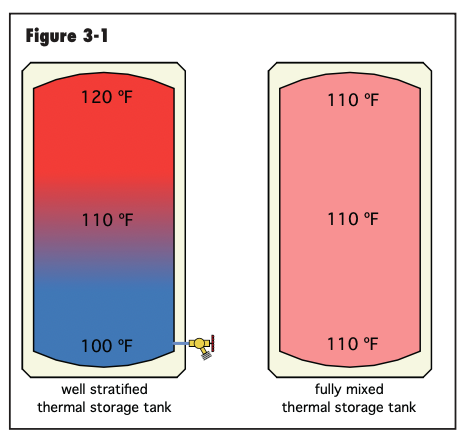
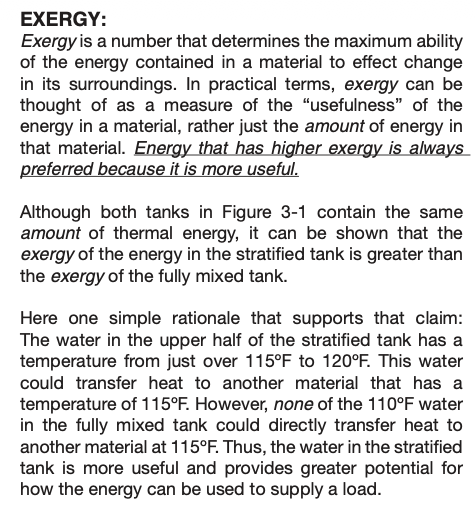
While outdoor reset will maximize the boilers efficiency, heating only to the required temperature based on outdoor, it will lessen the amount of energy stored in the tank compared to a tank maintained at say 170F. Also the drawdown is extended with a hotter trank.
The con is more heat loss through the tank insulation, and more fuel use maintaining a hotter tank. So that is one decision to make.
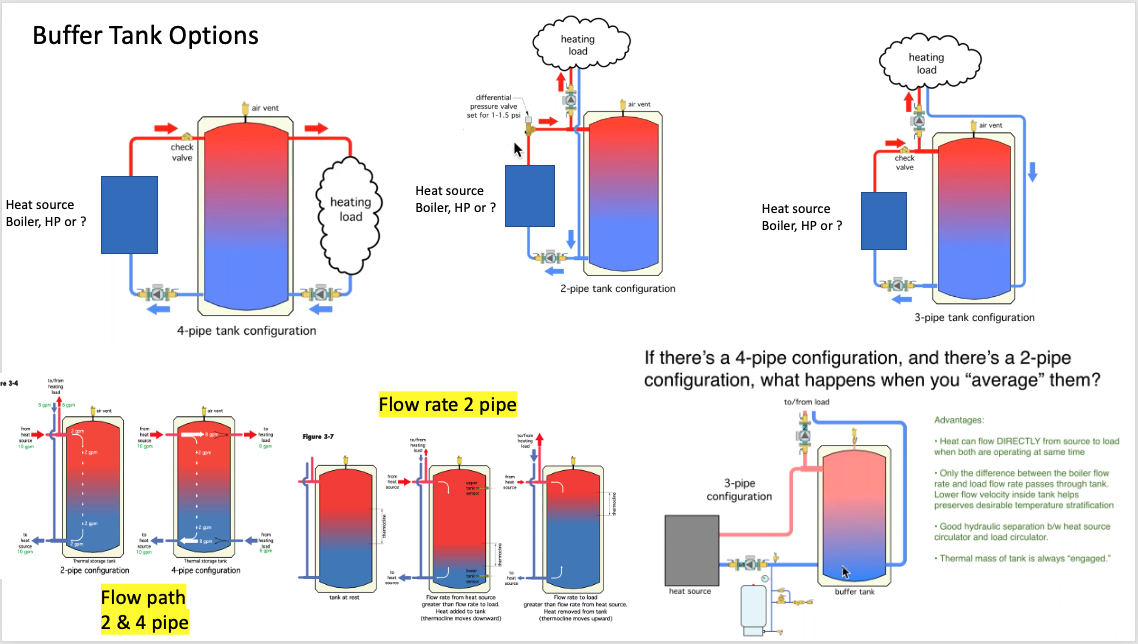
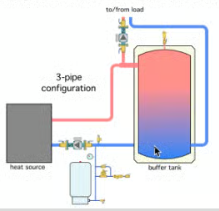
Also if you pipe the buffer as a 3 pipe, two advantages. The lowest temperature water returns to the boiler to keep efficiency up. More important with mod cos and heat pumps, but still some value with a CI boiler.
The 3 pipe allows the return flow to engage the lower volume of the tank while not upsetting the stratification. Both 2 and 3 pipe are direct to load. The tank is only engaged when the load is lower than what the boiler is supplying, or at the end of all heat calls, recharging the "battery".
If the boiler flow is 10 gpm, and all zones are open requiring 10 gpm, no flow goes into or through the tank. But with you boiler being so over-sized, I don't see that happening.
Here is a graphic showing various buffer piping arrangments. All of the options have a use and all have pros and cons.
The taller the tak, the more pronounced the thermocline.
 Bob "hot rod" Rohr
trainer for Caleffi NA
Living the hydronic dream0 -
How does a vent damper hgelp with a grossly oversized boiler short cycling?
Also the tank always stratifies, properly piped, when all the zone loads are off. The boiler loads, and stratifies the tank in that condition
Bob "hot rod" Rohr
trainer for Caleffi NA
Living the hydronic dream0 -
@hot_rod OK thank you. So it sounds like 3-pipe would be best. That would also help in the one loop of high mass gravity conversion that has a temperature drop of 30+ F with a flow rate of about 6 gpm. Because of the high mass in that loop and relatively low flow rate, response time is long, and a 4-pipe buffer could prolong the response time if the boiler was recharging the tank when that zone called. In the 3-pipe config, boiler output can go directly into that loop for fastest response, and the remainder of the flow rate through boiler will go either through bypass to maintain return at 130, or into the tank.
I will take another try at a schematic using 3-pipe and stratified tank. What about the variable speed circ to get higher water temps at the top of the tank as needed with ODR? And is my thermostatic bypass set up correctly?
0 -
Yeah, you don't want a 4 pipe. The tank is always engaged, and there is some lag.
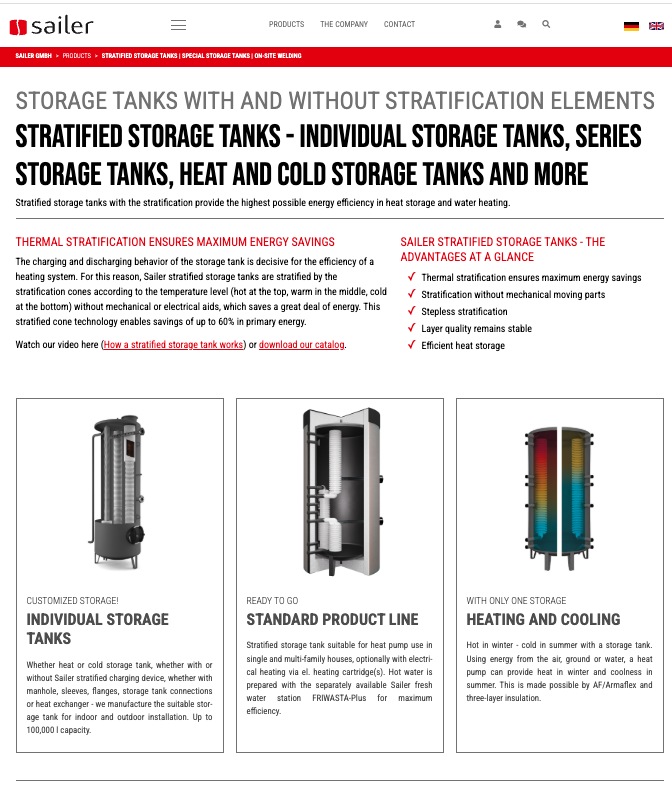
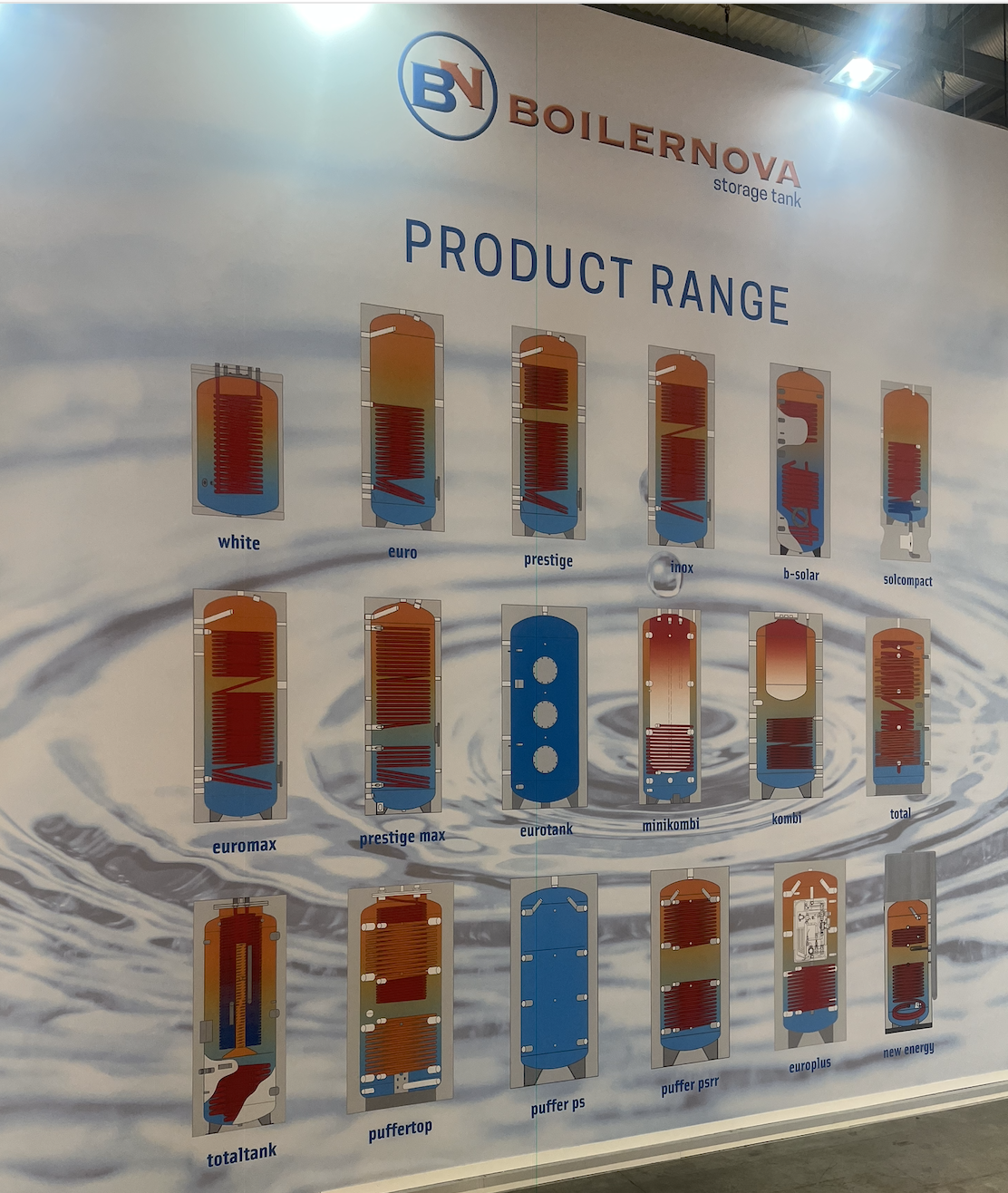
There are a number of tanks built in Europe designed specifically to stratify. I've seen these at solar shows and the recent Mostra Expo. Now they add resistance elements to take any excessive PV generation directly to the tank.
They have active stratificatio tanks also with pumps worhing into the tank at various levels.
I don't know that the cost of the pump and controller for a variable speed is worth it?
There is a way to use a variable speed setpoint pump as the return protection, instead of a 3 way thermostatic.
 Bob "hot rod" Rohr
trainer for Caleffi NA
Living the hydronic dream0 -
@hot_rod Thanks, that is an impressive range of storage tanks.
We met with the HVAC contractor this afternoon, and he understood the situation at my sister's house. He said he's seen a lot of older houses in her town with original gravity conversion systems that have been hacked up over the years and Frankensteined with baseboards and too many zones. He did agree that a buffer tank on the existing boiler would help, but ultimately I agreed with him that a new mod-con was the best solution. He installs Lochinvar and Viessman, and the GC who was there too said he has a Lochinvar and is happy with it. Sister also had a Lochinvar in the previous house. So it will probably be a Lochinvar, with a smaller buffer tank than we would have put on the existing boiler, but still useful for the small zones. It will be more $$ up front, but probably best to rip the Band Aid off now and do it right.
0 -
I agree the mod con is a better solution. A 110,00 will turndown to 8,000. With the anti cycling and ramp delay functions, you should not need a buffer.
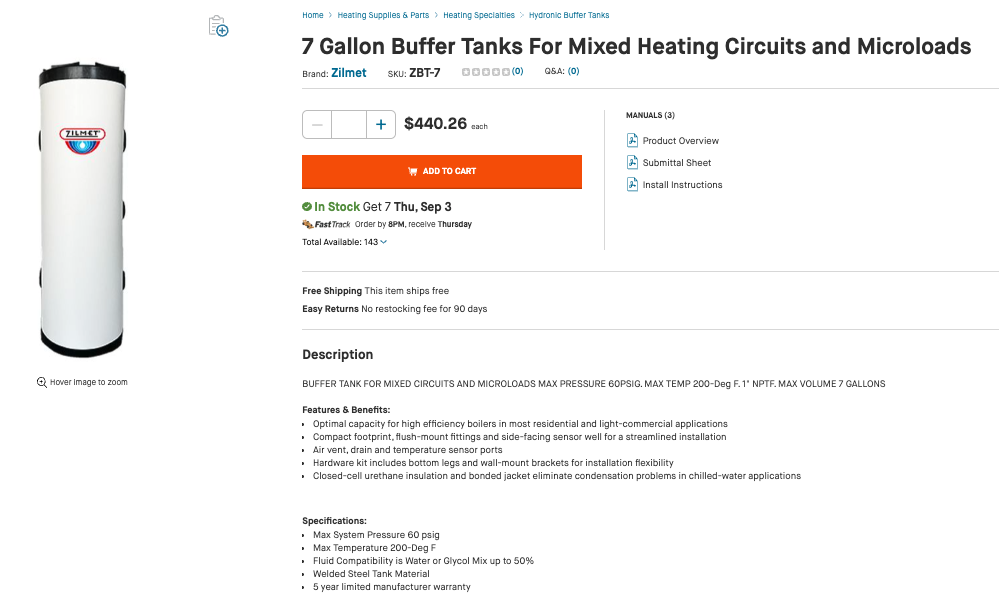
IF you still want to buffer, these small ZXilmet tanks are a good option 7, 14 and 21 gallon versions.
 Bob "hot rod" Rohr
trainer for Caleffi NA
Living the hydronic dream0 -
Bummer, the 155 only turns down to 15,000
But still much better than a no turn down CI boiler
Bob "hot rod" Rohr
trainer for Caleffi NA
Living the hydronic dream0 -
I would add an air separator on the red line out of the boiler before the tank.
There can be multiple pumps on that header at the tank
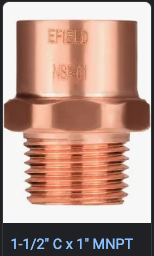
I wish the Zilmet tanks had 1-1/4 or 1-1/2" ports.
If you use the small 7 gallon, use a 1" male to 1-1/2" copper adapter to make that header 1-1/2", if you have multiple pumps on it
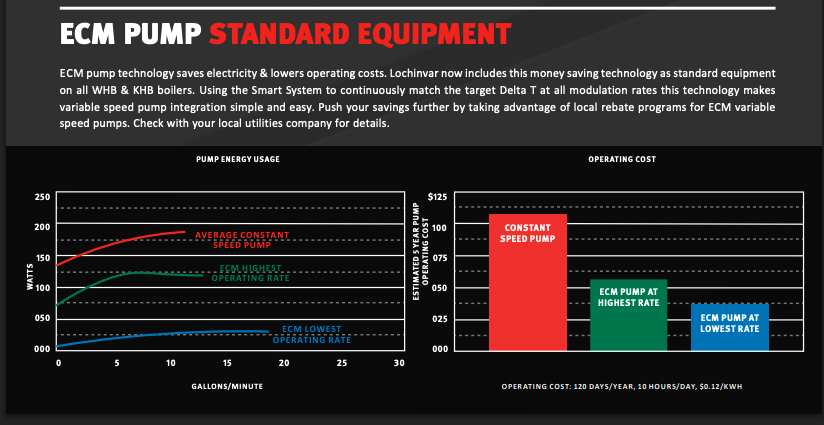
If you go with a Lochinvar Knight it comes with a variable speed circulator for the boiler loop.
Bob "hot rod" Rohr
trainer for Caleffi NA
Living the hydronic dream0 -
@hot_rod OK thanks. I didn't get into piping details with him, but he mentioned using a hydraulic separator and running only the baseboard loops off the buffer tank. The gravity conversion loop would run direct off the boiler. I guess that's almost the same as a 3-pipe arrangement.
I think he will propose a Knight. Sister had that in previous house, but it didn't appear to have ODR. I explained ODR to her and said we should make sure it gets set up right. Not sure why previous installer didn't do ODR, but this guy seems very competent so I expect ODR will be in the proposal.
0 -
I guess I'm not following why you need two hydraulic separators on the system. The buffer as I have shown is the hydraulic sep, and it gives you direct to load ability.
Adding a sep between the boiler and tank will add an additional circ and make the boiler heat call more complicated.
The additional sep adds some temperature blending as the flows through it change depending on which (gpm) load is callings. The 3 pipe tank allows flow directly to any/ all zones and the coldest possible return comes directly to the boiler to keep the efficiency as high as possible.
ODR can take some time to dial in, it is not a set it once and forget. If you want it dialed in perfectly. It would be good for you to know how to make any, all control setting adjustments. The Knight has a lot of features and functions onboard to maximize this investment.
I think you mentioned you are an engineer? Why not give him a piping and control schematic of how you want the job done?
You have an opportunity to make this as simple and efficient as possible, why over complicate it?
Bob "hot rod" Rohr
trainer for Caleffi NA
Living the hydronic dream0 -
@hot_rod OK, thanks, I'll put my system designer hat on (with your assistance) and give him a piping and control diagram. Here's my attempt at drawing up your schematic. Per Siegenthaler pg. 744 I included a check valve to prevent reverse thermosiphon, and added a purge inlet valve. If we used the Lochinvar Knight, the internal circulator would run the boiler loop, so the external circ in my diagram would go away. I assume there's no special control diagram I need to add, just an ODR sensor that comes with the Lochinvar Knight? So we would re-use the existing Taco 6-zone controller and probably add another zone controller because we will have to add a circ to the one cast iron radiator that was repiped in 3/4" and turn that into its own additional zone.
 0
0 -
Exactly!
The boiler circulator comes shipped with the boiler, it is not inside the boiler. I would install it as you show on the return into the boiler.
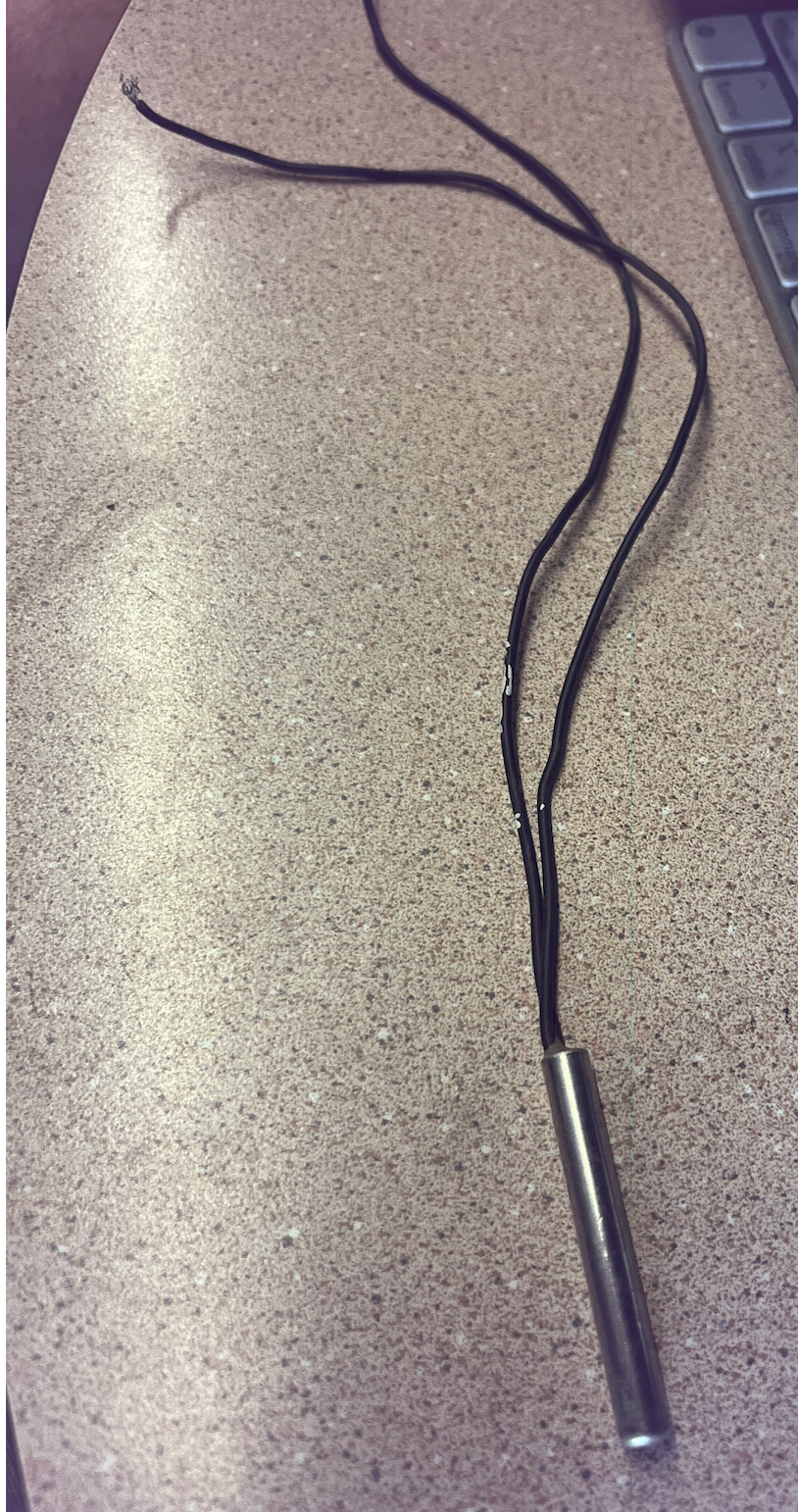
I believe it also comes with this spare sensor. This mounts on or in the mid point of the. It wires to the board on 23, 24 terminals. This is what operates the boiler, based on ODR
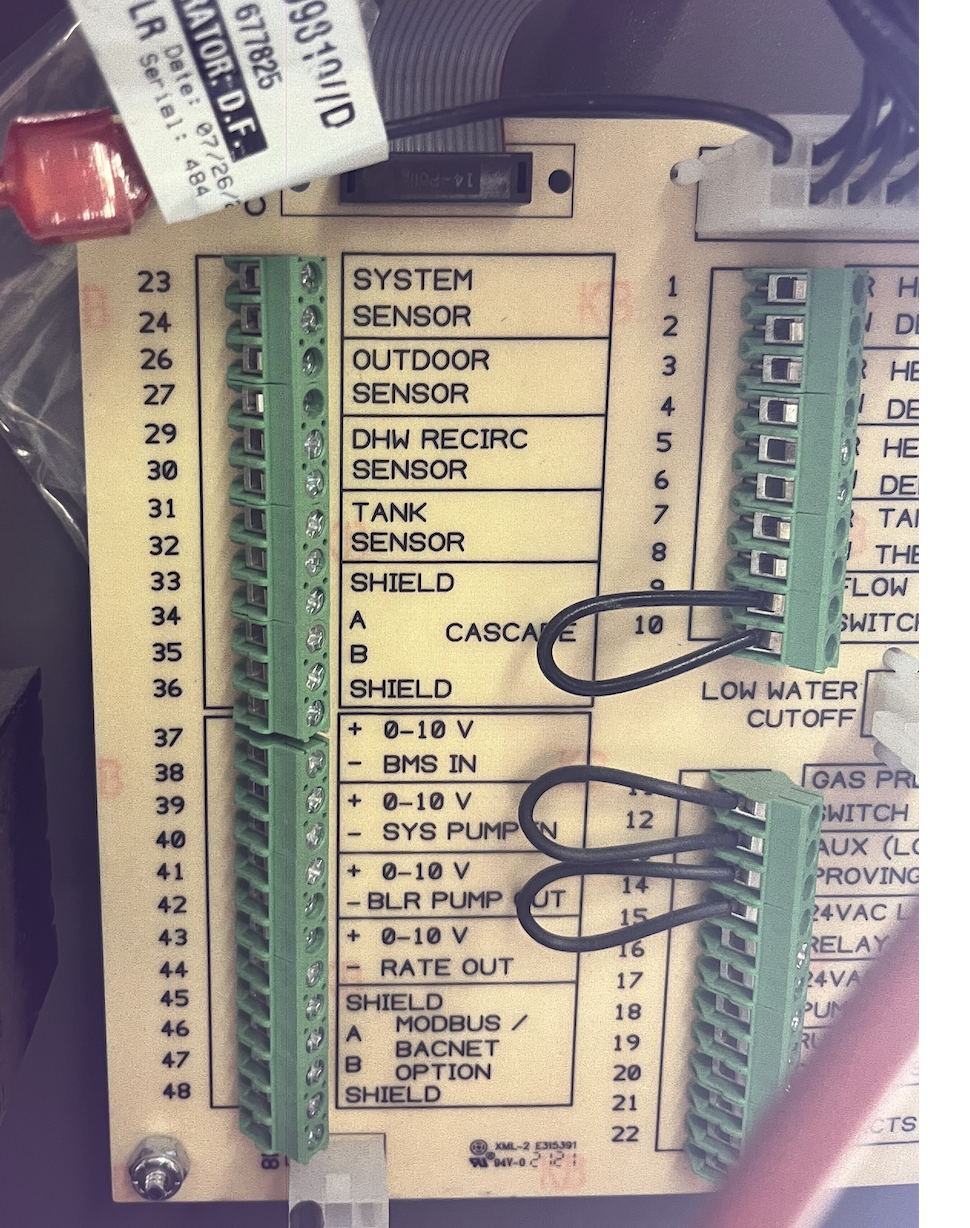
https://s3.amazonaws.com/s3.supplyhouse.com/product_files/Lochinvar-WHB155N-Product-Overview.pdf\
Also go to www.dsireusa.org and check for boiler and pump rebates
Bob "hot rod" Rohr
trainer for Caleffi NA
Living the hydronic dream0 -
@hot_rod Great, thank you! I will drop the diagram off at the HVAC contractor this afternoon.
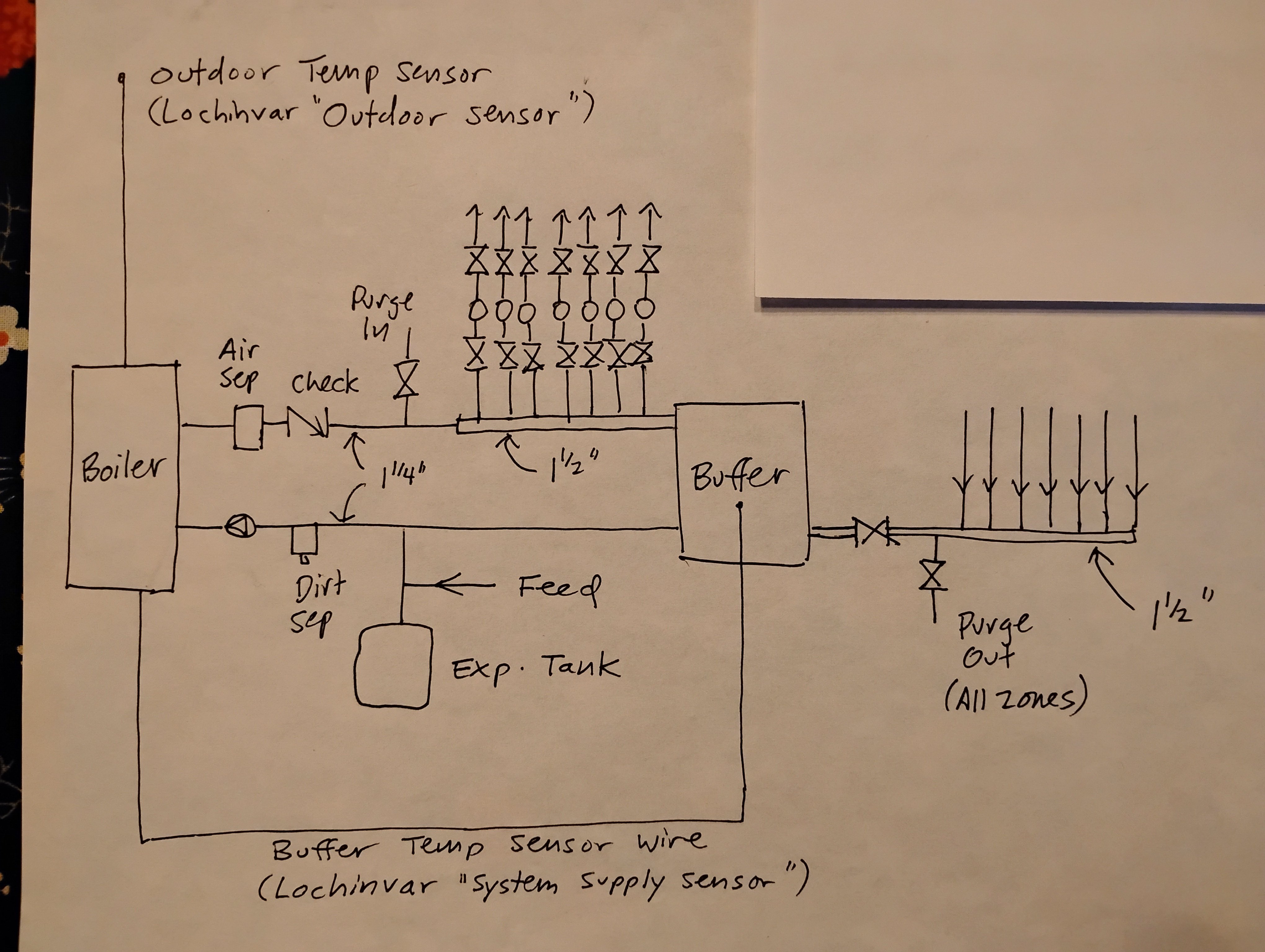
So if I understand, the boiler would run on ODR using a Lochinvar-provided outdoor sensor, plus another sensor that goes in the buffer tank to provide water temperature input to the ODR. And all the ODR logic is inside the Lochinvar Knight, so no separate ODR controller is needed.
Then the Taco zone controller only runs the circs, with no control over the boiler. Boiler only runs when the buffer temp drops below threshold, correct?
I also added a dirt separator before the ECM, since I've read here that iron crud inside gravity conversion systems can jams ECM's.
 0
0 -
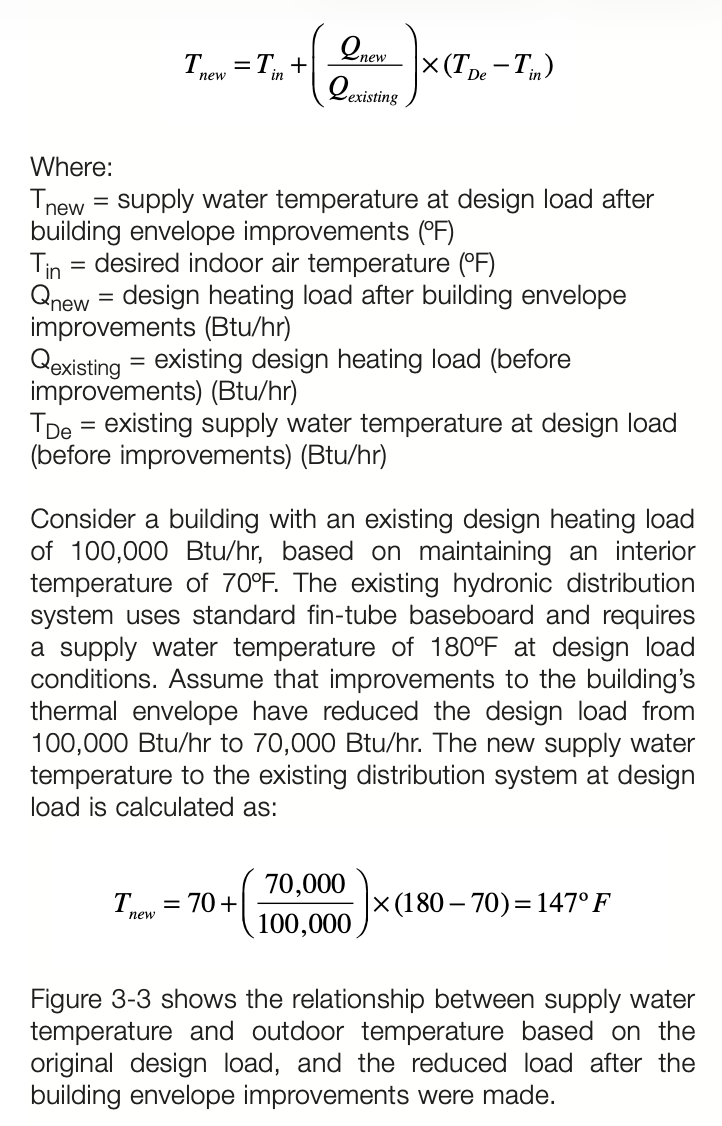
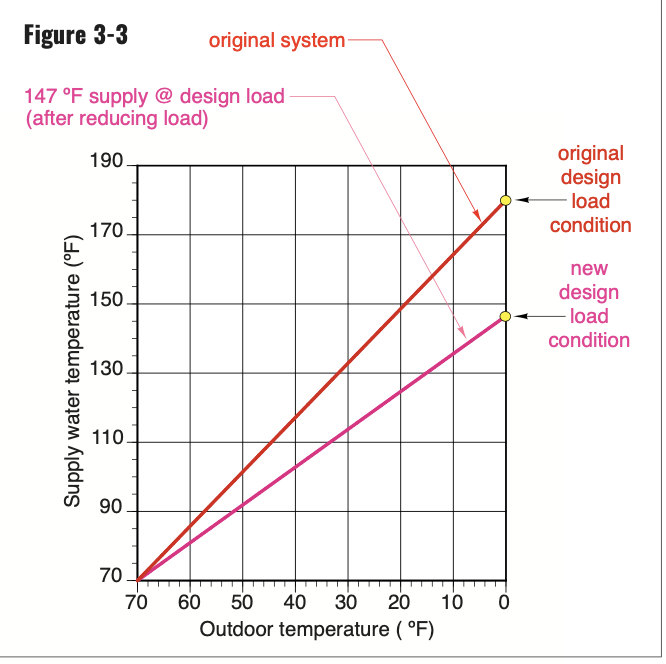
As you make building upgrades. Here is how SWT could drop, and a look at a reset curve at the before ad after SWT's.
From Caleffi Idronics 25

 Bob "hot rod" Rohr
trainer for Caleffi NA
Living the hydronic dream0 -
@hot_rod Great, thank you. I read the Lochinvar boiler manual last night trying to understand the programming for ODR, etc. I think I got the main points. It may take us a while to dial in ODR setpoints in the first few months. I'll be curious to see what water temp is needed on design day.
0 -
You can add Conxus to the boiler and read and adjust remotely
Bob "hot rod" Rohr
trainer for Caleffi NA
Living the hydronic dream0 -
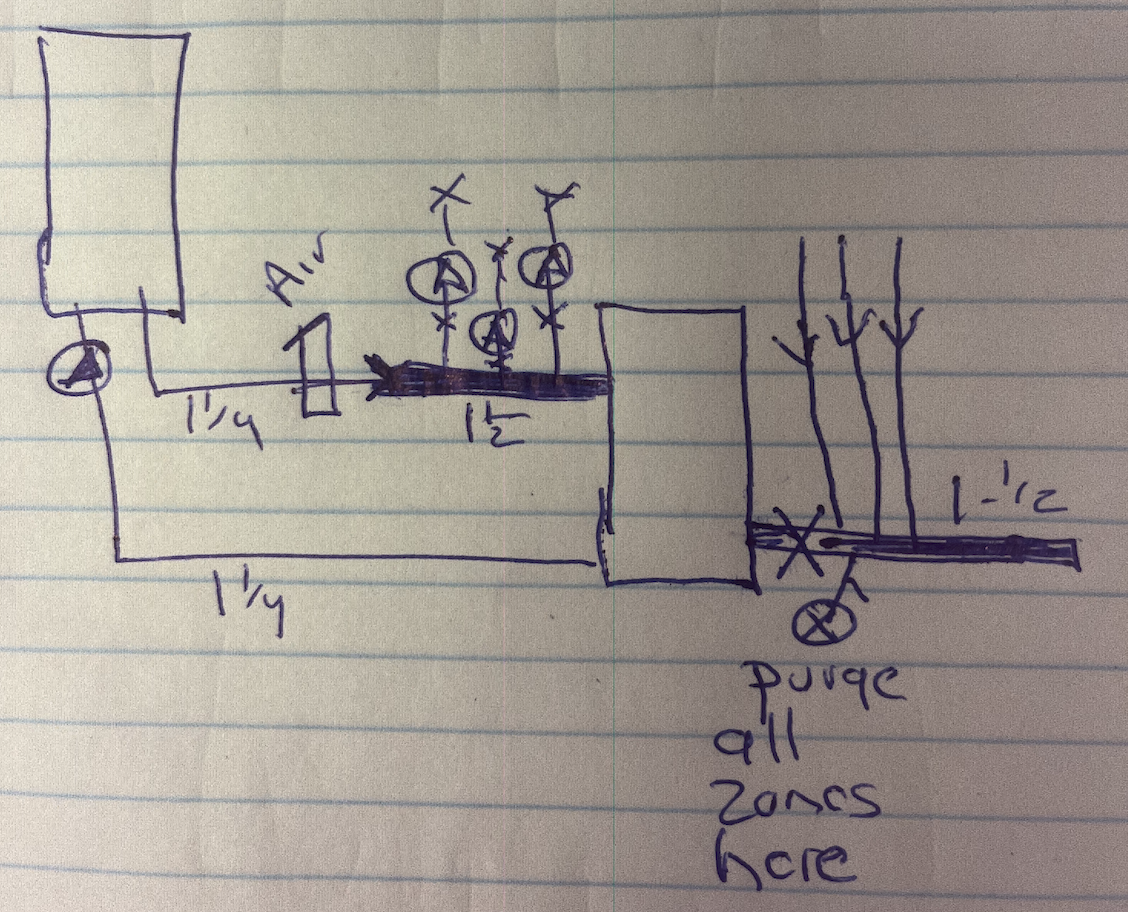
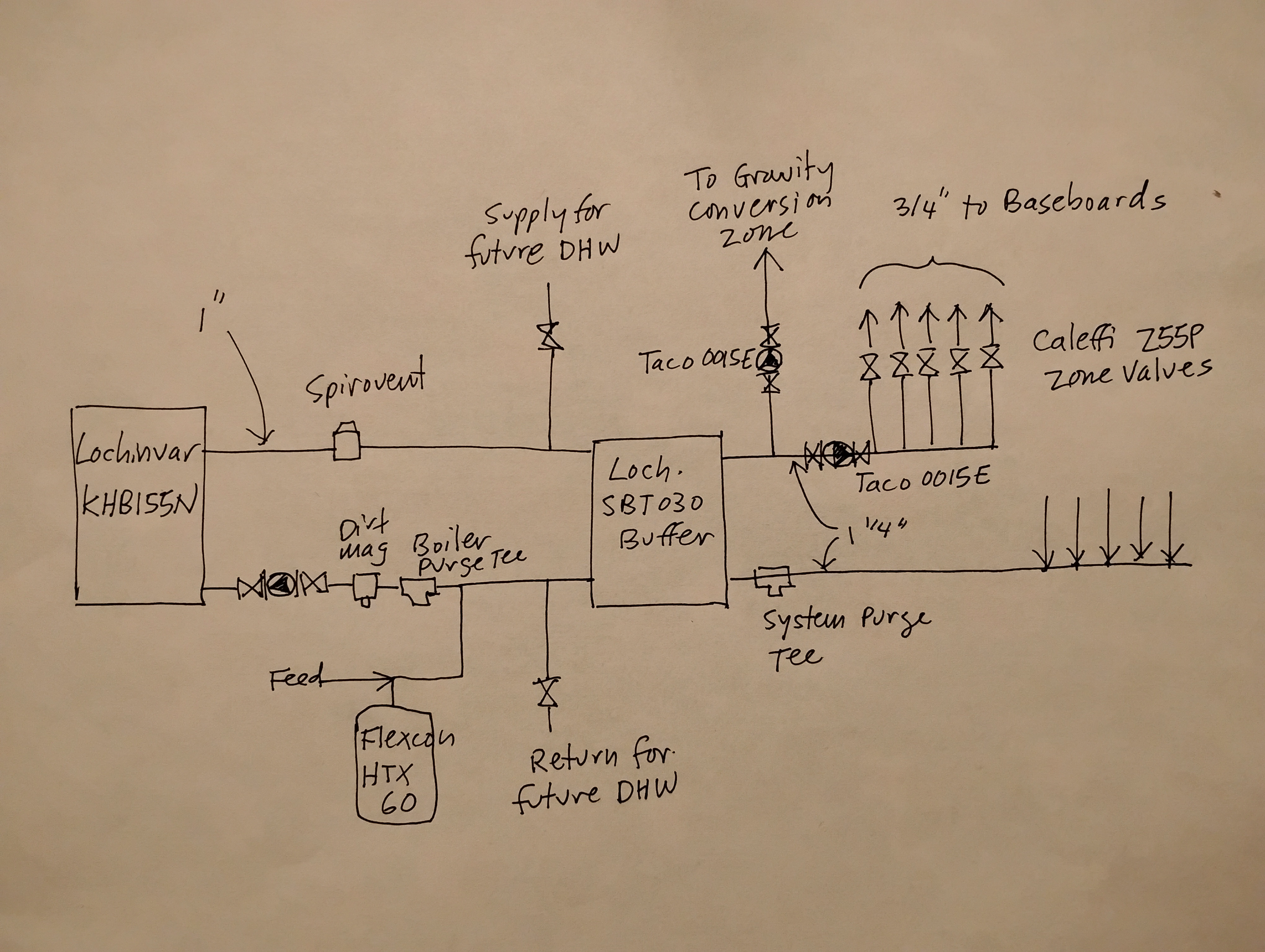
@hot_rod Ok thanks. I just got the proposal from the HVAC company. I won't quote prices but it was probably close to 3x materials, which I guess is reasonable around here. He didn't include a piping diagram, and I suspect he had already done the pricing by the time he got my proposed piping diagram, so needless to say it looks like he didn't take your good idea for a 3-pipe buffer. From the BOM, this is my best guess at his piping. I guess it will work, but it's not as elegant as the 3-pipe buffer because it forces all supplies through the 30-gallon buffer instead of allowing supplies to go direct to load. It's probably acceptable, but I'm posting it anyway just in case there's anything glaringly wrong. Again, this is my best guess based on BOM.
 0
0 -
Probably the worse way to add a buffer to a system like yours, if the plan shown is what they are proposing? But, whatever.
To my way of thinking whoever is paying the bill should get what they want??
That is an ideal 2 or 3 pipe buffer tank as it has 1-1/2" connections.
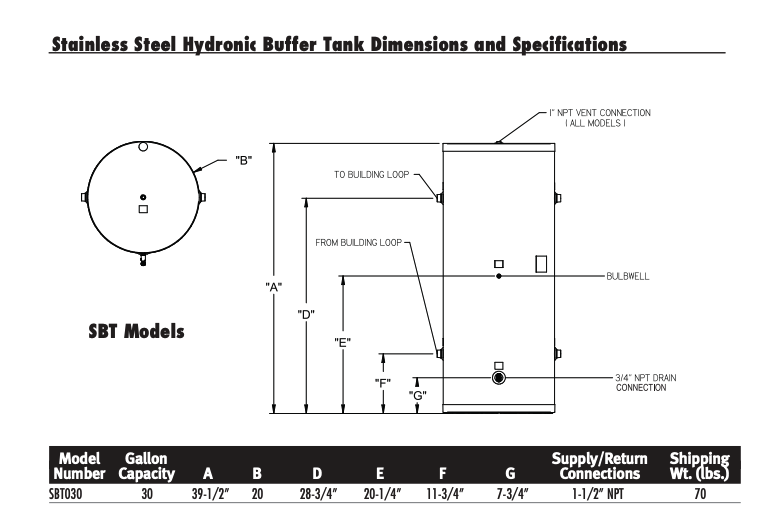
Maybe link your installer to this article, and Idronics
Bob "hot rod" Rohr
trainer for Caleffi NA
Living the hydronic dream1 -
-
Thanks, you are correct. I assume he was planning to return it into the 1-1/4" return header, and I forgot to add a 6th arrow there.
0 -
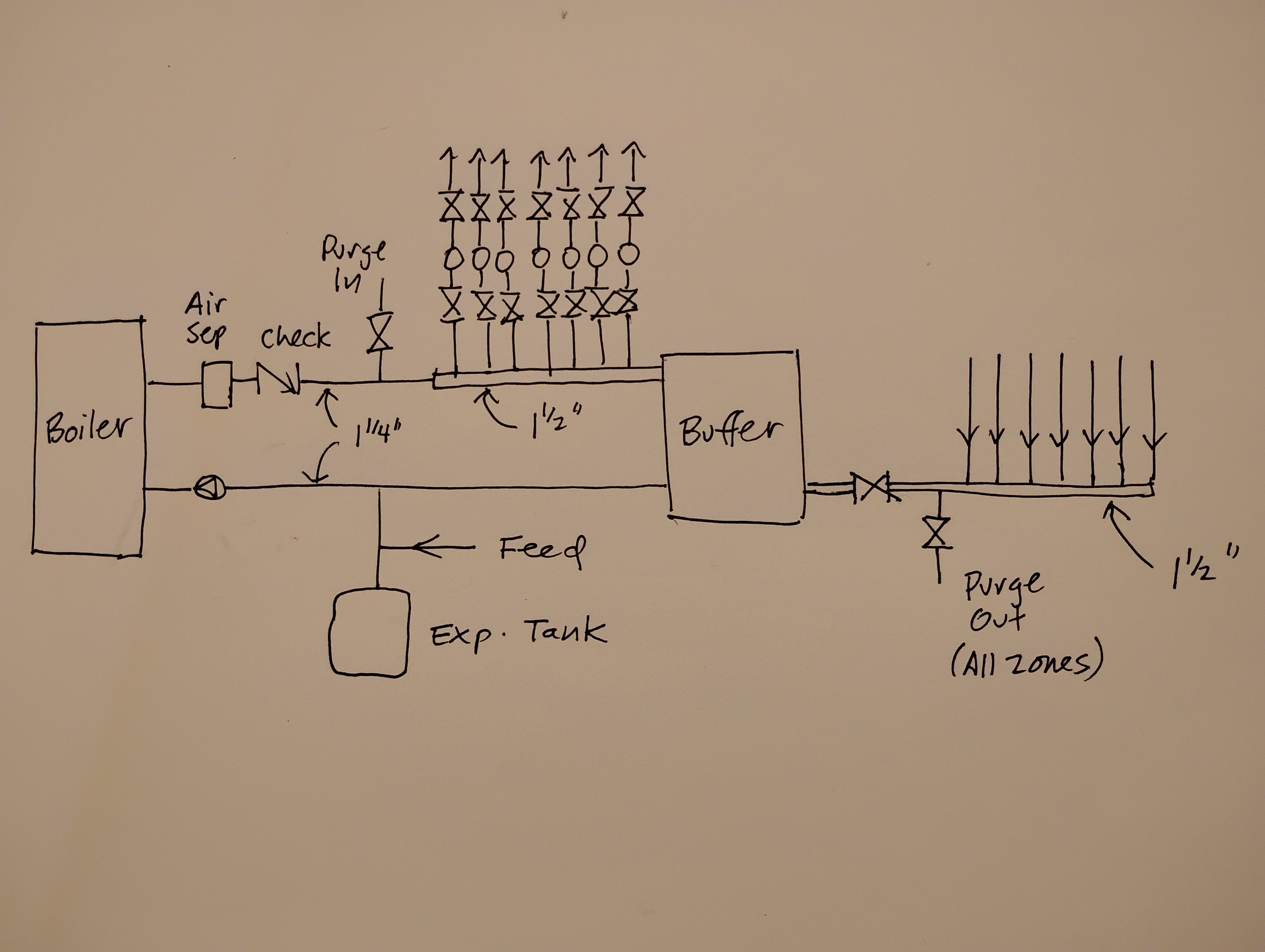
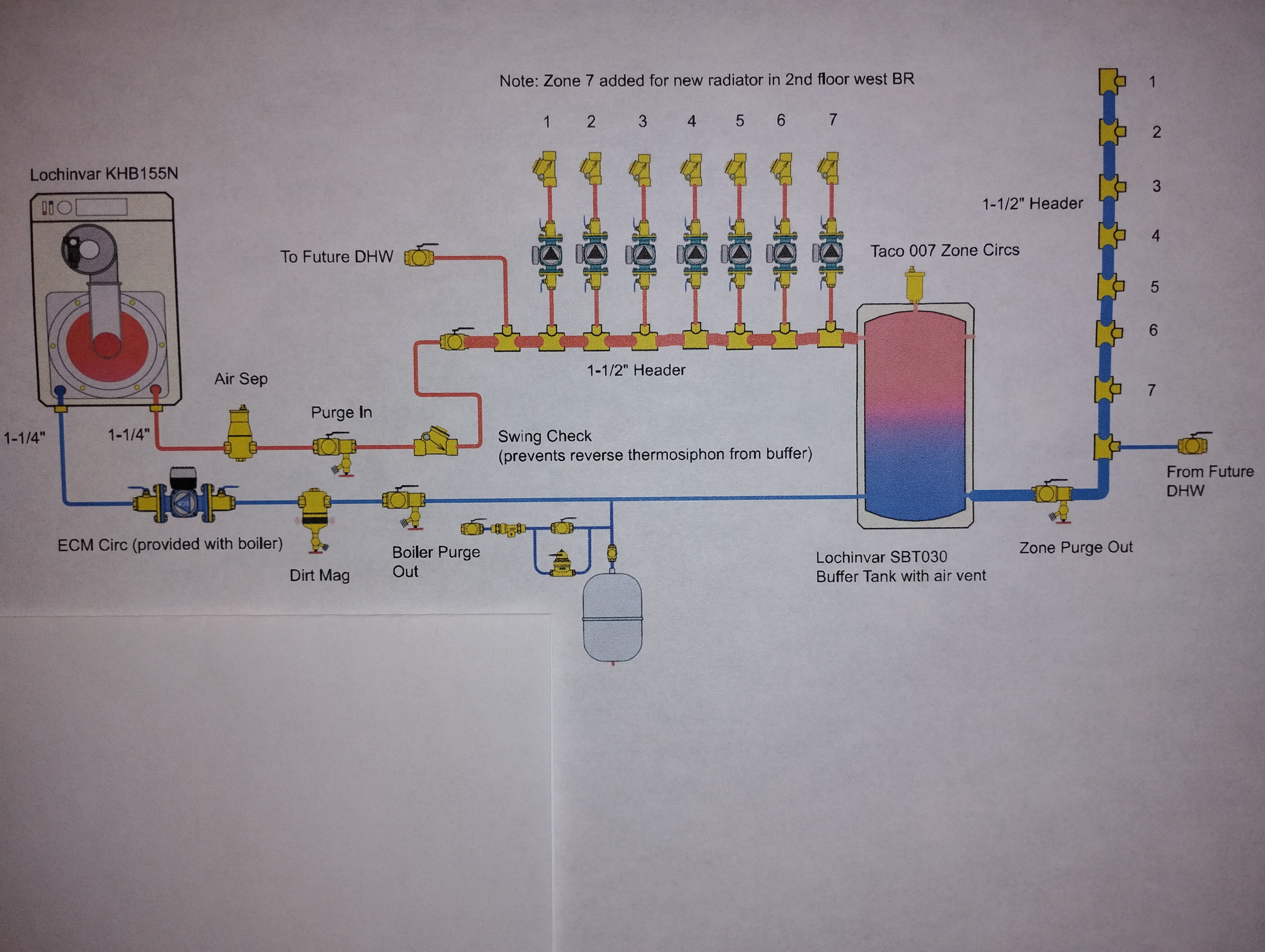
@hot_rod and @EBEBRATT-Ed Thanks for your inputs. I just found Siegenthaler's free online piping software and produced the following better rendering of Bob's 3-pipe buffer tank setup. Is it worth sending this back to the HVAC guy and asking him to re-price based in this schematic? I expect it will be more $$ because of larger pipe diameters and additional circs, but if this is the best way to pipe it, then $1k or so extra isn't a deal-breaker.
 0
0 -
Sounds reasonable to me. You only want to do it once.
0 -
Personally I prefer to zone with valves instead of pumps.
So one ECM variable speed delta P circ. A Grundfos 15-58 Alpha may do it, a 43W pump!
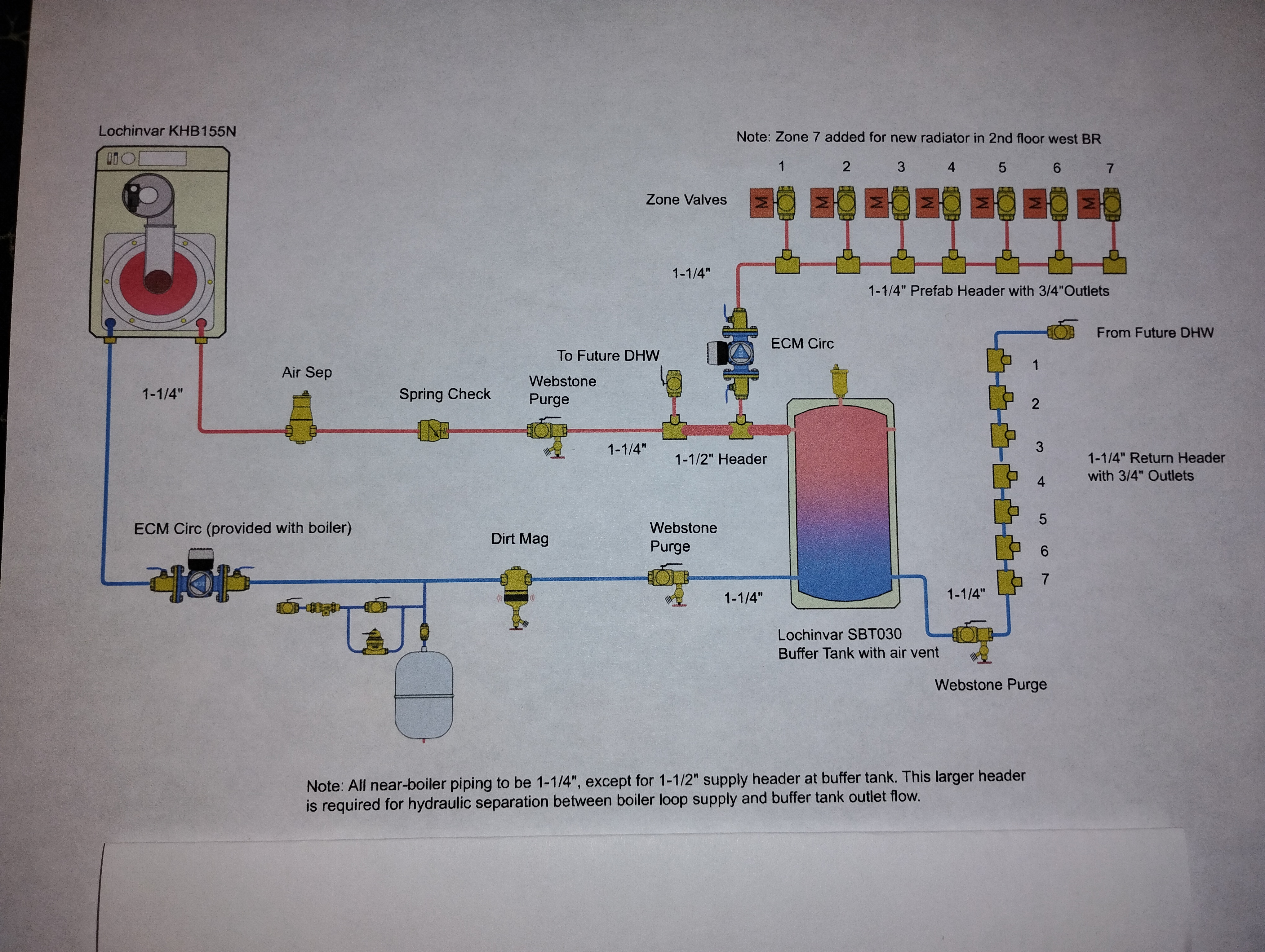
This give you high efficiency distribution as the pump will modulate as valves open and close, from 7- 43W. It also eliminates that big pump header. A short 1-1/2 header for the zone pump and future DHW pump.
The pump modulates as zone valve demand changes and the boiler also modulates as zone change. So basically "cruise control "on the boiler and on the distribution.
Off the top of the pump a 1-1/4" header for the zone valves, same on the return. No need for a large header for the valves or return as it is not acting as a low loss header. Only the section at the tank for the two circulators needs to be large for the separation function
So a high efficient distribution to leverage the high efficiency boiler.
Some suggestions.
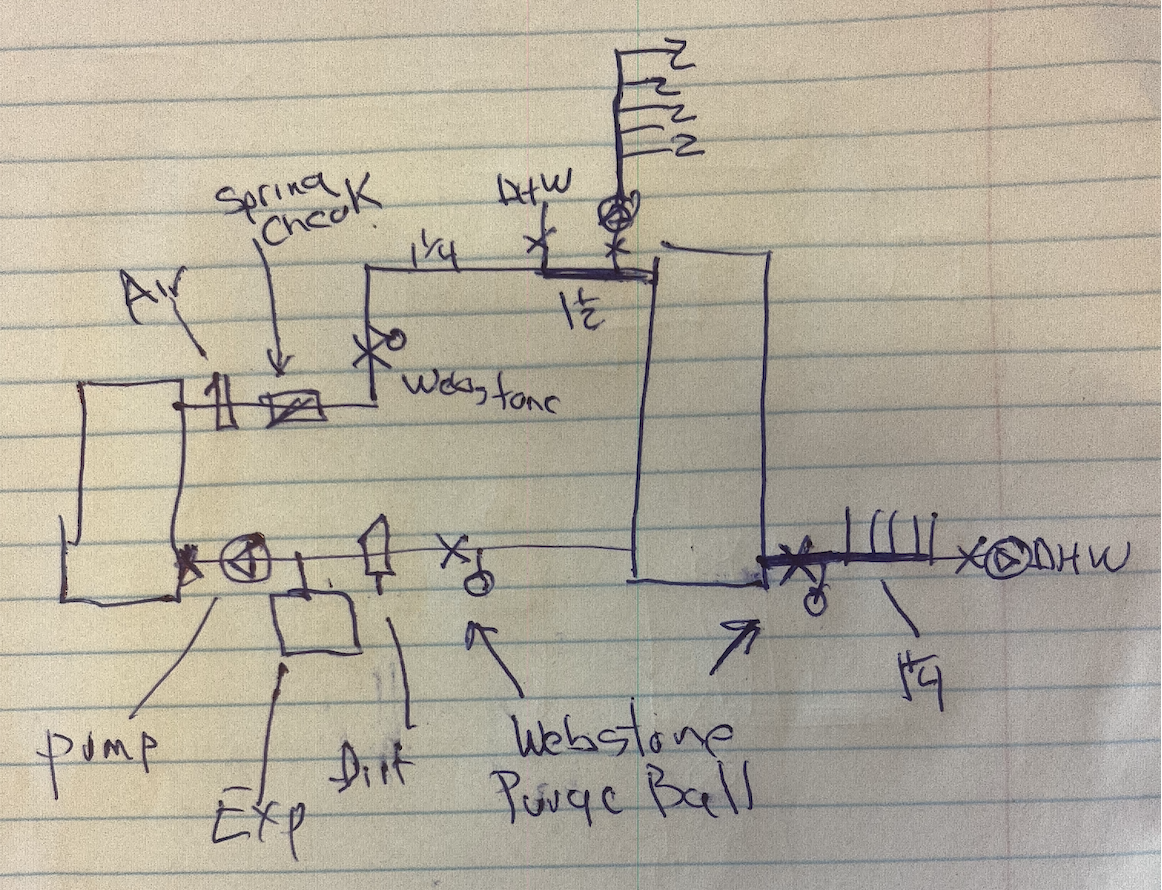
You want a spring check, not swing check.
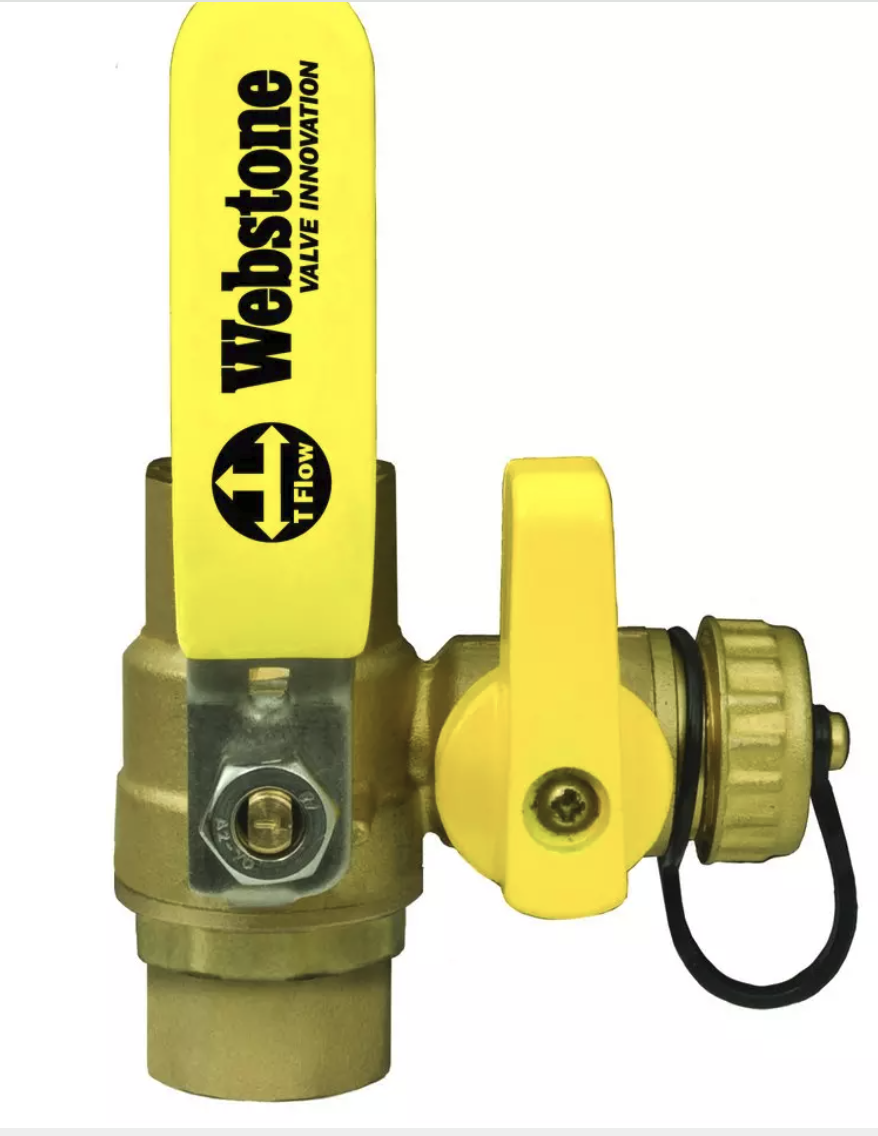
Use the Webstone purge valves as shown, they act as component isolation and purge all in one valve. Less connections, less cost.
The valve on top isolates the check and air sep., and a purge port
The valve on the return isolates the pump, DirtMag and expansion tank for service.
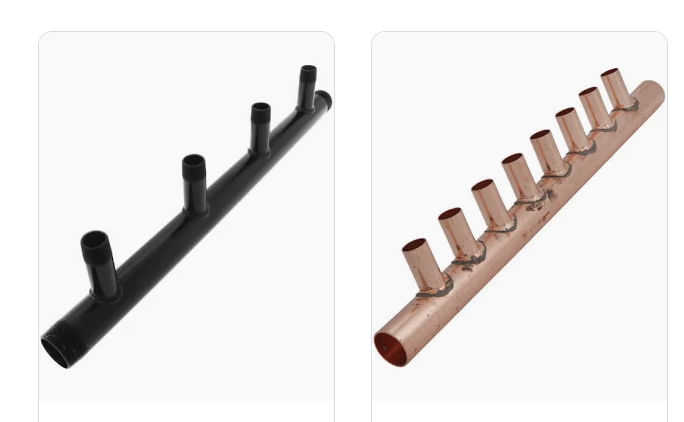
You can buy copper or steel "speedy headers" at Supply Houses. A fraction the cost of stacking steel or copper. Supplyhouse.com has a wide selection. A zone valve header would be a clean install.
CAD this out and send it to the plumber.
 Bob "hot rod" Rohr
trainer for Caleffi NA
Living the hydronic dream0 -
@hot_rod OK thanks. He had Caleffi zone valves, so I'll put those back in the dwg. He had a Taco 0015e circ. Slightly lower amps (.54 vs .71), slightly lower head (18 vs. 19), slightly lower max gpm (16 vs. 17). Roughly same price. Worth asking him to change to the Grundfos? Here is (hopefully) final version.
 0
0 -
That circulator should work fine.
Bob "hot rod" Rohr
trainer for Caleffi NA
Living the hydronic dream0 -
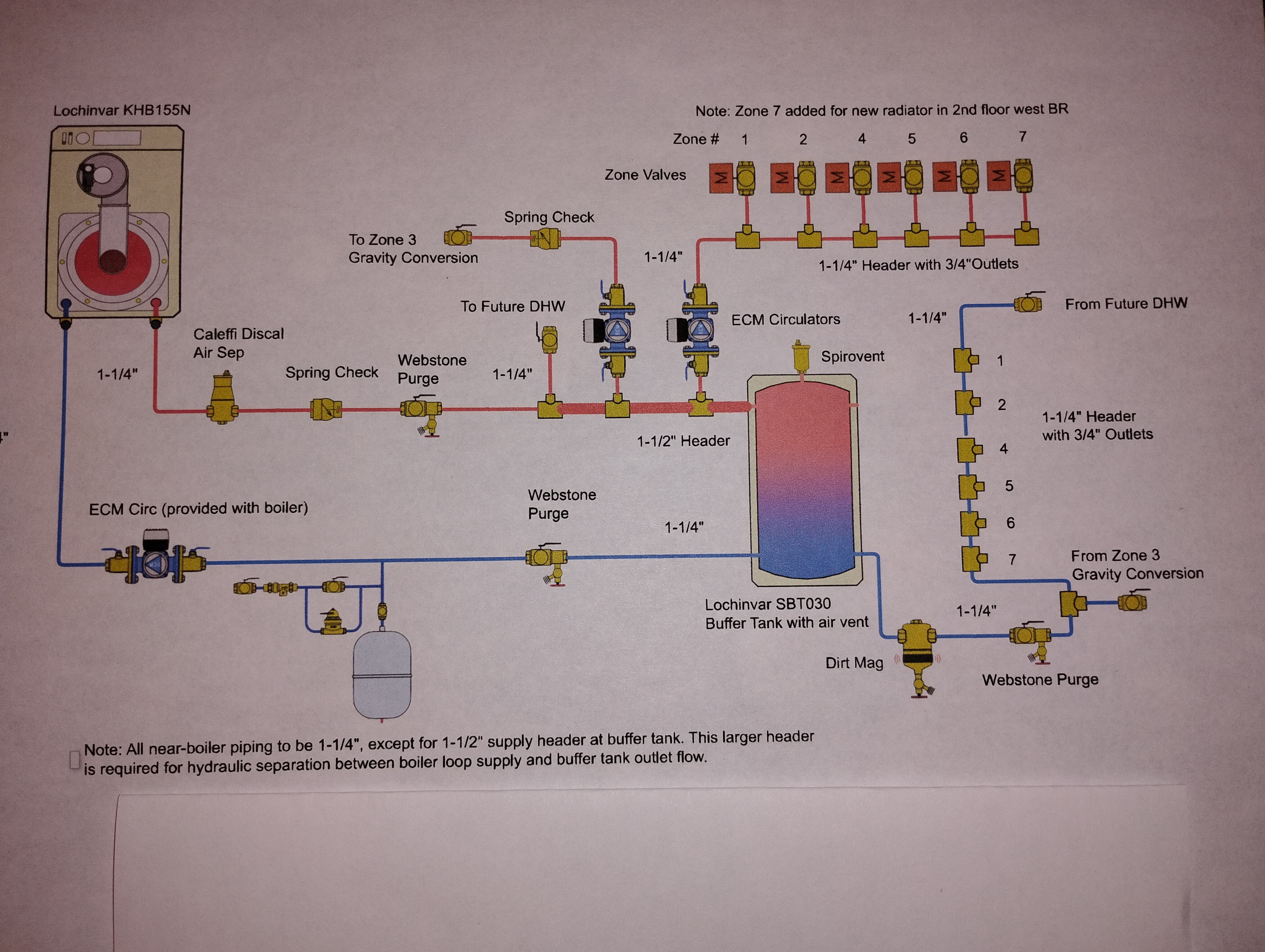
@hot_rod OK thanks. Two final thoughts. He wanted to pipe the gravity conversion zone (#3) as a separate 1-1/4" loop with its own circ, and I'm back to thinking that is probably a good idea. I'm not sure one ECM could handle that gravity conversion zone, which probably should get close to 10 gpm, plus the 6 baseboard loops. The 6 baseboard loops need maybe 2-3 gpm each, so 12-18 gpm there. So one ECM for the 6 baseboard loops and one for the gravity conversion zone? He wanted to pipe that in 1-1/4" all the way to the gravity conversion pipes. And a spring check on that also?
The other thought is location of the dirt mag. Where I had it before doesn't protect the two system ECM's, because dirty water from the return can bypass it through the buffer up into the supply header. So I moved the dirt mag to the return side of the buffer. Is that OK?
And he had a Spirovent on top of the buffer but no air sep at the boiler output, so I added a Caleffi Discal at the boiler output.
 0
0 -
I would skip the descale at the boiler. The buffer tank is a slow place in the road and with the low velocity in a buffer tank it's better than any air eliminator ever made
1 -
If you have a 110 boiler, net output, then 11 gpm is all you need to move if you are designing around a 20 delta
Sure, no harm in a dedicated circ for the gravity loop
I highly recommend a microbubble type air sep installed inline. It combines a low velocity zone along with a coalescing media
It is the media or mesh inside that removes microbubbles, critical with high efficiency boilers with small water content
Good move with the dirtmag The mag function is needed with ECM circs
Today’s circulators come with intergral check valves, no need to add another
Bob "hot rod" Rohr
trainer for Caleffi NA
Living the hydronic dream1 -
My current project is adding a buffer tank to a Knight WHN085 system, older 5:1 from 2012.
Issue I'm having is that the buffer tank sensor (wired into "SYSTEM SENSOR") has no way to tell the boiler to fire, so the boiler would only fire when there is a heating demand from the zone valve controller.
Once the heating call finishes, the boiler will shut down and not recharge the buffer.Then only way I can think of having the boiler maintain buffer tank is to jump out one of the "HEAT/LOOP DEMAND" so there is a continuous heating call. This would maintain the buffer at the target temperature of the respective ODR temperature. The zone valve controller only runs the heating pump when there is a heating demand.
0 -
@hot_rod will know the answer to the question above. I too still don't understand how the Knight is supposed to be wired/programmed so that it runs only in response to the SYSTEM SENSOR in the buffer tank. That's after I've read the Lochinvar manual several times. Lochinvar should have made that clearer, as you would think that's a control scheme many setups will want to use.
0 -
The control logic may vary depending on which version of control you have
You may jumper the heat call, then the sensor controls the tank temperature
However, would want to shut off the boiler pump when the tank reaches temperature
I will look and see how I wired mine, it is 5 years old
As for the system or zone pump, if you use an ECM delta P, just wire it to a plug
It wants to be powered all the time so it can run its exercise function during off season
This prevents the pump from getting stuck, although ECMs are DC pumps so they have good start torque
Bob "hot rod" Rohr
trainer for Caleffi NA
Living the hydronic dream0 -
After the space heat setpoint is met, the Knight turns off the boiler pump after the set "BOILER PUMP DELAY" is completed.
Regarding the ECM delta p system pump, how does it behave when all the zones are close? Would it not attempt to maintain the delta p and just run against the closed zone valves?
0 -
The plan is to pipe a buffer tank, so there will always be a flow path for the boiler and it's pump.
Bob "hot rod" Rohr
trainer for Caleffi NA
Living the hydronic dream0 -
I spoke with 4 different Lochinvar experienced folks. All agree the system sensor is the way to go, 2 said you need a heat call jumpered, two said no ?? I'll try the choices on my boiler to know.
I do know when you use that tank sensor in an indirect, wired to Tank Sensor, it fires the boiler for DHW.
The rep told me a spare sensor and well is in a plastic bag attached to the relief valve, when you open the box. They often get missed and discarded. So you just wire that sensor to System Sensor with thermostat wire. If the buffer tank has a mid point tapping, put the well and sensor there.
On the ODR be aware of the offset. if you set outdoor shutdown temperature at 70, 5° offset then it needs to drop to 65 to allow the boiler back on. Factory offset is 10°, you may go to 5° offset.
See Outdoor Air Shutdown Differential in the manual.
System Pump Delay allows the pump to run after the boiler stops firing, default is 30 seconds. With a fire tube boiler you may lengthen that after watching it run for a few cycles.
I would also use the Boiler Pump Anti Seize Delay, default is 20 seconds.
When I program or change my settings I write down all the settings right in the service manual next to the explanation.
Bob "hot rod" Rohr
trainer for Caleffi NA
Living the hydronic dream0 -
@hot_rod Thanks. When you consult four Lochinvar pros and two of them say one thing and two of them say the opposite, it kind of proves my point that the manuals omit some important details. It would take literally one sentence to clear up that question about jumpering a heat call, but apparently no one at Lochinvar thought to write that one sentence in the manual. Will be interested to hear results of your jumper-vs-no-jumper experiment.
Thanks for those tips on settings. I will definitely write down all settings, especially the ramp delay steps, which so far seem like the most important.
0





Categories
- All Categories
- 87.8K THE MAIN WALL
- 3.3K A-C, Heat Pumps & Refrigeration
- 60 Biomass
- 430 Carbon Monoxide Awareness
- 133 Chimneys & Flues
- 2.2K Domestic Hot Water
- 6K Gas Heating
- 124 Geothermal
- 170 Indoor-Air Quality
- 3.9K Oil Heating
- 79 Pipe Deterioration
- 1.1K Plumbing
- 6.7K Radiant Heating
- 397 Solar
- 16.1K Strictly Steam
- 3.5K Thermostats and Controls
- 56 Water Quality
- 51 Industry Classes
- 51 Job Opportunities
- 18 Recall Announcements