Snowmelt in Summer

We are doing a large snowmelt system this fall that will be about 20,000 SF with 3/4" tubing on 6" spacing, and (6) 399,000 btu boilers. The homeowner is also interested in harvesting heat out of the driveway in the summer for pool heating and domestic pre-heating. Any control strategies are welcome. There will be (5) remote manifolds fed by 2" dual-insulated pex, each with a Grundfos UPS 32-160 circulator. I'm thinking a pair of closely spaced tees somewhere on the system side to add a summer heating zone that would not affect the boiler side. The circulators will be on high in the winter, but could be switched to low for summer. A flat-plate HX would be needed, but don't want it sitting on the main system due to flow restriction.
Comments
-
if you size the HX correctly it should not add but a few ft head
You could add a couple manual valves and tees into the SIM supply return lines, direct to the hx, piped just before it goes into the boilers
Bob "hot rod" Rohr
trainer for Caleffi NA
Living the hydronic dream
 2
2 -
Ok. I've sketched where I might add a HX for summer auxiliary usage. The system will use a Tekmar 671 for control in the winter. I was planning to power the 5 system pumps through 5 of the 6 boilers, to balance the electrical load. However, if we opt to use the system in summer, should I think about a separate switching relay that could turn on just 1 or more circulators in summer? I doubt we'd need them all for summer auxiliary.
0 -
where is this located? How large of a pool?
In sunny warm climates pools can too warm in the summer.
The driveway is basically a large un-insulated collector, efficiency can be quite high, but when ambient is near pool temperature.
So how many days is the driveway surface warmer than the pool? And the pool actually needing heat? Will it be worth the $$ to try and capture this "free" energy.
A handful of pool specific solar collectors may be a lot less $$, if you have a place to mount them. Typically the pool pump circulates through pool collectors. So no HX additional piping, controls. Or tying into those 4" lines near the sep!
More ideas here.
 Bob "hot rod" Rohr
trainer for Caleffi NA
Living the hydronic dream 3
3 -
Good point, HR- I may just try to steer this back to basics. Adding a bunch of tech to save a few bucks is not always worth the squeeze. The project is in Ohio, and I doubt the pool or domestic heat load would be sufficient to merit the additional cost. Just because you can does not always mean you should. Thanks!
 1
1 -
I’d guess if they have the $$ to run six boilers to melt snow, they could afford a pool heater or HX 😉
Bob "hot rod" Rohr
trainer for Caleffi NA
Living the hydronic dream
 4
4 -
This makes sense is if you can use the snow melt boilers for heating the pool. In that case you already have the HX, so you are only adding in the controls to use the driveway heat when warm. The article @hot_rod linked to has good points on how to set it up and control it.
The one challenge with this setup is you need to protect the HX in the winter time from freezing.
0 -
@Mark Eatherton was a big proponent of this. I wonder if he ever figured it out.
0 -
you don’t see or hear of many, maybe the numbers don’t work so well.
The fittings, hx and parts to tie into the 4” piping may be more than what it contributes to the load ?Bob "hot rod" Rohr
trainer for Caleffi NA
Living the hydronic dream0 -
We did this in a rehab facility once upon a time, but without the snowmelt part. Tubing was cast in a concrete pad under the parking lot and then overlaid with asphalt so it technically could have melted snow, but was not intended for it. We had cascaded Lochinvar FTXL boilers for space heating and then dual indirects for DHW along with a large tube and shell HX for the pool. The fluid in the parking lot was constantly circulated when the outdoor temp was above a certain temp (I think 75*?) and then diverted through an injection setup to preheat the return loop to the boilers via a sensor on the parking lot return piping. I was never there after install, but was told by a coworker that it worked surprisingly well with 130+ degree temps coming in from the lot on a perfect day. Probably not very cost effective considering those days are minimal in Minnesota, but it was a cool project to be a part of.
0 -
I agree, @Kaos. Since the pool heater is already in place, and domestic hot is already designed, it seems a little late to pull all this into the snowmelt scope as an afterthought. I have the feeling, also, that independent systems will be best in this case anyway. Thanks everyone for the feedback, and the article from Siggy.
0 -
This is the type of system that requires one of two things. An experimental attitude ( and wallet) or TRANSYS. I can’t remember if i ever modeled heating by driveway, but we talked about it a lot.
- depth of pipe
- albedo of driveway
- Sunshine profile (orientation and weather)
- DHW and Pool profiles.
- Rejecting space cooling heat to pool
- Volume of water
- Heat loss rate (weather, surface evaporation and heat loss, ground contact)
- Hydronic heat pump using the driveway preheat or direct to HX
- Etc and good luck. I’d run it, but i dont currently have a system up and running.
0 -
As we gear up for the pour this fall, I read a recent discussion here on the topic of tubing and rebar placement, and the pros and cons of various methods. Our install game plan at this point is for about a foot of compacted limestone, a layer of Insultarp, 3/4" tubing on 6" spacings tied to #4 bar in an 18" grid, on 1-1/2" chairs. @GroundUp , I'm interested in avoiding the air pockets you mentioned that can result from bridging of tubing tied alongside the rebar. Is this avoidable by using a higher slump concrete mix or something? When I hear you've torn some out, I get palpitations. :) The input from this group is appreciated; I've got one shot to get this right. There is natural slope in all this driveway, and there will be trench drains crossways every so often to dewater the drive during snowmelt operation. Anything else we are overlooking?
0 -
Insultarp is designed to be rolled out over new concrete as temporary measure to prevent it from freezing while it cures.
Is it rated for below grade installs?
Why not use 2" XPS (R10)?
0 -
If you spend the $$ for 6x6 mesh, that goes over the insulation, tube ties to it, lifted an inch
Then rebar lies on top of the tube. That is the best shot of getting everything in a good location in the pour.
#4 bar, 1/3” will be 1” where the bar crosses
Rebar at the bottom doesn’t do much good, just as tube at the bottom is not so good
Given a choice Id rather the rebar in the slab center as opposed to the tube
If the rebar cannot be encased in the slab, might just as well eliminate it.
3/4 tube 6” on center will be tricky. You will need room to make big “light bulb” loop ends
It is the prep work, compaction below that has more to do with a good slab.
What is the true R value and psi rating of that tarp?
Common Dow or Owens foamboard 250 is 25 psi
The 150 board is 15 psi
Bob "hot rod" Rohr
trainer for Caleffi NA
Living the hydronic dream 1
1 -
@PhillipJones Bubble wrap and radiant barrier are things that feel like should provide insulation, but they don't. For radiant barrier to work, it needs to be facing an air gap, that is hard with gravel under and concrete over it. I don't know what testing those Insultarp folks did, but nothing out there will get you over R10/inch, which is about 2x what most real rigid insulation is.
Use real insulation like XPS or EPS. Around me (north edge of zone 5) for residential snowmelt the common way is with radiant PEX panels (EPS with vapor barrier facer and bumps for PEX) like:
The tubes are bellow and won't get fully covered by concrete but it is good enough.
0 -
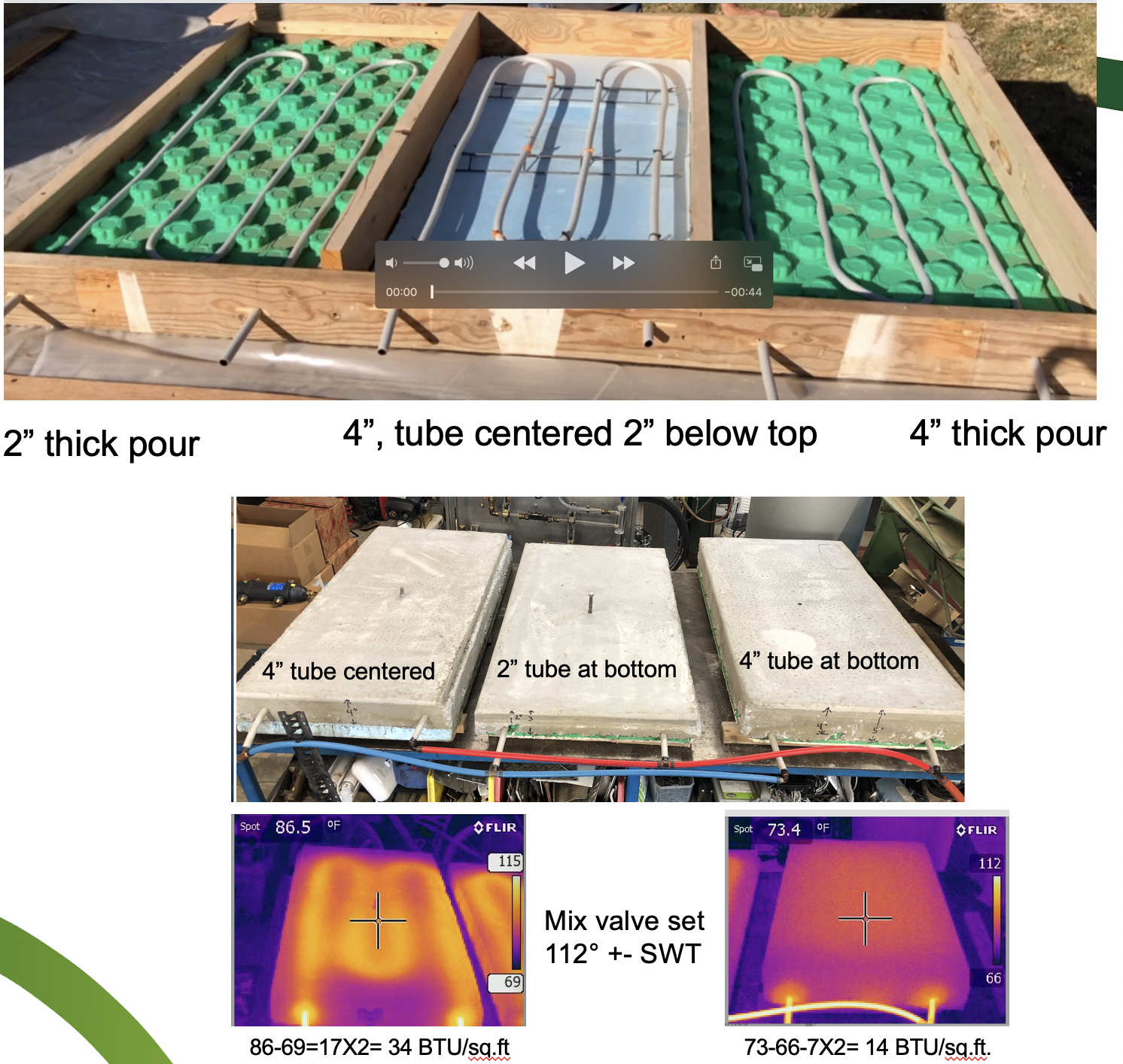
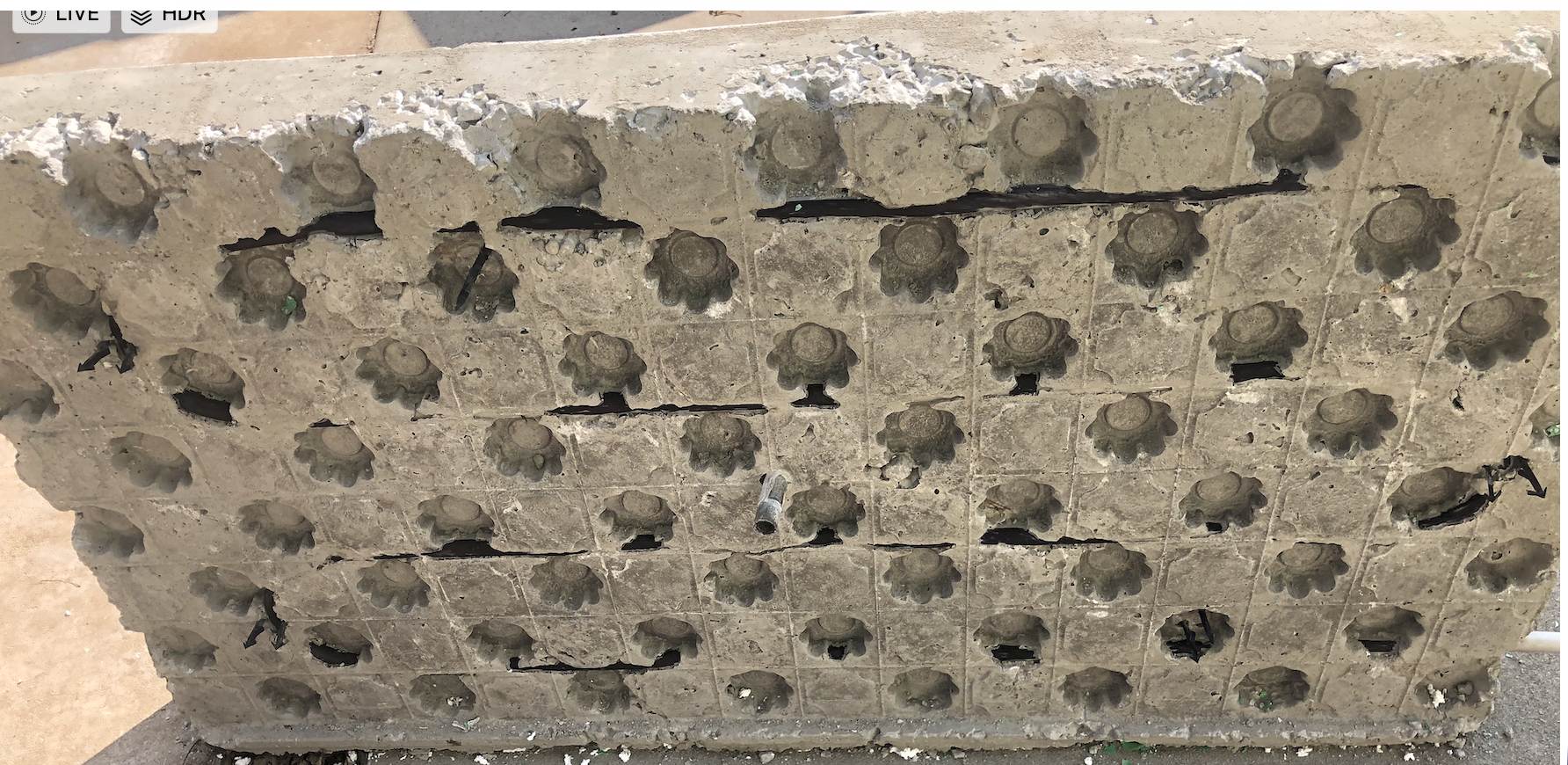
Personally I feel those nob foam panels are a bad idea. Puts the tube at the worse spot in the pour, at the bottom. It creates air space around and under the tube, and the foam nobs isolate concrete away from the tube.
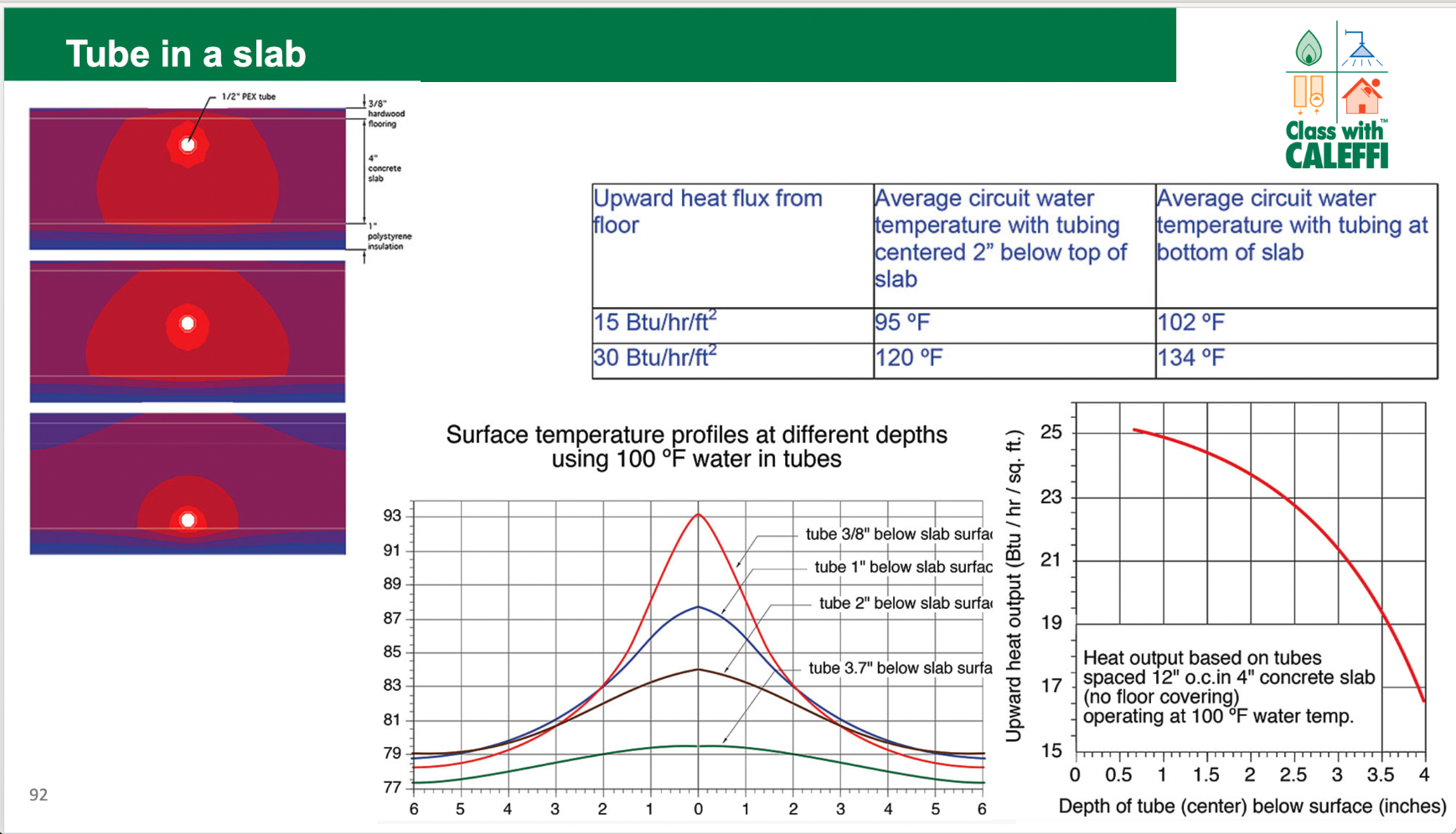
Tube at the bottom of a slab slows response time, requires higher SWT, and increses downward loss.
Yet another product that has not had a lot of independent testing. IMO.
Here is what the bottom of a slab on nob panels looks like.
It's worth some time getting the tube into the slab, surrounded by a conductor. Like concrete :)
 Bob "hot rod" Rohr
trainer for Caleffi NA
Living the hydronic dream0 -
I am not a concrete guy so I can not say with any degree of accuracy how slump would affect encapsulation, but I would again advocate against tying tubing to rebar. Use smaller mesh, and absolutely do NOT use Insultarp.
0 -
Thanks for all the input. There is a trade-off with each system it seems like. If you focus on R-value, you have to face a structural compromise in PSI rating. If you focus on structural, you compromise efficiency. If you focus on safety of the tubing, you compromise output. If you focus on output, you put the tubing at risk. The various insulation systems out there is interesting. I notice that Insultarp and Barrier both use the same disclaimer terminology, and wonder about their posted R-values. But at the same time, I think they are better than nothing, and at least they won't raise concerns about PSI rating. We inherited this design from a manufacturer's rep, whom I trust, and the Insultarp is bought. We plan to tie to the re-bar, and avoid tying alongside, but rather at cross-points. Thanks everyone for sharing, and @hot_rod , thanks especially for your test work on the panels. Keep it up!
0 -
The tarp is advertised as a thermal break and vapor barrier.
If you read the fine print the r-value is rated with 2” gravel and 1” sand over the product.
I recall the FTC came down on the bubble foam products early on, and made them change their claims.

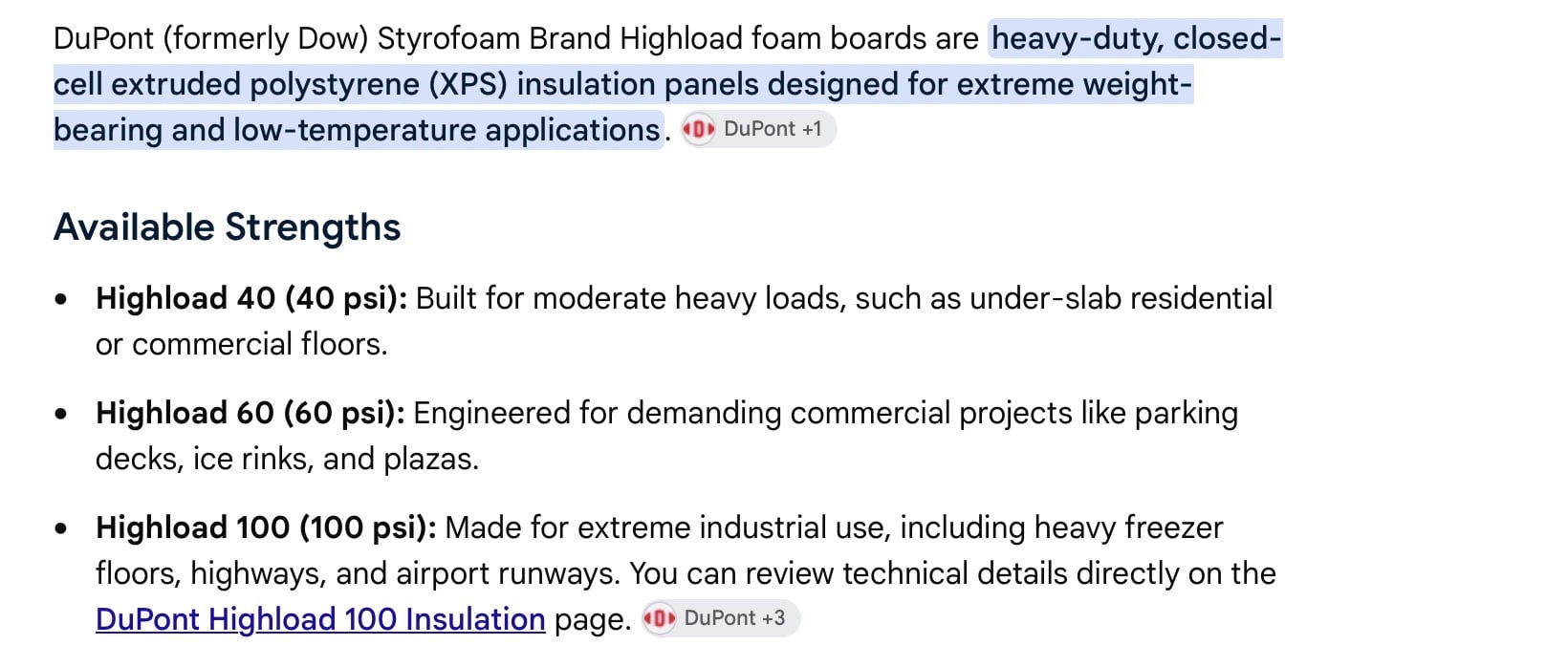
I can’t imagine a residential drive or home would need more than a 250 psi foam?Dow offers hi-load up to 100 psi. If you are doing a runway?
I asked a rep why he sold a product considered a little better than nothing? He told me it makes him a lot of money.
Is “better than nothing” an actual engineering criteria 😳
Bob "hot rod" Rohr
trainer for Caleffi NA
Living the hydronic dream0 -
Insultarp is literally just a thin concrete blanket with a few layers of the thin roll foam you'd see in packing boxes. When compressed under the weight of the concrete, R value goes to almost nothing so it's effectively just a really expensive vapor barrier.
1 -
Hmm.. not comforting, for sure. Has Siggy or anyone done any analysis of these roll insulation products? I can definitely see the shortcomings. Has anyone got anything good to say about them? If they have no value, it would seem that capitalism would run them out of town.
0 -
I guess I have to ask you these questions if the driveway is not already completed:
How many square feet is this driveway? are the approach aprons to a garage to be heated?
Have you even considered using continuous overlapping loops of black poly pipe tied to the reinforcing mech every 6 inches to heat the driveway from one end to the other to simplify things with a single return?
This was how my fathers 8 bay car wash floor and approach aprons were heated from October 1st to May 1st every fiscal year in New York State.
Why and how has a 2,400,000 BTU figure been contemplated?
A simple small coal stoker boiler can provide all the hot water you need for snow melt and pool heating with one 110 volt stoker using summer operating temperatures of 140 Degrees Fahrenheit low limit and 160 Degrees Fahrheit high limit hat could be powered with a generator if the power goes out.
The idea is to create a huge thermal mass early and use it to its advantage allowing to be continuously heated at a low rate which in my fathers car wash case was 160 degrees Fahrenheit.
There are car washes that still use coal for fuel to heat their hot water and the car wash floors.
1 -
Here's why 2.4 million. It's roughly 20k SF with 40k LF of 3/4" oxygen barrier pex.
1 -
Plenty of info and opinions on the web if you sear4ch a little.
https://www.jlconline.com/how-to/insulation/are-bubble-wrap-r-value-claims-accurate_o/
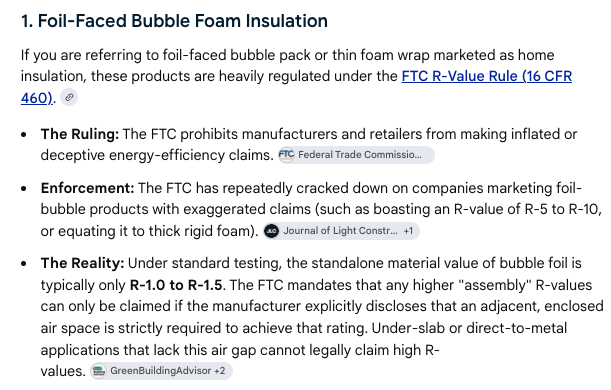
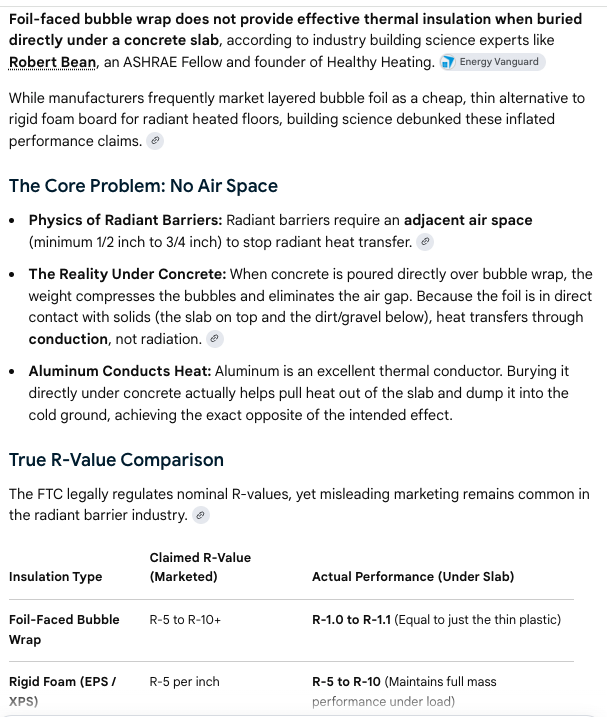
I believe this is the compliance work around.
 Bob "hot rod" Rohr
trainer for Caleffi NA
Living the hydronic dream0 -
the market hasn't run the stuff out because it is the cheapest way to meet code minimums in some areas. so the contractor doesn't care if it does what it claims, the inspectors dont know any better, and the end user gets stuck with the bill. Will have to look around at one point I saved a study that maybe @hot_rod or someone posted here. the foil manufacturer paid for a study of their product in a slab and the early results were showing it was basically useless so they abandoned the study.
0 -
I suppose you could run some numbers and come up with a dollar amount difference running that system for the next 20 years or so with R-1 vs R-7.5 or 10.
Ramp up time to melt will be shortened with a good insulation package, also.
Or maybe the owners are not so energy conscious?
Bob "hot rod" Rohr
trainer for Caleffi NA
Living the hydronic dream0 -
@PhillipJones Say you take a car that is 4000lb with 35PSI inflated tire. Each tire has 1000lb of load which the tires distribute to 1000/35=~30 sqin (so say roughly 5"x6" contact patch).
When you have a load like that over concrete, the load spreds out at 45deg slope as you go through a slab, so under a 5" slab, the 30sqin contact patch spreads out to 160sq in. So the load on the foam drops to only 6.25PSI. Typical XPS is rated for 20PSI, so you are barely loading the foam. That doesn't take into account any mesh or rebar that will further spread the load. Unless you are parking a Mack truck, regular foam is plenty strong.
@hot_rod The Amvic panels raise the tubes off the bottom, as long as the concrete has reasonable size aggregates and slump, most of the pipe gets encapsulated. I do wish manufacturers would publish test data for these.
0 -
Save your client some money and suggest they use black PVC in tight loops with 6 inch separations from beginning to end with a single return back to the boiler. Adding a 1,000 gallon solar storage tank with 5-6 coils in it will only save them more money. Universities use poly pipe and hot water in walking paths to keep them ice free.
0 -
8000 pound sand mix concrete with the concrete vibrated to eliminate air bubbles.
0 -
Edited today;
I have neglected to add that the black poly pipe is also an oxygen barrier pipe and much less expensive than pex.
High Density Polyethylene pipe (HDPE) would be fine for a snow melt application and much less expensive. Laying the HDPE pipe in four inch loops would work well.
Using the car wash example in my fathers case the black poly pipe over lapped and each loop separated by a six in spacing and it allowed may many more feet of tubing to heat the car wash approach aprons and the main slab surrounding the car wash pit.
Overlapping the tubing in four or six inch loop increments allows the black poly tubing to heat every square inch more effectively with one circulator because the concrete slab is absorbing the heat from the tubing.
The HDPE could be tied to the reinforcing mesh with black cable ties to secure it.
With a car wash and for that matter any heated slab keeping the slab warm continuously allows the system to maintain a balanced temperature for the entire heating season with a lower temperature heating fluid like non-toxic antifreeze or standard automotive antifreeze.
A 8,000 pound wet(neat) sand mix concrete would work well and not erode as quickly compared to a gravel mix concrete and the sand mix would more easily be vibrated into place eliminating air bubbles.
Buying the HDPE pipe in a large reel will save them a great deal of money.
You could purchase a large enough reel of 3/4 HDPE pipe which is oxygen barrier pipe anyway to do the entire driveway looping the HDPE pipe in 4 inch loops from beginning to end with one return to the boiler. Using 3/4" HDPE pipe in loops may consume more pipe for this installation but that would only benefit the home owner with a larger thermal mass in all seasons using continuous loops from the parking circle to the bottom of the driveway and back to the boiler in one loop.
Using water in the example 40,000" linear feet of HDPE 3/4" pipe would carry 1,207 gallons of water in the example.
0 -
If HDPE poly pipe is used for this driveway at a 4 inch spacing18 feet in diameter the circumference is almost 56 feet per loop where one foot would hold 168 feet of 3/4" HDPE pipe in 3 loops per foot of driveway length rather than straight pipe runs as drawn in the existing design.
0 -
snowmelt systems typically have gave glycol, so you want to use a tubing with an oxygen barrier
O2 will migrate through the wall of typical HDPE and breakdown the glycol turning it acidic
Bob "hot rod" Rohr
trainer for Caleffi NA
Living the hydronic dream0 -
The idea of using the driveway as a summer heat collector is pretty interesting. I agree that it makes sense to keep the summer circulation separate so you're not running the whole system unnecessarily. Having a dedicated relay/control strategy for the pumps seems like a good approach, especially if only part of the system is needed. It’s similar to the way energy use can be reduced with properly configured LED lighting controls, only running what’s actually needed rather than the entire system.
0



Categories
- All Categories
- 87.8K THE MAIN WALL
- 3.3K A-C, Heat Pumps & Refrigeration
- 60 Biomass
- 430 Carbon Monoxide Awareness
- 133 Chimneys & Flues
- 2.2K Domestic Hot Water
- 6K Gas Heating
- 124 Geothermal
- 170 Indoor-Air Quality
- 3.9K Oil Heating
- 79 Pipe Deterioration
- 1.1K Plumbing
- 6.7K Radiant Heating
- 397 Solar
- 16.1K Strictly Steam
- 3.5K Thermostats and Controls
- 56 Water Quality
- 51 Industry Classes
- 51 Job Opportunities
- 18 Recall Announcements