To purge or Not to purge, That is the Question

There are several YouTube videos that explain how to get air out of your baseboard heating loops. Some of them are very helpful. The problem is that many homeowners do not quite understand that purging only works properly on a series loop. For those with series-loop systems, that video may be all they need.
But what about the people with baseboard radiators that are connected to a one-pipe MonoFlo® Tee system? There are a lot of those systems out there, and purging seldom gets all the air out of every radiator. I have often thought that an animation would help explain this difference.
In this first animation, there is a series-loop system with no tee fittings, so the water can only flow in one direction and push the air out of the piping. There are no choices to make as to which path offers the least resistance. There is only one path.
EDIT: @hot_rod and others pointed out a mistake and I have corrected it below.
This second animation uses MonoFlo® tees to direct water to the radiators. When there is air in the radiators, the force of the water purging the main pipe will clear the air from the main loop, but the tee branches do not have sufficient pressure or force to move the air from the radiators above the main loop. This can leave air trapped in the radiators.
The correct way to remove that trapped air is to vent each individual radiator. That is why each radiator must have a vent to allow the air to escape from the high points of the baseboard radiator.
Let me know what you think!
I plan on adding an audio explanation later.
Edward Young Retired
After you make that expensive repair and you still have the same problem, What will you check next?
Comments
-
Why the expansion tank at the pump discharge?
Add a air purger in the drawings?
Can a monoflo be purged with brute force. A pump cart with a 15 gpm flow for example?
Nice work on the animations
Bob "hot rod" Rohr
trainer for Caleffi NA
Living the hydronic dream 1
1 -
I lived with a Monoflow for 35 years.. I had put a Spirotop vent on the main so I would just let handle the main. I would fill the system and vent each of the baseboard once. Then start the circ and let it heat a bit.
If I had too, I would vent the baseboard again. Usually it would heat after venting the baseboard the first time but sometimes you would hear air. It would either get pulled back into the main and the Spiro top would get it or I would vent the baseboards again with the circ off.
 2
2 -
Why the expansion tank at the pump discharge?
Add a air purger in the drawings?
I am so stupid sometimes. That is the way AI drew the system and I never even thought about it.
I was consentrating of getting the water in the pipe to animate and never looked at the hydronic technical side of it
Here is my finished video with commentary
I guess I need to go back to the drawing board. Literally
Edward Young Retired
After you make that expensive repair and you still have the same problem, What will you check next?
0 -
Teach AI about Pumping Away!
Bob "hot rod" Rohr
trainer for Caleffi NA
Living the hydronic dream2 -
Best I can tell (and this comment may very well age poorly) but it seems like you can't teach AI.
Each time to start, it's fresh and doesn't learn. Seems like it may be setup that way intentionally.
Single pipe 392sqft system with an EG-40 rated for 325sqft and it's silent and balanced at all times.
0 -
Whenever a boiler was replaced that had a mono flo system, we would pipe in a purge station for the main. Vents at the rads would get checked/replaced before pressurizing the new boiler.
0 -
makes me wonder how true this is?
 Bob "hot rod" Rohr
trainer for Caleffi NA
Living the hydronic dream0 -
True. The AI large language models were originally trained on the data scraped from the web (including HH) but now that data is becoming contaminated with other AI generated data. Think mad cow disease.
Those vintage / old books represent fresh uncontaminated writing and knowledge they need to refine the spoken/written language models.A friend was complaining about the loss of those old books which are being absorbed into the AI mass knowledge “like sand on the beach, untraceable to its origin”. 😥
On the bright side, it will improve the quality of generated work by all the new authors who rely on Gemini, Llama, ChatGpt and other LLM.
🙄0 -
You are correct, @ChrisJ. AI “knowledge“ is a simply a weighted conglomeration of all the information that scraped off the web. Since the majority of hydronics professionals don’t understand “piping away” it’s understandable that it’s not well represented in the large language model (AI) generated solutions.
I’m sure there are specialized AI models for hydronic’s but those are behind paywalls or integrated into high-end tool sets.
0 -
If AI is looking at past diagrams of hot water piping, consider most drawings, since the introduction of circ pumps show the pump on the return of the boiler.
Pumping towards the expansion/compression tanks.
Most Audels books show this also.
Consider that in the past boilers were shipped with the pump on the boiler return.
1 -
Just when we though we were making progress on training Pumping Away, AI will show the masses a less effective piping method.
Back to the garbage in garbage out model.
Bob "hot rod" Rohr
trainer for Caleffi NA
Living the hydronic dream0 -
Gemini is in the know!
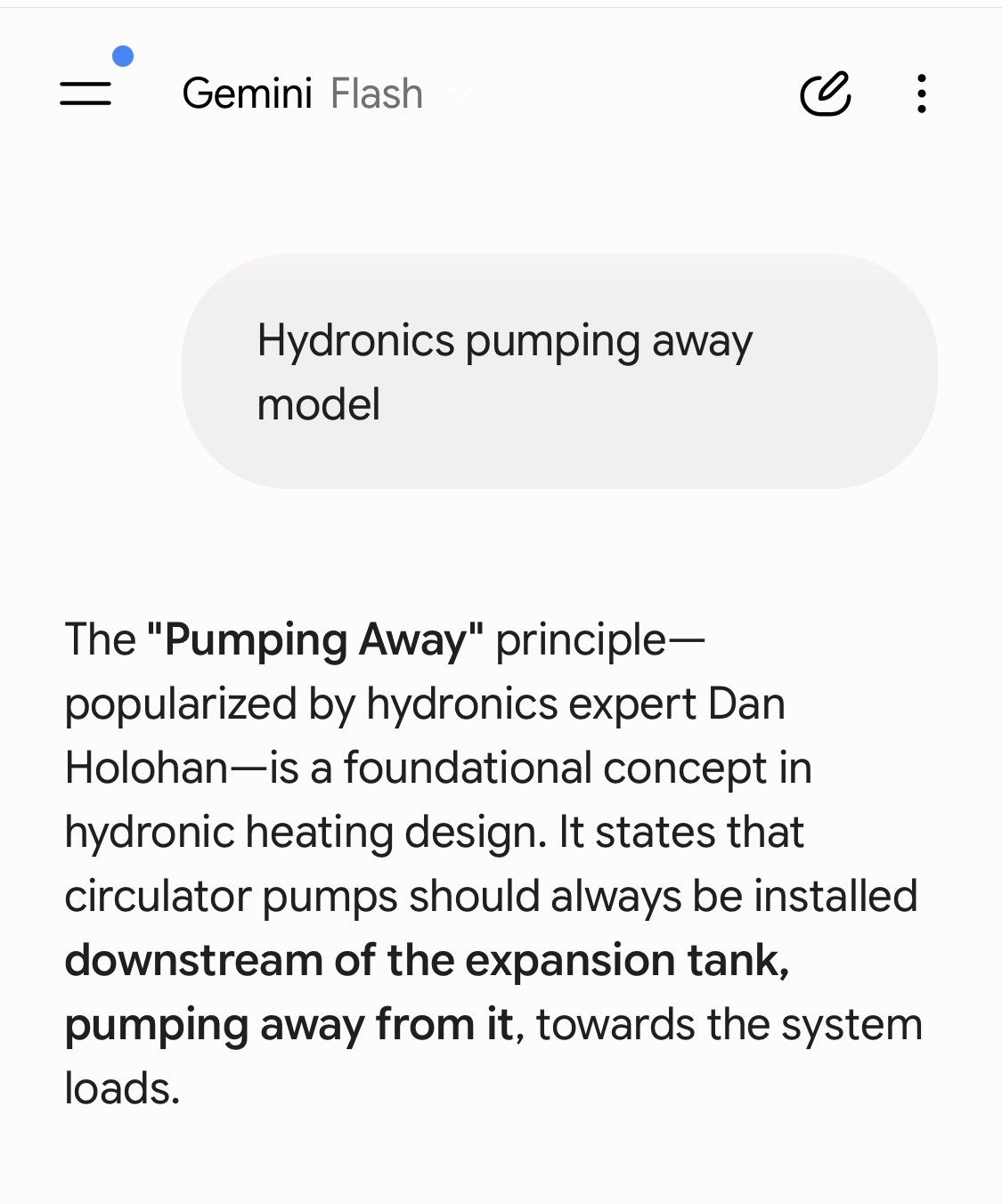
The Core Physics
The point where the expansion tank connects to the main piping loop is called the Point of No Pressure Change (PONPC).
- The expansion tank acts as a pressure reference point. The static pressure at the PONPC remains constant regardless of whether the circulator pump is running.
- Pumping Away (Correct): When the circulator is placed downstream of the PONPC and pumps away from it, the pump's head pressure adds to the system's static pressure. Higher pressure keeps entrained air dissolved in the water and pushes it toward the air separator to be vented.
- Pumping Towards (Incorrect): Placing the circulator upstream of the PONPC pumping toward it causes the pump's head pressure to subtract from the system's static pressure. This drop in pressure can pull air into upper radiation units, cause cavitation at the circulator impeller, and create noisy "pinging" pipes.
Standard Component Order
To implement "pumping away" on a supply main, arrange components in this exact sequence along the flow direction:
- Boiler outlet (hottest water)
- Air scoop / Air separator
- Expansion tank (connected directly to the bottom of the air separator—this creates the PONPC)
- Circulator pump (pumping away from the tank connection into the system distribution)
Key Benefits
- Self-venting system: Prevents air binding in upper-floor radiators or radiation loops.
- Noise reduction: Eliminates gurgling caused by pockets of air breaking out of solution.
- Component longevity: Protects pump impellers from cavitation and erosion.
- Reliable flow rates: Ensures zones get predictable flow without sub-atmospheric pressure zones.
0 -
I think a lot of people are going to get hurt. Plaster disclaimers everywhere. You know somebody is going to purge with a hose into a bucket, and when that first big air pocket comes through, its gonna jump out and strike Johnny Homeowner in the face like a viper. WE know because we've all done it. And there's nobody to blame but ourselves... or the guy who was training you with Baptism By Fire. But when someone says "ED TOLD ME TO DO IT!!!", then AI isn't so fun anymore. I say let Darwinism do its job.
0 -
The Carlson- Holohan award goes to Gemini
But you specifically asked for pumping away? Ed didn't? So he got the pumping at option?
Bob "hot rod" Rohr
trainer for Caleffi NA
Living the hydronic dream0 -
I’d say so. So keep spreading the word, informed users get better results!
😊0 -
Here is the corrected version of the first video about purging baseboard radiators.
The second one that covers MonoFlo® tee system problems will be here soon.
Is this better @hot_rod
Edward Young Retired
After you make that expensive repair and you still have the same problem, What will you check next?
 1
1 -
much better, knowing this may be out on the WWW for eternity :)
I would say flow more than pressure pushes bubbles around. It takes some of each. Higher pressure squeezes the bubbles smaller, and the flow moves them around to the purge points or auto purger.
I'd like to see a Discal in the animation piping, if it is not asking too much :)
Bob "hot rod" Rohr
trainer for Caleffi NA
Living the hydronic dream0 -
With a particularly hard to purge mono flo system, I was tempted to cut the bypass and put in a ball valve that I would close to force fluid through the radiators during purging. It would stay open during normal operation. Would that have worked or am I missing something?
0 -
Always the salesman. 🤣 Maybe on the next one for the monoFlo. since I have not rendered that one yet!
Edward Young Retired
After you make that expensive repair and you still have the same problem, What will you check next?
0 -
Edward Young Retired
After you make that expensive repair and you still have the same problem, What will you check next?
1 -
@DCContrarian Yes if you put a ball valve between two regular tees you can skip the monoflow tee entirely. Close the valve to purge and the set it for the flow you need through the baseboard.
1 -
That is a big IF when you come across one. I agree that you can design it and put it together that way, but then you need to run around the basement opening and closing valves during the purge.
Most of them were designed with an air vent on each convector or loop of baseboard. Then a hydroscopic vent was placed on the vent tee opening. That seems to work but i have encountered problems with one or two radiators no working after a Purge and needed to manually vent those problem radiators.
Edward Young Retired
After you make that expensive repair and you still have the same problem, What will you check next?
0 -
I agree valves may not be the best choice but @DCContrarian asked if it would work and it will. Could use a circuit setter between the tees but they may be too restrictive but would be easier to set and return to the normal balanced position after purging
0 -
It's a teachable moment.
May as well include as much accurate info as possible.
Folks like @EdTheHeaterMan don't read instructions, they become the instructions.
Bob "hot rod" Rohr
trainer for Caleffi NA
Living the hydronic dream1 -
Interesting comments. First, 30% of AI is bulls**t and must be checked by a human mind. Ya, it can save time, but can not be fully relied upon.
I only have used B & G monoflo tees and not the Chinese diverter tee crap. Ya, they cost more and I'm cheap, but sometimes Quality is worth the higher cost.
Now to what I want to say—several years ago, I had a job on a 3 story residence with baseboards without coin vents and baseboard tees. What someone did to remove the trapped air was to in stall on each baseboard refrigerator self-piercing needle valves. It worked for 20 years. It was an option.
0 -
Like a refrigeration line tap valve?
I have also seen holes drilled and a Schrader valve soldered or brazed in.
0 -
-
OK here is what I was going for.
I wonder if i can get some royalties from the Caleffi folks
Edward Young Retired
After you make that expensive repair and you still have the same problem, What will you check next?
0 -
@HomerJSmith that looks like a valve for a refrigerator ice maker or a humidifier. not legal on plumbing in some areas but I guess it could be used on heating.
0 -
Send me a mailing address to send the checks to :)
Bob "hot rod" Rohr
trainer for Caleffi NA
Living the hydronic dream1 -
@EdTheHeaterMan, you're a good looking guy. Watched your video, nice. Lucid, to the point, and understandable even to me with a fourth grade edjucation. I could have gone to the fifth grade, but I didn't want to pass my Dad.
Your video on a monoflo sys reminded me of a job I had eons ago. The customer complained about the house being cold. He had drapes hanging on the windows thicker than carpets and he was still cold in the winter. He had an old oil burner and a monoflo sys. I replaced the burner with my favorite nat boiler, a Crown CXE, and removed the monoflo sys and made it a series baseboard sys with a new thermostat. He told me later that winter that he couldn't believe how warm his house was. So warm he had to open a window (well, almost). He suffered all those years. I think he could have kissed the ground I walked on.
1



Categories
- All Categories
- 87.8K THE MAIN WALL
- 3.3K A-C, Heat Pumps & Refrigeration
- 60 Biomass
- 430 Carbon Monoxide Awareness
- 133 Chimneys & Flues
- 2.2K Domestic Hot Water
- 6K Gas Heating
- 124 Geothermal
- 170 Indoor-Air Quality
- 3.9K Oil Heating
- 79 Pipe Deterioration
- 1.1K Plumbing
- 6.7K Radiant Heating
- 397 Solar
- 16.1K Strictly Steam
- 3.5K Thermostats and Controls
- 56 Water Quality
- 51 Industry Classes
- 51 Job Opportunities
- 18 Recall Announcements