Buff it out

Never used a buffer tank before. So this is a little bit of an experiment/ looking for advice. 3 zone home ~12500, -11000, ~15000, so roughly 38,500BTU design load. I want to install a 50gal indirect. Boiler will be Trio P4 106,000 BTU Net.
Can I use a 3 pipe buffer tank configuration for this set up, or am I looking for trouble?
I’ll control buffer tank temp and indirect off the hydrostat 3250 plus with outdoor rest for WWSD.
3 sentry zone valves and an taco 0015 low pump.
Im not worried about head and flow rates, I can figure that out later. What I’m worried about is the short cycling the boiler will be going through because of how over sized it is compared to the heat load, but I need the domestic HW above 2 gpm.
Or am I over thinking this, and a VT2218 on delta T mode alleviate the short cycling issue for the heat demands?
help, criticisms, and insults are appreciated.
Bill
Comments
-
the other thing I’m worried about is if I have a long run for the domestic priority, will I be risking low water temp return if the zones are still running off of the buffer tank?
I hope this all made sense.
0 -
Why a p4?
Why not a p3es.
Buffer tank is overkill imo.
0 -
did you already buy the stuff? a better way to go would be to size the boiler for the dh load and use a bigger indirect to get the dhw capacity you need unless you have some unusual condition where you have a continuous dhw load.
 0
0 -
I have not bought anything yet. Just trying to work this out in my head. Wouldn’t I still be risking short cycling even with the smaller boiler? Then have a flow rate of 1.6 gpm of HW?
0 -
p4 was for the DHW along with the 50 gal indirect.
0 -
Why not get the right sized boiler instead?
Typical average domestic hot water load is about 2000BTU, so with a 55k boiler you can recover a days use in 45min which is 3% of your day. No house will notice loosing heat for 3% of the day even on design days.
If you are worried about DHW capacity, instead of a bigger boiler, get a bigger tank. Even better, skip the indirect and get a power vented gas tank or a HPWH. Cheaper BOM cost, simpler install and cheaper to run.
0 -
the indirect stores energy, a bigger tank stores more energy. unless you need continuous hot water you can size the indirect to store enough hot water for your use then recover while you're not using hot water.
i thought the boiler was a modulating boiler but it is a 3 pass oil boiler. you probably can't find an oil boiler small enough to match your load so the buffer tank would be the better way to go although you could probably do some things with controls to keep it from short cycling. the buffer is the cadillac installation. a bigger indirect and smallest boiler you can find along with controls with some anti short cycling features would be the more cost effective option. might be able to downfire the burner some too.
there are also some schemes to make the indirect the buffer.
with a buffer tank you are buying 2 storage tanks, one for domestic heating water and one for domestic hot water.
0 -
Yeah, oil is the fuel source. And I know. It’s definitely more money. The other option was an electric tank, but I’m pulling an electrician in to do his work if we do that.
Im trying to balance 3 different things. Space, sizing, and cost. My thought was the buffer because I can control the cost to some extent, but I’ve never done one before. Only read/ watched videos about it and thought this would be a good opportunity to try.0 -
what type of heat emitters, what temperature do they need? Will you run outdoor reset control?
How often would the smallest zone run by itself?
How much dhw do you want?
Bob "hot rod" Rohr
trainer for Caleffi NA
Living the hydronic dream0 -
an electric tank doesn't solve your the boiler is twice the size of the load problem.
a big turbomax could act as a buffer and an indirect.
0 -
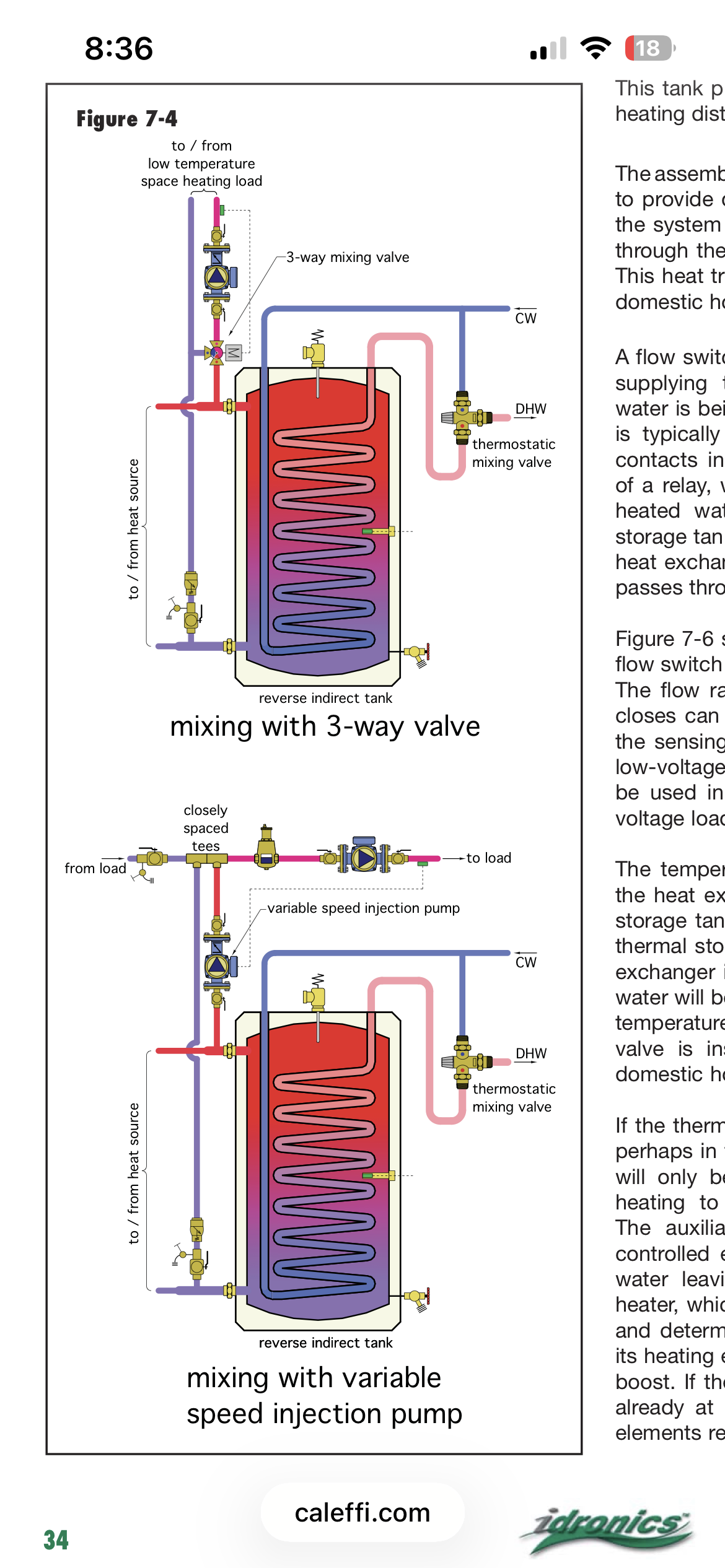
a reverse indirect may work depending on dhw load,
This is a two pipe buffer, reverse indirect.
The injection option if you want ODR control
 Bob "hot rod" Rohr
trainer for Caleffi NA
Living the hydronic dream0 -
yes, the electric tank does not solve my problem. But allows me to drop to a P3 which is only 79,000BTU and hope for no call backs 😁.
170 average water temp. Baseboard heat. Hydrostat 3250 plus allows for outdoor reset. I’d like to get at least 2 gpm of continuous flow. My best guess for the smallest zone would run over a 5-8 hr span throughout the day?
0 -
I talked to a TACO rep, and they brought up the idea of a VT2218 pump on delta T mode as a potential solution for the space heating. But it doesn’t make total sense to me. I contacted them because I had no clue how to do the wiring for a buffer tank as a means for controlling the boiler, from my original idea.
0 -
the p3 will have far more recovery than an electric tank. the indirect to cover that load with the p3 will be smaller than the electric tank to cover that load and an electric tank certainly isn't doing 2 gpm continuous.
0 -
is that just a standard indirect, but you reverse the tapping?
0 -
500x flow x delta
500x 2 x 77=77,000 btu to provide 2 gpm
So you might want a 100k if you use reverse indirect
With a reverse indirect the tank needs to be maintained cat 180, do the boiler ODR wouldn’t work
That is why the injection option
The best use if a buffer is with a hot tank, pull the load via odr
Bob "hot rod" Rohr
trainer for Caleffi NA
Living the hydronic dream0 -
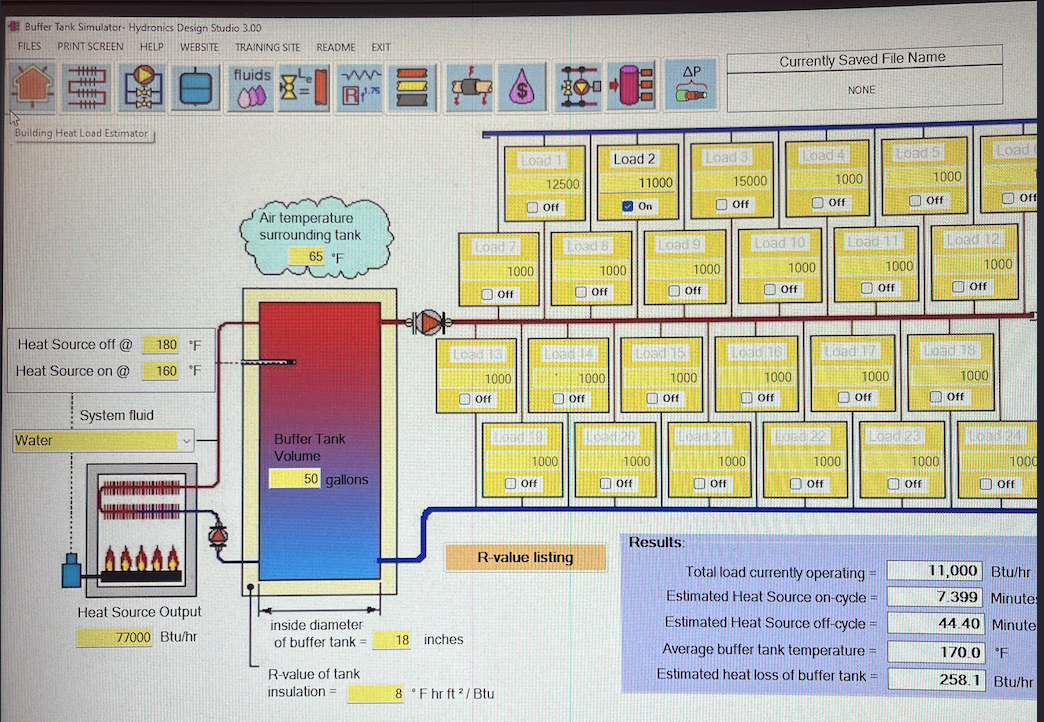
Here is what a 11,000 load looks like.
Rule of thumb you want a minimum 10 minute run time every time a boiler like that fires.
So a 50 gallon buffer gets you close at 7 minutes. 44 minute off cycle is great.
With ODR if you pulled down to 145F you get a 13 minute run.
 Bob "hot rod" Rohr
trainer for Caleffi NA
Living the hydronic dream0 -
this is a reverse indirect. the tank is filled with boiler water and the dhw flows through a coil and is heated by the boiler water. it is sort of a combo of an indirect and a buffer tank so the boiler water serves as the mass to store the energy to cover the dhw load instead of storing dhw water directly:
the odr maybe doesn't make so much sense with fin tube and a ci boiler. you could make the heating more even with odr but the boiler would still have to cycle to provide it and fin tube needs a rather high minimum on the odr curve to have any appreciable output.
0 -
I had no clue tanks like that existed. I just looked the reverse indirect tanks up. Again, first time doing something like this.
Hot rod, first thank you. I’ve watched a lot of your videos so it’s kind of cool getting help from someone I’ve learned from.
Is there any chance you could direct me to more resources to learn about this set up specifically? Including the control wiring? Is that info in any of the caleffi ebooks?
Not taking anything away from anyone else, I appreciated the help from everyone! Matt Mia might have brought up the turbo max but I had no clue what that was.
0 -
if you find whichever idronics @hot_rod took the screenshots from, that should cover it in possible somewhat vague , brand agnostic terms.
you would control the boiler off the tank temp then you'd serve the zones out of the tank. if you wanted to do odr you'd do injection mixing or a modulating valve to feed the zones from the tank. it would make it a little better but might not be worth the expense to do odr on fin tube.
0 -
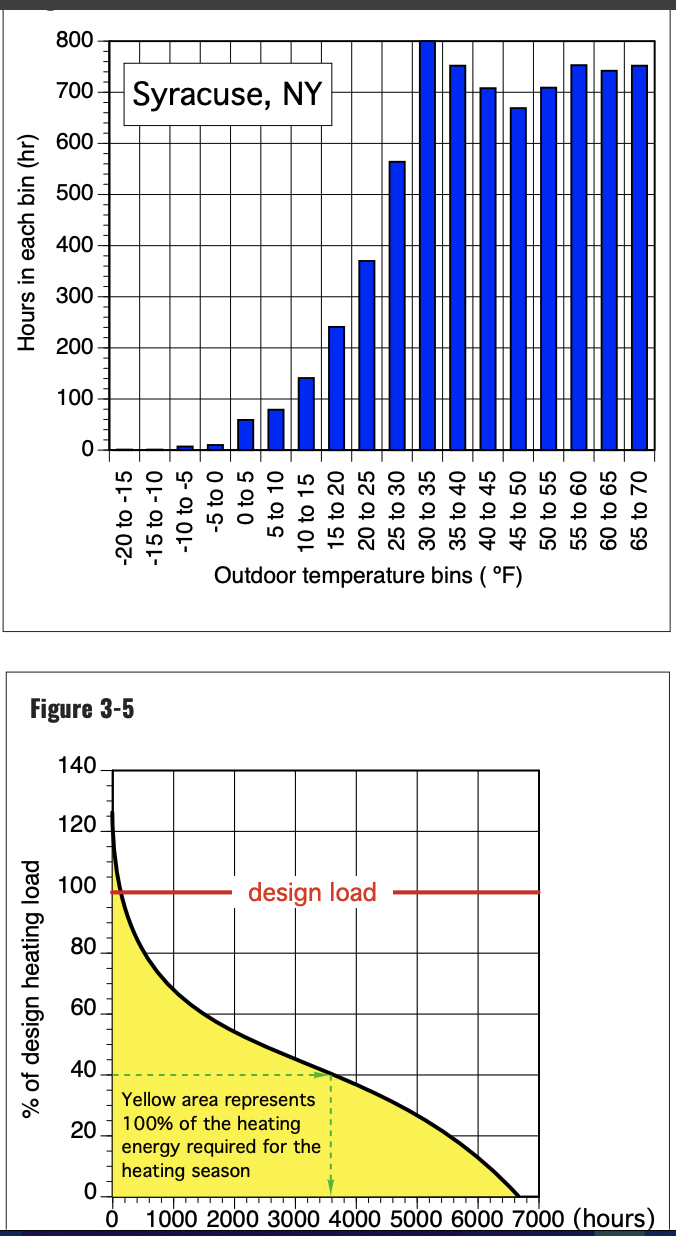
If you want to do more number crunching, determine how much fin tube in each zone. Compare it to design load. Then determine how often and how low you could run the fin tube on less than design days.
Probably 80% of the heating season you are below design. That data is available also.
The tank will run 160- 180, so the boiler is protected from cold return. The key is to pull off the buffer via ODR, also have enough boiler capacity for DHW.
With a control logic, you could drop heating load with DHW call. So a 177K boiler coiuld supply 2.5 gpm or so. Check with the TurboMax output chart to confirm DHW output at various boiler input and incoming water temperatures.
An example of BIN temperature data
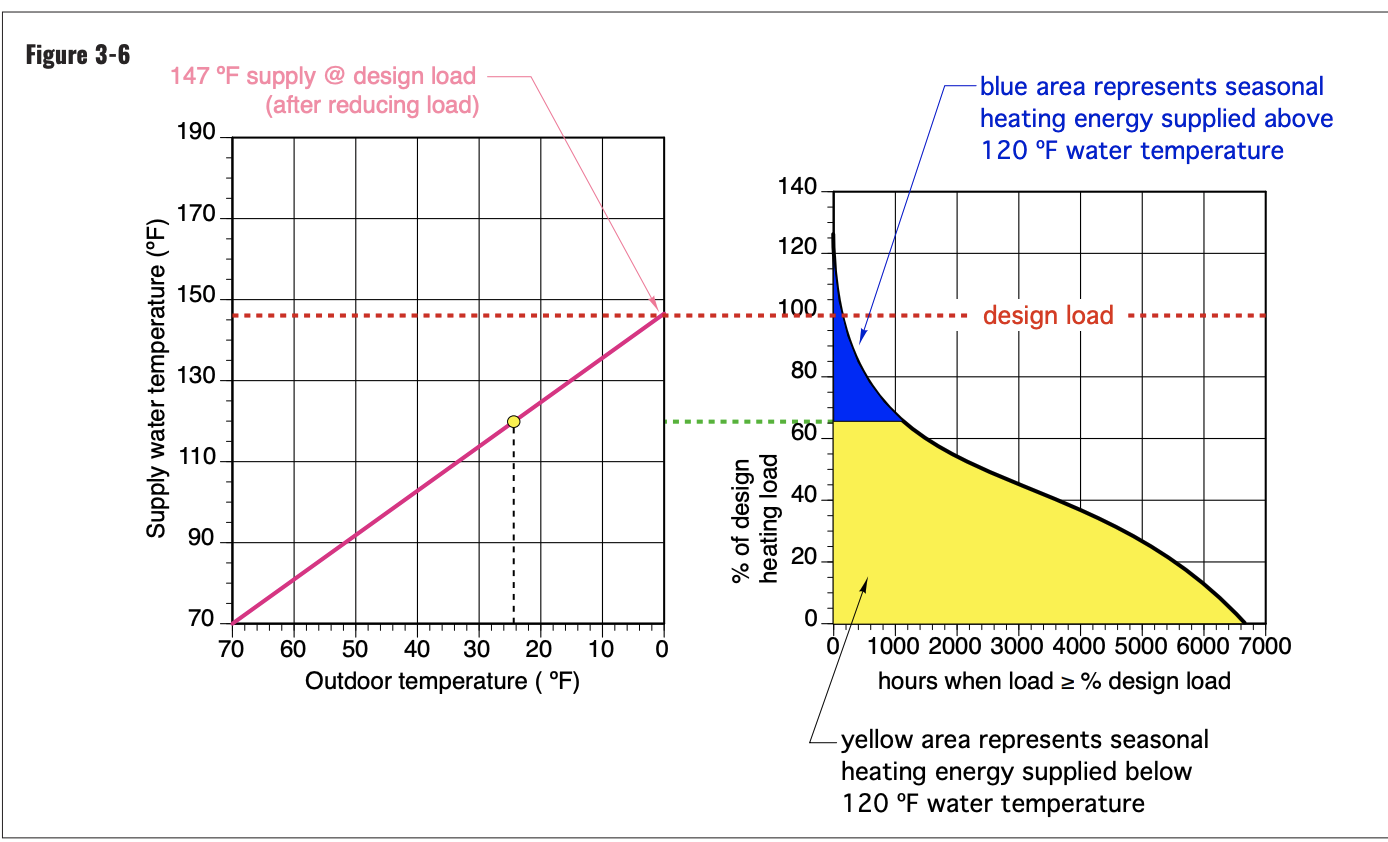
I think SlantFin output charts went down to 120 SWT.
This Idronics has some ideas and formulas for lowering SWT.
\
Bob "hot rod" Rohr
trainer for Caleffi NA
Living the hydronic dream 1
1 -
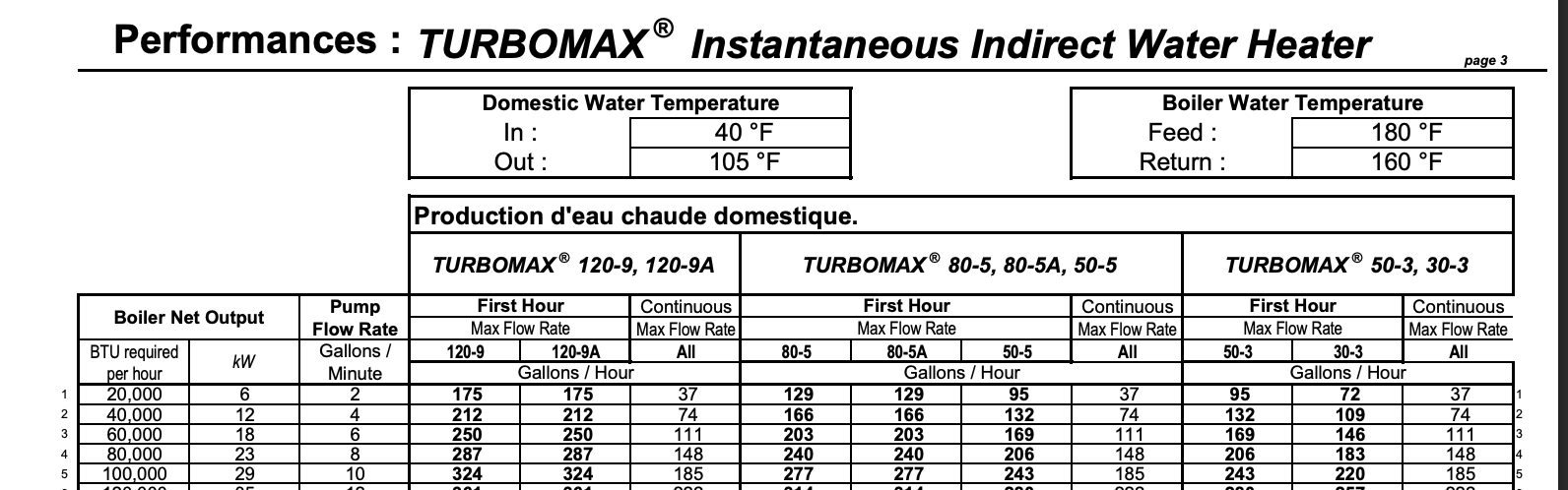 Bob "hot rod" Rohr
trainer for Caleffi NA
Living the hydronic dream0 -
the only down side I see from this is that the tank is going to be heated year round. Almost similar to a tankless coil. I’m not trying to add an additional wrinkle to this, but my intent was to put an indirect in to eliminate the need of maintaining temp year round for fuel savings.
Am I chasing an impossible perfect scenario here?
0 -
or is that the same as maintaining an indirect temp?
1 -
you guys are both recommending reverse indirect tank. Discrepancy between injection and mixing valve between the two of you.
hot rod you referenced a “control logic” is that a specific control from caleffi or other manufacturer?
0 -
the reverse indirect is well insulated, it is more or less the same as maintaining the indirect temp. the temp is higher than an indirect so there is somewhat more loss but it isn't a huge difference. you could also probably lower the temp in summer if the municipal swt is warmer.
0 -
control logic is just referring to the control logic, could be tekmar or others.
to do odr you would need either to do injection mixing with a variable speed circulator or a modulating 3 way valve, there are pros and cons to each, either will work. others know much more about this than i do.
on the dhw supply you want a fixed thermostatic mixing valve to bring the dhw temp in the coil or tank to safe temps and to keep the temp consistent as the tank temp varies.
0 -
Around me DHW off oil is more expensive than resistance. I would check your local energy costs. Indirect off oil burner is about 60% efficient in the summer.
Usually the lowest operating cost is a heat pump water heater. This avoids having to fire the oil burner in the summer (good thing during like the current heat wave) plus it gives you a bit of free cooling.
You can get an 80 gallon 120V plug in HPWH which doesn't need any electrical work although I would go for 15A/240V model which needs a double pole breaker swap on an existing dedicated 15A circuit. That is still way ahead on BOM/install/operating costs.
Instead of science experiment with oversized boiler, buffers, injection and fancy controls, I would go for KISS. Right sized boiler with a deltaP circ, zone valves, limited/no ODR. HPWH for DHW.
Less to install, cheaper to operate and easy for anybody to maintain/fix down the road.
0 -
What is the coldest outdoor temperature you have experienced? Does the home maintain a comfortable temperature, able to stay at 70 indoor?
If so that could indicate that you have plenty of heat emitters, fin tube.
Then determine the boiler operating temperature at those high load conditions. Does it operate at a common - 180 temperature?
It is possible with sufficient or oversized radiation that the boiler could run lower temperatures even at design conditions. That would make a better case for ODR.
Next I would look at the reverse Indirects performance output at lower temperatures. If it gives you adequate DHW at a 160 or lower tank temperatures that too helps the boilers and systems efficiency. Dig into the performance data at Turbomax I know they have a software that you can input all you specific data and see what tank can cover the loads. Either call tech support or a local Thermo 2000 rep for sizing help.
Assuming you have multiple goals, reduce micro zone short cycling, maximize efficiency, and take advantage of the near constant circulation that ODR can provide.
So, how good is good enough? If you want the very best bang for the bucks I’d suggest some more data collecting and number crunching.
Spending big $$ to upgrade should give you big improvements.
Or just buy the smallest boiler and let it short cycle as I suspect it has been?
You could also build your own buffer/ DHW system. A plain insulated tank with external plate HX A FPHX is much more efficient than a tube and shell HX, which is basically all an indirect is.
Bob "hot rod" Rohr
trainer for Caleffi NA
Living the hydronic dream1 -
it isn't a science experiment, all that is calculatable. the only thing that is unknown is exactly how people will use dhw
0 -
the only caveat to the bphx is that it usually requires descaling once a year or so.
0 -
It depends on water hardness, temp[erature and amout of water passing tbhrough.
Could be a descaling is needed every months, or every 3 years. A properly sized FPHX will have high velocity flow which helps scrub the plates.
Adding tankless valves on the HX makes descaling a job that takes 30 minutes with a pump kit.
Same scaling is going on with combis, tankless WH and even your tank type water heater. The FPHX will let you kow, unlike a tank heater which probably 90% of them never get flushed or descaled. They ru their entire lige at 60- 65% transfer efficiency :)
I have dome a few of these FPHX off a buffer tank. At my own shop I could generate 110F DHW with 120 SWT on the hydronic size.
Using a close approach sizing method you can get A & B sides of a FPHX within 3° of one another. This method gets used with A2WHP also
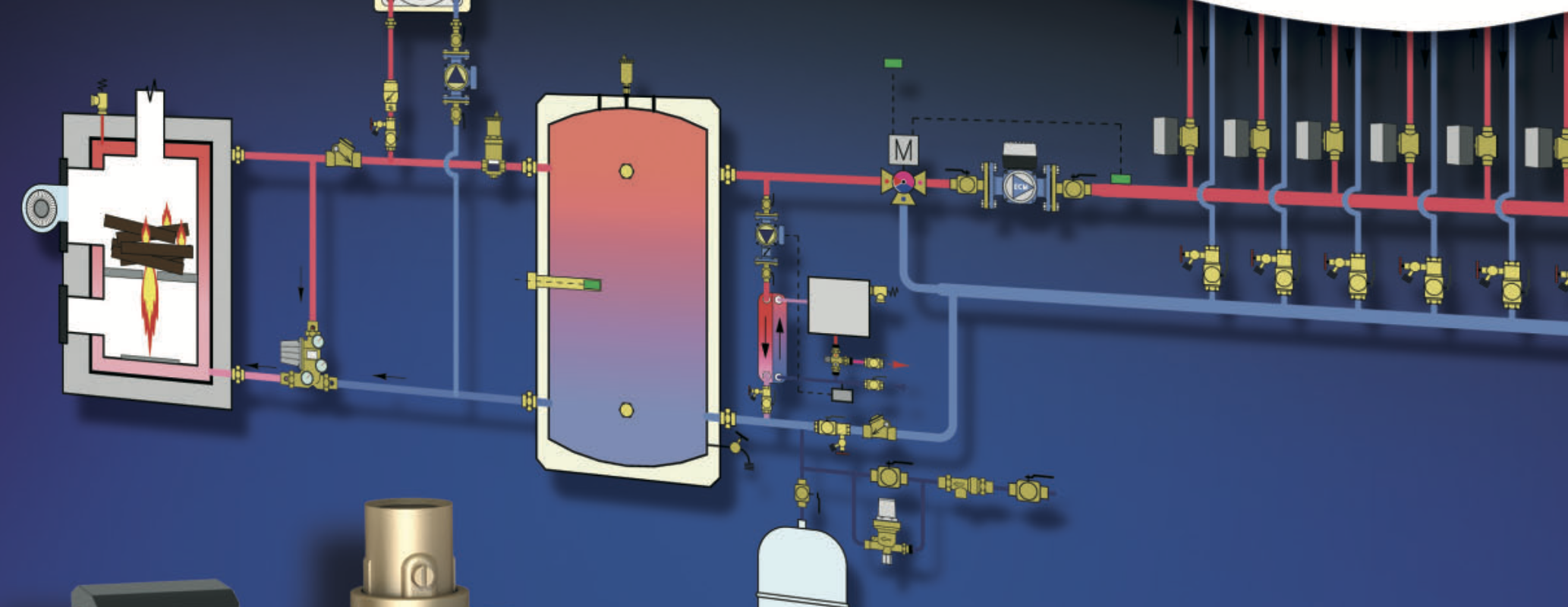
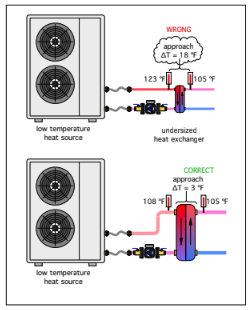 Bob "hot rod" Rohr
trainer for Caleffi NA
Living the hydronic dream0 -

Fuel oil at 4 bucks a gallon, electricity (resistance element) needs to be around .13, delivered cost, to compare.
A HPWH changes that if you can run 2, 3 4 COP or better.
Bob "hot rod" Rohr
trainer for Caleffi NA
Living the hydronic dream1 -
I honestly thought a buffer tank was keeping it simple. I’ve clearly been corrected lol. I’m looking for performance and cost effectiveness.
I know some heating guys hate us, but i am indeed a plumber, who is trying to install a good product. I myself was taught the old rule of thumb install, and I know there is more to it.
I’ve read dans books, watched the taco and caleffi videos, and I’m trying to implement a higher quality product now that I am out on my own now.
What I don’t want is to walk out of the mechanical room listening to a boiler that was installed wrong.
The reverse indirect install sounds like it solves my problem. Reduces from 2 storage tanks to 1, reduces short cycling, increases efficiency, and achieves my minimum DHW GPM on a fuel oil system. I’ve just never done something like it before. So honestly, if there are any books, media, or other resource you guys have that I can inform myself more about it, I would greatly appreciate it.
1 -
The Idronics that @hot_rod made some screenshots of is probably great although I don't know which issue it is.
Turbomax probably has some training materials for professionals on their web site too. Look for presentations and whitepapers and design guides, don't just look at the manual for a specific product. I'm not sure if there is a good way to do DHW priority.
0 -
-
It can be this simple. Boiler pipes to top of TurboMax, supply circ and zones connects there also. Zone valves on supply to prevent ghost flow.
Large piping, 1-1/4" at the tank where the boiler and zone piping connects. That serves as the hydraulic separation function between boiler and zone circs.
Air sep and exp tank in that pipes somewhere. TurboMax comes with high point float vent also.
A delta P circ modulates with ZV opening and closing, Grundfos Alpha 15-58 for example.
Isolatiopn under system pump, ZV are top isolation.
Isolation valves at boiler pump.
Purge valve, like a Webstone at the return from the zones
Thermostatic mix valve at dhw connection from tank.
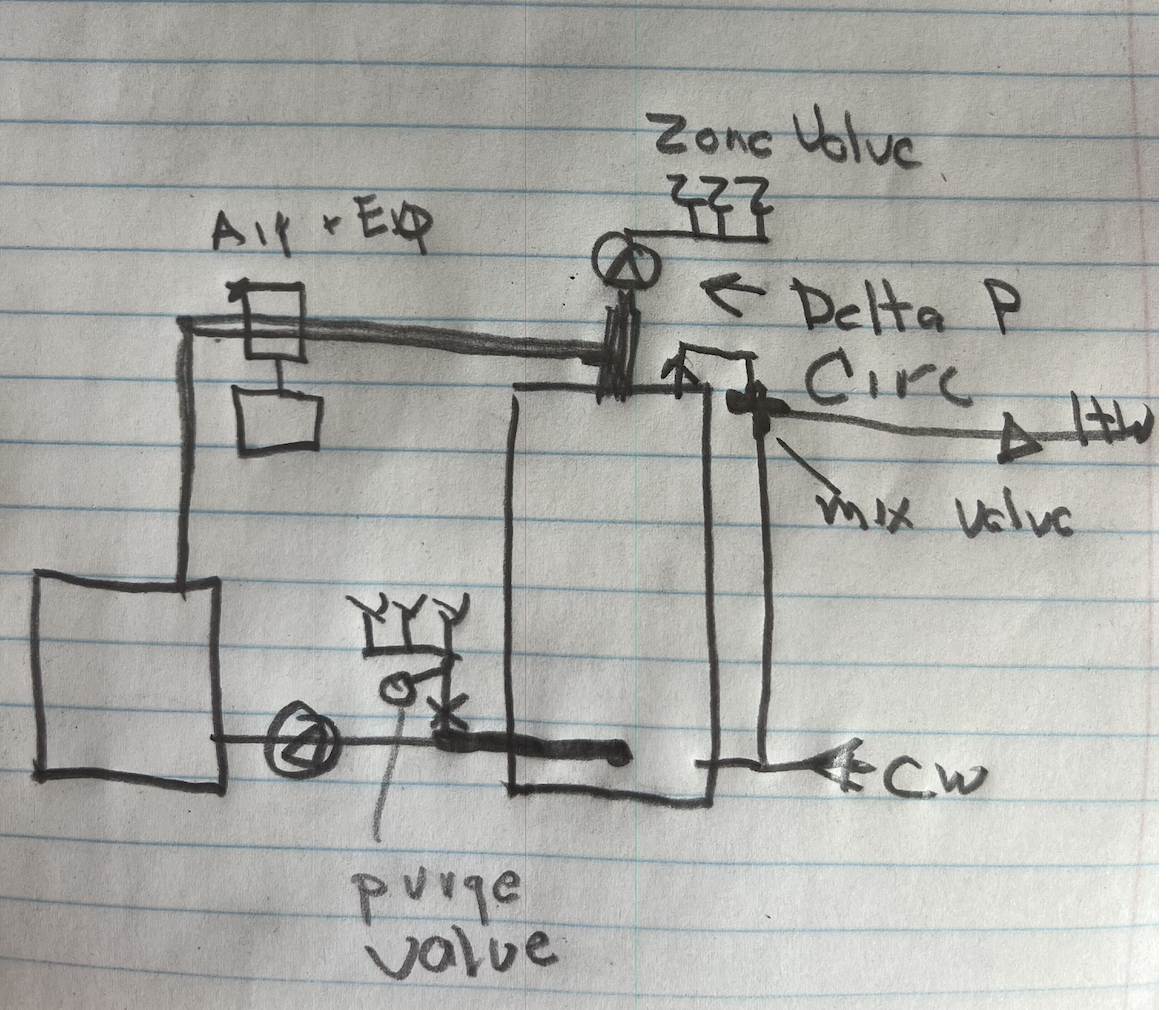
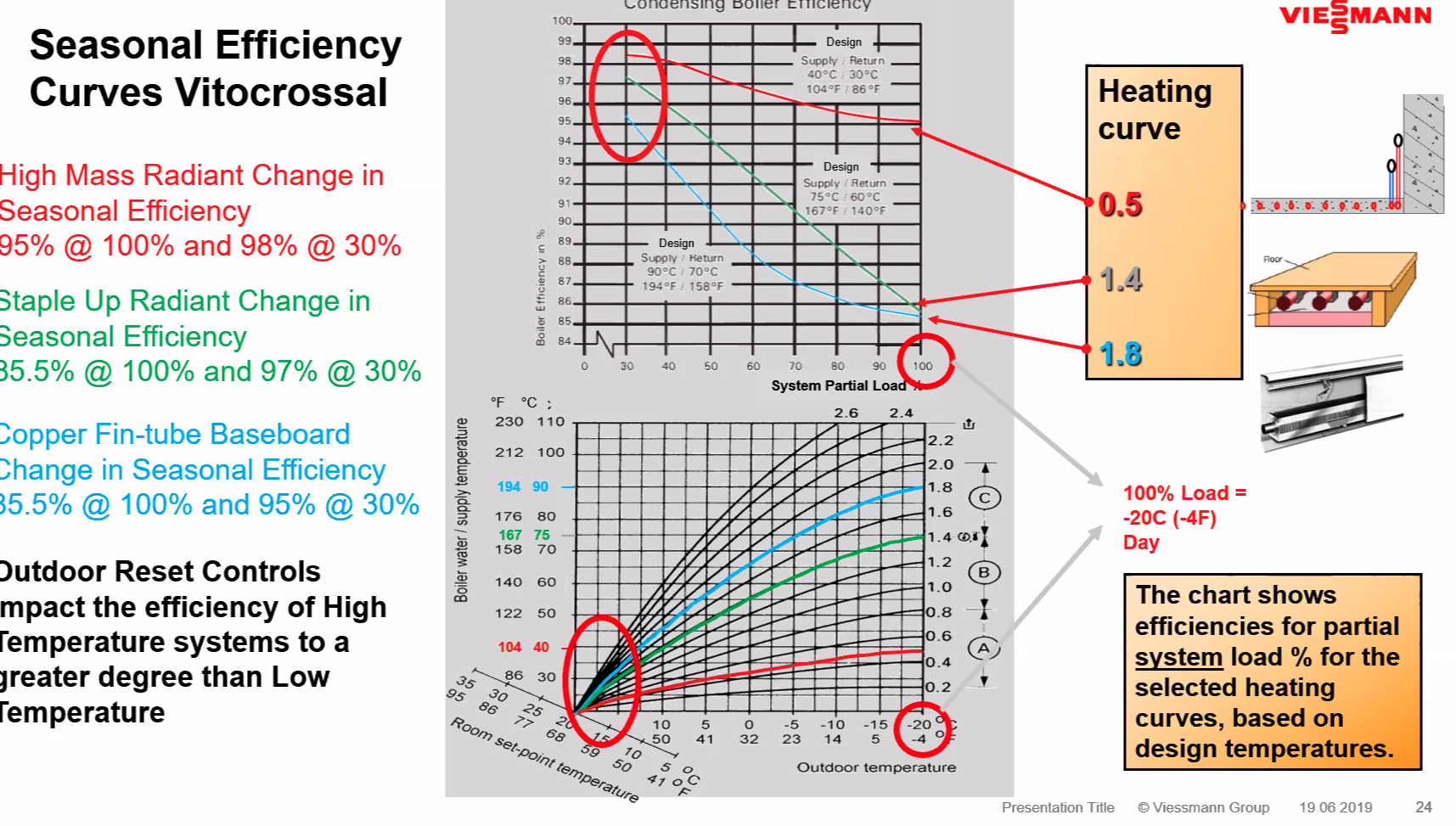
You will just need to use trial and error as far as tank operating temperature, if you don't have dhw requirement numbers. Basically start at 180, crank it down until dhw doesn't provide what you need. Lets say it can run as low as 150- 170. Now you have the points to set the boiler ODR. The "blue" 1.8 curve may be a good start:. You tune the curve to what works for you and the family, there is no "right" number.
The perfect system would have the zones open on first heat call and never shut down. The boiler water modulates to the load condition, pump always runs for constant circulation. ODR can get you close to this condition if you play with settings for a heating season.
The bottom graph shows fin tube at 194°F on design day. That may be too high. Unless they skimped on fin tube 180 or lower should get er done.
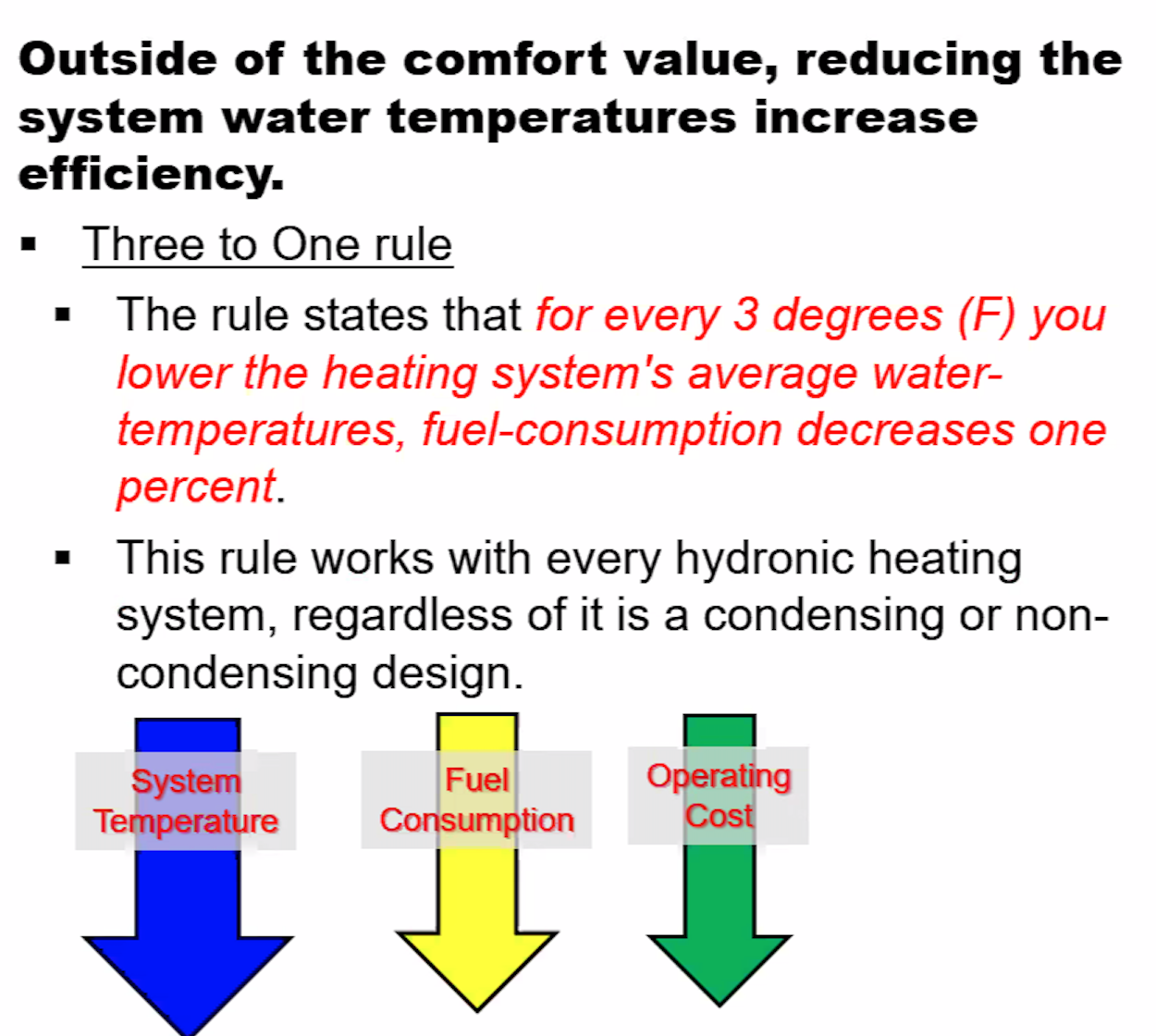
The goal is to lower the operating system as low as possible and cover DHW and heat loads. Basically the 3-1 rule, see below.
As mentioned there is an Idronics and Coffee with Caleffi for most every portion of hydronic system installation, wiring, troubleshooting, down to the individual components.
 Bob "hot rod" Rohr
trainer for Caleffi NA
Living the hydronic dream1 -
Bad idea for oil. Reverse indirect would be best.
0 -
I didn't see it was oil until I googled that boiler. It woudl be ok if they made oil boilers as small as the load but they really don't.
1 -
Not in America. They have small ones in Europe and Asia.
0


Categories
- All Categories
- 87.8K THE MAIN WALL
- 3.3K A-C, Heat Pumps & Refrigeration
- 60 Biomass
- 430 Carbon Monoxide Awareness
- 133 Chimneys & Flues
- 2.2K Domestic Hot Water
- 6K Gas Heating
- 124 Geothermal
- 170 Indoor-Air Quality
- 3.9K Oil Heating
- 79 Pipe Deterioration
- 1.1K Plumbing
- 6.7K Radiant Heating
- 397 Solar
- 16.1K Strictly Steam
- 3.5K Thermostats and Controls
- 56 Water Quality
- 51 Industry Classes
- 51 Job Opportunities
- 18 Recall Announcements