Plate/Frame Heat Exchanger Questions

Is there a way to determine temperature inputs/outputs of a plate/frame heat exchanger if you know a few variables?
I have a heat exchanger with the following characteristics. The hot side of the heat exchanger goes to a condenser water loop for water source heat pumps. The cold side of the heat exchanger goes to a cooling tower. What information do I need to ascertain what the temperatures will be on all four pipes, if every component is clean and operating as designed? I do know the following:
- Cold side (Tower side): 5,325,000 btu/hr capacity, 900 total gpm, 2.5 gpm per ton, 12 degree delta T
- Hot side (Condenser water): 5,124,000 btu/hr load, 854 total gpm, 2.5 pgm per ton, 12 degree delta T
- Desired hot side outlet (Condenser water supply) is 80 degrees
I'm assuming I will need to know the surface area of the heat exchanger, I do not have that information on hand as I write this. Is there anything else I need to know to figure out the temperatues on all four pipes?
Comments
-
Ah… you have the delta T values… what more do you need?
Br. Jamie, osb
Building superintendent/caretaker, 7200 sq. ft. historic house museum with dependencies in New England0 -
The critical missing temperature for this problem is:
You need the cold-water temperature entering the heat exchanger from the cooling tower.
That temperature is determined by:
- Outdoor design wet-bulb temperature
- Cooling-tower design approach
- Actual tower selection and fan performance
- Water flow through the tower
Your required exchanger duty is:
- 5,124,000 BTU/hr
- Approximately 1,500 kW
- Approximately 427 refrigeration tons of heat transfer
That is a very large water-to-water duty. I would expect this to be handled by:
- A large gasketed plate-and-frame exchanger, or
- Multiple brazed-plate exchangers piped in parallel
A single ordinary brazed-plate exchanger may not be the most practical choice at 854–900 GPM.
What are you working on, may I ask?
Edward Young Retired
After you make that expensive repair and you still have the same problem, What will you check next?
0 -
you can measure the temperatures under operating conditions
If you are troubleshooting you need to know the load it is trying to carry and some gpm info.
Most all the fphx manufacturers have free sizing software. I use the Swep program, you need to just register to get in. I did an inline tutorial to learn some of the finer points.
In most cases a fphx will outperform any other type of HX. You have two moving flows, lots of surface area and turbulent conditions.
The plate and frame versions come in very large sized.
Wessels , is but one brand, they can handle up to 50,000,000 btu/hr!
Bob "hot rod" Rohr
trainer for Caleffi NA
Living the hydronic dream0 -
If I was doing this I would start with the cooling capacity of all the heat pumps in tons. The GPM on the condenser side of the HP system is typically 3 gpm/12,000 btu of cooling (maybe more with glycol). But I am assuming no glycol with the plate and frame.
The tower (or closed circuit cooler) will have to reject (1.3x x tons of cooling x 12000btu + any HX inefficiency). The tower will have to reject this BTU load at the outdoor design conditions where the tower is installed knowing the db & wb at that location.
Normally towers are sized at a 10 degree tD but 12 may work depending on the location.
The heat pumps but the BTUs into the water loop.
Water gpm and tower capacity will determine the expected water temps.
Is this a large chiller or multiple heat pumps? If multiple heat pumps are they all in cooling at the same time? or will some be heating like a tower/boiler system?
Your going to need information from the tower MFG and HX mfg to work your way through this.
Alfa Laval is popular in these larger units.
We replace one in a high rise in Hartford. It had to go up an elevator that couldn't handle all the weight.
We had Alfa ship it to us broken down and it went up the elevator in pieces (the two end plates are still a huge chunk of metal). 13th floor I think it was. loaded it on and the guys upstairs called the elevator no one road up with it……..just in case…………LOL
We had Alfa send a guy up to supervise the reassembly
0 -
it depends on how critical of an application.
For a residential solar or wood boiler, you might ball park or error on the large size. These hx are not too expensive. The wood boiler industry seems to ball park them also.
For a specific commercial application I would call a rep and have them size and spec it.
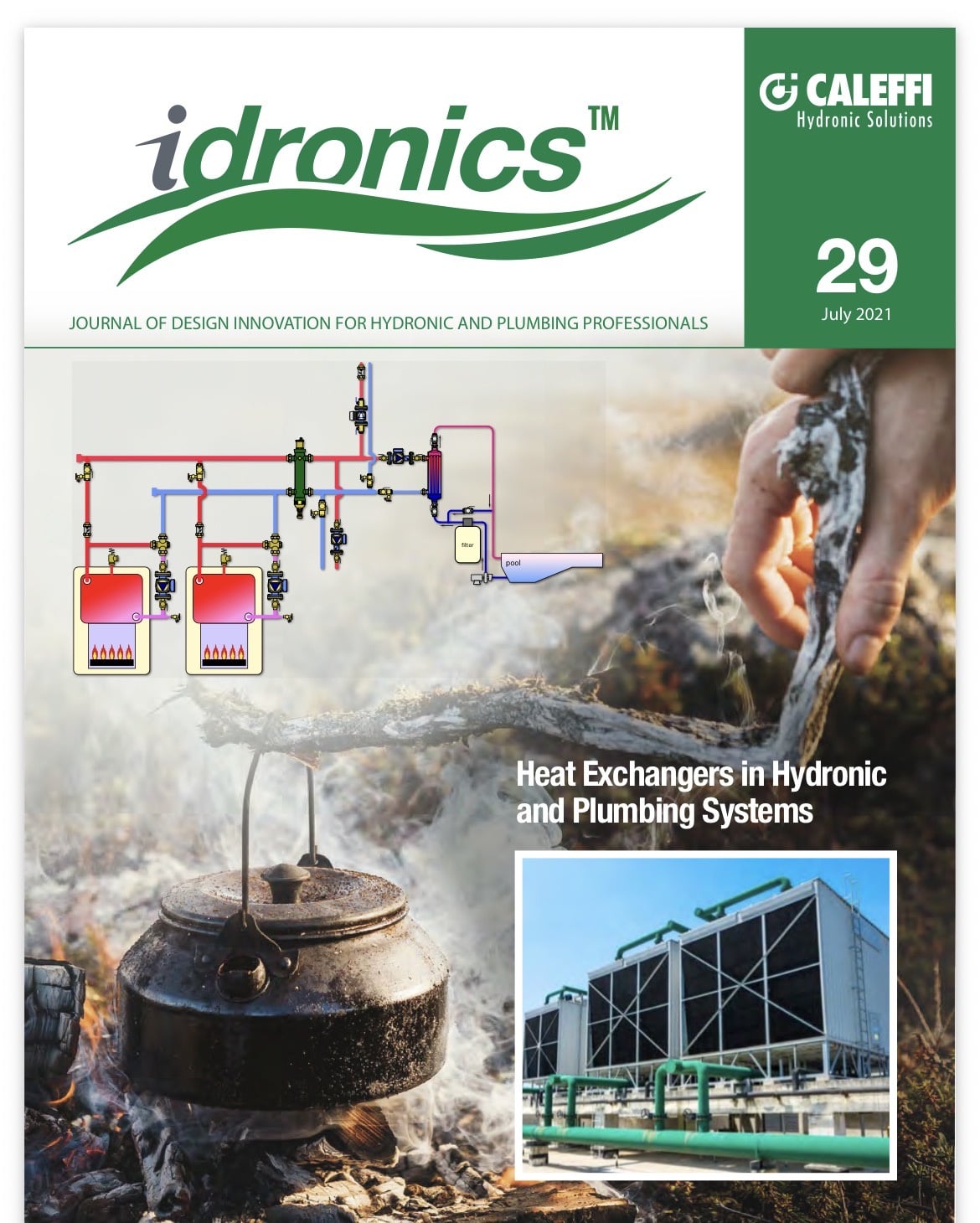
I just recently learned to use the software after we put together Idronics.29
I have been on the hunt for a Swep B3, to mess with, it is about the size of a small I-phone.
 Bob "hot rod" Rohr
trainer for Caleffi NA
Living the hydronic dream1 -
The reps for the plate and frame HXs do this all day every day. They are not going to want a problem so if they have the right information, they will nail the design.
0 -
Thank you for the reply. What I'm working on specifically is as I stated in the original post, it is a plate/frame heat exchanger with a cooling tower used to cool down the condenser water loop for apartment style heatpumps for a commercial residential building. Based on a variety of factors I strongly believe the heat exchanger is dirty, and my goal is to try and make an educated guess at what the temperatures should be on all four pipes, and then compare my findings to when I actually do clean the heat exchanger.
Cooling Tower:
- 355 Ton BAC XESE-1212-11JN
- 2) 450 GPM Pumps
Condenser Water Loop:
- 341.6 Tons in heat pump load
- 2) 427 GPM Pumps
The outdoor design wet bulb is 74 Degrees.
As for your first statement, "You need the cold-water temperature entering the heat exchanger from the cooling tower". This is one of the variables I am trying to make an educated guess on, or wanting to know if there is a way to calculate this temperature.
As far as what I do know:
- The btu/hr of the tower is 5,325,000. The gpm is 900(about 2.5 gpm per ton). Using the universal hydronics formula I know tower is theoretically cabable of a near 12 degree range(Hot return to cold supply).
- The btu/hr of the total heat pump load is 5,124,00. The gpm is 854(2.5 gpm per ton). Using the universal hydronics formula I know there theoretically will be 12 degree range from condenser water supply to condesner water return.
- I want the condenser water supply to be 80 degrees. This would mean the condenser water return would be 92 degrees. This would also mean the cooling tower approach would be 6 degrees.
So I suppose my main question is, if the tower is fed 92 degrees, and if the tower is shown using that equation to be capable of a 12 degree range, will the heat transfer be a complete swap? Will the condenser loop perfectly reject 12 degrees to the cooling tower side which will then perfectly reject 12 degrees out of the cooling tower fan? Also I know cooling tower approach has a direct inverse effect on cooling tower size. The lower the approach the physically bigger the tower has to be, a larger surface area of fill is required. So this would all be assuming the BAC XESE-1212-11JN was sized correctly for a 6 degree approach. And how does the surface area of the plate/frame heat exchanger play into all this?
Apologies for the run-on questions, I do appreciate all the responses it is helping me understand. I guess at my core I'm a mechanic not an engineer an I struggle to wrap my head around(and trust) these perfect number scenarios.
0 -
if you know the delta and flow on each side you know how much heat is moving more or less. Getting pretty close on the temp is easy. You will lose a little from the outer surface of the hx but that amount will be small. what will be harder is making sure you have an accurate measurement of the flow. There are a lot of reasons the flow could be significantly different from what the theory calculates so you need to know the actual flow to figure the heat transfer. You should be able to calculate the change in heat of the water on both sides and they should be very close to each other.
Unless the weather and a number of other things are exactly what was used as inputs to the calculations for the cooling tower, I wouldn't expect it to have the performance in the specification, that is more a worst case to make sure it can perform in the worst case situation.
0 -
One minor tip — the water temperature leaving the cooling tower will never be less than the wet bulb temperature (for an evaporating (open or wet) tower) or the dry bulb temperature (for a dry tower).
Br. Jamie, osb
Building superintendent/caretaker, 7200 sq. ft. historic house museum with dependencies in New England0 -
I have had experience with those big plate and frames and cooling towers.
If this is truly a water tower which is an open system and it has been in operation for a year it needs to be cleaned.
We had several of these with open cooling towers and 200 ton chillers . They had to be cleaned every year.
The stainless steel HX plates should be ok unless the HX is toast. We used to measure between the heavy plates on the ends of the HX then loosen the nuts to separate the plates and clean them and hose them out. When you are done refer to the measurements to return it to the correct dimensions.
We used to keep spare gasket kits on site (pricy) but found we could take it apart maybe 5 times (1/year) and reuse the gaskets.
I suspect you're trying by checking temps and flows etc to prove the HX is dirty before cleaning it . Too many variables going on and that will i think be a futile experiment.
If this is a closed circuit cooler (basically a water tower with a coil in it) then both sides of the HX are closed loops and it may not be dirty.
The openings in the p & F are pretty small.
0 -
Thanks for the update. Not sure what you were doing. making domestic hot water for something, space heating, or some other process. "Thank you for the reply. What I'm working on specifically is as I stated in the original post, it is a plate/frame heat exchanger with a cooling tower used to cool down the condenser water loop for apartment style heatpumps for a commercial residential building".
This is helpful, and my guess is that there is currently a problem with insufficient cooling. This is a little outside my area of expertise. I believe that @hot_rod is the best person on the site for your situation .
Since you have the existing heat exchanger, there must be something that identifies its properties—Model and Serial number—at a minimum, the pipe connection sizes, dimensions, and number of plates. With this information, you should be able to obtain the original specifications from the manufacturer and work from there.
With the specifications showing what it is supposed to do, along with the readings you have under operating conditions—such as the inlet and outlet temperatures on both sides of the heat exchanger—Bob can calculate the numbers you should have and compare them with the numbers you are actually getting. That should reveal whether there is a large enough discrepancy to justify taking it offline and cleaning it. You won’t be very popular for a day or so, so you want to be reasonably certain that the temporary inconvenience will produce a permanent improvement that is measurable to some degree of satisfaction.
Edward Young Retired
After you make that expensive repair and you still have the same problem, What will you check next?
0 -
That is a great theory and it should work but unless you have very accurate test instruments (and ultrasonic flow meters are worthless) the flow will not have to be off by much to send you on a wild goose chase. Maybe checking the PD across the HX would help but if you can't measure the flow it won't.
I do agree that going back to the MFG and the original design is the way to go.
Besides how do you get All the heat pumps and all the pumps running full blast and also the water tower has to be up to speed and does this all have to happen on a design day. Too many variables.
It still comes down to Maybe an educated guess.
If the system is truly an open cooling tower and the hx has been in use for a while the HX having debris in it is the most logical guess.
0




Categories
- All Categories
- 87.8K THE MAIN WALL
- 3.3K A-C, Heat Pumps & Refrigeration
- 60 Biomass
- 430 Carbon Monoxide Awareness
- 133 Chimneys & Flues
- 2.2K Domestic Hot Water
- 6K Gas Heating
- 124 Geothermal
- 170 Indoor-Air Quality
- 3.9K Oil Heating
- 79 Pipe Deterioration
- 1.1K Plumbing
- 6.7K Radiant Heating
- 397 Solar
- 16.1K Strictly Steam
- 3.5K Thermostats and Controls
- 56 Water Quality
- 51 Industry Classes
- 51 Job Opportunities
- 18 Recall Announcements