Boiler Maintenance and Recommendations

I have a few questions I'm hoping you guys can help with.
I'm considering leaving my very large oil-provider and looking into service contracts.
I'm in Suffolk County on LI and have a ~40 year old Utica OBT-3O which I believe is a dry-base boiler.
It was suggested that draining the water from a boiler and treating for scale is something that should be done with the annual tune-up, but from what I'm seeing, no one seems to include this in their service. Is this not a critical maintenance step, or is it a royal PITA or somehow a liability?
To be clear, I could see possibly not starting this on my old boiler after 40 years (assuming that dry-base boilers require this service), but it doesn't seem to be offered for new boilers either.
When I do replace my boiler, it looks like the choice might be between a Peerless WBV-03 or an EK-1 due to limited depth/ need for top venting.
The Peerless has been described as the best pin boiler on the market but I see a lot of VERY negative comments about pin boilers on the forums: is there something about the Peerless that allows it to transcend the typical issues with pin boilers, or would you run away?
Regarding the EK and criticisms I've seen: I can't imagine that here in the Northeast oil-country any dealer would have an issue getting parts, but I am concerned about complexity/ sophistication impacting reliability. I expect to have the EK installed by a company that is very experienced with EK, and service performed every year without fail (assuming every 6 months is not required?): is decades of reliable performance a reasonable expectation?
One last EK question: in my small 918 sq ft house, anything will be grossly oversized, and while I understand that the EK strives for maximum efficiency, am I correct in thinking that as a result of being oversized, it's still subject to more wear-and-tear as a result of (relative) short-cycling? Or does EK do something to reduce its net output, similar to using a smaller nozzle?
Thanks for reading and for any thoughts you might have.
Comments
-
Either is a good choice.
Regarding your present boiler- OK, it's older, but if it's the one I'm thinking of, it's built like a tank. Look at the return line from the radiators and see where it connects to the boiler- if it connects at the very bottom it's a wet-base (or at least wet-leg) unit. If it connects above the firebox, it's dry-base.
Also, what burner is on it?
Post some pics if you can.
1 -
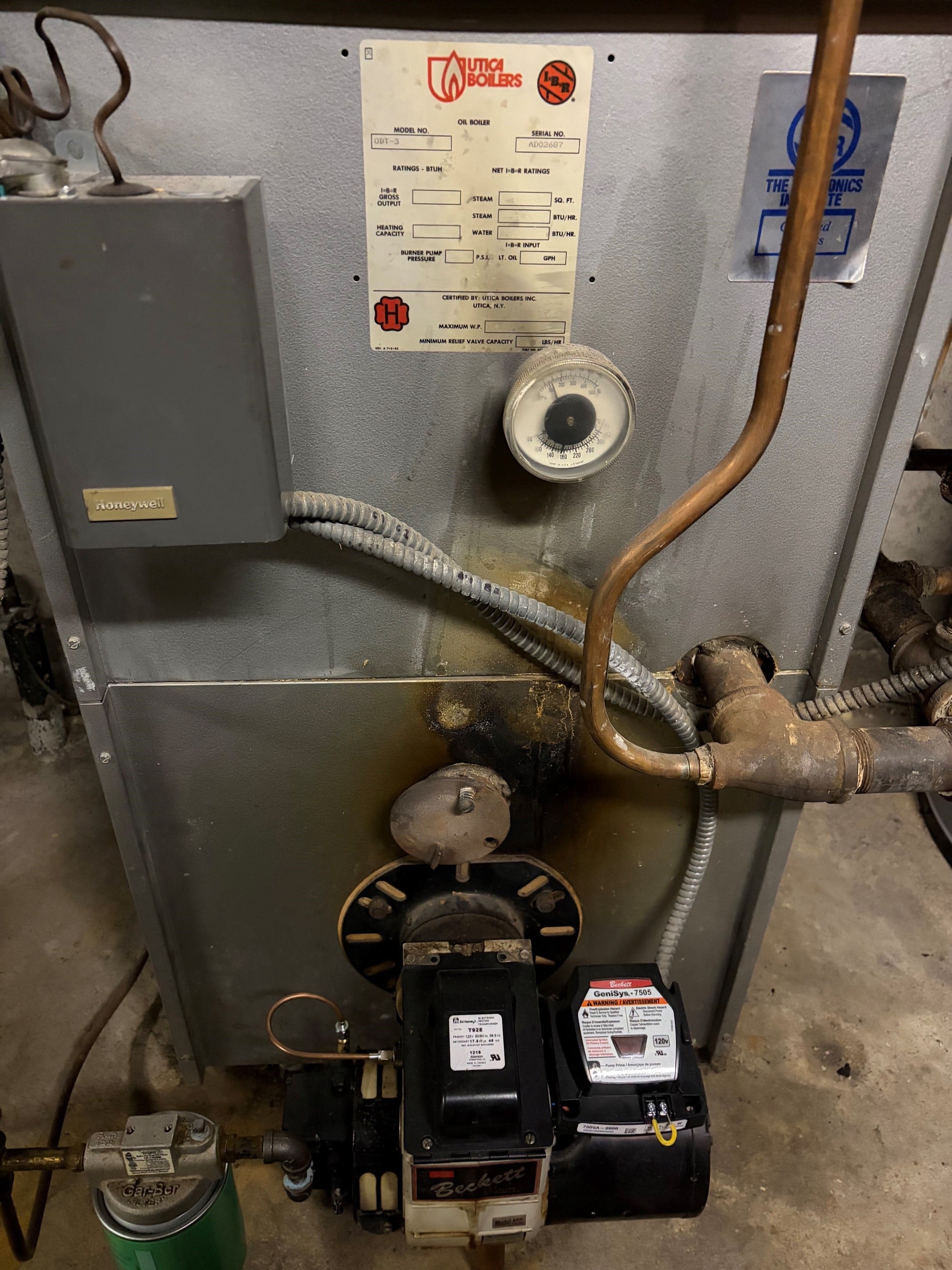
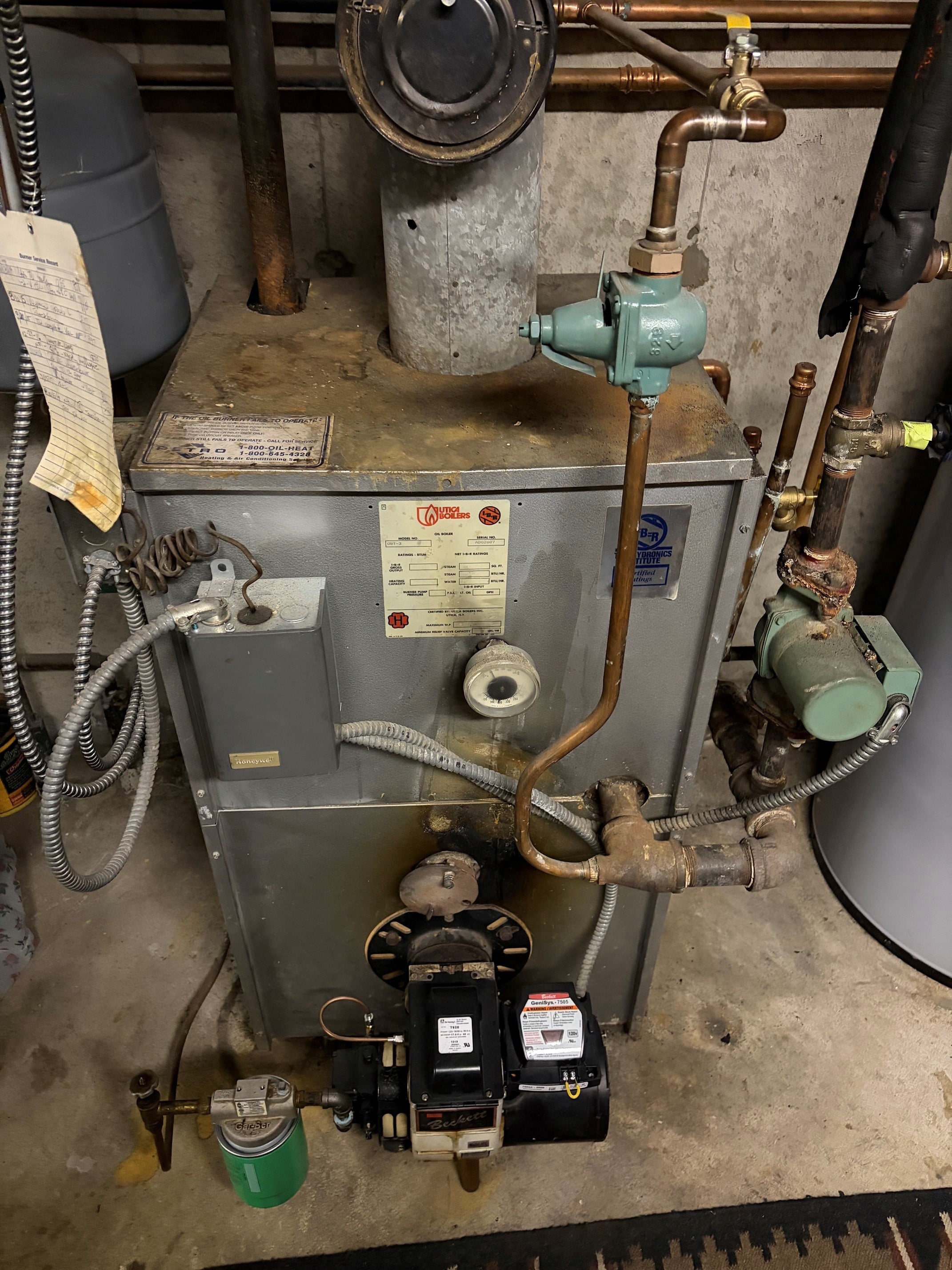
@Steamhead, let me know if these help, or I'll take another. I was told these burn out in the back but the back seems fine, the front looks a little tired but I was told the chamber is in good shape.
0 -
That is a dry base boiler.
Yes, they can burn out the back but they don't have to.
The reason they burn out the back is when the combustion chamber breaks down and needs replacement and if that is ignored they will burn out IMHO.
It's because most "techs" will not replace a combustion chamber because it is a dirty job. They would rather sell a new boiler.
1 -
Yup, dry base. It wasn't the one I was thinking of.
I see lots of discoloration around the inspection port above the burner. When was the last time the top was removed and the baffles removed to clean the tubes? If they aren't doing that, they're simply taking your money.
1 -
Thanks for the guidance, I called and there's no indication that they took this apart last year or even looked, so unless the record shows that this was done a year or two ago and it only needs to be done every few years, I'm guessing that this isn't part of their scope. I'm sure if I asked you the same question it would be clear from your reply that this is something that you do, they were kinda vague.
Is this something that should be done every year? Also, do you have any thoughts about the water/scale issue?
I'm posing your question to another service provider to see if it's in their scope…
BTW, if anyone knows of a service co that does the right thing, feel free to advise, I'm just east of Port Jefferson. I have a Roth tank going in Thursday and I need to decide if I'm getting a new oil provider (the easy part) along with a service plan of some sort.
0 -
I would avoid any pin boilers and only use a triple pass or an EK. Nothing against the Peerless, just concerned that anyone cleans them properly.
The next person who services it should pull the burner. Poor cleaning habits usually leave a ton of crud in the chamber. They just brush them down and never clean the chamber.
You’re going to short cycle even with the smallest boiler. I don’t think they’ll be much of a difference in wear and tear. Most important is proper set up and near boiler piping for boiler protection from low temperature return water.
Then proper combustion set up, proper draft, proper adequate combustion air, double fuel filtration and you really shouldn’t have any problems.
EK’s advantage is that it’s more efficient. Don’t worry about parts. Any person authorized to sell them, services them. Depending on the model, if the Manager goes bad, every tech has a service board they can install to keep you running, while they get a new Manager from EK. And the other part that may be an issue is their aquastat. Which a service tech can switch out with a standard Hydrostat with a simple mod. Everything else is standard off the shelf parts. 2
2 -
@HydronicMike, thanks for that, unfortunately, I don't think there are any triple pass boilers with top vent. I think I had ~36" from rear wall to front of burner.
I would expect to have the installer service the Peerless, but I guess there's no guarantee that I'll be getting a thorough service even if he sold the thing.
So nothing tweaky about the EK-1, too sophisticated for its own good?
0 -
with a hot water boiler there should be very little corrosion or scale. if there is a leak and a lot of fresh water you will get corrosion but the solution to that is to make sure the system isn't leaking.
1 -
Go here to find a good contractor on LI:
1 -
@mattmia2 No leaks thanks, is the corrosion due to a fresh supply of minerals or oxygen in the fresh water?
@Steamhead Thanks, I'll check that out.
A couple of EK questions: I love the fact that you can fit a 40 gal tank under the EK-1 but I have a hybrid water heater that's only 4 years old so I guess if I did go EK I'd have to skip the tank.
- When using the EK tank and therefore increasing the demand on my oversized boiler (better because it's reducing the oversized factor a bit), does this make for a 'better designed' or somehow more efficient system, or is there no such benefit?
- It was suggested that I could have both water heaters connected and transfer over via valves seasonally, but I'm thinking that having a water heater sit idly/stagnant for 6 months at a time is not a good idea/ unhealthy/ kinda gross?
- The exterior walls of my boiler room are uninsulated but the heat put off by a typical boiler eliminates the possibility of pipes freezing. Though I'm sure it's much reduced, does the EK put off any heat?
0 -
the corrosion is mainly due to the air dissolved in the fresh water but some of the dissolved minerals also precipitate out when you heat it so it leaves those behind too.
you can set up a boiler to heat an electric or in your case heat pump tank during the heating season. not sure how that fits in to the ek system, the president of ek hangs out here, i'm sure he'll give you better details than i can at some point. i think it uses a heat exchanger to heat their storage tank so that could heat your existing tank instead.
part of the way the ek system gets efficiency is by putting some of the heat still in the boiler after the cycle ends in to the hot water tank.
1 -
The smallest oil fired boiler available I'm aware of is the Weil McLain GO-2, at 75K net BTU. That would be over 81 BTU's per sq ft. Then you have options on domestic hot water. An indirect with priority, electric (probably not a good choice on Long Island unless you've got solar), heat pump.
If you're interested in the System 2000, you need to locate companies that are EK dealers. Even though the house is 918 sq ft, the System 2000 doesn't waste those extra BTU's. It dumps them into the water heater or the last zone calling. Or wherever you program it to dump. They're not hard to service once you're familiar. That's why you can't get them at any supply house. Boilers get shipped directly from EK. The company needs to be an EK dealer, and the techs and installers are (should be) experienced in them. But at the end of the day, its just an oil burner. There's nothing any oil tech doesn't already have in their van that would be needed to service a System 2000.
Peerless, Weil McLain, and others offer efficiency controls like the Hydrostat 3250 Plus, or Beckett AqauaSmart, but they dont compare to the design and function of the System 2000. The EK will be more up front, but it will save fuel over the other options. If you swap a WBV for the OBT, you're not saving much. Since you're on the Island, you're familiar with BNL. EK did comparison studies there. Check it out.
The last time I saw an OBT Utica, I had waaaaay more hair.
2 -
@mattmia2 To clarify, the hybrid would run independently of the EK in the warmer half of the year, and I'd use the EK tank during the colder weather. This would allow me to invest in a new EK system and avoid discarding a relatively new hybrid water heater. The ability to stack the boiler with the tank appealed to me, and the purging of the last bit of heat to the EK tank that you mentioned only makes that option more appealing.
Is it ok to let a water heater sit idle for 6 months at a time, is this what people do who fly down from NY to Florida for the winter?
@HVACNUT Yes, I've been in touch with a few dealers and EK themselves, thanks.
0 -
Thank everyone for such positive and informed comments all around.
The Frontier’s low mass thermal purge design means that you’ll have very high efficiency operation from very small to full loads. The boiler is heavily insulated, so it won’t give off nearly as much heat as your current dry base boiler.I’m sorry I don’t have a good technical answer for you about using a tank after being stagnant for six months. At a minimum, thoroughly flushing out the tank before use makes sense. Possibly others here would have knowledge on a proper, safe, and hygienic procedure.
Please let me know if we can assist further with other technical information or dealers.
Best,
RogerPresident
Energy Kinetics, Inc.1 -
Thanks Roger, and as always, thanks to everyone on here, always very helpful (sorry for the many questions).
It appears that a stagnant tank is not a good idea so I'll probably forget about the Lowboy and replace the hybrid with another hybrid or the standard 40 gal EK when the time comes.
It sounds as if whether or not I have the DHW load on the EK-1 is of little consequence to the overall efficiency of the EK system, even when oversized, so using the hybrid would probably make the most sense (we'll have to see how long it lasts).
And the absence of the DHW as a place to send the final heat purge is of no concern?
Thanks again all.
0 -
i would see if it is possible to set up the hp water heater as an auqabooster type setup with the ek to avoid the tanks sitting stagnant alternately for half the year. the savings from the post purge won't be enough to justify buying a second dhw tank. though they won't corrode as much wile idle they will still corrode. you'd want to heat them hot enough to kill off any bacteria before putting them back in service after sitting idle. systems where they want to be sure there is no legionella in the system run the tanks hotter and mix down the water for consumption.
0 -
You're welcome, @charlie123 . The boiler will thermal purge to the last zone that called, which can be heat or hot water. If there are very long cycles between hot water calls, or no hot water calls, the efficiency does not suffer. You could install the boiler (it comes with a hot water control and built in connections for the plate heat exchanger, so it's ready to add the tank) and then replace the HPWH at end of life with a non-stackable tank with plate heat exchanger.
The stackable tank stand is designed taking into account the mass from a 40 gallon tank full of water under it. It can be braced without a tank, but it should have a full tank of water in the stand if not.
@mattmia2 , your idea about an aquabooster made me think about putting the two tanks in series, with the HPWH second and the piping well insulated between the two. We do something similar with solar thermal water heaters with the EK tank and solar tank in series. This will allow flow through both tanks all year long and avoid stagnation. Simply add a switch from the lowboy tank thermostat - when it is on, the boiler heats the tank and it flows through the HPWH and then out to the fixtures. When the thermostat is off, the HPWH will maintain it's tank temperature so fixtures will have hot water. If you are away for many days in the winter with the lowboy tank on and the HPWH tank cools off, the HPWH will reheat itself to maintain the temperature - no need to flush the entire tank to get hot water to the fixtures. At the HPWH end of life, you can decide what to do (replace or just cut it out and use the lowboy tank).
Roger
President
Energy Kinetics, Inc. 1
1 -
Thanks again, Roger.
1


Categories
- All Categories
- 87.8K THE MAIN WALL
- 3.3K A-C, Heat Pumps & Refrigeration
- 60 Biomass
- 430 Carbon Monoxide Awareness
- 133 Chimneys & Flues
- 2.2K Domestic Hot Water
- 6K Gas Heating
- 124 Geothermal
- 170 Indoor-Air Quality
- 3.9K Oil Heating
- 79 Pipe Deterioration
- 1.1K Plumbing
- 6.7K Radiant Heating
- 397 Solar
- 16.1K Strictly Steam
- 3.5K Thermostats and Controls
- 56 Water Quality
- 51 Industry Classes
- 51 Job Opportunities
- 18 Recall Announcements