Gas Boiler Options, what to know about high efficient gas systems

I currently have an oil boiler vented to chimney. I want to convert to gas for a number of reasons. If I do mid efficiency I know I’ll need to line chimney, if high efficiency going out side wall power vent.
Got different quotes from different companies on different systems. Can someone please give me an overview on the different systems, pros and cons, and if any are actually worth more money?
Also I have radiators ([mostly] cast iron) and am curious if that plays into the efficiency of a high efficiency gas boiler (I’ve seen some comments on Reddit that seem to suggest this)? Or what else plays into if we are able to get highest efficiency out of a high efficiency system and will it always be significantly more than the 84% mid efficiency units?
I have an indirect hot water heater 45 gallon that I plan to keep. May even consider increasing size as sometimes we run out of hot water in the winter.
High efficiency
Lochinvar Knight KHB155N - interestingly the only option 2 different companies would recommend.
Burnham Alpine
Burnham Altac - notably includes 10 year extended warranty but alpine (from same contractor) only includes 5 year.
Moderate efficiency
Burnham X-205N-GH 140,000
Burnham series 2
Thanks in advance!
Comments
-
It would be good to know what the heat load of your home is, a heat load calc is fairly easy to do. Have any energy upgrades been done? That is always a good step for reducing fuel consumption regardless of if the boiler type. Check online for any utility programs for an energy audit. www.dsireusa.org
Then an assessment of your radiators. Determine their output at various temperatures.
The goal is to supply the lowest possible temperature while maintaining a comfortable home.
With a mod con the boiler can run as high as 90% under low operating temperatures. A conventional boiler has a limit as to how low a temperature it can safely operate at. Usually measured by the return temperature. Low to mid 80% is about the best you will do with a non condenser
The mod con boilers come with outdoor reset to modulate supply temperature. Additionally the modulation will provide nice long, efficient run times.
All boilers, by the manufacturer instruction should be serviced regularly. If you are handy some of the yearly checks are fairly simple, checking intake screens, running through the control looking at error codes, if any. Disassembly and cleaning may be best handled by a pro with the correct analyzers.
Crunch numbers here to compare fuel cost now, and the near future anyways
https://coalpail.com/fuel-comparison-calculator-home-heating
Bob "hot rod" Rohr
trainer for Caleffi NA
Living the hydronic dream1 -
People seem to be happy with Lochinvar. As far as Burnham goes I don't care for anything Burnham but that is just me others love them so don't let that scare you away.
Since you have CI radiators a MOD CON will get you the highest efficiency because you can run lower water temps in most cases.
Mod Cons save fuel because they modulate the flame. If your house needs 80,000 BTU when its 0 deg outside it will ramp up the flame. If you need less heat in the spring and fall tit reduces the flame size.
This saves money over a conventional boiler which is on-off 1 size flame. Mod cons can run lower water temps than a standard boiler.
Mod cons need regular service by a decent technician. A conventional boiler with less parts should have regular service as well but that is usually ignored until it fails.
Mod con more $$$ to install and is more like a 10-15 year boiler although they can last longer. A CI boiler will usually last 20 years + on hot water.
0 -
poor insulation, putting in cellulose this summer. In Mass. I’ve got slightly different j loads but around 140,000.
I have an indirect hot water tank if that makes a difference.What’s involved with radiator output assessment at different temps. How is this done when they are coming in June?
thanks again!0 -
you'd use some sort of a radiator survey, if they are new enough to be standardized types there are sheets you can fill in the measurements and calculate the equivalence of direct radiation of the radiators. from there you can find the output at different water temps and compare that to the heat loss. if they are older radiators that aren't standardized there is stuff in the library of this site and people here can help you find the edr of those radiators.
keep in mind the heat loss you will calculate is on a design condition day and will be more than 90% or so of the time so you can operate at lower water temps than what those calculations give you most of the time.
0 -
thanks. Im a little lost on the point / reasoning you are trying to make in the second paragraph. Are you able to please clarify / say in another way?
0 -
when you calculate the heat loss you calculate the amount of heat the structure loses and the system needs to replace on nearly the coldest day in your area. most of the time it will be warmer than that, so with a mod con boiler that can vary its supply water temp based on outdoor temp (outdoor reset), it can run at a lower supply water temp and get higher efficiency.
0 -
Here is a generic radiator derate., and the math needed to correct the output.
If you can
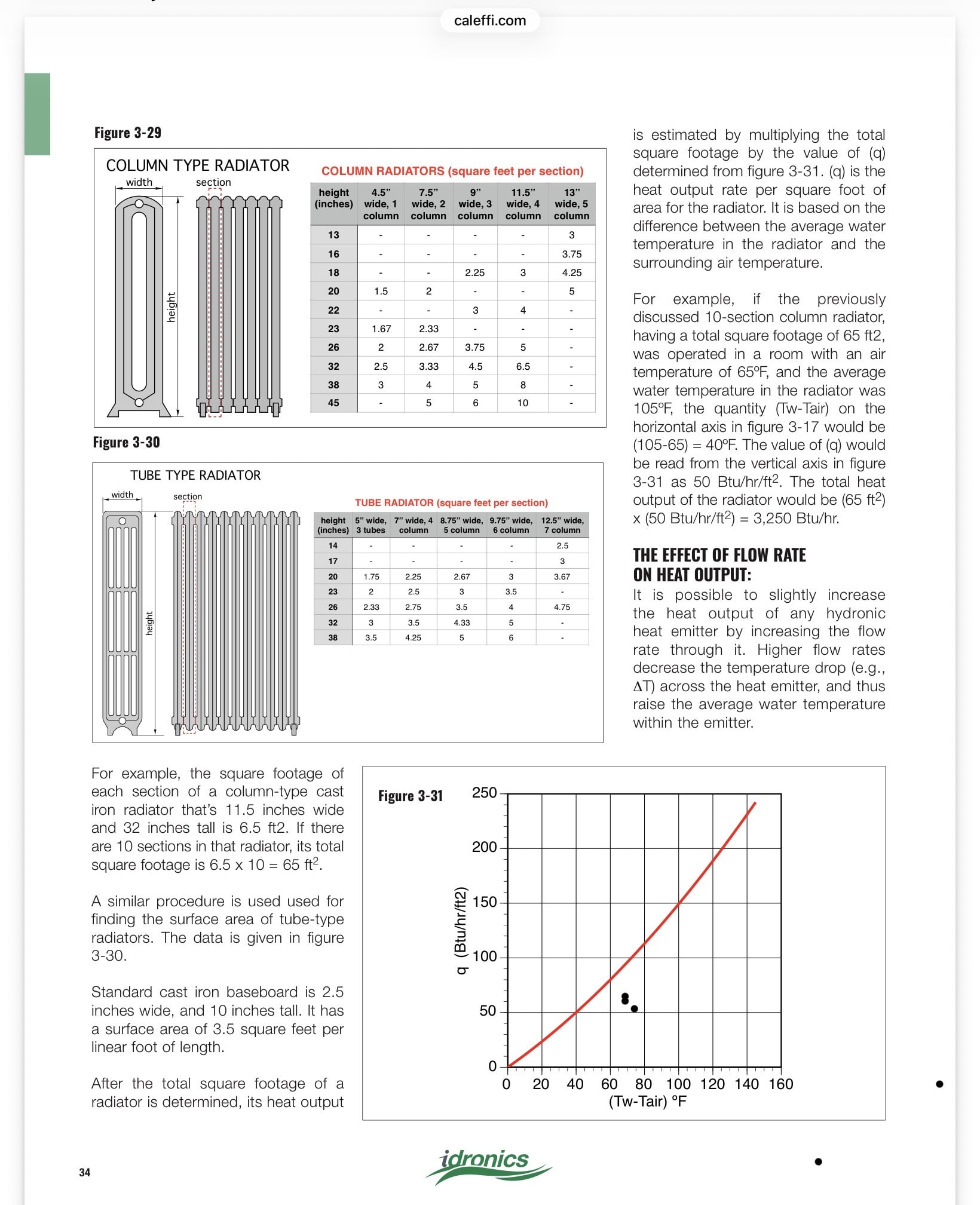
determine your exact radiator sq ft, use that number.
The graph takes into account the water temperature Tw and the ambient air temperature Tair at the radiator, see the example, adjust to your actual numbers.
With Amos con that Tw will adjust up and down based on outdoor temperature Think of it as a cruise control on your boiler.
Bob "hot rod" Rohr
trainer for Caleffi NA
Living the hydronic dream0



Categories
- All Categories
- 87.8K THE MAIN WALL
- 3.3K A-C, Heat Pumps & Refrigeration
- 60 Biomass
- 430 Carbon Monoxide Awareness
- 133 Chimneys & Flues
- 2.2K Domestic Hot Water
- 6K Gas Heating
- 124 Geothermal
- 170 Indoor-Air Quality
- 3.9K Oil Heating
- 79 Pipe Deterioration
- 1.1K Plumbing
- 6.7K Radiant Heating
- 397 Solar
- 16.1K Strictly Steam
- 3.5K Thermostats and Controls
- 56 Water Quality
- 51 Industry Classes
- 51 Job Opportunities
- 18 Recall Announcements