Old Gravity System Converted To Gas Boiler

Hello,
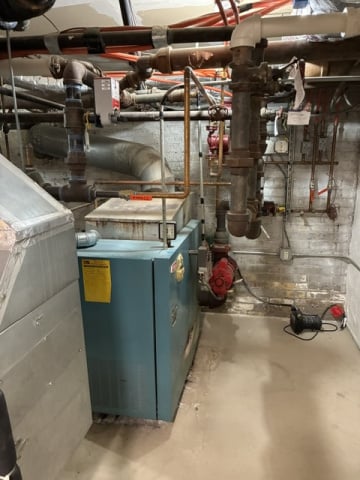
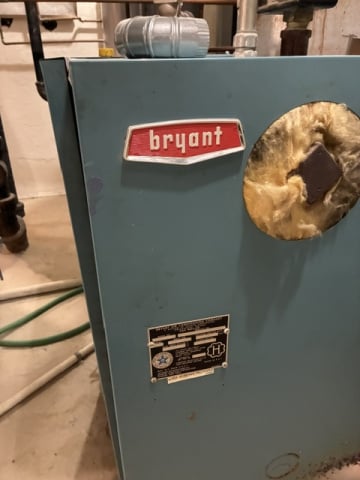
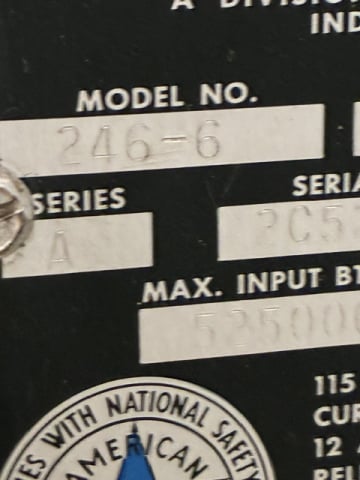
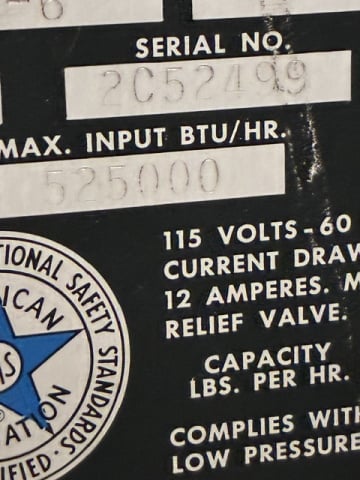
We reside in a northern suburb of the Chicago are, have an old gravity hot water cast iron radiators system that was converted onto a gas fire boiler in the 70's. It currently has Bryant boiler model 246-6 that takes 525,000btu input, Gross output 420,000btu (Water sq feet 2800), Net Rating 315,100 (2100 sq feet). It is controlled with a Nest thermostat (Radiator setting). Most rads have individual TRV's.
The house is about 8000sqft, built in 1917. We insulated the exterior walls about 10 years ago, however, it is not tightly insulated—there are few gaps throughout given its age (doors/windows/etc).
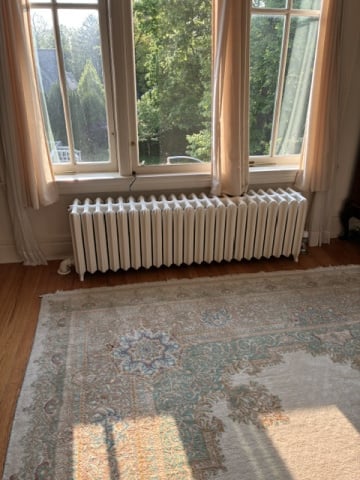
The house has the original cast iron radiators, many of which are quite large. During the coldest day of the winter the rads reach about 140-145 degrees, however it takes a long time to reach that temperature (can be 3-4 hours in the morning after a setback of 3 degrees from the thermostat setting of 67 at night to 70 in the morning. During the cold months the gas bill can reach $800-$900 per month and it feels expensive and inefficient.
Interestingly, the original blue print of the house specifies a total connected radiation of 2100 EDR, and that is about what we currently have. That 2100 EDR if I am not mistaken matches exactly the current boiler Net Rating of 2100 sq feet (315,100but) mentioned above.
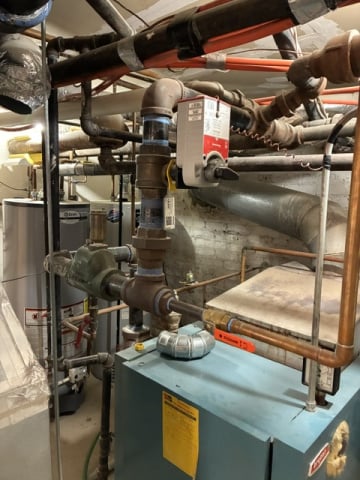
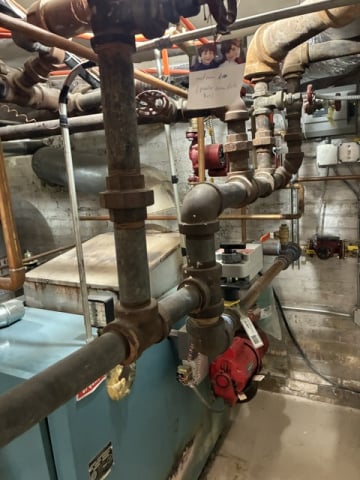
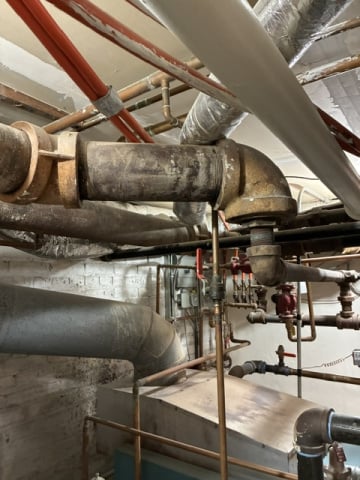
The original main supply lines (now uninsulated otherwise the basement gets too cold) run along the perimeter of the basement ceiling start at 5" in diameter and get reduced as they progress. There are 5 branches of return lines coming back to the boiler. The boiler does not have a bypass yet it's been working fine for the past 50 years. There are two newer toe-kick closed loops (on a separate heat exchanger) that heat out kitchen, also connected to that boiler. We installed automatic valves on the supply and return of the main house that close if the kick-toe calls for heat while the house thermostat is satisfied, otherwise the house radiators get hot despite no call for heat.
Because the heating cost feels expensive, and given the age of the boiler, and the fact that the radiators can heat the house comfortably with only about 140-150 degrees, I was considering upgrading it to as modulating/condensing boiler or to a new cast iron atmospheric one.
If modulating/condensing I was thinking of Vitodens 200-W B2HA-530 (530kbtu, ~93% efficient). The high output is considered to shorten the time the supply water gets to 140 degrees. I don't know if that boiler can handle the massive amount of water in the system (remember, large pipes for gravity system originally).
If cast iron atmospheric one, I was thinking of Weil LGB-6 650k input, 523k gross output("DOE") / 1.56(per Holahan) = 335k btu, which matches the specified (net) radiation per blueprint.
Or perhaps two smaller atmospheric boilers, staged to achieve higher efficiency.
What is your opinion? modulating/condensing one (which requires lots of periodic maintenance and attention), or a cast iron one (or smaller two)?
And what size to do you recommend?
Thank you very much
Comments
-
That is a massive system, at 8000 square feet you going to have a substantial fuel bill you have 4 ranch houses there.
Modulating condensing boiler are the way to go, maybe even 2 smaller ones to split the load. Viessmann is top of the heap.
With such a large project I would start with a heat loss calculation and a blower door test to check infiltration. This will nail down the right size boiler.
Your temp setback is probably hurting more than helping
Outdoor air reset will probably help which will be part of a mod con
Then a radiation survey which it sounds like you have
With 5" pipe you are massively oversized but the cost of downsizing that could be out of reach.
I am not a big Mod Con guy but this job screams Mod Con.
 1
1 -
Speaking as novice with a hot water heating system,
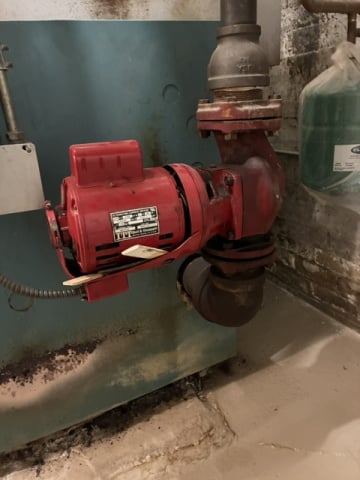
I guess I have to ask you this about the rats nest of plumbing you have, were the flow restricting discs removed from the radiators or left in place?
As you are pushing water from a smaller circulator to larger piping the water will slow solely because of the water weight above it. The other thing I noticed is you have a very small compression tank.
Previous to this:
Was an open to air expansion tank vented through the roof used to provide the point of no pressure change or were the individual radiators left with an air charge to create the point of no pressure change?
It would make more sense based on simple hydraulic flow to use the large tapping located at the top of the boiler on the side to connect to your existing piping to maintain a gravity system allowing hot water to rise slowly and evenly and the cool water to return naturally, eliminate the circulator and the boiler heat the water and let it flow through the large piping as it was designed to do with the old coal fired boilers piping.
First I would eliminate the circulator.
Then I would use the large tapping at the top of the boiler and connect it to the point where the elbow closest to it would allow the hot water to rise and I would use the sump tapping where the circulator is for the cool water return.
If the boiler has a second tapping in the boiler sump on the opposite side I would for use it for another cool water return.
0 -
It's the building that is driving fuel consumption.
The mod con would help out some as far as reducing fuel consumption, but.
The best money you can spend is upgrading the building envelop first as much as realistically possible.
A blower door, or two :) and an infrared scan might point out some easy energy upgrades.
Infiltration can be a big number and cans of spray foam can often reduce that leakage.
Check with you utility for weatherization programs to help reduce energy use.
If you can do some more tightening up, do another blower door test and run the heat load calc with the upgraded shell.
Even getting the load down to 25 btu/ sq ft puts you at 200,000 btu/hr
Staging a couple mod cons makes sense, it eliminates the need for boiler return protection that the standard boiler would need.
Bob "hot rod" Rohr
trainer for Caleffi NA
Living the hydronic dream 2
2 -
With all the posts I see in here about new boilers not lasting over a decade I wouldn't consider changing the Bryant unless it rusts out. Like the experts said, put the effort and money into insulating the building.
Bryant 245-8, 430k btu, 2-pipe steam in a 1930s 6-unit 1-story apt building in the NM mountains. 26 radiators 3800sqf
0 -
Agreed. Up to a point. First, your gas bill sounds at first expensive — but with that size of a structure, it's really not. Sorry about that.
That said, you may be able to reduce the building heat loss. Some. But be very very careful about how you go about doing that. Old buildings (well, 1917 isn't that old in my book, but it qualifies) were never intended to be sealed up tight, nor were they intended to have vapour blocking insulation everywhere. They were intended to breathe, and this allows the entire structure to stay in good, mould and rot free condition. It also kkeeps indoor air quality good to excellent. So be rather wary about insulation which may allow condensation and moisture trapping in the walls and roof structure. Seen it too often.
Be especially careful about windows. There are plenty of folks who are willing to spend lots of your money for fancy new windows. Don't. Quality interior or exterior storm windows do just as well — longer, and for less money. If some of the windows need some care an attention, however, that should be attended to. There are craftsmen out there who can and do restore windows.
Blower door tests are often mentioned, as above. You may or may not find someone who is willing to give it a try, but a house like yours — or Cedric's home here (7,000 square feet, 1780 to 1893) they are just not practical.
Br. Jamie, osb
Building superintendent/caretaker, 7200 sq. ft. historic house museum with dependencies in New England1 -
not 100% sure but i think that series of bryant is from the 50's, not the 70's.
as long as the circulator isn't coming on with the toekick heater call for heat you don't need a zone valve to keep the main house from heating with the toekick call, you just neds a flow check valve in the main supply piping(and possibly return, especially with the large piping it is possible to get ghost flow within the same pipe from water flowing 2 ways within the same pipe by gravity)
check to make sure that the heat exchanger in the boiler isn't sooted up from the low temps, also check the chimney that it hasn't been damaged from condensation.
granted i'm in michigan but my as bill per square foot is abut 1/3 more than yours
0 -
if your house feels warm at 145F water temps on design day you are probably needing only 200,000 to 250,000 btu/hr, so the boiler sizes you’ve suggested above may be quite a bit too large. A real heat loss calculation might save you a bunch of money…
 1
1 -
8,000 sq ft of heated space with a net of 315K BTU's from the boiler is 39 BTU's per sq ft. There should be no problem heating the space with half that output on most days if everything is designed and operating correctly. There must be a few pros in the Chicago area who can go over the whole system in person.
0 -
It would be nice to think so. Old houses, however, don't play by 21st century rules — and 35 to 40 BTUh per square foot of livable area would be by no means unheard of, depending also on the climate — and depending on just where in Chicagoland one is, the heating load can get remarkably high
Granted, half or less that "on most days" is probably quite true. Some folks like to have capacity to be reasonably warm on all days, though…
Now it's probably true that some tightening up — as I mentioned above, I'd start with repairing the windows and adding storms, if that hasn't been done — might reduce the figure. Some.
Just for reference to our OP's setup, Cedric powers a system with at total net rating of about 360,000 BTUh for a house with a net total area of 7,000 square feet, and rarely runs more than half the time on most cold days. I have seen him run almost all day, though, now and then.
Br. Jamie, osb
Building superintendent/caretaker, 7200 sq. ft. historic house museum with dependencies in New England0 -
does it have indirect radiators that are still set up to pull air from outside?
0 -
I’m a former pro who spent 35 years in boiler rooms in and around Chicago. If it’s cold on the lakefront, it’s just as cold in Schaumburg.
Here’s the way I’d attack it. First off, I agree that a blower door test or two is good idea. I’d start with an evaluation of the boiler and the near boiler piping. I’d gather every bit of information that I’d need to do a Manual J heat loss load calculation, breaking every room down and determining how the EDR compares with the room heat loss. From there you’d want to look at the heat loss and ways that you can button up the envelope to decrease that heat loss. That’s when it’s time to evaluate boiler selection. I’ve done houses in the Chicago area up to 22,000 sf. At 8000, I would definitely go with two boilers and there will be many ways you can set up how to control them. I love the simplicity of the old school cast iron boiler, but I’m a modulating condensing boiler type guy. If piped correctly and serviced properly, you will get plenty of years from them that justify the upfront cost difference. The brand of boiler you choose is also significant. I was strictly a Lochinvar and Viessmann guy. Lochinvar has a strong presence in the Chicago area with their local sales rep. in Elk Grove Village. The boiler is available at Porter Pipe & Supply, hands down the best supply house in the Chicago area who provides a level of service that is very hard to find these days. A good guy to start with is Piotr Zelasko out of the Addison branch. He doesn’t have an important sounding job title, but I assure you he has brilliant mind and is a hydronic savant. He also has an engineering degree. He will come to your house, evaluate the situation, and recommend a contractor who’s worth his salt. Tell him I recommended you. I worked with Porter Pipe and Piotr for many years. There is no better choice in the Chicagoland area and I assure you, I have no skin in the game. I’m retired and living in the wasteland of Las Vegas at its furthest point north.Steve Minnich 3
3






Categories
- All Categories
- 87.8K THE MAIN WALL
- 3.3K A-C, Heat Pumps & Refrigeration
- 60 Biomass
- 430 Carbon Monoxide Awareness
- 133 Chimneys & Flues
- 2.2K Domestic Hot Water
- 6K Gas Heating
- 124 Geothermal
- 170 Indoor-Air Quality
- 3.9K Oil Heating
- 79 Pipe Deterioration
- 1.1K Plumbing
- 6.7K Radiant Heating
- 397 Solar
- 16.1K Strictly Steam
- 3.5K Thermostats and Controls
- 56 Water Quality
- 51 Industry Classes
- 51 Job Opportunities
- 18 Recall Announcements