Energy Kinetics EK1 flue liner condensation

We live in Alaska and I'm getting mixed opinions regarding using a flue liner with the EK1 in a cold climate.
Will installing a 5" liner into the existing ~30 foot 7" double walled SS vertical flue create a problem with condensation forming and collecting at the bottom of the 7" flue and then dripping on top of the boiler?
Thanks
Comments
-
It will depends on conditions . ….. North facing outside wall chimneys are the coldest , If there is a concern you can insulate the liner in …
There was an error rendering this rich post.
0 -
Thanks Ed
The existing 7" flue is not on an outside wall. It runs near the center of the house from the boiler thru 2 heated floors then thru the attic. The flue cap is near the roof peak. Any cold air exposer would come from the top down from the flue cap…. and cold air in the attic.
It can be -20 degrees F for days at time here…. sometimes even colder.
0 -
I'm no chimney expert, but IMO an interior 5 inch flue sleeved through a 7 inch B vent(?) chimney shouldn't be an issue with condensation. As long a the flue gas temperature at steady state (taken from the upper port) is 350° net or above. I would also seal the crown so there's no gap between the 5 and 7 up top. @Bob Harper would know chapter and verse.
 2
2 -
Agree with @HVACNUT
I would thing the smaller liner would heat fast and not be a problem. Is this a new boiler and liner install or is the boiler existing and the liner is to be added?
0 -
This is for new EK1 boiler to replace a 30 yr. old WM WTGO-5.
The 5" liner is to accommodate the EK1 flue size requirements.
0 -
Ok, back to the beginning. The existing chimney should be triple wall, not double wall. If it is triple wall rated for oil, why not just get a 7x5 reducer and connect there?
0 -
I'm a layman… but from what I've learned it has something to do with draft? or air pressure? to balance exhaust from the boiler and apparently using a 5" to 7" adapter out of the boiler and exhausting thru 30 feet of 7" flue will not work correctly.
0 -
EK monitors this forum often. They will probably comment in a few days or less. Their customer service is excellent.
 2
2 -
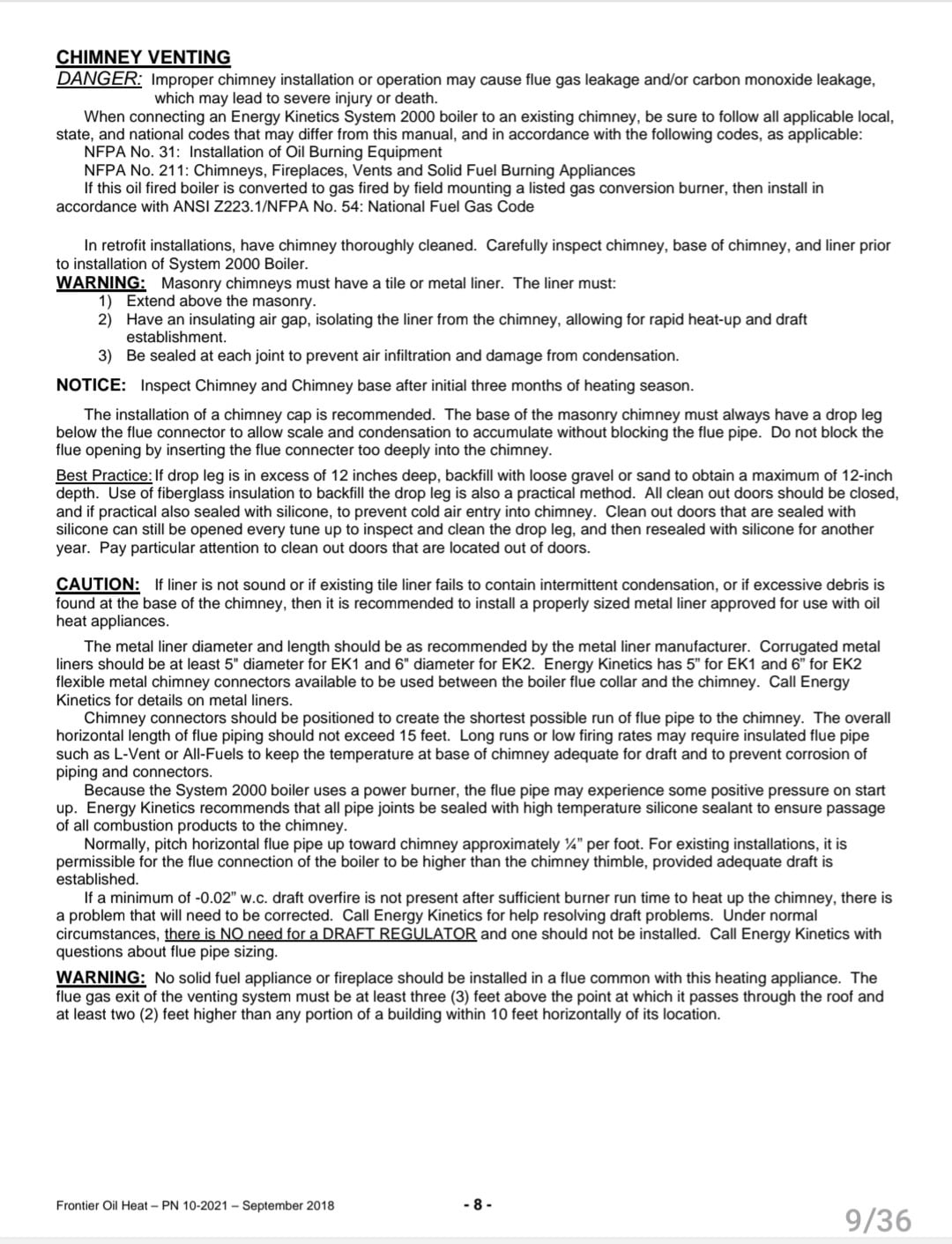
Out of the boiler is 4 inch. From that point it should be increased to 5 inch. There should be no issue adapting 5 inch to the existing 7 inch triple wall as long as the triple wall is rated, in good condition, and is the correct height.
 0
0 -
Thanks for info HVACNUT.
I could be missing something but I didn't see any reference to using an adapter to go from 5" directly into an existing 7" flue.
0 -
You didn't see anything that said you COULDN'T. They do recommend the use of insulated pipe like L-vent or All Fuels for long horizontal runs. You say it's double wall (L-vent). I think you have triple wall (All Fuels). Its typical to adapt from a single wall flue to a double or triple wall chimney. At worst you might need a sweep or a Drop Tee, but that's how connections are made every day.
0 -
The existing 7" flue is Metalbestos Model SS II. (double wall)
From the EK1 manual you attached:
"If a minimum of -0.02” w.c. draft overfire is not present after sufficient burner run time to heat up the chimney, there is a problem that will need to be corrected."
Couldn't using 30 feet 7" flue cause problems with draft?
0 -
The higher the chimney the more draft you get. 30' of 7" should give you plenty of draft
0 -
Thank you for everyone’s posts.
@arcticman , Energy Kinetics recommends a 5” flue for your application. Chimneys can be very site specific and it is possible the 7” flu will be adequate (especially if it worked with the prior system, and the site did not have any problems with draft or condensation).
As Alaska can be unique with its Arctic climate, please contact our territory manager, Dan at (907) 452-8368, in Fairbanks if you’d like to explore further.
Best,Roger
President
Energy Kinetics, Inc.
 4
4 -
Good question. Condensation from oil-fired appliances is a concern/issue, especially in the colder regions of Alaska. Utilizing a smaller diameter single wall flue pipe to go up and existing insulated pipe is very common and works well if the following measures are taken:
- Proper rain cap.
- The smaller diameter pipe is held away from the insulated pipe. This allows for rapid heating of the inner pipe.
- Fire wool should be installed at the top and bottom of the insulated pipe.
- The bottom (insertion of the smaller pipe into the larger) should be sealed so that air leakage is minimized. This is primarily for condensation on the exterior of the small diameter pipe from moist interior air, as is often seen in garages.
- Eliminating 90 degree joints.
It is impossible to eliminate all condensation within flue pipes, especially with high efficiency appliances in cold climates. Follow the above and you will minimize condensation.
Dan Spillane
Energy Kinetics - Alaska Territory Manager
Arctic Technical Services, Fairbanks, AK 907-452-8368
 3
3 -
Thank you for your informative post, @ArcticTech (Energy Kinetics Territory Manager, Dan Spillane).
@arcticman , since you posted a concern about the flue dripping on the boiler and there is no guarantee that the flue will not have rain or condensation, I would recommend taking action to make sure if some dripping occurs that it does not drip on the boiler or other areas that could cause damage.
Roger
President
Energy Kinetics, Inc.0 -
What precautions do you recommend ?
0 -
The best solution will be site specific, but the concept is essentially to not locate the boiler directly under the vertical flue; have a tee and cap offset from the boiler location, with the horizontal leg feeding the boiler. Most chimneys have a drip leg, so this would be similar.
President
Energy Kinetics, Inc.1


Categories
- All Categories
- 87.8K THE MAIN WALL
- 3.3K A-C, Heat Pumps & Refrigeration
- 60 Biomass
- 430 Carbon Monoxide Awareness
- 133 Chimneys & Flues
- 2.2K Domestic Hot Water
- 6K Gas Heating
- 124 Geothermal
- 170 Indoor-Air Quality
- 3.9K Oil Heating
- 79 Pipe Deterioration
- 1.1K Plumbing
- 6.7K Radiant Heating
- 397 Solar
- 16.1K Strictly Steam
- 3.5K Thermostats and Controls
- 56 Water Quality
- 51 Industry Classes
- 51 Job Opportunities
- 18 Recall Announcements