Water Temp When Hydronic System Is Not Running
Comments
-
" The 3250+ manual does not state anything about the “Plus” model having a 15 minute shutoff for the Hold-Off feature, so it seems it does not have that. "
On Page 9 see my post above.
National - U.S. Gas Boiler 45+ Years Old
Steam 300 SQ. FT. - EDR 347
One Pipe System0 -
I’m reading an idronics article by Caleffi I found online. It discusses gravity systems, states:
“Many of these early systems contained an expansion tank at the high point in the system, often in the attic of a house.”
When I first bought my house, and the gravity heat system was still in place, there was an expansion tank in the closet of a bedroom on the 2nd floor.
The article continues on, states:
“This tank was usually sized to 1/36th of the total system volume…”
My memory is the expansion tank in the closet of my house held about 5 gallons of water.
I’m not really sure about that, but if true, then…
YEE HAW!
The “ocean” in the system in my house holds 180 gallons of water.
That can’t be right. Can it?
0 -
So basically you have a temperature problem or concern. Based on collected data.
Really the best, most important data is the boiler temperature at the return connection and the elapsed time.
There is not set in stone rule for how long the boiler would run before return rises above the fuels dewpoint, call it 130°. 10 minutes is a number the industry seems to agree on.
So what you want is a temperature solution for the temperature problem.
To accomplish that you need a control or device that monitors that return AND responds to the temperature.
As mentioned there are a number of methods used, An electronic fix would involve shutting or holding off the pump until the boiler warms sufficiently. This may work but a boiler with no flow doesn't get you an accurate return temperature number. Under the on and off pump control method, possibly frequently cycles until the temperature at the sensor location is satisfied. Based on some of your numbers this may happen through the entire heating cycle, if the thermostats satisfy before the boiler reaches a safe operating condition. I'm not fond of turning a motor on off at 15 minute intervals for it's entire life, if that is what results.
The mechanical or hydronic fixes include modulating the flow leaving the boiler at the rate required to maintain that agreed on return temperature.
A thermostatic mix valve as Ed has has shown modulates flow based on the non electric temperature sensor inside. So it slowly regulates flow, it is a thermal clutch, not a thermal switch.
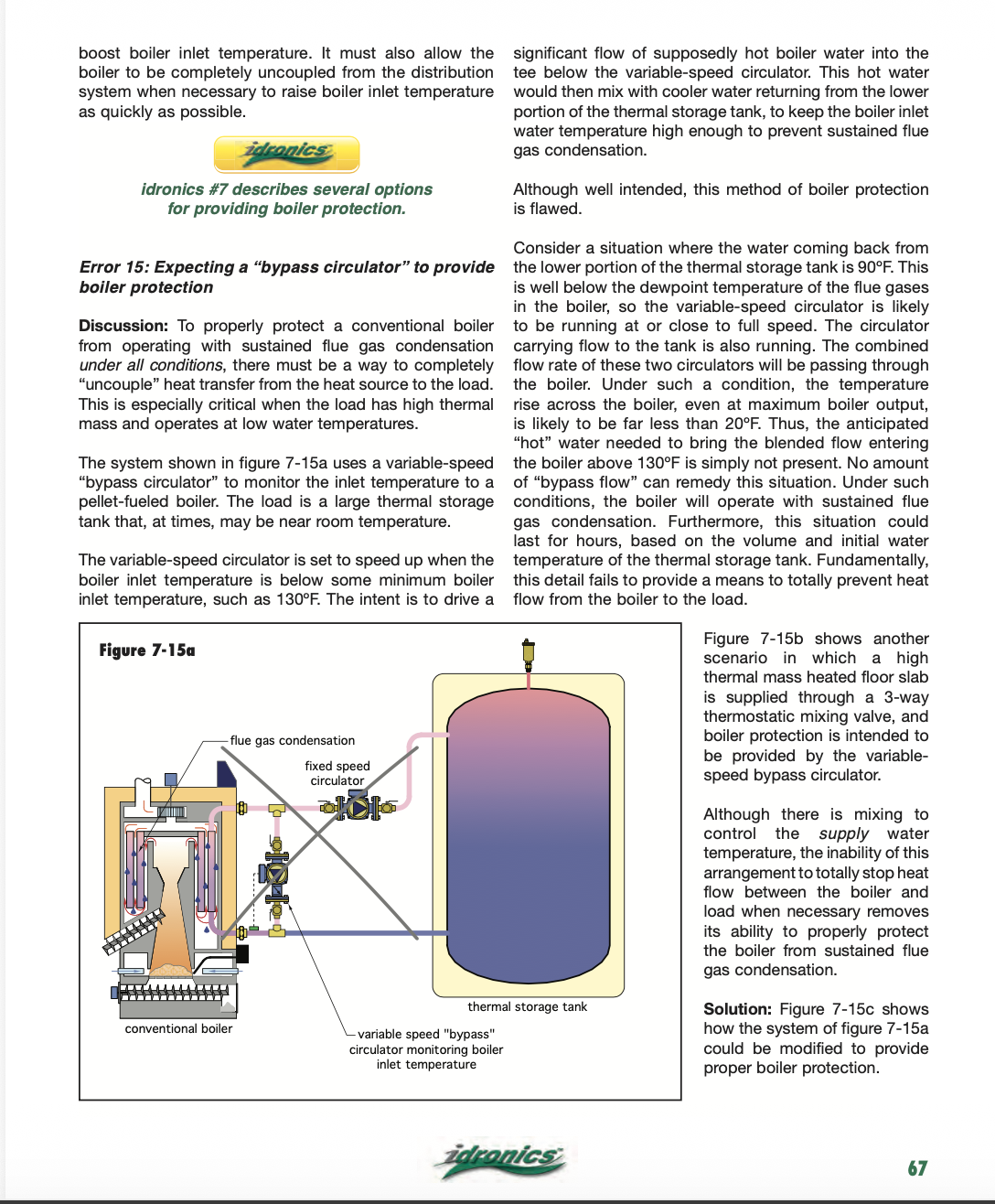
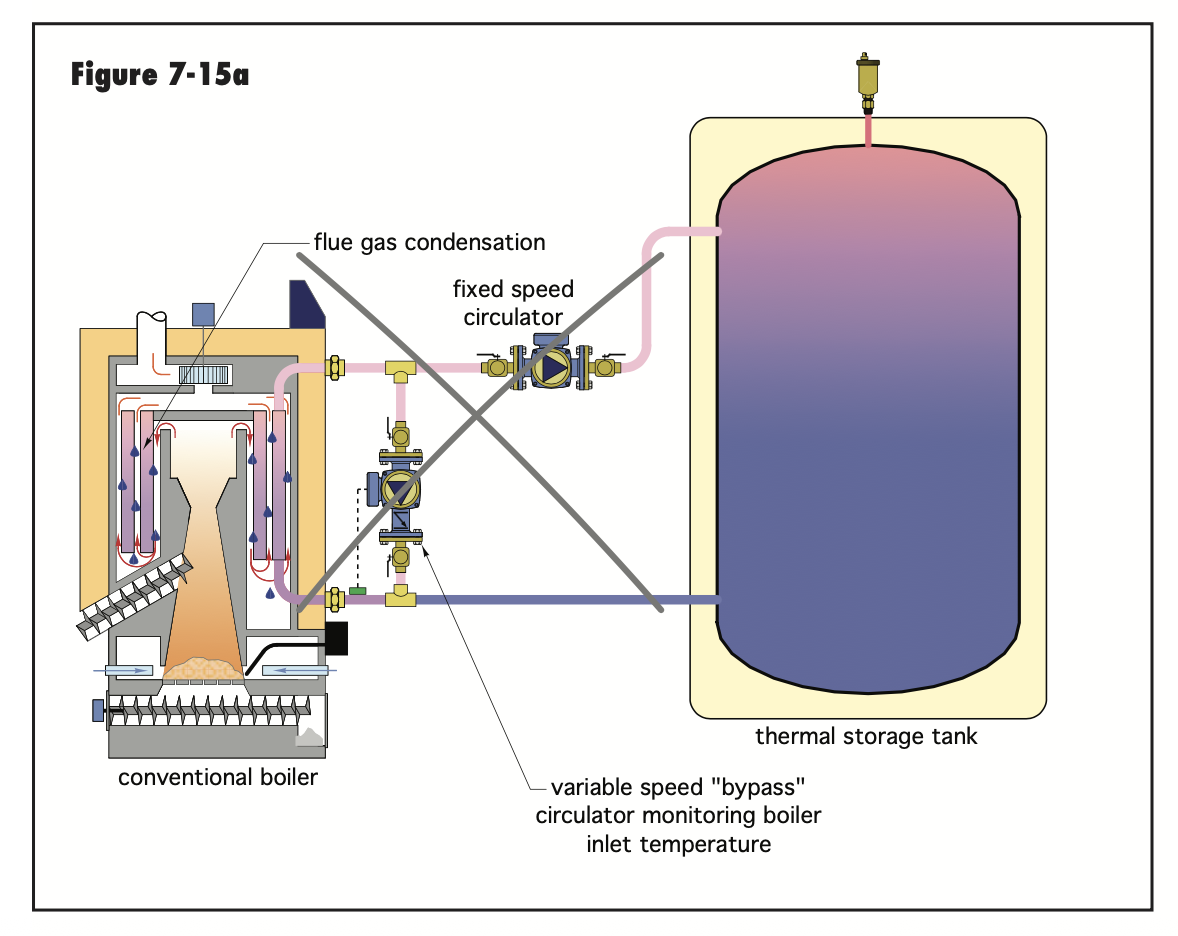
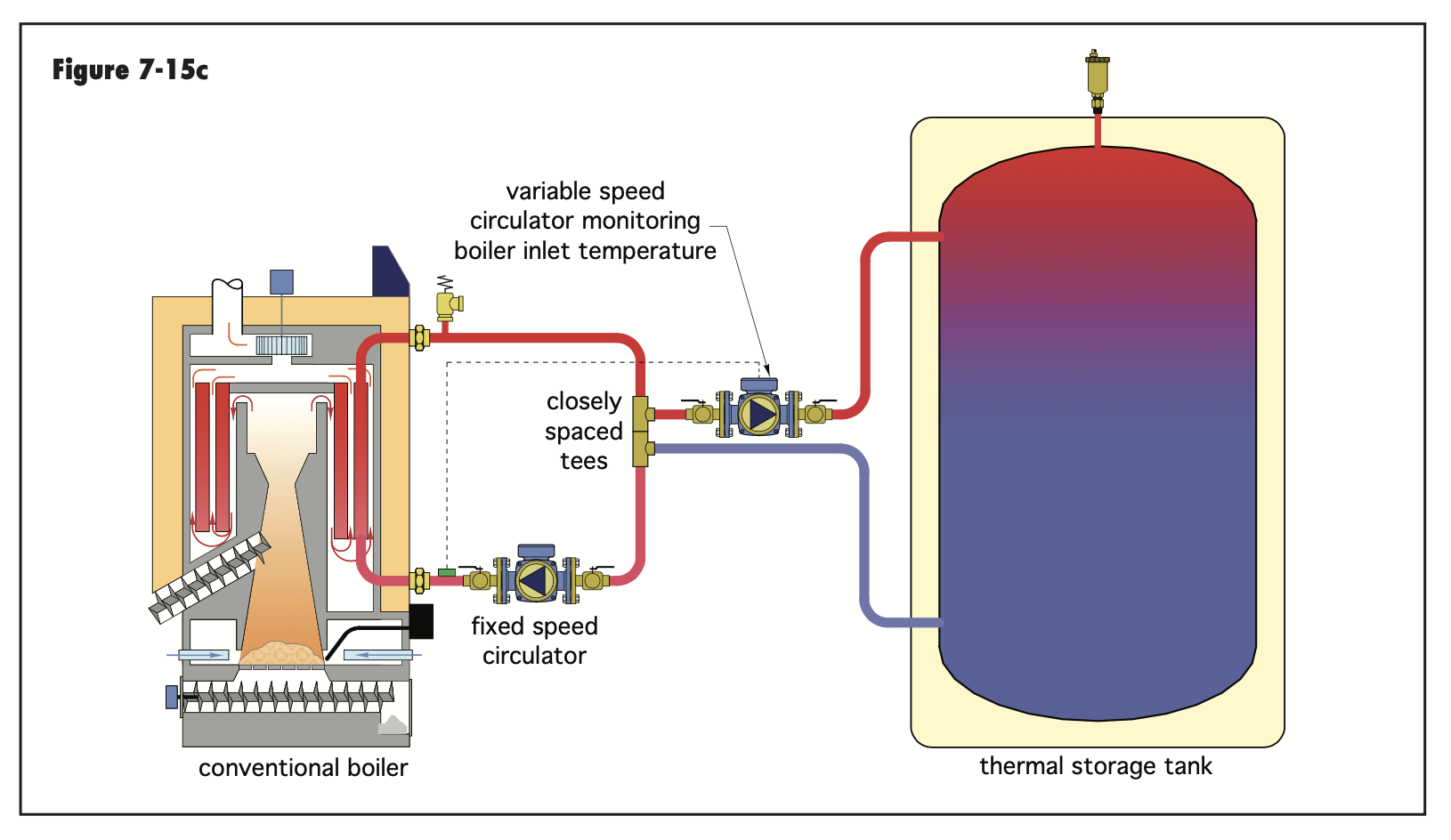
Another option is a temperature sensing variable speed circulator that blends the flows based on temperature. This requires a control and additional pump, and more involved piping. A pic below with a tank (ocean of water :) as the load as opposed to piping and radiators that you have.
There are a number of piping arrangements shown for using a variable speed circ. You want the method that has the ability to "disconnect" the boiler from the load until it catches up. fig 7-15c
There is a slight difference in the piping between the two pump temperature controlled variable speed Fig 7-15a and 7-15c, do you see that?
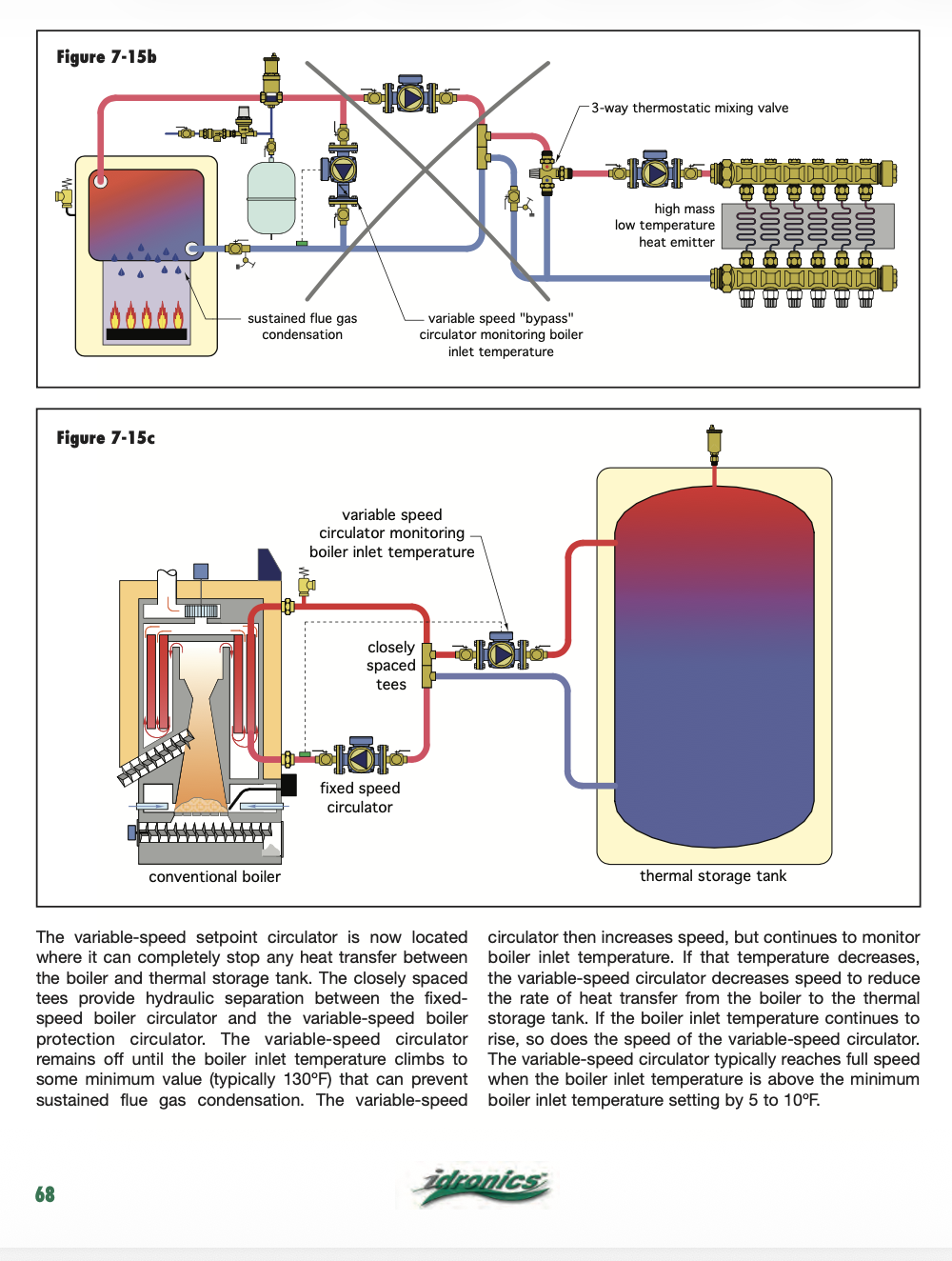
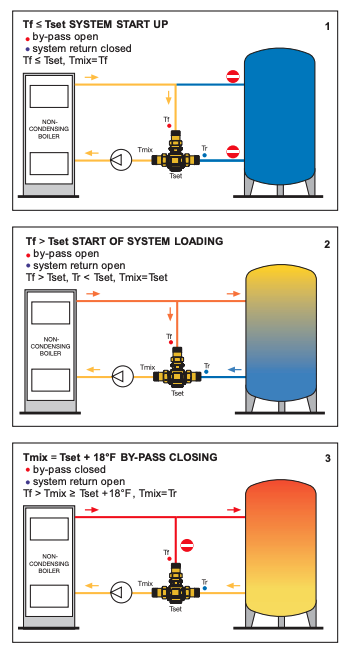
Here is a pic of how a 3 way thermostatic mix valve works. The system load is very dynamic, changing minute by minute. In sone cases the valve allows return within minutes, under a high load or massive mass system, it could take 10 minutes or much longer, every application is different.
The boiler is running steady state condition during this period, the most efficient state, other than completely off :) The pump is also running non stop circulating one or both loops, the boiler and the system.
 Bob "hot rod" Rohr
trainer for Caleffi NA
Living the hydronic dream0 -
So according to Google
How does the water content in a 3-inch iron pipe compare to other pipe sizes?
A 3-inch iron pipe has a water content of about 2.31 gallons per foot, which is higher than smaller pipes like 1-inch (0.34 gallons/ft) or 2-inch (1.36 gallons/ft) pipes but lower than larger pipes like 4-inch (5.44 gallons/ft) or 6-inch (13.6 gallons/ft) pipes. The water content increases with the pipe's diameter.
So you could walk around your basement calculating total pipe length to get a number and then probably 2 to 3 times it to account for all the water in the radiators and pipes.
But yes you have lots of water
0 -
" I'm not fond of turning a motor on off at 15 minute intervals for it's entire life, if that is what results. "
Why would it do this ? That is not what I get from the Hydrostat manual, if that is what you are referring to.
National - U.S. Gas Boiler 45+ Years Old
Steam 300 SQ. FT. - EDR 347
One Pipe System0 -
So how i read the hold circulator function is it will hold energizing the pump until broiler is 125 degrees, as the cold water is introduced back into the system and bolier temperature falls below 115 degrees it will hold again. But this looping cycle only last 15 minutes.
Which actually isn't bad, but in @HomeOwner7 case probably not long enough to keep the boiler temperature raised. But, if you are always adding in 125 water, it might have helped, however his bypass loop is AFTER the pump, so the only water you are heating is boiler tank.
0 -
TerrS:
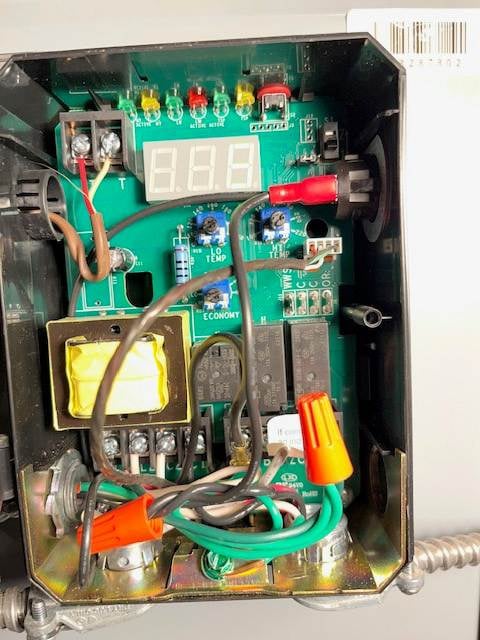
Thank you for the info. I’ve posted photos of the inner workings of the Hydrostat below.
hot_rod
Thank you for posting the detailed info. I’m anxious to read thru it. I should have time to do that over the next few days.
109A_5:
Thank you for having noticed that our Hydrostat 3250 Plus “Installation Instructions and Operating” manuals do not state the same things. This gets interesting.
The Manual you posted an image of states:
“Circulator Hold Off will expire after 15 minutes”.
But my Manual (below) omits that statement altogether.
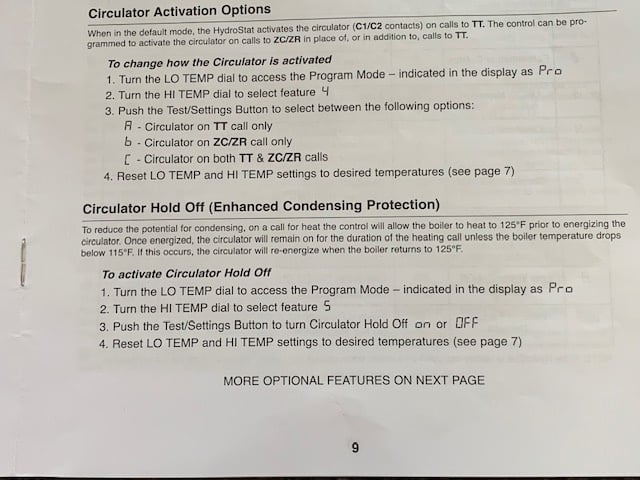
Additionally:
The Patent Numbers shown on the front cover of our Manuals also differ.
Your Manual references:
Patent No. 8,931,708, 8,844,834; 7,891,572; others pending
But my Manual (below) references:
“Patent No.7,891,572.
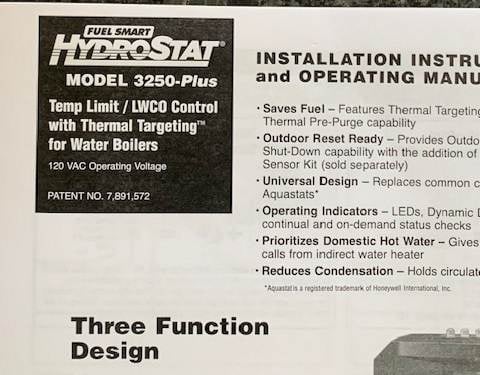
Therein lies the confusion.
I phoned HydroLevel to find out if the 3250-Plus, the model installed in the hydronic system in my cellar, does - or does not - have the 15 minute Hold Off feature.
Per the HydroLevel Tech: Yes, the model I have definitely does have that feature. He added that feature has been in place for the last 10 years.
It seems what has happened is certain features on the Hydrostat 3250 Plus were changed but the model number was not updated, remained the same.
So, I guess I have the wrong Manual. It must be outdated.
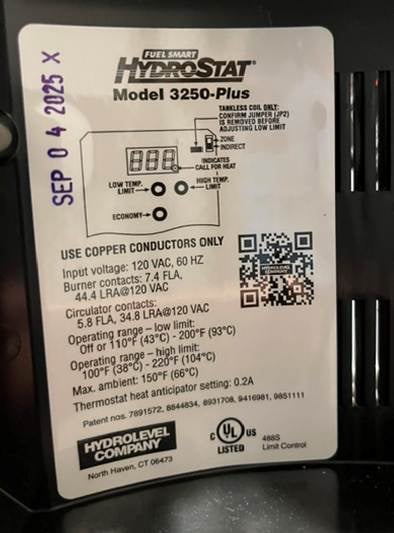
Note that the label on the Hydrostat in my cellar (see photo below, lists -five- patent numbers.
So I want to be sure I have the correct Manual. When I asked the HydroLevel Tech if the correct Manual could be emailed to me, he said I can find it on the HydroLevel website. When I asked how can I be sure I’m getting the correct Manual for the exact model Hydrostat I have, he suggested I search for the manual for the “new style” HydroStat 3250-Plus. I’m seeing only one Manual for the 3250-Plus on the HydroLevel website, so that must be the one and for sure, that Manual does state:
“Circulator Hold Off will expire after 15 minutes”.
Additional Info Regarding the Hydrostat 3250-Plus installed in the heating system in my cellar:
Label on inside door of Hydrostat in my cellar
Note: Five Patent Numbers are referenced.
Control Guts (so to speak)
With settings the installer company made.
 0
0 -
Thanks those pictures help. Except those wires in front of economy blocked what its set to? So just guessing from where its pointing maybe 4 or 5. Which isn't good in my experience. Its better to set to 1 or maybe 2.
I would definitely try the circulator hold and economy 1 or 2 and see how your boiler reacts.
0 -
Something odd having to do with posts on the forum has happened.
I typed my comment into the "Leave a Comment Window", but then it became unnecessary to post it, so I wanted to delete it, and I’ve tried about 10 times to do that, but nothing I do permanently removes it from the "Leave a Comment" window.
I made sure I had closed completely out of Heating Help website on both my home computer and iPhone after deleting the comments. My thought was maybe it's necessary to log out of the forum on both devices, not doing so may possibly embed the comment I'm trying to delete, making it impossible for me to remove it - but that didn't work either. The comments reappear every time I go back and open the forum.
So, I'm going to have to take the last resort method. I've again deleted the comments from the "Leave a Comment" window, typed this a new comment (this one) into the “Leave a Comment” window, and am posting it. Here goes.
If you see any comments after this, please disregard them.
0 -
Don't worry about it, just delete the text you don't want (or backspace) with your next actual wanted post.
Or save it as a Draft then click on your account picture (upper right)

then click Drafts, then click on

then delete the Draft.
National - U.S. Gas Boiler 45+ Years Old
Steam 300 SQ. FT. - EDR 347
One Pipe System 1
1 -
Hi. I'm still out here visiting this forum and considering options, what to do with what I've learned here.
109A-5: Thank you for posting how to remove comments that get stuck in the “Leave a Comment” window.
TerrS: The Hydrostat Economy setting that was partially hidden in the photo was set to Off. Thank you for suggesting resetting it but at this point, I’m burnt out and have no plans to try more things on my own. I’m at the point where I’m getting ready to discuss the boiler operation with the HVAC company that installed it.
I did another test - activated the Hold Off to see what effect that would have.
The results of having done that are below in Column #3 of the Table.
T est #1
Test #2
May 1
Bypass
30% Open
Hydrostat
Hold Off
Disabled/Off
May 2
Bypass
100% Open
Hydrostat
Hold Off
Disabled/Off
May 8
Bypass
100% Open
Hydrostat
Hold Off
Activated
Hydrostat Reading
Reached 130F
After Boiler Operated
This Amt of Time
1 Hr 20 Mn
1 Hr 14 Mn
1 Hr 14 Mn
Temp on Return Pipe
- Before -
Bypass Injects Hot Water
When Hydrostat
Reached 130F
104F
99F
99F
Temp on Return Pipe
' -After -
Bypass Injects Hot Water
When Hydrostat
Reached 130F
105F
105F
106F
Amt of Time System
Continued to Operate
After Hydrostat
Indicated 130F
22 Min
49 Mn
34 Mn
Hydrostat Reading
When System Turned Off
139F
149F
144F
Test #1: Opening Bypass All The Way:
As expected, this had very little effect on how fast the temperature of the water in the boiler rose to 130F.
Amt of Time It Took for Water in Boiler to Reach 130F;
--1 Hr 20 min. with Bypass 30% open
--1 Hr 14 min. with Bypass Valve 100% open
Test #2: Activating the Hydrostat Hold Off w/Bypass Valve Remaining 100% Open:
As expected, this resulted in the temp of the water in the boiler rising very rapidly to 130F…
But when the Taco 007e circulator pump kicked on, the water boiler temp. rapidly dropped to 111F.
—During the 15 minute Hold Off period:
—--The Taco 007e cycled On & Off @ 7 times .
—When 15 minute Hold Off period ended:
'——The water in the return pipe was 68F.—After 15 minute Hold Off period ended & Taco 007e Turned On:
'——Taco 007e remained On and continued circulating water w/o interruption until Thermostat stopped calling for heat'—--Water Temp in boiler per Hydrostat stabilized in @ 3 min . at 106F, then slowly increased to 149F before the boiler shut off.
'—--Return Temperature never reached 130F.
Overall effect of activating the Hold Off:
Little to no additional effect/benefit, also as expected.
I’ve deactivated the Hold Off and will be keeping it turned off.
0 -
The way I see your data the Hold off will help, however there needs to be another method to help raise the return pipe water temperature also.
National - U.S. Gas Boiler 45+ Years Old
Steam 300 SQ. FT. - EDR 347
One Pipe System0 -
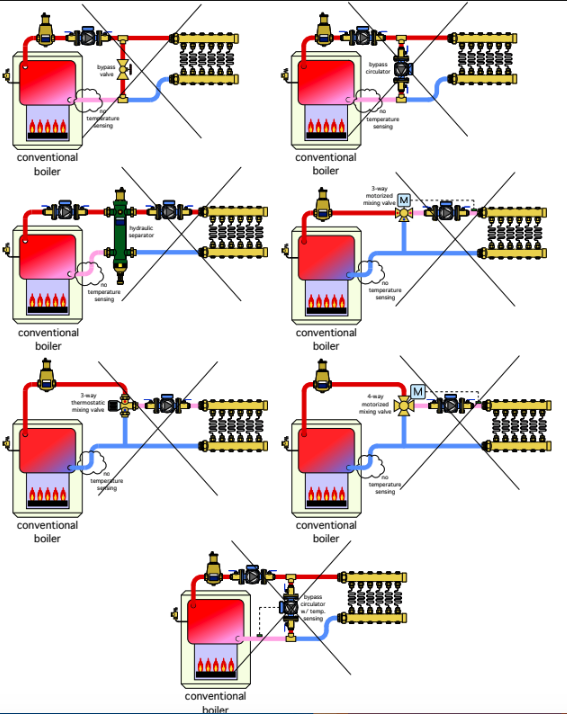
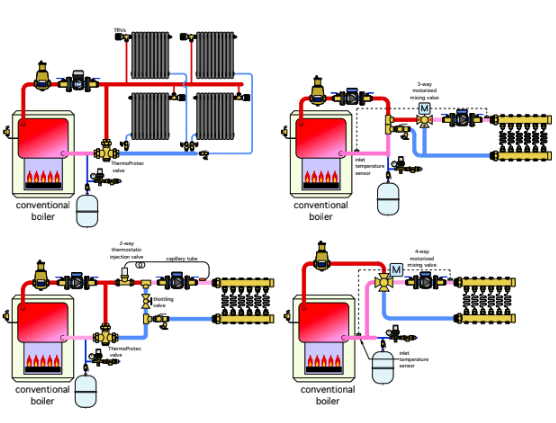
We dive deeper into this topic in the upcoming Idronics, a sneak preview.
Top slide show methods that do not protect the boiler, there is no sensing mechanism.
In the bottom 4 examples:
In each case the load gets decoupled from the heat source based on a temperature signal.
Two radiant examples you get a thermostatically controlled mix valve, for the radiant, via a second sensor protect the boiler. tekmar still offers these components, valves, actuators and controller.
Bottom left has mix down control and 3 way thermostatic (non electric) protection
 Bob "hot rod" Rohr
trainer for Caleffi NA
Living the hydronic dream0 -
Hi. I’m posting today about:
1) hot_rod: A reply regarding your posts.
2) 109A_5: A reply and questions
3) An updated table that provides additional info about how the boiler system is operating.
1) hot_rod:
Thank you for the info from the upcoming idronics issue. I’m reading through that and have some questions about that info. I’ll save those questions for another day.
I’m also responding to your comment that “Really the best, most important data is the boiler temperature at the return connection and the elapsed time”. With that in mind, I’m posting a table (farther down in this post) that focuses on return temp. The table also provides additional info about the two Heating Cycles.
2) 109A_5:
Your comment: “The way I see your data the Hold off will help, however there needs to be another method to help raise the return pipe water temperature also.” raises questions.
I’m not getting how the Hold Off will help much. Maybe the info I posted needs to be clarified so here’s a recap.
When the Hold Off is activated :
--The Hydrostat indicates 130F much more quickly - within 5 minutes of the boiler system turning on…
--But as soon as the Hydrostat registers 130F, the Taco 007e is triggered and begins circulating water though the entire system which immediately drops the water temp way down to @111F .
--The Hydrostat indicates 130F for just a fraction of a minute each time the Taco 007e turns Off.
--The On/Off cycle occurs 6 times during the 15 minute Hold Off period.
Based on that information I figure the water in the boiler is at 130F for only 6 minutes or so. (?)
Q1: Does getting water in the boiler to 130F for that short of a time provide much of a benefit to protect the boiler from condensation? Is this what makes it worthwhile to keep the Hold Off activated? Or is there some other benefit I’m missing?
Thinking about this raises another question:
Q2: Is there a consensus of how long the temperature of the water in the boiler has to remain at 130F for it to sufficiently drive off condensation in the system? Does burn off of condensation happen super-fast? Like in 6 minutes? I hope someone will jump in to discuss this.
I’m hoping some of the Techs here will jump in to provide some info about this.
3) Info Regarding Two Heating Cycles:
I never pointed out that each morning the boiler system goes through two heating cycles. Below is a new table that gives details of the cycles.
First, here is a reminder of the Thermostat Settings:
Thermostat Settings
--SLEEP Mode---------------66F 10PM-8AM
--AWAKE Mode--------------70F 8AM-10PM
--Learning Feature----------Disabled
How the System is Operating
Heat Cycle #1
--8:00 AM: AWAKE Program begins
--Thermostat calls for heat
--System turns ON
When Room Temp reaches 70F Set Point:
--Thermostat continues to call for heat
--System continues to run another 10 min.
--Thermostat stops calling for heat
--System turns OFF.
The System Rests for @ 10 minutes
--During this time Room Temp remains at 70F Set Pt
After the 10 Minutes of Rest:
--Thermostat Calls for Heat a 2nd Time
Heat Cycle #2
--System turns ON
--System continues operating @10 min .
--Thermostat stops calling for heat
--System turns OFF
After Cycle #2 Ends
The System remains OFF for hours
--Within an hour or so of the system turning OFF the Room Temp rises to 72F, sometimes 74F.
Regarding Cycle #2:
I didn’t know why the thermostat would call for heat a second time. I phoned Honeywell. They explained why it does that, it’s normal operation, so I’m all set with that. Another piece of info I had no clue of.
Here is the table.
Info for May 1, 2, 7, 8.
It provides additional info regarding both heat cycles that occur each morning when the AWAKE program kicks on.
MAY 1
Bypass 30% Open
Hold Off Disabled
MAY 2
Bypass 100% Open
Hold Off Disabled
MAY 7
Bypass 100% Open
Hold Off Activated
MAY 8
Bypass 100% Open
Hold Off Activated
Hydrostat Reading
At Start of
Cycle #1
67F
64F
64F
66F
Cycle #1 Operated This Amt of Time
1 Hr 42 Mn
2 Hr 3 min
1 Hr 19 min
1 Hr 48 min
Cycle #1 Turned OFF at This Time
9:42 AM
10:03 AM
9:19 AM
9:48 AM
Temp of Return When Cycle #1 Turned Off
114F
120F
???
I failed to log this. It may be helpful to know that
8 minutes before
Cycle #1 ended
(at 1 Hr 11 min) the Return Temp was 104F.
119F
Amt of Time System Remained OFF Between
Cycle #1
& Cycle #2
6 min.
7 min.
6 min
6 min
Cycle #2 Operated This Amt of Time
10 min.
9 min
11 min
12 min
Cycle #2 Turned OFF at This Time
9:58 AM
10:19 AM
9:36 AM
10:06 AM
Temp of Return When Cycle #2 Turned Off
115F
122F
110F
119F
To All: Your help is much appreciated.
0 -
Cycle 1 is great, over 1 hour run. Taking the home from 66- 70°?
There are various numbers out there for return temperature. For gas fired 130° is a commonly agreed number. I"ve seen 140 and even 150° suggested by some. It depends on the fuel, how the burner is adjusted., excess air, etc
But your system never gets close to the suggested return temperature.
What does the Hydrostat read when the boiler return is in that 115- 122° range?
I'm not sure why the system runs again after the thermostat satisfies and turns the boiler off. What was the explanation? It probably contributes a bit to the temperature overshoot you are seeing.
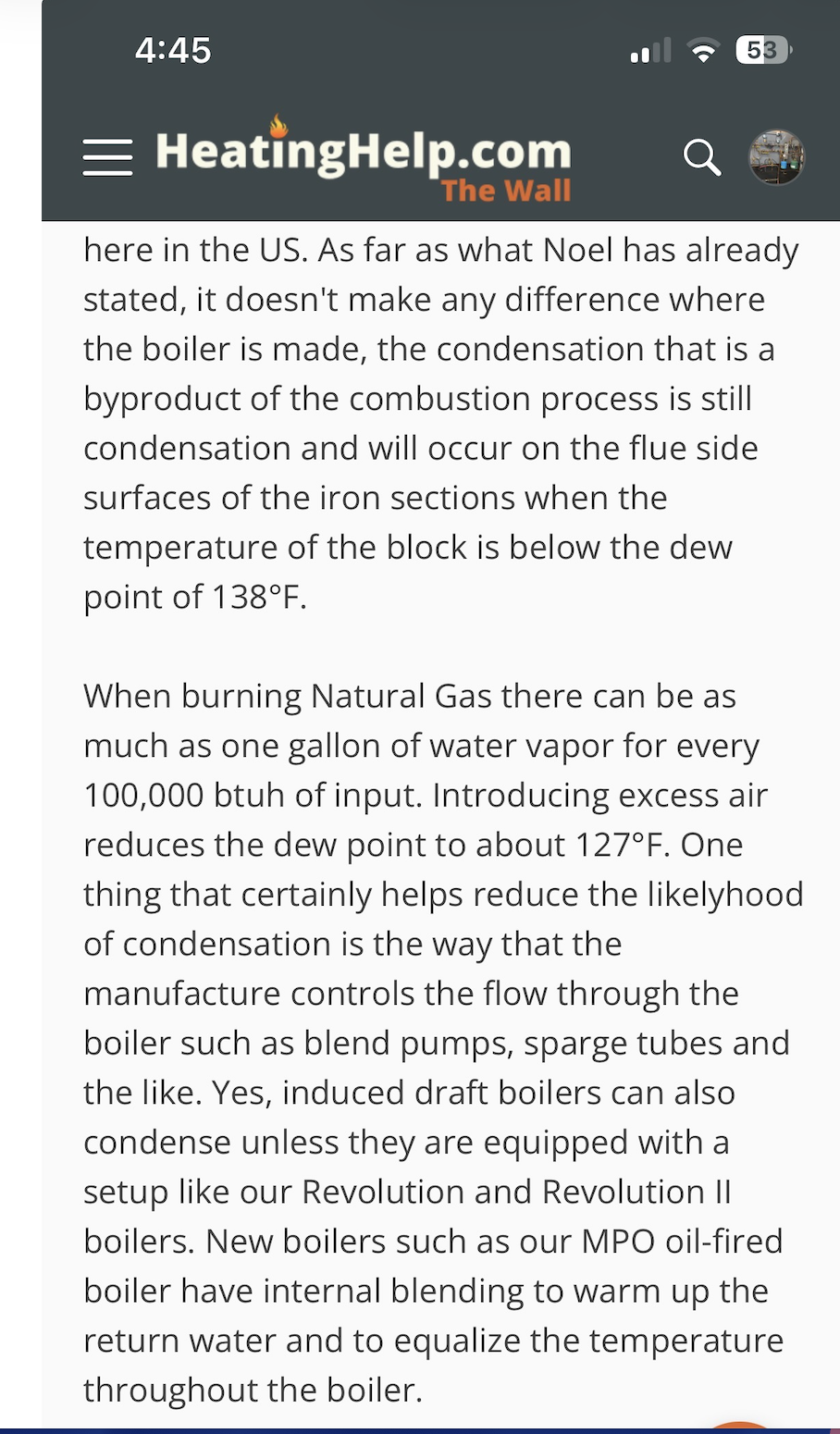
Here is a post from 2005 from a couple of the boiler manufacturers. They also talk about block temperature and some boiler designs that blend intenally.
 Bob "hot rod" Rohr
trainer for Caleffi NA
Living the hydronic dream0 -
Personally, I see no point running the circulator for no benefit. Why have the added wear and tear on the circulator (every boiler cycle) and the cost of electricity moving water that has no benefit. I'd rather spend the money on something else.
Once boiler reaches a reasonable temperature, then it is time to move water. However I also see no point of On - Off cycling the circulator either, so there needs to be a means to control the return water temperature so the boiler water temperature does not drop to the point where the Hydrostat wants to turn the calculator back off again.
Then when the water temperature stabilizes at about 130 degrees (or more if it continues to slowly rise) it is circulated throughout the rest of the system, heating the home.
I see no benefit in not using the Hold off functionality, however you do need to manage the return water temperature. The present bypass method is apparently insufficient for the job.
National - U.S. Gas Boiler 45+ Years Old
Steam 300 SQ. FT. - EDR 347
One Pipe System0 -
Constant circulation is probably the best, most efficient way to run a system. This is what all ODR controls strive to do.
A standard PSC circ is around 78W. If you upgrade to ECM, about 37W at full output. The circs last longest as you minimize the on/ off cycles.
You noted 6 on/ off cycles in a 15 minute period with hold off enabled?
With a thermostatic device, valve or VS pump, flow is always doing something! protecting the boiler, pumping the system, or a portion of both.
If it is pumping the system the closer to setpoint the tighter the ∆ which evens heat output from the first to last radiator. If the radiators are balanced then each room is receiving the amount of heat to meet the load.
If it is a single system pump, it could still turn off when the heat call satisfies.
Bob "hot rod" Rohr
trainer for Caleffi NA
Living the hydronic dream0 -
I’m back, still visiting here and wrestling with this. Thanks again for all the info. Today I’m posting a response hot-rod’s questions.
Topic #1: Hydrostat Readings
Quote by hot-rod:
“What does the hydrostat read when the boiler return is in the 115-120F range?”
hot-rod:
When the boiler return is in the 115F to 120F range the hydrostat readings range from 139F to 149F.
Topic #2: Boiler Calling for Heat a Second Time
First, here’s a reminder of what’s happening:
Every morning the thermostat calls for heat a second time after the 70F set point has been reached:
---The thermostat stops calling for heat
---Turns the boiler off
---The boiler rests @ 6 minutes
Then, while the thermostat screen indicates the temp is still at the 70F set point:
---The thermostat calls for heat a second time for @ 10 minutes , then
---Thermostat stops calling for heat, turns the boiler off.
Quote by hot-rod:
“I'm not sure why the system runs again after the thermostat satisfies and turns the boiler off. What was the explanation?”
hot-rod:
With regards to the thermostat calling for Cycle #2,
I phoned Honeywell two times about this.
---The first time I was told it’s perfectly normal.
---But the second time I called (after you posted your question, hot-rod) a different Cust Svc Rep said it may not be normal.
He offered 3 possible scenarios for why there could be a second call for heat, explained in more detail how the thermostat operates, and walked me through the installation settings to make sure the thermostat was installed correctly (it is).
Here are the 3 reasons the Rep said the second call for heat could be happening:
1-VOLTAGE:
---The voltage that operates the thermostat across the red and white terminals should be between 20 & 30 volts.
---If there is a problem with that voltage it could result in the thermostat calling for a second cycle.
---Fluctuations in voltage could create a call for heat that is not needed.
2-LOAD CAPACITY FOR THE BOILER
---As soon as the boiler turns off the room starts to lose heat which can result in a second call for heat which is normal.
---The Rep, however, had been under the impression the second calls for heat were occurring randomly.
---When I told him this happens every morning the Rep was unsure, he had been thinking the second cycle was acting in a more random way.
3-BOILER SYSTEM ITSELF
---Something having to do with the boiler itself could possibly be making this happen.
---The Rep does not know our Weil-McLain boiler system.
The Honeywell Rep suggested I talk to my installer about these things.
So now I know the thermostat is installed correctly, but I don’t know if the thermostat is operating correctly, The thermostat itself could possibly be faulty.
An additional note, some more fun facts to add to my brain which is already on overload: The first Honeywell Rep I talked to told me the thermostat measures temperature in the background in 10ths of a degree, but the screen displays temperature in whole numbers. IOW the thermostat can be reading the temp for instance at 69.8F in the background while the thermostat screen is displaying 70F.
I wish there was a way to state all this info in a sound bite.
0 -
you could buy an inexpensive heat only thermostat and see if it causes the rouge second cycle, that would rule out the boiler control being the problem.
Do as you readings show the temperature where the aquastat is reading is warm enough to prevent condensation in the boiler, but the return is too low
Seems like a grey area in the boiler manufacturers recommendation, do they want the boiler temperature or the return temperature above 130
If the boiler is blending internally, the maybe the low return is not as much a concern?
Up to you to decide if their info is ok by youSame with that thermostat from my experience the thermostat should be off at setpoint
What you do want to eliminate as much as possible is the short cold cycling
Bob "hot rod" Rohr
trainer for Caleffi NA
Living the hydronic dream0 -
I'm thinking your additional short cycle after a recovery from a set back cycle may be caused by multiple issues.
- Poor software emulation of the 'Heat Anticipator' functionality. Old mercury switch type thermostats worked much better in my opinion.
- Air currents in the room the thermostat is in.
- The heated area around the thermostat is not yet heat soaked. So there is more of a temperature roller-coaster ride that the thermostat is reacting to, until a more steady state temperature is achieved.
This additional short cycle after a recovery from a set back cycle is also probably contributing to the room temperature overshoot you confirmed earlier in the thread.
National - U.S. Gas Boiler 45+ Years Old
Steam 300 SQ. FT. - EDR 347
One Pipe System0 -
I’m responding to comments by hot_rod and 109A_5 today and have a question about valves. Sorry about the lag time between members comments posted and my responses. Finding the time to type out a response isn't always easy.
Quote by hot_rod:
“you could buy an inexpensive heat only thermostat and see if it causes the rogue second cycle, that would rule out the boiler control being the problem.
Do as you readings show the temperature where the aquastat is reading is warm enough to prevent condensation in the boiler, but the return is too low
Seems like a grey area in the boiler manufacturers recommendation, do they want the boiler temperature or the return temperature above 130
If the boiler is blending internally, the maybe the low return is not as much a concern?Up to you to decide if their info is ok by you
Same with that thermostat from my experience the thermostat should be off at setpoint
What you do want to eliminate as much as possible is the short cold cycling”
hot_rod:
Here’s some additional info.
During the 4 Test Days
Return
at 115F
to 120F Range
Hydrostat at 130F
Hydrostat at 140F
Amount of time it takes
for this to occur
1 Hr 36 min
to
1 Hr 42 min
1 Hr 14 min
To
1 Hr 20 min
1 Hr 36 min
To
1 Hr 42 min
DETAIL OF THE ABOVE INFO
Amt if Time
it takes for
Return
to get to
115F to 120F Range
Amt of Time
it takes for Hydrostat
to reach 130F
Amt of Time
it takes for Hydrostat
to reach 140F
May 1
1 Hr 42 min
1 Hr 20 min
1 Hr 42 min
May 2
1 Hr 37 min
1 Hr 14 min
1 Hr 37 min
May 7
1 Hr 36 min
1 Hr 11 min
1 Hr 36 min
May 8
1 Hr 37 min
1 Hr 14 min
1 Hr 37 min
With regard to the manufacturer’s recommendations for water temperature, Page 21 appears to be the applicable page for my converted gravity system.
Per Page 21 of the Weil-McLain Boiler Manual, Figures 15 + 16:
“Piping for systems requiring temperatures below 140F
“In most systems, this type of piping is not required. If system water temperature requirements are less than 140F, such as radiant panels or converted gravity systems, use piping as shown in Figure 15 or Figure 16.”
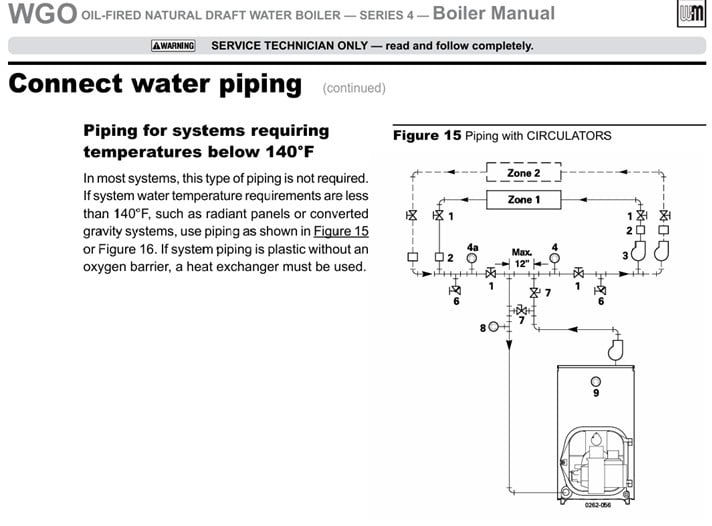
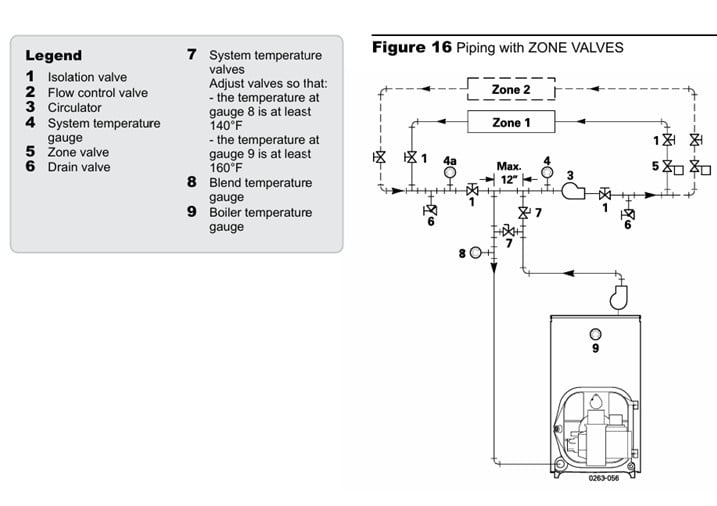
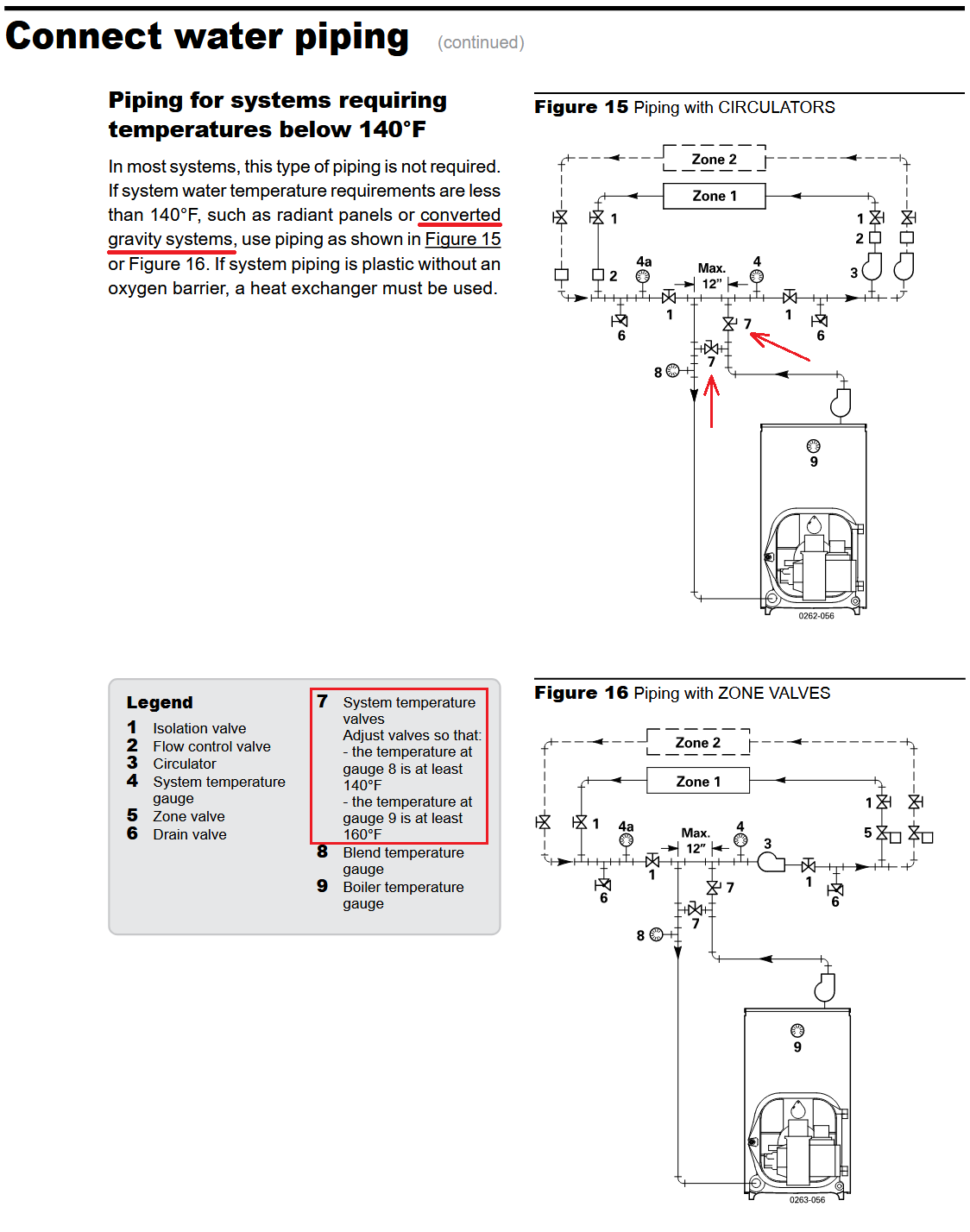
Per Pg 21 of the Weil-McLain Manual - Temperature Gauges 4, 4a & 8:
Figures 15 and 16 show Gauges 4, 4a and 8 are part of the boiler piping, separate from the Hydrostat.
The Manual states:
“System Temperature Valves:
Adjust valves so that the temperature at Gauge 8 is at least 140F”
“System Temperature Valves:
Adjust valves so that the temperature at Gauge 9 is at least 160F”
Note: Gauge 9 is the round gauge that measures PSI and temperature that is located on the front of the boiler. It is not the Hydrostat.
I realize industry professionals have seen this kind of stuff a thousand times and don’t need the added info. I’m including it to help get things straight in my own head.
Where I’m At With This:
The Second Cycle Occurring After Set Pt is Reached:
Is not a big deal for me.
I’m OK with this.
Taking over an hour for the Hydrostat to reach 130F.
This is my concern.
Quote by 109A_5
“I'm thinking your additional short cycle after a recovery from a set back cycle may be caused by multiple issues.
- Poor software emulation of the 'Heat Anticipator' functionality. Old mercury switch type thermostats worked much better in my opinion.
- Air currents in the room the thermostat is in.
- The heated area around the thermostat is not yet heat soaked. So there is more of a temperature roller-coaster ride that the thermostat is reacting to, until a more steady state temperature is achieved.
This additional short cycle after a recovery from a set back cycle is also probably contributing to the room temperature overshoot you confirmed earlier in the thread.”
109A_5:
When the new boiler system was first installed, the old thermostat, a Honeywell MagicStat CT3200, was left in place. It had been installed many years ago.
With the old thermostat in place, the new system would turn back and short cycle about 5 times after the set point was reached. The HVAC Tech said the short cycling was probably being caused by the old thermostat, so it was replaced with the new one. Now, with the new thermostat, there is one additional cycle that occurs after the Set Pt is reached.
The fact that additional heating cycle(s) occurred with both the old and new thermostats, seems to me to indicate that more than one thing may be going on. For example, if random drafts are a problem, perhaps the old thermostat was more sensitive to those fluctuations resulting in five on/off cycles as opposed to one on/off cycle. In any case, as mentioned above, the current situation with the boiler turning on one more time after set point is reached is not a concern.
Both the old and new thermostats, by the way, were digital, had no mercury according to the info I found on the internet.
I have a question about the valves W-M is talking about adjusting to control the temperature:
Q: It looks like those valves perform the same function as Ed’s mixing valve that automatically reacts to temperature, but W-M seems to be adjusting the temperature with manual valves. Is this correct?
0 -
Well… Good find !!! You read the manual better than the installer did. You might say it is installed wrong, not per the manual for the type of heating system the house has. As you can see it requires more parts even if it is a single zone. Yes those valves are manual. Manual versus automatic, both ways have their Pros and Cons. Often manuals show the minimum requirements, not the most exotic / expensive enhancements.
As far as the thermostat thing, the fact that two relatively modern electronic / digital Honeywell thermostats behave the same does not surprise me much. It would also not surprise me much if the temperature sensing software algorithm embedded in each is the same or very similar.
 National - U.S. Gas Boiler 45+ Years Old
Steam 300 SQ. FT. - EDR 347
One Pipe System0 -
The issue with this recommendation is they do not supply enough info.
When do you adjust the valves to get that 140° at gauge 8.
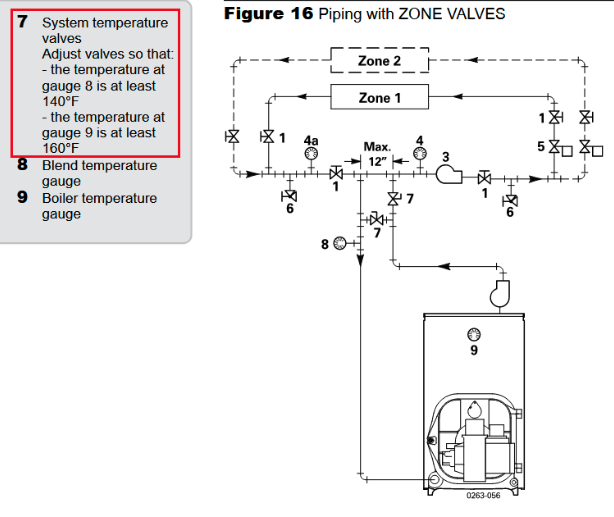
At cold start? When boiler reaches set point? What if the boiler doesn't reach setpoint before the heat call ends?
Too much bypass the load takes too long to get covered. Not enough bypass you never reach 140°
Whatever condition you set that valve at, will be wrong for most other condition.
Hence the name "dumb valve"
Adding a simple thermostatic response mechanism, turns a dumb valve into an intelligent valve. Well worth the small cost over the expected life expectancy of the boiler.
Primary secondary piping alone does nothing to protect the boiler without a thermostatic function. An more than likely it blends down the SWT that is required.
Bob "hot rod" Rohr
trainer for Caleffi NA
Living the hydronic dream0 -
Hi, Again.
I still have a few questions. One big one today to ask about.
But first, I’d like to thank everyone for your help and apologize for the delays before I reply. Too many things are “hitting the fan” at the same time that I have to deal with - the boiler issue is only one of them.
I will follow up with my install company about the issue with the boiler install. It will be a while before I do that, however. I intend to post back here to let everyone know how things work out.
In the meantime, here’s the question - it’s been hanging on my mind.
Q: The heating season is over. Is there anything I can do to ensure the boiler is as free of condensation as possible while it is not running, to remove as much condensation as possible so it doesn’t sit in the system during the entire summer non-heat season?
This discussion is many pages worth of reading. I wonder how many are following this discussion, if most have tuned out. The question I'm asking is relevant to this discussion but also stands on its own. I therefore wonder if it'd be a good idea to start a new post to ask this question but don't know if that fits the protocol here. If anyone thinks that's a good idea and is an OK thing to do, let me know and I'll do that.
0 -
If it is an a very humid location, a dehumidifier may be wise. Keeping the pilot on helps keep them dry aldo. It really depends on the location conditions, humidity, etc.
I doubt it would get enough rust over the summer to create a problem.
Bob "hot rod" Rohr
trainer for Caleffi NA
Living the hydronic dream0 -
hot_rod:
It's good to know there won't be much rust created over the summer. This is an oil system, so there's no pilot to keep on.
Is the idea that humidity levels of the air inside the boiler system will equilibrate to the humidity level of the air outside of the boiler system?
0 -
Unless you remove humidity either by moving some air around with a dehumidifier, yes it will balance.
Mother nature hates an imbalance of any sort, temperature, pressure, oxygen levels, moisture levels. Given enough time she will balance any mismatch.
Turn your heat off and eventually the house will reach the aimbient temperature surrounding it, for a simple example.
It comes doen to moisture levels you want to get to. Running a dehumidifier costs some $$ depending on the capacity.
Bob "hot rod" Rohr
trainer for Caleffi NA
Living the hydronic dream0 -
Hi, Again.
It’s been a while since I posted.
As a reminder, this discussion is about the recent replacement of the oil-fired, hot water boiler servicing a legacy gravity heating system in my 1917 era house. Legacy piping and cast-iron radiators remain in place. The system fails to heat the return water to the temperature required to mitigate condensation.
Forum members have generously offered solutions. I appreciate all the hard work that went into posting the diagrams, drawings, recommendations, and comments.
Over the past weeks I’ve collected the recommendations presented here and studied them.
The solutions offered here in this discussion include:
1 multiple circulators,
2 circulator and mixing valve combination.
For my situation, #2, the circulator and mixing valve combination, seems to be the easiest and best, so that’s what I’m going to shoot for.
Before I contact local professionals for an independent evaluation of the install and the contractor who installed the system, I have a few final questions about some conflicting information about where the circulator should be located.
The question seems to me to be of general interest. I’ve therefore started a new post and cross-referenced both posts. The link to that discussion is below.
I’d like to get going with the next steps. This has been weighing on my mind for too long.
Thanks, everyone, for your help.
0 -
I see you have another post. Stick with that one.
0 -
they are the op from 3 months ago. i didn't read the 3 pages, but i assume somewhere in there is mentions this is a gravity conversion where the contractor installing the boiler failed to add some sort of return water temp protection scheme.
0 -
I think the solution @EdTheHeaterMan and @hot_rod gave are your best options. Add the mixing valve to control how much of that cold return water is coming back at a time and possibly put a boiler loop with a circulator as to keep the boiler water at temp and find someone to install everything. The picture from May 5 from i think Hot_rod had what it should look like or close to it.
0




Categories
- All Categories
- 87.8K THE MAIN WALL
- 3.3K A-C, Heat Pumps & Refrigeration
- 60 Biomass
- 430 Carbon Monoxide Awareness
- 133 Chimneys & Flues
- 2.2K Domestic Hot Water
- 6K Gas Heating
- 124 Geothermal
- 170 Indoor-Air Quality
- 3.9K Oil Heating
- 79 Pipe Deterioration
- 1.1K Plumbing
- 6.7K Radiant Heating
- 397 Solar
- 16.1K Strictly Steam
- 3.5K Thermostats and Controls
- 56 Water Quality
- 51 Industry Classes
- 51 Job Opportunities
- 18 Recall Announcements