Water Temp When Hydronic System Is Not Running
Comments
-
109A_5: Thank you for explaining what the Hydrostat measures and posting the diagrams. I get it now.
Quote by Phil_17:
The strategy you are proposing here is exactly what the original gravity system would have done all by itself with no fancy controls, circulators, valves or anything else.
Our attempts to “modernize” things often leave us with really complicated systems that are less reliable and more difficult to maintain, but I am enjoying this discussion.
Phil: And when it was running you couldn’t tell. it was completely quiet.
Quote by 109A_5 regarding old gravity systems:
“…I think circulating the water would provide a more even heat than gravity flow. And I bet the old boiler had to get a lot hotter to heat the house. And may have taken a lot longer to recover from an overnight setback.
109A_5: That’s food for thought.
Quote by hot_rod
“The best information is gained by observing the boiler operate. Set up a chair and record data there.”
hot_rod: Yep. Don't I know it. I set a wood occasional chair in front of the boiler days ago. Last time I was recording what was going on, I sat in that chair over 2 hours. I’ll be doing this again before too long.
Quote from hot_rod:
When you fire up the zones, how long does it take for the return, right at the boiler, to reach 130°? Ideally every time the boiler fires it should reach 130 within 10 minutes or so. If you can do this on a cold day you get a realistic pic of design day operation. Record data on a mild heating day also to notice the run time difference.
hot_rod/Everyone:
I want to get that information, decent and more complete data. For that, I figure I need those wrap-on thermometer gauges I ordered. I wound up buying three of them, so I’ll have one to wrap onto the supply pipe, one for the bypass pipe, and one for the return pipe.
Once the temp gauges arrive, I’ll be spending hugely enjoyable hours sitting in my cellar on a wooden chair in the early AM hours with spiders, centipedes and who knows what else scribbling away with pen on paper, recording what’s happening temperature-wise with the boiler system. And using my cell phone to record the time things are happening.
Quote by TerrS:
“We really need to see pictures of his boiler setup i need to see his return and supply lines. Because with those pipe sizes he is boiling 2 oceans of water to 180 degrees.”
TerriS/Everyone:
Part of the reason I haven’t posted photos yet is I haven’t been able to find instructions anywhere on this forum how to do so. I've searched here at least 4 or 5 times, come up with nada. I've also searched more than a few time - a general internet search for info. I did find a discussion on how to post photos here on HeatingHelp, but it’s super old - from 2003. That’s so long ago the info could be outdated. And what's being said on that post seems kinda cryptic.
So how do we post photos here on HeatingHelp? Is it as easy as clicking on the paperclip icon at the bottom of the “Leave a Comment” window? Duh.
If there are instructions on this website, how do I find them? What do I need to click on to get to them?
0 -
Used and controlled properly those large pipes and large water volume can be a nice feature. You have a large thermal storage inside the building. Heat loss from any uninsulated piping is just more radiation
With some number crunching you may determine the system could operate at much lower than 180f for much of the year, which increases the boiler efficiency and lessen temperature swings and thermal lag or over shoot. A heat load calc and heat emitter assessment.
A pumped system is predictable 500 X flow X delta T is the math for the heat calc. With a circulator you can modify gpm and delta T in the formula
Some system owners spend thousands of dollars trying to add a thermal flywheel to there hydronics
Bob "hot rod" Rohr
trainer for Caleffi NA
Living the hydronic dream0 -
When I post pictures I just use Copy and Paste, probably posted hundreds so far. I use a computer, doing it from a phone may be different.
Copy and Paste makes them immediately viewable in the post, not a file name that you (or others) have to click on to view. Try it, experiment, you can always write "Oops it did not work" in the post.
Pictures often help a lot !!!
National - U.S. Gas Boiler 45+ Years Old
Steam 300 SQ. FT. - EDR 347
One Pipe System0 -
So in the leave a comment box, you should see 5 graphics, paper clip and the 2nd icon is attach picture. Click on that
1 -
@HomeOwner7, I'm sorry for the confusion about how to post images. Here is the forum user manual:
And here's how to post images and attachments to discussions:

Forum Moderator
0 -
Quote from hot_rod
“Used and controlled properly those large pipes and large water volume can be a nice feature. You have a large thermal storage inside the building. Heat loss from any uninsulated piping is just more radiation
With some number crunching you may determine the system could operate at much lower than 180f for much of the year, which increases the boiler efficiency and lessen temperature swings and thermal lag or over shoot. A heat load calc and heat emitter assessment.
A pumped system is predictable 500 X flow X delta T is the math for the heat calc. With a circulator you can modify gpm and delta T in the formula
Some system owners spend thousands of dollars trying to add a thermal flywheel to there hydronics.”
hot_rod:
I hope to get the water to a higher temp in a shorter amount of time but spending thousands of dollars trying to accomplish this aint in the cards.
109A_5, TerrS, HeatingHelp Moderator:
Thank you for letting me know how to post photos to the Forum.
hot_rod:
Your “Hiding in plain sight” comment: LOL
I did actually find that webpage with the instructions a while ago, but somehow failed to notice what I was searching for was there all along.
I should have time to post the photos tomorrow.
Two different ways to post pictures have been suggested:
Method 1) Use copy & paste.
Method 2) Use the image icon.
I feel it’s important for viewers to be able to zoom in and out.
Do these methods allow that?
0 -
"I feel it’s important for viewers to be able to zoom in and out.
Do these methods allow that?"
I think that depends on the image type and how the viewer is viewing it.
National - U.S. Gas Boiler 45+ Years Old
Steam 300 SQ. FT. - EDR 347
One Pipe System0 -
I feel it’s important for viewers to be able to zoom in and out.
Do these methods allow that?
For the most part that answer is YES
Edward Young Retired
After you make that expensive repair and you still have the same problem, What will you check next?
0 -
Or the viewer screen grabs your pic and thenb they can manipulate it.
Bob "hot rod" Rohr
trainer for Caleffi NA
Living the hydronic dream0 -
If anyone knows how to cram more hours into a 24 hour day, please let me know. I spent 2 hours this morning sitting in the cellar in that chair I mentioned in an earlier post recording how the boiler is operating, so I don’t have time to post photos today, have to put that off until tomorrow. What I will post today are the results of how the boiler operated this morning.
One good thing is I disabled the “learning” feature on the thermostat a day or two ago, so it was off before recording operation this morning. So, I only had to go into the cellar just before 8AM when the AWAKE program starts. Before that the “learning” feature was kicking the boiler on way before 8 AM which meant I had to be down in the cellar to track what was going on before 4:30 AM - that’s waaaaaaaay too early to be getting up, at least for me.
First is a more detailed account of how the boiler ran this morning. After that is a Summary.
THE NITTY GRITTY DETAILS:
Thermostat Programs:
Awake-------8:00 am - 10:00 pm
Sleep--------10:00 pm - 8:00 am
Disabled----The “Learning” Feature
1ST RUN:
8:00 AM: Boiler T/ON
-------------Hydrostat: 82F*
-------------PSI: 11
-------------Outdoor Temp 48F
*Regarding Colder Water Temps At Start-Up: This morning outdoor temps were hovering around 48F. On earlier occasions, when I was logging how the system operates, it was colder outside overnight, in the 30Fs and the water temps when the boiler first began attempting to raise the room temp to the Set point of 70F were also lower. The lowest boiler water temp I saw on the Hydrostat was 64F.
8:53 AM: System Still Running
-------------Hydrostat: 120F
-------------PSI: 17
-------------It took 53 minutes to reach 120F
9:25 AM: System Still Running
-------------Set Point/Room Temp 70F has been reached.
Note: Room temp actually rose to 70F some time before 9:25 AM. I’m not sure how much earlier. I just know for sure that at 9:30 AM the Room Temp definitely was 70F. -Edit: Correction: I should have said: "I just know for sure that at —-9:25 AM—-the Room Temp definitely was 70F.
9:36 AM: System Still Running.
-------------Hydrostat: 140F
-------------PSI: 22
-------------It took 1 Hr 36 minutes to reach 140F.
9:42 AM: System T/OFF
-------------Hydrostat: 143F
-------------PSI: ?
-------------Not Known. I missed logging PSI at 9:42 AM.
9:42 AM - 9:49 AM: System Is OFF
--------------Hydrostat Readings rose from 143F - 160F
After remaining OFF for 7 minutes:
System Turned ON again.
2ND RUN:
9:49 AM: System T/ON & stayed on 10 min. before T/OFF.
--9:49 AM - 9:50 AM:
----Water Temp dropped during 1st min of operation:
----From 160F to 139F.
--9:50 AM - 9:52 AM:
----Water temps hovered 137F - 139F
--9:53 AM:
----Water Temp rose a 2nd time to 140F
----Water Temp continued to rise
--9:58 AM:
----Water Temp: 143F initially
----Dropped to 142F within seconds
--9:59 AM: TURNED OFF
----Remained off for hours
----Hydrostat: 144F
SUMMARY
How System operated Wed, April 29.
System had been OFF for extended amount of time. I’m not sure exactly what time it had last turned off.
--1st Run:
------8:00 AM: Turned ON
------9:42 AM: Turned OFF
------Operation Time: 1 Hr 42 Mn.
System remained off 7 minutes.
--2nd Run:
------9:49 AM: Turned ON again
------9:59 AM: Turned OFF
------Operation Time: 10 min.
After Set Point and target Room Temp of 70F had been reached:
The system continued operating 17 more minutes.
Should this be happening?
Time It Took Water in Boiler to Reach 120F:
--53 minutes
--Reached 120F at 8:53 AM
Time It Took Water in Boiler to First Reach 140F:
--1 Hr 36 minutes
--Reached 140F at 9:36 AM
Boiler Operated 43 minutes while water temperature rose from 120F to 140F.
Boiler Operated 6 minutes while water temperature rose from 140F - 143F.
9:53 AM -9:59 AM.
Then the Boiler T/OFF and remained off for hours.
END.
TMI?
If so, please let me know.
Once I get those 3 thermometer gauges, I’ll watch how the system is operating again and be able to provide temp readings from the supply, return, and bypass pipes.
0 -
What you are describing is not abnormal. We still need to see those pictures of supply and returns. You have 148k btu but still trying to heat an ocean of water. Not that I am an expert but I would bet that the gravity feed system performed better, because the water moved more slowly.
I didn't see you mention how many cast iron radiators do you have in the house? And how many floors in that 2300sqft?
0 -
Well for the time spent I don't know if anything new and/or significant was learned. IMO it takes too long for the boiler's temperature to rise.
From 9:25 AM: System Still Running
-------------Set Point/Room Temp 70F has been reached.
to 9:42 AM: System T/OFF
Maybe just a characteristic of that thermostat. Or it is configured wrong.
How much room temperature overshoot was there ?
National - U.S. Gas Boiler 45+ Years Old
Steam 300 SQ. FT. - EDR 347
One Pipe System0 -
Sorry just realized something I forgot. On page 7 of the hydrostat manual, what is your settings for economizar? Set it to a 1 otherwise your boiler will only raise the boiler water temperature by 10 degrees every 30 minutes. I had to call tech support 3 times to get my settings correct. Ohh and what is the max water temp you allow? Mine is 185F, your boiler setpoint starts at 140F i think it is but will take 2hrs at economy 3-4 setting.
0 -
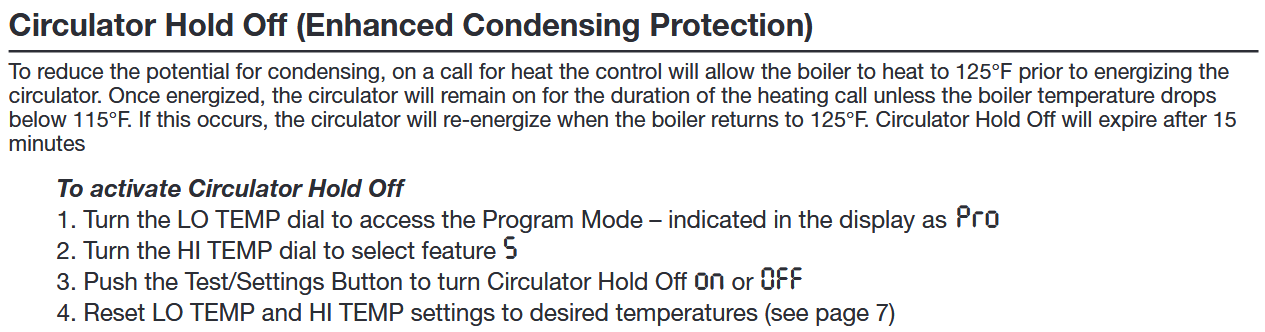
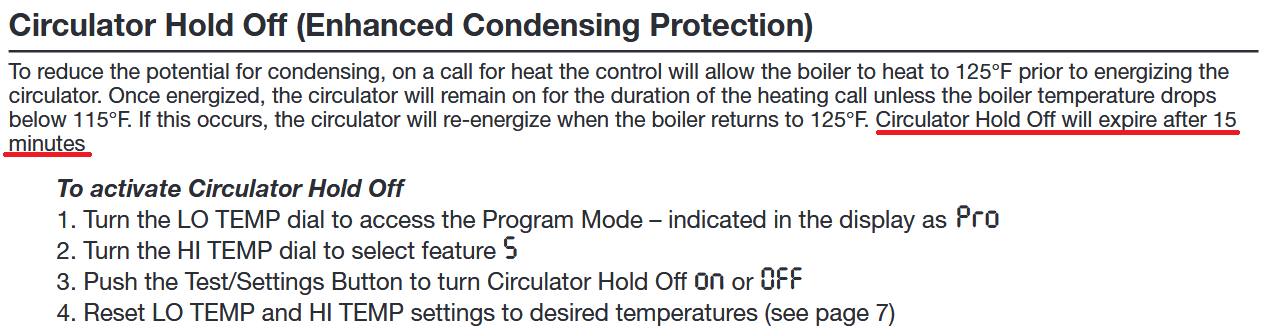
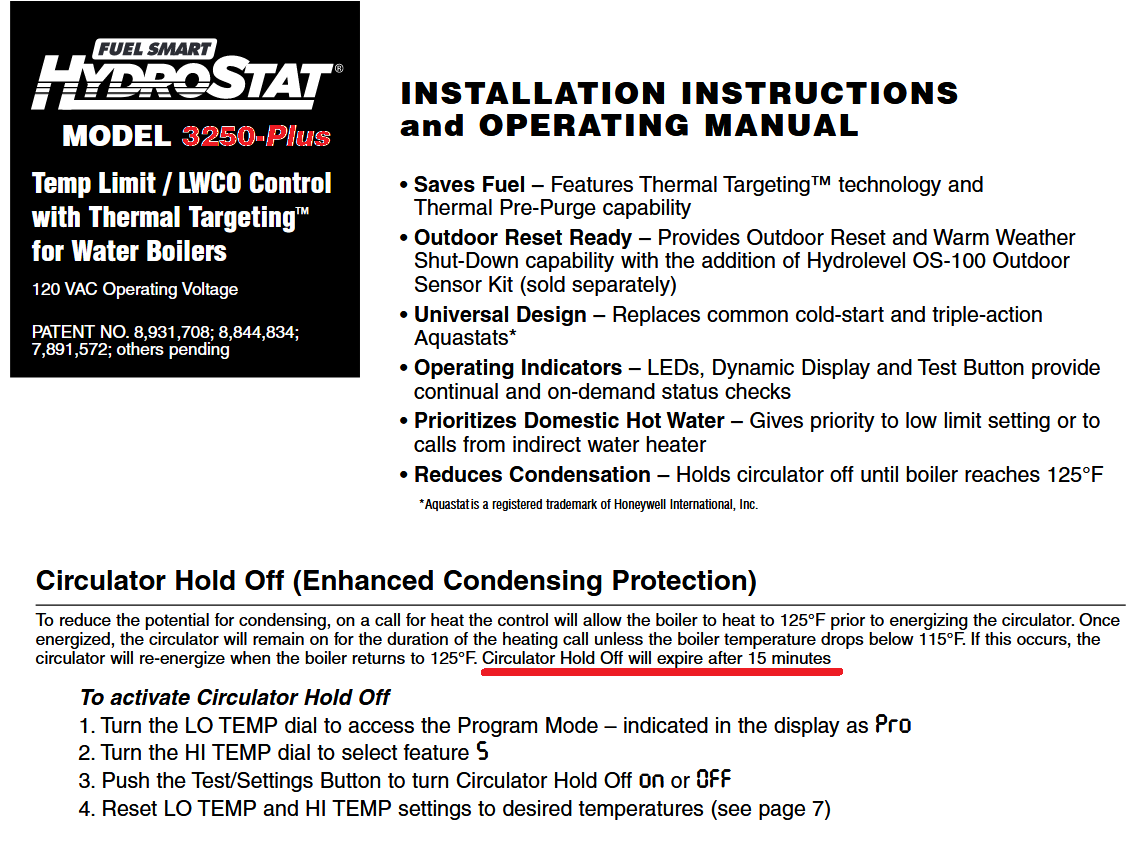
Also make sure thermal purge option is set to use the residual heat in the system before the boiler fires again. Also page 9 make sure circulator hold off as I read it the boiler should be at 125 degrees before the circulator starts. I would assume your pictures show maybe a bypass loop to just flow thru the boiler loop. Then at 125degrees the pump turns on.
When you where sitting there did the pump energize when the boiler fired or when the temp hit 125?
Watch the display on the hydrostat it tells you alot.
0 -
So an hour and 42 minutes to reach the 160 setpoint on a less than design condition or 43 outdoor?
It would be good to know when the return reached 130 or so
Regardless, that is not a healthy operating condition for a conventional non condensing boiler.
Maybe some tweaks in the Hydrostat can help lessen that time.
But I think you already know that a better boiler protection is needed
Bob "hot rod" Rohr
trainer for Caleffi NA
Living the hydronic dream1 -
Hi, Everyone:
I’m going to post the photos today, but first will respond to questions posted yesterday.
TerrS: In answer to your questions: My house is 2 floors. We have 11 cast iron radiators. I don’t know what the settings are on the Hydrostat, the HVAC Tech set those. Regarding max water temp allowed, the HVAC Tech said during one of his visits he’d lower the high temp from 187F to 180F. Maybe that answers your question. Lastly, the Taco 007e turns on when the wall thermostat commands it to do so.
109A_5: If by “room temperature overshoot” you mean how much the final room temperature exceeded the Set Point, it overshot the Set Point by 4 degrees. Although the Set Pt was 70F, after the boiler turned off, the room temp eventually rose to 74F.
hot_rod: After the boiler kicked on at 8AM, the Hydrostat indicated 130F at 1 Hr 12 min and 140F at 1 Hr 36 min during which time outdoor temps were around 48F. I’ll be able to take readings off the return pipe once the temp gauges I ordered arrive.
Now I’m going to post the photos, in a separate post.
0 -
So my hvac guy knew absolutely nothing about my hydrostat setup. It took me 3 phone calls with tech support to get everything set right.
Look at your 3250 and look for the economy know and tell us what it's set to? Also does your pump turn on as soon as your boiler fires?
0 -
Here are the photos, finally.
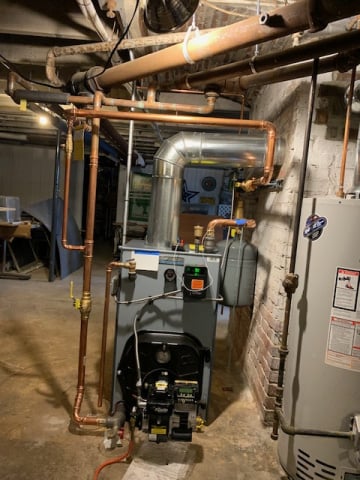
1A-Front of Boiler
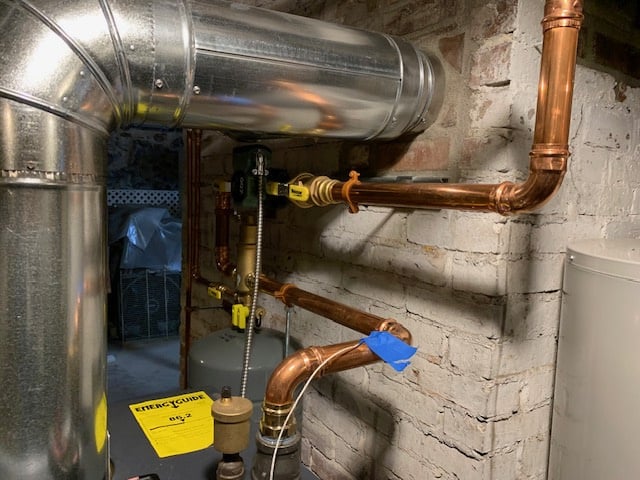
1B-Boiler Front-Close-Up Angle
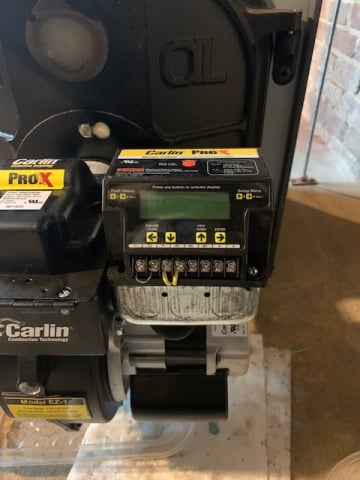
1C-Carlin ProX-CloseUp
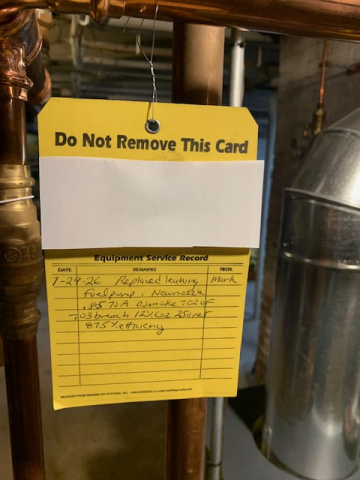
1D-Tag
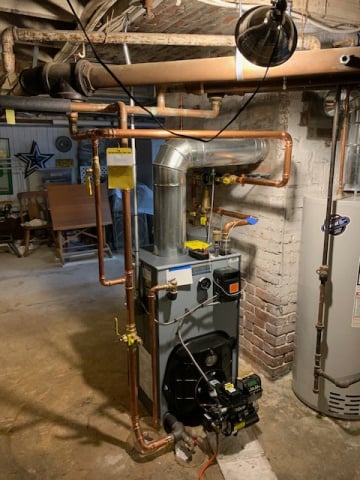
2-Boiler-Front- Side Angle
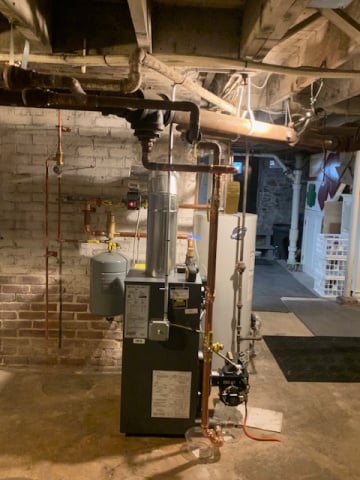
3A-Boiler - Left Side
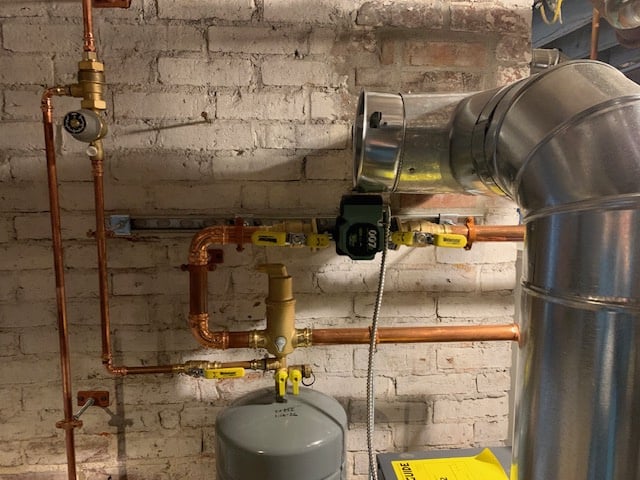
3B-System CloseUp-Taco 007e Straight On View
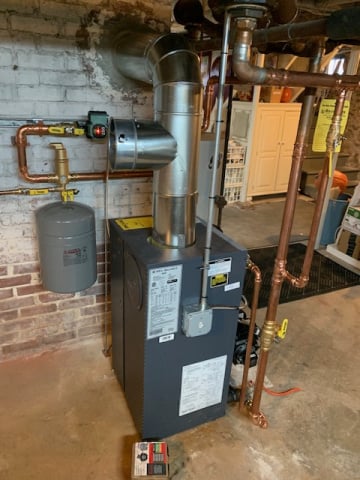
4-Boiler - Angle View - Different Perspective
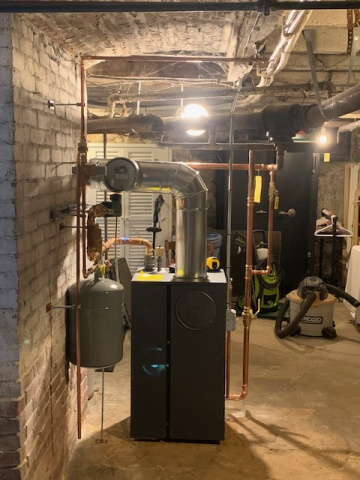
5-Boiler - Back
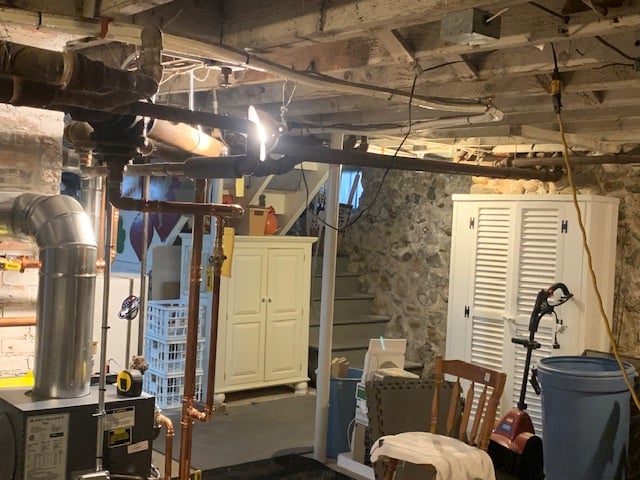
6A-Pipes In Ceiling -1
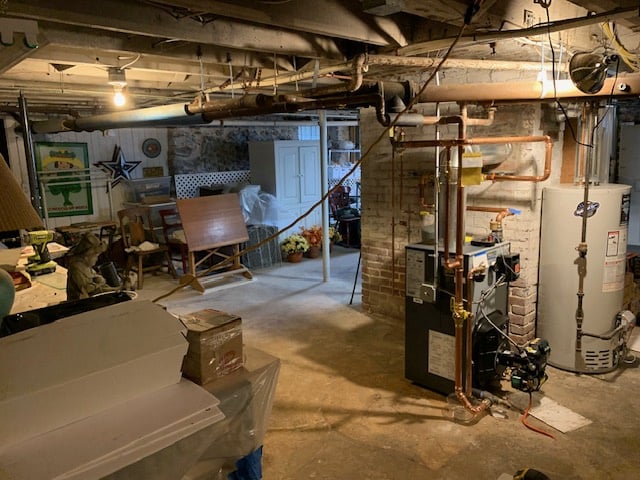
6B-Pipes in Ceiling - 2
0 -
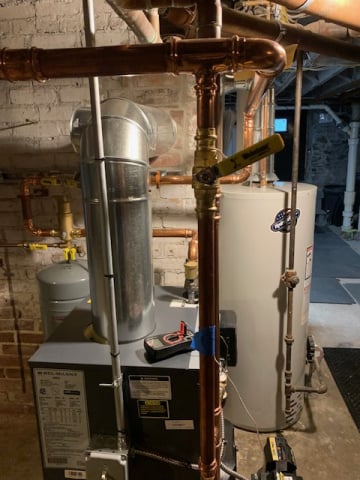
Two more photos. These are closeups of the yellow lever that in earlier photos above was disconnected from the pipes and hanging on a string tied to the bypass piping. I reattached the lever to show how open the valve is.
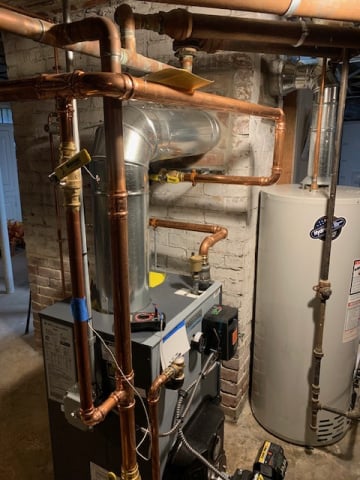
 0
0 -
So upfront I am just a very informed homeowner that had to do alot of research on my own because I had literally 5 different opinions on how my system should have been piped.
So given that, I think yours is piped slightly wrong, your bypass loop is on the other end of the pump, meaning it has to be on before water would get to it. My opinion here there should have been a tee from that boiler supply to that return line and then when that water gets to 125 degrees, turn on the pump to the system. With your pipe sizes its going to get diluted very very quickly but at least it would have been a start. I would still look at the hydrostat economy settings and maybe you can change something to help but after seeing your pictures not sure anything is going to help in that pipe size configuration.
Again I am not an expert by any means but I am sure others will chime in....
0 -
I'd enable the Hydrostat's Circulator Hold Off functionality and open up that bypass valve all the way, see what the system does. You can always put it back the way you found it. The bypass pipe is smaller than the boiler's supply and return pipes, so even with the valve all the way open there is still some bypass restriction.
I'm thinking the economy settings won't have much effect initially recovering from a setback. I believe the economy settings limit the boiler's run time which may extend the recovery time. They may help near the end of the recovery time to limit overshoot, thermostat settings may also help with overshoot.
 National - U.S. Gas Boiler 45+ Years Old
Steam 300 SQ. FT. - EDR 347
One Pipe System0 -
This is the bypass you are talking about (yellow)? This is not a large enough diameter and with all that ultra large piping around the system that will be the path of least resistance. Not too much back to the return here even with the small ball valve fully open
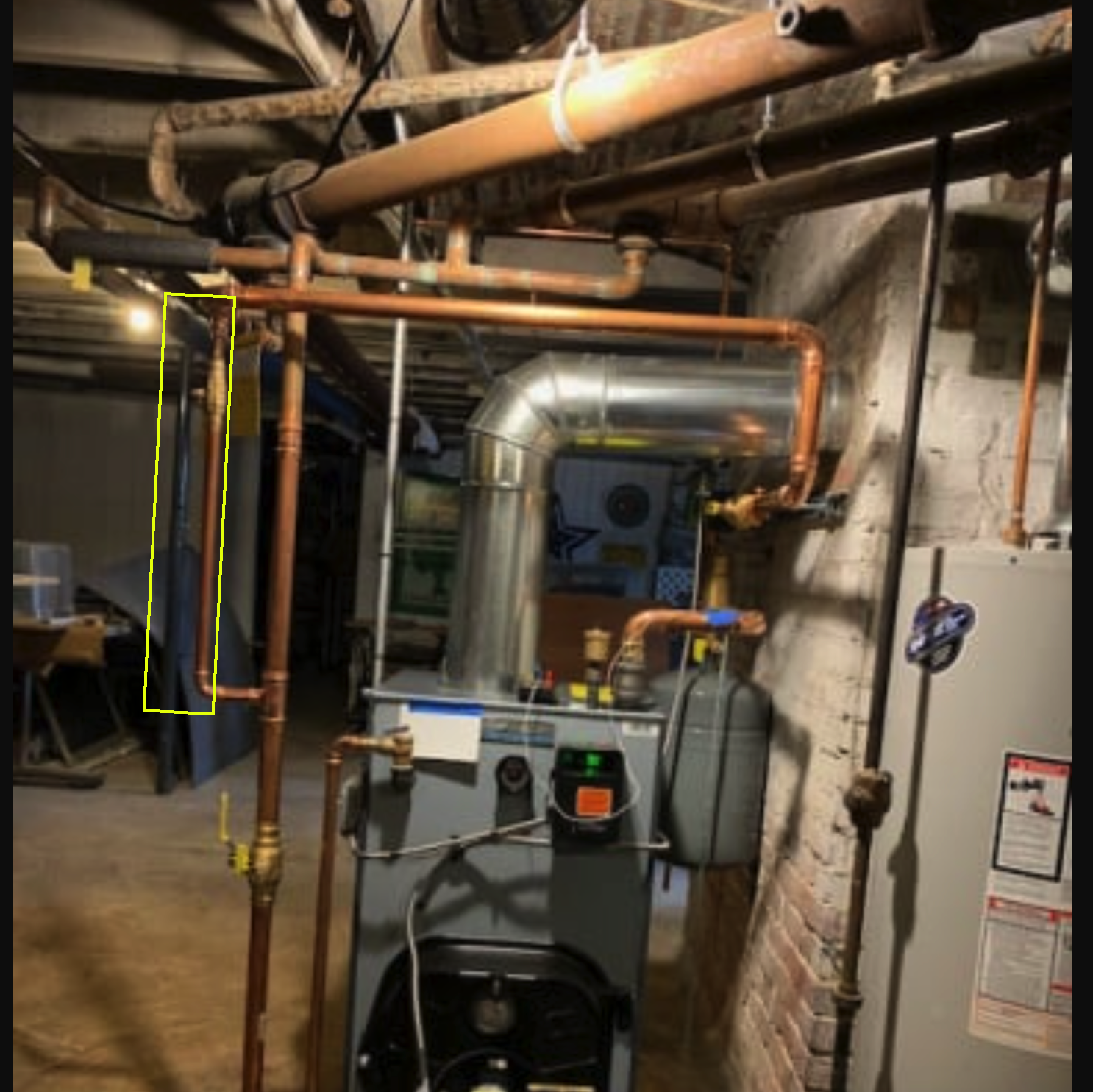
That bypass pipe should be the same size as the supply and return piping… 1-1/2" copper. You may need to add a circulator on that bypass in order to direct more supply water to the return and bring the boiler temperature up to 140°F, achieving at least 130°F at the return within 10 minutes.
Edward Young Retired
After you make that expensive repair and you still have the same problem, What will you check next?
0 -
I have a series of illustrations about what is happening to the water temperature in your boiler. The numbers are not exact byrare for illustration purposes only
1. You start with a call for heat with the boiler cold-ish and the radiators cold (room temperature-ish). the pump starts to pump whatever temperature is there. 82° boiler and 68° radiator. Not much heat is happening there
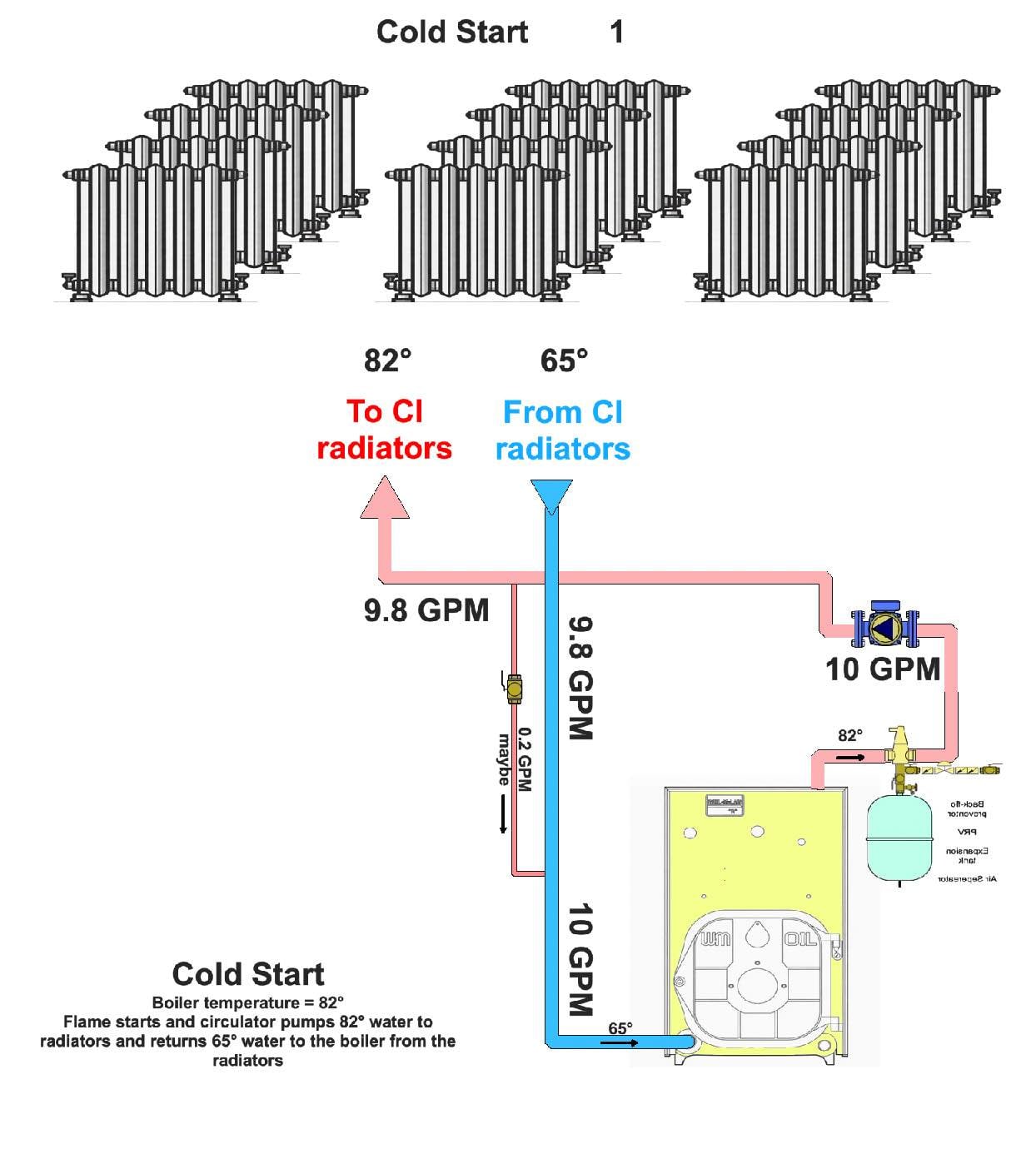
2. After 10 minutes the boiler water heats up but the return water from the radiators does not let the boiler temperature rise very quickly.
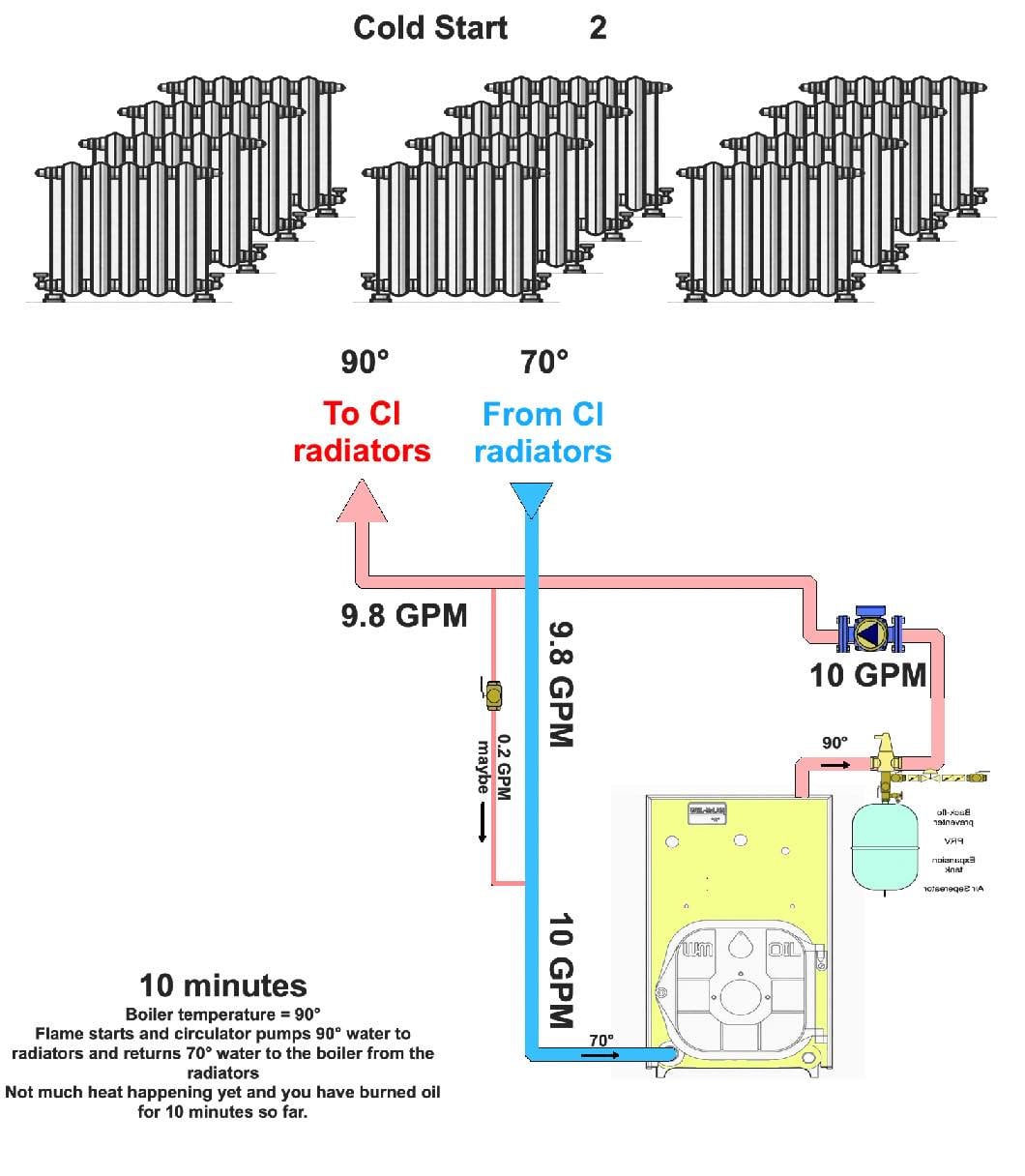
The boiler is now about 90° and the radiators are a little warmer and return 70° to the boiler.
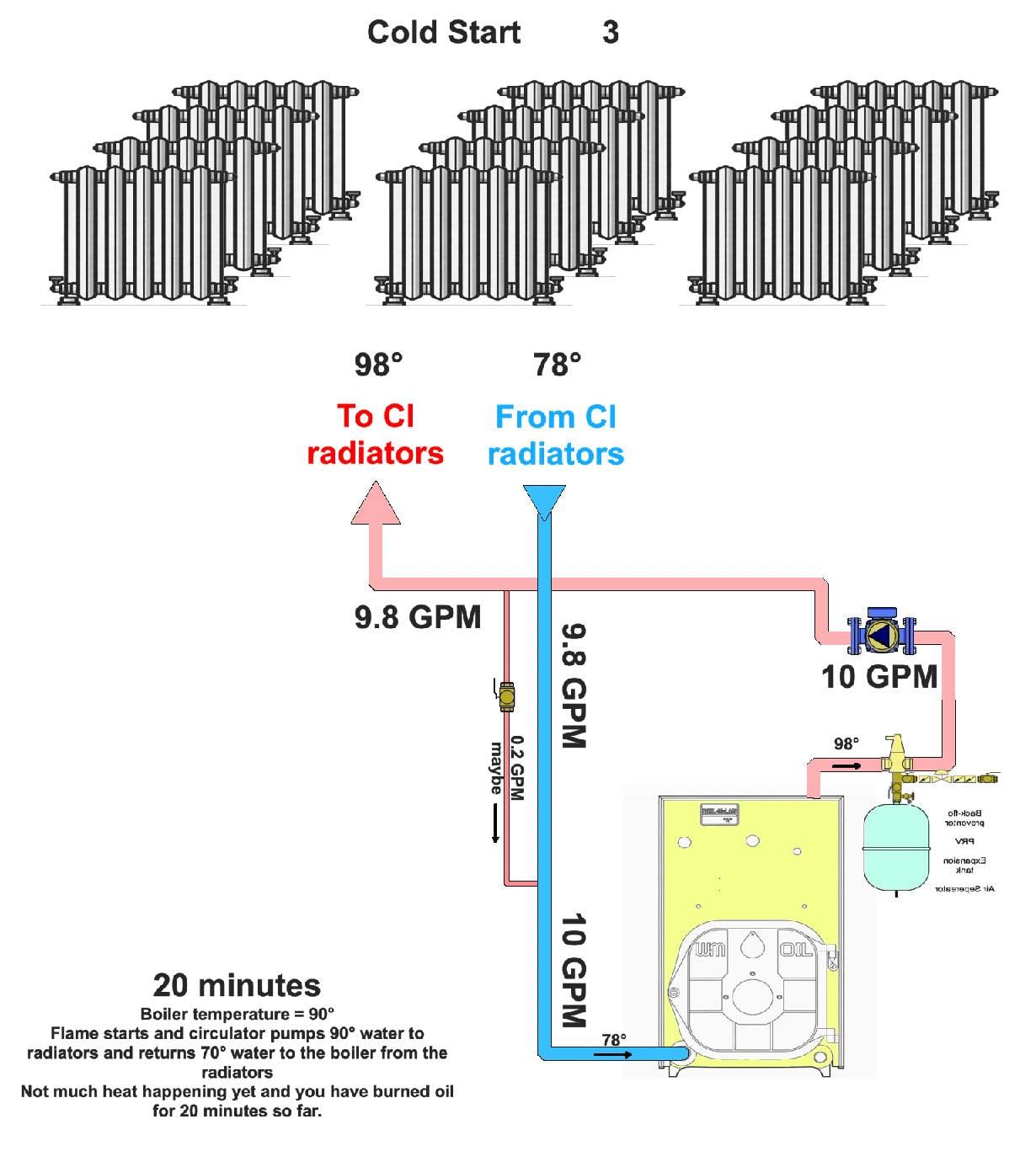
3. Now it is 20 minutes and the boiler does not get much hotter. The return from the radiators keep the boiler temperature from increasing much over 98°. The radiators are getting luke warm and rewturning 78° water. The bypass pipe temperature difference and pressure drop allows very little water to return to the boiler so not much help at all
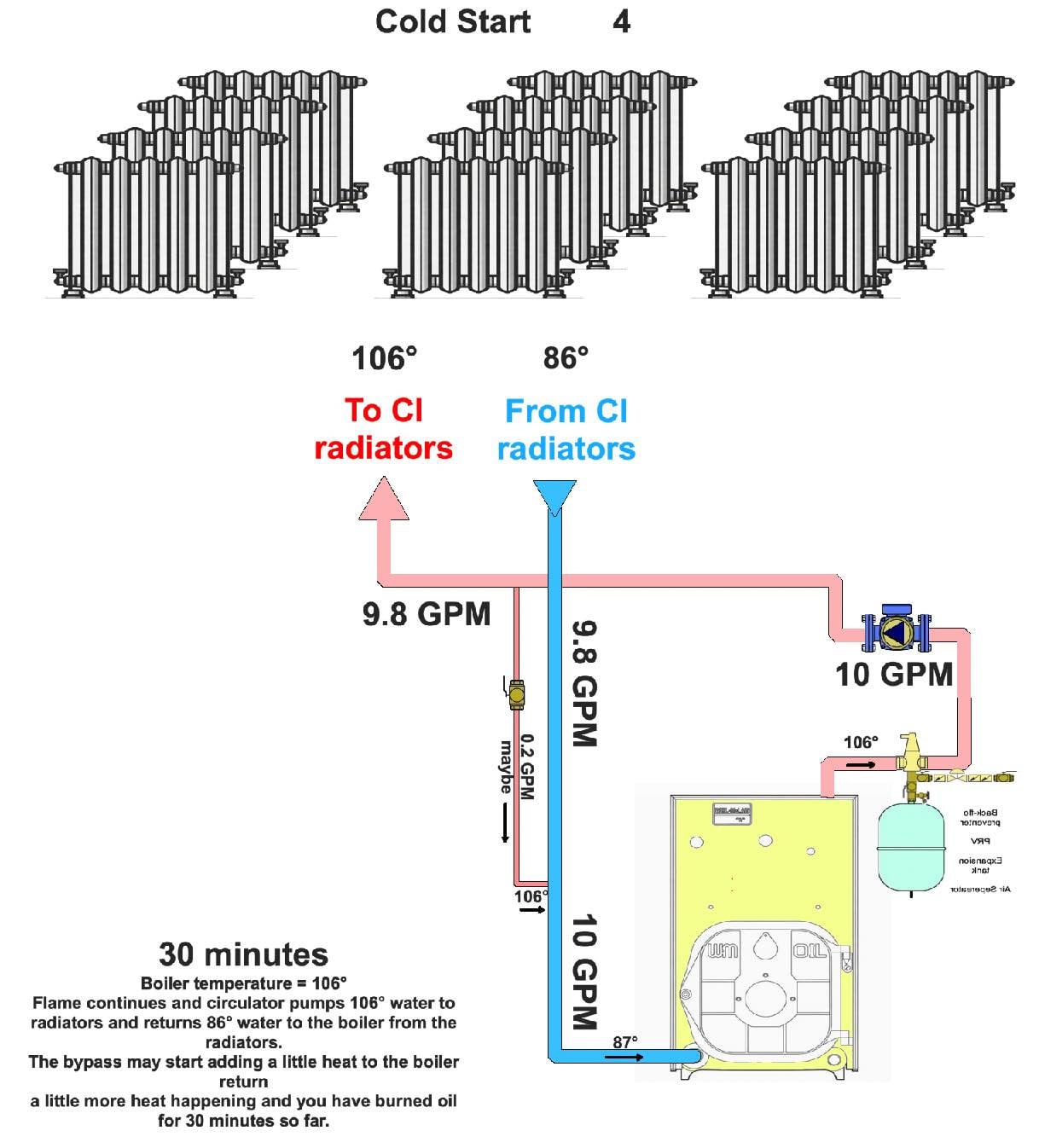
4. Now the boiler is starting to make a little heat for the home. At 106°F, the radiators are warm to the touch, and the bypass may even allow some supply heat to warm up the return. This is of little consequence, because mixing 106°F water with 86°F water cannot produce a 135°F return temperature.
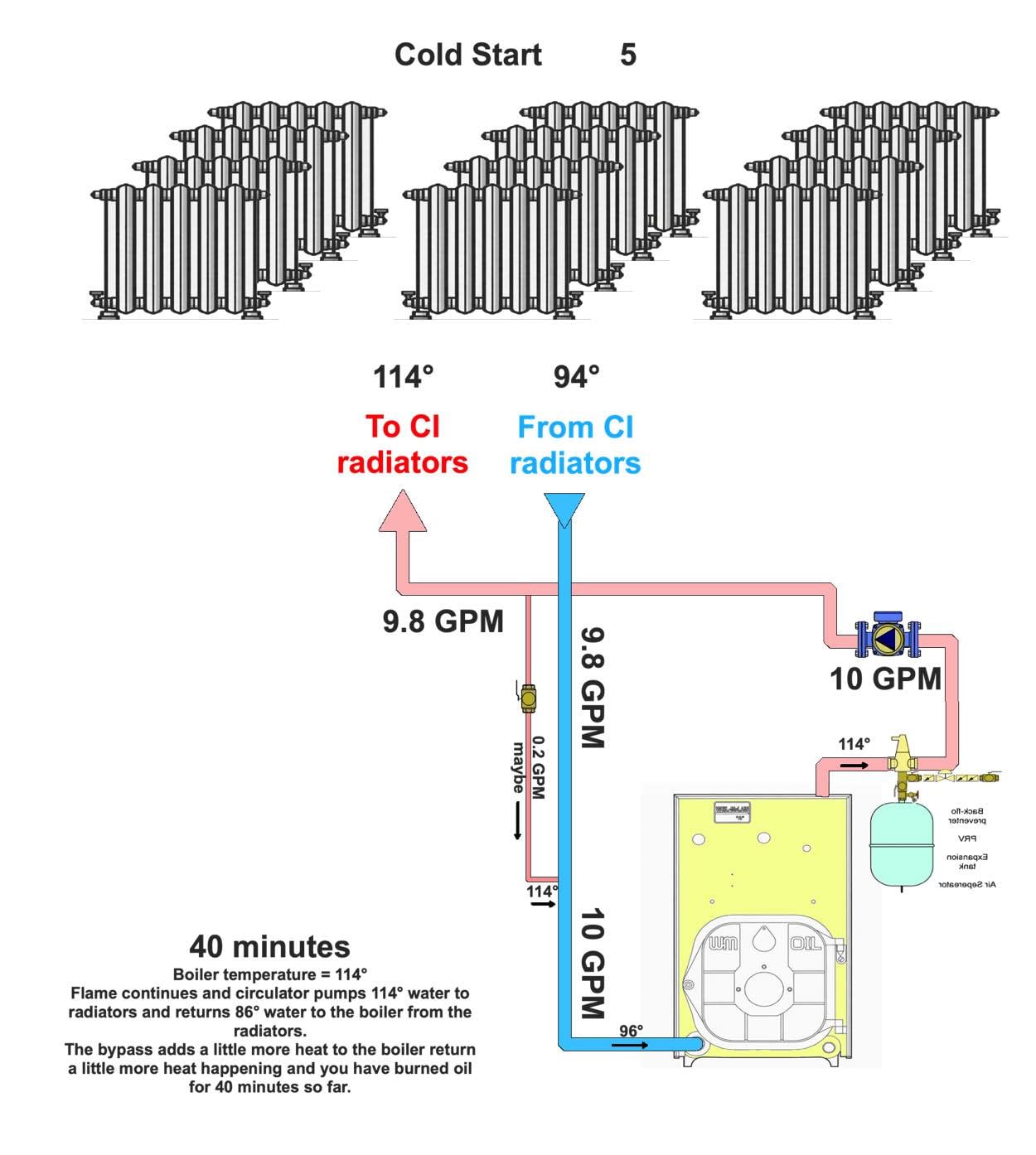
5. We are gettin some heat now but the return is still well below the desired return temperature to eliminate Flue Gas Condensation.
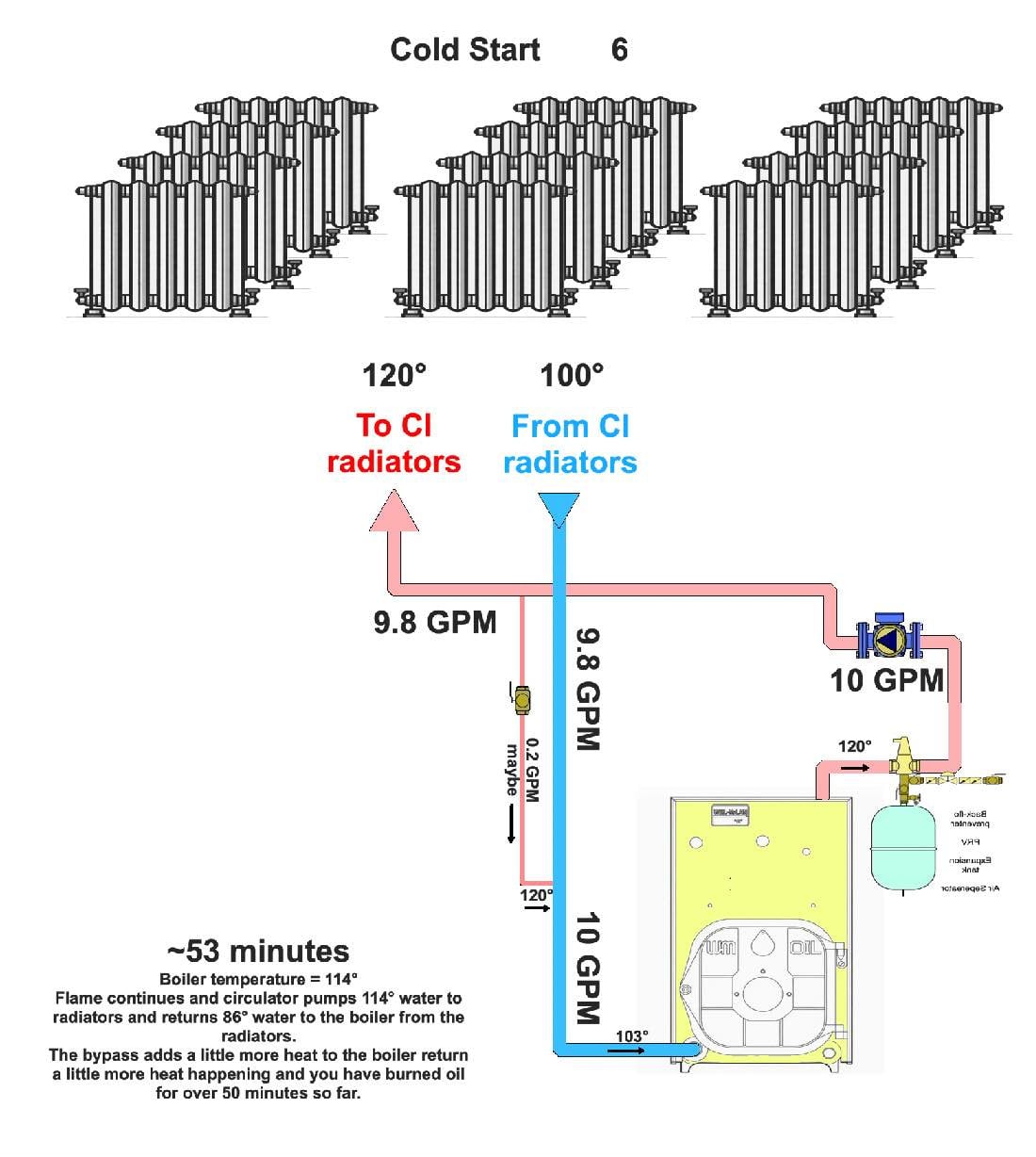
6. This seems to reflect what is happening to your boiler for the first 53 minutes of operation. You will never get the return temperature to 135° within the first 10 minutes of operation with the current near boiler piping design.
Edward Young Retired
After you make that expensive repair and you still have the same problem, What will you check next?
 1
1 -
A circulator hold off function is a lot like driving you car with the accelerator to the floor and using the brakes to control your speed? It’s called a bang/ bang solution.
You want a device that “slips “ the thermal clutch. Allowing the amount of flow to the system to allow the boiler return of 130 to be maintained.
A bypass pipe or pump only work effectively at the one condition it is adjusted to.
Hydronic systems are very dynamic, temperature conditions change minute by minute. Which you have already noticed in your data collection,
If you are going to spend any time or money to make changes, do it with an intelligent, temperature responsive, device.
If not, let it run the way it has been.
Bob "hot rod" Rohr
trainer for Caleffi NA
Living the hydronic dream0 -
The hold off functionality expires after15 minutes, I see it as like preheating the oven. You still loose heat when you open the oven door, but there must be some advantage to preheating the oven since in some situations it is recommended.
The thing is opening the bypass valve and the circulator hold off is free to try, it may provide some improvement, if it proves insufficient you can move on as your budget allows.
 National - U.S. Gas Boiler 45+ Years Old
Steam 300 SQ. FT. - EDR 347
One Pipe System0 -
I believe this is a better design with the least amount of change for @HomeOwner7. Add a mixing valve that protects the boiler.
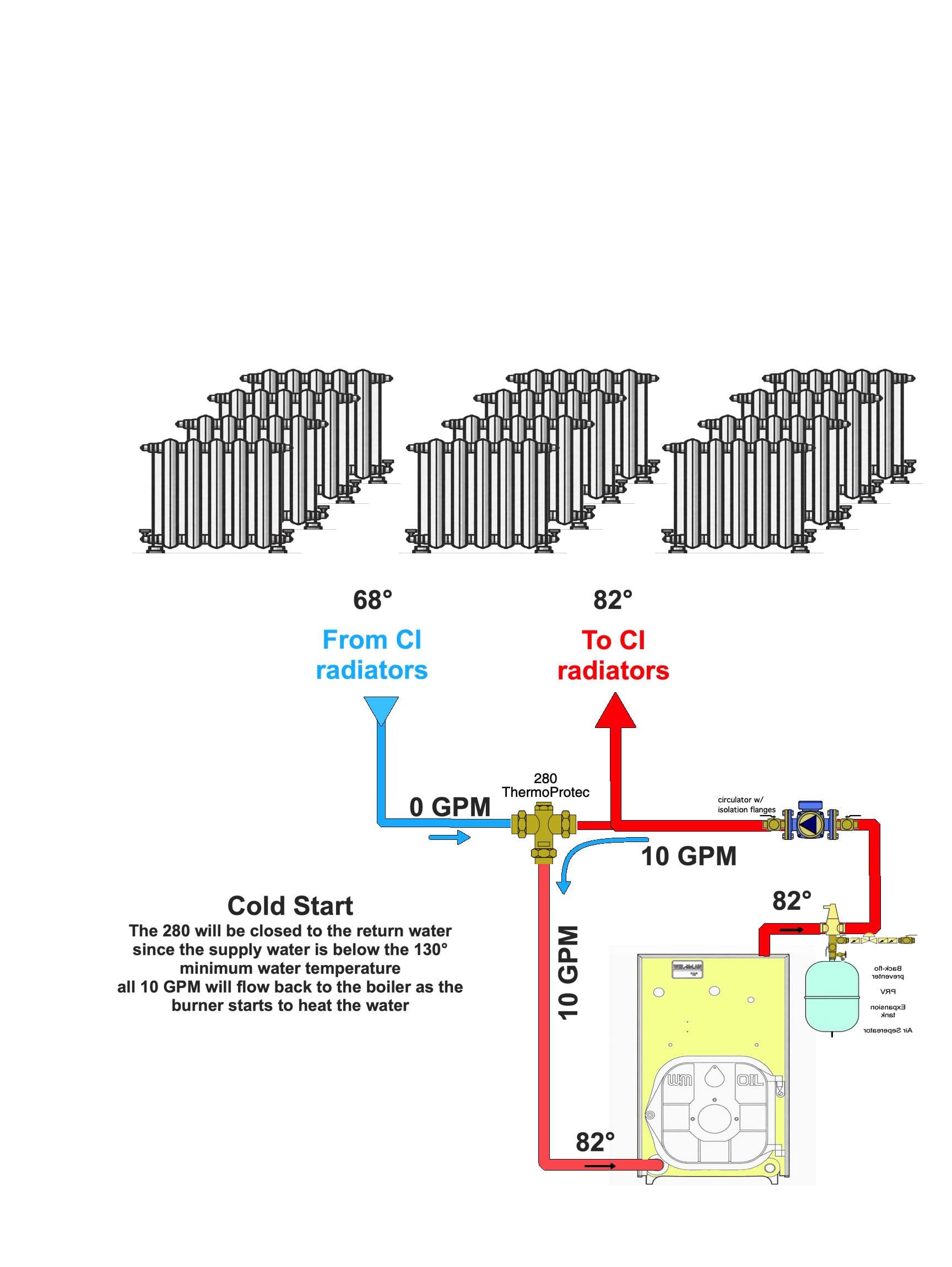
1. This illustrates the same boiler setup with a guess at the timing. This could happen even faster than 10 minutes. Maybe @109A_5 could look up the boiler water content and do the math.
82° boiler water at cold start and the same 68° radiator temperature.
Burner starts and circulator starts pumping into the mixing valve.
The mix side of the valve is open to the hot side of the valve with the cold side of the valve shut off since the mix temperature is not at 130°
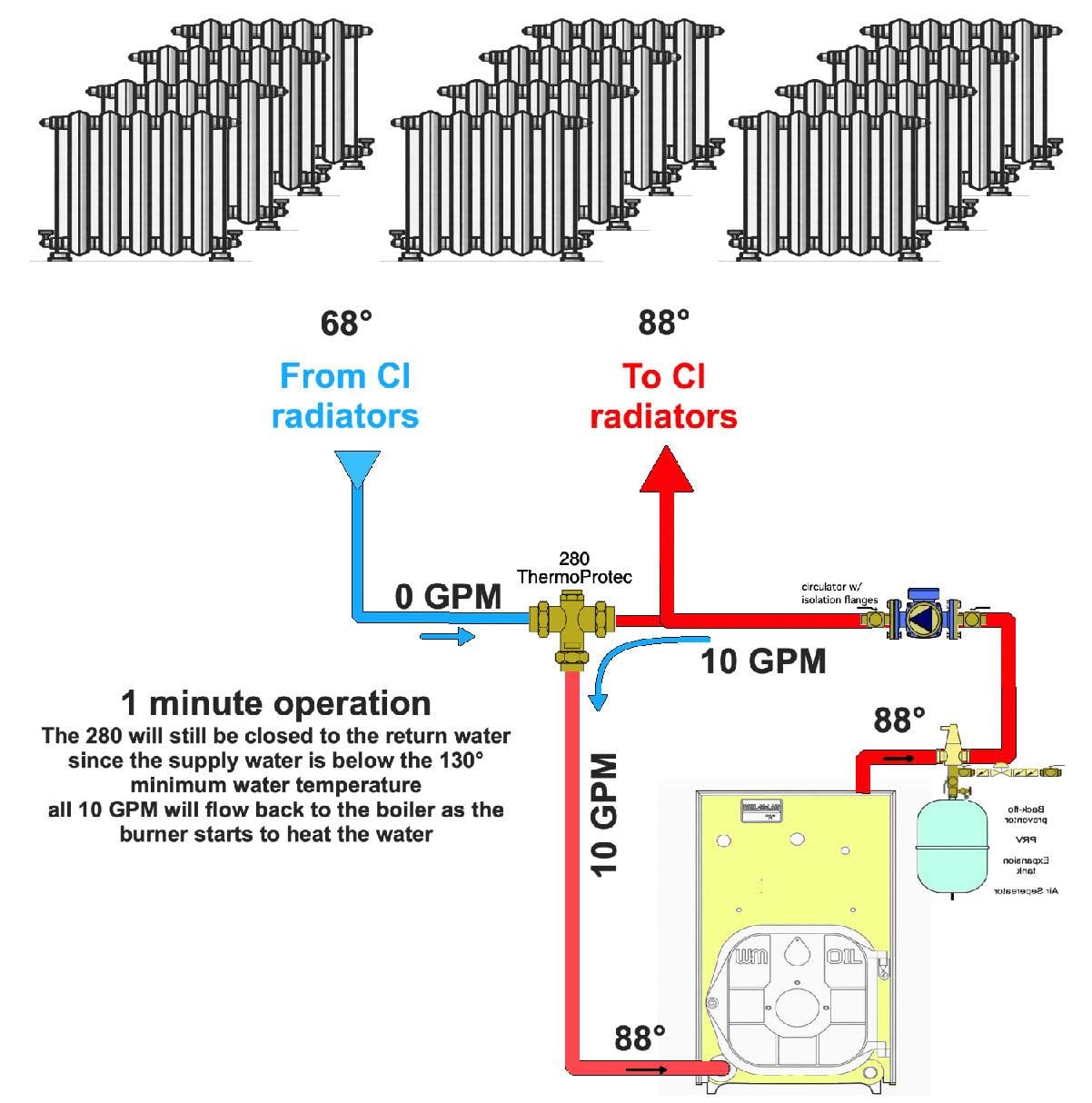
2. in just 1 minute all the heated water from the supply is directed to the return and the water temperature in the boiler increases in one minute what it used to take 10 minutes to do without the mix valve.
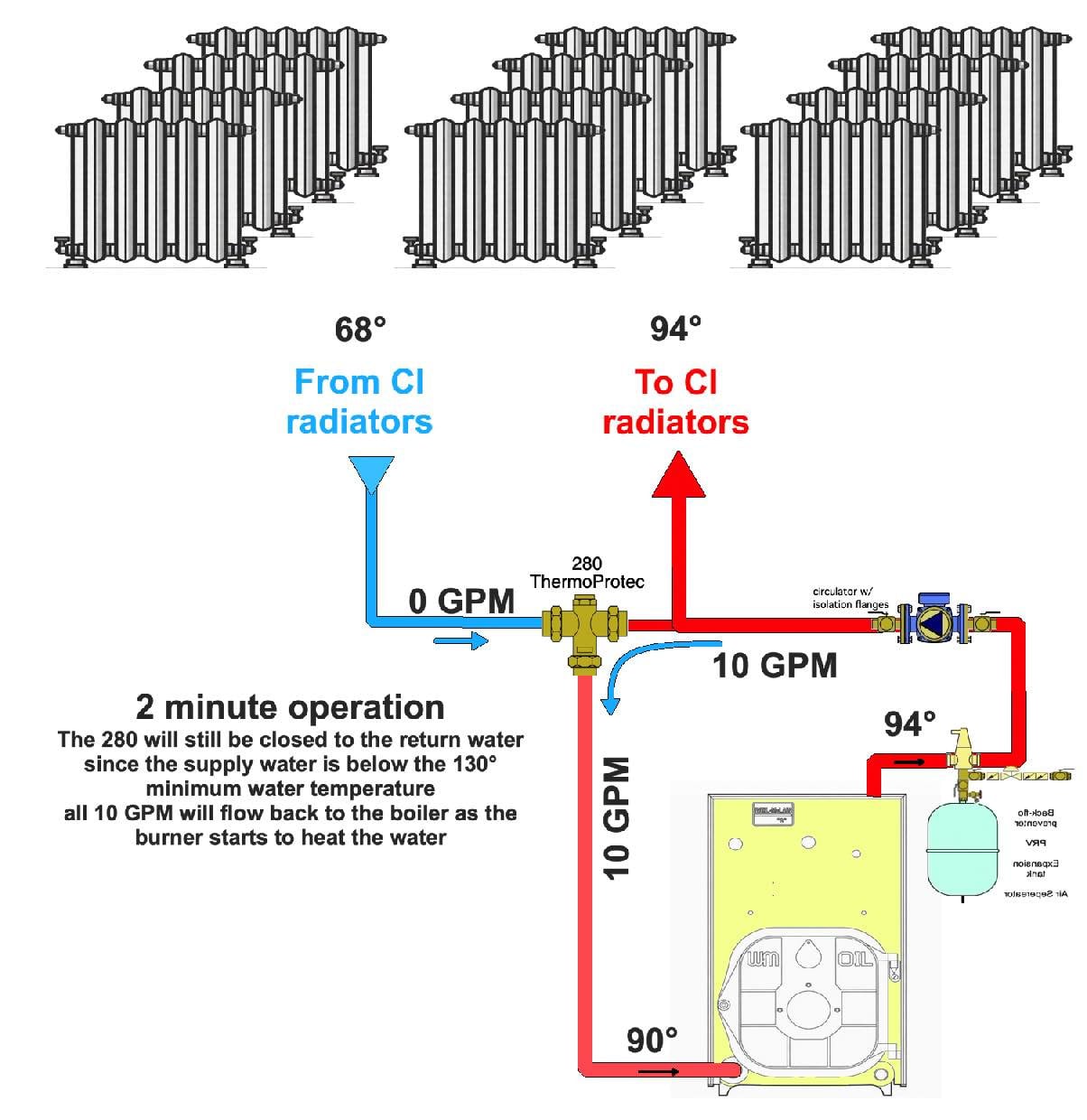
3. In 2 minutes the boiler temperature is up to 94°
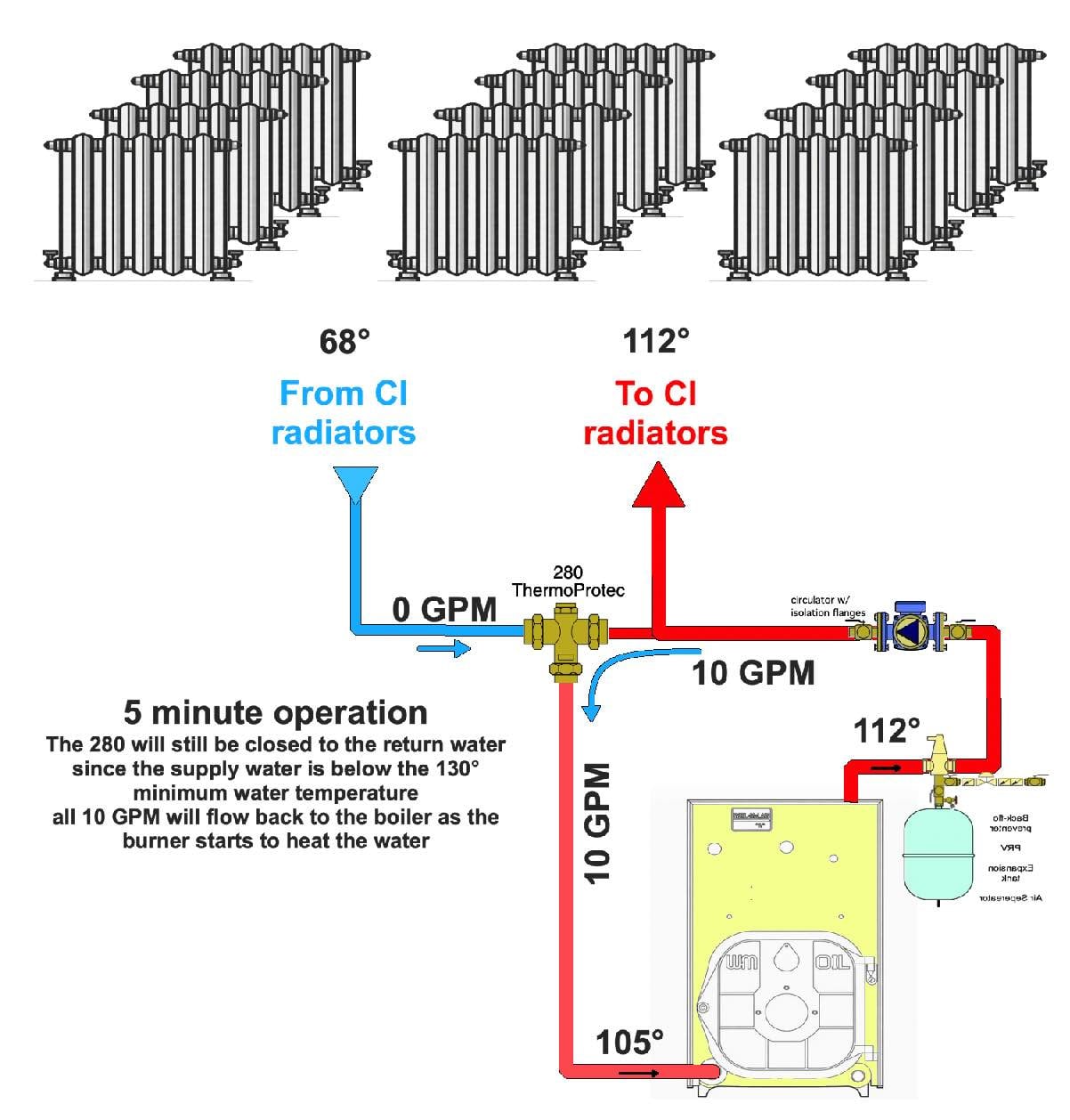
4. Skip ahead to 5 minutes and you can see the boiler temperature is increasing much faster. That is because there is not cold return water making the process tank much longer.
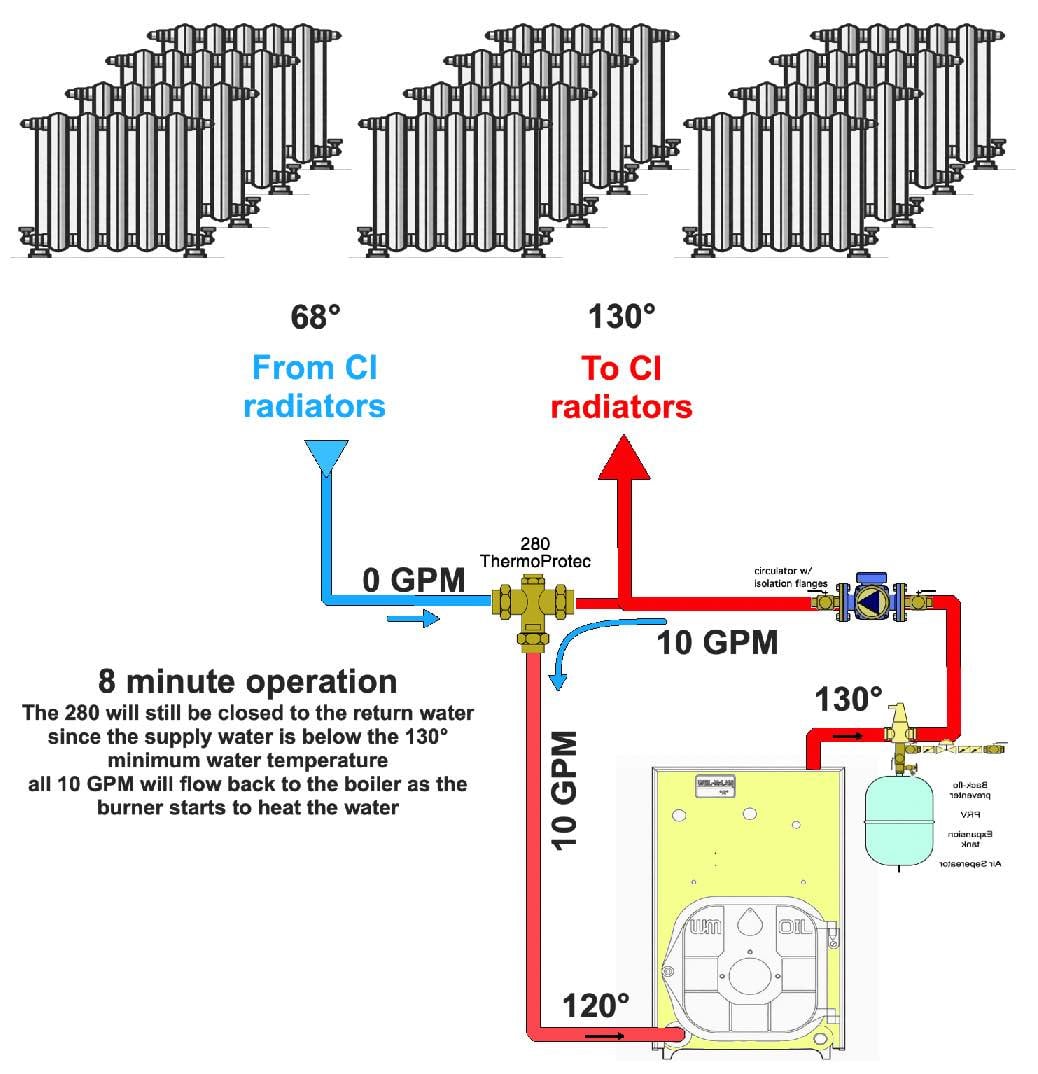
5. Now the boiler temperature is at 130° and the mixingvalve can start to allow some return water in to the system. That will allow some heated water to go to the radiators
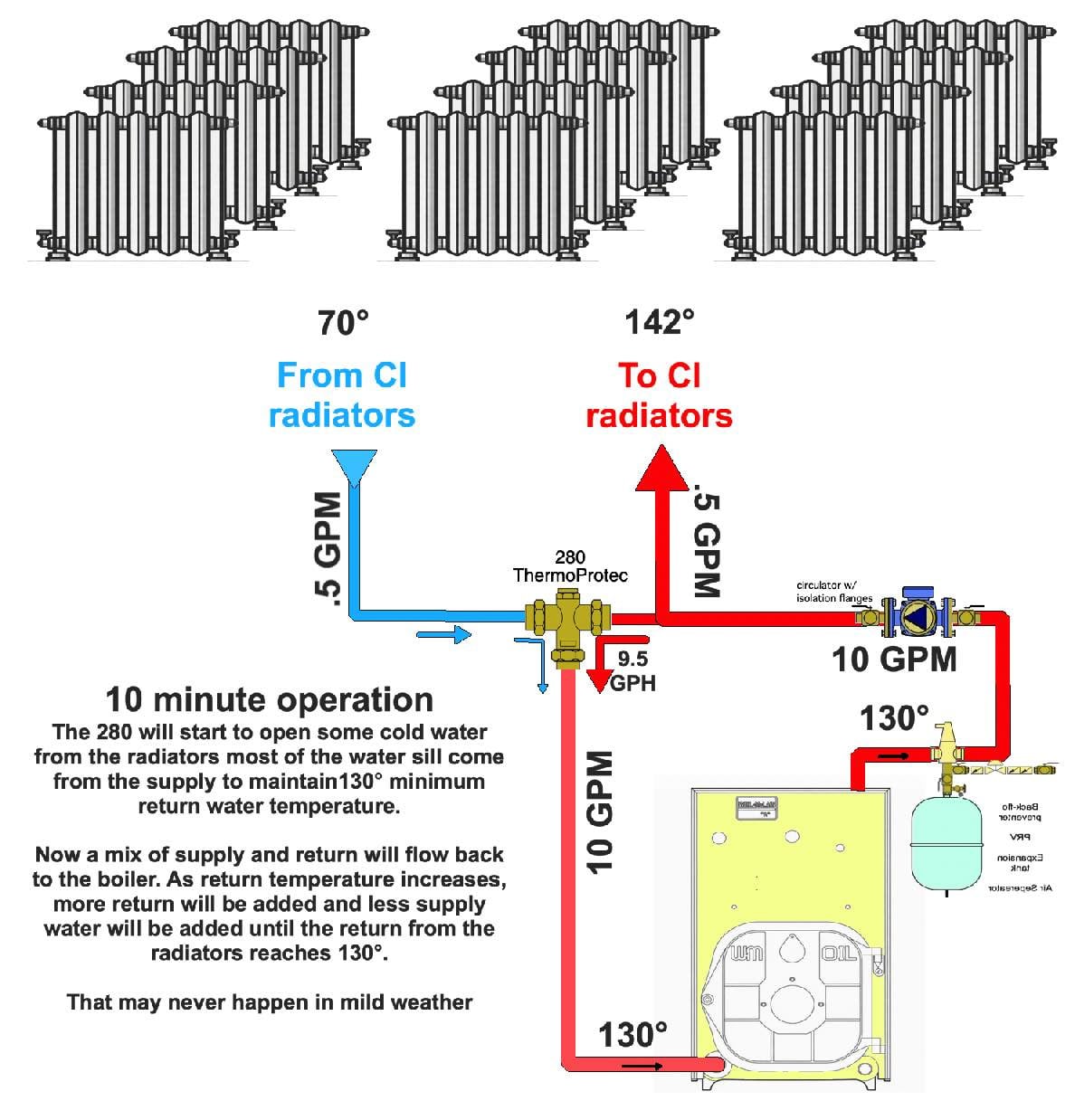
6. In 10 short minutes you are sending 140°+ water to the radiators and more return water is being allowed in to mix down that temperature to 130°. As the return temperature increases, the amount of return water will increase. That will in turn keep the return to the boiler at 130° limiting how hot the boiler actually gets.
You wont see that boiler go much over 145° to 150° as long as the return stays at 130°.
In the mild temperature season that will be the normal operation for that system. Only in the extreme cold will the boiler operate long enough to make the return go over 130°. At that point the boiler can increase to 155° or higher as needed to keep the home warm.
Hope this helps somebody:
Ed Young
PS
And yes I made a slide for each minute (zero to 10) and after looking at how ling that made my post, I removed half of them, 🤣 LOL
Edward Young Retired
After you make that expensive repair and you still have the same problem, What will you check next?

 2
2 -
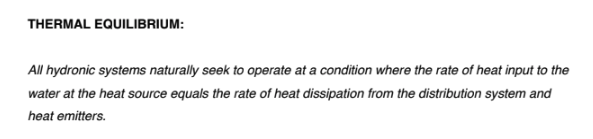
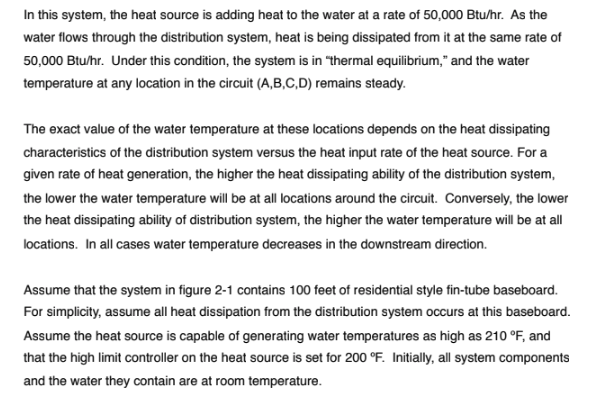
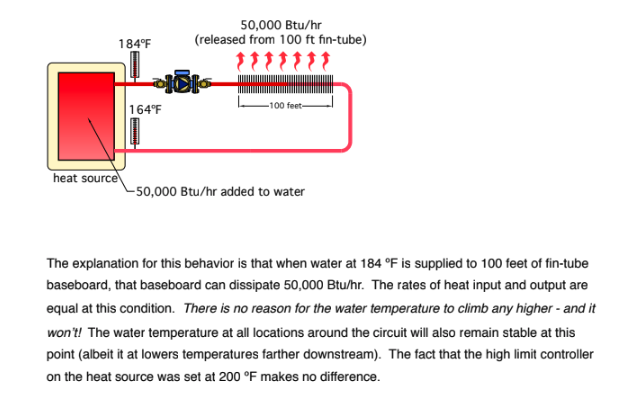
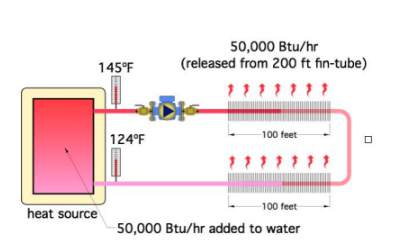
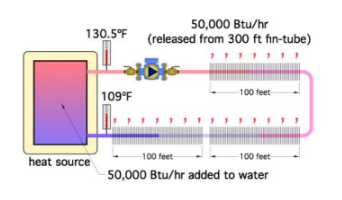
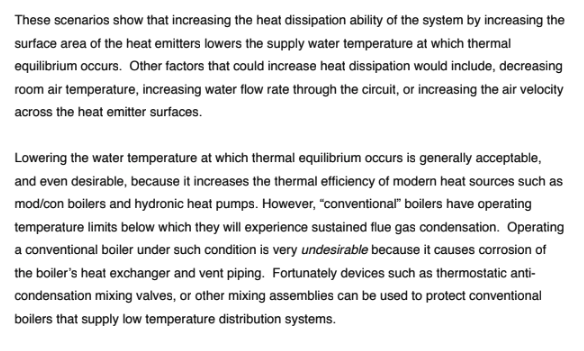
The concept playing out is callrd thermal equalibrium. The heat emitters connected to the boiler will; always dictate them operating condition, temperatures you observe.
He is a Ed type graphic to help visualize this.
In your case the large steel pipe mass, water volume of the rads and piping are the "emitters" if you knew the heat output size of each radiator you could diagram your system this way.
Notice in these graphics how the operating SWT and RWT, are changed as additional heat emitters are add, going from100 to 200, to 300" of fin tube.
It doesn't matter what temperature hi limit you set the boiler control too, it ain't going there while the loads are active.
From the upcoming Idronics issue.
 Bob "hot rod" Rohr
trainer for Caleffi NA
Living the hydronic dream 1
1 -
Nice preview, @hot_rod. That thermal equilibrium on an oversized boiler is accomplished by cycling the burner off the limit. For example, if the boiler has a 100,000 BTU/h output and is connected to that system, the high-limit control would shut off the burner about 50% of the time. If that happens with 3 minutes ON and 3 minutes OFF cycles, you may find that you end up operating at a lower efficiency. I wonder if that is covered in the next edition?
Edward Young Retired
After you make that expensive repair and you still have the same problem, What will you check next?
0 -
the controls on a boiler/ heat source are placed there to force the boiler to operate at certain conditions. Operating temperature controls, high limits, pump cyclers, etc.
If no controls were on the boiler it would seek and find thermal equilibrium. But that condition may not be desirable, or safe. So controls are added to get the boiler to do what we want, not what it may want.
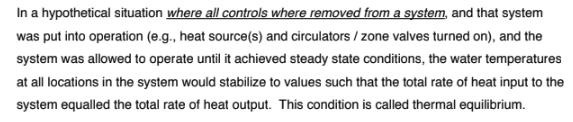
But some added controls, constrained pump operation may be trading one undesirable condition for another. Maybe a worse condition. So it helps to think it through.
Here is where that system would go with under sized radiant
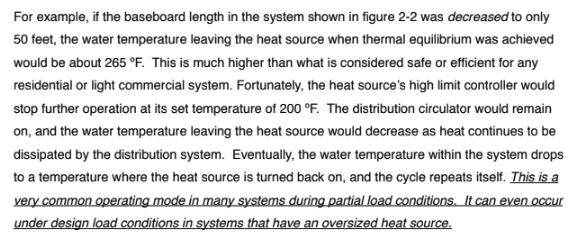
This is a simple condition to avoid with operating and limit control.
That low temperature operating condition, not as easily handled with (dumb controls) no temperature input or response ability.
A mod con boiler in those high mass, high volume systems is the win. They handle the low return nicely, the lower the better they like it, their ODR eliminates on/ off and over/ undershoot. You run 90% efficiencies some, maybe most of the time.
Doesn't it always come down to how much time and energy an owner wants to invest to make it some or much better? The first step is understanding and acknowledging the problem. that is the goal of HH, providing the source of appropriate info to make decisions.
Bob "hot rod" Rohr
trainer for Caleffi NA
Living the hydronic dream 3
3 -
Regardless of how the water temperature is controlled or modulated external to the boiler to keep the boiler's water temperature above the condensation point, I would still take advantage of the the Hydrostat's Circulator Hold Off functionality.
I see no point in paying to circulate water until it gets close to a temperature where it can actually go somewhere and heat something. Why waste the electricity ?
National - U.S. Gas Boiler 45+ Years Old
Steam 300 SQ. FT. - EDR 347
One Pipe System0 -
Ed: In response to your question, yes, the pipes outlined in yellow in the photo you posted are the bypass pipes and that is where the yellow lever is located.
0 -
Thanks, Everyone, for your help. I appreciate the time and effort it’s taken and willingness to share the info that’s being discussed here. It’s a wealth of knowledge.
I’ve read all of your responses and learned an awful lot but am nowhere near a professional heating person. I’m going to have to study what’s being said which is going to take a while. Then, once everything “settles” in my brain, I’ll need to decide what to do.
About those 3 temp gauges I ordered. I finally got them and attached them to the pipes. Now that I can actually measure the return, etc. temps, I’m going to gather some more data that I can use along with all of the info posted here to point me in the right direction. During my data-gathering extravaganza I may not be posting as often but will keep checking in.
1 -
I was going to suggest putting in a circulator on the bypass line and use a line voltage aquastat to control the circulator. This is what we would refer to as an anti-condensation loop. As soon as the supply temperature drops below the setpoint minus the deferential it kicks the circulator on. The circulator runs until the set point is made and shuts the circulator off. This way you get the best of both world where you get the boiler temp up and end up with keeping the system loop moving. the only issue is they they tied the bypass loop before the return ball Valve so now you would have to drain the whole system.
There is also a buyer beware situation here that might come into play. Because its an old gravity system not getting the system temperature up close to 180 is helping you. There is no question that if you start getting any higher your going to start tripping your relief valve. You actually can see it in your numbers that you posted. So you have an undersized expansion (provided it has lost any air).
i apologize if this was mentioned already, I wasn't going to read everything.
0 -
I was going to suggest you buy 1 - 10ft section of 1-1/4 copper , 2 tees and 2 elbows. Then have a plumber splice in on the supply line below the pump, down along the back of your boiler and tie into that return line. Then set the circular to hold until that boiler loop gets to 125 degrees. You would probably have around 7 gallons between boiler tank and piping at 125 before you start adding in that 68 degree water. Your boiler might have a fighting chance then. But I think Ed's 280 mixer is the best solution..
0 -
Here is my idea of the easiest way to add the Boiler protect valve 1-1/4" with your current set up.
Not a perfect picture but I believe you will get the idea.
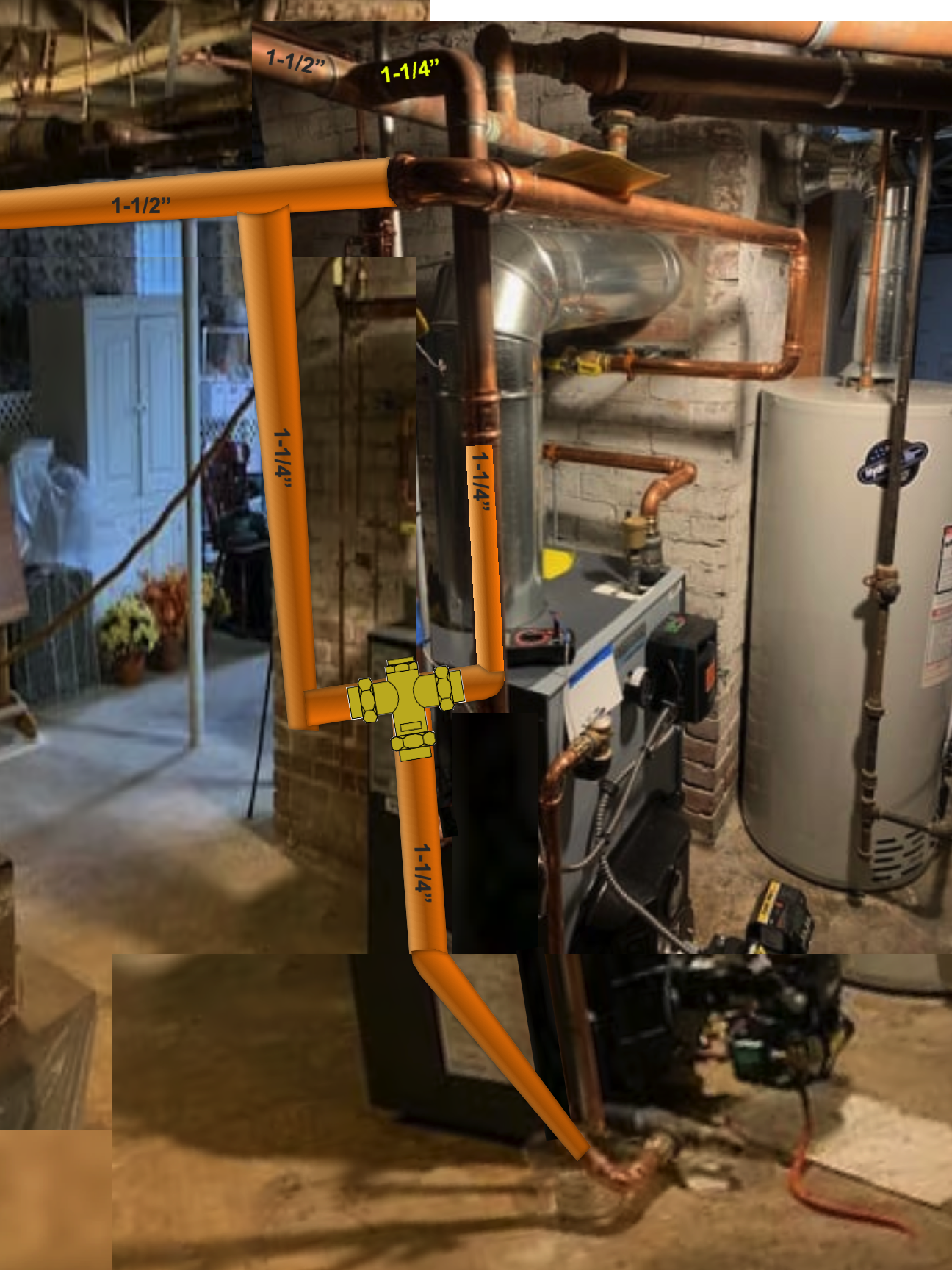
I can't be sure by your photos however I believe you have a 1-1/4" return. That is more than large enough for the amount of heat you will be bypassing. If it is 1-1/4" then your repiping is minor since all you need ot do is add the 1-1/4" bypass from the supply side using a 1-1/2" x 1-1/2" x 1-1/4" copper press tee and a 1-1/2" 90 elbow and a foot or two of 1-1/2" copper and about 6 feet of 1-1/4" copper. You may need a Couple of Couplings to Complete your Connection! (Say that 3 times fast LOL)
Edward Young Retired
After you make that expensive repair and you still have the same problem, What will you check next?
 1
1 -
Hi, Again,
All of the suggestions and recommendations here I'm taking in. For now, I’m posting some additional info and have some questions.
INFO:
1--Ed: The return pipe you asked about, yes, is, 1 1/4” in diameter.
And your suggestion looks like a good/the best option. The boiler health is my main concern.
2--Comparison - With Bypass 30% Open vs. 100% Open
I recorded the following info over the past couple of days.
Note: Regarding the Ball Valve on Bypass Piping, based on the position of the yellow lever handle, from time of installation this past January, it has been about 1/3rd of the way open.
I did a test, opened the valve all the way to see what effect that would have.
As Ed predicted - not much.
BYPASS 30% OPEN
MAY 1
BYPASS 100% OPEN
MAY 2
Hydrostat Reading
Reached 130F
After Operating
This Amt of Time
1 Hr 20 Mn
1 Hr 14 Mn
Temp on Return Pipe
- Before-
Bypass Injects Hot Water
104F
99F
Temp on Return Pipe
-After-
Bypass Injects Hot Water
105F
105F
Amt of Time System Continued to Operate
After Hydrostat
Indicated 130F
22 Min
49 Mn
Hydrostat Reading
When System Turned Off
139F
149F
3--Hydrostat 3250-Plus:
- The Hydrostat manual the installer provided is for the Hydrostat 3250+ (3250 Plus), not the 3250 model.
- The 3250+ manual does not state anything about the “Plus” model having a 15 minute shutoff for the Hold-Off feature, so it seems it does not have that.
- The 3250 Plus is described as an "upgrade" to the 3250 model.
QUESTIONS
Q1- hot_rod: What is the “intelligent, temperature responsive device” you refer to when you said: “If you are going to spend any time or money to make changes, do it with an intelligent, temperature responsive device. If not, let it run the way it has been.”
Do you mean the Boiler Protect valve in Ed’s piping diagram?
Q2-- Hydrostat Model #: Where is the part # located on the Hydrostat?
I’d like to confirm which Hydrostat model is installed but don’t see any info on the device itself. I guess I have to remove the cover. Is there anything I should know before I do that? I don’t want to run the risk of accidentally breaking something.
Q3-PSI: For our 2 story house, is it OK that the pointer on the boiler Temp/PSI gauge rests below the lowest reading of 12 PSI when the system is not operating? Is it advisable to ask the Tech to adjust the PSI up a tad? Or just leave as-is, as the gauge measuring the PSI may be a little off?
Q4- If the Hydrostat I have really is the 3250 Plus - which means it does not have the 15 min. shut-off - is it still OK to change the settings to see what effect that may have?
Q5- Once the return water temp reaches 130F, is there a rule of thumb for how much longer the boiler needs to continue operating to “burn off” all of the condensation? If the boiler runs too short a time after reaching 130F, is it possible condensation will remain in the system, never dissipate?
Over and Out! (For the Time Being)
0 -
On the hydrostat just turn the screw on the door and it will swing open. There should be a label on the door with the model of your hydrostat. Then take a close up picture so we can see some of the settings. But also when the boiler is operating what lights are light? Then just reclose the door and turn the screw
0 -
Thanks, TerrS.
Just a note regarding viewing the table I posted above.
The table above has 3 columns.
Column 2 has info with bypass valve 30% open.
Column 3 has info with the valve 100% open.
If viewing the table on a cell phone, it may be all too easy to think there is no 3rd column. That's what just almost happened to me.
I looked at this on my iPhone and didn't see the 3rd column in the table at all - it was completely hidden.
The column does, however, appear by turning my iPhone sideways so what's being viewed is in a "landscape" direction. Doing that made the entire width, all 3 columns of the table appear.
0




Categories
- All Categories
- 87.8K THE MAIN WALL
- 3.3K A-C, Heat Pumps & Refrigeration
- 60 Biomass
- 430 Carbon Monoxide Awareness
- 133 Chimneys & Flues
- 2.2K Domestic Hot Water
- 6K Gas Heating
- 124 Geothermal
- 170 Indoor-Air Quality
- 3.9K Oil Heating
- 79 Pipe Deterioration
- 1.1K Plumbing
- 6.7K Radiant Heating
- 397 Solar
- 16.1K Strictly Steam
- 3.5K Thermostats and Controls
- 56 Water Quality
- 51 Industry Classes
- 51 Job Opportunities
- 18 Recall Announcements