Swapping out baseboards for radiant.

My first post here
ended up getting the help I needed and figured let’s try again.
Boiler is still running strong now with the split loop and additional radiators put in place to bleed off the excess heat by the oversized boiler.
I want to add an indirect water heater as my gas fired is in the way out and got a deal on a practically brand new ID. While going through re-piping I thought why not do the radiant system I was talked out of when my original system was designed.
Here is my basic hand drawn schematic I was hoping to get some feedback on.
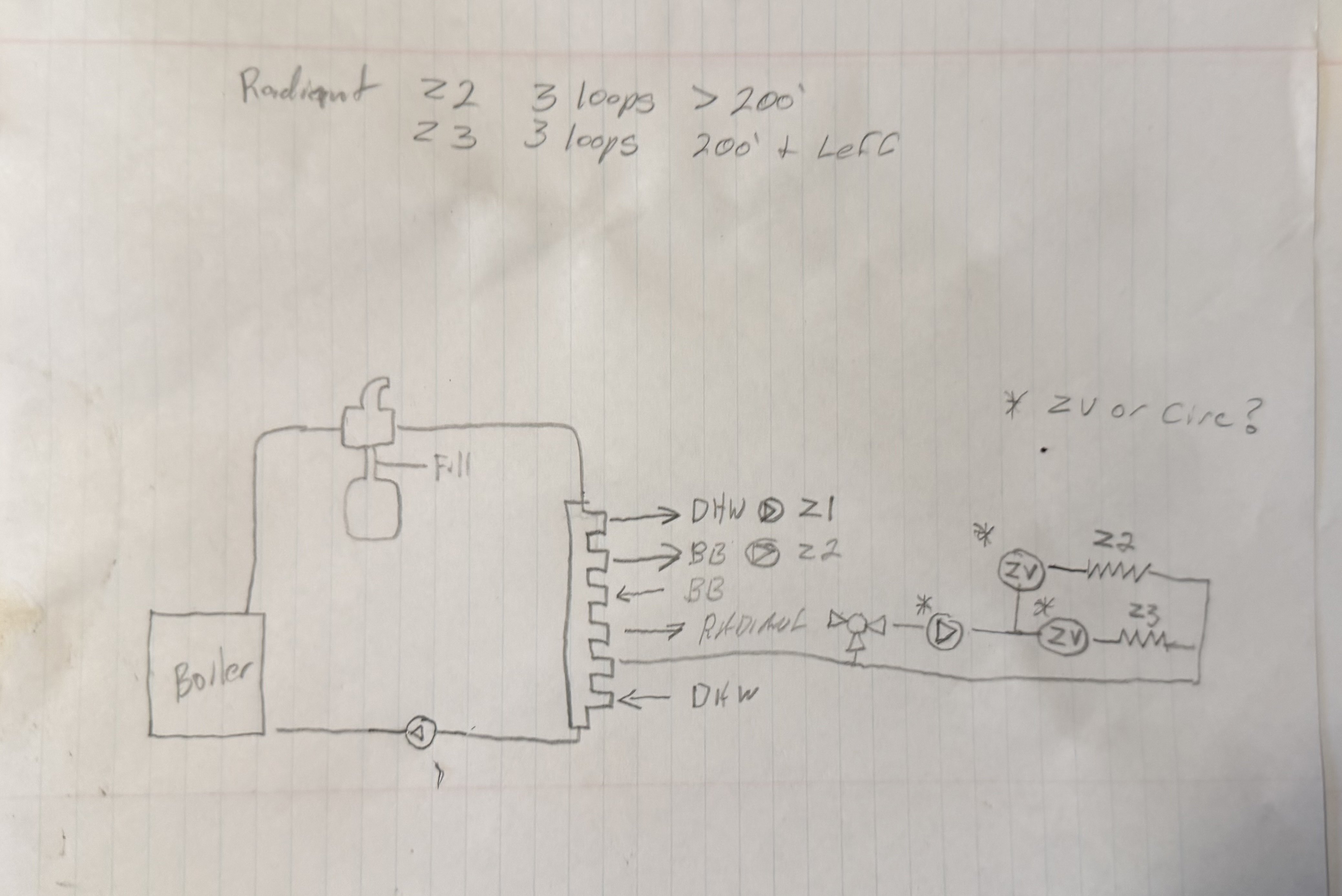
I’ll be adding a DHW loop, keeping a baseboard/radiator loop and adding (2) zones for radiant. I’d like 1 of the 2 zones of radiant to share a thermostat with a baseboard/radiator zone.
For radiant is it better to use the circulators or circulator→ zone valve setup?
I saw different piping diagrams showing 4-way and 3-way valves for lowering the radiant temp I’m really confused on which route to go here.
Also most of my floor joists are 24” OC 2x6 I was thinking of doing 3 runs of 1/2@ Pex on extruded track for what I’d like to call the “colder rooms” and 2 runs for interior or rooms that will still have baseboards/radiators.
Lastly what are the general piping mistakes I need to avoid when doing a project like this.
Comments
-
Zone valves aren't really needed on radiant, since it should be always on. That said, however, if your two radiant zones have distinctly different heat loads but similar piping layouts, they will need different floor temperatures — and therefore two separate mixing valves and circulating pumps.
Br. Jamie, osb
Building superintendent/caretaker, 7200 sq. ft. historic house museum with dependencies in New England0 -
Thanks for the response!What do you mean by “always on”? Circ always running?
Currently one side of my house gets colder (right side of current baseboard/radiator loop). Room 1 is due to door always being closed as it’s mainly and oversized closet. And other is bathroom due to an exhaust fan that backdrafts air no matter how many dampers I install. So I’d like to zone this section off from the main and add a separate thermostat.The 2nd radiant zone has the adjustable radiators in the higher demand areas. So those could be dialed down as needed.
0 -
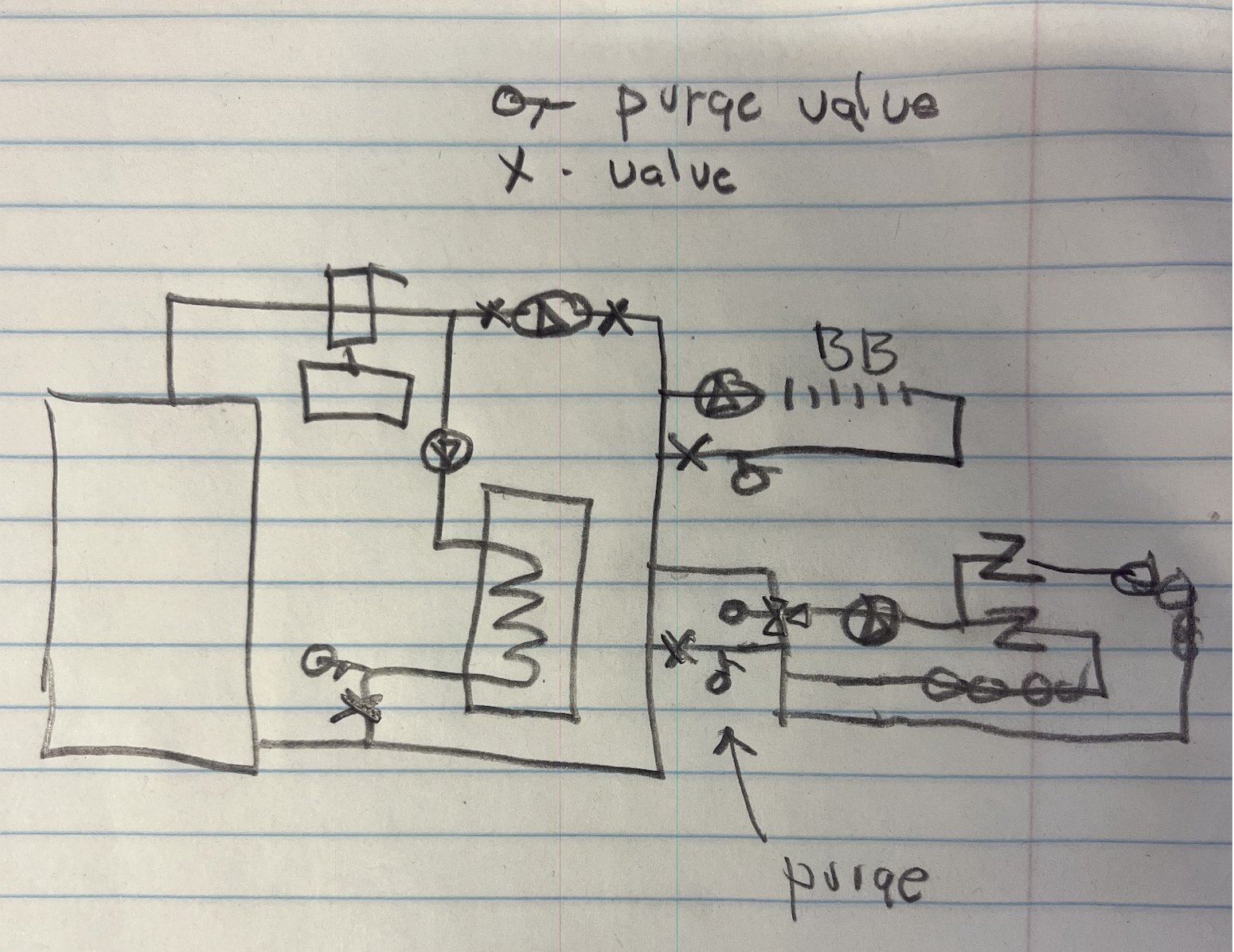
here is a piping option, putting the DHW tank as a parallel loop, on priority, only one pump runs, no flow through un powered pump.
Delta P circ with zone valves for the radiant.
3 way thermostatic is a simple method.
If you want outdoor reset on the radiant, use an electronic mix valve.
No need for a 4 way if the radiant is a small load, 25% of the boiler output as a guess? A 4 way has two mix points to protect the boiler from cold return. If the entire system was low temperature a 4 way would mix down, and protect the boiler.
 Bob "hot rod" Rohr
trainer for Caleffi NA
Living the hydronic dream0 -
By "always on" that's exactly what I do mean — circulator always running. The objective of radiant heat is to maintain a constant base comfort level. You can't dial it up or down at a whim! Even with tubing under a wooden floor it will take hours to respond to a requested temperature change. So one uses outdoor reset — or a good guess! — to set the radiant up with the right temperature and flow and just let it do its thing.
Br. Jamie, osb
Building superintendent/caretaker, 7200 sq. ft. historic house museum with dependencies in New England0 -
trying to understand the control aspect of this whole plan.
With this configuration the main loop runs continuously and DHW, baseboard and zone valves are activated by their associated thermostats call for heat?
The other member here mentioned keeping the radiant always running as it’s a sustained heat and not a on demand like baseboard/radiators.0 -
with a two temperature system, constant circ is a bit more complicated
The boiler has a minimum temperature if 150 supply, do ODR can only go so low
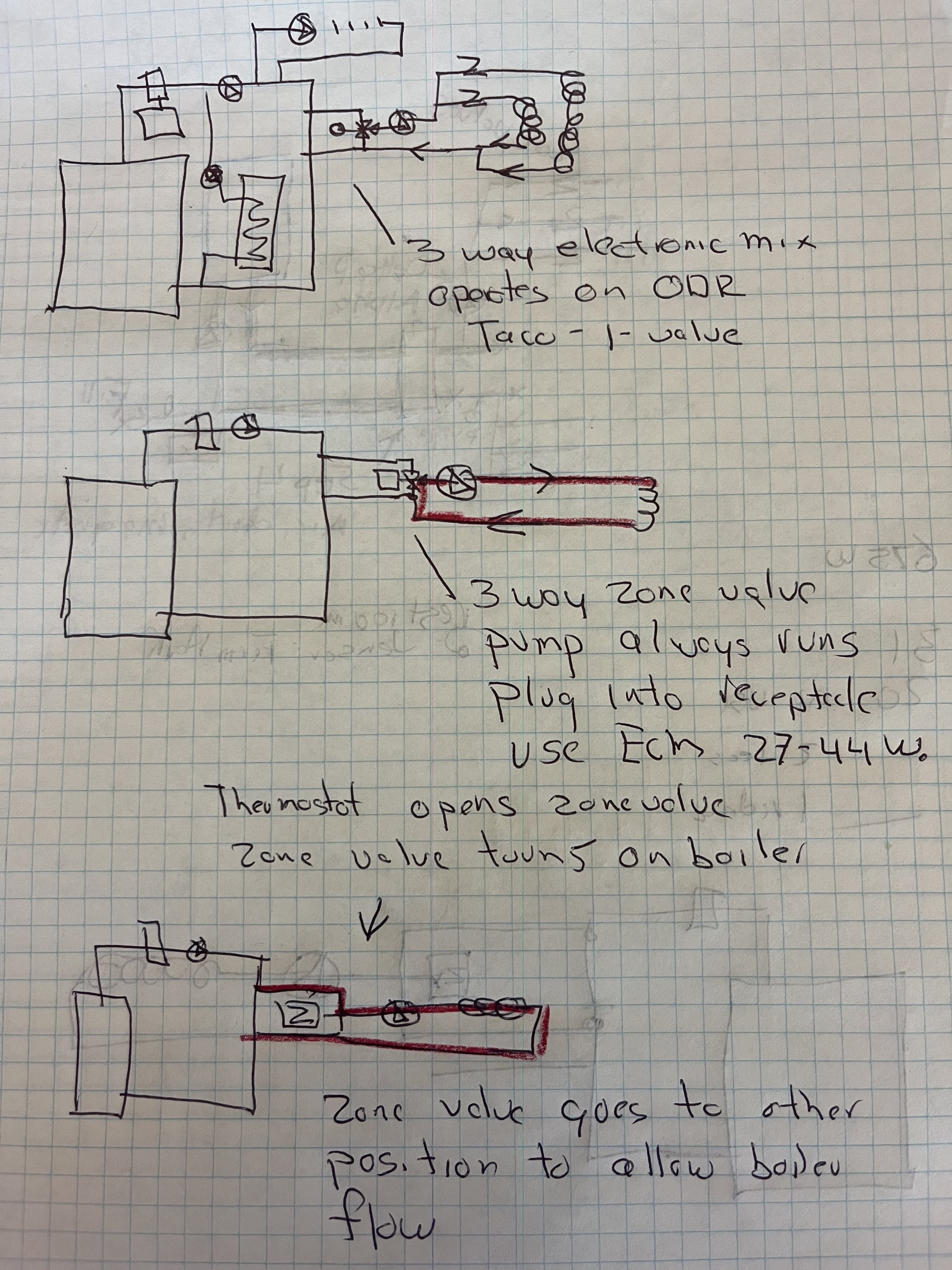
You can run the radiant a few different way as constant circulationThe Taco 3 way mix valve has ODR built in, so the temperature to the radiant is always changing, as a result you get close to constant circulation. On mild or warm dsys it will not allow flow
A true constant circulation is like the lower pics, where a 3 way zone valve switches from one position to another, flow never stops
When the thermostat calls for heat that 3 way changes position to allow flow from the boiler loop,
When the thermostat calls is satisfied the 3 way switches and flow just goes around snd around the loop, no boiler input is needed when the thermostat is off!
Note the flow path in red
This is a good option when slabs get a lot of solar gain, it moved that warm fluid around the entire zone. I use this in my shop
Plug the pump in in September, un plug it in May. The ECM pumps draw such small amount of power you can just keep it running year around, mine runs 37W!
You get a nice consistent floor temperature with constantly circulated water
There is yet another option where the boiler runs reset and a manual 3 way mix valve supplies the radiant. Its best for a single zone radiant, no zones
Constant circulation is the ideal way to run, but it takes more components and $$
 Bob "hot rod" Rohr
trainer for Caleffi NA
Living the hydronic dream 1
1 -
Most of the system — your baseboards or whatever — will run just exactly as it does now. It's the radiant part which is different.
As your sketch shows (disregarding the zone valves for the moment) the radiant loops are fed by a circulator pump — which is always on. That circulator takes its intake from a mixing valve. The hot side of that is fed from the primary loop, but the cold side is fed from the return from the radiant loops. That mixing valve is adjusted — ideally by outdoor reset — to maintain a temperature fed to the radiant loops which is "just right" for them to heat the floor to whatever temperature is needed to provide the base heating load in the space. Any excess return flow will go back to the primary loop.
Now you can put valves on the two radiant loops you show to adjust the flow in each if the heat loads — or the amount of piping! — in the two loops are different, but they are going to be balancing valves, not on/off zone valves.
Keep in mind when planning this arrangement, that there is a very definite upper limit on how much heat you can get from a floor — somewhere around 25 BTUh per square foot is about the limit in most cases, as above that the floor will be too warm to be comfortable underfoot — and that assumes that there are no heavy rugs of furniture or the like blocking the heat.
Br. Jamie, osb
Building superintendent/caretaker, 7200 sq. ft. historic house museum with dependencies in New England0 -
So based on what you both have said it’s sounding like doing 1 zone of radiant would be the best way to go. Baseboard/radiator run supplemental on separate thermostat.
Primary loop with circ controlled by boiler.
Then leave it up to the radiator/baseboards to run as is along with the added DHW.
Then I put a 3-way with ODR and variable circ on radiant side?
floors are 1 1/2” wood with no rugs. Kitchen and bath have cement board/tile on top of the wood0 -
For comfort or connivence you can zone the radiant it doesn’t change the mixing concept
A load calc would be a good idea that 1-1/2” wood is about a r 1.8 so those areas may need a high supply temperature
If you have plenty of fin tube you might just need a single temperature system maybe 150 swt does both high and low zones? Measure the amount of fin tube in each room and compare it to heat load for each room
if any upgrades have been done over the years you may be able to run lower supply temperatureWhen any heat call , the boiler and loop pump start, in addition to the circ for the zone either bb or radiant
When the dhw calls only the indirect pump runs most any
Any of the hydronic relay boxes can handle this. The boiler probably has an output for the loop pump
Bob "hot rod" Rohr
trainer for Caleffi NA
Living the hydronic dream1 -
I’m afraid that’s not a real world situation. It would only apply if the boiler was able to modulate down low enough. Otherwise you are wasting energy. Circulators don’t need to run constantly, regardless of the installation method. Running off a thermostat is fine. Running deep setbacks would be the only problem.
1



Categories
- All Categories
- 87.8K THE MAIN WALL
- 3.3K A-C, Heat Pumps & Refrigeration
- 60 Biomass
- 430 Carbon Monoxide Awareness
- 133 Chimneys & Flues
- 2.2K Domestic Hot Water
- 6K Gas Heating
- 124 Geothermal
- 170 Indoor-Air Quality
- 3.9K Oil Heating
- 79 Pipe Deterioration
- 1.1K Plumbing
- 6.7K Radiant Heating
- 397 Solar
- 16.1K Strictly Steam
- 3.5K Thermostats and Controls
- 56 Water Quality
- 51 Industry Classes
- 51 Job Opportunities
- 18 Recall Announcements