Water Temp When Hydronic System Is Not Running

Hi. I'm looking for info about how hydronic heat systems should work.
I've read several articles online stating the lowest temperature water should reach in hydronic heating system is 140F to prevent flue gas condensation that can damage the boiler and reduce efficiency.
I have a hydronic oil-fired hot water radiator heat system in my house. The boiler system is for heat only. There is a separate hot water tank.
I typically let the house cool off overnight. During that time the boiler does not run. The water temp measured by the Hydrostat has gone as low as 64F.
Q1: Are these articles suggesting the boiler should run to maintain water temp of 140F even when the system is not operating/when there is no demand for heat?
Secondly, the Hydrostat recently indicated it took 1hr 42 min for the system to raise water temp from 66F to 140F. During this time the outdoor temp was 46F.
Q2: Is taking 1hr 42min for the system to raise water temp from 66F to 140F acceptable operation? Is there a limit to how long a boiler should take to heat the water up to 140F?
???
Comments
-
You can let your boiler cool down to whatever it does without issues. The trick is for the boiler water temperature to increase above the dew of the flue gas to prevent condensation AND dry off the heat exchanger from any flue gases that did condense until the water temperature increased to above the dew point of the flue gases when running. The manufactures and the engineers say that the boiler water temperature below 140, give or take, is when condensation will occur in a cast iron boiler.
Now as far as running a boiler for 1hr 42 minutes is insane and does create another set of issues. i'm going to assume you have a big house with big radiators. This means that you most likely will never need 140 degree water to satisfy the space temperature. this is an assumption because you did not state the type of emitters your using. if this is the case you should have a system bypass installed at the boiler that will redirect some of the supply water back into the boilerso the water in the boiler will increase to prevent condensation.
you did not give enough info but enough to pretty much say what we are discussing
 1
1 -
pedmec:
Thanks for the info.
My house is 100 yrs old with cast iron radiators that are water, not steam. Thhe house is 2300 sq ft, no insulation on system pipes, no insulation in walls, old windows with old storms.
Regarding your comment about the boiler running 1hr 42 min, the boiler does have the system bypass installed that redirects some of the supply water back into the boiler.
Should the system with the system bypass installed have run 1hr 42 min? Is that an issue?
0 -
Yeah, that is a very long time. Like i said it could be a simple explanation. Oversized radiators, old gravity system with unbelievable amounts of water, boiler too small, etc. You need to provide more info to get a better picture of what you have. its all just an educated guess.
Pics of your system would be nice
0 -
The original heating system was gravity. Boy, that was quiet when running.
The pipes to and from the radiators buried in walls, etc. are original to the house.
The new boiler was tied into the old gravity system with new copper pipes.
I believe the boiler is correctly sized.
Side Comment: I tried to change the title of my post-to change the capital letters to lower case. The edit failed. Sorry.
0 -
I had an old converted gravity hot water system like that, from 1927. The oil burner was oversized for the heat loss of the house, but it would still take 2 1/2 hours to come from 60 up to 68° F on a cold morning. The boiler temperature never exceeded 150° F. there was no bypass, but the boiler was old and didn't seem affected by the condensation. Then with the huge radiators all warmed up it would stay hot for many hours.
This is normal operation for that type of system.
—
Bburd0 -
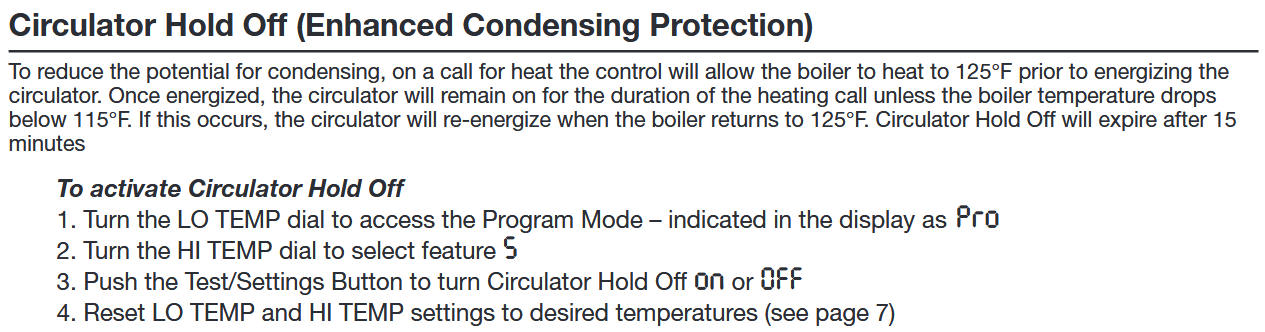
If you are using the circulator hold off feature on the hydrostat, then you have nothing to worry about.
But although your run time is fine for a system with that much water content, the boiler temp should be getting up quickly to and above 140, then probably hovering around there until the call for heat is satisfied. Regular calls for heat after the first call will probably run at a higher temp.
0 -
Chances are your Hydrostat hold-off for the circulator is not doing very much. With a gravity system design, you are likely getting thermosiphoning (gravity flow) even without the pump running.
Your new boiler needs to reach a return water temperature of approximately 135° to 140°F within the first 6 to 10 minutes of operation to prevent prolonged flue gas condensation. Every boiler will form some condensation on cold metal surfaces during startup. What matters is how long that condensation persists—you want that period to be as short as possible.
Boiler water starting at 60°–70°F (typical basement temperature) for ten minutes is not a problem, even if the burner runs for over an hour. As the boiler heats up, the flue gases will begin to evaporate any initial condensation once the internal surfaces reach a high enough temperature.
However, if the boiler water remains at or below 120°F for extended periods—such as during long morning run cycles—condensation will continue forming the entire time the burner is operating. This can significantly shorten the life of the boiler.
You should check the return water temperature at the boiler inlet (approximately 12 inches from the connection) to see how quickly it reaches 140°F. If it takes more than 10 minutes, a system redesign may be needed. If the return temperature reaches 140°F within that time, the system is likely piped correctly and should not be a concern.
Edward Young Retired
After you make that expensive repair and you still have the same problem, What will you check next?
 2
2 -
" the boiler does have the system bypass installed that redirects some of the supply water back into the boiler. "
Is there a valve to change the amount of bypass water flow ?
Make and model of the Hydrostat ? Maybe Hydrolevel 3250 ?
Although I did not know the Hydrolevel 3250 had a burner duration timing display function. Maybe it was 142 degrees and not 1hr 42 min ?
If you have a Hydrolevel 3250.
 National - U.S. Gas Boiler 45+ Years Old
Steam 300 SQ. FT. - EDR 347
One Pipe System0 -
@HomeOwner7 , read through the Hydrostat manual. The long run time is caused by letting the house cool off at night. Why, comfort? Even with a bypass and the circulator hold feature, those radiators are ice cold. High water volume? What is the Economy setting on the Hydrostat? You're not saving fuel by going low at night and trying to make it back up in the morning.
We also don't know the model boiler or the firing rate.
0 -
Thanks, Everyone, for the additional info. I have a few questions for now and a comment. I'll provide info regarding the system: boiler model, firing rate, etc. and more about how the system is operating a little later.
EdTheHeaterMan: If it takes more than 10 minutes to reach 135-140F you say "a system redesign may be needed." What would a "redesign" involve?
HydronicMike: You say if the Circulator Hold Off feature on the hydrostat is being used there is nothing to worry about. Can you explain further? Do you mean there's nothing to worry about even if the system is operating over an hour at less than 120F - as long as the Hold Off feature is active? Why would that be?
109A-5: Those were good thoughts about the possibility of my mistaking 1Hr 42Min for 142 degrees, but that did not happen. There isn't, as far as I know, any kind of burner duration timing display function attached on the boiler system. I've been writing down how the system is operating with pen and paper. Lots of enjoyment babysitting it. It, did, in fact, take 1Hr 42 Min, per the Hydrostat, to raise the water temp from 66F to 140F.
0 -
The hold off feature would allow the temperature in the boiler to increase before it starts to moving water out of the boiler. it will not decrease run time. it starts and stops your circulator. Not good for a circulator to start and stop all the time. Better to have a system bypass where the circulators runs for however the cycle runs
My question is in all that time it runs it takes an hour and half to satisfy the thermostat? if that's the case that's a lot of heat energy leaving your house. i think you need to get a home energy audit to have your house insulated, windows replaced, and whatever else is required to keep the heat in. keep the heat
0 -
" Hydrostat recently indicated it took 1hr 42 min for the system to raise water temp from 66F to 140F. "
" take 1Hr 42 Min, per the Hydrostat "
OK you have stated it twice now. I'm still a bit confused. To me the way you are writing it, it seems like the Hydrostat is the timing device. So actually you are siting there observing the Hydrostat for 1Hr 42 Min ? And the boiler and circulator are running the whole time ?
What is the timing device ???
The Hydrostat ?
The thermostat ?
A cell phone ?
A wristwatch ?
The clock on the wall ?
Other ?
National - U.S. Gas Boiler 45+ Years Old
Steam 300 SQ. FT. - EDR 347
One Pipe System0 -
Quote by pedmec:
“My question is in all that time it runs it takes an hour and half to satisfy the thermostat? if that's the case that's a lot of heat energy leaving your house. i think you need to get a home energy audit to have your house insulated, windows replaced, and whatever else is required to keep the heat in. keep the heat”
pedmec:
Yes, it takes an hour and a half -or more- and I guess, as you say, that’s a lot of heat energy leaving the house. Getting the house better insulated is good advice. I did have an energy audit years ago. I did what I could at that time to button up the house. Got the attic floor insulated, sealed up windows and doors, etc. I realize a lot more can be done but have hesitated doing, so for a variety of reasons.
Quote by 109A_5:
{per HomeOwner7) “ Hydrostat recently indicated it took 1hr 42 min for the system to raise water temp from 66F to 140F. "
*OK you have stated it twice now. I'm still a bit confused. To me the way you are writing it, it seems like the Hydrostat is the timing device.*
109A_5: My fault. The way I wrote that is misleading. Sorry ‘bout that. I’m not trying to say the Hydrostat is a timing device. I'm attempting to make it clear that the water temperature readings I’m stating I’m getting by my looking at the Hydrostat - not from a device attached onto a return pipe. I understand attaching a device to a return pipe is another way to find out what the water temp in the system is.
Thinking about the temp the Hydrostat measures raises a few questions:
1: What water does a Hydrostat measure? The water in the boiler tank?
2: How close/indicative of the temperature of the water in return pipes are the temperature readings I'm getting by looking at the Hydrostat? How useful are they?
Quote by 109A_5:
“So actually you are sitting there observing the Hydrostat for 1Hr 42 Min ? And the boiler and circulator are running the whole time ?
What is the timing device ???
The Hydrostat ?
The thermostat ?
A cell phone ?
A wristwatch ?
The clock on the wall ?
Other ?”
109A_5:
Yup. I’m sitting around in my house for 1hr 42 minutes observing what’s happening. Actually, much longer. I’m sitting in my livingroom, next to the wall thermostat, taking Set Point and Room Temp readings off of that, and then, every time I hear the boiler kick on, going into the cellar and taking H20 temp and PSI readings off of the Hydrostat. Good exercise. Hopefully not just an exercise in futility. LOL.
I use my computer or cellphone to record the times these things are happening
The more I learn about how these hydronic heat system work, the more respect I have for all of you techs out there who know your stuff. How everything works is really kind of fascinating. It seems to me being a good or GREAT tech requires a lot of brain power, knowledge, time, willingness to learn all kind of, shall I say it? c-r-a-p, but it's GOOD c-r-a-p!
I realize I know diddly squat. I’m just trying to learn what little I can, to qualm any concerns about whether the system install is operating as it should (or operating optimally - Imagine that.
As I’ve been sitting here writing this post, the system has kicked on twice for @ 7 minutes, at 4:56 AM and 5:23 AM. Both times I checked the wall thermostat monitor immediately after the system began running: Set Point 66. Room Temp 66. This is part of what I’m wondering about. If the wall thermostat is indicating the Set Point is at 66F and Room Temp is at 66F should the system be kicking on?
Another conundrum?
0 -
To clarify, the system:
-Turned ON at 4:56 AM ….Then OFF at 5:01 AM
-Turned On at 5:23 AM…Then OFF at 5:29 AM
So it ran 5 min, then 6 min before turning off.
Both times, immediately after the system began running, the wall thermostat indicated both Set Pt & Rm Temp as 66F.
0 -
Stop lowering the thermostat at night and you'll be fine.
Anytime the burner is firing with water temperature below 135°, its promoting condensing of the flue gasses. It should never take that long. Maybe an adjustment on the bypass is needed.
0 -
@HomeOwner7 asked: "EdTheHeaterMan: If it takes more than 10 minutes to reach 135-140F you say "a system redesign may be needed." What would a "redesign" involve?"
You may not need the redesign…. Does it take longer than 10 minutes for the return water to get to 135° or 140° (depends on the boiler manufacturer and the fuel you are using)
If you are operating at lower than 130° for more than 20 minutes then one of the redesigns would be to install a boiler protection valve like this one: Caleffi 280176A. So that heated water from the supply would be redirected to the return for the first few minutes of operation.
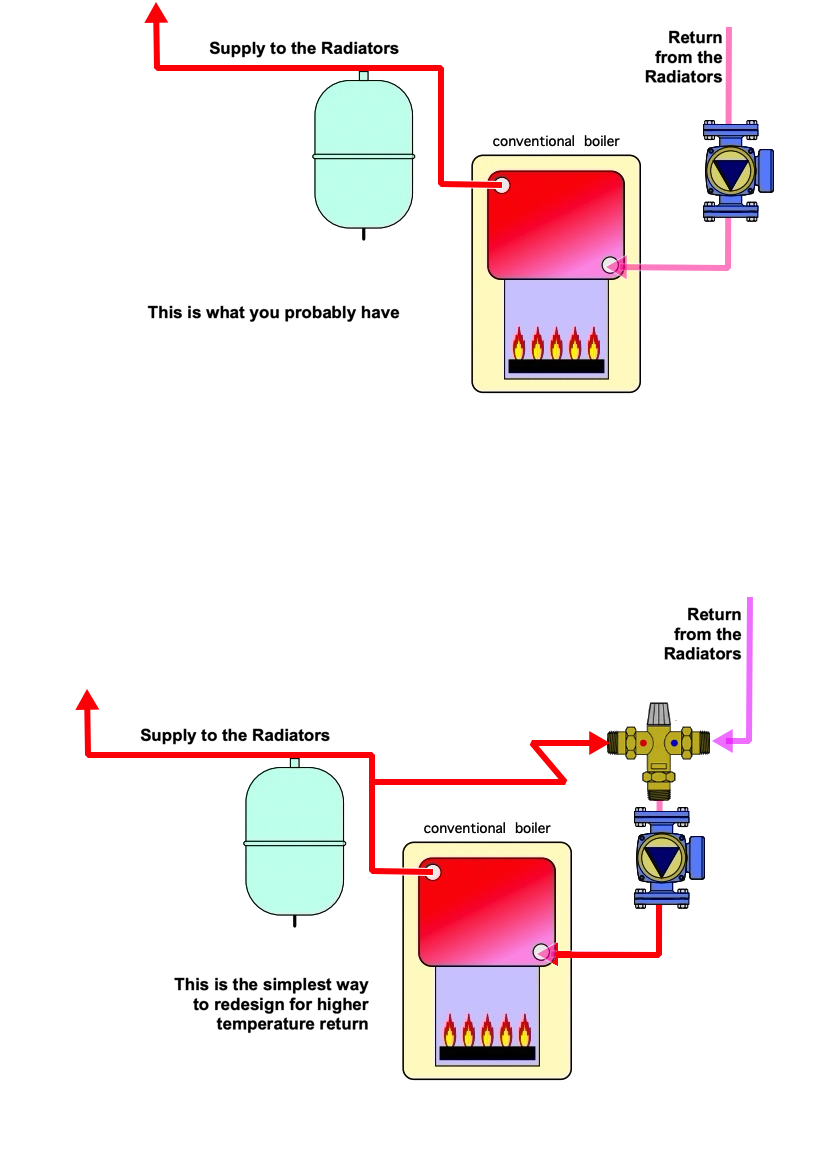
This will not let any heat go to the radiators until the boiler water return reaches 130° or 140°. When it is placed on the return to the boiler, that boiler’s circulator pump moves the water out of the supply side to the return. In the mixing valve the cold return water from the radiators will stay closed until the mix temperature reaches the setpoint of 130° or 140° depending on the valve model number.
Here is a diagram of the revised near boiler piping.
Edward Young Retired
After you make that expensive repair and you still have the same problem, What will you check next?
0 -
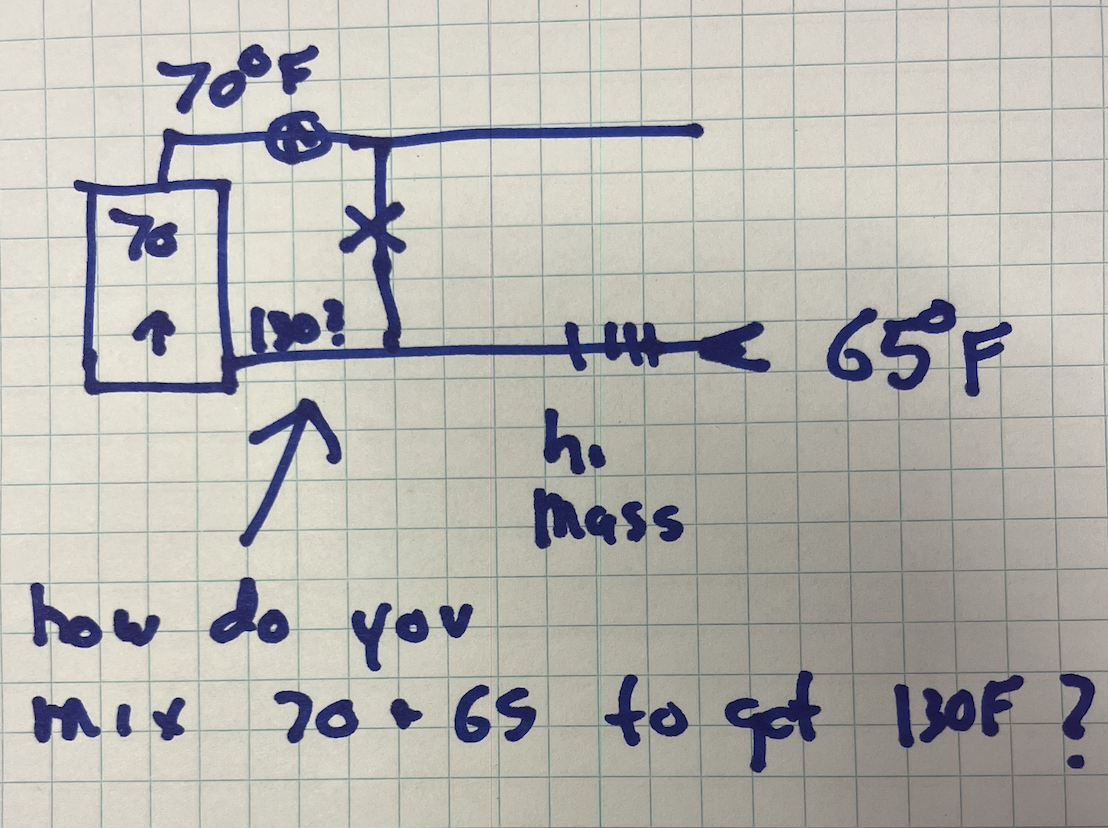
A properly sized and pumped boiler will raise the temperature from return to supply about 3-5° under load. So with high mass high volume systems that return may raise up from 65- 70°
With a bypass valve or even bypass pump you cannot mix those two temperatures to get 130 at the boiler return.
A "thermal clutch" regulated based on temperature at the boiler return is one sure way to protect the boiler, as Ed shows. A temperature controlled variable speed circ, properly applied can work also.
While holding off the circ with an aquastat does work, it can really short cycle that pump, on/off every few minutes until the system catches up, depending on the water content of the boiler.
Only adding a thermostatic function do you turn a "dumb" protection method into a "smart" control.
Granted there are systems with bypass valves or pumps that are somewhat better than nothing, and grossly oversized boilers can "mask" a return temperature issue with sheer horsepower.
So it becomes system specific, how much mass? How is the boiler sized to the load and heat emitters connected? The heat emitters (mass) and the volume of water in the pipes (gravity conversions) drive the thermal equilibrium of the system, not vice versa.
 Bob "hot rod" Rohr
trainer for Caleffi NA
Living the hydronic dream0 -
If you want to go crazy with your near boiler pipe redesign, then you can pump away from the expansion tank to the system and put a pump on the by-pass line that is operated by the return water temperature Adding a micro bubble air vent near the expansion tank will get rid of air from the entire system over a short time once the water temperatures get where you want them.
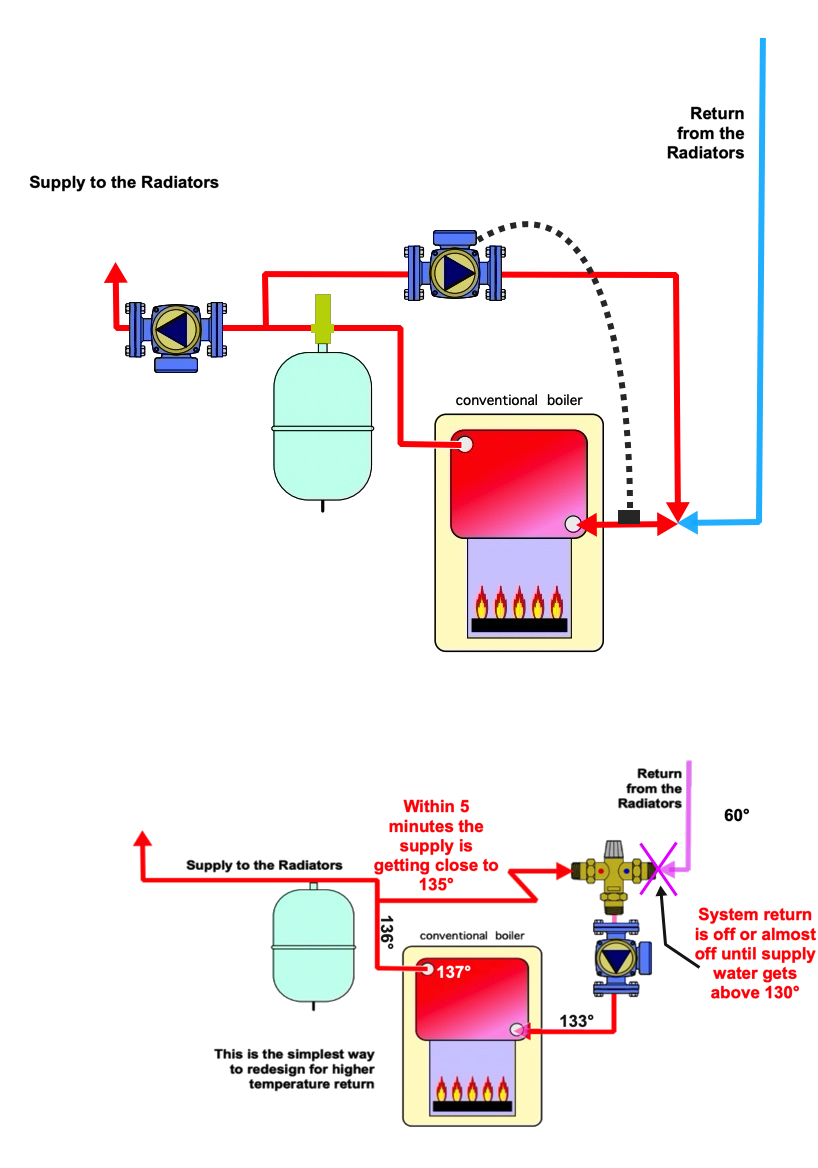
If your bypass circulator does not get the return hot enough soon enough, then the return temperature sensor can shut off the system circulator and bring on the bypass circulator until the return water is hot enough. This may short cycle between the two circulators, but there are some controls that can allow both pumps to run when the system reaches that sweet spot where the return water and the bypass water will share the return at just the right temperature. But now we are getting past "the simplest thing to do" stage of redesigning the near boiler piping, like the bottom illustration, and the price will reflect this.
Edward Young Retired
After you make that expensive repair and you still have the same problem, What will you check next?
0 -
I’m taking all of the info being provided here into consideration.
Ed and hot_rod: I’ve compared the system installed in my cellar to your diagrams.
Ed: In your post that begins with “If you want to go crazy”, the diagram that is at the top (not “the simplest way” diagram at the bottom) is closest to what I have in my basement. Imagine your diagram without the temperature sensor and replacing the circulator on the bypass piping with a ball valve.
HVACNUT: Your suggestion to stop lowering the thermostat at night, I get how that can help, but not so much for me. I like a cooler house overnight.
Is it possible that all the system needs to speed up raising the water temp to 120F to 140F in a reasonable amount of time is a few adjustments?
For instance, adjustments to the “Bypass Water Flow Valve” and ”Circulator Hold-Off Feature* on the Hydrostat.
I don’t know how these two pieces of equipment have been adjusted or if the Hold-Off feature on the Hydrostat is active and working.
Your thoughts?
It was suggested that I post more info about the system that’s been installed. I plan on doing that. It’s gonna be a big chunk of info to digest.
0 -
Enabling the Circulator Hold Off function and opening the bypass valve more or to 100% should be easy and quick to do, and see what happens. Since it appears your system has a large volume of water it may not shorten the boiler's run time during a recovery from an overnight setback but it may help reduce the condensation the boiler is exposed to.
National - U.S. Gas Boiler 45+ Years Old
Steam 300 SQ. FT. - EDR 347
One Pipe System0 -
I live in an area where we have gravity hot water systems still working. When we need to replace the boiler, I have had great success by using variable speed injection to not only protect the cast iron boiler from low return water temps, but it also allows the system to work with temperature modulation based on outdoor temp. These systems have design water temps typically in the 140F - 160F range and the homeowners always say that they love the warm radiators - not HOT - and the even outputs. We can keep those desirable traits while keeping the boiler from condensing during the burner cycle. The piping is not difficult, just make sure everything is sized according to actual heat load of the house. Tekmar #356 is the one we use.
0 -
So I just went thru this 2 years ago in my 104 year old house. My old boiler was 1 zone and I had to boil the ocean to heat the 45 gallons up to temp to heat my house. I also set back my house 3 degrees at night to save costs. So I completely understand. I didn't see or maybe I missed it, is the system zoned? If it is, meaning multiple return feeds, there still might not be zone values or multiple pumps. My system first thing in the morning took 1hr to heat the house. So your house is about 500sqft larger than mine. My solution was when I had my new boiler installed, we installed zone valves as to only heat as many zones as required heat in the morning. And now in 8 minutes my house is toasty.
0 -
Quote by TerrS:
*” I just went thru this 2 years ago in my 104 year old house. My old boiler was 1 zone and I had to boil the ocean to heat the 45 gallons up to temp to heat my house. I also set back my house 3 degrees at night to save costs. So I completely understand. I didn't see or maybe I missed it, is the system zoned? If it is, meaning multiple return feeds, there still might not be zone values or multiple pumps. My system first thing in the morning took 1hr to heat the house. So your house is about 500sqft larger than mine. My solution was when I had my new boiler installed, we installed zone valves as to only heat as many zones as required heat in the morning. And now in 8 minutes my house is toasty.*
TerrS:
You had to “boil the ocean to heat the 45 gallons up to temp” to heat your house? LOL. You have a way with words! 😊 You asked if the system in my house is multi-zoned. No, it is not, it’s 1 zone. I’m not sure what the way you had your heating system designed involves.
Would getting my 1 zone system set up like yours mean 1) simply having the kind of device I’ve seen demonstrated on the “This Old House” TV program that can be installed on each individual cast iron radiators? Or something else that would require a lot of rerouting of pipes?
Quote by TerrS:
*”And now in 8 minutes my house is toasty.”*
TerrS: Eight minutes!? Not Really!?
Quote by 109A_5:
*“Enabling the Circulator Hold Off function and opening the bypass valve more or to 100% should be easy and quick to do, and see what happens. Since it appears your system has a large volume of water it may not shorten the boiler's run time during a recovery from an overnight setback but it may help reduce the condensation the boiler is exposed to.”*
109A_5:
I’ll ask the installer if the Circulator Hold-Off is enabled and about opening the bypass valve more or to 100%. I’d like at a minimum to reduce the condensation the boiler is exposed to. The new system was just installed in January of this year. I'm more concerned about the condensation than the system operating an overly long time to heat the house. The install of this system was not inexpensive. I’d like it to last as long as possible.
Quote by willie13:
*”I live in an area where we have gravity hot water systems still working. When we need to replace the boiler, I have had great success by using variable speed injection to not only protect the cast iron boiler from low return water temps, but it also allows the system to work with temperature modulation based on outdoor temp. These systems have design water temps typically in the 140F - 160F range and the homeowners always say that they love the warm radiators - not HOT - and the even outputs. We can keep those desirable traits while keeping the boiler from condensing during the burner cycle. The piping is not difficult, just make sure everything is sized according to actual heat load of the house. Tekmar #356 is the one we use.”*
willie13:
The water pump on the system in my cellar is a Taco 007e. I don’t see anything on the Instruction Sheet about variable speed nor variable speed injection so I assume it doesn’t have that feature. There's no outdoor temperature sensor on the system, either.
I'm thinking piping for the kind of system you discuss would require changing the piping in my cellar? That’s an expense I’m not ready to take on.
The info you (and everyone else here) is sharing surely is helpful to homeowners like myself who are looking for info about how this stuff works. I wish I'd had the foresight to read about how best these systems can be designed before going ahead and having the system in my house replaced. So I would have been at least minimally informed about how the system could be designed. Always with the realization that, as I said before, I'd know, if I was lucky, maybe 1% of the Tip of the Iceberg of what there is to know about HVAC.
Questions about Taco 007e: I have a few questions about the Taco 007e water circulation pump that’s part of the hydronic system in my cellar. What is the protocol here in the HeatingHelp Forums? Should I ask that here in this discussion - or - start a new post/new discussion to ask about this and then, if what I found out is relevant to this discussion, reference that here in this discussion? Which is the acceptable way?
0 -
So a few more questions. You said you have radiators, which probably have 1.5in piping, im guessing but probably way bigger than my 3/4 copper with my baseboard elements. So depending on if you have a 2-pipe setup or single, meaning they are all in series, depends on if you could control it at the radiator itself.
You didn't mention do you have multiple returns back to the boiler? If you do I would buy a pump and run thermostats to control each of them, I am guessing your ocean is probably 75 gallons or more all circulating and heating at the same time due to your 1.45 hrs to heat.
0 -
@HomeOwner7 replied: "Ed: In your post that begins with “If you want to go crazy”, the diagram that is at the top (not “the simplest way” diagram at the bottom) is closest to what I have in my basement. Imagine your diagram without the temperature sensor and replacing the circulator on the bypass piping with a ball valve."
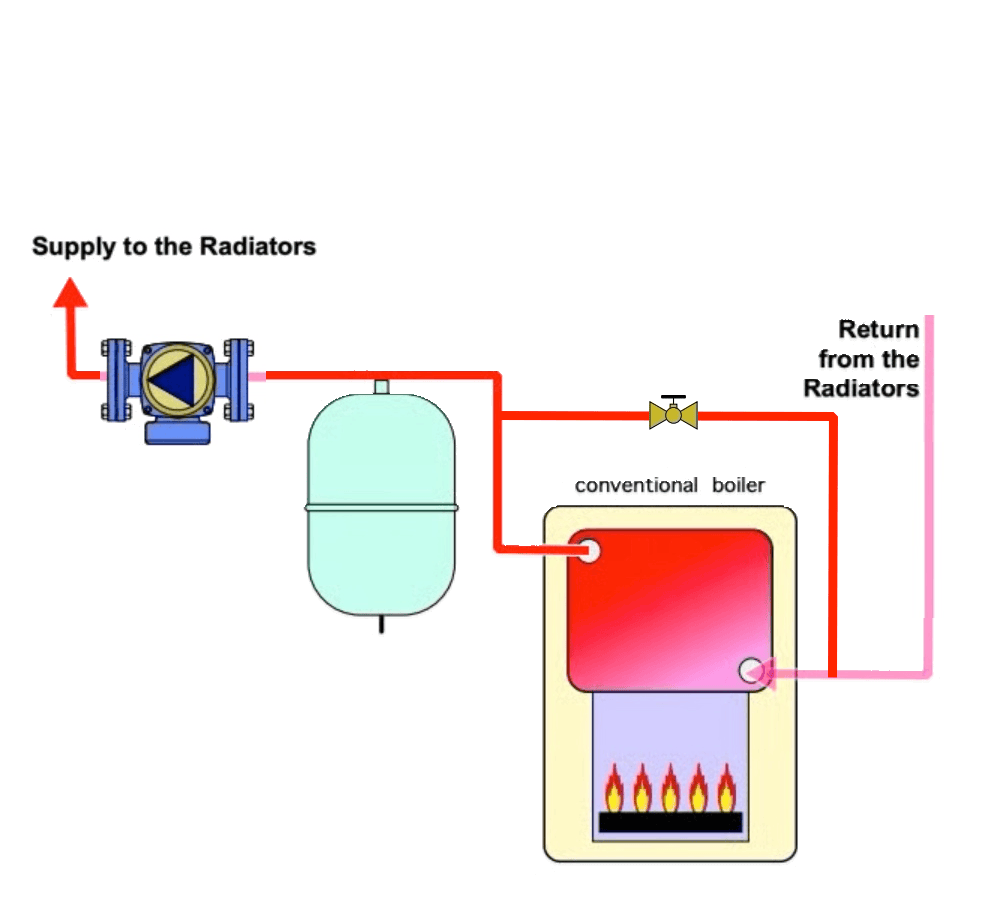
So this is what it sounds like your have:
In this diagram there is nothing to prevent the heated water from leaving the boiler and the cols water from the radiators from returning to the boiler when the circulator pump is operating or when the circulator pump is off.
There is also nothing that will direct the hot supply water to the return even of the bypass valve is fully open. as a result the boiler will take a very long time to get up to 140°. For that reason you will not get the bypass to do much of anything for you in preventing Flue Gas condensation.
As illustrated in this diagram by @hot_rod , without the pump to forcibly move the supply water back into the return to increase the temperature more quickly, you may as well just leave the valve closed on that bypass.
My reply to your question, “What would a redesign involve?”, assumed that the circulator pump was located on the return, as many systems still have that design flaw.
With a mixing valve and the circulator on the return pumping into the boiler, the “mixed” water entering the boiler will initially come entirely from the supply pipe of the boiler. The system return (from the “COLD” port on the mixing valve) will be effectively closed, while the “HOT” port is fully open. This allows progressively hotter water to be fed back into the boiler until it is producing water hot enough to maintain approximately 140°F (or at least 130°F, depending on the model number) at the return inlet.
Then, as the boiler temperature rises, the combined effect of gravity and circulator flow will begin to draw more water from the system return, allowing a greater proportion of cooler return water to mix in and supply the radiators with a greater amount of heat.
If you do have a circulator on the supply side of the boiler and it is pumping away from the expansion tank, then the redesign is straightforward: install an ECM circulator on the bypass and let it run full speed until the return water reaches about 135°F to 140°F. At that point, the pump can either shut off or ramp down to a lower speed, as long as the return water temperature to the boiler stays above the desired non-condensing temperature. Like the “If you want to go crazy” diagram… because you are already there and repiping for the mixing valve with the pump on the return will defeat the purpose of pumping away to remove air from the system.
I hope this makes it as clear as mud!
Edward Young Retired
After you make that expensive repair and you still have the same problem, What will you check next?
0 -
Ed, hot_rod, Everyone:
I’m attempting to digest all of the info. My brain is getting fried.
I mentioned earlier that I plan to post photographs of the system. I’m getting those ready. In the meantime, here’s the info about the system. It’s a lot of info. I’ve attempted to make it easy to view.
HOUSE
2 Story House
Built 1900s
2300 sq ft
I’m in Climate Zone Zone 6A or 6B
House is not very well insulated, leaky.
Insulation:
--Attic floor
--Kitchen wall-other walls are not insulated.
Windows:
--Some with newer storm windows
--Others have vintage storm windows.
2002: CONVERSION FROM GRAVITY HEATING SYSTEM
--- New Hydronic non-gravity Boiler System Installed
JAN 2026: HYDRONIC SYSTEM REPLACED JAN 2026
--Water began leaking onto the cellar floor from the boiler.
--The leaking boiler system was replaced.
--Hot Water Oil Fired
--Large pipes from original gravity system remain in place.
--Outside diameters of pipes in old gravity system that remain: 3 1/2” and 2”
—Cast Iron Vintage Old-Style Radiators original to the house, still in place.
--Rads are water not steam.
--Installer used J Manual calculations to determine size of boiler.
--Radiators were measured
--Sections of radiators counted.
WEIL MCLAIN WG04 BOILER
--Model P-WGO-4
--145,000 MBH
(1) CARLIN WM B-GO-4 EZ OIL BURNER
--Burner Nozzle Firing Rate: 1 Gal per Hr
---The “1 Gal per Hr. for the “Burner Nozzle Firing Rate” noted above is stated on the Proposal to have the boiler installed.
--The HVAC Tech who tuned the system wrote on the “Do Not Remove” tag that is hanging on the boiler system: “Nozzle .85”
HYDROSTAT: MODEL 3250-PLUS
H=Hydrolevel Company.
--Has “Circulator Hold-Off Feature” that “Holds circulator off until boiler reaches 125F”.
--I do not know if the “Hold-Off Feature” is active.
VALVE TO CHANGE AMT OF BYPASS WATER FLOW:
--Is installed as part of the system.
--The lever that operates it has been disconnected.
--Is hanging by a string tied to the copper pipes.
SUNTEC A2VA-3006-B OIL PUMP
--Cast Iron.
--Came as part of the Carlin EZ Oil Burner.
--13 days after Install pump cracked & began dripping oil
--Was replaced with a Becket pump.
Additional Info Re: SunTec & Becket Pump:
11 days after install of system at 2:48 AM: EXTREMELY LOUD shrill hissing noise occurred - gave the impression some sort of pressure was being released. It lasted only a minute or two, then stopped. Nothing out of the ordinary seemed to be going on in the cellar. Later that morning, before an HVAC Tech from the Installer Company came to check on things, I found a small amount of oil had dripped onto floor below the oil pump.
Two days later (13 days after the install), an HVAC Tech tuned the system. Oil had continued to drip, not much, about a tablespoon full a day. The Tech visiting found a crack on the Suntec cast iron oil pump under the pressure regulator screw. He replaced the Suntec oil pump with a Becket pump:
Here's the pump that replaced the Suntec oil pump:
BECKET CLEAN CUT PF20322 OIL PUMP
--4GPH 100-150 PSI
On we go…
(1) Caleffi 502015A Minical 1/8” Auto Air Vent
(1) Caleffi 57336A 1/2” Auto-Fill Combination Valve
(1) Amtrol Extrol 60 Expansion TanK
---1/2” Expansion Tank Service Valve
(1) Spiro-Vent VJR100TM 1”
-------Automatic Air Separator
(1) TACO 007e WATER CIRCULATOR PUMP
------This was included with the Boiler
------VM1816-HY2-FC2H07
------Stamped on Bottom: “Date: 9/22 22133“
-----------(2) 1” Isolation Shutoff Flange(s)
-----------(1) 1” Ball Valve w/drain
Note: I said earlier in this discussion that I didn’t see anything on the Instruction Sheet about the Taco 007e having variable speeds. I was wrong. The Taco is described online as being energy efficient, having “ECM variable speed technology”. There is no outdoor temperature sensor on the system. Ed: You referenced ECM in your latest post. I didn’t know what that was, looked it up, now know that means “electronically commutated motor”.
More…
OIL PRIMARY CONTROL:
--Carlin Model 70200 Universal
One last note: Our 30 year old wall thermostat we had replaced.
THE NEW WALL THERMOSTAT:
HONEYWELL Home FocusPRO
P200 Series Programmable Thermostat
MODEL TH200OU4004
--Installed in April @12 wks after install of new boiler system
--Adaptive Intelligent Recovery is activated.
--WAKE program----8:00 AM-10:00 PM 66F
--SLEEP program--10:00 PM-8:00 AM 70F
THAT’S IT for now.
I need to go rest my brain.
0 -
D0nt worry about your photos, I have a picture in my mind what you have based on your description.
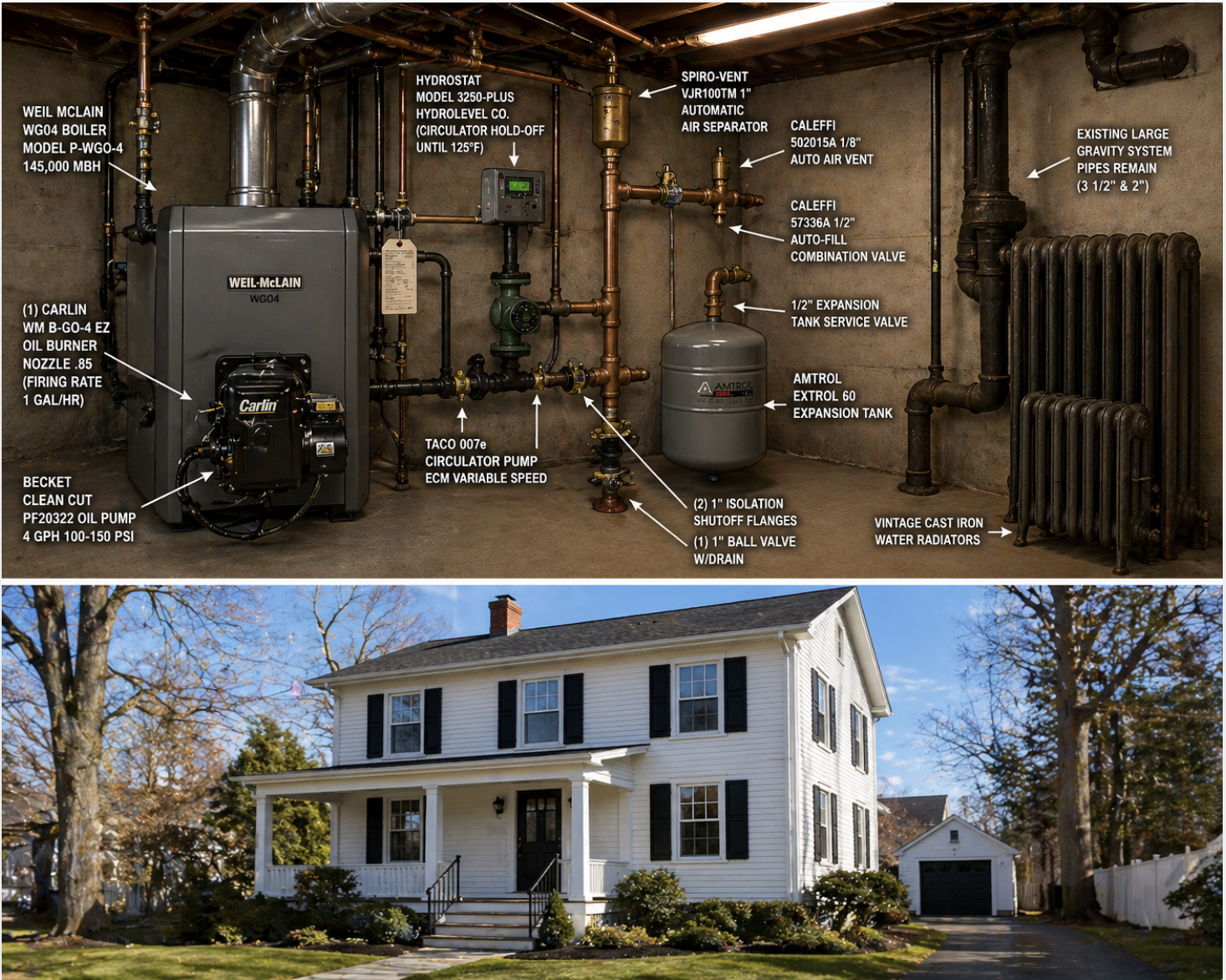
I know that some of the details might be off, but at least AI included them in the photo of the boiler room. even if they are not in the right place. How's my idea of what your house looks like?
Edward Young Retired
After you make that expensive repair and you still have the same problem, What will you check next?
1 -
I need to kick myself.
Hi, Ed:
I accidentally omitted what I wanted to say right at the very beginning of my last post. I meant to start off by saying (brace yourself):
Ed: In my earlier post I said - when describing the bypass - that the system in my cellar is just like a particular diagram of yours - only with a valve in the middle. I’m sorry to report that is wrong. The valve is downstream of the pump. I will post photos of the system to show exactly how it’s configured.
TerriS: I hope the photos I plan to post will provide the answers to the questions you asked. I’m not sure if I have a 2-pipe setup or single nor if there are multiple returns back to the boiler. Also, when I commented LOL when you referenced an “ocean” in one of your posts….. I think I’m catching on that “ocean” is a term HVAC industry professionals use. I didn’t have a clue.
I’m sorry I screwed up and gave the wrong information about where the bypass valve is located.
The AI generated image you created, Ed, that’s pretty cool. Thank you for taking the time to make it and post it here. I’m going to study it but if it’s based on the wrong info I wrote about the location of the valve, I’m thinking I still should post photos? The way the boiler is situated resulted in the pipes being routed behind the boiler - maybe seeing exactly how the pipes are routed is another reason to post photos?
Should I post the photos?
The second image in your post: That’s a fine-looking house but nothing like mine. The design of my house is best described as Arts & Crafts or Craftsman with Swiss influences.
0 -
@HomeOwner7 Post your photos. That AI hallucination is goofy, it is only for amusement.
National - U.S. Gas Boiler 45+ Years Old
Steam 300 SQ. FT. - EDR 347
One Pipe System
 3
3 -
This might be a longshot…
Is it a HydroStat 3250 with an outdoor reset sensor installed? With the outdoor reset sensor installed the economy dial becomes the reset ratio control. If the reset ratio is wrong and the boiler temp is too low to satisfy the thermostat, the outdoor reset Thermal Boost feature will boost the reset temperature by ten degrees at thirty minute intervals, until the thermostat is satisfied. According to the literature.
If the outdoor reset sensor is installed maybe try disconnecting it to let the 3250 Thermal Targeting take over and see if things improve.
0 -
Wouldn't that shut off the burner to limit the water temperature ?
Also @HomeOwner7 stated " There is no outdoor temperature sensor on the system. "
National - U.S. Gas Boiler 45+ Years Old
Steam 300 SQ. FT. - EDR 347
One Pipe System0 -
I thought AI did a great job of confusing everyone. Just shows that Artificial Intelligence isn't ready to take over the job of boiler room repiping. My version of AI would be to use Actual Intelligence for setting up your nar boiler piping. Your installer may not have had any Actual Intelligence regarding flue gas condensation and why you dont want that to happen.
Please post some Photos!
Edward Young Retired
After you make that expensive repair and you still have the same problem, What will you check next?
0 -
Quote by 109A_5:
“…That AI hallucination is goofy, it is only for amusement.”
Quote by EdTheHeaterMan:
“I thought AI did a great job of confusing everyone. Just shows that Artificial Intelligence isn’t ready to take over the job of boiler room repiping.”
109A_5, Ed: I’d only given a quick glance at that AI image before I posted last time. The AI’s idea of what a system with those components would look like is bizarre. We can’t always trust AI, that’s for sure.
Weaver6m:
Thank you for the info, however, the system in my cellar does NOT have an outdoor reset sensor installed. I think the way I stated what I had to say (“There is no outdoor temperature sensor on the system.”) makes it way too easy to miss the word “no” and think I’d said just the opposite.
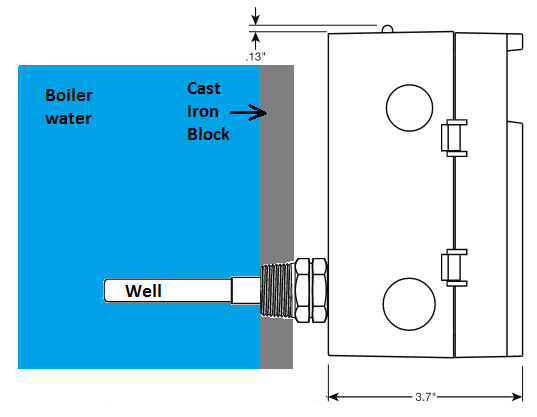
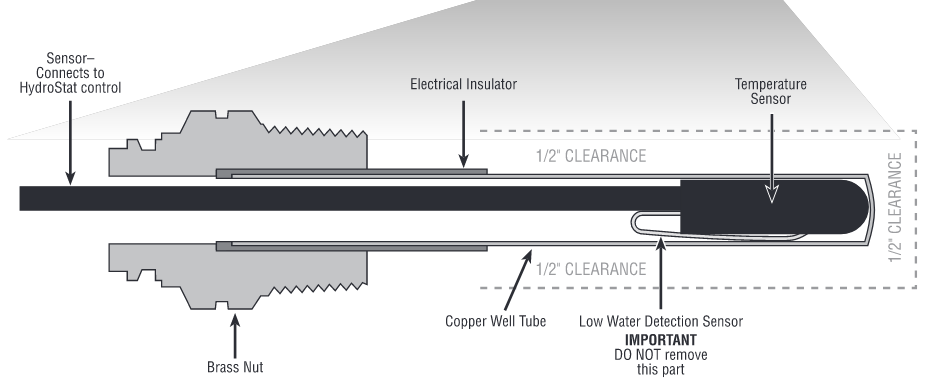
Regarding the Hydrostat: I tried to find out what the Hydrostat is measuring and got what seems like two different answers. Online resources state Hydrostats measure the temp of water in the boiler, but a Weil McLain Customer Service Rep told me Hydrostats measure “the boiler block which is the heat exchanger”. “Boiler block” sounds to me like something other than water is being measured. Are those two answers essentially saying the same thing?
I’m finding I’m not a big fan of the “learning/Adaptive Recovery” feature on the HoneyWell thermostat that was installed. I plan to disable the “learning” function and program it so I will know exactly when it is going to command the Boiler to kick on.
I’ve been relying on the Hydrostat so far for temp readings of the water in the Boiler. I also want to get a good idea of the temp of the water leaving the boiler through the copper line, in the return pipes, and traveling through the bypass, and learned about a gauge that can be strapped onto the water pipes, so I went ahead today and ordered two of these:
PLUMBFLEX 2.5 in. Clamp-On Thermometer Gauge with 30F to 250F Temperature Range.
I hope these thermometers will provide decent readings. I should be able to pick up them up next week.
I may wait to post photos until after I’ve taken more temp readings using the PLUMBFLEX thermometers.
I’ll follow up no matter what as to what’s happening with the system.
In the meantime, I’m having a hard time getting my head wrapped around the idea that water in the return pipe can be raised up to 140F within 10 minutes or so of a cold start. The Hydrostat in the system in my house indicates the water temps in the boiler system typically range from 60F to 65F before the Thermostat Awake program kicks the Boiler on to operate.
0 -
The boiler block is the Cast Iron Heat exchanger. The temperature the Hydrostat is measuring it the water inside the boiler or Cast Iron Heat exchanger. The Hydrostat typically has a Well that enters the Cast Iron Heat exchanger to sample the water temperature in a place where the Well is surrounded by water. The sensor is in the Well.
National - U.S. Gas Boiler 45+ Years Old
Steam 300 SQ. FT. - EDR 347
One Pipe System0 -
Your overall system has so much water in it that when the boiler fires the water in the boiler needs to be almost stagnant until it gets to a temperature that minimizes condensation. Then slowly the water is circulated into the rest of the system while managing not to cool down the boiler too much. As the overall water temperature increases the water flow could increase. There are different ways to manage this process. Some work better than others. Some cost more than others.
National - U.S. Gas Boiler 45+ Years Old
Steam 300 SQ. FT. - EDR 347
One Pipe System0 -
The strategy you are proposing here is exactly what the original gravity system would have done all by itself with no fancy controls, circulators, valves or anything else.
Our attempts to "modernize" things often leave us with really complicated systems that are less reliable and more difficult to maintain, but I am enjoying this discussion.
0 -
The best information is gained by observing the boiler operate. Set up a chair and record data there.
When you fire up the zones, how long does it take for the return, right at the boiler, to reach 130°? Ideally every time the boiler fires it should reach 130 within 10 minutes or so. If you can do this on a cold day you get a realistic pic of design day operation. Record data on a mild heating day also to notice the run time differance.
The boiler also needs to operate long enough to assure the venting warms up to prevent condensation damage in the flue or chimney. A good run cycle is around 10 minute to warm return to 130, and a 20 minute run cycle when fired.
These numbers crunch together to determine your "run cycle"
In a perfectly sized system, the boiler would run non stop on your coldest design day. The boiler adding heat energy at the same rate the home ids losing energy.
With todays modulating boilers that is quite attainable. You system will cycle as loads change, shoot for longest possible run cycles.
The best boiler protection methods are like "slipping the clutch" blending the flows as the boiler operates at a safe temperature. This requires a device that measures and responds to temperature at the boiler. It can be a valve, or and injection pump piping method.
It always comes down to how much time and $$ you want to invest to getting the best results?
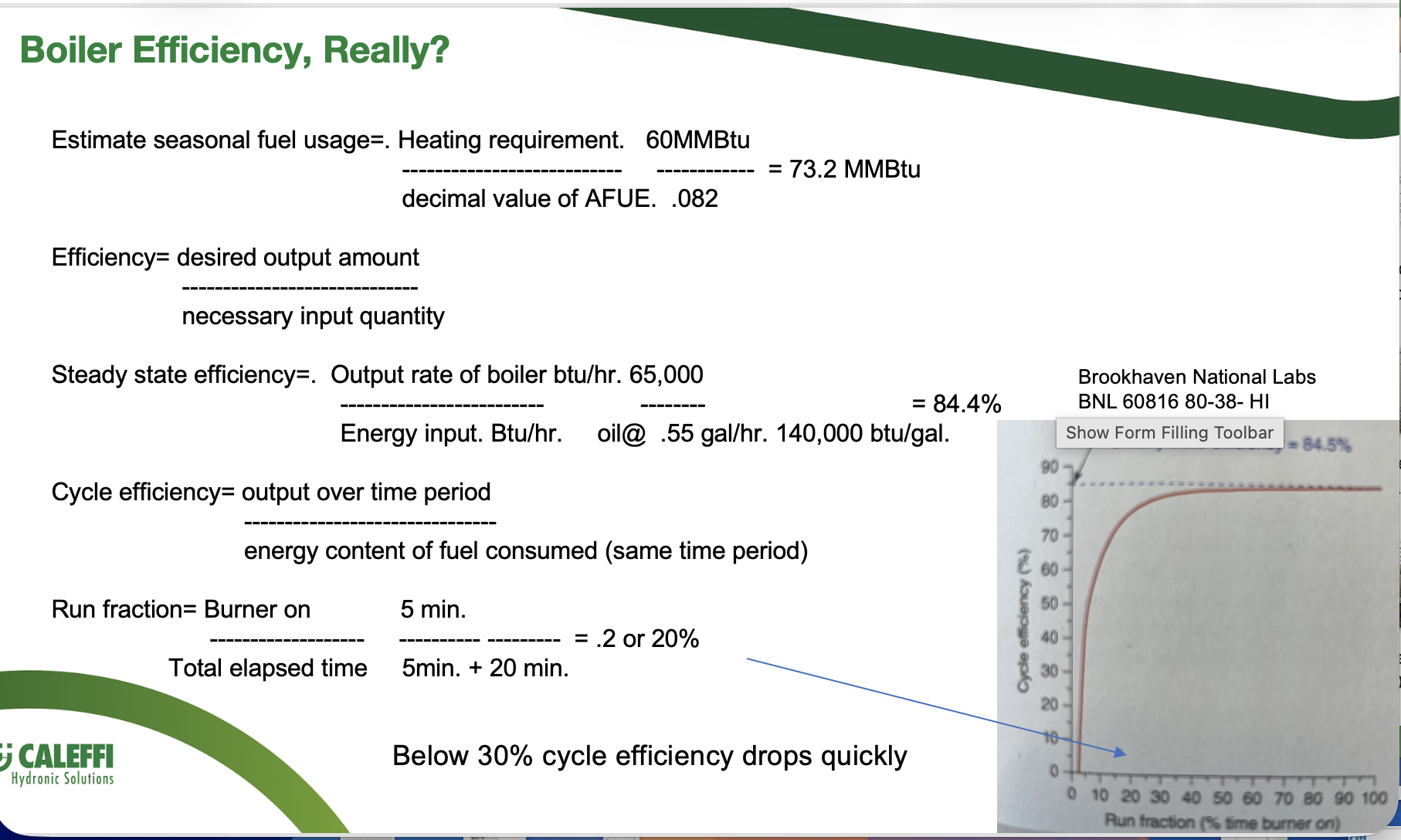
This slide explains the various efficiencies, and the bottom line to where the boiler is actually running. In this example the boiler on for 5 minutes, off for 20. The run fraction is 20%. Plotted on the graph the boiler is running below 80% efficient, around 75% or less.
Notice the steady state is more like 84%, a realistic number.
.
Bob "hot rod" Rohr
trainer for Caleffi NA
Living the hydronic dream0 -
Maybe, but I think circulating the water would provide a more even heat than gravity flow. And I bet the old boiler had to get a lot hotter to heat the house. And may have taken a lot longer to recover from an overnight setback.
National - U.S. Gas Boiler 45+ Years Old
Steam 300 SQ. FT. - EDR 347
One Pipe System0 -
We really need to see pictures of his boiler setup i need to see his return and supply lines. Because with those pipe sizes he is boiling 2 oceans of water to 180 degrees
2



Categories
- All Categories
- 87.8K THE MAIN WALL
- 3.3K A-C, Heat Pumps & Refrigeration
- 60 Biomass
- 430 Carbon Monoxide Awareness
- 133 Chimneys & Flues
- 2.2K Domestic Hot Water
- 6K Gas Heating
- 124 Geothermal
- 170 Indoor-Air Quality
- 3.9K Oil Heating
- 79 Pipe Deterioration
- 1.1K Plumbing
- 6.7K Radiant Heating
- 397 Solar
- 16.1K Strictly Steam
- 3.5K Thermostats and Controls
- 56 Water Quality
- 51 Industry Classes
- 51 Job Opportunities
- 18 Recall Announcements