Hydronic Radiant Water Temp

I'm building a house in upstate NY, doing my design in LoopCAD.
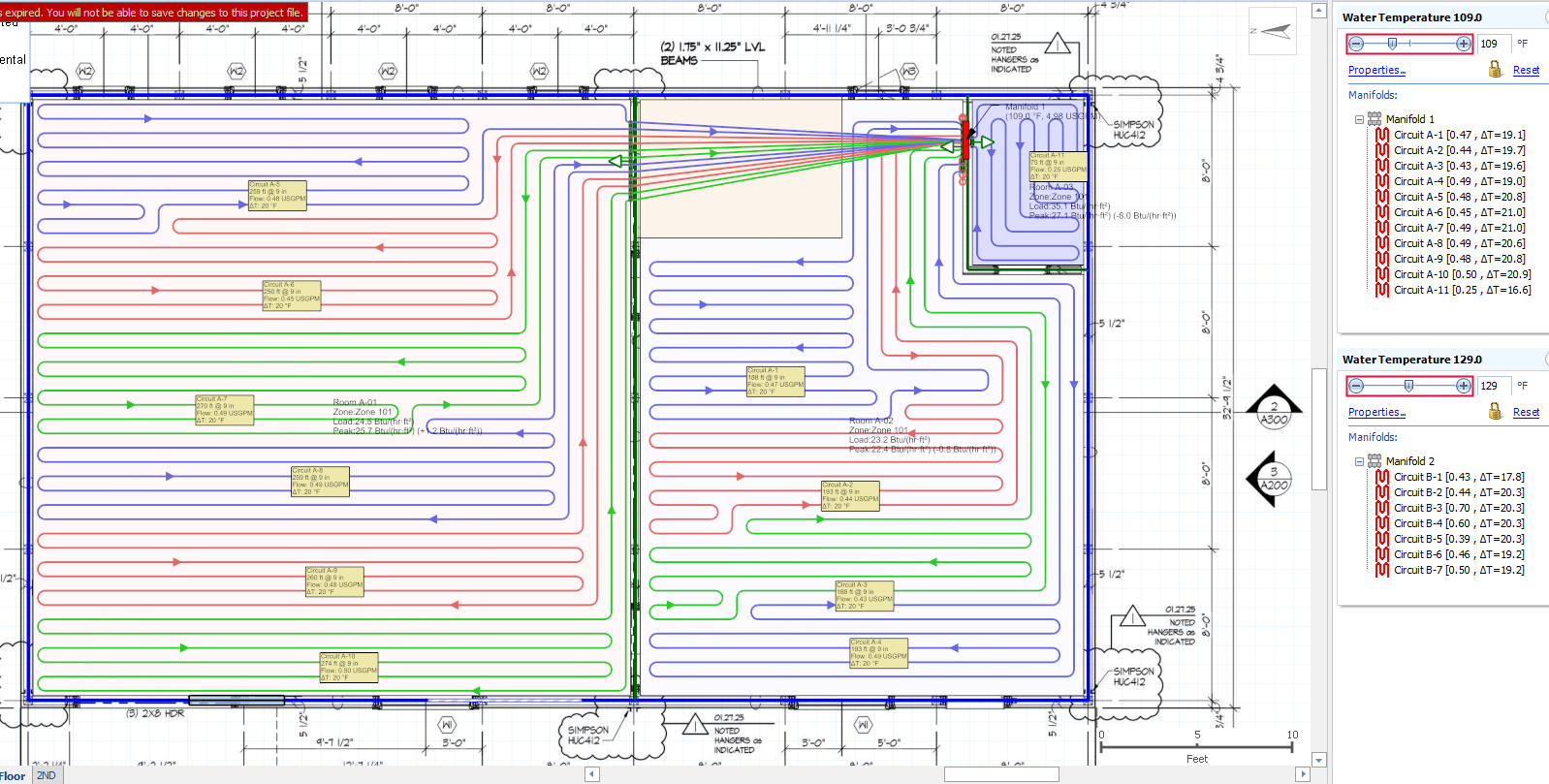
1st Fl is slab on grade, with 1/2" pex on 9" centers (6" on perimeter) - installed and concrete poured.
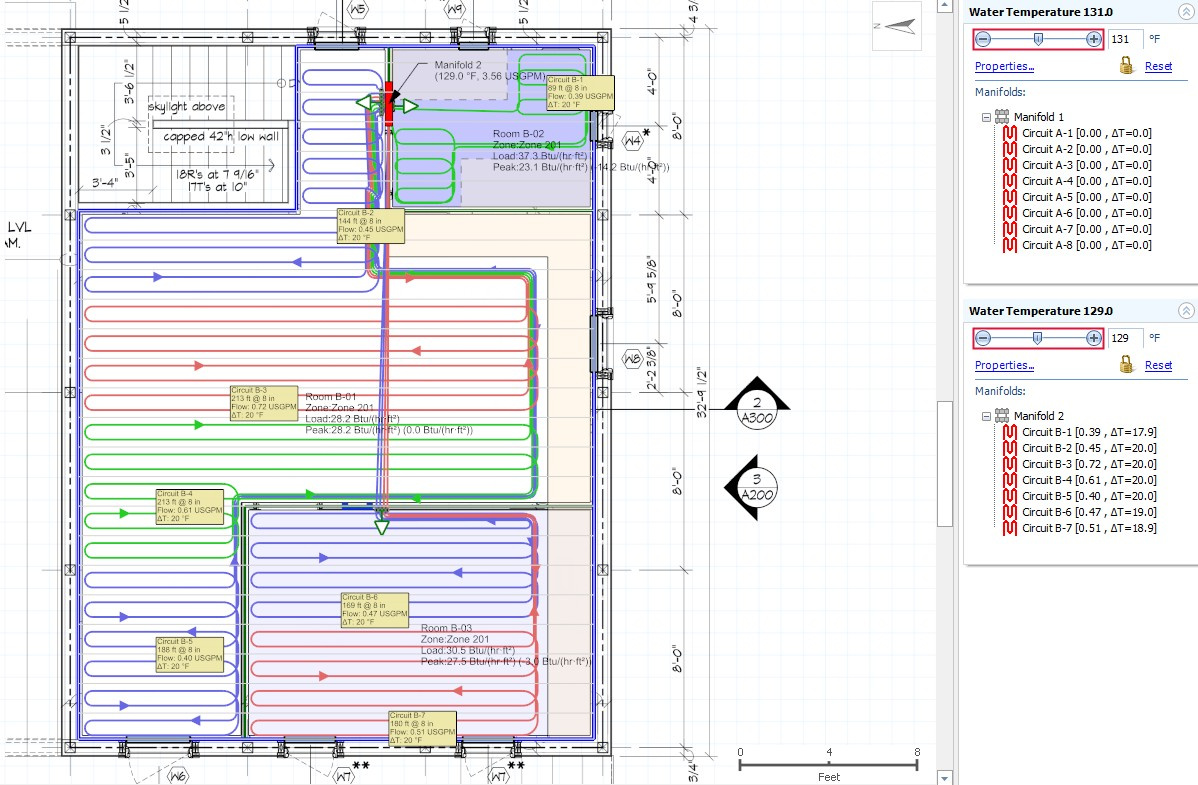
I later decided I wanted to do underfloor heat-transfer plates for the 2nd floor apartment which will have engineered bamboo flooring - truss joists are 16" OC for the most part. However, I'm coming up with different water temps for each floor - 109F for 1st floor, and 129F for 2nd floor.
These seem high to me, but probably fine for concrete floor I assume. For the second floor, this seems like it will be too hot for the flooring.
Also, the second floor bathroom (top right), is under heated, not sure how I can fix this…
Any advice is appreciated!
Comments
-
your room loads seem high fir new construction? That high btu/ sq ft load is what drives the supply temperatures
I see would expect loads in the 20’s even the teens per sq ft?
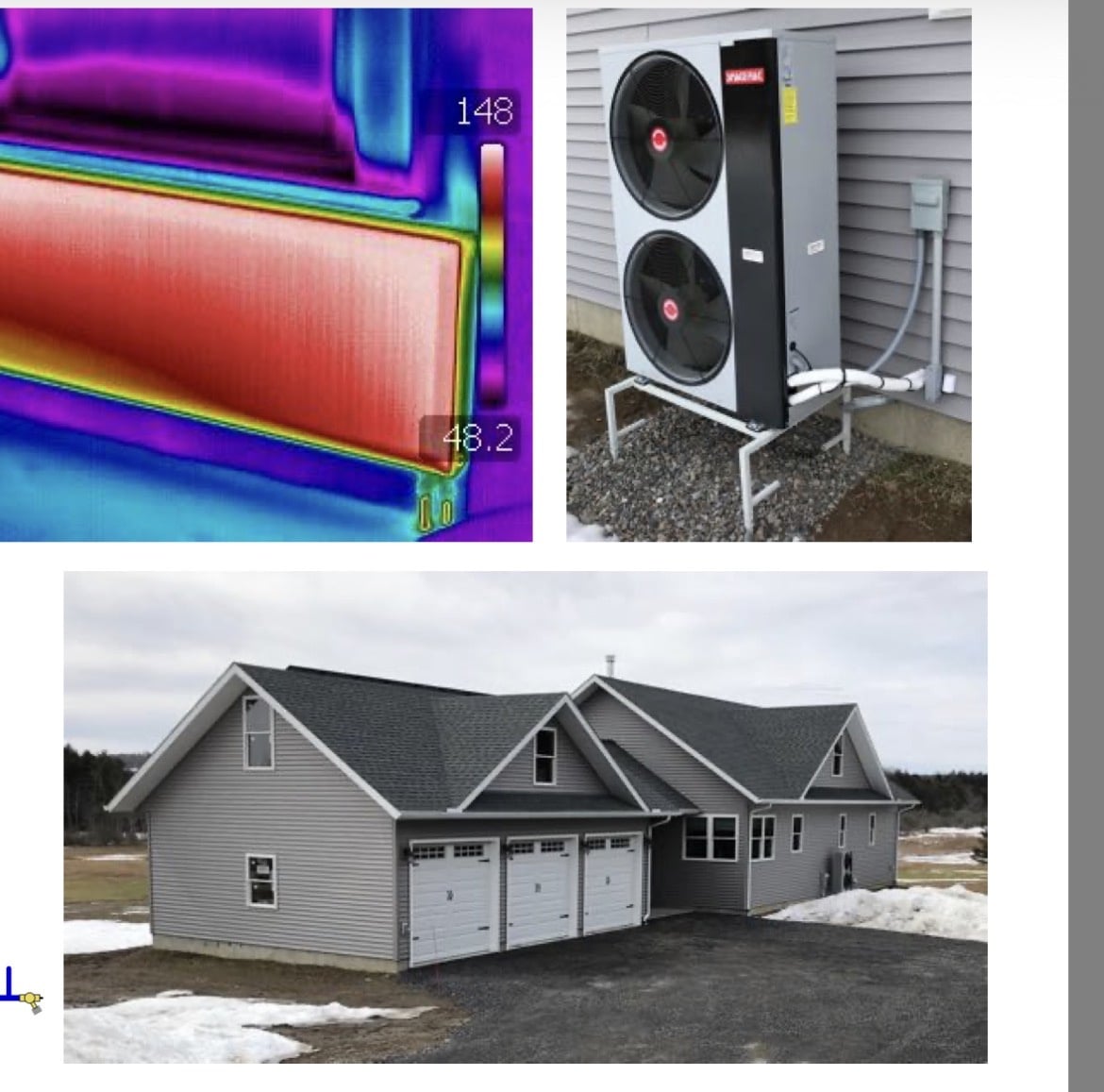
A friend built this home above Utica NY , a few years back with average loads around 23 btu/ ft
Panel l radiators and an A2whp
 Bob "hot rod" Rohr
trainer for Caleffi NA
Living the hydronic dream1 -
You need to get a better handle on your actual heat load, for that you need a proper Man J. Anything code min (2x6 construction with sub 3ACH@50PA) will be well under 20btu/sqft.
Once this is sorted, what you end up finding in new construction, the loads are low enough that the floor will never be warm, never mind hot, if you have 100% coverage. Getting a handle on the load will let you reduce the piping a fair bit.
I live with bamboo click over heated floor and has been nothing but trouble. The issue is it is dimensionally unstable and start pulling the floor apart in the winter time. Mine is solid, engineered would be better, but I would still watch unless the manufacturer specifically allows for heated floor.
1 -
For wood floor , low temperatures but also humidity control will keep the movement to a minimum
Engineered wood flooring works best with radiant . I used a brand that has all hardwood plys. The cheap brands with particle board or softwoods core tends to dent or damage easily.
Bob "hot rod" Rohr
trainer for Caleffi NA
Living the hydronic dream0 -
Thanks for the responses and pointing out the high loads.
When I did the 1st floor design, I must have skipped some steps as I was focused on just getting the loop drawing.
The bamboo flooring by Ambient BP I'll be using has plywood cores below and is rated for radiant use. I have a sample and it looks fairly high quality.
I re-ran the calcs and 1st floor loads are 10.3-14.8BTU/sqft. 2nd Fl is 15.3-16.3 BTU/sqft.
However, the second floor bathroom is under-heated, requiring 23.3BTU/sqft. I think I can go ahead and add radiant under the bathtub, but it won't be enough. I assume I can raise the water temperature for that loop especially since it will be tiled but I don't know yet how this actually works. Does that mean having this on a separate manifold with its own mixing valve and circulator?
I have seen watched some Youtube videos about installing these systems, but if you have any recommendations for resources on the design and install of the plumbing side of these systems I would appreciate any leads!
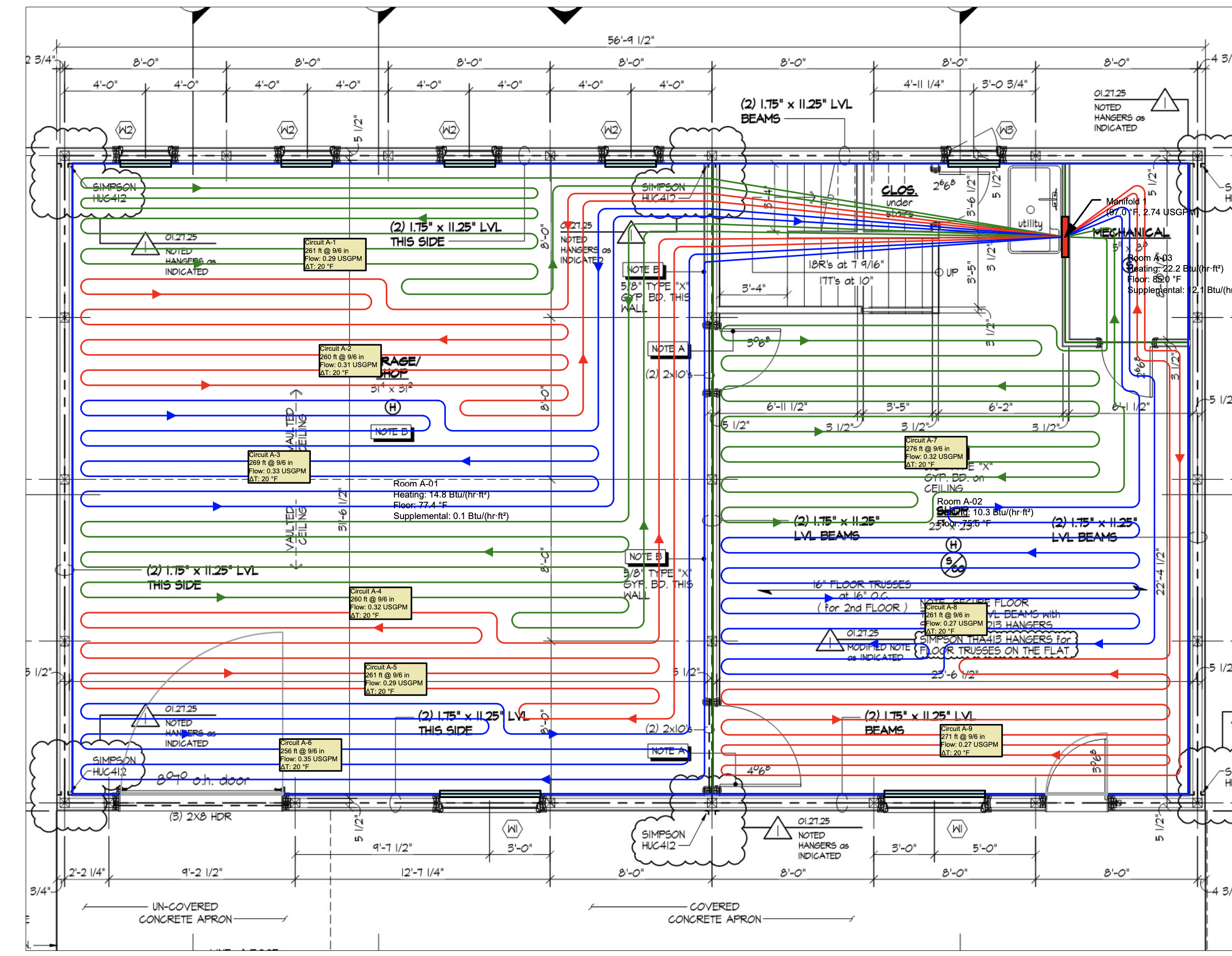
Edit - added updated plans
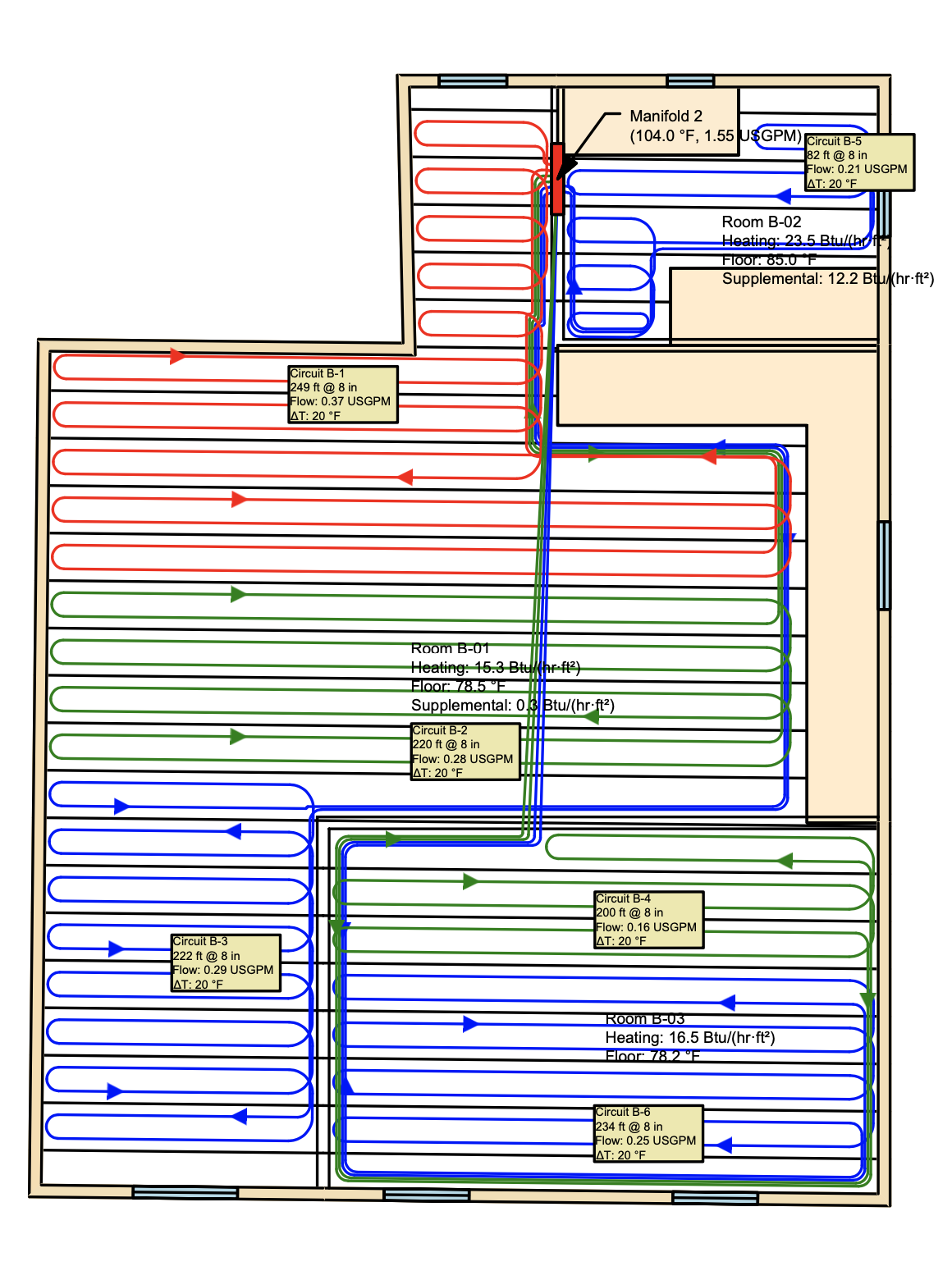 0
0 -
Higher temps for a single zone are very hard with an AWHP. About the best way to do it is a small in-line resistance heater to bump up the temps otherwise you have to raise the supply temp for the whole house which reduces your COP.
Instead, install a hydronic towel warmer to make up for the difference. This can run in parallel with your floor heat, so no need for higher temp.
Another way to add extra area is to do heated walls.
1 -
This is going to be a propane boiler fired hydronic system with indirect water heater for DHW. Another commenter posted the AHWP, I assume that threw you off. Does your comment still apply in this case?
Thanks
1 -
have you made sure that the upper level areas are set for the area under them being heated? (assuming of course the space under that room is heated) you can right click the room, select room properties, and then floor, look at the field labelled "space below"
1 -
I would look at running the loops behind the tile in the shower walls using radiant plates. The shower area will help heat the room, keep it all one temp. The tile is not really warm to the touch, it is not cold either. You know it's just nice and comfortable. You don't feel the heat but the body is not losing the heat to the tile so you don't feel cold. Just make sure you have a good layout mapped out, so if or when you need to add grab bars you knows where you can mount them.
0 -
I would add one of these to bathroom wall. It will keep your towels warm and radiate some heat toward the occupant. https://www.supplyhouse.com/Runtal-RTR-2924-24-x-29-Radia-Hydronic-White-Towel-Radiator-RTR-2924
"If you can't explain it simply, you don't understand it well enough"
Albert Einstein0 -
an electric towel bar would supplement for the few design days. Plus you can run it in the summer to warm towels. I put mine on a timer also
Bob "hot rod" Rohr
trainer for Caleffi NA
Living the hydronic dream0 -
We have limited ceramic tile in our master bath which has shower, WC and tub.
The other half is walk in closet that has carpet.
The ceramic floor is on 1 1/4" of plywood so heat transfer is limited.
For additional heat, I put wall heat in where possible on inside walls.
Extruded plates are used with insulation behind them. The plates are configured just like the under floor installation. The flats of the plates are pushed against the SR. An inside corner of 24" by 24", wall above tub is 6' x 5', tub skirt is 2' x 6'.
This room is on the NW corner with 2 outside walls and one window. We keep it at a constant 74 degrees. Northern Nebr. Happy wife…..happy life.
0



Categories
- All Categories
- 87.8K THE MAIN WALL
- 3.3K A-C, Heat Pumps & Refrigeration
- 60 Biomass
- 430 Carbon Monoxide Awareness
- 133 Chimneys & Flues
- 2.2K Domestic Hot Water
- 6K Gas Heating
- 124 Geothermal
- 170 Indoor-Air Quality
- 3.9K Oil Heating
- 79 Pipe Deterioration
- 1.1K Plumbing
- 6.7K Radiant Heating
- 397 Solar
- 16.1K Strictly Steam
- 3.5K Thermostats and Controls
- 56 Water Quality
- 51 Industry Classes
- 51 Job Opportunities
- 18 Recall Announcements