Gas boiler multizone apartment systems need heat turned off, hot water kept on

Gas boiler multizone apartment systems need to have the heat turned off for the summer, while keeping the hot water supply on. Some boilers are very old, from 1971 HB Smith brand, others are a few years old McLeins. Most of them have the high and low aquastats.
Thank you
Comments
-
You need a boiler management control system. Tekmar and Heattimer are just 2 that come to mind off the top of my heat. There are tons of these available.
0 -
If you producing domestic HW from the boiler system your boilers should be all set up for this. With your thermostats turned down you should get no heat but should get domestic HW.
If it doesn't operate correctly you could have a bad zone valve a bad flow check valve and the aqustat settings could be out of adjustment.
1 -
The information given so far is insufficient to answer the question asked.
- We know this
- there is more than one boiler
- some are HB Smith that are old from 1971
- some of them are Weil McLain that are newer
- these boilers produce space heating and domestic hot water
- most of the boilers have 2 aquastats.
- We don't know this
- how many boilers there are
- if the boilers are in the same building or if the boilers are in separate buildings: like one boiler per building.
- what size boilers they are
- are the boilers manifolded together as one large system or if there are separate systems
- how the boilers make hot water
- indirect tanks
- heat exchanger coils with storage tank(s)
- tankless coils inside the boilers
- or some other potable hot water source that is heated by the boiler(s)
- what existing controls are on the boilers
- what controls the hot water temperature
- what controls the room temperatures in the apartments
- if there is even a problem with apartments over heating in the summer as a result of the hot water operation
But without that additional information, we can all answer this with the experience we have all had on similar buildings. I remember shutting down a 220,000 BTU boiler for the winter that was only used to generate heat that goes into a shell and tube heat exchanger that fed a 2000 gallon domestic hot water tank that was covered with 3 inches of asbestos insulation with a plaster coating that was in pristine condition. the reason for shutting the boiler off for the winter was that no one lived in the building in the winter and the entire building was drained of water to prevent freezing water damage.
But that info won't help in this case.
EDIT:
The more info we have, the lower the cost of the solution to the problem: For example @pedmec solution is a complete control system for thousands of dollars. @EBEBRATT-Ed solution is to repair something that is already there. That has to be less expensive.
And since some of those boilers are from 1971, I believe that this situation has come up at least 54 times over the last half century. But that is just a guess
Edward Young Retired
After you make that expensive repair and you still have the same problem, What will you check next?
0 - We know this
-
I was under the impression he was looking for something new to upgrade the old.
0 -
I thought he has 5 boilers in one building. but the more I thought about it, I believe there are many buildings with individual boilers in each building. Why would you have several boilers manifolded together and have 1971 boilers in the same system as boilers that are only a few years old? Makes no sense. that is when I thought of separate buildings. BUT… I am only guessing like you.
@4343 needs to offer more details.
I wonder if that is a new member that replaces @4321 from the other building down the parking lot of the apartment "systems" 🤣
Edward Young Retired
After you make that expensive repair and you still have the same problem, What will you check next?
0 -
I just found all these comments in the blog, had no clue they were in here. Sorry, I just signed up, and I'm still learning my way with the website. To clarify, there are total of 20 buildings in the development, built in the late 1940's.. Some buildings have 15 apts, others 20-25 apts. serviced by a single boiler. They all have radiators, mostly still the original plumbing, the boilers provide heat and hot water.
My question is, with the warm wether around the corner and ni need for heating how do I set up the boilers so they still supply hot water, and the heat is off
.
0 -
Every boiler room has a heat exchanger for making hot water. The heat for the apts. is controlled by the boiler settings. There are no individual radiator controllers, very outdated setup
0 -
If it has been installed for years it probably already does what you want it to do. You will find a aquastat (hot water control) that probably senses the boiler water temperature.
It could be set at a temperature from about 140-180 deg 160-180 is probably the most common. This control is referred to as a low-limit and maintains the boiler at the minimum temp required to provide domestic hot water 24/7.
How your heating system is controlled is another matter. You could have thermostats in every apartment to control zone valve and or circulators or it could be all one zone based on outdoor air reset.
The wiring for the heat and the wiring for the DHW come together usually to start the boiler. When the heating system is not calling for heat it should still work for DHW.
You may not have the most efficient system but that is the way it was done.
1 -
You still need to provide more info. Are you saying the boilers are supplying hot water thru a tankless coil, indirect fired hot water heater. or storage tank? maybe even a sidearm instantaneous? You state one boiler per building if i am reading right? You dont say the type of water heater.
All the old buildings that i take care of use a outdoor temperature control (Honeywell T678 or similar) that turns the circulator on. This is the rudimentary way of suppling heat to the tenants prior to the advent of logic control. Boiler stays on year round so the hot water, if boiler is being used to provide the hot water, is always available. A flocheck valve or valves depending on piping prevent gravity flow during the no heat demands. This is the basic setup for older buildings that haven't
0 -
From the photos you sent me via PM, it appears that your boilers use the Honeywell T775 Series 2000 Electronic Stand-Alone Controller. That control can manage boiler staging well in buildings with two boilers, but preventing summer heat migration into the space-heating zones is mostly a piping and flow-control issue, not just a control issue.
In systems with shell-and-tube domestic hot-water heat exchangers, like the photos show, the boilers often fire in summer to maintain DHW temperature. When that happens, heat can migrate into the space-heating loops by gravity circulation (thermosiphoning) or through leaky zone valves. You should not need to do anything to prevent this from happening, since the systems have been operating this way for as long as they have been in service.
The only time you need to address this is when a tenant experiences gravity circulation on an individual basis. If that happens, there is usually a valve stuck open when it should be closed. A temporary fix is to shut off the manual service valve to that zone until you can repair the defective zone valve or flow-control valve.
You should share those photos on this post/discussion. Those photos have made your query very understandable, and easier yo answer your question. Basically "Do Nothing" is the answer unless there is a problem.
Edward Young Retired
After you make that expensive repair and you still have the same problem, What will you check next?
1 -
To better understand your system I will explain some of the different items I noticed in your photos.
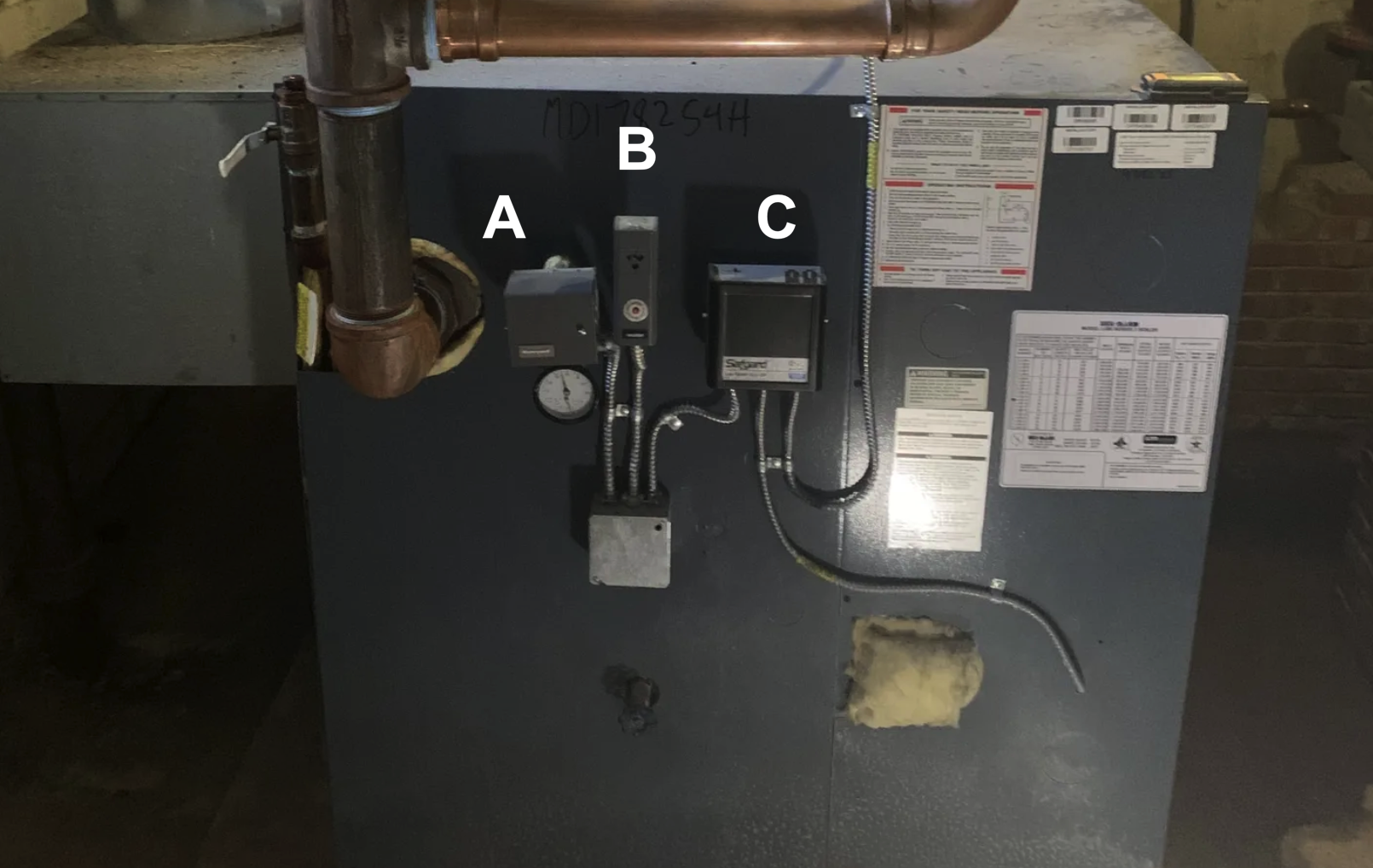
On the newer Weil-McLain boilers, there are three controls attached to the side of the boiler. Each one has a probe that measures the temperature or level of the water inside the boiler.
The double aquastat marked “A” operates the boiler at a minimum temperature to maintain domestic hot water temperature inside the boiler and in the shell of the shell-and-tube heat exchanger. The LO setting might be set at 160°F, so the boiler and shell contain 140°F to 160°F water, depending on the differential setting on the LO limit side (the red DIFF dial).
When the apartments call for heat, the burners will operate along with the circulator for space heating. If the circulator operates so much that cold return water from the apartment radiators causes the boiler temperature to drop below the minimum temperature (about 140°F) needed to provide sufficient hot water for showers and other domestic hot-water needs, then that control has the ability to stop the space-heating circulator from operating until the boiler temperature increases back to the 160°F LO temperature setting of the control.
Sometimes during extremely cold weather, calls for heat may continue indefinitely from several individual apartments or another, for longer periods of time, causing the burner to operate continuously. When this happens, the boiler temperature will rise above the 160°F LO setting to provide more heat to all the zones. If that temperature ever rises above a safe operating temperature, the HI limit on Control "A" will stop the burner from operating above that temperature (for example 180°F). Once the boiler water drops to about 175°F, the burner will restart and the heating process will continue normally.
In the event that the HI limit on the operating double aquasta "A" fails to keep the boiler at a safe temperature, Control "B" will stop the burner. This is a manual reset control that might be set at 200°F or 210°F. If this control ever shuts off the burner, you will need to manually reset it and determine why the operating limit did not stop the burner from allowing the water temperature to rise above the operating limit (190°F, for example).
Control "C" is a low-water cutoff that will stop the burner if there is not enough water in the boiler. If the water level ever drops below the safe operating level, the burners cannot operate.
Hope this explains some of the functions of your boilers.
Edward Young Retired
After you make that expensive repair and you still have the same problem, What will you check next?
1 -
There are three thing I want to talk about in this photo.
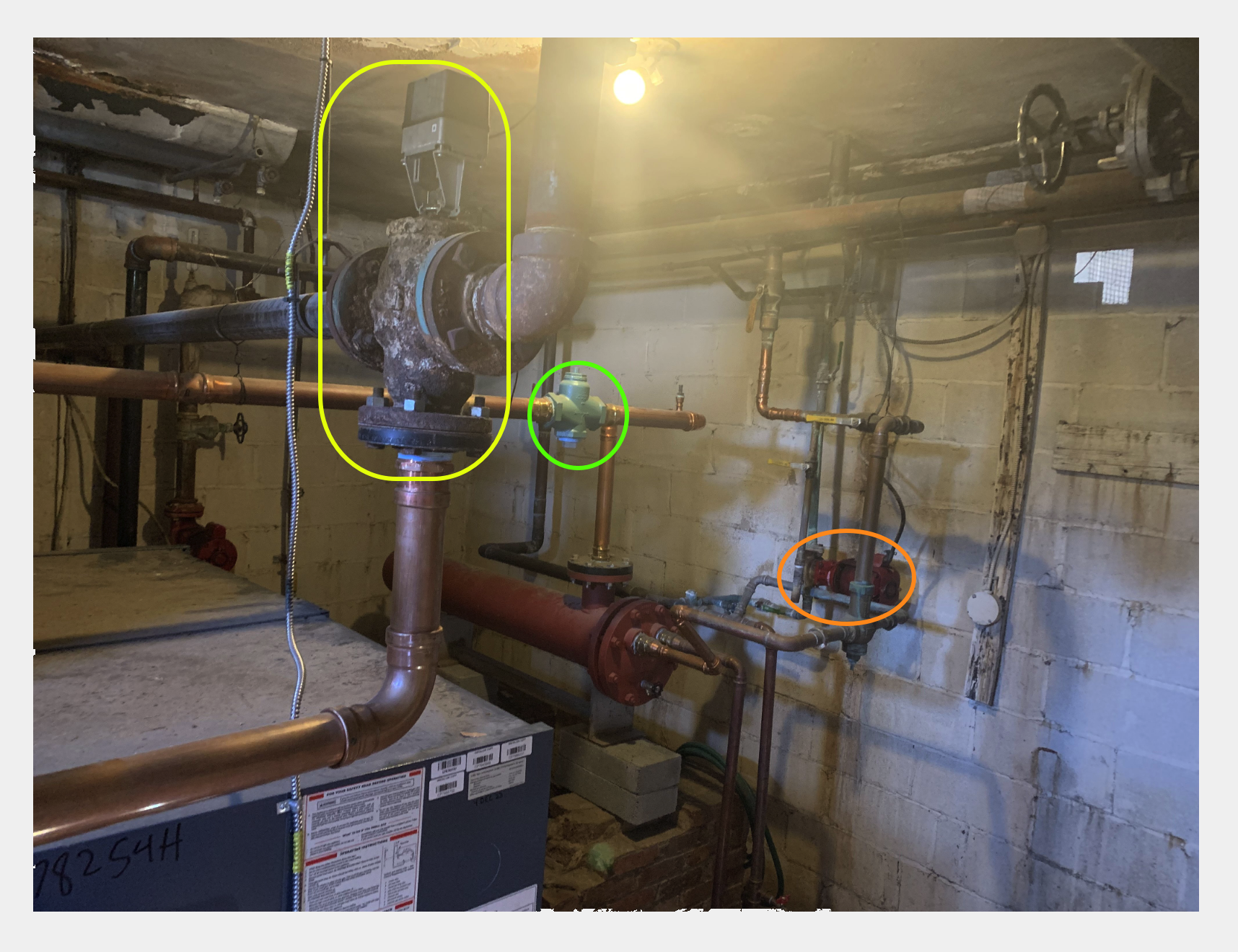
This large valve in the yellow oval may not be operational anymore since I do not see wires connected to it anymore, but that may just be the glare from the light bulb. On your older system, that control may have been connected to some device that measured outdoor temperature, and that control may have adjusted the position of that three-way valve in order to send lower-temperature water to the radiators on mild days and higher-temperature water on colder days. So that valve on older systems may still be in operation today. The Honeywell T775 Series 2000 Electronic Stand-Alone Controller in the other photos is performing that function at the boiler and making boiler temperature adjustments as needed.
The flow control valve in the green oval is designed to prevent gravity flow from occurring when the DHW circulator is not operating and the space-heating circulator is operating. There may be another valve like it on the space-heating side of the system so the space heating will not get gravity flow when the DHW circulator is operating and the space-heating circulator is not operating. If there is no flow control valve on the space-heating side of the system, then your individual zone valves are performing that function of the flow control valve.
The orange oval shows a circulator pump with a bronze body, but someone replaced the bearing assembly with a cast iron section (not bronze). If this circulator is designed as a recirculation pump for the DHW open system, then you may find there is rust in your water from time to time, when taking a shower or filling a pitcher with hot water. Plumbers and handymen should refrain from using cast iron parts on potable water systems. That is just an FYI for the future and has nothing to do with the original question.
I hope this information helps.
Edward Young Retired
After you make that expensive repair and you still have the same problem, What will you check next?
1 -
I can't thank you enough for all the information provided, sir! This answers many questions I had about the aquastats settings that currently are set to 180 for the LO, and 210 for the Hi which, I assume were the winter settings. In this line of thought, would it be reasonable to lower the setting to 140 LO and 160Hi during the summer for more efficient operation? The other question I have is in regards to the piping and flow control you mentioned earlier, as in would it be any manual shut-off valves that need to be engaged to stop the water flow directed to the space heat radiators in the apartments. The radiators inside the apartments do not have any valve controls, and tenants cannot control the heat in their apartments. There are outdoor air sensors hooked to Johnson temperature control, the little blue box under the electric breakers on the wall panel.
Again, thank you so much, you've been more than helpful! Very grateful!
0



Categories
- All Categories
- 87.8K THE MAIN WALL
- 3.3K A-C, Heat Pumps & Refrigeration
- 59 Biomass
- 430 Carbon Monoxide Awareness
- 132 Chimneys & Flues
- 2.2K Domestic Hot Water
- 6K Gas Heating
- 124 Geothermal
- 170 Indoor-Air Quality
- 3.8K Oil Heating
- 79 Pipe Deterioration
- 1.1K Plumbing
- 6.7K Radiant Heating
- 396 Solar
- 16.1K Strictly Steam
- 3.5K Thermostats and Controls
- 56 Water Quality
- 51 Industry Classes
- 51 Job Opportunities
- 18 Recall Announcements