Could my envelope really be this good? And how bad is it to oversize a modcon?

I am in the middle of speccing a new modcon boiler to replace a ~70-year-old, 220 kBTU/h cast iron hot-water boiler in my large, 1925 duplex (~4500 sqft). I did a lot over the last couple of years to improve the building envelope. Attic insulation, air sealing, blow-in wall insulation, weatherstripping, etc. This has helped a lot. But I still have lots of drafty windows, sizable stack infiltration, lots of single-pane windows, etc.
Nonetheless, for the last two heating seasons, I have been monitoring the gas usage on a daily basis, and calculating the gas used per degree day. I claim that the design heat load (at -5F) is less than ~70 kBTU/h. The monthly gas bills say the same.
The “problem” is that this works out to only about 16 BTU/h/sqft. This seems low. Therefore, the contractors I am interviewing want to put in much larger boiler than my calculations and gas bill would warrant. (Of course, none of them wants to do a Manual J.)
I am all on-board with the accepted notion at HH of NOT oversizing a boiler. However, one question I have how bad is it to oversize a modcon in particular? I claim I really should get a boiler of approximately 80 kBTU/h. Contractors are begrudgingly considering ~130 kBTU/h (based on 29 BTU/sqft).
But how bad is that, really? If their recommended modcon has a minimum output (with a 10:1 turndown ratio) of ~13 kBTU/h, would that work okay? Two salient considerations: (A) Even at 120F AWT, my smallest zone can absorb ~13 kBTU/hr (and 37k at 170F); and (B) According to my calculations, the outside temperature would have to be higher than 54F to have the heat load drop below 13K, causing the boiler to short-cycle.
So, would it be correct to say that a modcon is much more forgiving for oversizing? Should I fight with these guys to put in a smaller boiler, (or find someone who will), or am I going to be saved by the turndown ratio and I should just allow them to put in a bigger unit than I think it needs?
Thanks for your thoughts.
Trying to keep Bernie burning!
Comments
-
You need to trust your numbers. Contractors really have no business specifying heating equipment without doing some form of heat-loss calculation first.
That said, the modulating-condensing boiler (mod-con) has changed the boiler world quite a bit because it greatly reduces the traditional oversizing problems we used to see with fixed-input ON/OFF boilers.
Since this is your own building — and you probably are not working on other systems every day — there is always a chance your numbers could be a little off. One place that often causes trouble is the infiltration assumption. If the air-changes-per-hour (ACH) value is set too high or too low, it can skew the load calculation noticeably.
My advice is simple: find a contractor who is willing to perform a proper load calculation and walk you through the numbers.
That’s the contractor you want to buy the system from.
PS: thanks for reminding me… I need to get my envelope ready for church tomorrow
Good Night
Edward Young Retired
After you make that expensive repair and you still have the same problem, What will you check next?
 2
2 -
@EdTheHeaterMan said "My advice is simple: find a contractor who is willing to perform a proper load calculation and walk you through the numbers.
That’s the contractor you want to buy the system from."
THIS!
2 -
the biggest unknown is always the infiltration. To pin-that down a blower door test is a good option
Do the test on a cold day and use an IR camera to pinpoint the leakage
Another check it to measure and calculate the heat emitters. If the building has been heating adequately then you have enough emitter. So check the boiler sizing against that number.
Ideally you would size the boiler to where the load will be after you finish all the building upgrades. As you upgrade the building the SWT drops for even more mod con advantage
I agree the oversizing it not a big issue with a mod con. Most all models can be limited to a fixed output with 10-1 a typical turndown
Modulation and ODR for the win
Bob "hot rod" Rohr
trainer for Caleffi NA
Living the hydronic dream 2
2 -
OR just go with the lowest bid and hope for the best. That is how the government was able to put a man on the moon!🤗
Edward Young Retired
After you make that expensive repair and you still have the same problem, What will you check next?
2 -
People tend to overestimate heat loss for houses. 30but/sqft does exit but it is the outlier not the norm. Heat loss on on a multiplex tends to be lower as there are a lot of internal gains from people and equipment.
Fuel use based heat loss calculation is the most accurate for any existing building where there are too many unknowns about insulation and infiltration. Trust your numbers and size off that.
I'm not surprised about your numbers, typical residential boiler is 3x oversized around me.
The hard part will be convincing the installer to trust your number. Even a good man J can be quite a bit off for older houses. The best you can hope for is to install the smallest modcon they are comfortable with, even with a small zone it is rarely the case that only the smallest zone is calling for heat, so cycling won't be all that much different between an 80k and 130k unit.
Besides a proper install, the most important part is good ODR. Make sure the installer puts in the outdoor sensor and show you how to adjust the curve as the default ones tend to be very conservative.
 3
3 -
Thanks, all. I appreciate the feedback.
Although I have had a whole-house energy audit done, they won't do a blower-door test due to the presence of asbestos in the house. (Fortunately for me, there is almost no exposed asbestos anymore, but I know the pipes in the walls are asbestos covered.)
And yes, unsurprisingly, there is PLENTY of emitter capacity! I have catalogued all of the emitters, and I claim that I can meet design-day load at 120F AWT.
I have not yet received final design proposals from any of the contractors, so I will wait and see if I was able to convince anyone. (To be fair, one of the three contractors I contacted immediately asked for my gas bills and intended to measure all of the emitters before I gave him all of that info. The other two just pulled out rules of thumb. We'll see.)
Thanks.
Trying to keep Bernie burning!
0 -
If you are going off the actual gas usage there is no risk in downsizing the boiler. Actual usage is actual usage. Infiltration means nothing as it is already figured in your fuel usage. Find a contractor that will install the correct size boiler.
3 -
As others have said, trust your actual gas usage numbers. I live in a similar building (circa 1924, 4800 sq ft, 4 units) with some thermal upgrades, but not very well insulated, in the Boston area, and our design day heat loss at zero degrees F is around 13-18 BTU/sq ft depending on what number I use for our overall system efficiency. That is also based on 10+ years of fuel usage records.
You are in a similar climate though slightly colder, so with some upgrades to a similar vintage building, 16 BTU/hr/sq ft is very believable.
One thing to be aware of is the convection and infiltration effect of wind on heat loss. During a record-breaking polar vortex event in the Boston area a few years ago, our heat loss was around 40% higher for the 2-3 day period of extreme low temps and high winds. Of course, that was a once-in-70 year event, so I'm not saying everyone should size to such a rare event. But since you're considering a modulating boiler with a 10:1 turndown, you have the option to consider whether you want to size to, say, 1.5 times design day heat loss, which would put you around 100,000 BTU/hr capacity, still far below what most contractors would size by rule of thumb, but large enough to handle rare extreme conditions.
1 -
true the oversized modulating boiler can compensate for below design conditions, but the emitters will be the bottleneck. The heat emitters dictate the boilers operating condition, so you would expect to see on off cycling if the emitters cannot handle the boilers increased output. You have the horsepower but not the driveline to transfer it.
What will increase heat transfer is allowing the ambient to drop a few degrees changes the delta, increases output.
A wise radiant guru once said if you want to increase the radiant floor heat output on a cold day, open the windows!
Bob "hot rod" Rohr
trainer for Caleffi NA
Living the hydronic dream0 -
Yes, emitters will dictate boiler operating conditions, but in OP's case, he has large EDR cast iron rads and presumably large water volume (gravity conversion) like we do, both of which will tend to prevent short cycling.
Another factor is thermostat setup. Increased swing will also reduce short cycling. We have ours set for a swing of 1.5, which typically results in 45-minute boiler runs followed by 2+ hours between cycles (again with our high thermal mass gravity conversion system). This is even with our 3x oversized non-modulating boilers.
So given the OP's combination of large EDR/thermal mass gravity conversion and a modulating boiler that can turn down 10:1, plus the flexibility to increase the swing setting for longer boiler runs, I'd be surprised if he had a short cycling problem with, say, a 100MBTU modulating boiler.
1 -
Yes, @jesmed1 is correct about my house. I have ~1400 sq.ft. EDR of cast-iron radiators, so they can absorb north of 210 kBTU/h at high water temperatures. (Even 110k at 130F.) And I have ~170 gallons of water in the piping and rads.
That's a good tip about the thermostat swing. I have some smart honeywell t-stat, and I have never looked into setting that parameter. Thanks!
Trying to keep Bernie burning!
0 -
Some smart Tstats don't allow you to set the swing. I chose our ecobees partly because they do allow you to set the swing. Don't know about the Honeywells.
When I moved in, our boilers were short cycling for several reasons, one of which was that the old Tstats had been left set at factory default for forced hot air, which was a low swing setting of like 0.5 F.
0 -
I just checked. The Honeywell T-stat (RTH9585WF1004) doesn't seem to have a way to set the swing setting. However, it does allow you to set whether your heating is forced air, hot water, steam, or heat pump. So hopefully they are doing something sensible with that information! 🤪
Trying to keep Bernie burning!
0 -
that Honeywell has cycles per hour adjustable
0 -
Yes, Honeywell has apparently given up on allowing users to set the swing, instead making the CPH adjustable based on system type. For example, 3-5 CPH for forced hot air, 3 CPH for heat pumps, and 1 CPH for steam/gravity hot water.
However, I've seen a post on Reddit where the owner of a Honeywell T5 said that even with his T5 set to 1 CPH, the stat still calls for heat more than once per hour. He said he called Honeywell tech support and was told that the thermostat prioritizes maintaining room temp to within 1% of the setpoint, which would imply a swing of 0.7 degrees at a 70 F setpoint, and that the tstat is programmed to give priority to maintaining room temp within the 1% fixed swing rather than the CPH. To which the user replied, what's the point of having a CPH limit if the stat is going to ignore it and prioritize a fixed swing?
I don't know whether that post was accurate, but if true, it illustrates what I find annoying about tstats that don't let you explicitly set the swing, and why I will never buy another Honeywell.
However, for your purposes, a swing of 0.7 F will still probably be OK with a correctly-sized modulating boiler, as your thermal mass will take a long time to heat.
0 -
it sounds like the perfect candidate for a mod con. Over-sized radiators may allow you to run condensing temperatures for much of the year. I have run cast radiators down as low as 120F, you still get that radiant comfort.
Efficiency may climb into the 90% and if you spend time to dial in the ODR you could get constant circulation, the boiler modulating down as low as 8,000 btu/ hr, depending on the model, rarely shutting off.
Bob "hot rod" Rohr
trainer for Caleffi NA
Living the hydronic dream1 -
Nothing new here, but just commenting on HOW LONG it took me to realize that this (from Viessman):
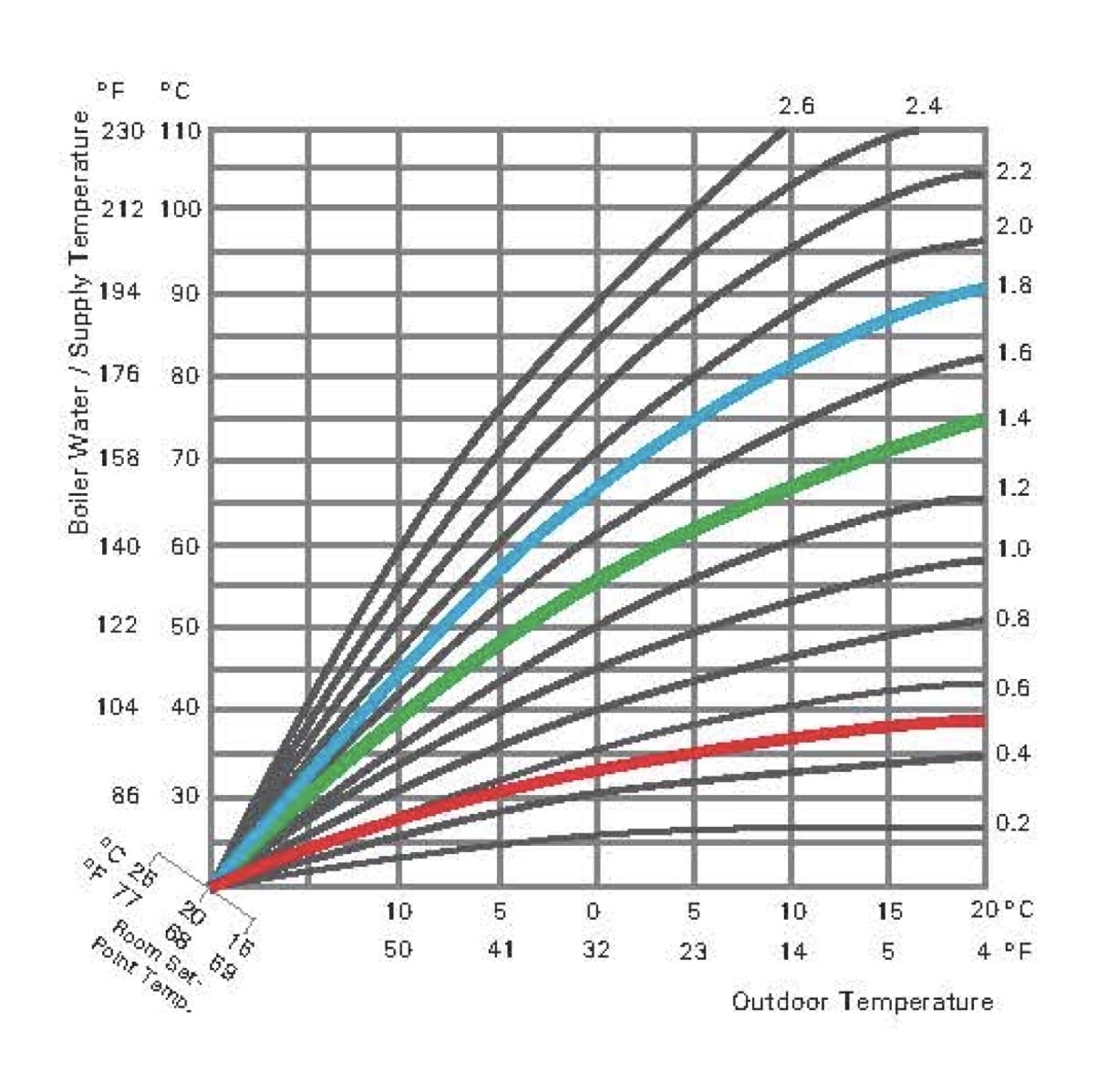
is just a fancy version of this:
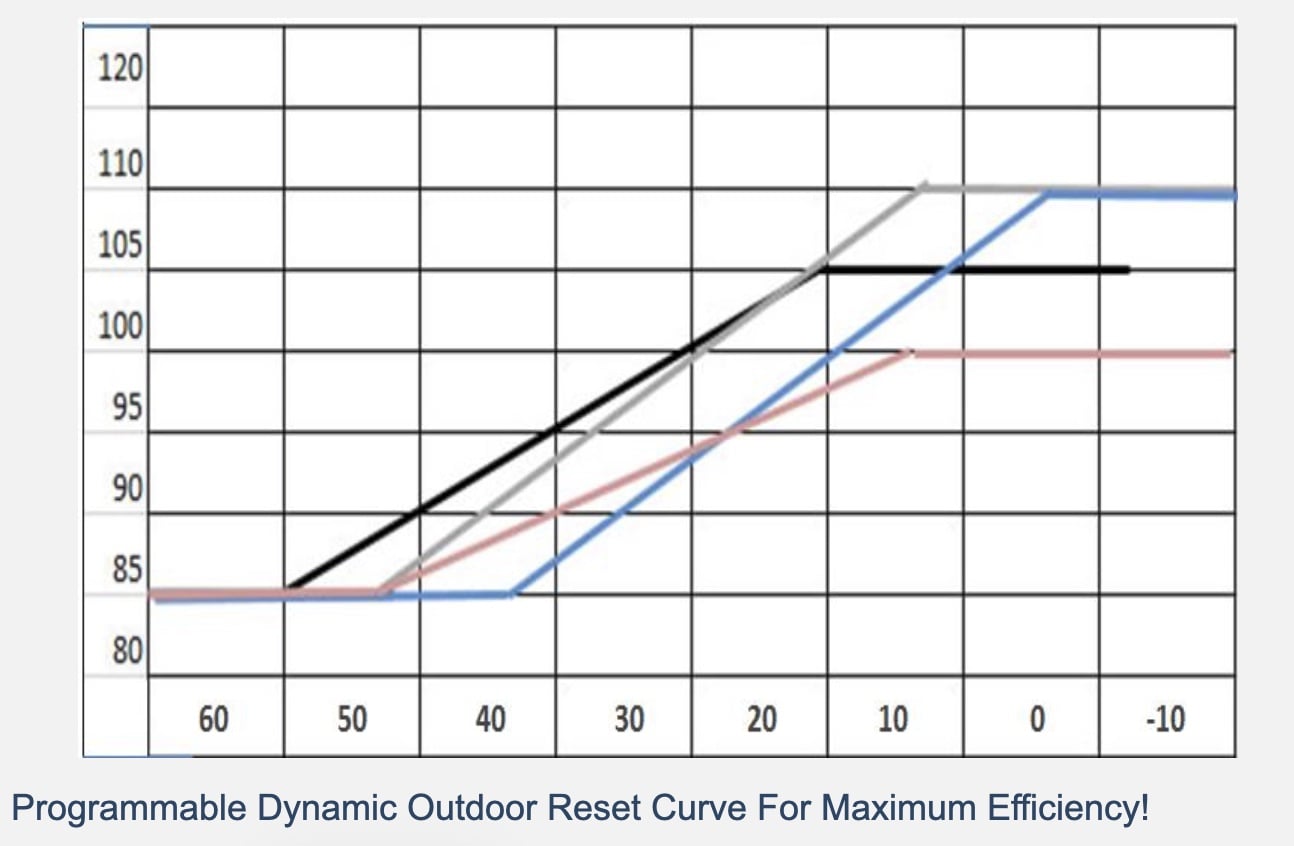
🤦♂️
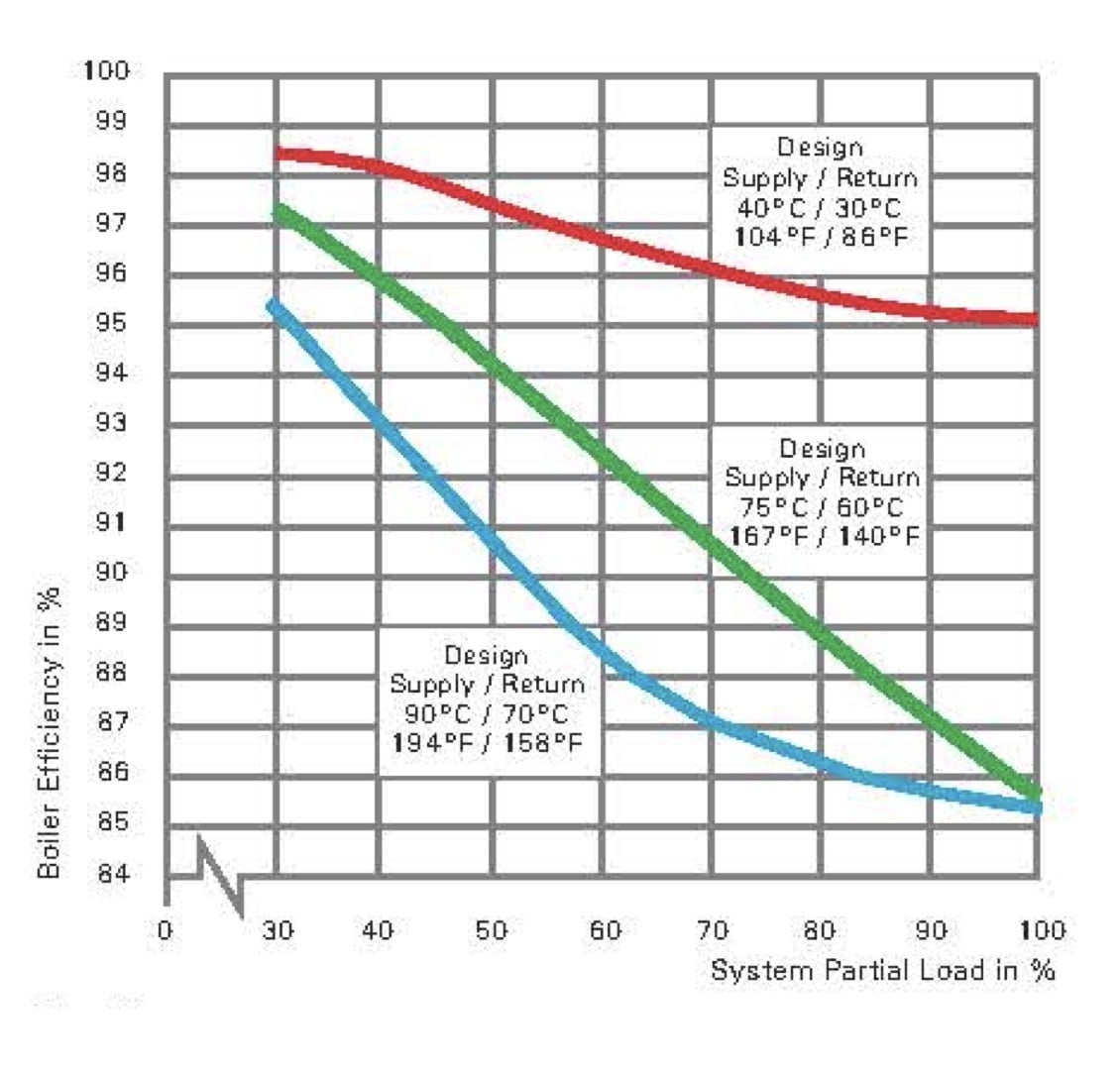
Because the fancy Wiessman ODR curves are paired with an efficiency curve (below), I thought that that whole family of curves was portraying something intrinsic to the operation of a modcon, instead of a suggested way of doing the ODR. 🤦♂️ (Of course, the related message of the efficiency curve shown below is "Design your system so that it is able to run at a low supply temperature for max efficiency." Now I am grateful for oversized emitters in a newly-insulated old building! :) )
Trying to keep Bernie burning!
0 -
This winter I had the chance to do a reality check on the calculations that I had done on my house using gas consumption and manual J. I was able to monitor the boiler for a couple of hours when the outside temperature was close to the heating design day temperature. The house stayed at 72 degrees inside when it was -10 outside and the cast iron boiler was only on for about 50 percent of the time. That validated the calculations and my suspicion that the boiler was significantly oversized after all the energy improvements I've made to the house.
 2
2





Categories
- All Categories
- 87.8K THE MAIN WALL
- 3.3K A-C, Heat Pumps & Refrigeration
- 60 Biomass
- 430 Carbon Monoxide Awareness
- 133 Chimneys & Flues
- 2.2K Domestic Hot Water
- 6K Gas Heating
- 124 Geothermal
- 170 Indoor-Air Quality
- 3.9K Oil Heating
- 79 Pipe Deterioration
- 1.1K Plumbing
- 6.7K Radiant Heating
- 397 Solar
- 16.1K Strictly Steam
- 3.5K Thermostats and Controls
- 56 Water Quality
- 51 Industry Classes
- 51 Job Opportunities
- 18 Recall Announcements