Flexible faucet/lav connector for hydronic exp tank

I’ve seen this here and there, and utilized the method a couple times. It now occurs to me that these stainless braided connectors may not be oxygen barrier… obviously not intended for this purpose. Anyone have a preferred connector this?
Comments
-
Why would you want it flexible.
Ive never seen a flexible connector to a hydronic expansion tank.0 -
In some cases it makes sense to get it out of the way. Actually many of the tank brackets allow for this. Axiom, Calefactio, etc.
I use barrier pex and a couple adapters.
 1
1 -
I have seen thermal expansion tanks on water heaters connected with flex tubes. Most are 3/4" however.
\
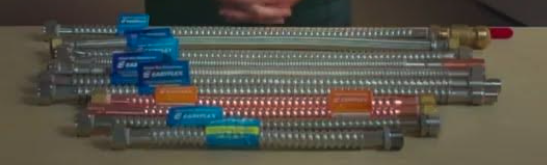
If a faucet braided connector is rated for the temperature and pressure it should be fine. Most likely it
is an EPDM hose with stainless braid.
Capacity could be a concern on larger boilers, perhaps. Amtrol probably has a sizing formula for the tank connector tube :)
Bob "hot rod" Rohr
trainer for Caleffi NA
Living the hydronic dream1 -
Where are you guys working? I have never seen a flex connector to any expansion...ever. And I have seen some really poor installations before. Home Depot subs that use flexes on water heater hot and cold wouldnt even put a flex on around me. Maybe in seismically active locations? Technically, even where i am in NJ is a "seismic area" but not really.
0 -
I have not seen flex connectors but can imagine someone out there would do it if they dont have tool / skill/ time…
0 -
unless it is a huge commercial system the flow from expansion is far less that the max capacity of 3/8" soft copper.
if i really wanted something flexible i'd use soft copper.
0 -
Actually a lot of the Euro boilers that have pancake type expansion tanks inside the cabinet have small flex lines connecting them. I had an early Laars Mascot (Baxi 330) that had a SS flex expansion line. Straight connections with fiber washer connections.

Zilmet has tank/ flex kits for systems that are common in other places around the world.
 Bob "hot rod" Rohr
trainer for Caleffi NA
Living the hydronic dream0 -
Yes but are they have oxygen barrier for hydronic systems?
0 -
You would need to ask the manufacturer what the inner tube is made of. This example shows a PVC inner liner. That is not considered O2 barrier material. PVC is not typically rated to 180° either.

I don't know the SS braid is tight enough to be O2 impervious? Stainless is, but maybe not the braid.
I don't know that 24" of non barrier tube in a system would create a O2 ingress problem?
Pump gaskets and other components are not O2 barrier material in hydronic systems. A 100% O2 ingress free system is near impossible.
The amount of O2 ingress is directly related to fluid temperature, so systems at 180 are more prone to O2 ingress than systems running 120°
What temperature would the flex be exposed to under continuous operation?
You can always add a hydronic conditioner, like Fernox, etc, which have a component to address small O2 ingress. Oxygen scavengers.
I have seen flex connectors used on panel radiators, and unit heaters also, must be someone builds hydronic rated flexs like Zilmet and other Euro expansion vessel manufacturers, sell?
A short piece of Watts Radiant Onix hose would be an option.
Caleffi solar expansion tank kits included a stainless corrugated flex connector, 3/4"X 18"
Bob "hot rod" Rohr
trainer for Caleffi NA
Living the hydronic dream0 -
i'd imagine the stub to the expansion tank is relatively cool.
0 -
Until the bladder tank fails.
0 -
even then there will be little flow other than briefly
0 -
every time the boiler heats, water expands, there is water movement into the tank
That fluid movement will be the temperature the boiler operates at. In theory it happens at every heat up cycle.
On high temperatures evac tube as solar arrays a cool down tank was installed in front of the solar thermal expansion tank as there are no expansion tanks , even solar versions, that could handle 300 plus temperature on a regular basis
Amtrol suggests a Heating leg if tanks could be exposed to over 240F.
 Bob "hot rod" Rohr
trainer for Caleffi NA
Living the hydronic dream0 -
unless it is a very large boiler the system water will get up to setpoint over maybe 10 minutes or so and the expansion is a couple gallons so you have the pipe and the tank getting something like < .25 gpm. the surface of the tank and the pipe will radiate a fair bit of that energy at the rate is is being added as the temp increases beyond ambient and the transfer rate increases.
a small fin tube system that contains maybe 20-30 gallons will have maybe half a gallon of expansion volume that happens over 5 minutes or so.
a gravity conversion system will have hundreds of gallons of water with maybe 2-5 gallons of expansion but the whole system will heat over maybe half an hour to 45 minutes.
in a residential or small commercial system the flow rate to the tank is tiny.
you could get more heating of the tank if you get gravity circulation in the line to the tank.
0




Categories
- All Categories
- 87.5K THE MAIN WALL
- 3.3K A-C, Heat Pumps & Refrigeration
- 61 Biomass
- 431 Carbon Monoxide Awareness
- 124 Chimneys & Flues
- 2.1K Domestic Hot Water
- 5.9K Gas Heating
- 118 Geothermal
- 170 Indoor-Air Quality
- 3.8K Oil Heating
- 78 Pipe Deterioration
- 1K Plumbing
- 6.6K Radiant Heating
- 395 Solar
- 15.9K Strictly Steam
- 3.5K Thermostats and Controls
- 57 Water Quality
- 51 Industry Classes
- 51 Job Opportunities
- 18 Recall Announcements