Thoroughness of service and combusion readings

57 year old American Standard boiler with Ameritherm damper. Maintenance was performed by a respected local company. I have two red flags to consider. The tech did not clean the burner tubes. He did brush off the surface but did not remove them to brush the inside. When I asked why he said, the holes are so small that nothing falls down inside and that they are too hard to put back in place. The flue gases were measured by inserting the probe (which I was told had been recently calibrated) into the Ameritherm damper. CO was 0; O2 was 10.1% and the draft was 0.017". No CO2 was listed. I suggested that the gas rate should be turned down because the flame is a bit orange. He did not tell me anything was amiss but my subsequent reading suggests that the O2 to too high and the draft is too low.
A couple questions. 1) Should I bring in someone else when the boiler function is fine?
2) The flue vents into an 8" chimney along with the water heater and no added liner other than the original tiles. The height is ~35'. Should I consider lining a chimney now in anticipation of an eventual boiler replacement?
Comments
-
A 1967 American Standard boiler is pretty bulletproof. There’s very little on those old burners that actually requires maintenance. Removing the burners from under the heat exchanger is straightforward in most cases, though I’ve run into a few where reinstalling them can be a bit tricky. I wouldn’t worry about it unless you’re having real issues.
Regarding combustion readings on a boiler with a draft hood like yours: you’ll likely need to sample flue gases before the draft hood. Any readings taken after the draft hood are contaminated with what we call dilution air—essentially room air pulled into the flue. Those samples don’t reflect true combustion and can be misleading, so I wouldn’t rely on them.
This is a photo of a typical Am Std boiler from the 1960s.
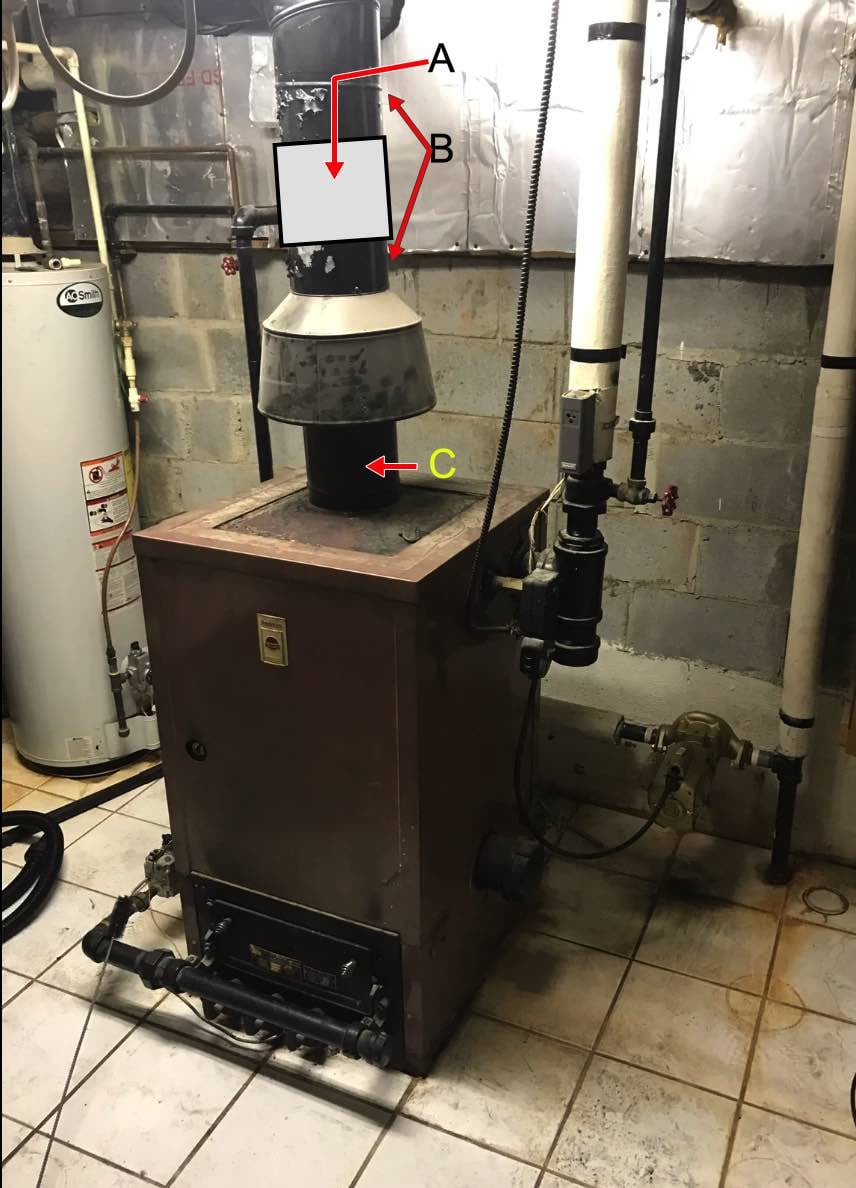
Location A is a possible Ameritherm damper location.
Location B is the incorrect place to sample the flue gas for a combustion analysis.
Location C is the proper place to take a flue gas sample for a combustion analysis test.
Edward Young Retired
After you make that expensive repair and you still have the same problem, What will you check next?
0 -
My damper sits atop the boiler housing. Is it even possible to get a reading without make up air? I recall the temp was > 400 maybe 430 degrees.
https://imgur.com/a/KRQERTp
0 -
That big rectangular opening in the front is your draft hood. One would need to insert the analyzer probe into the flue collector behind the draft hood, in effect sampling the flue gases as they come up out of the boiler.
All Steamed Up, Inc.
Towson, MD, USA
Steam, Vapor & Hot-Water Heating Specialists
Oil & Gas Burner Service
Consulting

 3
3 -
that ameritherm damper isn't a great idea. they spill for a bit until they open, they don't close until much of the heat has gone up the vent, they may change how the clay lined vent behaves by letting it get colder between cycles. It could be fine, but it also could cause problems. also no interlock if it were to get stuck closed for some reason.
1 -
So the combustion analyzer probe should be placed inside the draft hood and collect a sample before the flue gas exits the actual cast iron sections
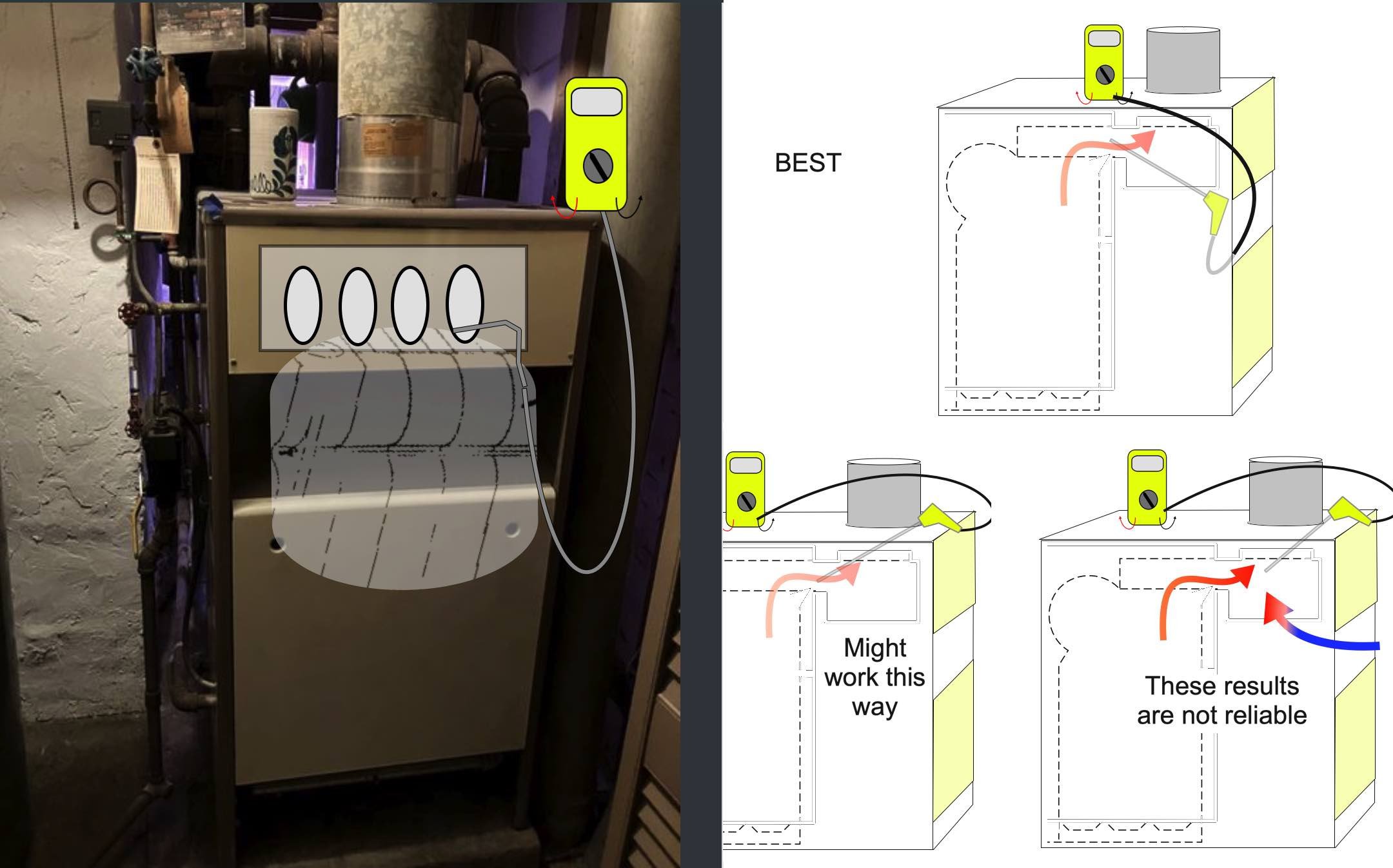
these illustrations of how to take a flue gas sample from the Bacharach combustion analyzer illustrate how to take a sample that does not have dilution air that will invalidate the results. Since your boilers uses a flue collector in combination with the draft hood your sample location is more like the firced air furnace on the left than any other appliance shown.
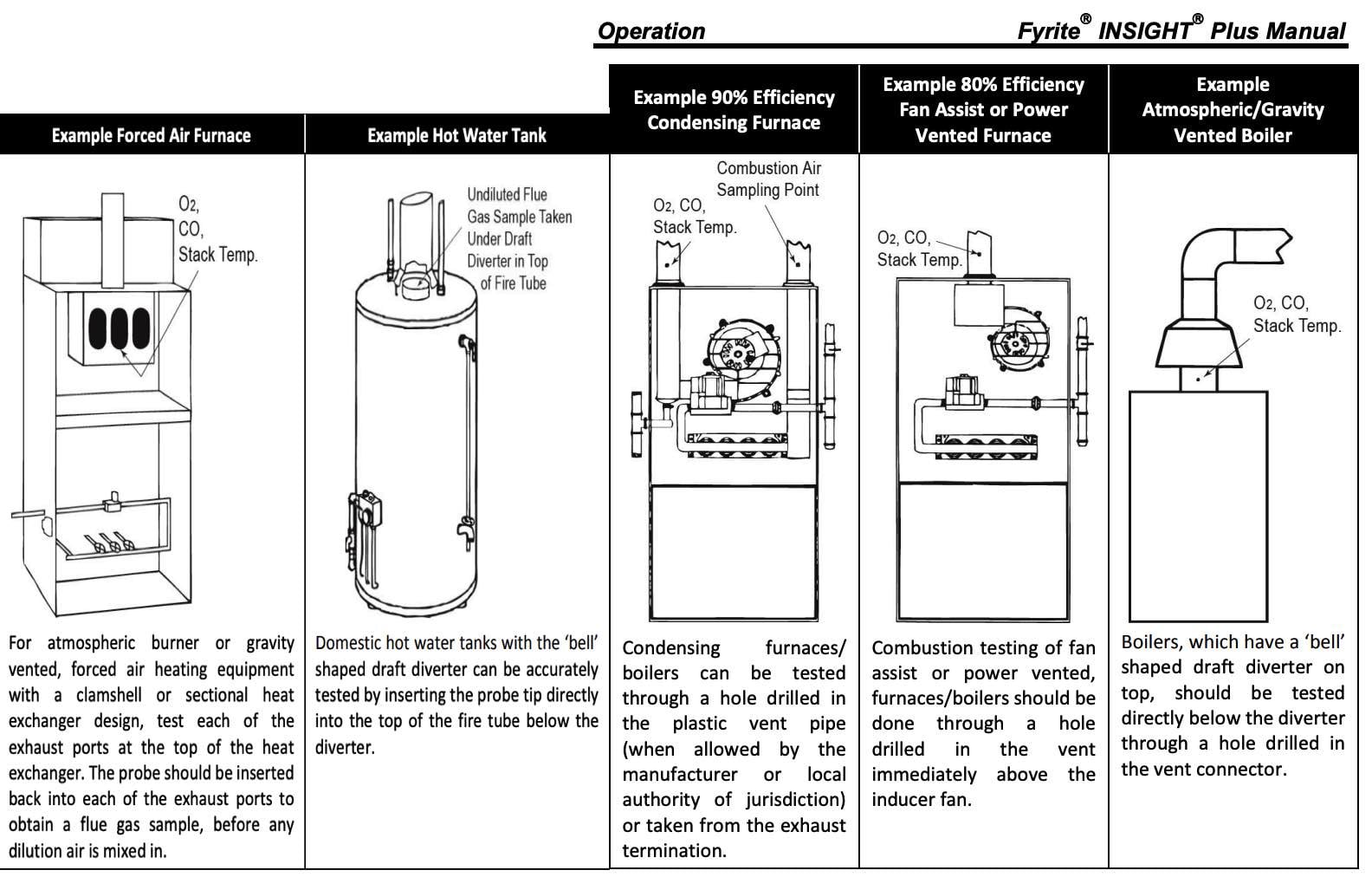
Depending on the assembly of your flue gas collector, you may need to take measurements at multiple points across the cast-iron heat exchanger, as some burners may be operating differently from others.
That is why I don't believe you can trust the combustion readings you received.
Edward Young Retired
After you make that expensive repair and you still have the same problem, What will you check next?
 2
2 -
Modern building and gas codes (e.g., IRC/IFGC) require that any vent damper on a natural draft (atmospheric) gas appliance cannot impede proper draft. Thermal bimetal dampers like the Ameritherm you have can fail partially closed, creating a risk of flue gas spillage, including carbon monoxide, into the living space. Because of this, many jurisdictions prohibit the use of non-motorized dampers on new installations of draft-hood gas appliances.
If I were you, I would remove that device and throw it in the garbage. This is a better device for your application:
Edward Young Retired
After you make that expensive repair and you still have the same problem, What will you check next?
2 -
And, if the motor on this damper fails, it is replaceable.
All Steamed Up, Inc.
Towson, MD, USA
Steam, Vapor & Hot-Water Heating Specialists
Oil & Gas Burner Service
Consulting0

Categories
- All Categories
- 87.6K THE MAIN WALL
- 3.3K A-C, Heat Pumps & Refrigeration
- 59 Biomass
- 429 Carbon Monoxide Awareness
- 124 Chimneys & Flues
- 2.2K Domestic Hot Water
- 5.9K Gas Heating
- 119 Geothermal
- 168 Indoor-Air Quality
- 3.8K Oil Heating
- 78 Pipe Deterioration
- 1K Plumbing
- 6.6K Radiant Heating
- 394 Solar
- 16K Strictly Steam
- 3.5K Thermostats and Controls
- 56 Water Quality
- 51 Industry Classes
- 50 Job Opportunities
- 18 Recall Announcements