Gravity boiler to forced water conversion

I have a customer that has a super old 1960 gravity boiler system, 2 pipes up and 2 pipes down, 1 thermostat. My question is if I replace this how I would normally with a circulator pump and tie the 2 supplies/returns together and pipe the boiler as necessary for a new one, what issues am I going to run into? I have never removed and converted from a gravity. First one I have ever seen in person.
Comments
-
Biggest one is the mass of it(the water, the pipes, usually the cast iron radiation), if you use a conventional boiler you will need some sort of return water temp protection to keep the boiler from sustained condensing(or use a mod con boiler).
Radiators may have orifice plates in the valve unions on the upper floors if it is more than one level to slow down the flow to those radiators. You will either have to remove them or move them to the 1st floor if they exist. Gravity circulation favored flow at the highest points, pumped circulation favors flow near the boiler.
You would do a heat loss of the house and size the piping and circulator and boiler off of the heat loss, the piping to the boiler will be much smaller than the gravity supply and return mains.
Probably will need to use the radiator valves to balance it.
If it is an open expansion tank convert it to a bladder tank, if it is a compression tank you can either convert it to a bladder tank or arrange the near boiler piping to separate the air and put it in the compression tank.
Use a magnetic dirt separator to protect the wet rotor pump from the 70 years of much that will get stirred up by the circulator.
Not a bad idea to run some cleaner in it and flush out as much muck at possible before/during/right after the install.
0 -
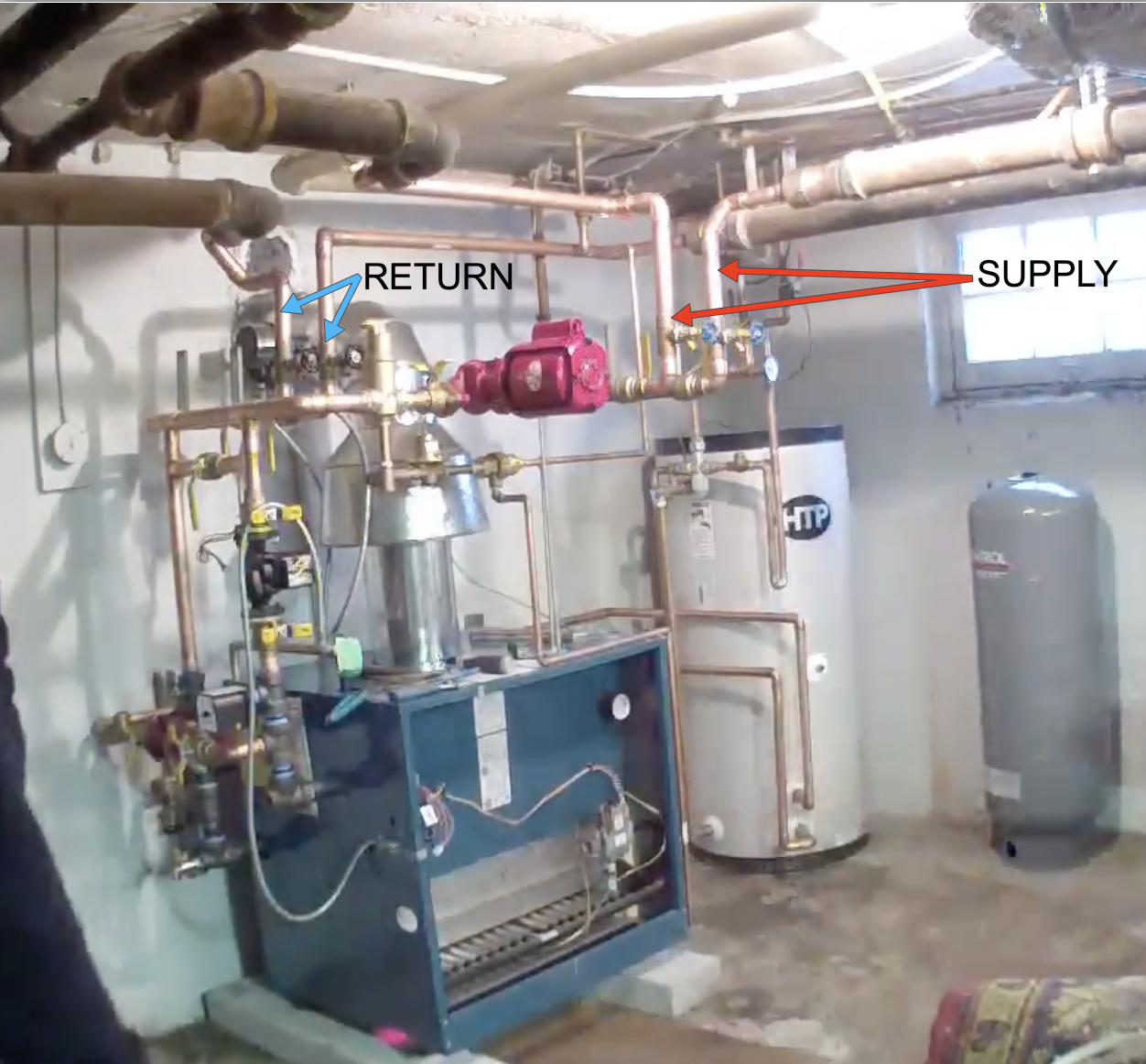
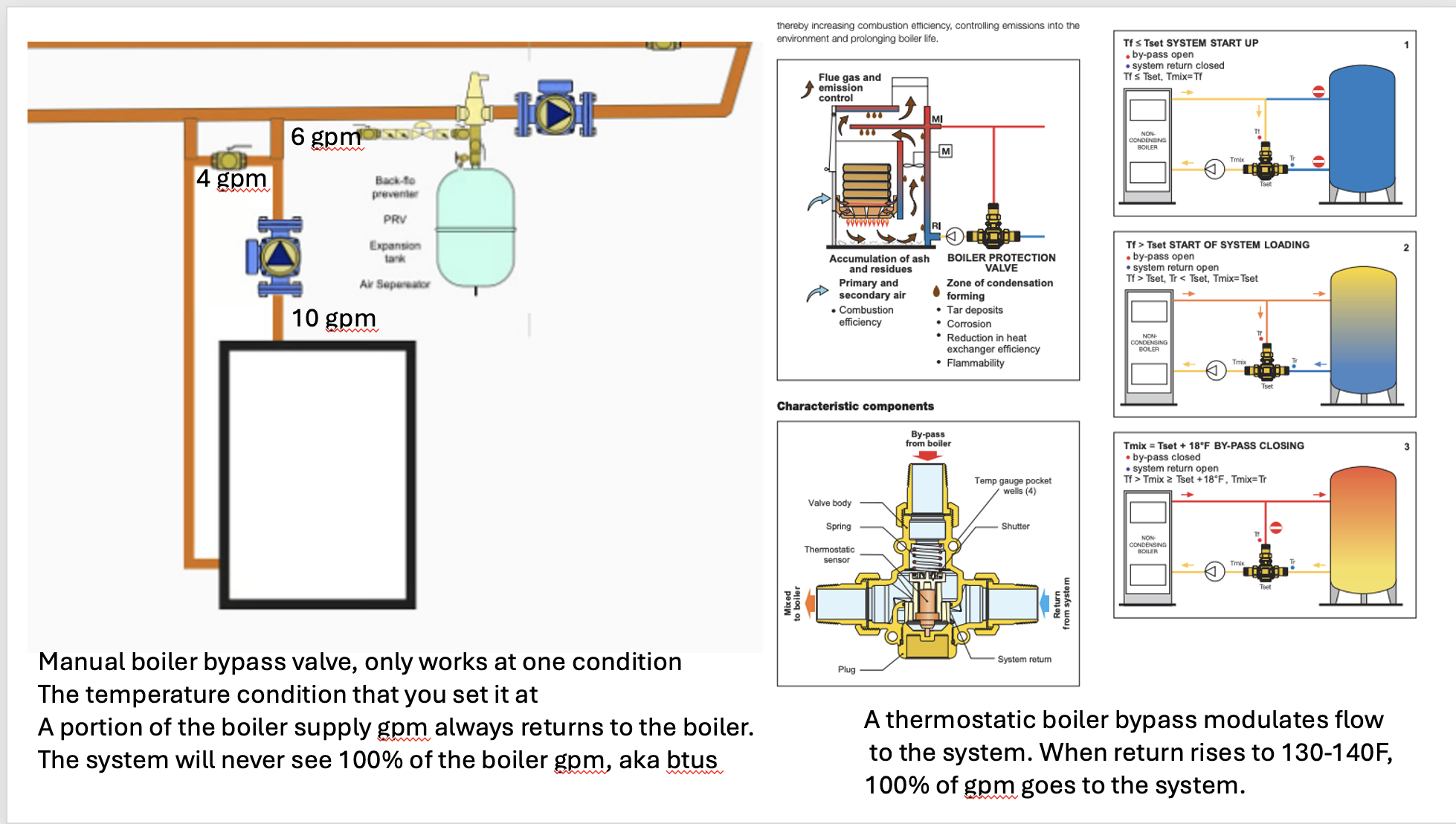
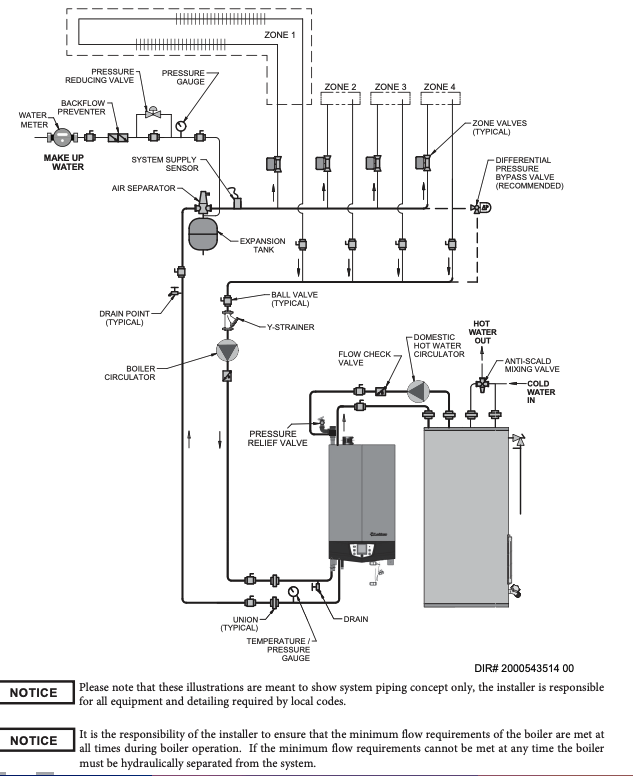
Condensation of flue gas would be my biggest concern. You can try several different piping designs, but I find this one to be bulletproof when you need to add a small water-content boiler to a large water-volume system. Primary/secondary with a bypass for adding heat to the return to get it up to 140° quickly.
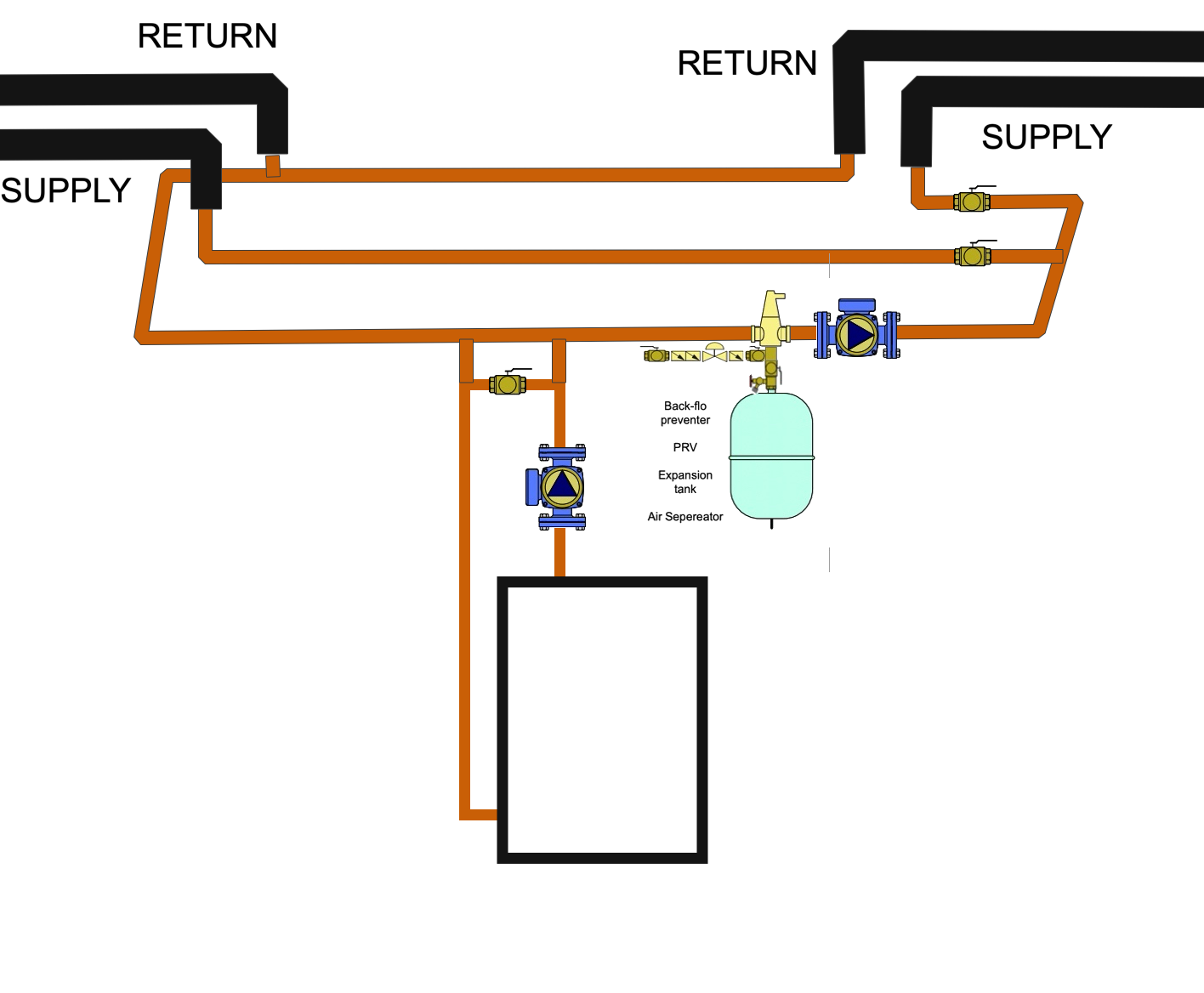
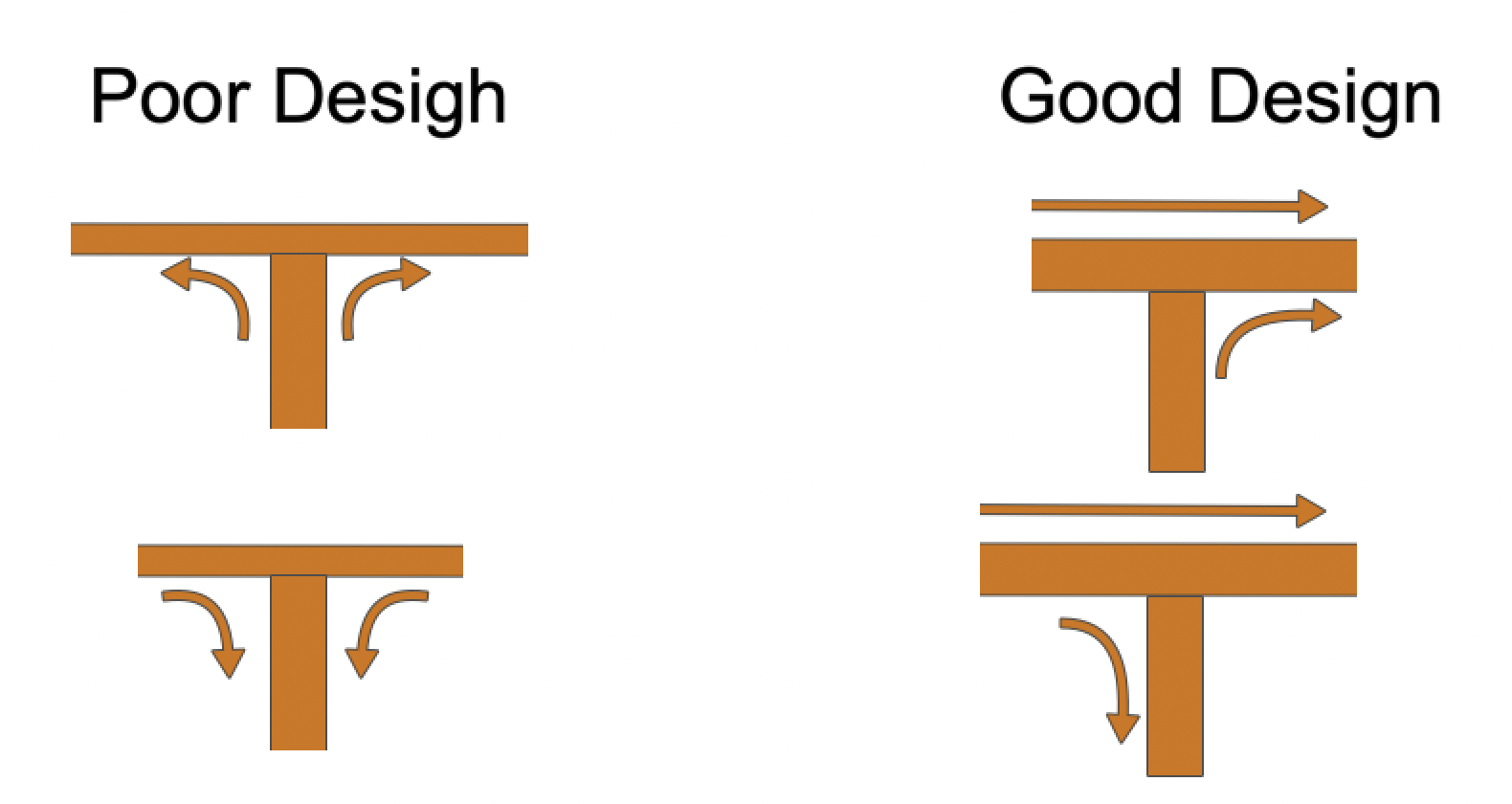
Don't put the water flow into the tee at the run in opposite directions and exit at the branch, or put the water into the branch and exit thru the run in opposite directions
Here is a job similar to your question:
Old boiler with two supply and two return not circulator
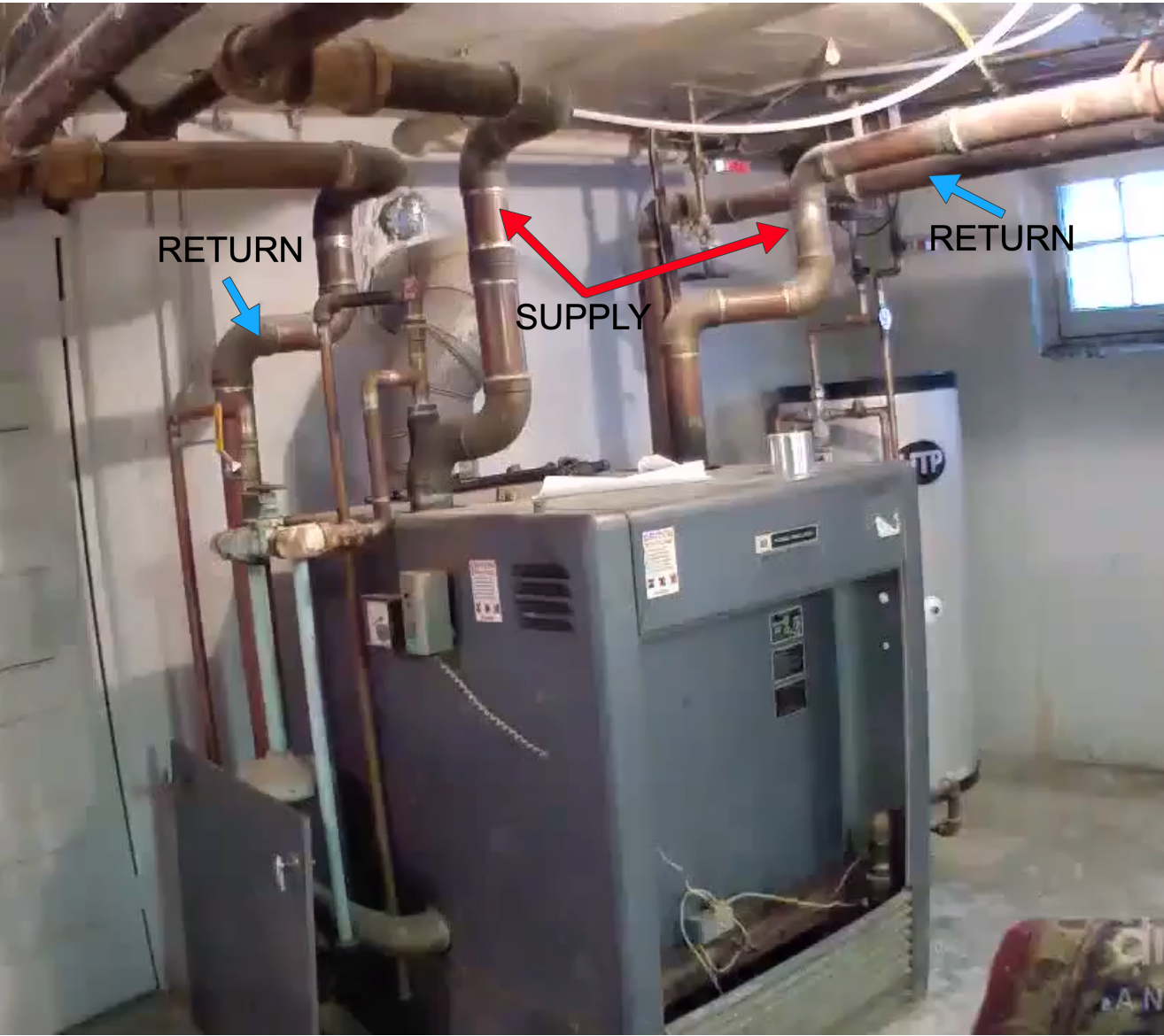
Remove old boiler and start from this point
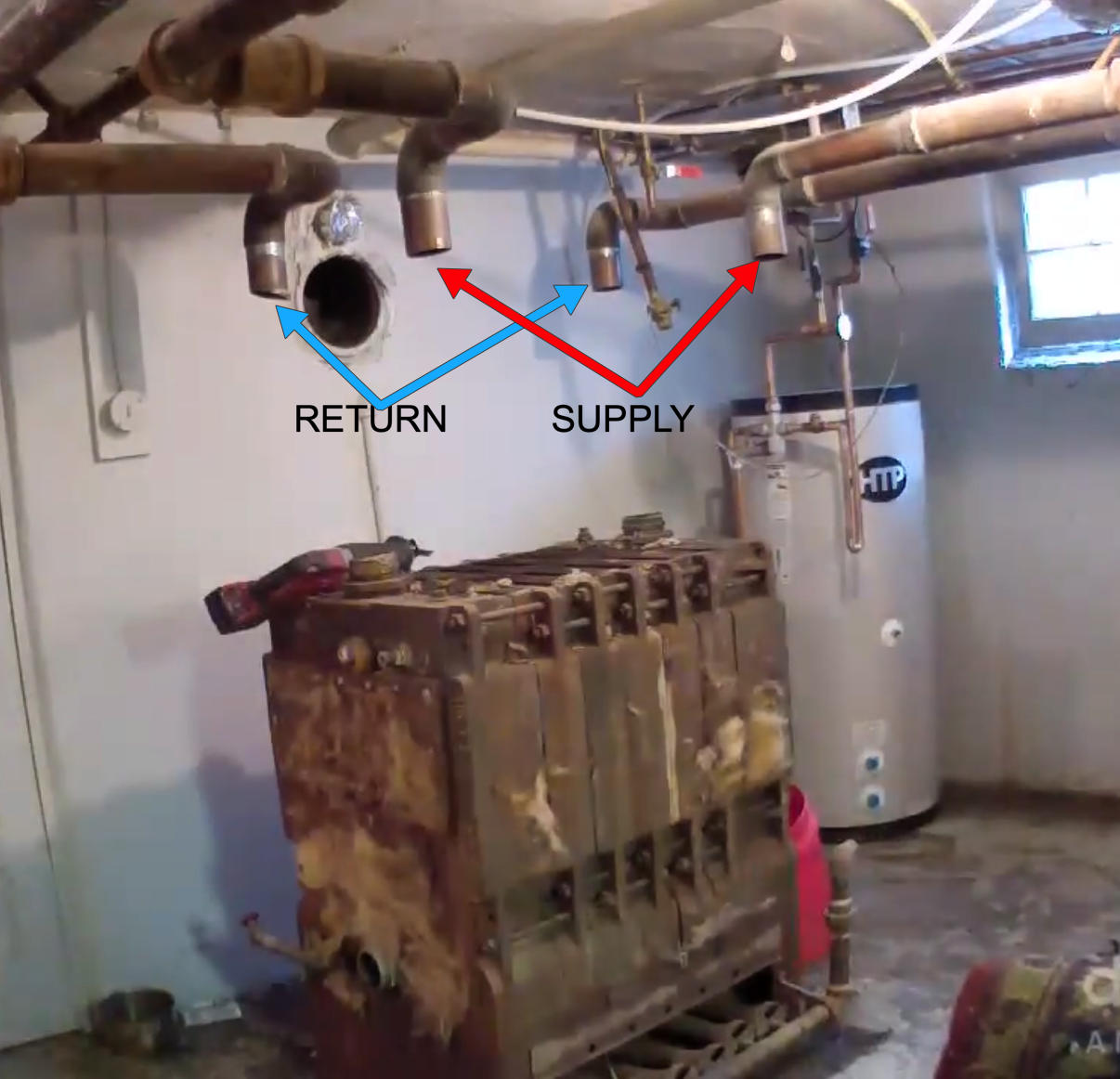
This is the primary/secondary piping with the bypass just like the first diagram.
Edward Young Retired
After you make that expensive repair and you still have the same problem, What will you check next?
 1
1 -
We have two gravity conversion systems heating our old 4800 sq ft condo building near Boston. One comment I would add is that gravity conversion systems typically have very low head because the pipes are so large, so you typically don't need a large circulator unless you have a lot of radiation and/or a big boiler like the one @EdTheHeaterMan has in his photo. Our building is split down the middle with two identical systems each heating 2400 sq ft through 10 cast iron radiators, and a Taco 007 on each system that gives us about 17 gpm, which is plenty for our 168,000 BTU/hr oil input on each boiler.
We also don't have bypasses on our boilers (which Ed correctly says are required by the boiler mfr, but our installers neglected). The bypass will reduce the flow rate out to the system, but even if we did have bypasses, assuming half the flow goes through the bypass and half into the system (for example), we'd be getting 8+ gpm through the system, which would probably still be enough for us. I have a variable speed control on the 007 and have experimented with dialing it down to 10 gpm, and there's no difference in system performance, other than a higher delta T across the boiler. But it still heats evenly and takes the same time to satisfy the thermostat at the 10 gpm flow rate.
You might find this article on circulator sizing by @Steamhead useful. He says to size assuming 3-1/2 feet of head for gravity conversion systems. By back-calculating based on delta T across our boilers, it looks like both our gravity conversion systems have about 4 feet of head, based on the pump curve for the Taco 007, which is very close to the recommended design point of 3-1/2 feet of head.
We have about 500 sq ft EDR per system, which according to the chart in the above link should have about 12 gpm, but as I mentioned, I've experimented down to 10 gpm with no apparent problems.
The chart recommends higher gpms based on our boiler BTU rating. Depending on whether I used the 168 MBH input rate or the 138 MBH output rate (at 82% efficiency), the chart recommends 20-25 gpm, which is overkill, as I've found that 10-17 gpm works fine for us.
0 -
The balancing valves on that @EdTheHeaterMan shows on the two loops are important. Mine was missing that and sometimes the flow would reverse through one of the zones (due to the oversized pipes, all the water from the pump would flow to the 1st floor only and the return water from the 1nd floor would flow due to convection into the return for the 2nd floor).
There are a lot of gravity conversions around me, most are simple single pump setup. Since these old gravity systems are such low pressure drop, modcons that have internal pump can be connected direct to load for a very simple install. Make sure to set up a decent outdoor reset, not just for fuel economy but it will eliminate pipe expansion noises.
 1
1 -
Speaking as a homeowner, I guess I have to ask this first as you have given us very little information:
What problems have been identified and exist or are perceived by the owner to be a problem??
I much would rather see you invest in a copy of CLASSIC HYDRONICS and learn more about how gravity hot water systems work reliably and silently for decades before you make a massive change/butcher this heating system that would very well ruin it by disrupting the flow of hot water using a circulator.
Is there an open to air expansion tank at the highest elevation or are the radiators used as a point of no pressure change with an air charge in each radiator?
Is the old boiler leaking?
Installing a circulator would disrupt the flow of thermal mass I.E. the entire hot water volume in the system.
If this boiler has been working reliably for 66 years why not replace it with a better more efficient boiler with the same size tapping's only IF it is leaking and install TRV's on each radiator and leave the functioning and working gravity system intact?
PICTURES are better than a thousand words as all the fuel delivery system and burners may need is simple cleaning and perhaps installing Wyes at the very top to clean the risers of any buildup of rust/dirt on the joints using boiler brushes.
Changing the system may very well affect its ability to heat this home/business etc. as it may have very little insulation in the walls and very old windows and doors that leak heat as gravity hot water systems were designed to use hot water to heat the home slowly and evenly during the heating season with a great deal of hot water rising and heating the thermal mass of the pipes, radiators, floors and walls of the home.
My thoughts on a lousy rainy day.
 0
0 -
 Bob "hot rod" Rohr
trainer for Caleffi NA
Living the hydronic dream0 -
@leonz asked: "Speaking as a homeowner, I guess I have to ask this first as you have given us very little information: What problems have been identified and exist or are perceived by the owner to be a problem?"
This is a decent question based on limited knowledge of the job. More information is always better than insufficient information.
I have over 40 years of experience in hydronics and have seen firsthand that the old gravity boilers are no longer available in the size needed for a replacement boiler with a gravity-flow design. All the new boilers that replace 50+ year-old systems are packaged boilers, and they all come with a circulator pump to move the water through the boiler since the space inside the newer boilers is much smaller.
This change began in the 1960s when packaged boilers were becoming very popular. The problem still exists for those who are removing gravity circulation boilers that are still in homes today. Those problems have easy answers since we have been doing this upgrade for over 50 years now.
So the questions from @Brandon123 are common questions , and I give credit to him for asking what might happen before he undertakes this project.
@leonz states "I much would rather see you invest in a copy of CLASSIC HYDRONICS and learn more about how gravity hot water systems work reliably and silently for decades before you make a massive change/butcher this heating system that would very well ruin it by disrupting the flow of hot water using a circulator."
A replacement gravity boiler is no longer available, so understanding how the original system works can only help when designing the near-boiler piping for the replacement boiler. So recommending that book is probably a good thing
@leonz states: If this boiler has been working reliably for 66 years why not replace it with a better more efficient boiler with the same size tapping's only IF it is leaking and install TRV's on each radiator and leave the functioning and working gravity system intact?
A better more efficient boiler will be equipped with a circulator.
@leonz states "Changing the system may very well affect its ability to heat this home/business etc. as it may have very little insulation in the walls and very old windows and doors that leak heat as gravity hot water systems were designed to use hot water to heat the home slowly and evenly during the heating season with a great deal of hot water rising and heating the thermal mass of the pipes, radiators, floors and walls of the home."
Just about every home that was built in some past era has inefficient features compared to today’s building standards. But for some reason, many people love those old homes and live in them for 40 or 50 years. Some of the reasons are the memories associated with the home, and sometimes it’s because they can’t afford to move out of a mortgage-free house.
There are hundreds of different reasons for not tearing down old homes so that a more efficient home can be built in their place. The way a BTU enters a home and the way that same BTU leaves the home really has no concept of the how and why. That is up to the professional heating contractor or the well-informed DIY homeowner to make the proper decision about the next step in how that building will proceed.
If your home were over 150 years old and you stayed completely true to the original form, as you suggest with the heating system, you would remove all the indoor plumbing and install an outhouse in the backyard. The kitchen would have a wood stove for cooking, and there would be no refrigerator—maybe an icebox with daily ice delivery.
I still commend @Brandon123.
Although I disagree with several of your points @leonz, about this project, I believe there is merit to your concept. For example, a gravity heating system with a millivolt gas valve is largely power-outage proof. There is no circulator that requires electricity to operate and no 24-volt gas valve that requires external power. Sadly those boilers are no longer available since the government mandated minimum efficiency standards.
Edward Young Retired
After you make that expensive repair and you still have the same problem, What will you check next?
0 -
Fortunately these old gravity conversion systems can still work extremely well with a wide variety of modern boiler setups and with a minimum of alterations. Our two Weil Mclain WGO-5's are proof of that. Installed around 30 years ago with no bypasses (oops!) and just piped direct with a Taco 007 each, and they work fine with no evidence of flue gas condensation despite being run cold start with no bypass for 30 years. (I am not advocating ignoring the boiler mfr's instructions to pipe with a bypass, just observing that our boilers have miraculously (?) survived without one.)
And the practice of installing a massive amount of radiation in the old gravity conversion systems when they were built means that a high efficiency mod-con boiler running at low supply temps can often heat an old house with 120-degree water. That is the case in our old house.
0 -
Hello Ed,
As I/we are still waiting on more information from Brandon123 I will throw this handful of pencil shavings on the fire;
Why couldn't a steam rated boiler with large enough tapping's matched to the size of the risers in this homeowners basement be well set up for gravity hot water heating?
I fully understand the new boiler may have less water but I see more advantages than disadvantages as that much less water would need to be heated.
A hot water/steam boiler with large tapping's would be ideal and allow them to leave all the existing piping in place and add only the required close boiler piping in black iron pipe, new unions, elbows, couplers, tridicator gauge, relief valve, immersed low water cut off, mechanical triple aquastast, barometric damper and boiler drain.
0 -
@leonz would have someone do this: Why couldn't a steam rated boiler with large enough tapping's matched to the size of the risers in this homeowners basement be well set up for gravity hot water heating? in order to uphold the integrity of the gravity system without a circulator.
Let's see how that might work out using published wholesale prices from the internet.
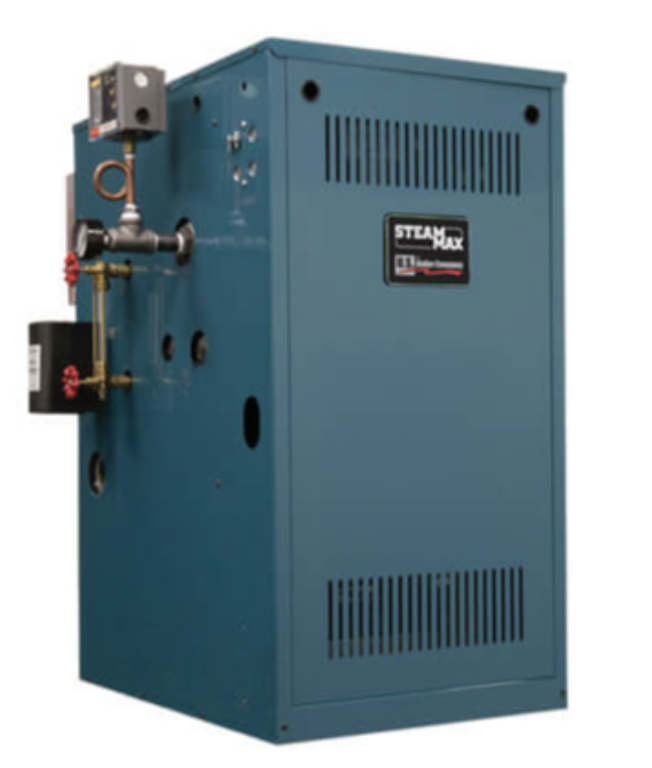
- 1. Burnham STMX100 ………………………..~ $ 4,000.00
- 2. Operating limit control L4080A………..~ $ 90.00
- 3. High Limit L4006H …………………………..~ $ 290.00
- 4. 30 PSI Relief valve …………………………….~ $ 50.00
- 5. 2" copper pipe and fittings ………………~ $ 2,500.00
- 6. Labor to remove pressure controls
- 7, Labor to remove sight glass
- 8. Labor to remove steam pressure gauge
- 9. Labor to remove the plugged openings needed for gravity hot water
- 10. Labor to install the limit controls
- at least 2 extra hours for items 5 thru 10
- This boiler is rated at 82% AFUE
The total for the labor is not able to be posted because that is against the ruled for this forum. But lets just say that there are about 2 extra hours of additional labor to do that work that must be added to the cost of the job.
After the rest of the regular piping and wiring that is included in the standard package boiler using smaller diameter copper pipes. You can imagine the markup and labor costs for your particular area.
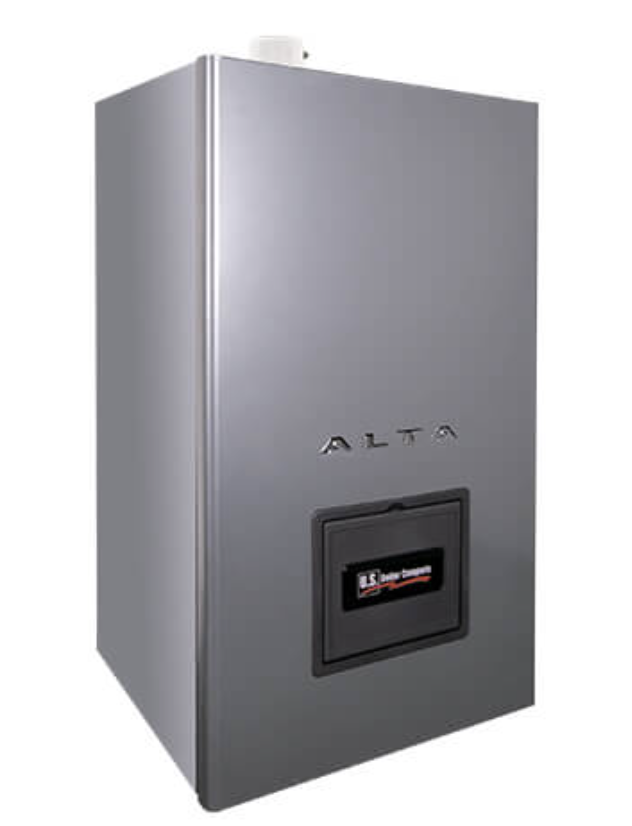
- 1. Burnham Boiler 95% AFUE ALTA120 ………………….~$2,556.00
- 2. Circulator UPS26-99 …………………………………………..~ $400.00
- 3. Circulator Star-S-21F ……………………………………………~ $150.00
- 4. 1-1/4" copper pipe and fittings ………………………..….~$1,200.00
- 5. No extra labor to take stuff off of a steam boiler
- 6. Limit controls are already included
- 7. Correct relief valve is already included
- This boiler is rated at 95% AFUE
So after looking at this simple comparison of a modulating Condensing 95% efficient boiler and comparing it to the 82% efficient cast iron boiler, I believe that the average homeowner will probably select the more efficient boiler with 2 circulator pumps that will heat his home comfortably, even of both system cost the same total installation price. But in this comparison since the labor for a Mod Con boiler is more involved with primary secondary piping, there may be more labor hours.
Now if we look at a Burnham cast iron boiler
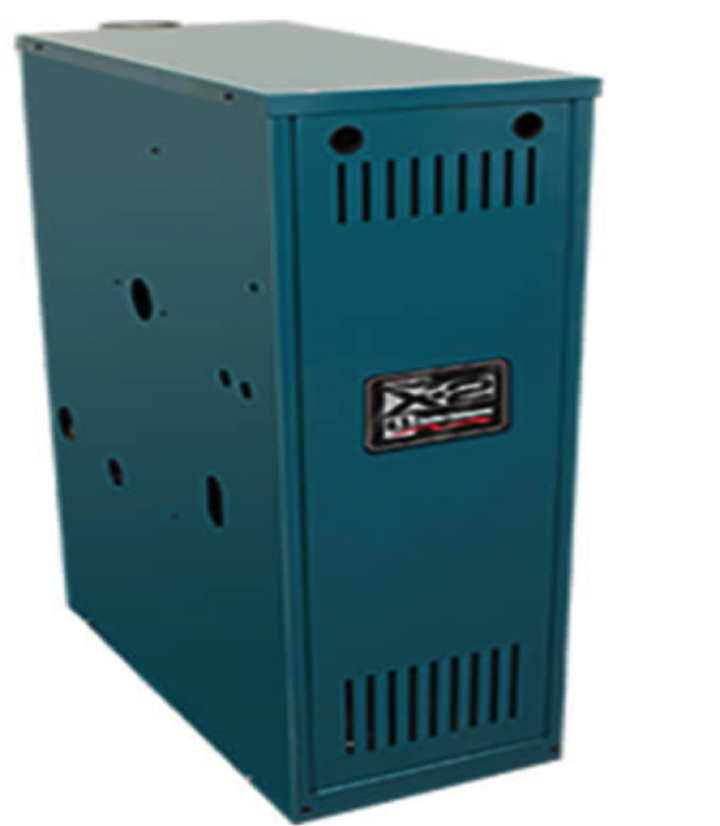
- 1.Burnham ES24BIN …………………………..…..~ $ 2500.00
- 3. Circulator Star-S-21F ……………………………~ $150.00
- 4. 1-1/4" copper pipe and fittings …………….~$1,000.00
- 5. No extra labor to take stuff off of a steam boiler
- 6. Limit controls are already included
- 7. Correct relief valve is already included
- This boiler is rated at 82% AFUE
Looking at what is included with boiler, we can see that there is no need for an additional boiler circulator because the boiler circulator is included with the package boiler price of $2,500.00 and it is already wired up with the proper limit control and circulator relay.
These prices speak for themselves. The labor to install all three boilers should be completed in a long day with a mechanic and a helper. So if the labor markup and overhead was to $2,000.00 or $20,000.00 the price of the gravity job would cost more and the efficiency would be the lowest of the three choices.
So to answer @leonz query about would a steam boiler be a good match for keeping the gravity system operating as a gravity system. The answer is yes. Would any professional take on such a project? I doubt it very much. Would any homeowner select this option? I can only think of one.
Edward Young Retired
After you make that expensive repair and you still have the same problem, What will you check next?
0 -
i'm not sure i'd agree that a steam boiler would work for gravity hot water circulation, or at least would work well. the passages are designed for steam flow which is a much higher energy content per volume than water. the gravity hot water boiler would need much more flow. it might work, it might not, but it wasn't considered in the manufacture's engineering.
1 -
I will gladly do that install...first I gotta talk to my lawyer though…write up a bullet proof hold-harmless clause...70% down payment...add legal costs to estimate…you want me to cut and thread all the nipples right? Domestic steel and cast iron fittings right? Maybe throw in some vintage controls that have been sitting in my shop since the great depression?
1 -
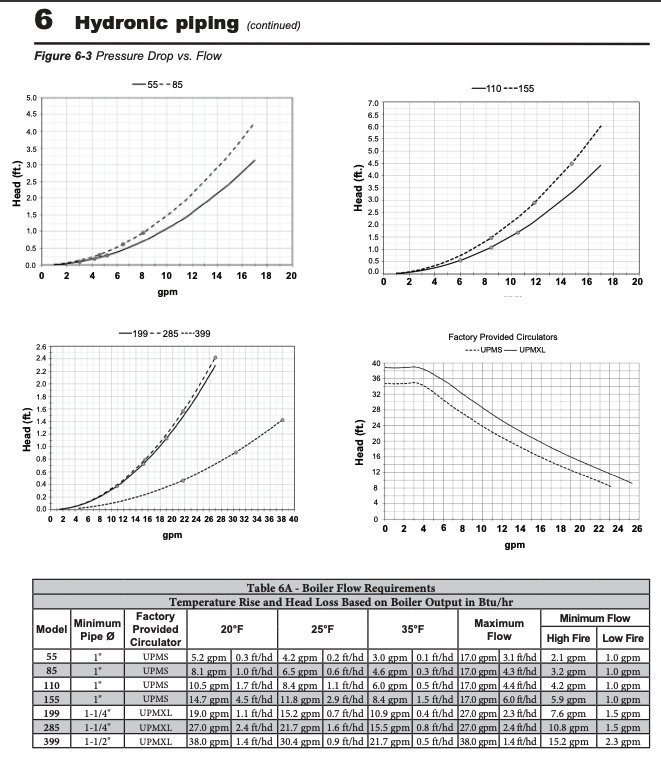
I think most of the fire tube mod cons could work with one circulator. Their manuals tell you how much pump capacity it takes.
The Lochinvar Knight comes with a variable speed ECM, so it would match pump gpm to load or boiler modulation.
\
 Bob "hot rod" Rohr
trainer for Caleffi NA
Living the hydronic dream1 -
Hello and good morning to you Ed,
To muddy the water further;
A dual fuel coal stoker boiler like the Alternate Heating Systems S500 could be used for a gravity hot water heating system. It has a large top tapping and 2 side tapping's for hot water return
It comes complete with all the hot water heating controls tucked in the ash basket set with the boiler from Little Egypt, Pa.
The EFM DF520 dual fuel coal stoker is even simpler and has tapping's for steam and hot water and a dual fuel burner that is segregated from the firebox by a burner door that is opened and closed.
If there is an old coal room in the basement which is most likely the dual fuel EFM DF520 would be a good match as it is an underfed pot stoker with a door sealed dual fuel burner.
The combustion chamber for either of the dual fuel units is totally segregated from the coal burning fire box and operates with a manual switchover.
The coal feed tube on the AHS S500 would have to be plugged with a threaded plug after the hopper is removed and Bobs your uncle.
It may be simpler to order a hot water boiler with a change order requesting larger tapping's for the riser and dual returns rather than add the plumbing mess with the circulator, additional piping, circulator flanges and additional wiring and allow the original piping to remain intact except for the close boiler piping and adding a direct immersion low water cut off and a simple more reliable mechanical triple aquastat like the Honeywell L8421L.
I guess I would call a boiler manufacturer and ask if they would build a new hot water boiler with larger tapping's and certify the welds to the current ASME and UL steam standards and pressure test it for one hour as required and there again it could be plumbed for the gravity hot water heating in the home with new black iron close boiler fittings and an immersion low water cut off, tridicator and other plumbing as needed.
It cannot hurt to ask for a change order that would simplify the boilers installation by installing and welding a larger tapping in the top of the hot water chest to match the central riser and 2 in the sides of the water chamber to mate with the return riser to allow for good water flow to maintain slow even heat.
0 -
^^^^^^^
This; @hot_rod recommended this designed to me six years ago for my gravity feed radiator system. I use a a fire tube mod con boiler with a single pump and TRV radiators.System works flawlessly. A lot of energy efficiency improvements done over the years to the house so I’m able to run a low temperature curve (90F -120F) using built in boiler ODR greater.
PM me if you would like more information.
 1
1 -
I guess I look at it this way, there are gravity hot water systems in operation today that are over 100 years old or more and have only required simple care.
It would be interesting to find out how many gravity hot water systems exist and are operating here in the United States and Canada.
0 -
Converting a steam boiler to water the MFG will never approve it and it will void the warranty.
Some commercial boilers (and older boilers) the mfg used to make the same boiler for steam or water and you just installed the correct trim. This has mostly gone away but I am sure there are some boilers made (Weil McLain has some) where the same boiler is used on steam or water but probably not gravity hot water.
Back in the day I replaced an old gravity boiler with a HB Smith BB-14 which had a high-water content and it worked fine
0 -
@leonz said: "Hello and good morning to you Ed,
To muddy the water further;
A dual fuel coal stoker boiler like the Alternate Heating Systems S500 could be used for a gravity hot water heating system. It has a large top tapping and 2 side tapping's for hot water return
It comes complete with all the hot water heating controls tucked in the ash basket set with the boiler from Little Egypt, Pa.
The EFM DF520 dual fuel coal stoker is even simpler and has tapping's for steam and hot water and a dual fuel burner that is segregated from the firebox by a burner door that is opened and closed.
If there is an old coal room in the basement which is most likely the dual fuel EFM DF520 would be a good match as it is an underfed pot stoker with a door sealed dual fuel burner.
The combustion chamber for either of the dual fuel units is totally segregated from the coal burning fire box and operates with a manual switchover.
The coal feed tube on the AHS S500 would have to be plugged with a threaded plug after the hopper is removed and Bobs your uncle".
So you’re saying that a half a million BTU boiler is the best answer for @Brandon123? I’m not sure you understand what we do here.
You know that we have discovered that world is round, have traveled faster than the speed of sound, and. have put a man on the moon. And Mr Johnson invented the Electric Tele-Thermoscope in 1883. Today we call it a thermostat. After you install that S500 in your home, let me know how that works out for you.
Edward Young Retired
After you make that expensive repair and you still have the same problem, What will you check next?
0 -
I do understand what this forum is for. I simply mentioned the S500 model as a possibility due to its larger tapping's and the dual fuel option. A smaller model like the S260 would or could work just as well.
The EFM DF520 has an 8 inch flue breech and a dual fuel option and large tapping's.
We as yet have no idea how large the existing boiler is Ed, or if it even really needs work.
0





Categories
- All Categories
- 87.5K THE MAIN WALL
- 3.3K A-C, Heat Pumps & Refrigeration
- 59 Biomass
- 429 Carbon Monoxide Awareness
- 124 Chimneys & Flues
- 2.2K Domestic Hot Water
- 5.9K Gas Heating
- 118 Geothermal
- 168 Indoor-Air Quality
- 3.8K Oil Heating
- 78 Pipe Deterioration
- 1K Plumbing
- 6.6K Radiant Heating
- 394 Solar
- 15.9K Strictly Steam
- 3.5K Thermostats and Controls
- 56 Water Quality
- 50 Industry Classes
- 50 Job Opportunities
- 18 Recall Announcements