Stumped: New increase in water pressure

Hi everyone!
Hoping for some advice.
I own a 4-family, 1938 building. I live in one of the units. A few weeks back I noticed my toilet fill valve was hissing. I replace ther fill valve and all is well again.
A few days later, I noticed a small pool of water had collected from a now dripping T&P valve on the hot water heater. This is a 2004 Ruud PR75-70N, 75-gallon natural gas hot water heater. No expansion tank.
This unit has been very reliable, yet I have never flushed the unit.
I live in Cincinnati where the water is hard.
What I've done:
- Checked the pressure at the basement utility sink, roughly 65 psi.
- Emptied enough of the tank to replace the T&P valve, the water that drained out was clear.
- Replaced the T&P valve….same symptoms
- Placed the pressure gauge on the HWH drain valve and opened the valve.
- Watched the valve during a complete heating cycle. The pressure increased slowly as the tank heated, some moments the pressure quickly dropped back to 60 (assuming a toilet flushed or sink opened, etc…), then increased again, a max pressure of nearly 110 psi.
- I measured the water temp after the heating cycle -- roughly 120 degrees F.
I've noticed moments of a higher pressure "bump" when I would turn on a kitchen facuet or bathtub, but not consistently.
I'm sure there is quite a buildup of sediment at the bottom of the Ruud, yet the hot water delivery has been fine.
The buildings main PRV is older, yet I would think if this was failing, I would have other symptoms.
I'm considering having a expansion tank pressed-in to the cold water suppy on the Ruud, yet stumped on why "now".
Thanks for any help!
Comments
-
Sounds like thermal expansion, if it rises as the tank heats. Any possibility the water provider added a backflow device on the main line to the building?
Or the PRV has a bit of debris under the seat allowing a slow over-pressurization.
Bob "hot rod" Rohr
trainer for Caleffi NA
Living the hydronic dream1 -
Thanks @hot_rod ! I'll check on the water works adding any other equipment. I'll look into the building PRV, also.
0 -
If there is a PRV valve on the supply, yo need an expansion tank. Why now? Who knows. Something changed — but you need one anyway.
Br. Jamie, osb
Building superintendent/caretaker, 7200 sq. ft. historic house museum with dependencies in New England 3
3 -
Thank you, @Jamie Hall. There is just the main PRV on the building supply and another on the boiler make up supply. Sounds like the expansion tank is the way to go. This was installed in 2004…maybe before a expansion tank was required by code?
0 -
very likely
Br. Jamie, osb
Building superintendent/caretaker, 7200 sq. ft. historic house museum with dependencies in New England0 -
It sounds like you have had what's called an "open system" supply from your water utility.
If they added something…a device that has a check valve in it or another device that is faulty the system would then be considered a "closed system" causing the relief valve to discharge and the water supply to fluctuate as described.
I hope your water supplier has some answers.
0 -
Some PRV have a bypass function, others act as a check. What brand and model do you have?
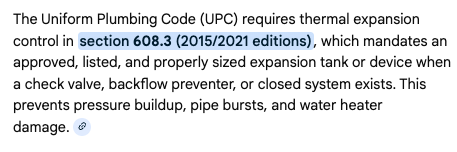
The current codes suggest a thermal expansion "control". I believe this was added on 2015?
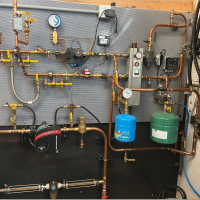
Certainly no harm in having a thermal expansion "control" An expansion tank is the most common way to add this.
Currently your T&P is that control😲
 Bob "hot rod" Rohr
trainer for Caleffi NA
Living the hydronic dream1


Categories
- All Categories
- 87.6K THE MAIN WALL
- 3.3K A-C, Heat Pumps & Refrigeration
- 59 Biomass
- 429 Carbon Monoxide Awareness
- 124 Chimneys & Flues
- 2.2K Domestic Hot Water
- 5.9K Gas Heating
- 119 Geothermal
- 168 Indoor-Air Quality
- 3.8K Oil Heating
- 78 Pipe Deterioration
- 1K Plumbing
- 6.6K Radiant Heating
- 394 Solar
- 16K Strictly Steam
- 3.5K Thermostats and Controls
- 56 Water Quality
- 51 Industry Classes
- 50 Job Opportunities
- 18 Recall Announcements