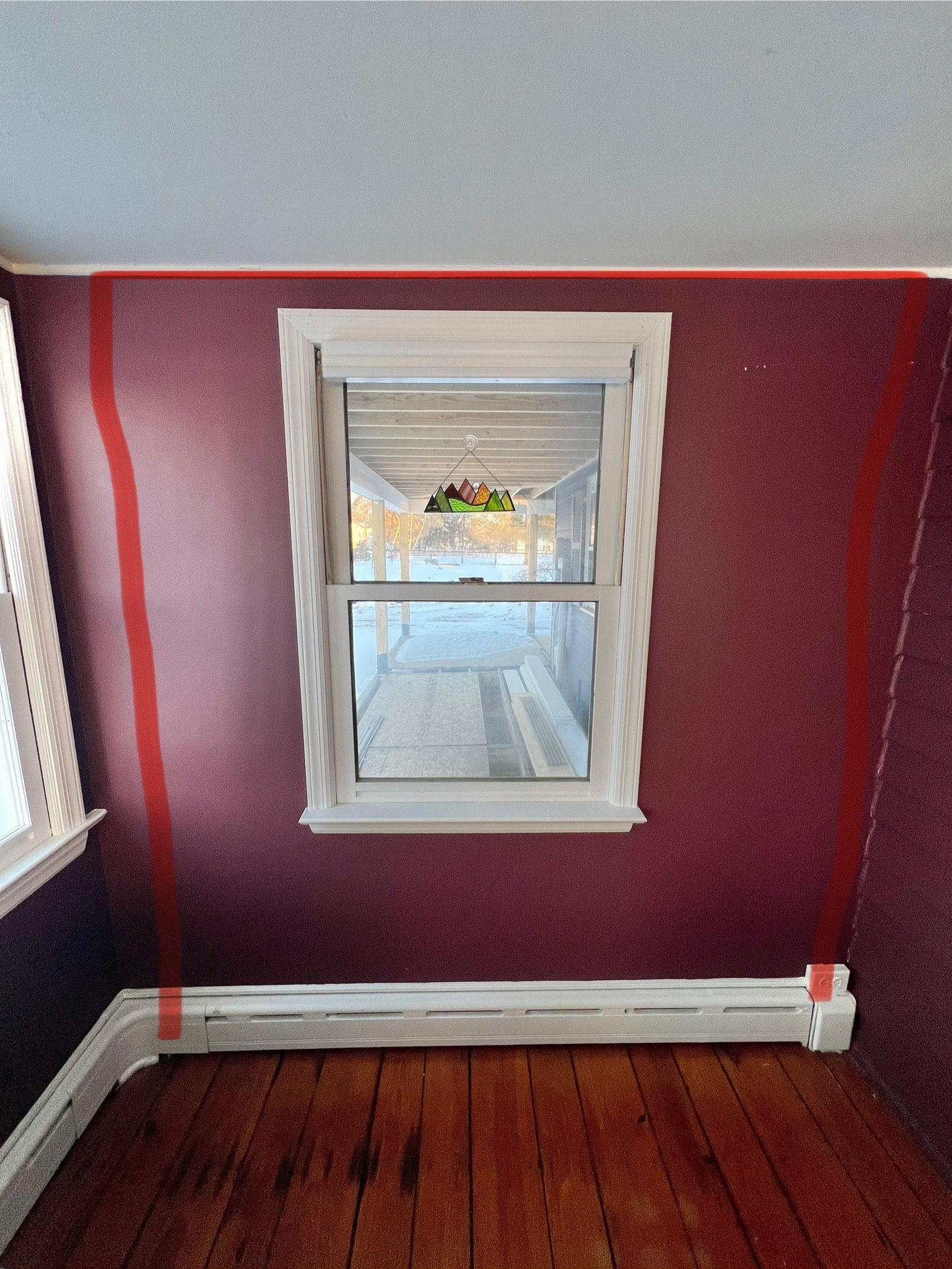
Re-routing baseboard around doorway.

Hey fellas. I’m looking to install some French doors out onto a new wrap around porch I built, but i currently have cast iron baseboards running all the way around the current enclosed portion of the porch. What would be the best way to route this section of the piping? Am I thinking along the right lines by going up over and back down again? Any feedback would be appreciated.
Comments
-
do you have access underneath? usually that is easier. if you go above there will need to be space between the header and top plate to run the pipe and depending on the height of the door and the size of the header needed frequently there isn't space between the 2. i would also either spray foam the cavity up to the pipe or fill it with rigid foam if that is an exterior wall.
if you run it in to the attic because you don't have space in the wall above the header then protecting it from freezing especially where it gets from the top plate in to the attic will be difficult.
0 -
Access underneath is very limited, less then a foot from the ground. I thought about installing the new door then packing out a false wall to the inside just thick enough to run the piping, this way I don’t mess with the header for the door and don’t have to go into the ceiling. I would loose a little room inside the enclosed porch though.
0 -
furring it out would solve many problems. just make sure you plan your door trim for it, probably just wider extension jambs. i would also take caulk or foam in a can and seal up the wall surface of the existing wall to the floor and the new door and anything else that has a gap before closing up the furred out wall so there are no drafts in to the cavity to freeze the piping.
0 -
I hadn’t thought about potential drafts with the false wall, good idea with the caulk. Only other issue is I’m eliminating nearly 1/3 of the baseboard in that room and it’s always freezing cold in there as it is.
0 -
You might want to kill two birds with one stone. Get rid of all the baseboard and install a properly-sized cast iron radiator that will heat the room comfortably on the "near" side of the door. If you have a lot of windows, you can get a long low radiator. We have a 22" high cast iron radiator 66" long that runs under two windows in our living room. It cranks out the heat even at relatively low (120-140F) supply temps. Put a TRV on it for added control. Then you solved both your piping problem and your heating problem in that room.
0 -
is the rest of the house ci baseboard? is that its own loop either on its own zone or part of another zone or is it in series with other loops? you could get more output from panel radiators but they would cool faster than the cast iron so that room would likely cool off before the rest of the house calls for heat again. maybe something with more mass like 4, 5, or 6 tube runtal. it is kind of pricey but it has more mass than a standard panel radiator and you could like the room with it like baseboard.
0 -
consider running a heat load calculation on the room to see what you actually need for heat emitter sizing.
If it was cold in the past and you are removing 1/3 of the radiation, that doesn’t sound so good.
Bob "hot rod" Rohr
trainer for Caleffi NA
Living the hydronic dream 1
1 -
The whole house is cast iron baseboard, old 9” tall base ray, that porch is 6” tall and was added later. It never seems to get hot. I have two zones, upstairs and downstairs. Adding a third zone for the porch and front living room may be a good idea, the front living room has plaster walls with fieldstone stacked in between old timbers, no insulation back in the 1700s.
I also like the idea of eliminating that front porch base board entirely and using the cast iron radiator. It seems I loose a lot of heat on the long loop going around that porch room before it gets to the living room. I’ll have to look at what makes the most sense cost wise
0 -
if it is all one series loop you have to size the next section of the loop based on the temp of the water after it comes through the first section of the loop. if they just added that porch on to the end of the existing 1st floor loop the water may be pretty cool by the time it gets there so you would need a lot of emitter to be able to het it with that cooler water. it also looks like it has a lot of outside walls and glass, both of which increase the heat loss significantly.
it sounds like as @hot_rod mentioned the first step is to do a heat loss calculation for that room. if you do add a 3rd zone I would pipe the 2 rooms in parallel with balancing valves.
0


Categories
- All Categories
- 87.6K THE MAIN WALL
- 3.3K A-C, Heat Pumps & Refrigeration
- 59 Biomass
- 429 Carbon Monoxide Awareness
- 124 Chimneys & Flues
- 2.2K Domestic Hot Water
- 5.9K Gas Heating
- 119 Geothermal
- 168 Indoor-Air Quality
- 3.8K Oil Heating
- 78 Pipe Deterioration
- 1K Plumbing
- 6.6K Radiant Heating
- 394 Solar
- 15.9K Strictly Steam
- 3.5K Thermostats and Controls
- 56 Water Quality
- 50 Industry Classes
- 50 Job Opportunities
- 18 Recall Announcements