Three colder rooms...

Hi Everyone, it’s 5 degrees here in Worcester, MA and I’m stuck home with the kids again for another snow day, so I thought I’d take the chance to record what’s going on with my steam heat so that I can finally try to fix some of the imbalance. This is our 8th winter in this house and it’s MUCH better than when we moved in. Two years after moving in we found New England Steamworks. Our system is working much better since using them and all the knocking and hissing is gone. They do yearly maintenance for us and they also refinished some of our radiators and they are GORGEOUS. We are lucky to have them.
Five years ago, after advice from this forum, I replaced all the vents with maid o mist (minus the downstairs bathroom, I can’t reach it easily or get it off) and experimented with the vent sizes and got upstairs versus downstairs balanced out much better. Still there’s three rooms that are colder and in an effort to make the system even better, I'm trying to figure out what to adjust, but I am struggling. Here are my issues:
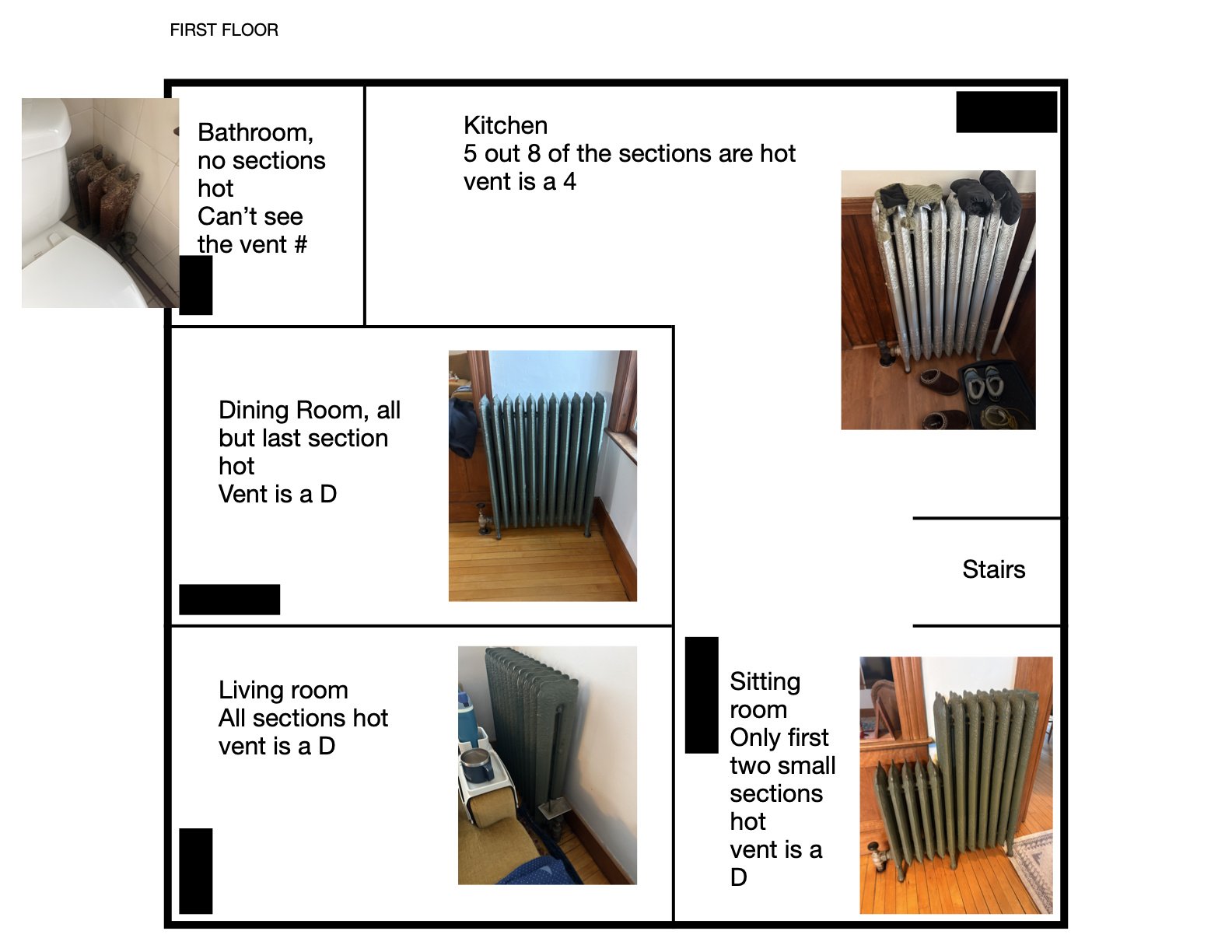
- The first floor sitting room gets cold and the giant radiator in there does not heat up past the first two small sections. We spend a lot of time in this room so it’s my biggest priority to figure out.
- The downstairs bathroom is also very cold, and this radiator does not heat up much either.
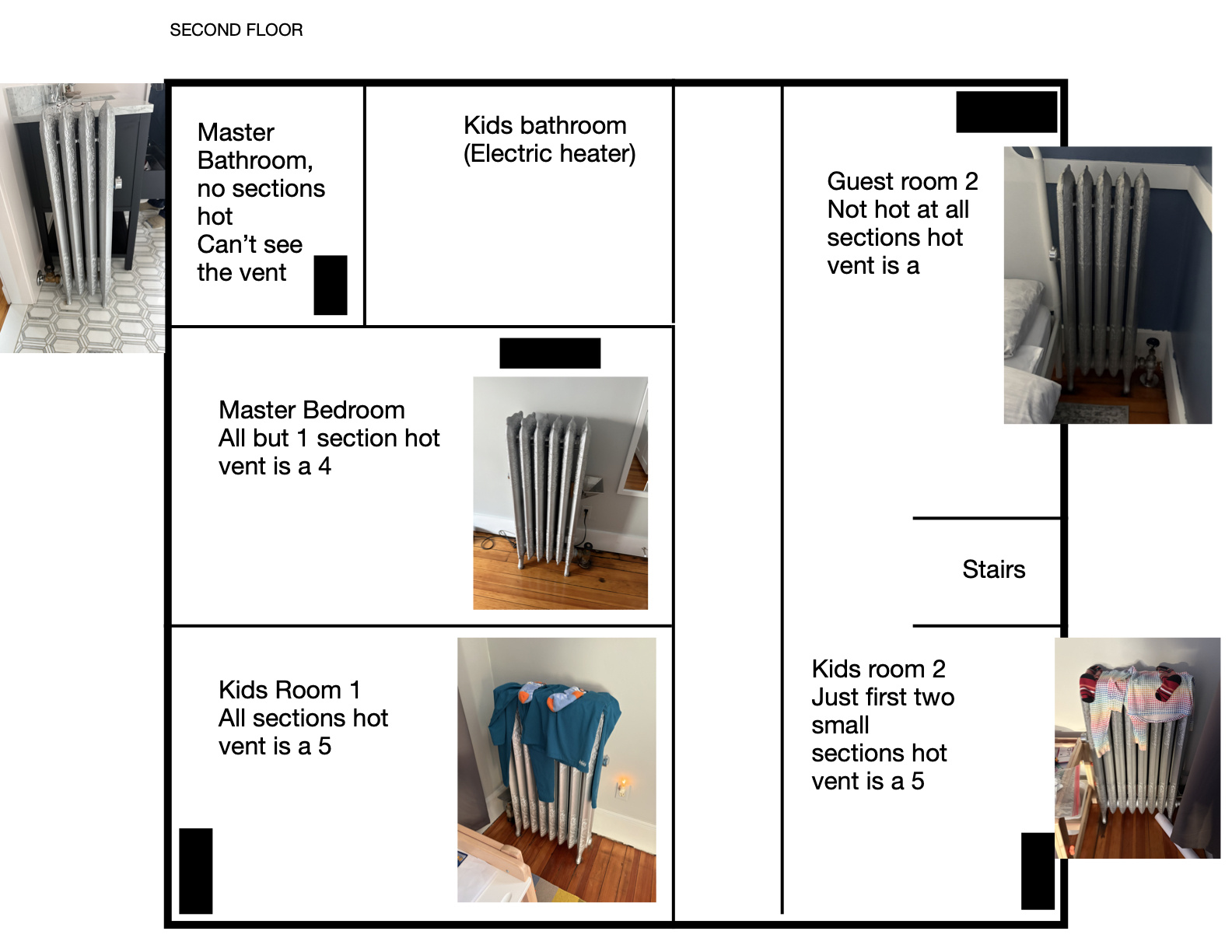
- The upstairs guest room is cold, but we also don’t use this room much so it’s fine unless we have a guest.
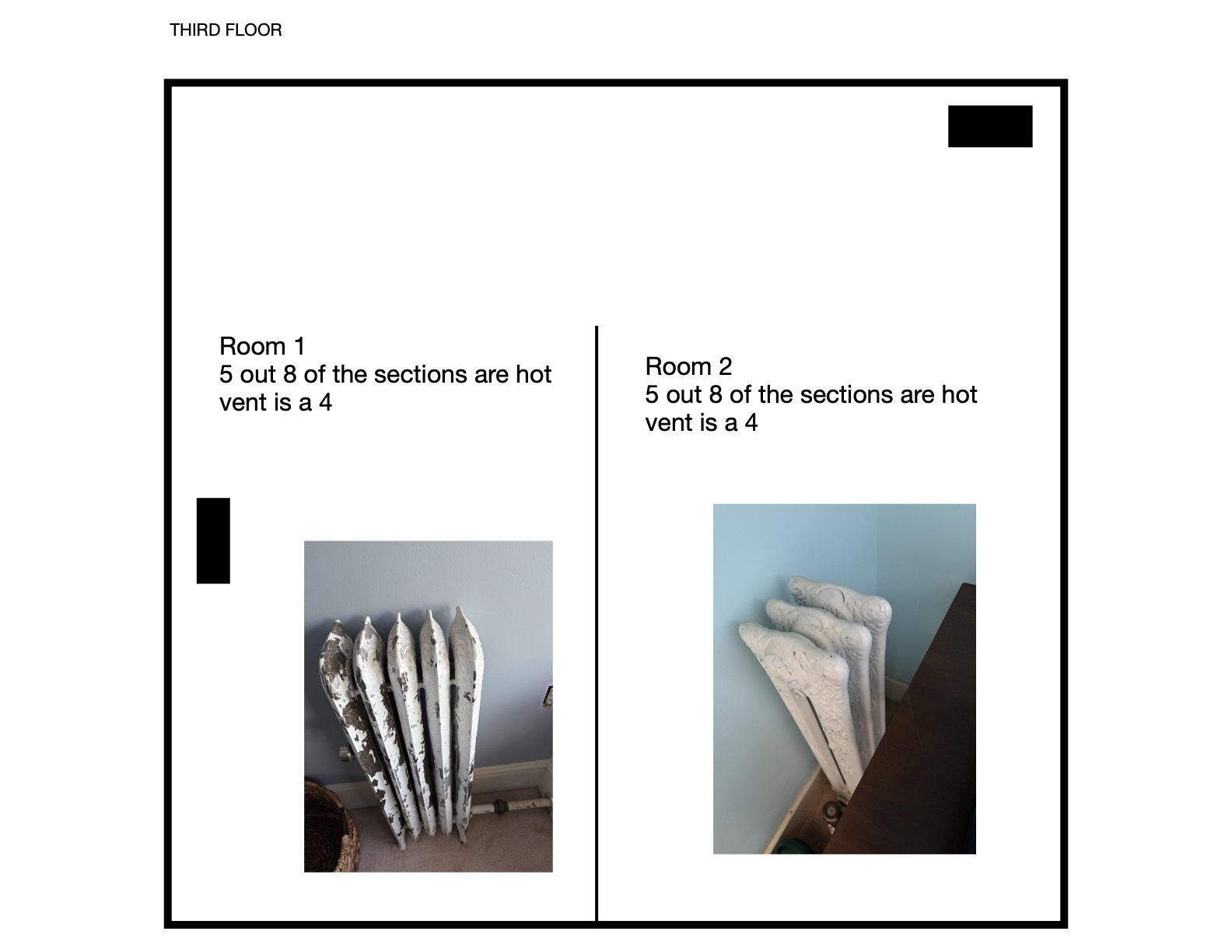
- (The third floor is also very cold, but we don’t use those spaces much because it's so hot in the summer and so cold in the winter).
We keep our heat at 67 all the time. Don’t touch the thermostat once winter hits. Any ideas on what to try?
I’m attaching the diagram I made to help myself think it through, in case it helps. The black boxes are the radiators (nothing about this diagram is to scale! :) Thermostat is in the dining room, almost all the way in the far right bottom corner. And the guest room vent is a 5—just realized I didn't put it on the diagram!
Comments
-
Each of those D vents is as large as a Gorton #1 main vent
So while those D vent radiators might be getting hot, it is hard to balance with so many of those…the steam has too many places to go.
My advice is to slow all those down to like a #6 then see where you are at. As you probably know, with these MoM vents you can purchase orifices and just swap those out without swapping the whole vent (or you can purchase some #6 vents and steal the orifices from them, keeping the vents as spares)
As for the cold bathroom one where you can't see the vent, that vent is probably failed closed and needs to be replaced.
Out of curiosity, how did you decide to go with the largest D vent on so many radiators (especially first floor ones)?
NJ Steam Homeowner.
Free NJ and remote steam advice: https://heatinghelp.com/find-a-contractor/detail/new-jersey-steam-help/
See my sight glass boiler videos: https://bit.ly/3sZW1el0 -
The D vents I went with because those radiators weren't getting hot. I was having an issue (which I posted on here) that all my upstairs radiators were getting really hot and my downstairs radiators weren't, so our upstairs was steamy and our downstairs was cold. So that's why all the Ds on the first floor.
Do you think I should change those two Ds that are getting hot to a 6 and then leave the D on the big radiator I'm trying to get hotter? I have tons of the orifices cause I bought new vents all the radiators and they each came with a full set. 1
1 -
Yes I would try something like that to slow down the ones that don't require that much speed.
In my opinion, if you have to put a D vent on any radiator, it is a sign of some other problem such as a sagging supply pipe that is holding water.
But I do have a friend with a D vent on every radiator in her house and she loves it so as is usually the case, weird stuff can work.
NJ Steam Homeowner.
Free NJ and remote steam advice: https://heatinghelp.com/find-a-contractor/detail/new-jersey-steam-help/
See my sight glass boiler videos: https://bit.ly/3sZW1el1 -
If you could draw a sketch with lengths of mains (with locations and specifics on vents) and runout pipes to the radiators (with lengths and sizes and floor # and vent sizes) that would help. I don't think anyone can balance a steam system from afar without knowing more details. General rule is to vent the mains fast as practical and the radiators more slowly. You could have pitch problems causing problems with condensate pooling. Mains supposed to be pitched downward (for parallel flow system) away from boiler at 1 in. per 20 ft. and radiator supply pipes at twice that pitch , upwards away from main.
A couple resources for you:
 2
2 -
Thank you or these resources!
0 -
here is a video i've made about balancing steam system:
what are your main vents?
»»» See my steam heat YouTube videos:
https://www.youtube.com/@HeatingBlog0 -
From your 2020/2021 post at the end it looked like you were pretty well balanced but for the one large living room radiator. Exactly what all did you change from that point? Use the second reference sent to you by @Captain Who and compare the venting rates of what you swapped out to what you swapped in with the MoM's. That may help you reconstruct your balance.
I don't think you ever did answer the question about your main venting other than assuming it was good since NE Steamworks installed them (which is probably right). Also, I assume NE Steamworks compared your boiler size to the standing radiation so do you have that number? BAsically the advise has not changed here since 2020. Vent the mains fast and the radiators slower. If rooms are cold start by slowing down the hot rooms. Personally I don't think you should ever need a D vent on a radiator.
1


Categories
- All Categories
- 87.6K THE MAIN WALL
- 3.3K A-C, Heat Pumps & Refrigeration
- 59 Biomass
- 429 Carbon Monoxide Awareness
- 124 Chimneys & Flues
- 2.2K Domestic Hot Water
- 5.9K Gas Heating
- 119 Geothermal
- 168 Indoor-Air Quality
- 3.8K Oil Heating
- 78 Pipe Deterioration
- 1K Plumbing
- 6.6K Radiant Heating
- 394 Solar
- 16K Strictly Steam
- 3.5K Thermostats and Controls
- 56 Water Quality
- 51 Industry Classes
- 50 Job Opportunities
- 18 Recall Announcements