Planning to replace an old boiler — What are my next steps?

Two years ago, we bought a large 1925 Duplex in Milwaukee, WI. I believe the time has come to replace the old boiler, and I am looking for some guidance in how to go about this.
Since buying the house, I have put my efforts into tightening the building envelope and giving the old converted gravity system some much-needed maintenance. We have installed attic insulation, wall insulation, weatherstripping, air-sealing, etc. Our measured fuel consumption (BTU/HDD) is down considerably (>30%). With the help of this forum, I have the old boiler running as it was intended. However, this boiler is probably from the 1940’s or ‘50s, is now vastly oversized for the house, and I would like to replace it with something more efficient before it goes out. (I realize that I will never recoup the investment by fuel savings, but that is okay.)
In preparation for replacement, I have done the following. I have had a energy audit with a whole-house Manual J calculation. I have monitored our actual fuel consumption on a daily basis, and now have a pretty good handle on our heating load (BTU/HDD). Our actual heat loss is in rough agreement with (but moderately lower than) the Manual J calculation. I know the EDR of all of our heat emitters.
With the improvements to the envelope, I calculate that our existing radiators would be sufficient to heat the house on a design day with as low as ~120F water temperature. I am imagining that a system with a mod-con will be optimal, but there are still lots of questions about implementation.
Therefore, I am trying to figure out how to best go about specifying the new system. I am reading all I can (this forum, Siegenthaler, idronics, etc.) But what’s next? Just hire a pro and hope they know what they are doing? Hire a HVAC engineer to design the system? Would it help me to buy myself a Manual S? Try to design the system myself and ask for feedback here? (I have a technical background.)
Any suggestions appreciated.
Thanks!
Trying to keep Bernie burning!
Comments
-
The thing to do to get the right job is to make a complete drawing and specifications for what you want and then get 3 contractors to bid on it. Then they are bidding on apples-apples so you can compare quotes
Now the question is who does the drawing and the specs?
You could hire an engineer
You could do it yourself
You could find someone on HH to design it for you. I am thinking that @Harvey Ramer or @DanFoley or someone like that could design it for you. There are some people on HH that do design work.
Start a new post "looking for a Hydronic designer" and see who pops up.
1 -
I can put you in touch with designers in the Milwaukee area. Its good to work with someone familiar with the area, knows those old buildings and could refer reputable contractors.
Bob "hot rod" Rohr
trainer for Caleffi NA
Living the hydronic dream1 -
Just remember that while a mod-con will likely be optimal in theory, it won't save you money if the cost of servicing and repairing that more-complex system turns out to equal or exceed the amount of fuel savings. You can find numerous sad stories here from mod-con owners who have been burned by those additional costs, and headaches from incorrect installs.
Since you're already on oil, I would look seriously at an Energy Kinetics System 2000. It's non-condensing but about as efficient as you can get with a non-condensing oil boiler. Reliability and support are excellent, but you do need an installer who is EK-qualified. Best efficiency is obtained when coupled with indirect DHW, because some of the efficiency gain comes from post-purging residual boiler heat into the DHW tank.
A mod-con could save you $$ in the long run, but beware that costly service/reliability problems can quickly eat into that margin.
 1
1 -
Thanks for the thoughts so far. Just for clarification, we are on natural gas. Our old boiler was an oil-burner, but was converted to NG in, I believe, the '50s, possibly '60s.
Trying to keep Bernie burning!
0 -
Just for fun:
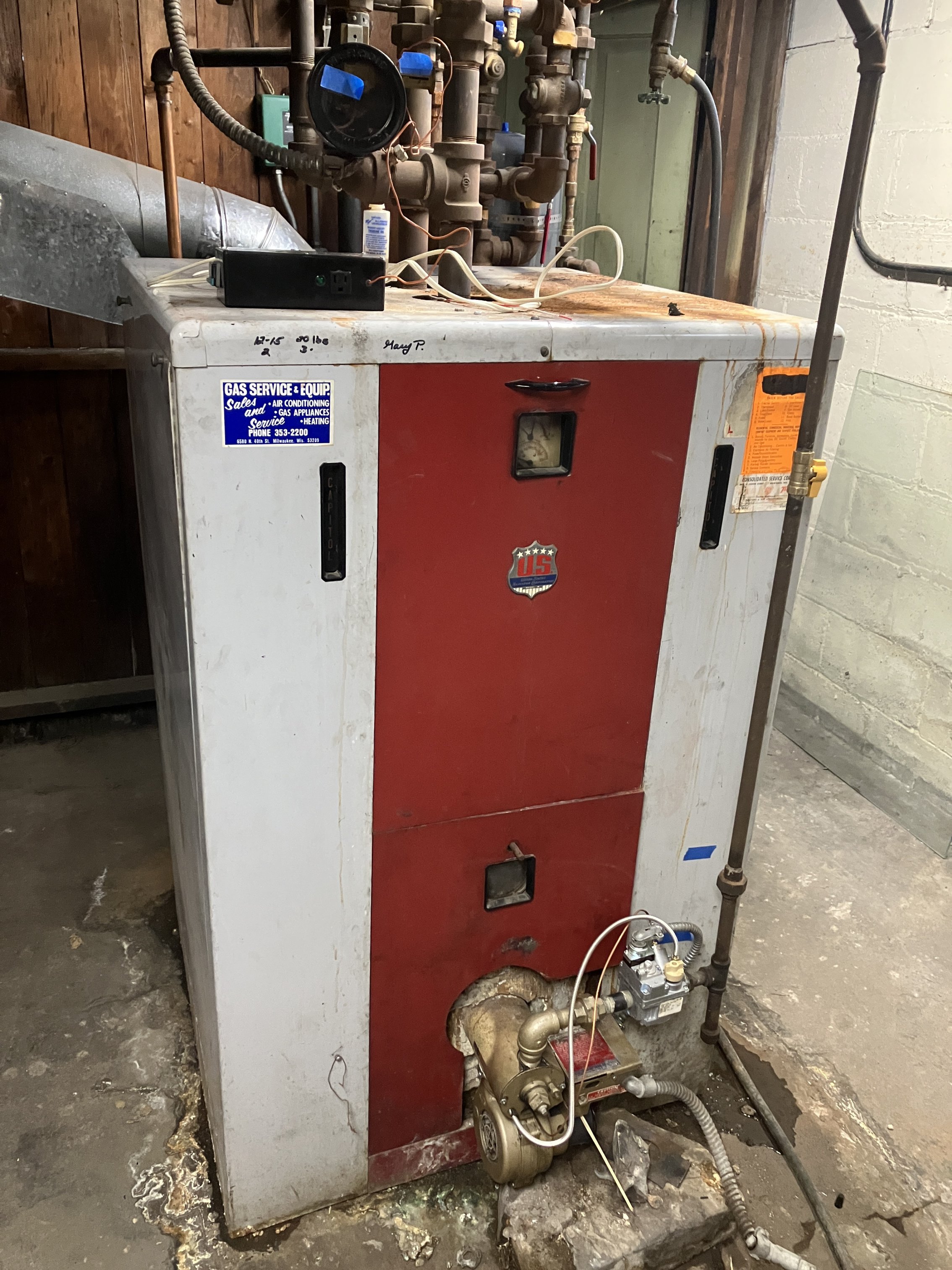
Trying to keep Bernie burning!
0 -
you have done some good homework, it should be an easy design.
If in fact you can heat with 120 SWT, then a mod con is a no brainer. Running a typical cast boiler at 160 or so , mixing it down to 120, while running 400 degree flue temperatures?.. like flooring your cars accelerators and using the brakes to control speed.
All boilers need to have an annual check according to installation manuals. With proper installation, proper maintenance and good water quality monitoring a mod con should run 15- 20 years. Mod cons fail from poor setup and adjustment, hard water, lack of attention.
Electronics are on pretty much all boilers now days.
If you plan on zoning, maybe with TRV, the modulation is a big plus.
Bob "hot rod" Rohr
trainer for Caleffi NA
Living the hydronic dream 1
1 -
Maybe off topic but what is leaking ?
National - U.S. Gas Boiler 45+ Years Old
Steam 300 SQ. FT. - EDR 347
One Pipe System2 -
a mod con might not last as long as a cast iron boiler but it will be much simpler than trying to make a ci boiler mix down to the temp you need and most likely that cost you save in longevity of the ci system will be lost in the complexity of mixing it down for the gravity system. maybe not completely, but a mod con with a magnetic dirt separator will hook directly to your system or connect primary secondary. if you pick the right model it could even have the zone controls built in and do different reset curves for each zone.
1 -
I'm not a heating pro, just a homeowner/mechanical engineer, so I defer to the expertise of the heating pros here.
I would just note that the OP does not need to "mix down" to 120 F supply water temp. He has a 1925 house similar to ours, with "existing radiators" (which I assume means the original cast irons) that could heat the house with 120 F supply water. This is our situation too. But we have cold-start cast irons boilers that run about 45 minutes per cycle in a high water volume gravity conversion system, starting at 65 F water temp and ending at 140 F or so. Then idle for 2-3 hours or more because the boilers are so oversized. The only "mixing" the boiler mfr recommends is a bypass, which we lack, for condensation protection, but that can be a simple 3/4" line with a manual globe valve or a thermostatic.
A mod con could be the best solution for the OP. I'm just observing that if the OP chose the longevity and simplicity of a cast iron boiler (with admittedly lower efficiency) over a mod con, mixing down to a lower supply water temp doesn't appear to be required here. All that would be required is a simple bypass to maintain return water temps above condensing.
1 -
Nothing now! :) That was an old picture from when I was bringing the old girl back up to snuff from the previous owners. It had a vastly undersized expansion tank (presumably because they didn't take the large volume of the gravity system into account). The HH forum helped me figure out a number of things, including that.
Trying to keep Bernie burning!
0 -
To be clear, jesmed1 is correct: The house is heated by cast-iron radiators (with a few original convectors). As he points out, I don't "need" to run at 120F, that is just the theoretical minimum on design day.
But jesmed1 has brought up a point I have been struggling with. My current heating cycle is like his. I use a temperature setback at night and during mid-day. A morning heating cycle brings the house back up to temp, then we coast through the day on the high-mass radiators and insolation. In the afternoon/evening, another cycle brings us back up up to temp. I think with any boiler that is properly sized, recovery from a setback could be problematic on cold days. My present boiler is about 220 kBTU/h, and my heating load is down to roughly 80k.
I guess my proposed solution to that is to plan on NOT using a nightly setback, but use TRVs in the bedrooms to allow us to sleep cool at night. Is that what people generally do?
Trying to keep Bernie burning!
0 -
Yes, setback recovery will take longer with a smaller boiler. We currently run a 3-degree setback, and with our massively-oversized boilers, recovery takes about 1 hour. With a properly-sized boiler, I figure it would take 1.5-2 hours.
But remember that one factor in radiant heat is the "radiant" part. Even with a smaller boiler, your rads will be hot in 1 hour or less of run time during recovery, so the room will feel warmer despite the still-lower air temps. Also, you can simply start the recovery burn earlier in the morning if you want.
@hot_rod is correct that the cast iron boiler is not going to be as efficient as a mod con, and that long burn times result in even higher water temps that then reduce overall efficiency. I had hoped adding our 3 degree setback might get us some fuel savings, but so far I haven't been able to see it in the data.
My current plan is to replace our oversized WGO-5's with Buderus G115/3's running at 0.7 gph input, vs our current 1.2 gph input. That would give us a net IBR output of about 150MBH for two boilers, or 1.5 times our design heat loss of 100MBH. I figure that our current recovery burn times of about 1 hour from a 3-degree setback would increase to maybe 1.5-2 hours at most. We may also eliminate or dial down the setback, as it doesn't seem to be saving much if any fuel.
For efficiency comparisons, I've collected a bunch of data on our boiler outputs, and I figure our overall efficiency is about 65% after all flue losses, etc. That's vs a mod-con with, say 95% efficiency if you're condensing 100% of the time. So a potential 30% efficiency gain, balanced against the possible lifecycle cost issues.
1 -
if you do add TRVs, that will be considered micro zoning A modulating boiler is much better suited to those multiple, small, snd changing loads. If you plan on setting back temperatures, especially
A properly sized cast boiler will need return protection and the boiler operating temperature needs to be high enough to allow that
In @jesmed1 situation with “massively oversized” boilers the temperature protection is not as much an issue.
If you read today’s cast iron boiler manuals they state that bypass piping or bypass pumping may not be adequate to assure temperature protection.
Owning and testing many mod cons over the years on LP, often called a dirty fuel, I think the fear factor is a bit over-hyped. Often coming from people that have never owned one.
Choose a reputable brand , install and adjust properly, maintain it as required.
The Lochinvar Knight, as one of many examples is celebrating 20 years on the market.
Bob "hot rod" Rohr
trainer for Caleffi NA
Living the hydronic dream1 -
if the calculation of 120 swt is correct, if the boiler is the right size, the water will get to about that temp on design days and be cooler most of the time so you will need return water temp protection. sometimes a fixed bypass works, a lot of times you need a thermostatic bypass. your return water temp should be getting about about 140 within 20 minutes, if it takes hours to get there you will have a lot of condensing for a prolonged period which can cause corrosion and sooting of the boiler. some boilers run for half a century like that, others die in under 10 years.
1



Categories
- All Categories
- 87.6K THE MAIN WALL
- 3.3K A-C, Heat Pumps & Refrigeration
- 59 Biomass
- 429 Carbon Monoxide Awareness
- 124 Chimneys & Flues
- 2.2K Domestic Hot Water
- 5.9K Gas Heating
- 119 Geothermal
- 168 Indoor-Air Quality
- 3.8K Oil Heating
- 78 Pipe Deterioration
- 1K Plumbing
- 6.6K Radiant Heating
- 394 Solar
- 15.9K Strictly Steam
- 3.5K Thermostats and Controls
- 56 Water Quality
- 50 Industry Classes
- 50 Job Opportunities
- 18 Recall Announcements