Erratic Steam Heat

I'm trying to even out a steam heating system in an 8 unit self-managed condo building in Brooklyn, NYC.
There seems to be a roughly 10ºF swing between the warmest and coldest measurements in the apartments.
We have a Honeywell thermostat in the staircase/hallway, plus 4 remote sensors (in 4 of the apartments).
Until recently, there have been strange heat spikes at night, when the thermostat was set to a lower temp.
What issues should I be looking for? Broken valves? Boiler maintenance issues?
What other information would be helpful?
Attached is a chart of the 4 Bluetooth thermometers in the apartments. At the same time the Thermostat has been set to 76º all day, and 75º from 11pm-6am. (the thermostat is in the hallway and much more insulated from the outside, which is why it's set to a higher temp)
Thanks!
EDIT: I'm adding a pdf of photos of our system here:

Comments
-
Are your steam mains properly vented?
All Steamed Up, Inc.
Towson, MD, USA
Steam, Vapor & Hot-Water Heating Specialists
Oil & Gas Burner Service
Consulting2 -
-
temperature variance if that extent is not so unexpected. so what you are saying is
are there radiators in the hall where the thermostat is or is the hall heated by the apartments because it is internal and has common walls with apartments.
while you have remote temps are you able to set your thermostat to respond to those.
besides @Steamhead main venting, is it two pipe or one pipe system. air valves or steam traps require balance and maintenance you have to go unit to unit and see if each radiator is heating during a heating cycle.
is there an outdoor temp sensor so you get a sense of whether the difference increases or decreases as outdoor temperatures are warmer or colder? you could probably graph utdoor temp from some weather source although you probably could place a remote sensor outdoors and add its input to graphs as future data.
by quick look at your graph you get a significantly different result later in the season vs. shoulder season (presumably longer vs. shorter run times to satisfy the hall temp). but that is a guess by dates and doesn't actually tell outdoor temps. and it seems like the apartments that are slower to heat actually deliver more btus in longer runs as they overtake the other units in the later season, or did you do some maintenance that might explain the threshold approx between nov. and dec. 2R (orange trace) seems especially erratic compared to others.
of course the perrenial question here of how low can you go with pressure to help radiators fill evenly and not carry water up. you don't mention any clanking or other problems so maybe this is well attended to. do you have a quality steam pressure gauge that can actually read in useful low range, e.g. 1 psi or less? 2
2 -
yeah, let's start at the boiler, what pressure are you set to? and what pressure are you seeing while making steam?
pictures, boiler floor to ceiling, one shot, 2 different angles, and close up on the controls side, so we see Ptrol, siteglass, LWCO,
has the pigtail been serviced? needs to be free breathing all the way back into the boiler so control sees boiler pressure,
known to beat dead horses1 -
Hay, @archibald tuttle
I looked up the degree day data for Brooklyn and pasted it over the temperature chart and tried to line up the days and dates as close as I could. there does not seem to be a correlation to the weather at one end of the graph to the other end of the graph compared to the center where the boiler performed at its best in keeping the temperatures at a relatively consistent temperature between 71° and 77° on December 5, 6, 7, 8, and 9. The high and lows that go way past the 75° target seems to have no rhyme or reason when matched to the weather data
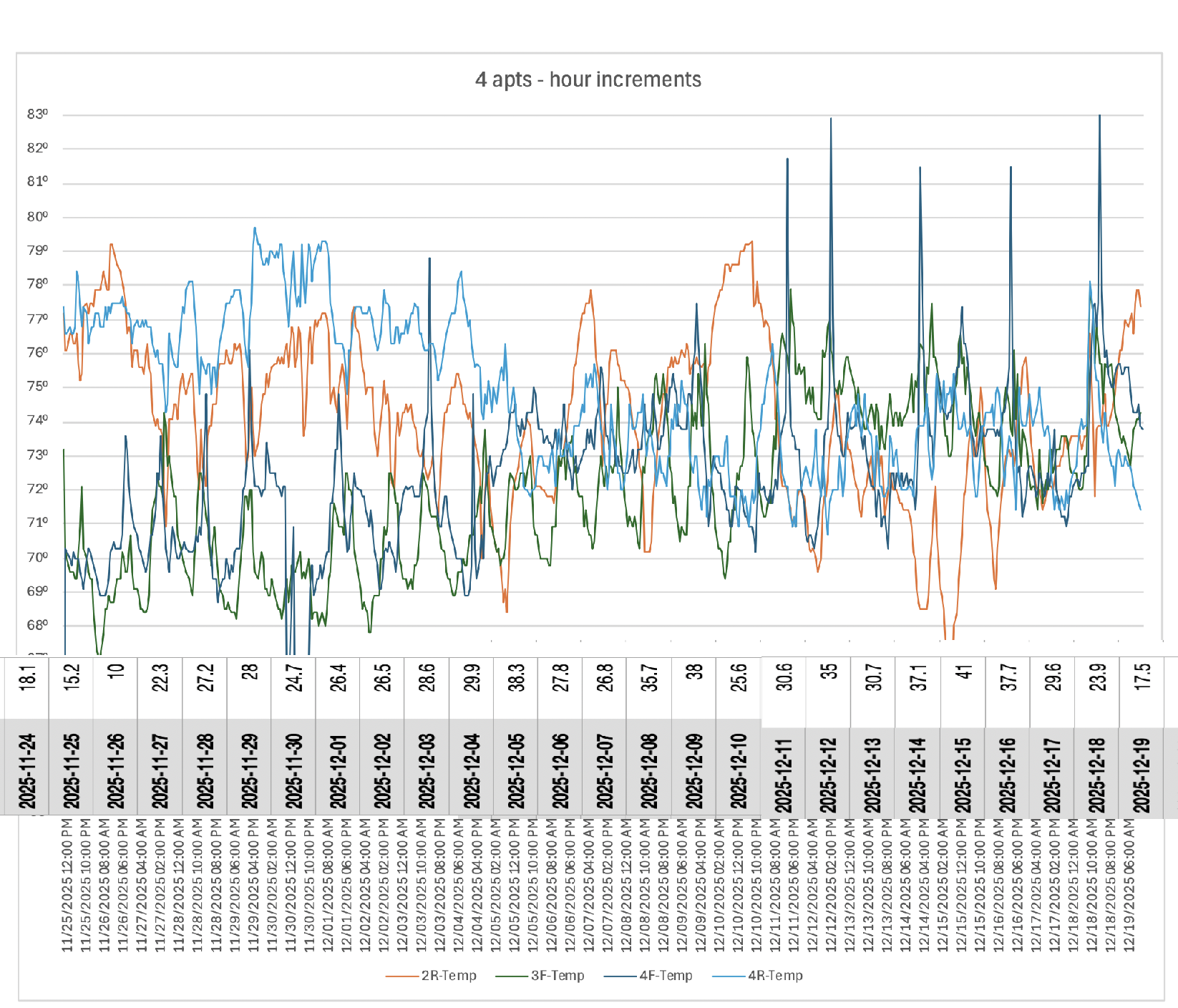
Of course some of the very low temperatures could be a result of leaving a window open to counteract the overheating. Tenants seem to do that from time to time. Open a window and forget to close it before they leave for the day, only to come home to a cold living room. Then the window gets closed and the temperature spikes again. So without real time surveillance of the building, those temperature readings may not be so helpful. I have heard the procedure is called using your “Double Hung Thermostat”
Edward Young Retired
After you make that expensive repair and you still have the same problem, What will you check next?
1 -
Thanks for all the replies, and questions. I'll gather the requested info and will reply asap. Thanks!
0 -
or someone cooking in the apartment with the thermostat or tenants opening and closing radiator valves.
1 -
@EdTheHeaterMan are those low temps for the day in deg F? oh degree days. nevermind.
the time series in OPs data are a little funky because I think they are on 10 hour intervals so you get different times each day. yours is good rough estimate that the phenomenon doesn't seem to run with temp. although it would be great to put blue tooth sensor outdoors to complement.
vapor pressure and venting of each radiator seems to be where its at. if you had money you could get the fancy room temperature sensing vents or valves that could stem overheating while other areas are catching up. although just more modest cost adjustable vents (if you have one pipe steam) applied to units that seem to overheat could help although it kinda seemed to change over the course of time. And your outliers (albeit all units aren't shown since you got 8 units and 4 sensors) seem to be 2R and 3F. would maybe say you want to slow 3F on a guess. 2R is all over the map though. could this be the window stat or folks turning on an off rad valves?0 -
Are you referring to the 4F temperature spikes ? Have the spiked temperatures actually been verified ? Many seem during the daytime. They look too high and narrow to be real.
I'd swap sensors around. before I did anything else. See if the spikes follow the location or the sensor device.
National - U.S. Gas Boiler 45+ Years Old
Steam 300 SQ. FT. - EDR 347
One Pipe System0 -
To me it seems odd that when one or two areas are warming up the others are cooling down and this is over many hours. Kind of makes me wonder if the data is actually accurate. Maybe I don't understand your data. No zoning, correct ?

 National - U.S. Gas Boiler 45+ Years Old
Steam 300 SQ. FT. - EDR 347
One Pipe System0 -
By "steam mains" do you mean the very end of each branch of the system?
In our case there's one riser pipe that goes all the way to the ceiling in the front room and bathroom of the front apartments, and the same in the back apt bedrooms, bathroom & kitchens.
0 -
The thermostat is a Honeywell Wi-Fi VisionPRO® 8000.
It's on the 3rd floor in the staircase. The staircase/hallway isn't heated. There's a radiator on the 1st floor but it's turned off, because the staircase is already so well insulated, it doesn't need to be heated, and heating it would throw the thermostat off even more.
I've also installed 4 remote sensors (in 4 of the 8 apartments) to try to get a better average temp.
0 -
The mains in the basement.
All Steamed Up, Inc.
Towson, MD, USA
Steam, Vapor & Hot-Water Heating Specialists
Oil & Gas Burner Service
Consulting0 -
There is a radiator in the hallway/staircase ground floor, but it's off. The hallway is in the inside of the building and is always comfortable.
Yes, the thermostat is reading the 4 remote sensors (in 4 of the 8 apartments) and should be averaging those readings and responding to them.
It's a 1-pipe system. I think that most of the radiators are heating now. I just switched some of the air valves (to larger openings) in the front top apartments (the furthest from the boiler) and that helped those apartments. (I think that's why apartments 3F and 4F get a little warmer after Dec 4th)
I think the top rear apartment (who has been complaining about too much heat) has a broken vent valve on the bedroom riser pipe, still need to replace that.
We have been adjusting the thermostat while I've been logging this data, so that could explain some of the changes in the data.
0 -
That is strange, I hadn't noticed that. Maybe the Bluetooth thermometers are off? Or, some people complain while others just open a window?
The orange line (apt 2R) always just says that the heat is fine, but her apartment gets up to 79º on December 10th and then down to 67º on December 15th.
0 -
I need to check if the steam mains in the basement are vented.
Would that vent on a main line look similar to a radiator vent?
0 -
I need to check if the steam mains in the basement are vented.
Would that vent on a main line look similar to a radiator vent?
0 -
sort of but bigger and they are usually connected straight in the bottom instead of with a built in 90 and there are many different designs of both main and radiator vents.
1 -
For better balancing you want fast main venting in the basement and then tend toward slowing down the hot rooms at the radiator rather than speeding up the cool rooms within reason. Not sure what you have at this point for venting on the mains or the radiators.
 1
1 -
I appreciate everyone's comments and suggestions. To be honest, this might be beyond my scope of ability.
What type of service would I look for? Are there steam heat specific companies in NYC that anyone can recommend? It sounds like we might need someone to come and take a look at everything and either make suggestions or make the changes.
Thanks!
0 -
@dmoder , go here:
All Steamed Up, Inc.
Towson, MD, USA
Steam, Vapor & Hot-Water Heating Specialists
Oil & Gas Burner Service
Consulting 2
2 -
Thanks so much, that's a great list. Some of them mention steam heat as a "specialty".
0 -
Let us know how it goes.
All Steamed Up, Inc.
Towson, MD, USA
Steam, Vapor & Hot-Water Heating Specialists
Oil & Gas Burner Service
Consulting0 -
@dmoder thanks for the explanation of changes during the monitored period. seems like you might have it down to the day when you put larger vents on further radiators. seems like you are doing many of the right things. @dabrakeman point is right about fine tuning. you can only get the hard/far ones to fill so fast. i believe the largest available vents are the heat tempt varivalves. but folks have had mixed results with failure to fully close or the heat sensitive element breaking loose and then being effectively closed by gravity against really low pressure steam so rads don't fill.
while the jury is out on those vents it is in on the definitive guide for balancing rads:
and the quick chart:
Vent-Valve-Comparison radiator main.pdf
these references will still be useful to you if you bring in a professional as you might be able to parse his analysis and recommended intervention in main vents or piping with changes in individual unit venting you could make and monitor yourself.1 -
Thanks, Archibald!
0





Categories
- All Categories
- 87.5K THE MAIN WALL
- 3.3K A-C, Heat Pumps & Refrigeration
- 59 Biomass
- 429 Carbon Monoxide Awareness
- 124 Chimneys & Flues
- 2.2K Domestic Hot Water
- 5.9K Gas Heating
- 119 Geothermal
- 168 Indoor-Air Quality
- 3.8K Oil Heating
- 78 Pipe Deterioration
- 1K Plumbing
- 6.6K Radiant Heating
- 394 Solar
- 15.9K Strictly Steam
- 3.5K Thermostats and Controls
- 56 Water Quality
- 50 Industry Classes
- 50 Job Opportunities
- 18 Recall Announcements