Indirect water tank

we just got a Weil McLain GV90+5 boiler installed to replace the 60 year old oil boiler. There was already a newer electric water heater in the basement so we switch that for our hot water. My question is, is an indirect tank a good option? Our electricity bill is crazy and I’m sure the water heater is a main reason. I’ve heard gas instant hot water heaters aren’t worth the hype, which is why I’m leaning towards a indirect tank connected to the boiler.
Comments
-
depends on your relative cost of gas and electricity. unless you are using a ton of hot water i kind of doubt that the hot water is the source of your high electricity usage.
 1
1 -
What size and how old is the electric tank?
What size boiler?j
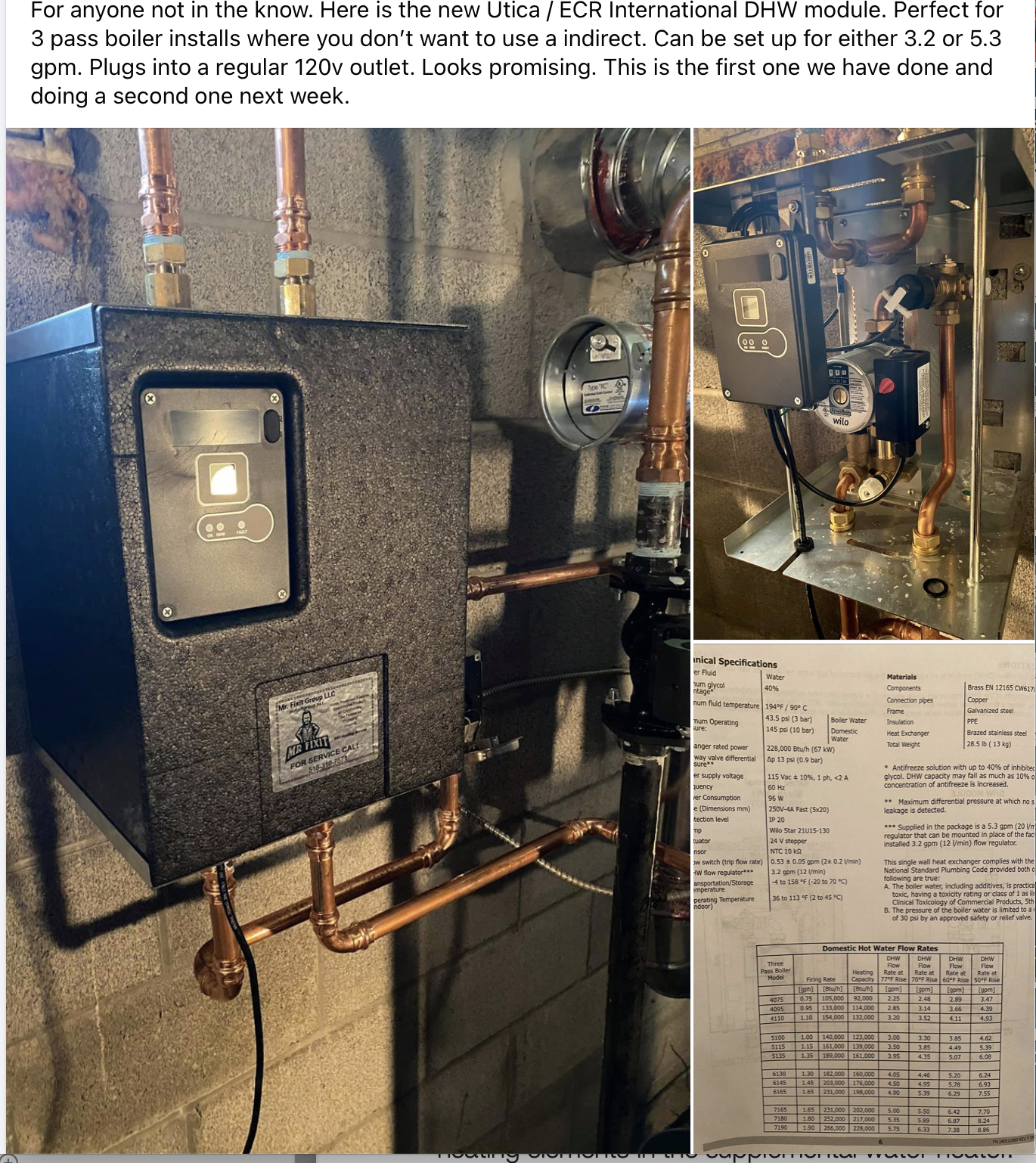
Leave the electric tank as a pre-heat, breaker off, then feed one of these HX modules.
It works like a tankless giving you continuous DHW, from the boiler.
If the boiler ever fails, turn the electric tank breaker back on for backup DHW source.
 Bob "hot rod" Rohr
trainer for Caleffi NA
Living the hydronic dream
 3
3 -
What is your electric rate $ per kWh? Time of use?
gas rate? $ per therm?
How many gal is your current electric tank? do you ever run out of hot water?
0 -
I’m going to look more into that system. The water heater was replaced in like 2021, I believe it’s a 40 or 50 I’ll have to look.
Boiler is a 140,000btu
0 -
so you have about 120,000 for DHW production. With a plate HX assembly you get 3 gpm at a 77 degree rise
Incoming water at 43 to 120F for example
Here is a fuel cost calc
Use electricity at 100%, gas at 87%
https://coalpail.com/fuel-comparison-calculator-home-heating
Bob "hot rod" Rohr
trainer for Caleffi NA
Living the hydronic dream0 -
there doesn’t seem to be a lot of info on this product, do you have one yourself?
0 -
Your GV90+ boiler operates at a lower cost per BTU than the oil boiler it replaced. Am I correct that the old oil boiler used a tankless coil for DHW, which proved problematic, leading to the addition of an electric water heater in 2021?
Most of your savings from switching to gas come from the GV90+ being a cold-start boiler. The old oil boiler likely maintained a minimum temperature for DHW even when hot water wasn’t being used. When a separate water heater is added, the oil boiler is often not converted to cold-start, so it continues wasting energy. Now you are using electricity—the most expensive fuel—to maintain DHW temperature.
I believe an indirect water heater would be a better solution. It’s a dedicated, well-insulated tank with no vent connection, reducing standby heat loss, and it uses the more efficient gas boiler as its heat source. An indirect tank can typically hold hot water for 16–20 hours with minimal temperature drop before needing to recover, whereas electric and vented gas or oil water heaters lose heat more quickly and often reheat every 4–5 hours.
In my opinion, based on over 40 years of oil and gas service and installation experience, indirect water heaters are the most efficient and reliable way to produce and store domestic hot water. Unless you are like @ethicalpaul and decide to install a heat pump electric water heater. I guess that will cost about the same as the Indirect job, but I'm not sure how long those tanks last. I don't believe that they have a lifetime tank warranty like my indirect does.
Edward Young Retired
After you make that expensive repair and you still have the same problem, What will you check next?
0 -
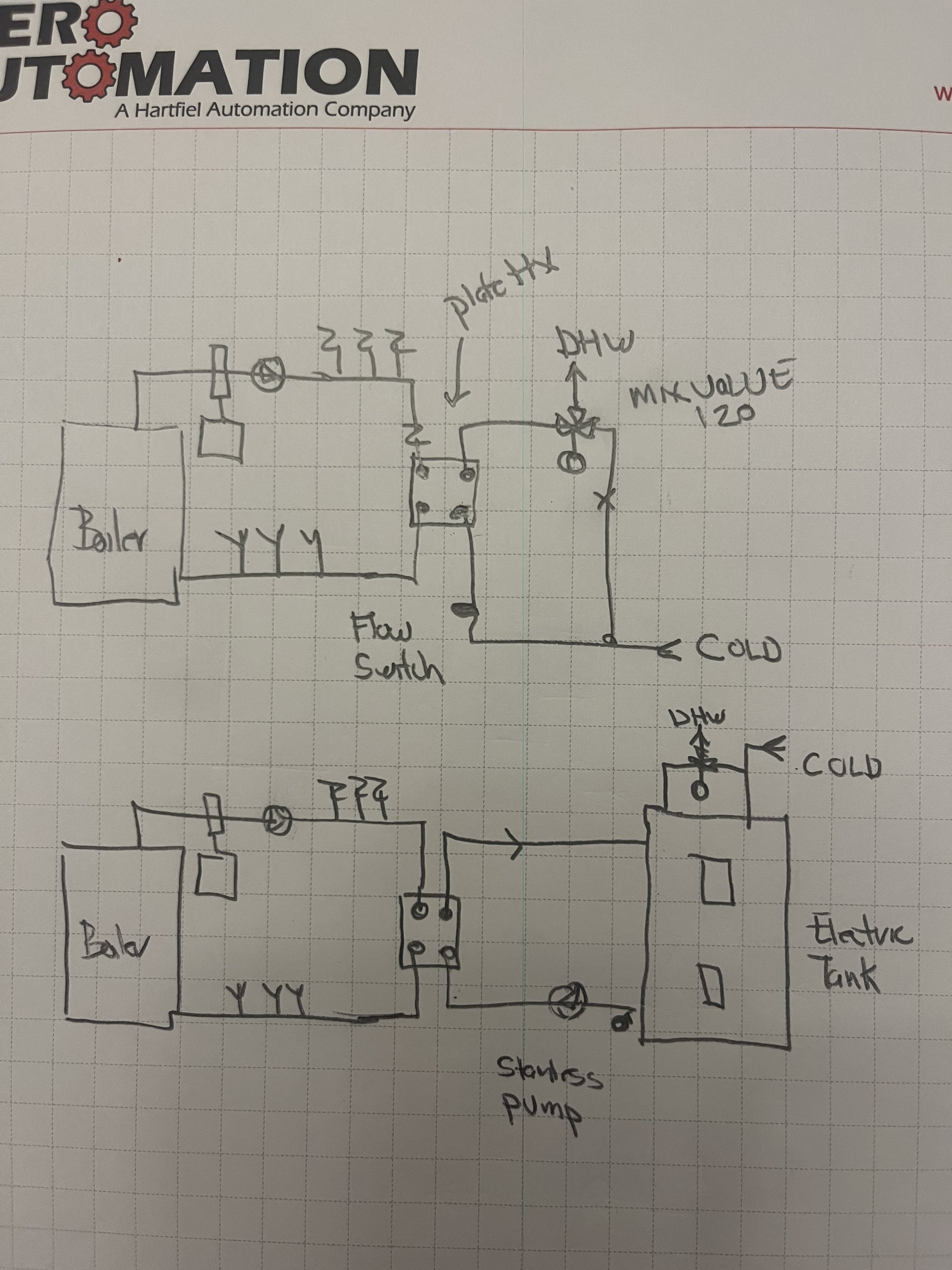
here are two options
1st is basically a site built combi boiler built with a plate hx. A flow switch turns on the zone valve to heat DHW instantly. This has a bit of lag unless you keep the boiler at 150 or so, same as a combi boiler
2nd option uses your electric tank as a storage, so the boiler always keeps the txnk how. So instant hw and also continuous hot at 3 gpm or so. Thus us pretty much how the EK systems are built
This is basically an indirect with an external HX
A flat plat heat exchanger is about 5 times more efficient than a coil in a tank indirect as you have two moving flows to transfer heat
I have built a hand full of if these myself, never bought a premade module
It is a plate hx, pump, flow switch on option 1
On option 2, plate hx, pump, temperature control
3 way mix valve to allow you to run the plate or tank at higher temperatures
External plate HX are easy to clean or descale compared to coils inside a tank
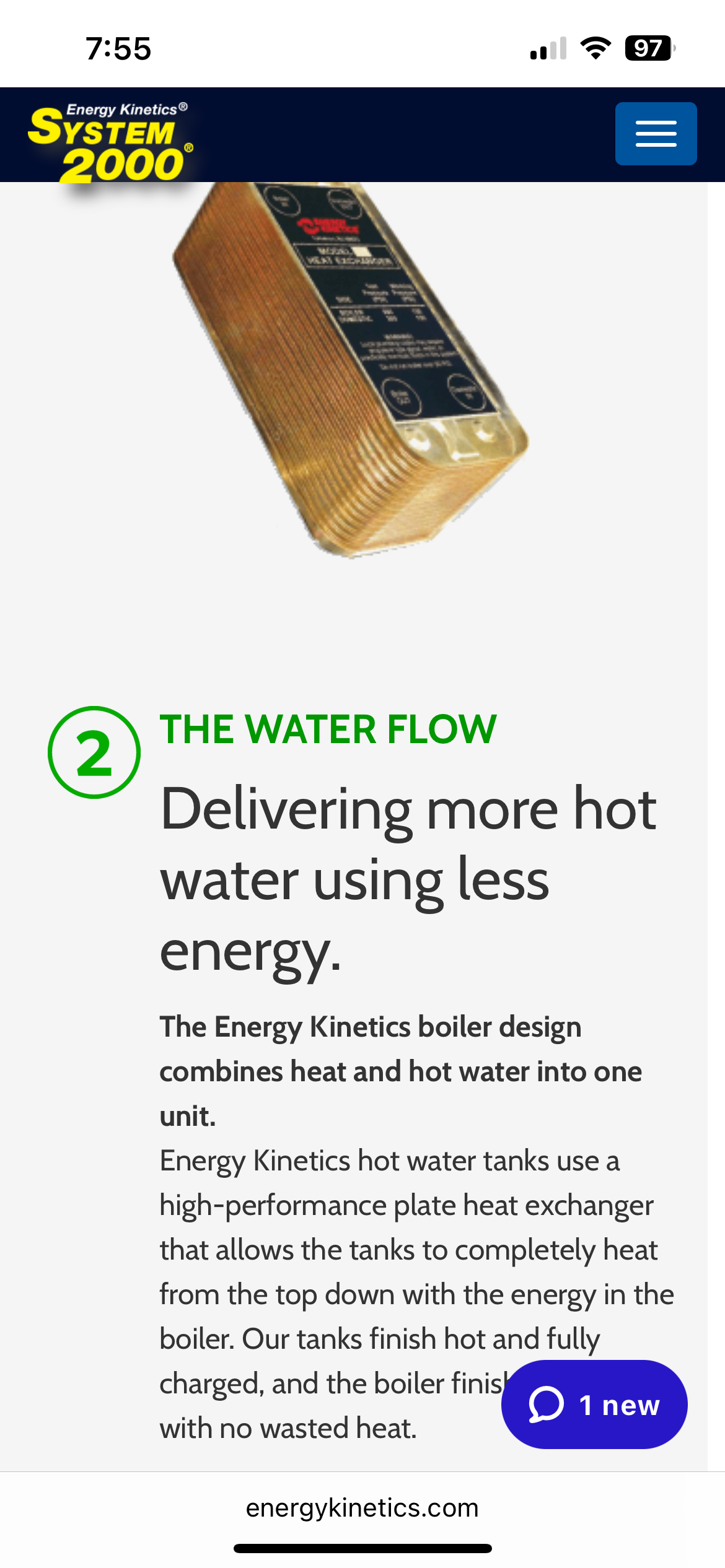
Also info from the EK website below
 Bob "hot rod" Rohr
trainer for Caleffi NA
Living the hydronic dream 2
2 -
The answer is no, an indirect is not a good option. If you think your electric bills are high, wait until you see the parts and labor to install an indirect.
And plus, I strongly doubt that your electric bill woes are due to your 40 gallon water heater. The cost to run that should be in the $600/year range.
But if that is more than you want to spend, you should look at a heat pump water heater. You may have incentives to install one from your state or utility or both, and they are almost free to run.
NJ Steam Homeowner.
Free NJ and remote steam advice: https://heatinghelp.com/find-a-contractor/detail/new-jersey-steam-help/
See my sight glass boiler videos: https://bit.ly/3sZW1el
 4
4 -
DHW usage is all over the map. Showers, laundry, dishwasher, tub fills all need to be considered.
You should get an idea of your current use and make sure the options you consider will work. I like the idea of a HPWH, but they are slow recovery, so depending on how and when you use DHW is important. Life expectancy of HPWH ?? look at other posts on HH with actual experience.

I think a family needs an 80 gallon HPWH, and it may need to kick in resistance elements occasionally.
Bob "hot rod" Rohr
trainer for Caleffi NA
Living the hydronic dream 3
3 -
if you use an indirect or a hydrobooster, you need to size it such that it mostly just runs with big loads, it doesn't fire the boiler 10x a day just for hand washing and losses because although the boiler is maybe 20% more efficient at putting the energy in the water, the boiler has significant standby losses every time it starts and stops and that will quickly eat up your gains over a direct fired or electric water heater if it happens a lot.
1 -
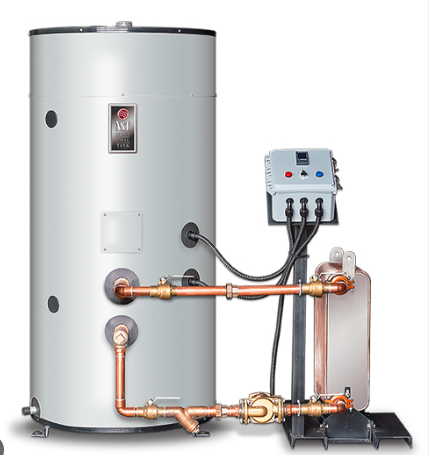
There used to be some tanks pre-built with external plate heat exchangers back when solar was popular.
Most of the tank manufacturers offer them more in commercial sizing applications. Niles tank for example.
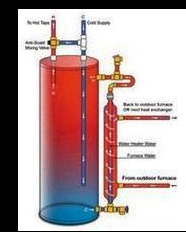
The wood boiler industry still uses these copper thermosiphon tubes (heat pipes) to mount to existing tanks.
 Bob "hot rod" Rohr
trainer for Caleffi NA
Living the hydronic dream0 -
thank you for all that info! I’m leaning towards an indirect, as I don’t have enough info on that other system.
0 -
Thanks for that! I’m going to research this more, I wasn’t aware of all these options
0 -
Here are a few options EK still offers with explanations on how they work.
Joe Szwed
Energy Kinetics0 -
Excellent description of the external HX option. Dating back to 2006!
I assume you still custom build these packages?
Bob "hot rod" Rohr
trainer for Caleffi NA
Living the hydronic dream0 -
Yes, these kits are still valid part numbers. I'm not exactly sure when we first offered them but I found a cut sheet dated from 2000. The modified dip tube is a key feature when converting an electric tank for storage and we actually sell them as a replacement part.
Joe Szwed
Energy Kinetics0 -
A hybrid heat pump water heater is the worst water heaters. I can't even tell you how many have failed and are running in full electric mode. I can't overstate the amount of compressor failures that are out there. every manufacturers are having compressor failures. i just had to switch over one to full electric mode due to compressor failure and the landlords would rather wait for a complete tank failure than replace the water heater under warranty. Don't take my word for it. just look it up. A O smith has an error code that is turning into an internet joke.
1 -
@szwedj with a modified dip tube can they still be used in electric mode as backup?
0 -
@Forge_Fixer88 It could possibly still work because we pipe the make up water directly to the bottom of the tank through what is normally just the tank drain, but you would need to give the wiring some thought as electric tanks use line voltage through the tank aquastats to power the heating elements and boilers typically use low voltage for the TT call. So possibly using a seperate tank aquastat to call the boiler or isolation relays of some sort?
Joe Szwed
Energy Kinetics0 -
@szwedj Would running the hot water in at the t&p valve get the same effect as modifying the dip tube?
0 -
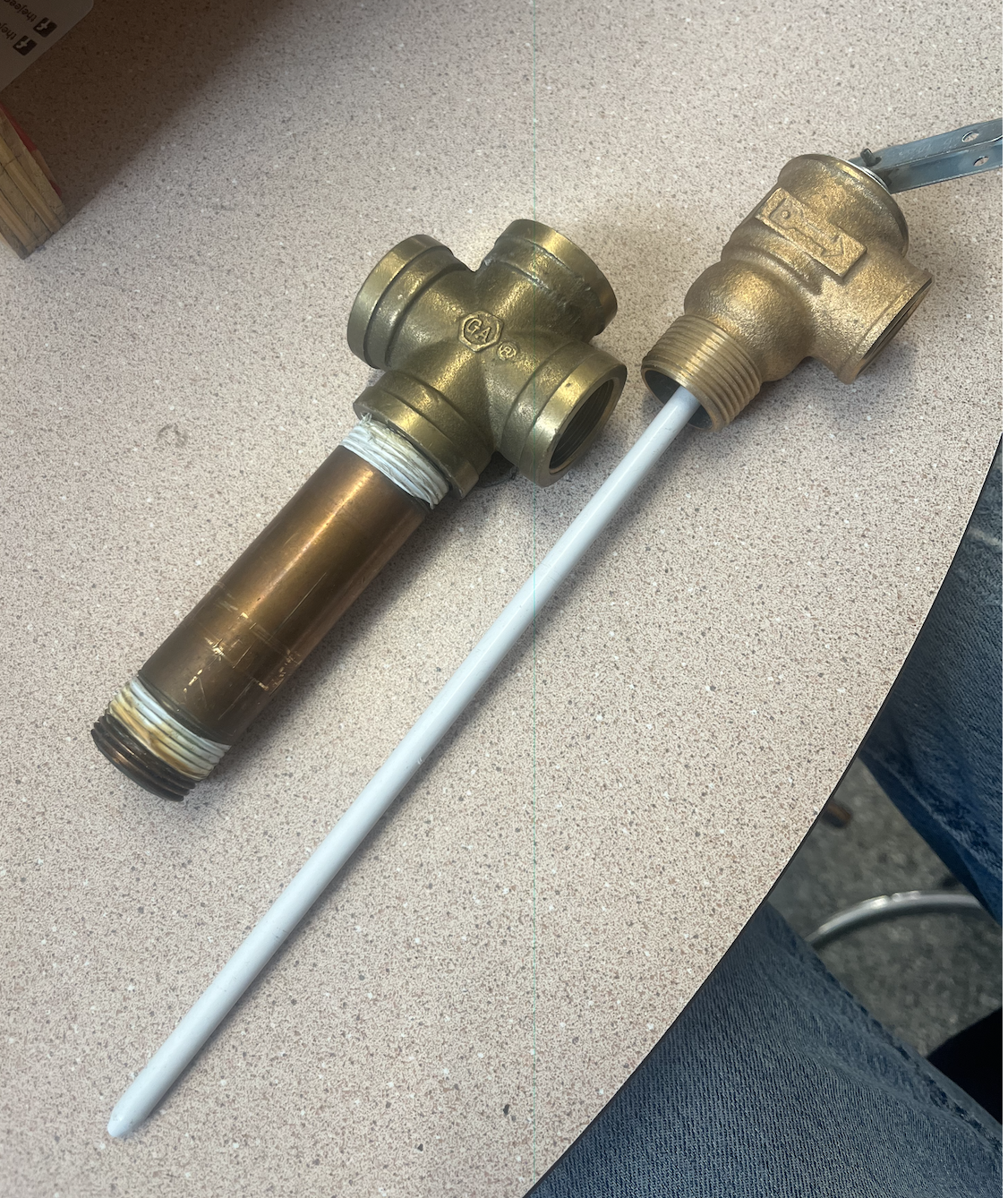
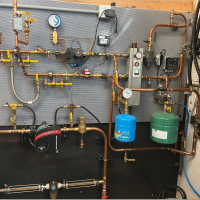
It is not uncommon to see the T&P port doing double duty.
This cross gives you options.
Use a T&P with a -8 at the end, giving you an 8" probe to reach into the tank.
The nipple length depends on the tank insulation thickness, a 3-4" should work.
 Bob "hot rod" Rohr
trainer for Caleffi NA
Living the hydronic dream1


Categories
- All Categories
- 87.6K THE MAIN WALL
- 3.3K A-C, Heat Pumps & Refrigeration
- 59 Biomass
- 429 Carbon Monoxide Awareness
- 124 Chimneys & Flues
- 2.2K Domestic Hot Water
- 5.9K Gas Heating
- 119 Geothermal
- 168 Indoor-Air Quality
- 3.8K Oil Heating
- 78 Pipe Deterioration
- 1K Plumbing
- 6.6K Radiant Heating
- 394 Solar
- 16K Strictly Steam
- 3.5K Thermostats and Controls
- 56 Water Quality
- 51 Industry Classes
- 50 Job Opportunities
- 18 Recall Announcements