Radiant Manager/Control System

Hi folks,
First post but periodic lurker. I've been working on a project for myself that is essentially an orchestration layer for controlling the radiant system for my home and as I was writing the documentation (for my own memory purposes) I decided that others might find something like this useful. My house had a pretty simple implementation of a bunch of smart thermostats that operated as their own individual brain vs. a centrally controlled system and had some short cycling issues for smaller zones, so I decided to solve that with some software :) It's runs/requires Home Assistant and is built in python (via pyscript) and I'm at a point where I think it's good enough to consider sharing. Since this was purpose built for me (via learning/iteration/testing, etc) it has a good bit of specific details to my house however I could spend some time cleaning it up and making it more generic and reusable by others if it would seem useful.
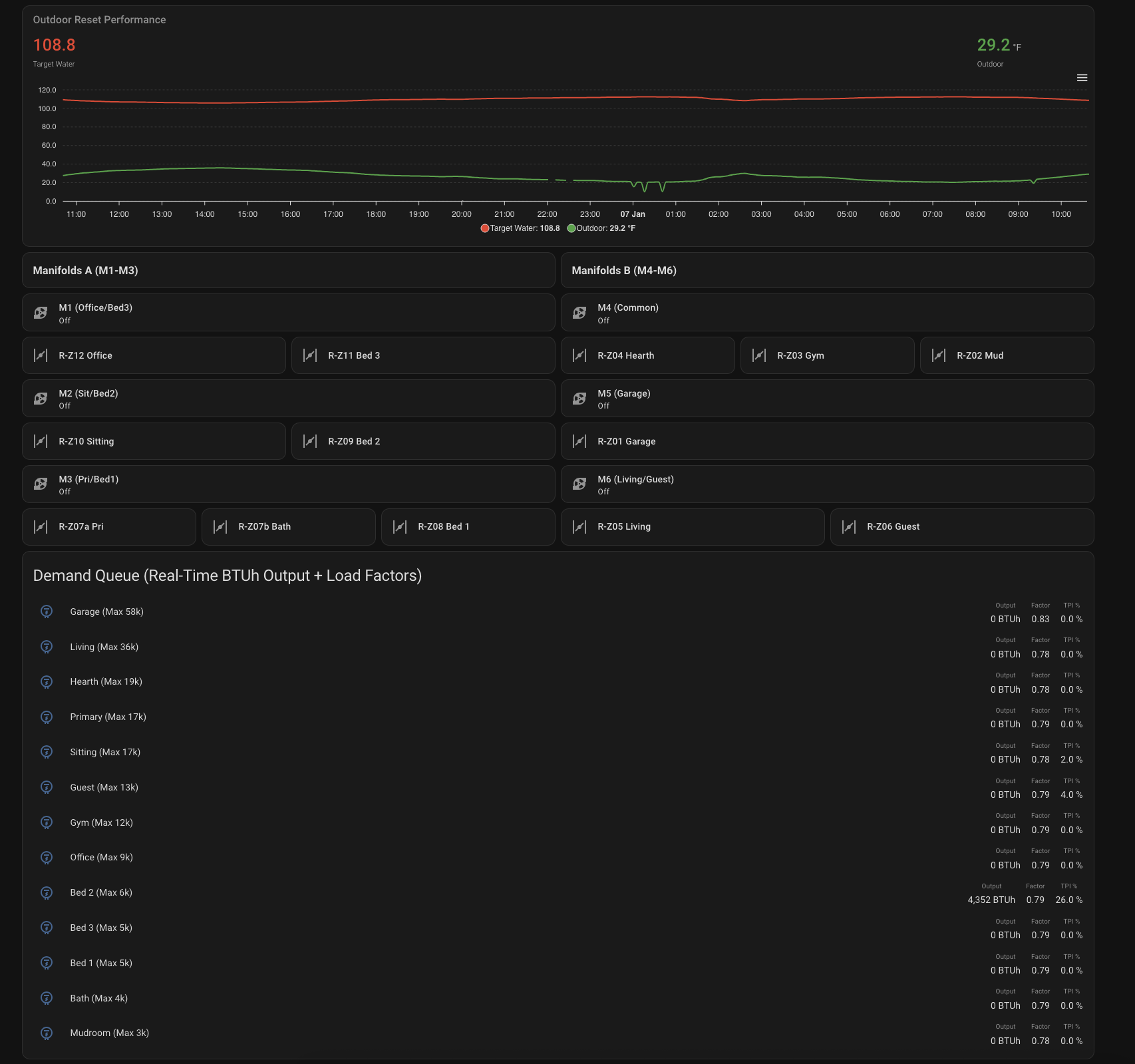
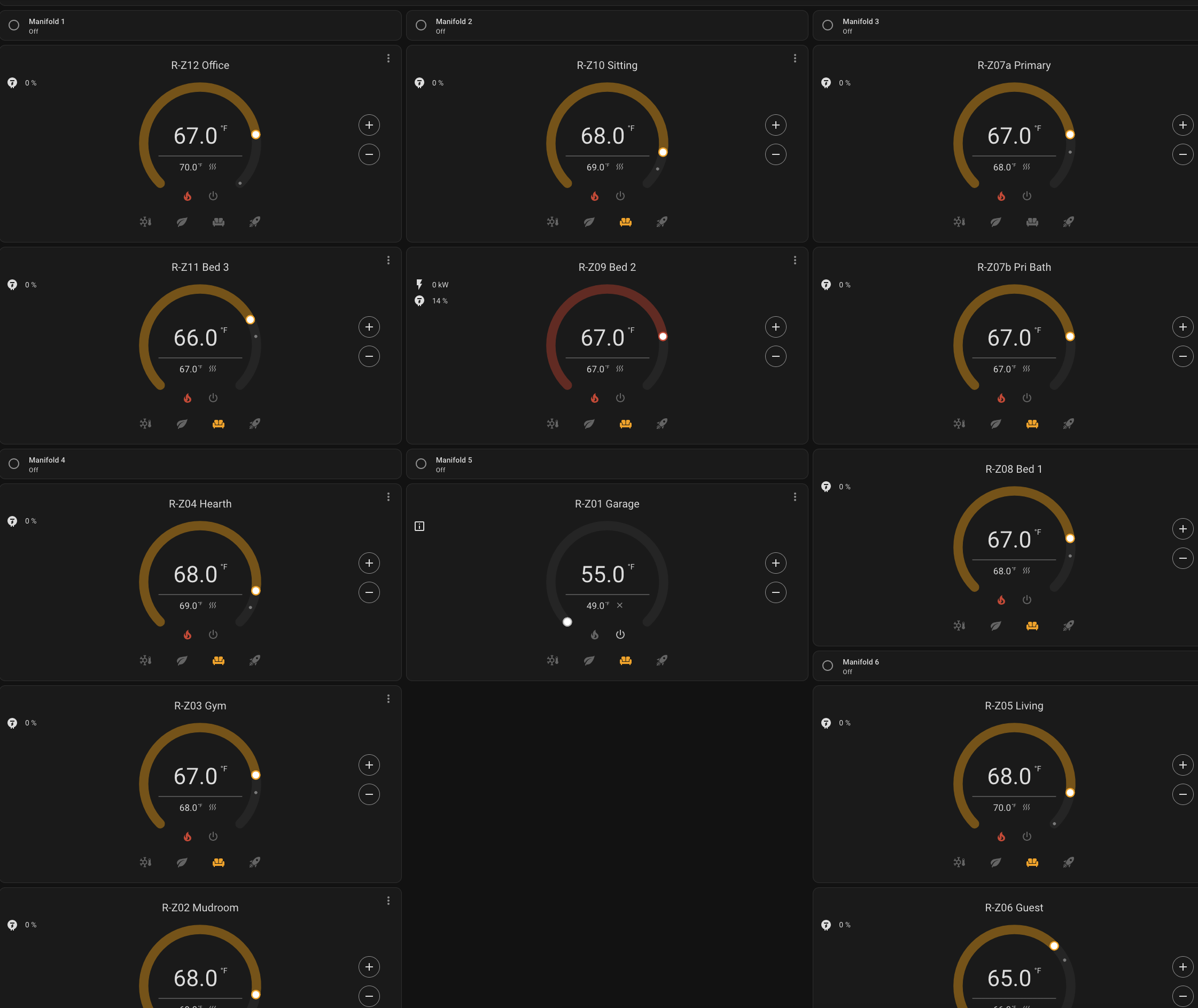
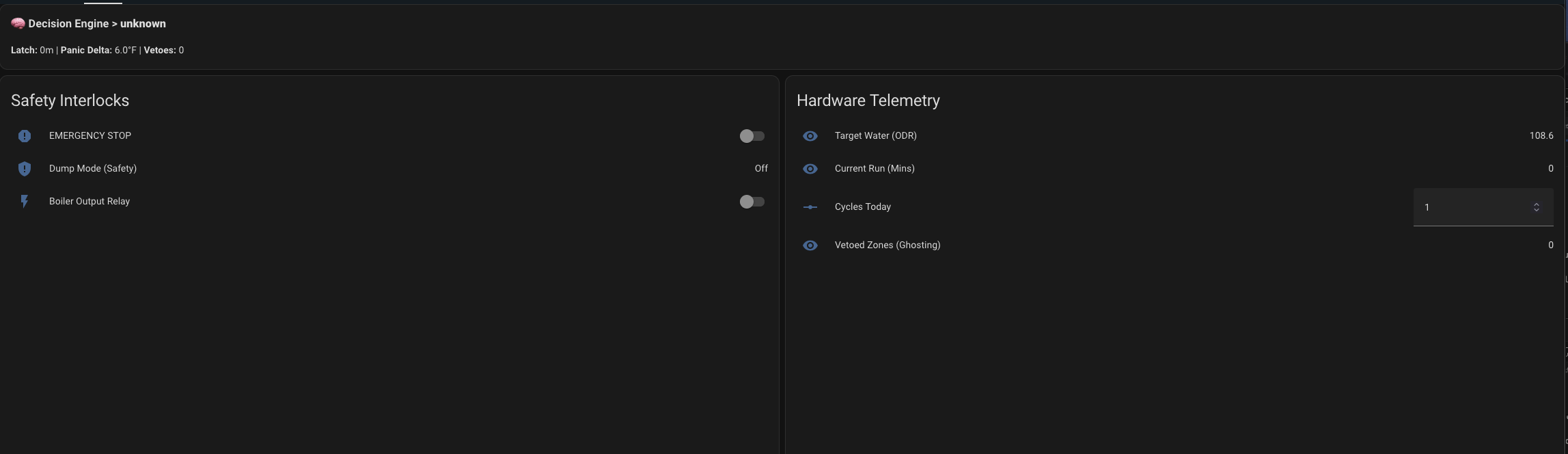
I've included some dashboard pics of the system. Note that these include some purposeful testing of overshooting and crash recovery over the past couple days as I am still making some operational tweaks and ODR curve tweaks.
Let me know if there is any demand for something like this beyond… me :)
Full details here:
(the code is actually in a private repo but I shared the README to a public location). Definitely check it out because it's pretty exhaustive (I'll forget how the thing works once I stop tuning it so a bit of verbosity :))
Here is the tl;dr
This project is an intelligent orchestration layer running in Home Assistant (Pyscript). It sits between your smart thermostats and your boiler/valves, treating them as simple sensors and actuators.
Key Features:
- Orchestration vs. Control: Instead of reactive on/off, it uses TPI (Time Proportional & Integral) logic to "Pulse Maintain" slabs, preventing overshoot.
- Physics-Aware: Solves the "Minimum Fire Rate" problem by intelligently batching zones and recruiting smart buffers (e.g., heating the bathroom and the sitting room) to ensure the boiler runs long and efficient.
- Solar Feed-Forward: Features "Rocket Logic" to brake early on sunny days and "Catching the Knife" to pre-charge slabs before cold nights.
- Hardware Agnostic: Works with any thermostat exposed to HA (Ecobee, Nest, Z-Wave, ESPHome).
It turns a collection of disconnected zones into a single, cohesive, efficient fuel-sipping machine with lots of customizable knobs to tune the overall system.
Here are some snippets of the dashboard system:
Primary view:
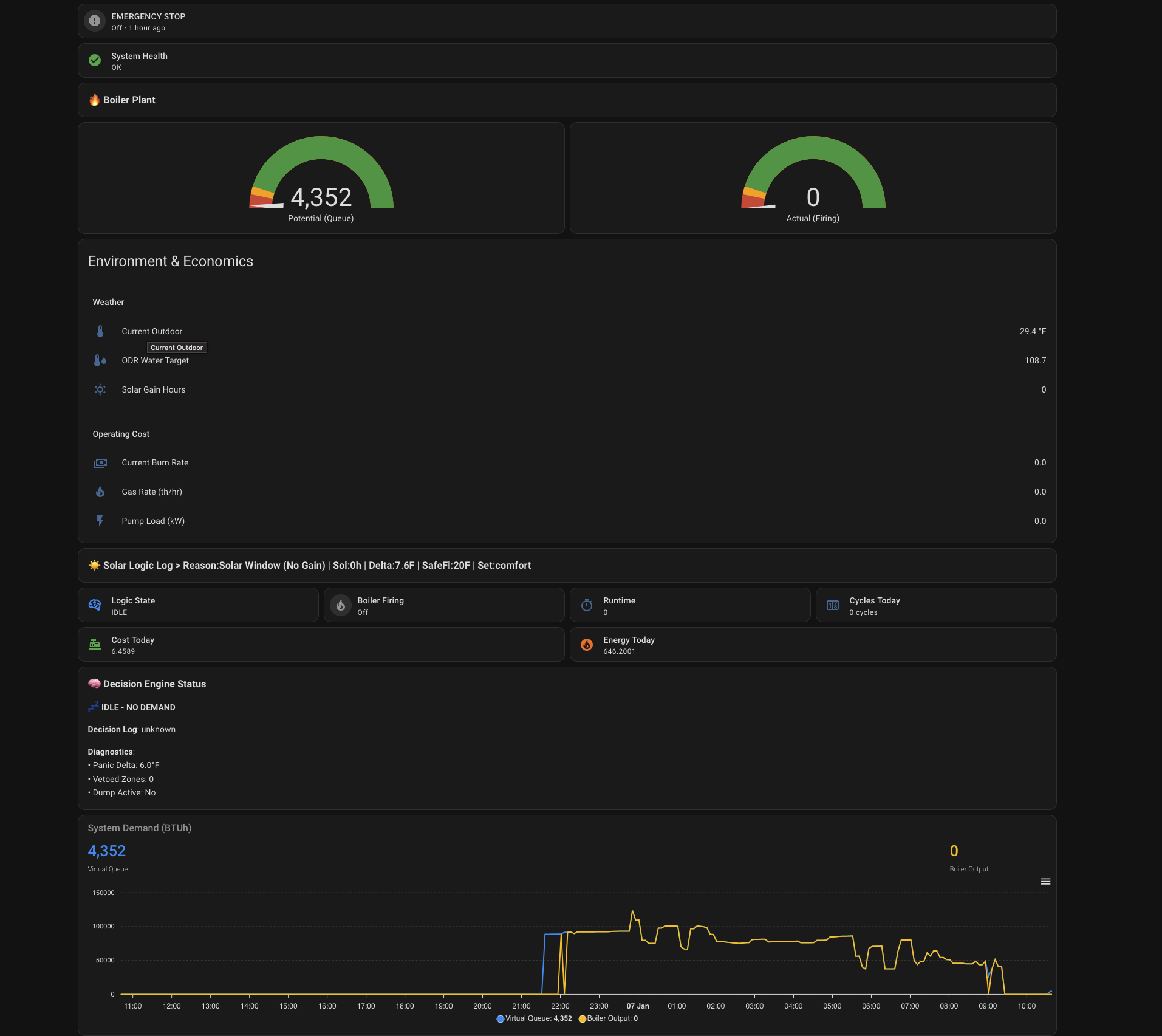
Primary view (2nd part) (BTU loads dynamically adjust with outdoor temp)
Temperature Control
Details of the brains (need to update the decision engine log):
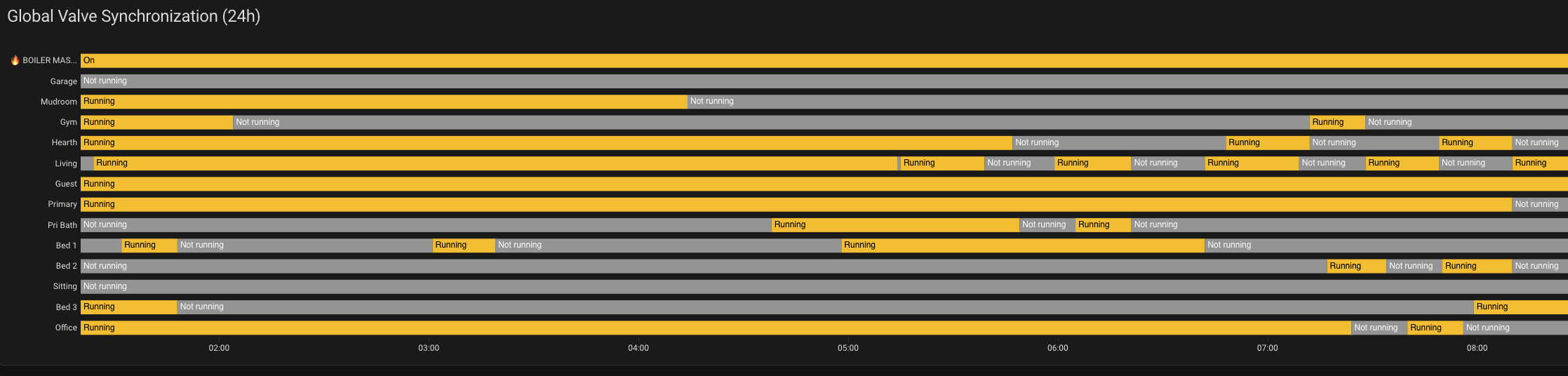
Overnight zone view (zoomed in to smaller window of time for more details)
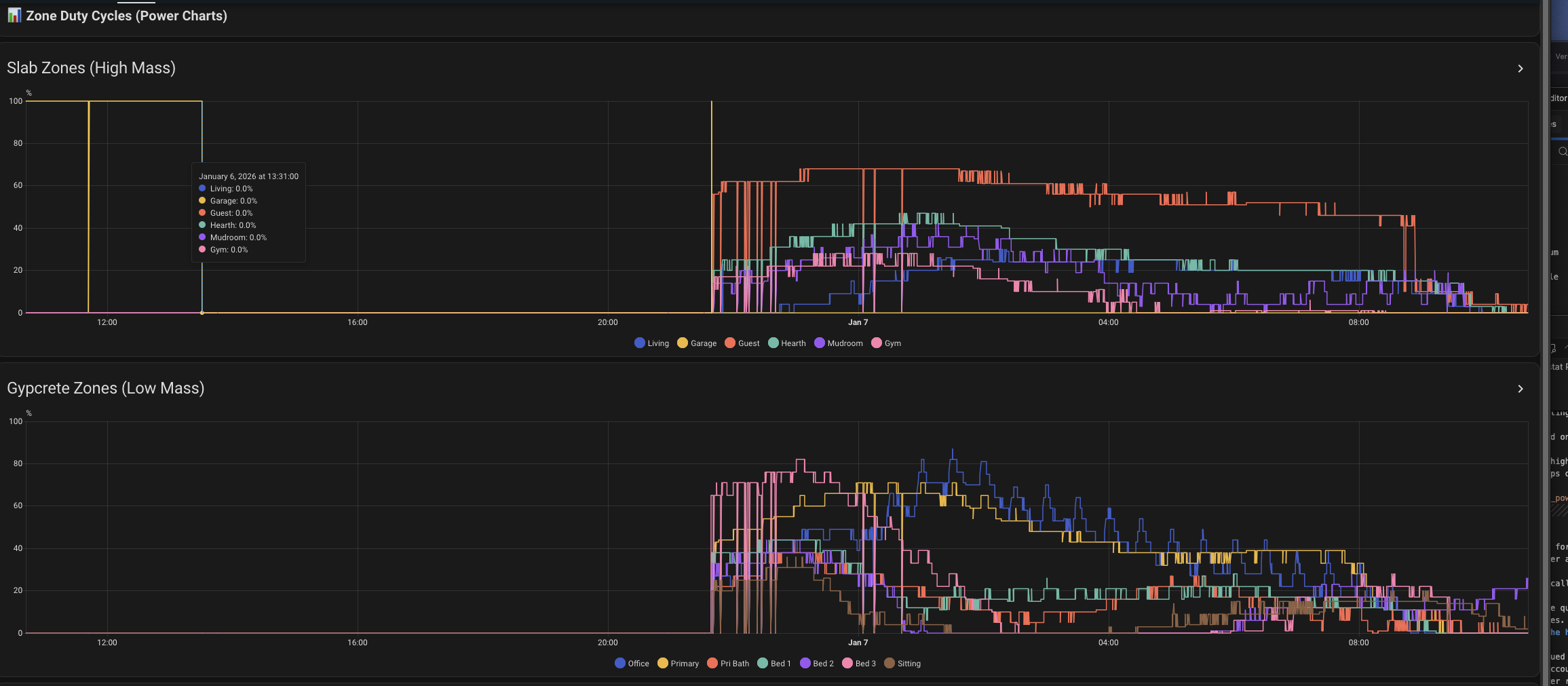
Duty cycles per zone (note the flat spot/system off to cool) The jagged spikes are actually from my forced air systems circulating air so there is a bit of dampening in the enter/exit of the system.
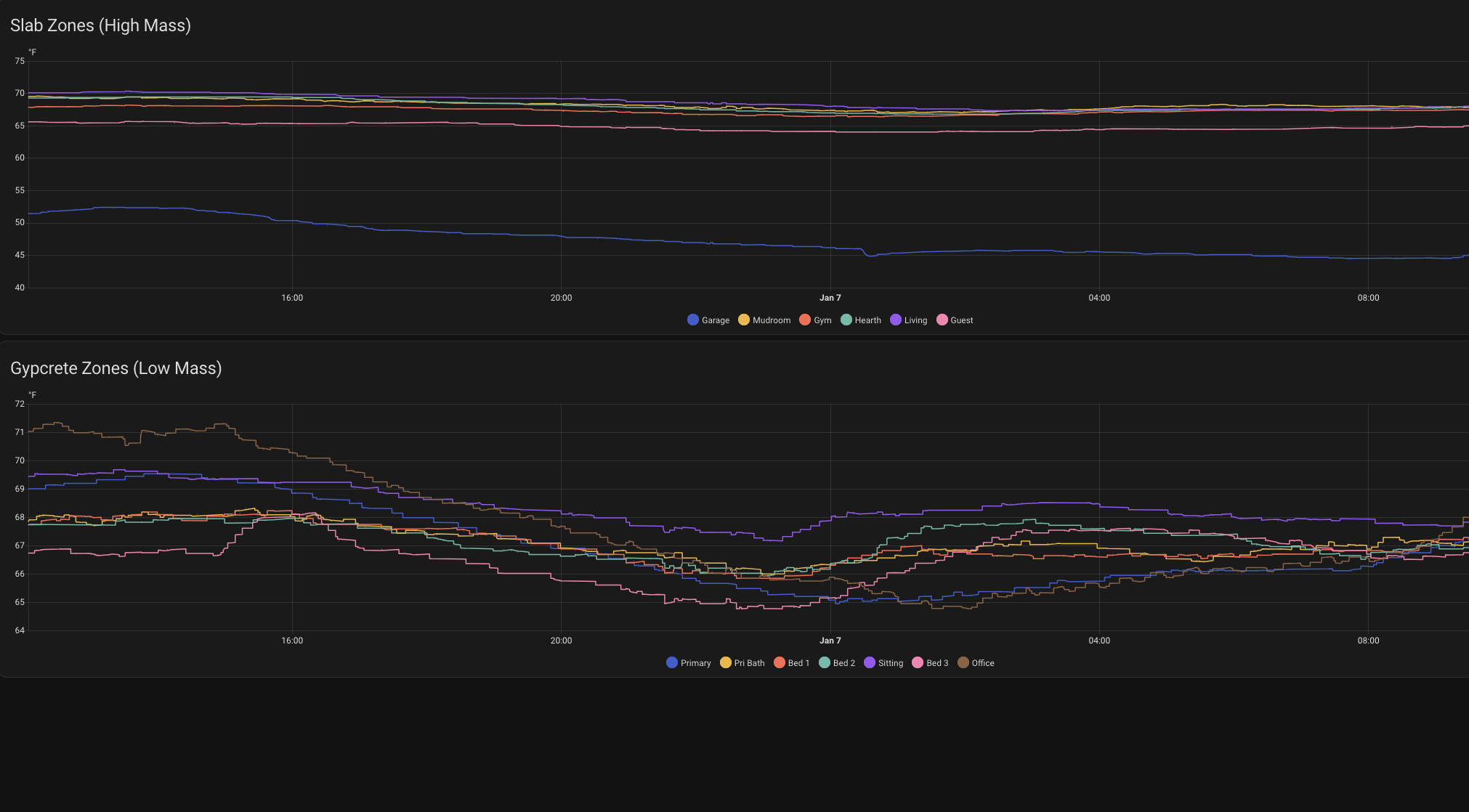
24 hour zone temp differences (with crash in between). This does a good job showing different programming tunables between two days with similar conditions
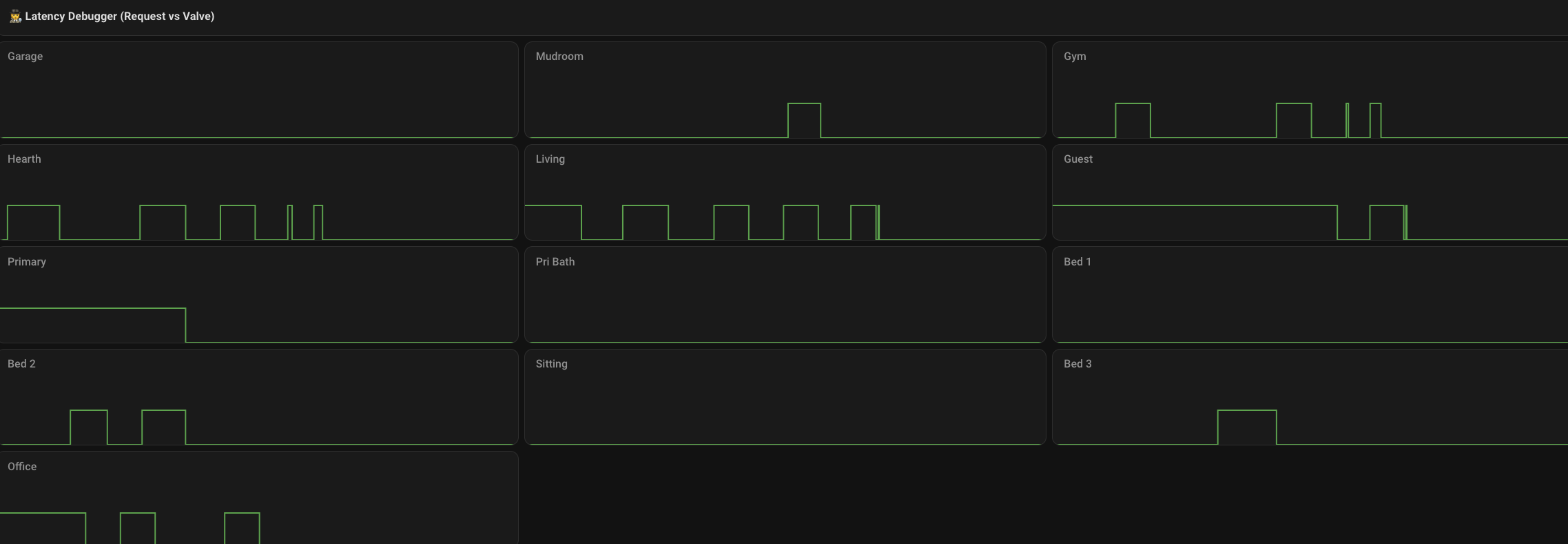
This will show a call vs. valve status (stuck valves show up here)
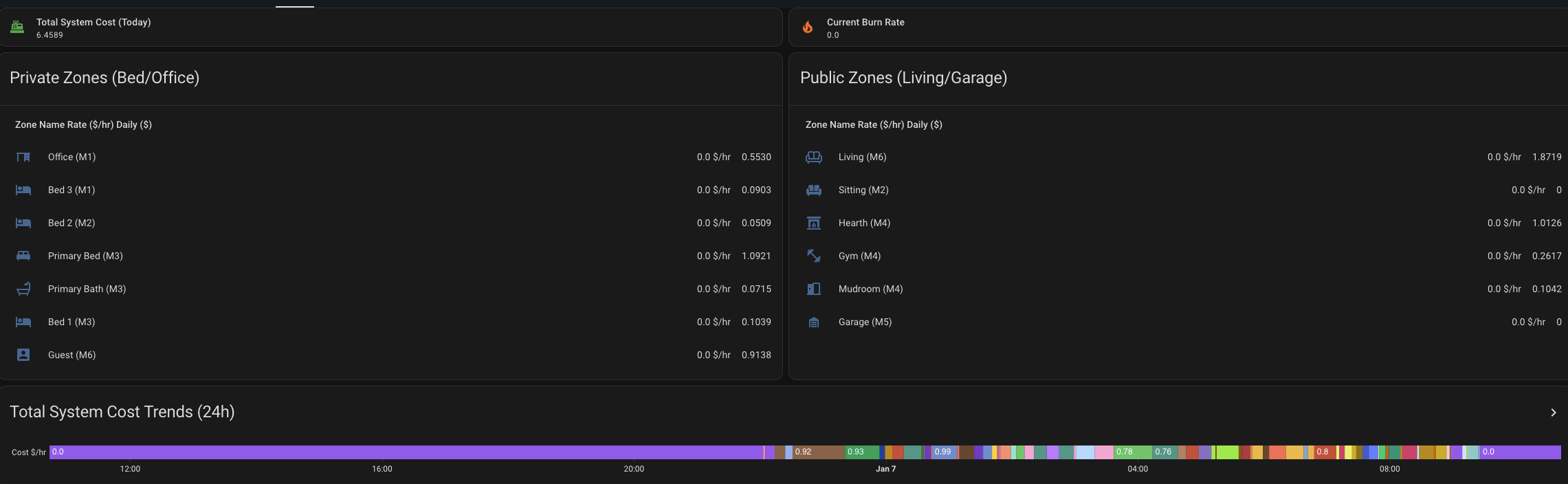
Real-time and per day cost per room! The first column will show active fire cost and the second is accumulated. Costs dynamically cost with real-time BTU loads
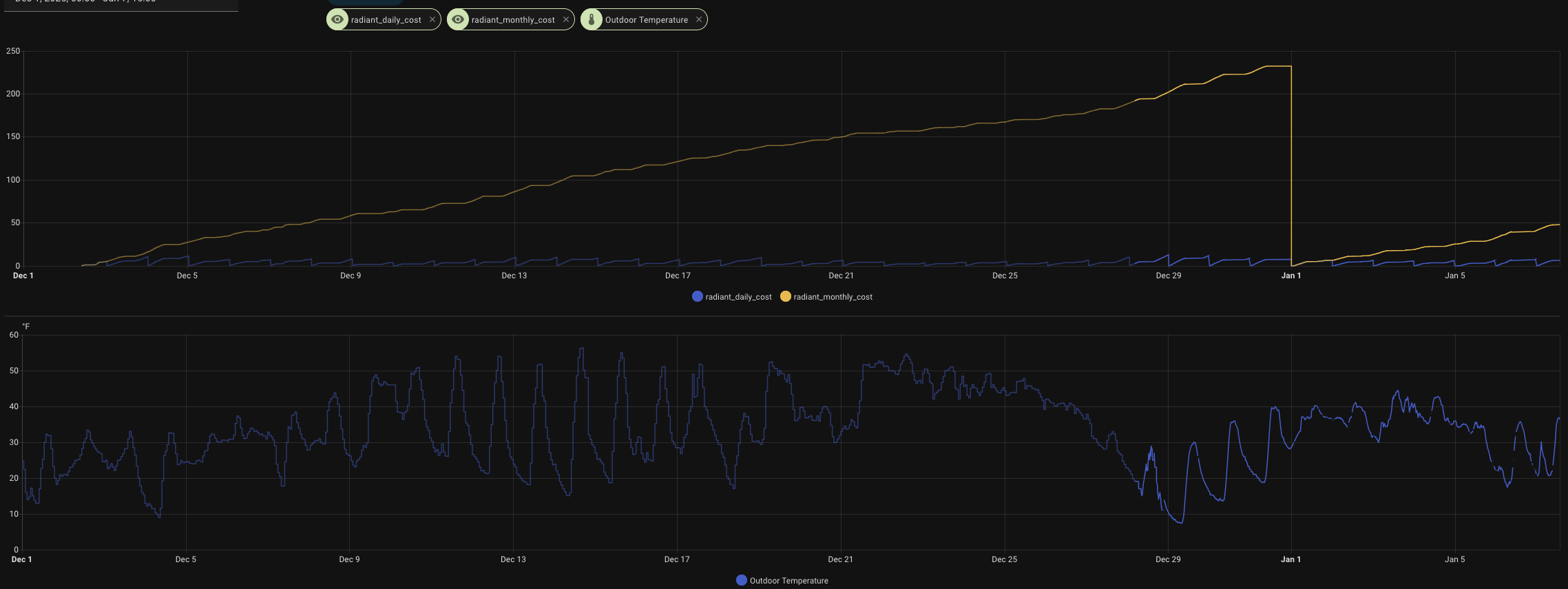
Daily and monthly cost (just about dead on since it's load factored).


Comments
-
I could see this on higher end home. Cost will be an issue for most people. The issue that I can foresee is that there are already products like this on the market. If you google Building Automation systems this type of control is common place in commercial buildings to optimize equipment, save energy and provide trending data. They also have communication. protocols like BacNet, Modbus that can pull data from condensing boilers to adjust set points or send 0-10volt signals to vary firing rates.
Easy I/O is one of the less expensive options out there. Tridium, Distech are just a few others. Initial cost for a customer and support would be key features to look at.
Owner of Grunaire Climate Solutions. Check us out under the locate a contractor section. Located in Detroit area.
1 -
@offdutytech thanks for the response. I did this just to solve an existing problem with the system I had and wanted a project to tackle efficiency and reliability/longevity of equipment. Not to mention I had originally just started with some smarter thermostat controls and then was uncovering issues along the way, so my initial YAML-based config turned into a full-blown control system over a couple of weeks of on/off tinkering. But yeah you're right — systems like this exist in the commercial space. I was thinking more of just cleaning it up and having it be open source :) The target audience would probably fall into the tinkerer/home automation geeks out there.
Having control of the firing rates would be fun to do more interesting profiles for rooms and such.
I knew about systems like tekmar on the residential side but hadn't heard of most of the commercial systems you had mentioned. For a system like Easy I/O — can they drop into an existing system or is it a full end-to-end system? I do think my boiler is considered a commercial one that likely allows direct BMS control of it. One of the deficiencies I saw while looking into tekmar was that it didn't appear to have forward looking forecasting (not to mention I didn't end up with slab sensors installed :(). I do like the idea of a system that would run isolated from my home assistant if I could get similar functionality that I've built/want to build (or maybe they're more advanced).
I have some research to do on the names you mentioned — thanks! 2
2 -
You put a lot of thought into that control system and logic.
There have been numerous one off controls developed over the year but they tend to fade away leaving the owner with no support or repair options. If you did want to market it you might approach the BAC companies as @offdutytech mentioned.
The market for taming over-sized boilers may be quite "underground"
Bob "hot rod" Rohr
trainer for Caleffi NA
Living the hydronic dream1 -
So there are a few variations to keep this simple as possible. In commercial BAS systems you have your I/O devices that are Dry Inputs/outputs (binary controls). Then you have analog inputs and outputs ( 0-10 VDC modulating or 4-20ma outputs which are analog outputs.) and AI or analog inputs there's several variations based on sensor types.
These can be dumb blocks that get mapped to a controller. Then you have third party devices that use BacNet for example to control things(Boilers, roof tops etc). The controllers and third party devices communicate via Bacet, IP or other means to a supervisory controller.
Some supervisory controllers have the ability to connect to the internet and allow you to log into a web browser with a graphic of your system to monitor and make set point changes. You of course can set up accounts for various levels of read only or admin. Essentially creating a standalone system that's not dependent on a cloud or remote server. Most of these have weather modules to allow realtime feedback of site conditions and weather forecasts.
Say for example you have a college campus you can network the buildings with their own supervisory controller to a remote server so all the data is displayed in one place ie graphics package. If you google Tridium Controls this is prob the best example of integration. It's kinda the gold standard open protocol system vs having a proprietary control system.
Tekmar is very basic in the sense of what you want to do. I did commercial BAS system programming, design and service for a long time and I get the frustration that there's not a product that fits your market. It's boiled down to cost and what people are willing to pay.
Here is the link to check out.
https://www.tridium.com/us/en/Products/niagara
Owner of Grunaire Climate Solutions. Check us out under the locate a contractor section. Located in Detroit area.
1 -
I agree 100% that many exist and sadly we often see like sized boilers being replaced here on HH without and load or distribution data being considered.
I think that over-sized boilers are often over-looked by troubleshooters, or ignored as not "fixable." It can be an expensive fix.
Swapping longer cycles for lower occupant comfort may not be a plus for the industry or consumer, purposely holding zones off for example. I don't think that will be a crowd pleaser, especially with older indoor temperature sensitive folks. Like me😨
Even correctly sized boilers become over-sized as homeowners upgrade building envelops, or weather patterns change. Utah is having the warmest winter on record, everyone has an oversized heating system :)
That being said our future may someday be all mod con boilers so the over-sizing becomes more manageable, comfort and fuel efficiency can be a plus also..
Bob "hot rod" Rohr
trainer for Caleffi NA
Living the hydronic dream0 -
@offdutytech thanks! This is good information and I'll poke around the Tridium stuff. It's both surprising and not that the residential market doesn't seem to have evolved all that much more towards commercial level functionality. I also know that the average person doesn't actually care (even though they should) and they just want to set a temp on a thermostat and forget it. I'm kind of an efficiency geek so when I started instrumenting/seeing trends in dashboards I was like "hmm, why is this doing that? how can I fix that? why do I need to fix that vs. systems just doing it". I can't imagine how many houses out there are just senselessly burning fuel/short cycling/overshooting like crazy heh.
I would have to imagine as tech has evolved, the price of being able to implement something like the Easy I/O (or equivilent) is a pretty negligible price vs. the overall cost of homes that have a big thermal footprint. I do get the 'keep it simple stupid' part too so I guess it's all a balance.0 -
@hot_rod funny I am in Utah and it's provided me a good grounds for getting the system tuned for this crazy boiler weather! The dynamic temperature change for BTU load calcs I built into the system was primarily because I know that rooms don't require the same BTU load at 40F vs. say 15F. At least it's given me a some runway to get it dialed in difficult times for heating systems :)
I will say that I am fortunate enough that most of my building envelope moves pretty much the same so putting zones into a holding pen hasn't been a comfort issue yet. And if it does become one I've built some switches in to allow me to toggle behavior to prioritize fixing those zones at the expense of a dump zone (garage) or warming up some of the larger thermal footprints.
I'm pretty shocked at how efficient the modulating boilers are during long run cycles! As I've been slowly making minor adjustments to the ODR curve and stretching out the run times a bit there hasn't really been a noticeable increase in daily costs.
The one minor issue that I'm trying to work through is the pain of some of the solar impact (I have a lot of glass) where the house ends up retaining so much of the heat that radiates into it for so long so the entire system may not even start running zones until very late in the night and then the cold slug from water not moving for most of the day doesn't provide a lot of muscle to overcome the cooling slope for many hours. I try to precharge it when I know it's going to be cold overnight, but for the more moderate temps (ie; lows of ~30-35) it's kind of tricky! I guess it also doesn't really matter since it's during the time we're sleeping but still… it bugs me :)0 -
Most of my radiant work was in the Park City area, so large glass solar gain homes was a common problem. To be honest we never got a good handle on it.
I've visited glass ender trophy homes in Colorado that have AC running on the south side of the home, heating on the north side!
Probably not the efficiency model that you pursue :)
The mod con should handle many of the oversizing challenges.
The solar gain and flywheel effect of radiant slabs is a tough one.
There are some home designs, even slab homes that are not a good match for slab radiant systems regardless of all the various tubing work arounds. Maybe that gets defined best by low btu/sq ft rooms or entire homes. At some point occupants and internal gains cover the load!
Panel radiators seem to offer the best of all worlds in those low load type applications.
Bob "hot rod" Rohr
trainer for Caleffi NA
Living the hydronic dream0 -
The issue is the skill on some contractors. Some get very scared when there's a lot of blinking and flashing lights. Not to mention when you start talking domains/ servers / DHCP etc
Owner of Grunaire Climate Solutions. Check us out under the locate a contractor section. Located in Detroit area.
1 -
Yeah that's where I am at and boy is the sun @ 7k a challenge I am finding out. I am also not surprised that some people would offset the temps with their AC. I'll take and bank the free heat though :) I have just tried to shuttle heat out of my east facing stuff in the AM by using the forced air systems to run and mix the air a bit.
There isn't enough of a solar brake that I have found to work without making the morning very uncomfortably cold for an hour or two. I tried braking at 3AM just to see what happened (when it was super cold out) and… unpleasant is all I can say — cold slabs are cold. It did heat up from a solar perspective pretty quick after 830-9am but still. Not going to solve physics/thermodynamics problems completely I guess :)
I was watching some build show on youtube several months back and saw that some houses back on the east coast (maybe Vermont or New Hampshire) are adding panel radiators in addition to the infloor heat and use them to ballast the temperatures up/down quickly and keep the floors pretty low. I think they may have been using geothermal for the infloor if my memory serves me right.0 -
Yeah, stratification adds another problem. Even in radiant floor heated homes there will be some temperature stratification. I remember doing fire sprinkler work in those high ceiling homes and it was definitely more than a few degrees warmer on top of a 10' ladder.
On a couple jobs we tubed the high solar rooms so that heat could be pushed back to the rear of the home, the north side bedrooms. But as you mentioned, controlling the air temperature can go beyond just slab modulation. Some of the 1990 vintage homes up there had those all glass solar rooms, best we could do was some large fans and louvers to dump that hot air.
A long shot is to install a light mass over the top of the slab radiant system for quick ramp up and down. The solar gain addressed with automatic window blinds.
I'd like to try some widows with the blinds between the two layers of glass.
How old is your home or system, we sold the PC plumbing business in 1994. Hot Rod and Yox is on its 3rd owner now, we started in 1978!
Bob "hot rod" Rohr
trainer for Caleffi NA
Living the hydronic dream0 -
It's actually a new house (end of 2025!). I am pre-emptively solving some of the issues as I've only been in it for a couple months and had experienced just a few inefficiencies (nothing catastrophic). I had a previous house built in 2007 up here that had radiant that had all sorts of issues so I took my learnings from that and wanted to apply it to here. In that old place I just remember the previous owners saying "keep all the temps the same" in the winter and we had a few rooms that we never used so I turned them down… only to find out they controlled the wrong rooms. That was my entrance into debugging radiant system problems and wanted to be on top of it this time. Then I found a handful of dead/slow pumps in that house that seemed to have been caused by deadhead issues… ahh the joys of debugging :)
The thermal envelope is quite good in this new house but I'm still going through the process of making sure it's sealed very well (ie; still working with the window/door supplier to adjust doors and such for any potential drafts, etc). And I had some free time so I wanted to solve the lack of a central control plane for the system from virtually day 1. I just wish we would get some 10-20F temps for several consistent days without sun so I can dial the ODR curve in better!
I had actually wondered if in an environment like here if it ever made sense to run solar loops (similar to those used for heating pools) maybe south/west facing that would bank heat in a storage tank for the evening or if it would just make the system too complicated. Too late for this place but in general there seems to be some creative ways to use the big ball in the sky to our advantage (although over-complication is bad too). Was there ever a phase in this industry where this was a big thing?0 -
You might find this discussion helpful:
1 -
Thanks! I'll take a look at it.
0 -
There were actually some creative solar thermal systems installed in the area in the late 70 early 80's
I think it was Piper Solar out of Texas that put in some mini district systems at condo projects. Small energy sheds with collectors were spread through the complex, with 3 storage tanks below the collectors.
Poly butylene tube into all the condos that had Myson fan convectors. So heat and DHW.
They worked well for about 3 years. For what ever reason they used a plastic film on the collectors, snow, hail and harsh UV took their toll on the coverings.
Personally I would go with PV instead of thermal now a dazes. I'm running heat pumps at the shop and house and have an EV, so electricity is more useful.
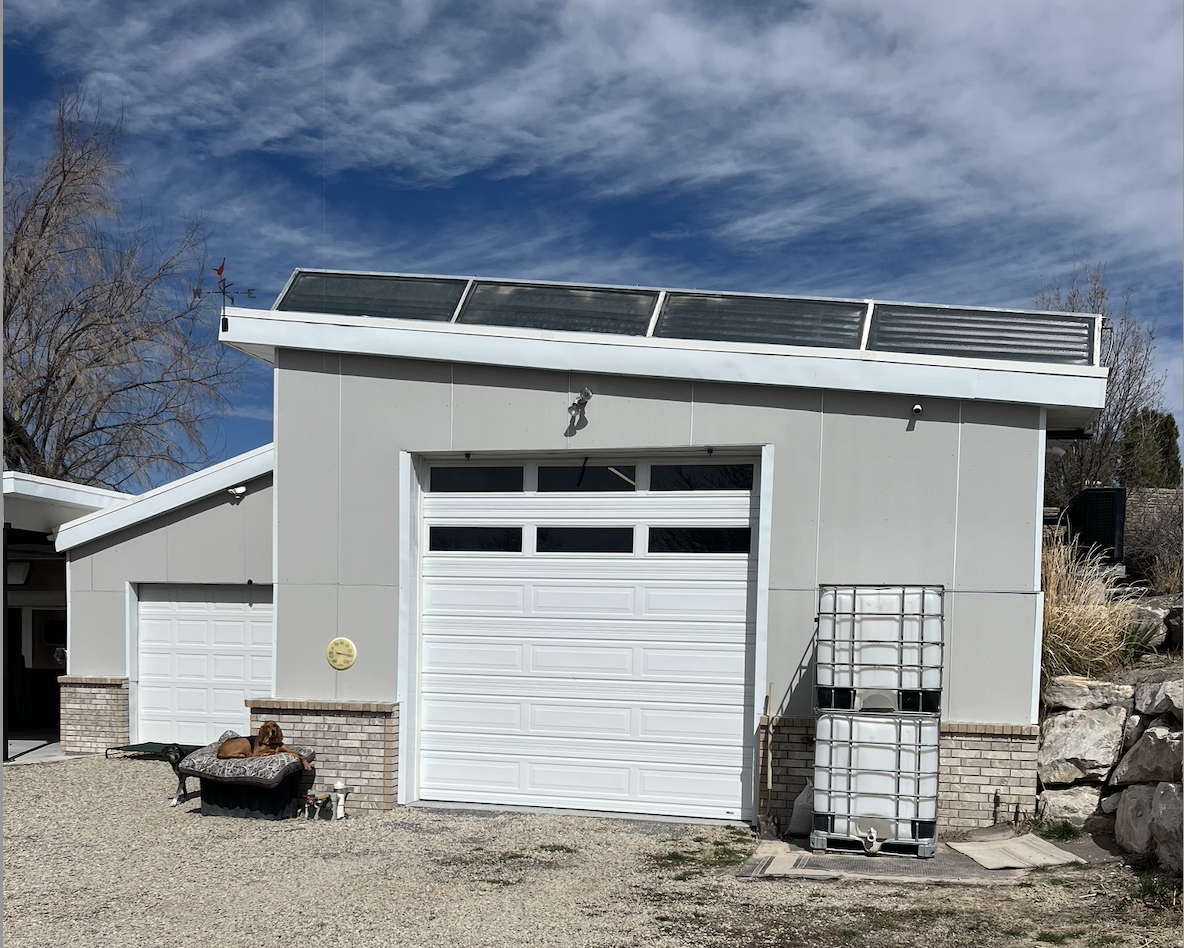
Although I have a large homebuilt thermal collector on the shop, mainly for DHW generation, and the homebuilt outdoor shower you see.
 Bob "hot rod" Rohr
trainer for Caleffi NA
Living the hydronic dream1 -
@DCContrarian that was an interesting thread. Here's a bit of an interesting data from the last couple of days as I've been tuning the TPI algorithm + enter/exit logic. I got to a point where I pulsed a bit too aggressively last night for concrete slabs however the total run time was dramatically less than previous nights and the ending result of the room temperature was definitely better. We'll have to see how much fuel the zone consumes for the rest of the day, however it's definitely a pretty clear case of PWM being a pretty nice option for bigger slabs. I have an unfortunate issue with one of my zones where there is some thermal bridging that I don't think I can soften the ODR curve all that much more and still maintain the muscle to overcome down to it's design temp of -7F. Although we did actually upgrade a pump on that loop so it might be OK to soften the curve up a bit. I also noticed by serendipity that the bigger zones ran opposite of each other last night which makes me wonder if there's an opportunity to cascade/alternate zone sets for better ramp up and maximize BTU uptake vs. all zones running along with each other (TBD).
I've included some charts that show some of the progression of tuning: first one is the overall system and each zones run time (the ones that are doing short pwm pulses on Thursday are concrete, the longer running ones in that are gypcrete zones — targeting concrete tuning first). Second one is how the duty cycle ramp changed based on TPI adjustments, and then I show one of the more stable zones with some more detailed temp data, run time, boiler water temp, etc.
Overall system (you can see the progression to more aggressive pulsing for temp/slab maintenance (and yes, these cycles are too short — 15-21 minutes on and 15-20 minutes being blocked)). You can also see the outdoor temp vs. total cost to run per day. Also don't mind all the reboots - I was tweaking/fixing some things.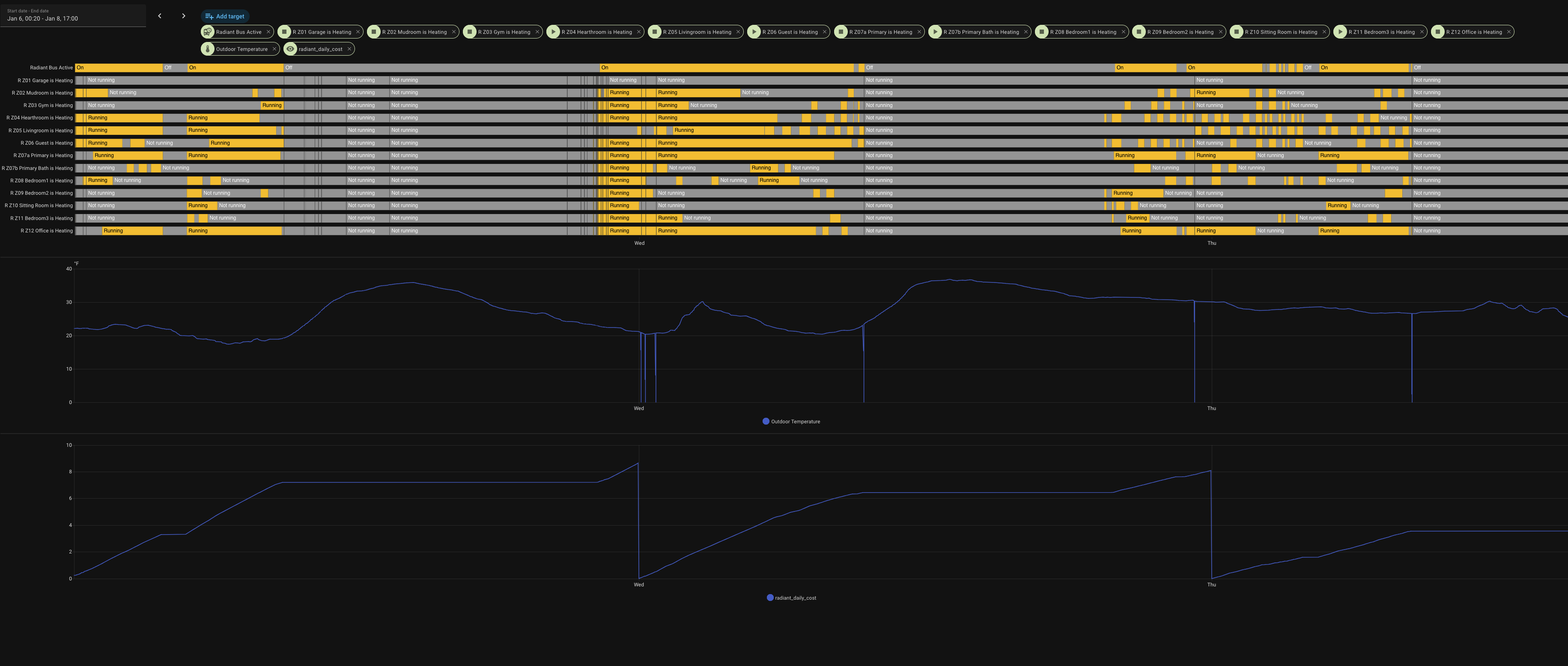
Duty cycle changes due to TPI algo changes. Can you guess who has the thermal bridge?

Here is the temperature/btu load/boiler temp/daily cost data of the living room zone. Ignore that flat mesa as I broke something so the slope would just connect beneath that thing :) The first day we had a lot of sun (all day), second day was moderate sun, and today we had just short periods of it but not crazy. The overnight is the more interesting data anyway as you can see the temp curve shifts and pulses. Also the ODR temp is calculated and is spot on to what the boiler is running. BTW bottom chart is how much it cost (in dollars) to run the zone for each day — looks like I cut off the lower portion.
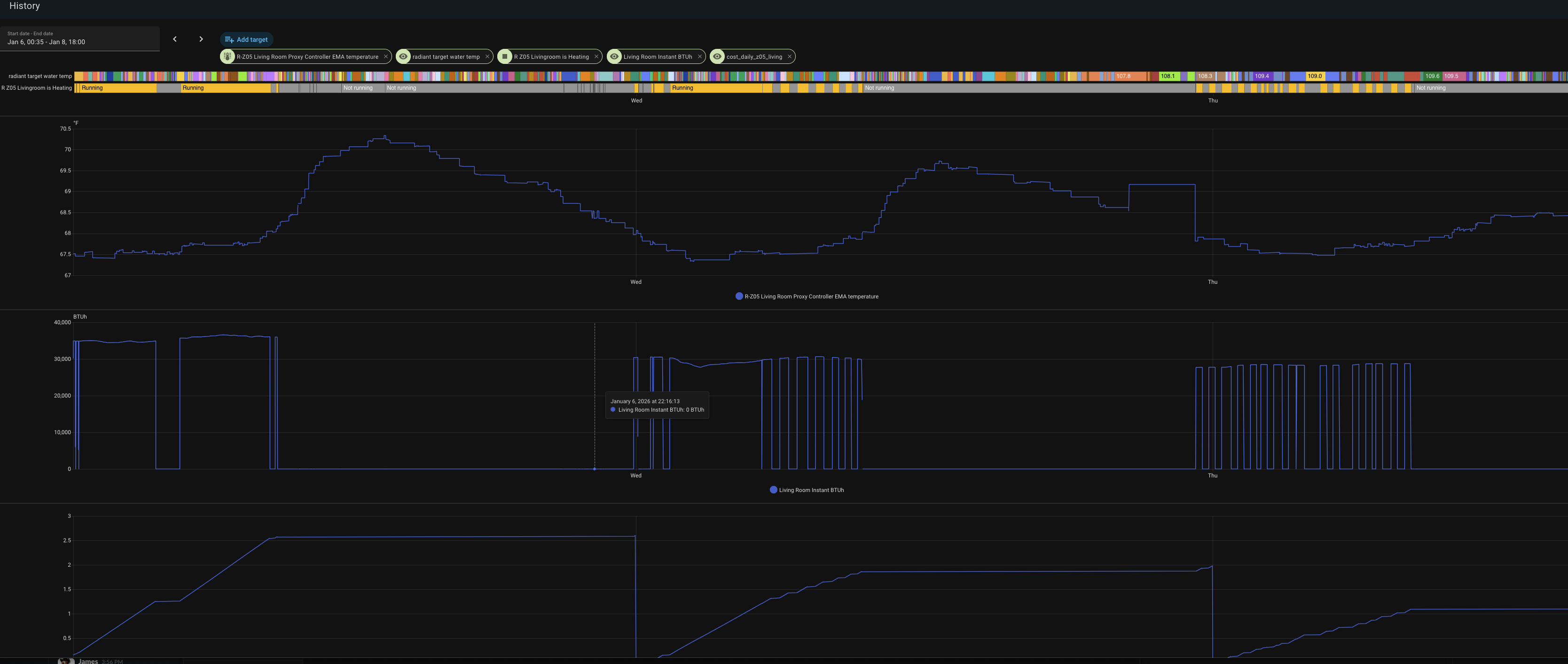
Going to keep experimenting and tweaking to see what ends up netting out to be the best mix of comfort+efficiency.0 -
Robert Bean is a big proponent of total comfort systems.
In his advanced training classes he really drill down the term MRT
Mean radiant temperature is the area-weighted average temperature of all the surfaces in the room.
As the temperature of all the surfaces in the room goes up, heat radiated from your body slows. And the opposite.
This is where the cold at 70° Holohan parable comes from.
So setbacks, short cycles, or allowing the furnishings to cool down plays a part in the comfort formulas.
A thermal camera is a good tool for exploring MRT conditions. Shoot your widows to get a good graphic of a "cold" surface that pulls heat from your warm body :)
Years ago someone was playing around with MRT controls, maybe along the lines of what you are doing.
Bob "hot rod" Rohr
trainer for Caleffi NA
Living the hydronic dream1 -
Maybe I missed it, but can you talk about how you're using PWM to modulate the heat output of a slab?
0 -
New here too and I also built something VERY similar to this haha. Mine is more of a "so simple you don't know its there" design though. I didn't want to get stuck in the Home Assistant trap so I went with Raspberry Pi devices for my zone controller and thermostats.
0 -
These DIY projects are great. There's a significant gap at the residential level for multi-zone systems in North America. Tekmar is good, but as mentioned, it doesn't have the ability to monitor forecasts.
 1
1 -
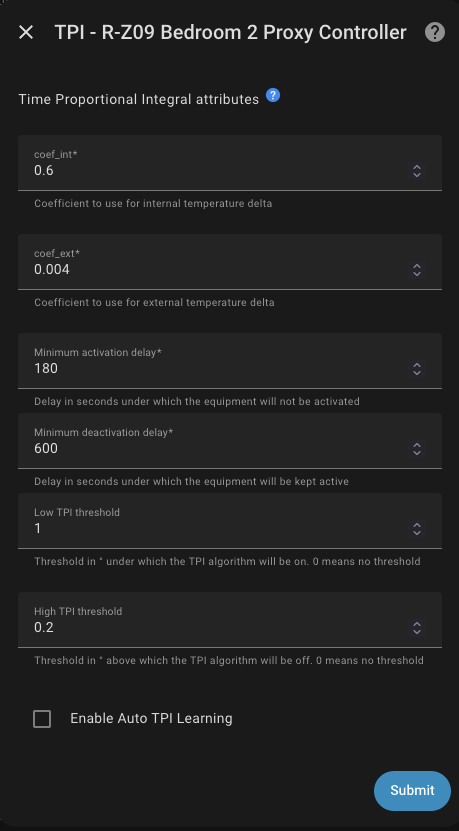
@DCContrarian I am using versatile thermostat (https://github.com/jmcollin78/versatile_thermostat) within home assistant. I've set up my ecobees as basically dumb on/off switches and have a proxy layer to interact with them (you don't even need this, but I did it because I've been playing with things like zone scavenging, load accumulation, etc…). You can set up the TPI configurations as a central config, or you can use per room TPI settings which controls the pulsing based on it's observed behavior of each individual room. As an example if you have a high BTU loss room (drafty or lots of glass) you could set a very reactive algorithm that basically calls for larger chunks of heat faster (or the reverse for slower/stable slabs). There is an external temp factor as well that you can tune that basically adds a baseline of required power so it can fight the cold faster (or slower if your house is super tight).
Here is an example of a room with gypcrete right now. It has a cycle time of 60 minutes, and to maintain the 67F setpoint it believes it needs to pulse for 865 seconds out of the 3600 to maintain. In the next hour it'll re-evaluate where it is in relation to that setpoint and will either add more or less time.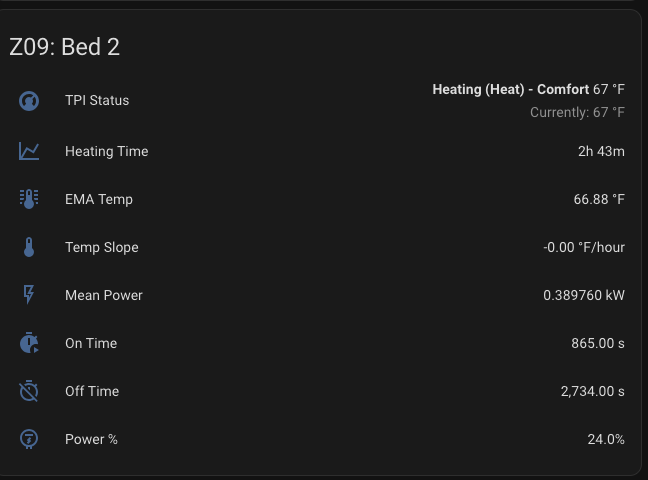
Here are the settings for TPI for this zone:
Here is the chart for that zone (its set point is 67F) — you can see when it gets a bit of sun ;-) The system pulled out of it's solar brake around 330 and started a pre-charge. The algo is still 'settling' down as I have been changing it a good bit but given how much sun we had today it didn't do too bad. It'll be interesting to see how smooth it could stay on a consistently cold day. Today's range was 8F to 33F.
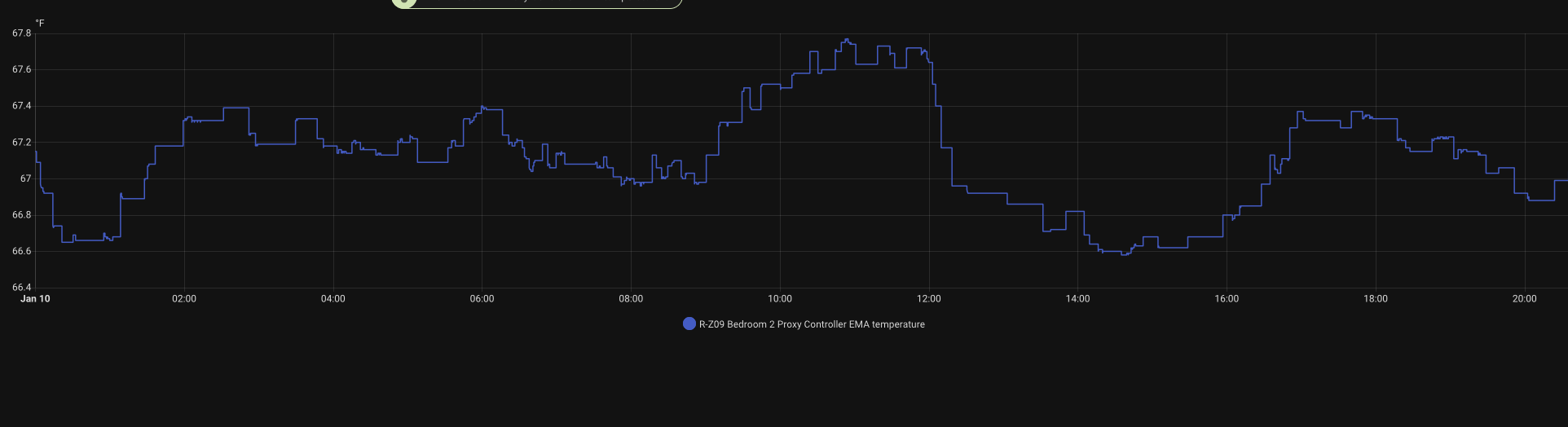
Here is last night up through ~830-9am today. You can see some of the variability in the length of run times as it's adapting based on the environment.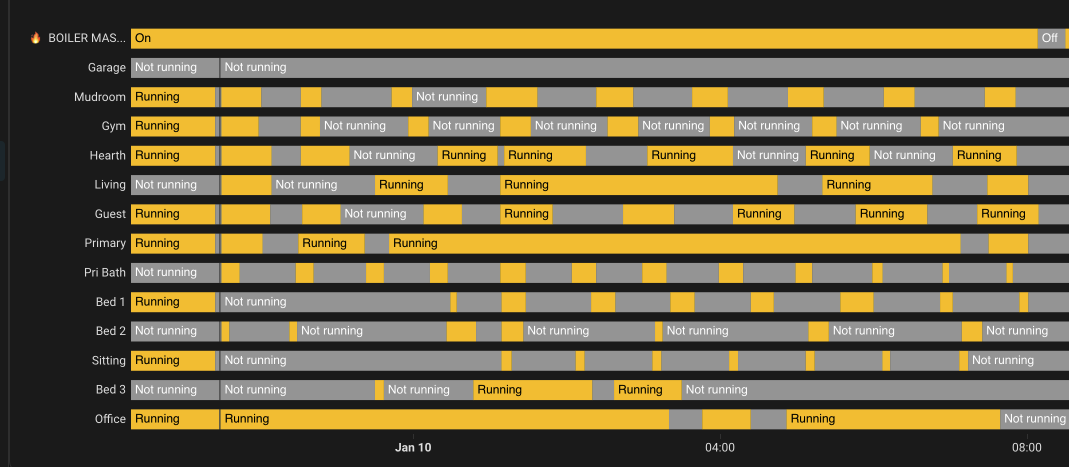
And I have a solar brake that pulls the forecast, calculates the impact of the weather and will potentially put the brakes on the heat if necessary. In this case (as of now) the forecast sees that we'll have 7hrs of sun tomorrow and we've calculated a potential solar impact of about 3.2F. From there I can do different things; I can back off heavy slabs early in the AM (2-4AM depending on impact) and maybe be less aggressive with gypcrete zones, maybe those are 60 minutes before sunrise, etc… The cool part is that it recalculates all of this every 15 minutes so if the forecast drastically changes or something from my weather station (ie; starts raining) signals us of a change of plan — we won't leave the house in a vulnerable position. The same script calculates slab pre-charging in the evening so if we're going to have a cold night and we need to 'catch the knife' as that much solar gain may keep the slabs off for 12+ hours, we can do it a little easier.
 1
1 -
I'm a big fan of KISS. Every time I'm building something, my goal is to remove as much content as possible and make controls as dumb as I can get away with.
Running heat with a somewhat aggressive outdoor reset. A number of zones are always on. The rest, since aggressive outdoor rest, might as well be also on as the thermostat is calling for heat most of the time.
Temperatures are even, even with decent solar gain, there is no overheating. Air to water unit does not cycle once bellow 5C (40F). Good enough.
 2
2 -
@pcericm : "It has a cycle time of 60 minutes, and to maintain the 67F setpoint it believes it needs to pulse for 865 seconds out of the 3600 to maintain."
OK, that's not how PCM is usually understood. Typically PCM is used with DC motors where you want to control the output of whatever the motor is driving by varying the motor speed, you'll see it in variable speed compressors, pumps and air handlers.
I thought maybe you had a variable speed pump and were altering the flow.
0 -
That's the ideal state! The beauty of this is that if the brain goes offline it defaults into its normal operating mode of thermostats with their set points(+1/-1F) so it's more of an optimizer than a requirement for the system to work. I'd love to be able to run strictly on an ODR curve but I've discovered a pretty bad unfixable thermal bridge that needs a bit of extra kick in the curve.
Kind of fun to see tangible impact to the cost of things. More efficient and more comfortable is a win-win :) Started rolling out iterations of PWM at the end of December and pushed some improved settings over the last 2-3 days.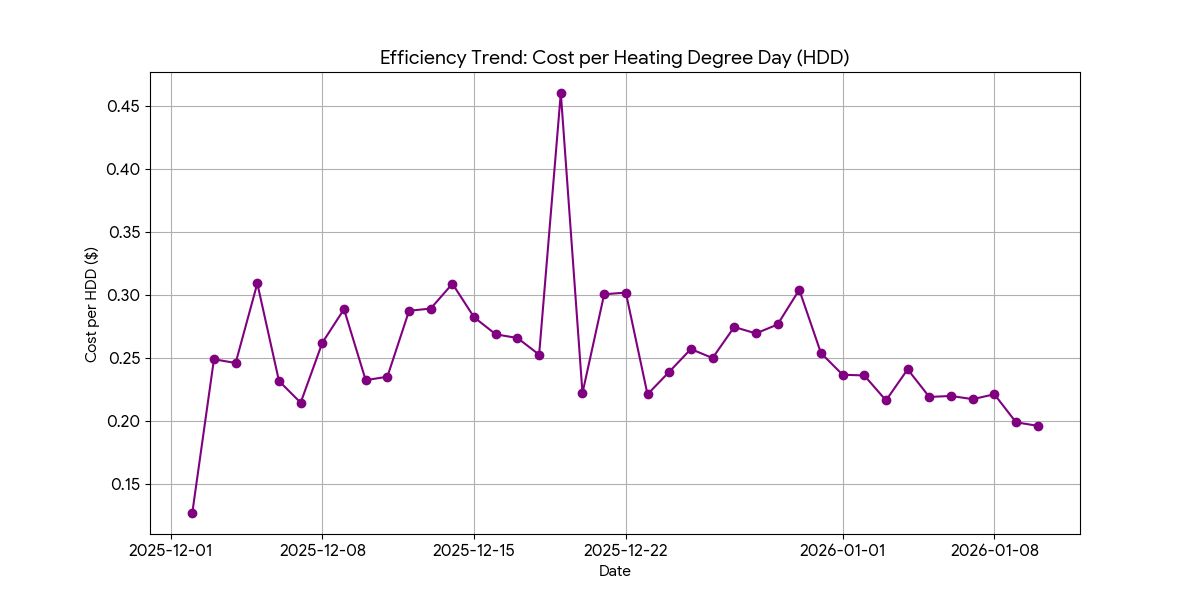
Raw data (cost is in dollars per day):
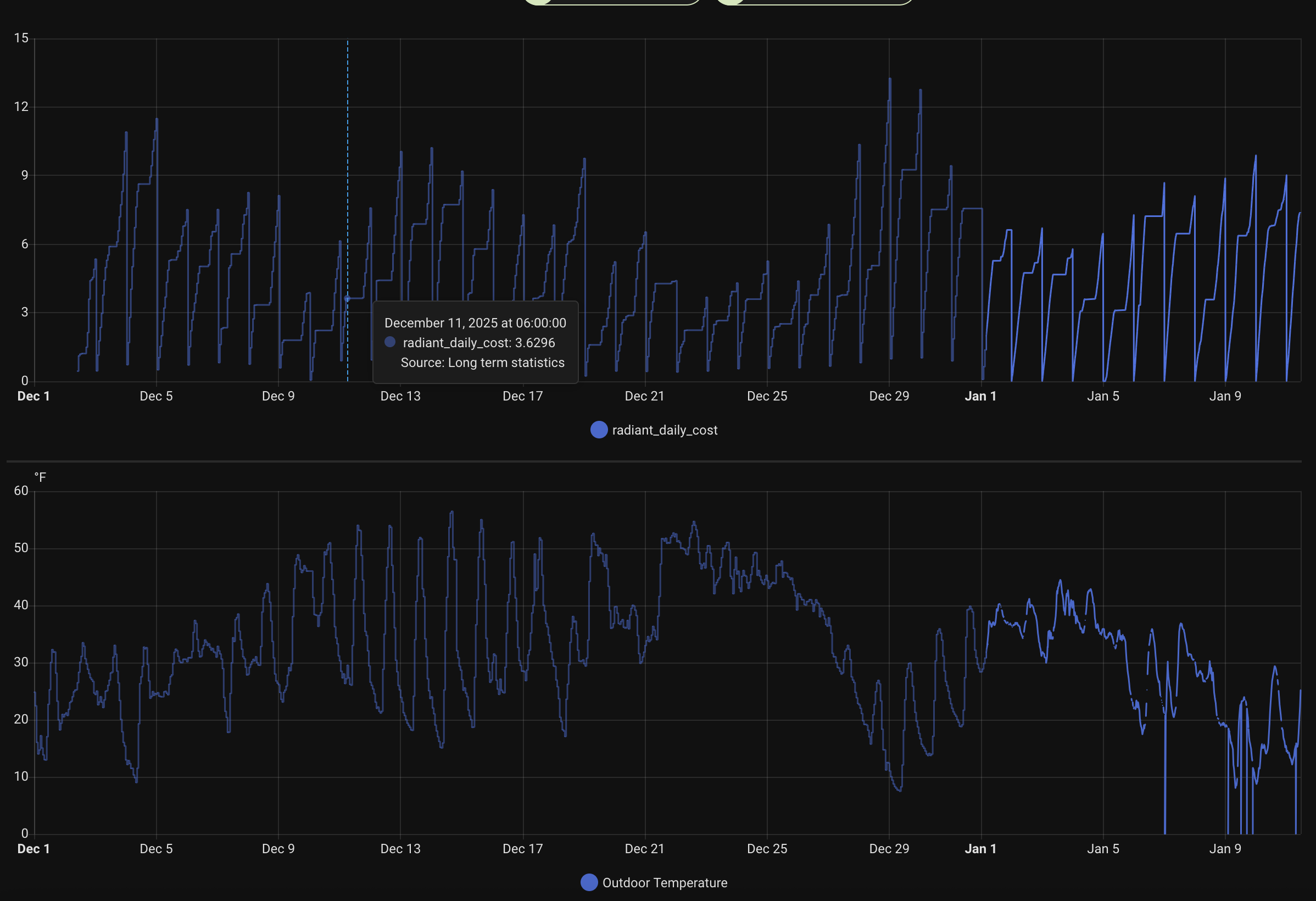
What type of environment are you in? Ours is typically much much colder than what we're seeing this year.0 -
Ahh yeah not the direct motor control PWM — it's very similar though, just on a larger time scale (cycle time). The software I linked you actually does exactly what you're talking about being able to control motors/open %s, etc… I just adapted it to radiant slabs :)
0 -
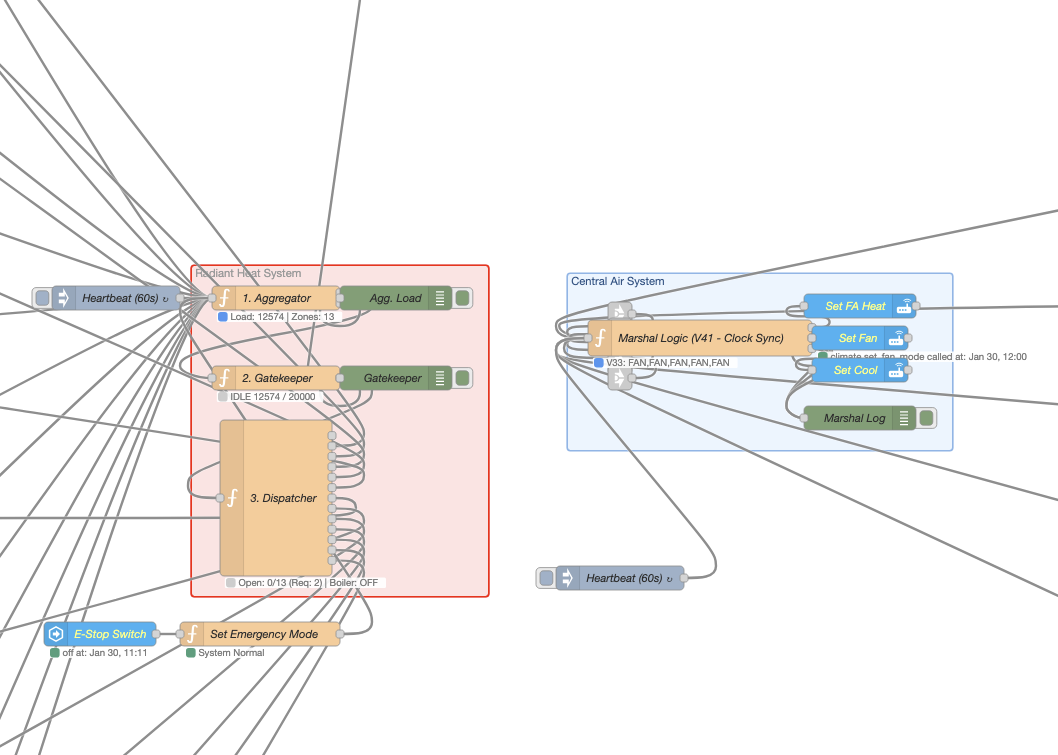
I recently made a pretty big change to this system that has made life and comfort so much better. I kept a bunch of the reporting/data metrics in place from above but I pulled the logic engine out and put it in node-red which has made it soooo much easier to plumb things together and do what I was ultimately setting out to do. When I get it into a final state I'll provide updated documentation on how to do it but the big changes are as follows:
- I was finally able to get PID to work properly vs. depending just on duty cycle %s and a brake scenario
- If I need to wait for the queue, any extra accumulated time to the PID run time will be applied at the next run. So if for instance if a room had a ~20 minute pulse demand and it sits in queue for say 5-10 minutes, it might have accumulated another 2-3 minutes of actual runtime, so that’ll get added when the gatekeeper unblocks the queued zones.
- Instead of using preset switching for solar braking and pre-charging I was able to implement a feed forward bias into the PID itself. This is pretty cool because the processing logic stays a bit cleaner where all it needs to care about is pulse length/rest lengths per zone based on the PID. The feed forward utilizes outdoor environmental from local weather station + forecast to add or subtract bias, changing the input into the PID by up to ~20% (still playing with sweet spot). This has been working a lot better than just slamming the brakes on 2 or 3 hours before sunrise
- Incorporated my 5 forced air units to work in conjunction with the radiant system by way of a new air marshal system. Each unit services a subset of the radiant zones so there was some opportunity to do smart things
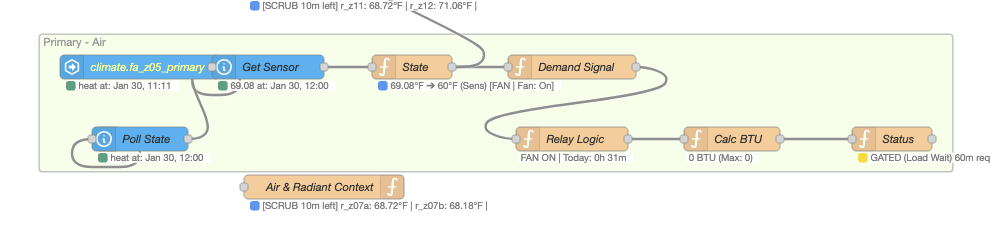
- Programmatic air scrubbing vs. the ecobees running 5 minute chunks of time at varying times per hour. Supports quiet time dynamically
- Air shuttling: basically if there is an imbalance between the radiant zones being serviced by a specific air handling unit from say solar radiation, it’ll dynamically spin up that fan and it’ll start mixing the colder air from the other rooms and warmer air from the room being slammed with sun to flatten the overall temp curve
- Harvesting: if a single room is either struggling to keep up, or maybe a window or door was left open, it’ll first try to harvest warm air from other rooms, and if not it’ll move onto the next point
- Heat support: if the above harvesting doesn’t work, or the temperature slope is too steep, the forced air system will turn on the heat and lend a hand. There is significant boosting capacity (7-8F increase in < 1hr)
- Created a much cleaner input system to the feed forward process where you can see exactly why/how it’s making decisions
New functionality being worked on:
- Humidity harvesting: any time there is a meaningful increase in detected humidity from showers, washing dishes, etc relative to the rest of the house the closest air handler will shuttle it before the next air scrubbing cycle
- Use MRT as the driver of thermal control. Radiant base + more proactive forced air trimming (split PID strategy as an idea)
- A real BMS-style dashboard that integrates the real time bits of these flows
Here are some updated screenshots:
Much nicer cycles. You'll see a reduction in the block sizes towards 8AM as it dynamically reduces the feed forward %.

System flows(there's a bit of overshoot today but not bad at all given the temp has gone from 6F → 41!):
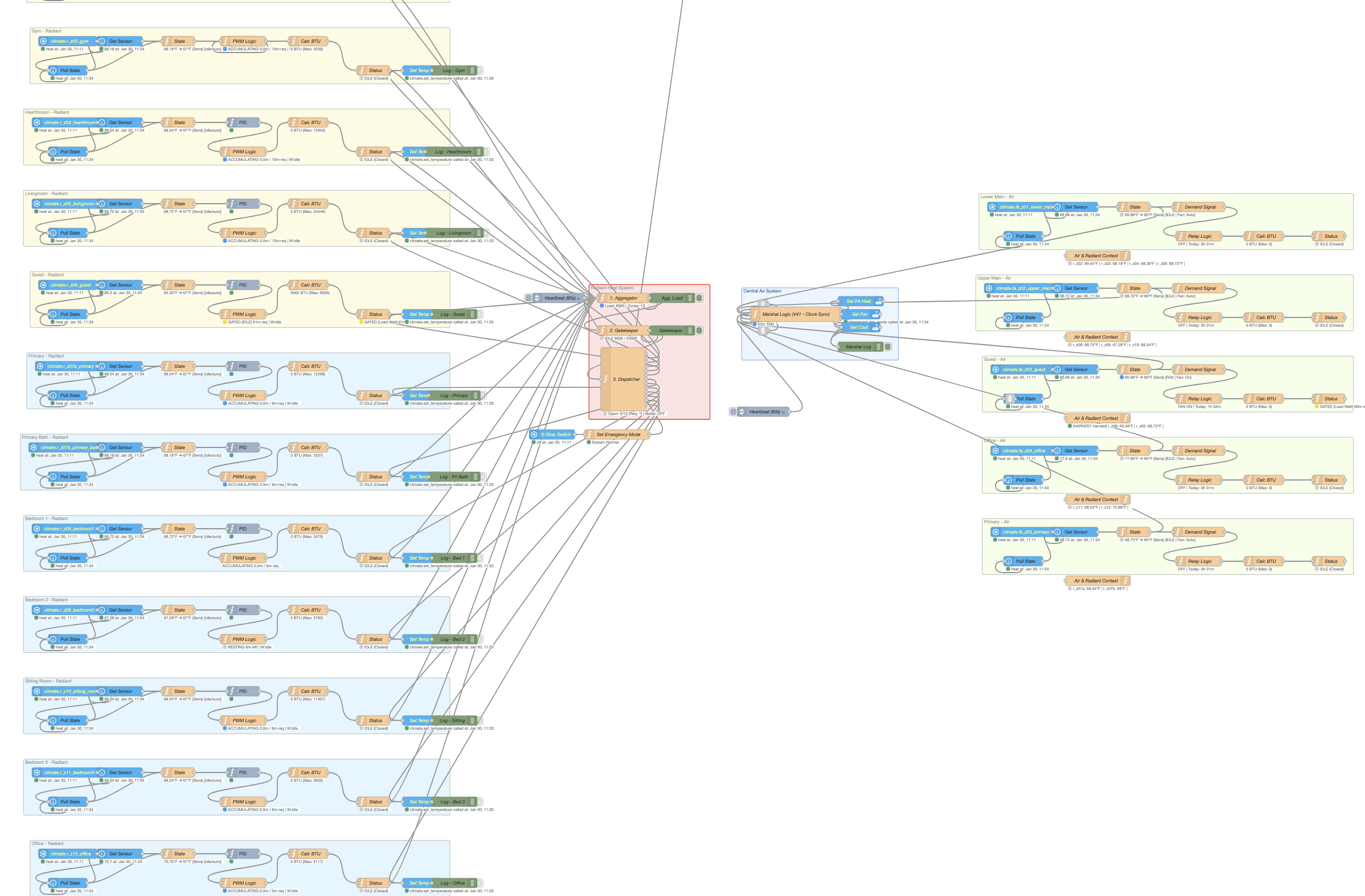
ODR / Feed Forward Input data (bias %/brake):
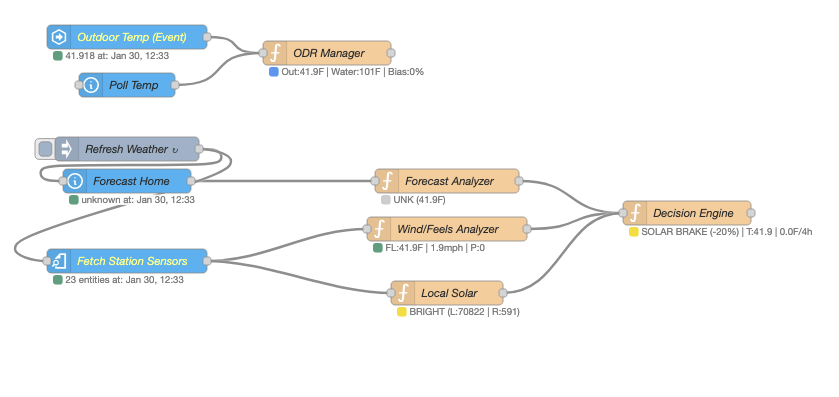
Brain core:
Air handler performing air scrubbing:
Air handler performing harvesting for guest radiant(r_z06) (note temp delta (on purpose for testing)):
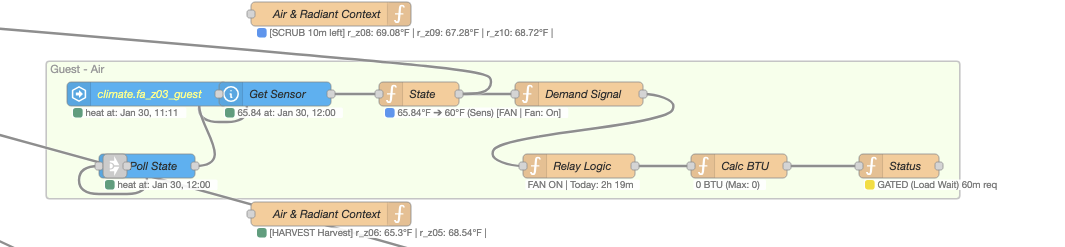
Same guest radiant zone that is utilizing harvesting above (note the gated status):
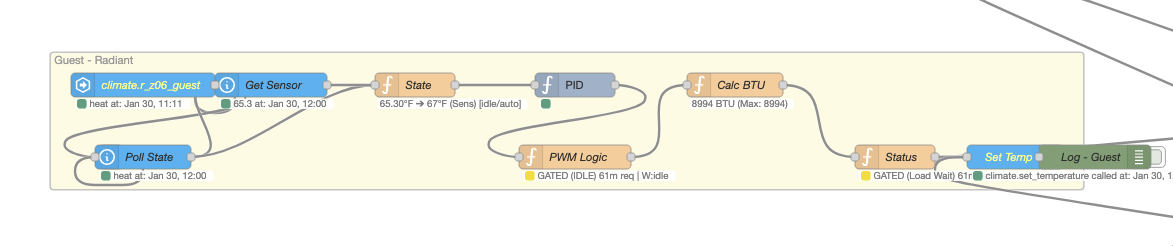
This new implementation still requires home assistant to manage the homekit+thermostats interaction since I didn't find a great homekit option for node RED. What I am probably going to do is just run a small home assistant core + node-red on it's own LXC or maybe even it's own industrial PC to just live on it's own :)
0 - I was finally able to get PID to work properly vs. depending just on duty cycle %s and a brake scenario
-
I just wasn't satisfied with the way the last implementation so I ended up with a final system that I think is pretty close to perfect for my environment. tl;dr I moved the core of the system to a PLC (CODESYS) that runs on an industrial PC that just runs on it's own, use NODE-RED for weather logic (solar braking, feed forwarding, etc), and use home assistant as a driver layer for HomeKit.
The final system is outlined here:It's been running for several weeks now with pretty awesome results :) It only took 3 rounds of iteration but hey, it was fun. If anyone wants to dabble with CODESYS code (it does require a license for full time use) I can push the structured files up — just let me know.
1 -
It's really nice what you did here. I think most "off the shelf" style systems of this nature are severely lacking by comparison to what a hobbyist can do with a few sensors, a board or 2, and programming knowledge. There have been a couple folks who posted similar projects here, I love seeing that stuff, I wish I could find a way to implement it on some jobs. unfortunately the cost to the end user would be quite high given how much time setting it up can take, and then of course you are on the hook if there is a glitch. Most residential contractors I know would rather keep all the technology they sell simple, commercial systems typically have a separate commercial controls contractor, varying degrees of quality there..
1 -
Yeah — the existing residential stuff is pretty meh. It's been really fun to play with and learn the dynamics of high mass systems and control theory. One of the things that I did with this system was basically positioned it more as an optimizer vs. putting it inline with anything critical so my PLC can fail and the most that happens is a room is a degree or two off of optimal and the system runs a bit less efficient so nominal impact.
I have also gained some appreciation as to why these smarter systems don't exist in the residential market… at least yet. Auto-tuning would have to be rock solid because I just can't imagine the typical person wanting to understand how any of the knobs work :)1




Categories
- All Categories
- 87.6K THE MAIN WALL
- 3.3K A-C, Heat Pumps & Refrigeration
- 59 Biomass
- 429 Carbon Monoxide Awareness
- 124 Chimneys & Flues
- 2.2K Domestic Hot Water
- 5.9K Gas Heating
- 119 Geothermal
- 168 Indoor-Air Quality
- 3.8K Oil Heating
- 78 Pipe Deterioration
- 1K Plumbing
- 6.6K Radiant Heating
- 394 Solar
- 15.9K Strictly Steam
- 3.5K Thermostats and Controls
- 56 Water Quality
- 50 Industry Classes
- 50 Job Opportunities
- 18 Recall Announcements