Any Roth Oil Tank Downsides?


Comments
-
Your set up will work , with a top feed set up , you need to remember to keep up on the oil treatment . You need to kill algae growth
And don't reuse the oil.. I know it is temptingThere was an error rendering this rich post.
0 -
Downside: I can only think of one.
Roth offers a tank gauge that is a weighted float that sits on the surface of the oil. There is a string attached to the float that pulls down on the gauge that causes the numbers on the gauge to change indicating how much oil is left in the tank.
Roth also offers a floating oil pickup tube that has a flexible tube that is connected to the top feed of the tank. There is another opening to fill the tank. When you place the gauge and the pickup tube next to each other,on the top of the tank, the force of the oil filling the tank will entangle the gauge string and the pickup tube. You will not know about this until you get to about 1/2 a tank of oil. The tangled string and tube will stop the pickup tube that is supposed to float on the surface of the oil from dropping with the oil level. You will end up with no heat and the gauge will read 1/2 tank so you know you are not out of oil.
The service tech will try to prime the burner with no success. Then go out to the tank to see how much oil you have, then go back in and try to prime it again. Then he will replace the plugged oil filter only to find that the filter cartridge is pristine like the day it was installed (Not Plugged). Then get his clogged oil line kit and try to blow out the blockage in the fuel line (that is not there) . After that he will recommend that you get a new fuel line because there must be a break in the fuel line since he can not get the fuel to draw thru the existing fuel line. Then he will remove the fitting on top of the tank for the fuel line in order to start the new fuel pipe process. When he sees that the gauge string is wrapped around the oil pickup, he will then feel so stupid for not looking at this problem 2 hours earlier. Then he will throw away the tank gauge and the floating pickup tube and install a rigid pipe to pick up the fuel from the bottom of the tank. He will then need to come up with a reason you need a new gauge (different kind) because it is not compatible with the new fuel pick up line.
The fuel line repair will be less than 1/2 the price quoted because he found the break in the fuel line pickup in the tank and you don't need the entire fuel line replaced.
Ask me How I know this?
Go ahead and ask... I dare ya'Edward Young Retired
After you make that expensive repair and you still have the same problem, What will you check next?




 8
8 -
No one uses floating pickup tube anymore.
Roth or similar Granby is all anyone should use.
Installed correctly, no vacuum leak, power purged, single pipe, no tiger loop needed.There was an error rendering this rich post.


 3
3 -
enjoyed reading your one downside to a Roth tank EdTheHeaterMan. I am in the process of having a new Roth 275 tank installed next week. This is going into a rental property I own in RI. my tenants pay their own oil heat; so my question is. How can this entanglement be avoided between the pickup tube and the gauge string so my tenants aren’t calling me in the middle of the night with no heat. Is there an option to avoid this that I can tell the installer? Although who doesn’t enjoy a middle of the night call every once in a while.
0 -
I think @STEVEusaPA is right. When I was still doing such work we had stopped using the rubber pickup tube and used a soft copper line straight to about two or so inches from the bottom. This eliminated the entanglement issue. We also found the the flexable tube would sometimes split at the connecting point causing a vacuum leak.
Miss Hall's School service mechanic, greenhouse manager, teacher, dog walker and designated driver
0 -
Is just getting another Steel Tank with proper maintenance an option with a bottom feed to burner? Its just that a lot of so-called improvements in past often show up as disasters later, eg. Urea formaldehyde insulation once considered the best thing since sliced bread. Seems a patch would get Poster to the warmer months for a replacement too
"
Urea formaldehyde foam insulation (UFFI) is a type of insulation that has been associated with various health risks and deterioration issues, leading to its decline in use.
Regards,
RTW
0 -
I don't see anything wrong with a properly installed steel tank, pitched towards outlet. All gravity, no Tiger Loop. I'd put a bio rated spin-on at the tank, then an oil safety valve, then oil line to the burner. You can even go bio-rated cannister filter & spin on (double filtration) at the tank.
And being pitched toward the outlet, it won't accumulate water.
When servicing the filters, if it looks like you're getting sludge, microbes or any goo, treat the tank.
They even make a custom pan you can put under it.
Or you can get an Eco Guard, which is a steel double walled tank with a bottom outlet. But they're super heavy. Two regular dudes aren't carrying it down a basement. You'll need to bring in some muscle…lol.
I can't emphasize enough, NEVER reuse the old oil. It voids the warranty on a steel tank, but more importantly, no matter how much you filter it, it will still be bad oil, and you're giving your brand new tank a 20-30 year head start on failure, all to save a few hundred bucks on a $3500-$6000 tank job (depending on logistics and ease of replacement/removal).I had people do this and in one case their steel tank only lasted 7 years and started leaking.
1 -
Insightful Quote:
"no matter how much you filter it, it will still be bad oil" courtesy of HydronicMike above
Reminds me of oil quality assessments of a country south of the boarder
Regards,
RTW
0 -
I don't know what that means. Care to explain.
But what I meant is that people think if they run that old oil thru a filter (or two) it will get rid of all the bacteria, microbes, sludge, etc. It won't. You would need to run it thru a commercial fuel polishing machine to bring it back to a quality that won't give your new steel tank a head start on corrosion. But people will do what they want, and they may be ok, or they may not. 0
0 -
Basically just keep the gauge and pickup line on opposite ends of the tank.
As far as transferring oil from the old to the new, not if it can be helped. If the new tank is going in a new location, install the tank, run new oil line to the burner, and fill the tank with new oil. Run off the old tank until it runs out. Quick switch over. N/F/S, test and done.
If the new tank is going in the same location, I'd like to see the job before deciding on a pump over. I definitely would leave the pickup tube at least 6 inches off the bottom of the tank. Say bye bye to the rest.
0 -
FWIW - I had a 20yr old steel tank, pitched to the outlet with a bottom connection. I typically ran it dry in the spring. When insurance forced us to switch to a Roth, I kept the old tank for the metal. Two years later I needed a metal sheet , so we emptied out an expired fire extinguisher into it just to be safe, then cut out a panel of metal. We could see inside the tank now and other than the dust from the extinguisher, that tank looked very clean. No sludge or rotted areas.
30+ yrs in telecom outside plant.
Currently in building maintenance.1 -
The downside of a bucket style tank, it turns into a "SWAMP" if let go …
There was an error rendering this rich post.
0 -
Just keep the suction 2-3" off the bottom when pumping into your new tank and get rid of that bottom stuff. I'm assuming the diesel in the tank is recent anyhow and not from 1987 or something? yes?
It's an oil furnace, not some super high pressure and $$ common rail diesel.
Myself, I'd just drain the old tank, weld the leak, refill and be done with it. But there's no way in heck I'd drop $3500 on a new tank! A regular 275 gal steel tank is around $1000… so not sure where another $2500 would be from.

 0
0 -
I can remember buying 275s for $75.00
0 -
Please read the fine print on the 30 year warranty the original poster referenced, seems any manufacturer defect would show up early and may exclude coverage for degradation due to normal use, just sayin
Regards,
RTW
P.S. theres a bit of a "build a better mousetrap" at work here in pushing Roth Tanks
0 -
I think Grover Cleveland was President back then. At least that's what some old person told me.
Edward Young Retired
After you make that expensive repair and you still have the same problem, What will you check next?
1 -
All bad advice…sorry. When an oil tank fails, just because it's from a single pinhole leak, doesn't mean it's fixable. In almost every case, when you remove that tank, scrape all the sludge out, you'll find dozens of pinholes. Welding a steel tank that is mostly compromised is a bad idea.
First of all, where are you putting the 'used oil'?
Where are you putting the sludge?
A regular steel tank may be $1000.00 by itself. Are you picking it up or getting it delivered? Add in the legs, whistle, gauge, all the fittings & piping required. Add in 2 guys and their labor, plus their benefits, a truck, truck insurance, tools, disposal of waste oil, removal and disposal of tank, etc. etc. These are some of the many costs of doing business. Not a lot of extra profit in that job. And no one stays in business doing things for cost.
And yes, unless the tank was drained, and wiped clean you'll have a little bit of every oil deliveries oil in that tank.
Tank Leaking, replace it. I already gave all my other ideas in an earlier post on this thread about steel vs. Roth. 1
1 -
Mr MIKE
Question, I looked back at your previous post recommendations:
"I don't see anything wrong with a properly installed steel tank, pitched towards outlet. All gravity, no Tiger Loop. I'd put a bio rated spin-on at the tank, then an oil safety valve, then oil line to the burner. You can even go bio-rated cannister filter & spin on (double filtration) at the tank.And being pitched toward the outlet, it won't accumulate water."
You described my steel tank to a tee, In CT bio fuel became mandatory at 5% around 2023. in July 2025 it 15 % became mandatory and by 2035 50% is on the table. My question is can you recommend a brand name bio rated cannister filter etc. I currently have a standard filter -General brand that I have changed out 2x a year. I noticed a curious film last time it was changed
Im a homeowner and first I heard of bio rated filters
Regards,
Bob
0 -
Although you can get a General replacement cartridge with bio gaskets, as of now, the filter element is not bio-rated. People are discovering at higher bio contents (IIRC 20%+) emulsification of the filter element. Which is ending up in pump/pump strainers and clogging nozzles (confirmed by Beckett via autopsy).
Even though I did recommended General then spin on, that’s only for an area with no bio. But considering they are almost non existent, probably better would be just a bio-rated spin-on (or two).0 -
Thank Mr Mike
In Connecticut, the percentage of biofuel in heating oil sold is as follows:
- 5% biodiesel required by July 1, 2022.
- 10% biodiesel required by July 1, 2025.
- 15% biodiesel required by July 1, 2030.
- 20% biodiesel required by July 1, 2034.
- 50% biodiesel required by July 1, 2035.
This means that by 2035, all heating oil sold in Connecticut will contain 50% advanced biofuels, including biodiesel and renewable diesel
QUESTION: do you recommend upgrading to spin on bio rated at this time? I was home last time the technician removed oil filter and he commented on a kind of light colored film, but didnt say anything specific
Regards,
RTW
0 -
Here in MA we only have B5 biofuel so far, but our oil company routinely puts Mitco 264-100M spin-ons on our oil tanks. Those are B100 compatible filters.
1 -
Beckett makes a b100 approved adapter for a canister filter that converts it to a spin on…
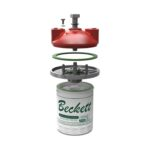
I wouldn't have a tech make a special trip but when you set up next PM/tune up, you may want to tell them you want to either put on the spin on adapter kit, or replace with spin on filter.
 2
2 -
Put the old oil in drums or totes. Filter it into new tank (or repaired tank). Reuse all the stuff from old tank unless it's not serviceable.
My 1000 gallon tank started seeping at a weld last year. I rewelded it. It's 3/16" wall though.
Yes, pick up a tank, and haul down in the cellar.
But I'm going to DIY vs fixing someone else's job anyhow after I paid way too much for them to do it. haha.
0 -
And it's a bit more than $1K when you add up everything else. I probably had close to $1400 in costs when I figured in the leg kit, a new filter housing, new gauge (why not), new firomatic valve - plus the new pipe (and I used Dresser couplings as well 🙃). I also paid a scrapper to cut up and haul out the old tank.
0





Categories
- All Categories
- 87.6K THE MAIN WALL
- 3.3K A-C, Heat Pumps & Refrigeration
- 59 Biomass
- 429 Carbon Monoxide Awareness
- 124 Chimneys & Flues
- 2.2K Domestic Hot Water
- 5.9K Gas Heating
- 119 Geothermal
- 168 Indoor-Air Quality
- 3.8K Oil Heating
- 78 Pipe Deterioration
- 1K Plumbing
- 6.6K Radiant Heating
- 394 Solar
- 16K Strictly Steam
- 3.5K Thermostats and Controls
- 56 Water Quality
- 51 Industry Classes
- 50 Job Opportunities
- 18 Recall Announcements