Therma-HEXX ThermaCEILING

In another thread, @Oldbugsy wrote:
The state of the art in heating and cooling is a Therma-HEXX ThermaCEILING hydronic radiant system controlled by a Loxone intelligent room control system. The heating and cooling source is best served by a Chiltrix air to water heat pump system. It can be backed up with your existing boiler.
The ThermaPANEL units are installed in tracks that sre screwed to your ceiling joists. They can either be installed oover your existing ceiling or remove the old ceiling to the framing. The system thickness with 5/8” drywall is 2.125”.
The Loxone control system along with a mixing valve manages fluid temperatures to prevent any dew point condensation issues. In conjunction with this system, you will need to manage humidity with a separate dehumidifier and steam humidifier for year round comfort.
By decoupling the sensible radiant heating and cooling from latent (humidity) you can achieve perfect comfort year round quietly, cleanly and efficiently.
Robert Barmore, Founder and CEO
I have a similar system in my own house — not Therma-Hexx but ceiling heat with a Chiltrix heat pump — so I'd like to offer some observations.
First, ceiling heat is delightful, it's invisible, quiet, unobtrusive. I can't tell when it's running, and I can't tell from inside whether it's 20F or 60F outside. But I have a new, well-insulated, well-sealed (1.4 ACH50) house, and I would only recommend it for similar houses. In leaky houses you get a lot of temperature stratification, where the ceilings are a lot warmer than the floors, which is driven by cold air leaking in and sinking to the floor. Heating from above is going to make stratification worse.
The Chiltrix heat pump is impressive. It's a real good match for low-temperature panels. I also have heated floors in the bathrooms and it's a good match for that.
The thing to watch out for is that it really loses capacity as the temperature drops. The unit I have has a nominal capacity of 33.8k BTU/hr at 47F. At 17F it's 20.6k BTU/hr, at 5F it's 17k BTU/hr and at -4F it's 14.4k. Where I am, Washington, DC, it's not that cold — design temperature is 21F — yet I still need two units to meet a heating load that's under 40k. On the coldest nights I have supplemental resistance heat running. If I were anywhere colder I'd want a unit with vapor injection that did a better job of keeping capacity.
While I applaud the idea of decoupling sensible cooling and latent cooling — I believe that's the future of comfort — I strongly recommend against using the panels for cooling.
I set my house up with a combination of air handlers and panels, the thinking was that I would run the air handlers only enough to remove the humidity, and let the panels do any remaining cooling. The problem I ran into was there was no remaining cooling — in a tight, modern house, in a humid climate like mine, the sensible loads are so low that even getting all of my cooling from an air handler I don't get as much dehumidification as I'd like. So the ceiling panels never come into play.
Comments
-
In theory radiant energy travels in a line to anything it can "see" So the ceiling panels should heat the objects much the same a floor radiant. With the ceiling unencumbered with furnishings you should feel like it is always a sunny day, everywhere.
Since you are not heating air with radiant panels there should not be much stratification, but there is some with that warm surface up high.
Cold floor drafts from leaking door seals are another issue, that is more infiltration load.
Glad you like the radiant panels, regardless of where they are mounted, and thanks for the AC observations.
Bob "hot rod" Rohr
trainer for Caleffi NA
Living the hydronic dream0 -
I want to compare the effectiveness of panel cooling with an air handler in an environment that needs dehumidification.
Imagine you prefer your space to be 75F and 55% RH in summer. Imagine further that you have a conventional air conditioner where the coil temperature is 40F. When that interior air hits the coil, 61% of the cooling will go to reducing the temperature of the air (sensible cooling) and 39% will go to removing humidity (latent cooling).
Suppose that on a humid day your sensible and latent loads are both 10,000 BTU/hr (I'm in Washington, DC, we get days like that in the summer!). If your AC runs until the thermostat is satisfied, removing 10,000 BTU/hr of sensible heat, it will only perform about two thirds of the needed dehumidification -- 39%/61%, or 64%.
So you add a dehumidifier. When the dehumidifier runs, it dumps the latent heat it extracts from the water vapor, plus the heat of the electricity it consumes, into the house. That heat causes the AC to run more -- which extracts more humidity.
How much more? Let's say the dehumidifier has a COP of 3, so when it extracts 1 BTU of latent heat it uses 0.33 BTU of electricity and increases the sensible load by 1.33 BTU. I can show the math, but what you get is the AC runs at 20,620 BTU/hr and the dehumidifier runs 1860 BTU/hr. The dehumidifier converts the latent load into sensible load, so the entire combined load -- 10,000+10,000 BTU/hr -- now gets handled by the AC. The dehumidifier also does 1860 BTU/hr of dehumidification, which takes 620 BTU/hr of electricity, and the heat from that gets handled by the AC as well. Over 80% of the dehumidification is handled by the AC; if you were to compare the condensate flows the AC would be five times greater. (It's actually kind of neat — or "cool" — how the two devices complement each other).
What happens if you use panels for cooling? The sensible load stays the same at 10,000 BTU/hr. But the panels can't do any dehumidification, so it all — the full 10,000 BTU/hr — has to be done by the dehumidifier. It dumps the heat from that into the house, and with the same COP of 3.0, another 3,333 BTU/hr from the electricity it uses, or 13,333 BTU/hr total. The total sensible load on the cooling is the 10,000 BTU/hr of sensible load, plus the 13,333 BTU/hr dumped by the dehumidifier, for a total load of 23,333 BTU/hr.
So in the first scenario the AC is providing 20,620 BTU/hr and the dehumidifier is providing 1,860, for a total 22,480 BTU/hr of cooling action. (I'm assuming the two devices have COP's that are similar enough that you can just add them.
In the second scenario the AC is providing 23,333 BTU/hr and the dehumidifier is providing 10,000, for a total of 33,333 BTU/hr. This is 48% more cooling required than the first scenario.
Also, the first scenario requires a much smaller dehumidifier. Dehumidifier capacity is measured in pints per day, removing a pint of water vapor requires roughly 1,000 BTU. So 1860 BTU/hr of dehumidification is 44,640 BTU/day, or about 45 pints per day. That's a very small residential dehumidifier, something that you can just tuck in a corner of a utility room.
On the other hand, 10,000 BTU/hr is 240,000 BTU/day, or 240 pints per day. I've never seen even a ducted model with that capacity. If you could find something you'd still need to run ductwork through the house to support it.
Using the panels consumes a lot more electricity and it's not clear what it gains you.
0 -
I haven't experienced a radiant ceiling in decades. I feel like they wouldn't handle areas around doors and windows very well. Also, I really like how heated floors dry out and warm damp boots and gear. And any snow and slush that gets tracked in disappears real quick.
0 -
@hot_rod : "In theory radiant energy travels in a line to anything it can "see" So the ceiling panels should heat the objects much the same a floor radiant."
Radiators are kind of misnamed, the heat they provide is a combination of radiant heat from line of sight but also convection from warming the air they are in contact with which causes the air to convect away.
In a floor convection is much more effective than in a ceiling. Siegenthaler* says when designing a ceiling you should use a constant of 0.71 BTU/hr/sf/F, as opposed to the 2.0 which is standard for floors. So at the same temperature you get about 2.8 times as much heat from a floor as you do from a ceiling of the same area.
So with everything else equal, you need 2.8 times as much area on the ceiling as in the floor. On the other hand, you can run the ceiling hotter than the floor without creating objectionable conditions**. Although if you're using a heat pump, you probably don't want to.
*(I've never seen him say where he gets that number)
**(Unless you have sprinklers in the ceiling!)
0 -
But if you have ever run heat flux numbers on a floor, you will find all the furnishings cut down on output, especially in kitchens with cabinets and appliances. That is seldom taken into account
The number I have seen for sheetrock and gypcrete is 120, so potentially a 100 surface temperature. As such the ceiling has more output potential with a much higher surface temperature, and non existent heat flux
120 AWT gets you about 30 btu/ sq ft from a ceiling. That would take a hot floor temp
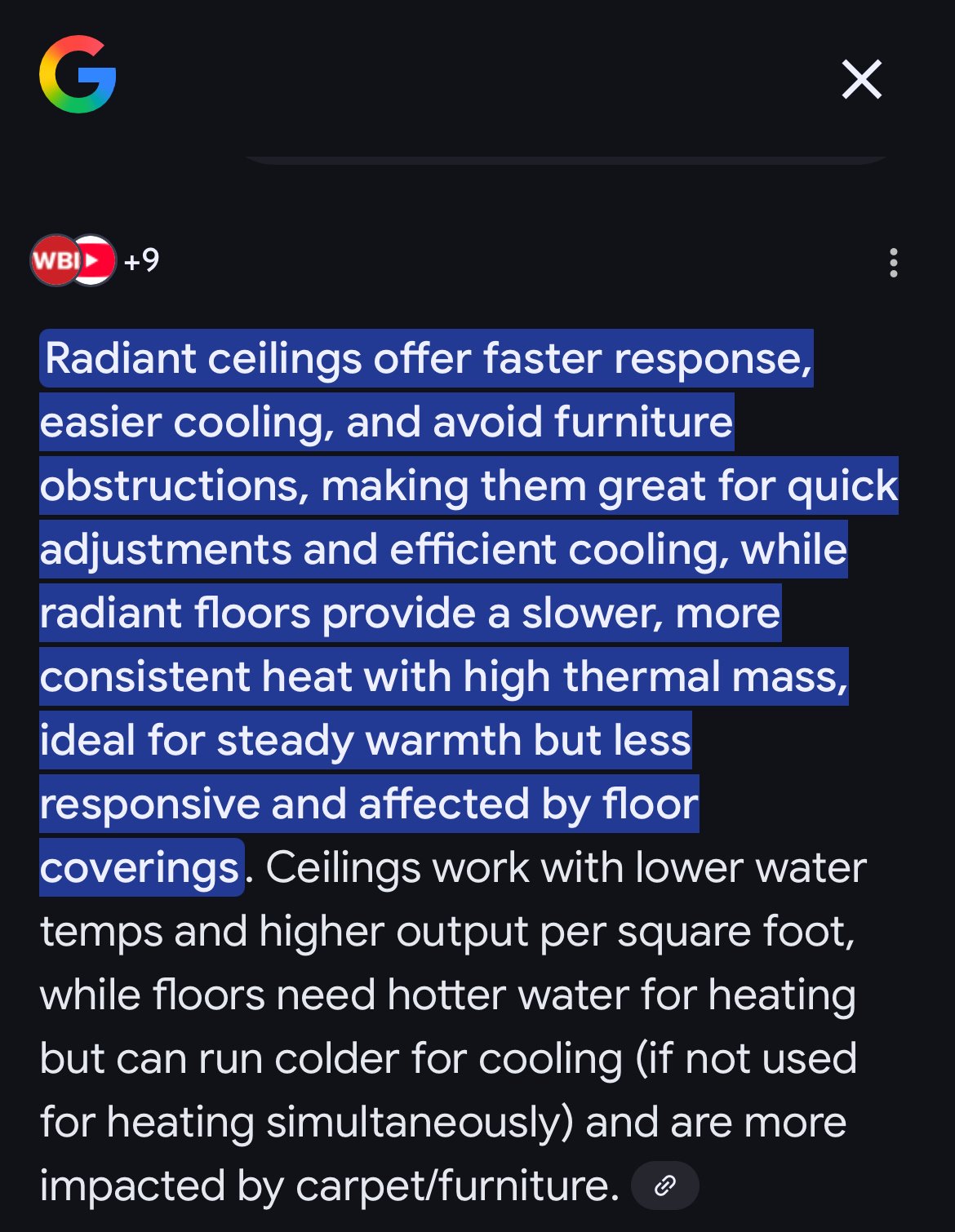
Some thoughts from AI
 Bob "hot rod" Rohr
trainer for Caleffi NA
Living the hydronic dream0 -
"Easier cooling" says a lot about the quality of AI answers.
0 -
The point is the heat output with higher surface temperatures, do you agree?
Bob "hot rod" Rohr
trainer for Caleffi NA
Living the hydronic dream0 -
There is so much gibberish in that clanker text I'm not sure which part you're talking about.
Radiant ceiings offer faster response,
Agree
easier cooling,Disagree, violently
and avoid furniture obstructions,
Agree
making them great for quick adjustments
Disagree
and efficient cooling,
Disagree violently
while radiant floors provide a slower, more consistent heat with high thermal mass,
"Disagree" doesn't do it justice, it's a nonsense statement
ideal for steady warmthHuh?
but less responsive and affected by floor coverings.Agree
Ceilings work with lower water temps and higher output per square foot,
Disagree completely
while floors need hotter water for heatingDisagree
but can run colder for cooling
Utter nonsense
(if not used for heating simultaneously)
Wha?
and are more impacted by carpet/furniture.
Agree
0 -
One more example that "artificial intelligence" is a contradiction in terms.
All Steamed Up, Inc.
Towson, MD, USA
Steam, Vapor & Hot-Water Heating Specialists
Oil & Gas Burner Service
Consulting0 -
specifically about heat output, ignore the cooling gibberish, I’ve learned to do that with AI
Garbage in, garbage out
I believe
Hot goes to cold
The greater the delta the higher the transfer
I think you agreed
Bob "hot rod" Rohr
trainer for Caleffi NA
Living the hydronic dream0 -
@hot_rod :"Hot goes to cold. The greater the delta the higher the transfer."
That's true, all other things being equal. But a ceiling panel isn't necessarily going to have higher output than a floor one simply because the temperature difference is higher.
0 -
A radiant floor with an 82° surface in a room at ambient 70°, 82-70 X 2 btu/ft = 24 btu/ sq ft.
Many designers and pros agree 24- 26 btu is about max for a comfortable radiant floor in a residence. It depends a bit on the floor surfaces also. ASHRAE suggests 66- 84° for floor surface temperature.
Various numbers are floating around out there. Robert Bean had good info about this at healthyheating.com, as I recall European studies were more in the 80- 82° range.
Above that 24- 26 btu/sq ft load load, supplemental heat should be considered, as surface temperatures above 82-84 range•° can start to be uncomfortable, especially on concrete, tile and other. Supplemental could be ceilings and walls to keep the heating system unobtrusive.
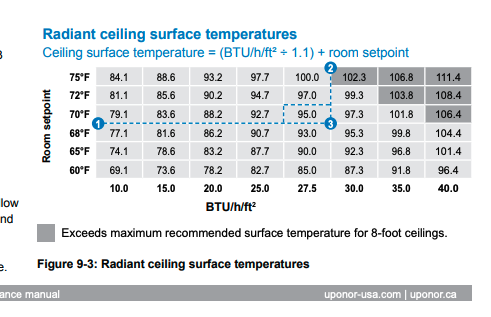
This Radiant Ceiling output chart from Uponor runs out to 35 btu/ sq ft in a 70 room setpoint, 40 btu/sq. ft in 68° room.
Additional benefits of ceiling radiant in addition to higher out put
quicker warm up and ramp down.
higher R-value insulation m ay be possible compared to r-10 below a slab
no concerns with floor coverings being added, furniture placement, heat flux, etc.
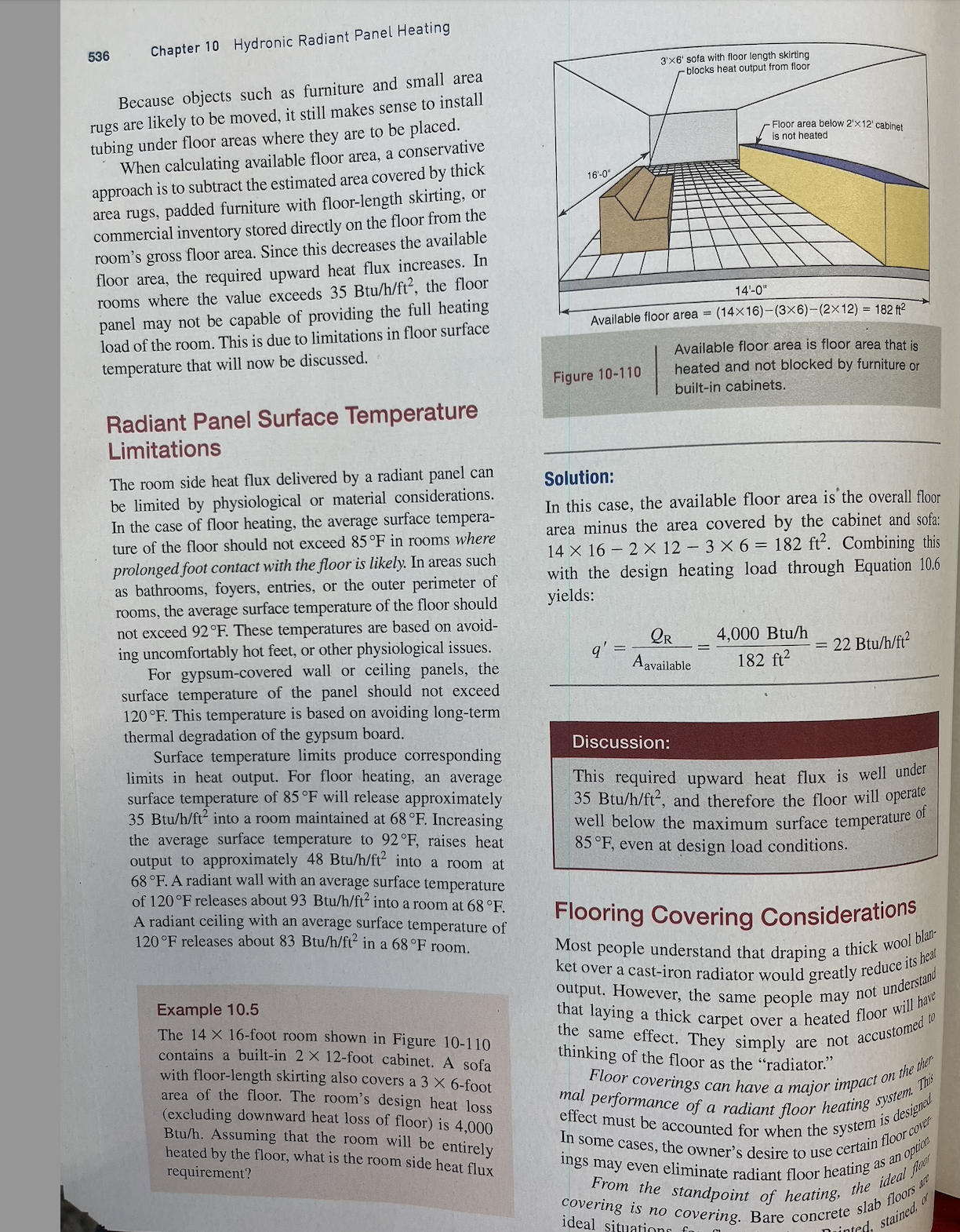
This page in Modern Hydronics talks about surface temperatures, heat flux and the calculations used to determine it. Although I don't know many consider the heat flux calculation? Until they end up with a cold, under radiated kitchen floor in a customers home:)
Mentioned on this page is ceilings radiant outputs up to 93 btu/sq ft from a wall, 83 btu/sq ft from a ceiling 120° AST (in a 68° room) So you can play around with ambient numbers to change the radiant panel output numbers. Uponor suggests 104 AST as their max. And their chart runs out to 40 btu/sq ft.
I don't see 40 btu/sq.ft in a 68° space realistic from a comfortable residential radiant floor.
As I age I find I need 70° in radiant rooms to be comfortable. I have my A2AHP running 72° currently. Shop concrete slab I can work comfortably at 68, but that is a bit cool for desk work. For me anyways. Your mileage may vary.
So my point is the higher btu output available from radiant floors and walls, period. Depending on whos numbers you want to use.
 Bob "hot rod" Rohr
trainer for Caleffi NA
Living the hydronic dream0



Categories
- All Categories
- 87.6K THE MAIN WALL
- 3.3K A-C, Heat Pumps & Refrigeration
- 59 Biomass
- 429 Carbon Monoxide Awareness
- 124 Chimneys & Flues
- 2.2K Domestic Hot Water
- 5.9K Gas Heating
- 119 Geothermal
- 168 Indoor-Air Quality
- 3.8K Oil Heating
- 78 Pipe Deterioration
- 1K Plumbing
- 6.6K Radiant Heating
- 394 Solar
- 16K Strictly Steam
- 3.5K Thermostats and Controls
- 56 Water Quality
- 51 Industry Classes
- 50 Job Opportunities
- 18 Recall Announcements