Estimating annual heating energy use

I'm starting to read Siegenthaler's "Modern Hydronic Heating and Cooling" fourth edition, and it's chock full of good stuff. I'm on section 2.8, estimating annual heating energy use. I have previously done several heat loss calculations for our small condo building in the Boston area, and have used heating degree days (HDD) in the various calculations. But I had not come across the correction factor Cd for heating degree days that allows easy estimation of annual energy usage based on the number of HDD's for the area and the known or calculated design heating load.
The Cd is essentially a correction that accounts for the fact that in milder weather, a building's heat loss per HDD is lower than it is in colder weather. The correct value for Cd will also depend on a building's design; for example, one with a lot of passive solar gain will have a lower Cd than one with little solar gain. But an average Cd can get you close to a correct estimate for annual energy use.
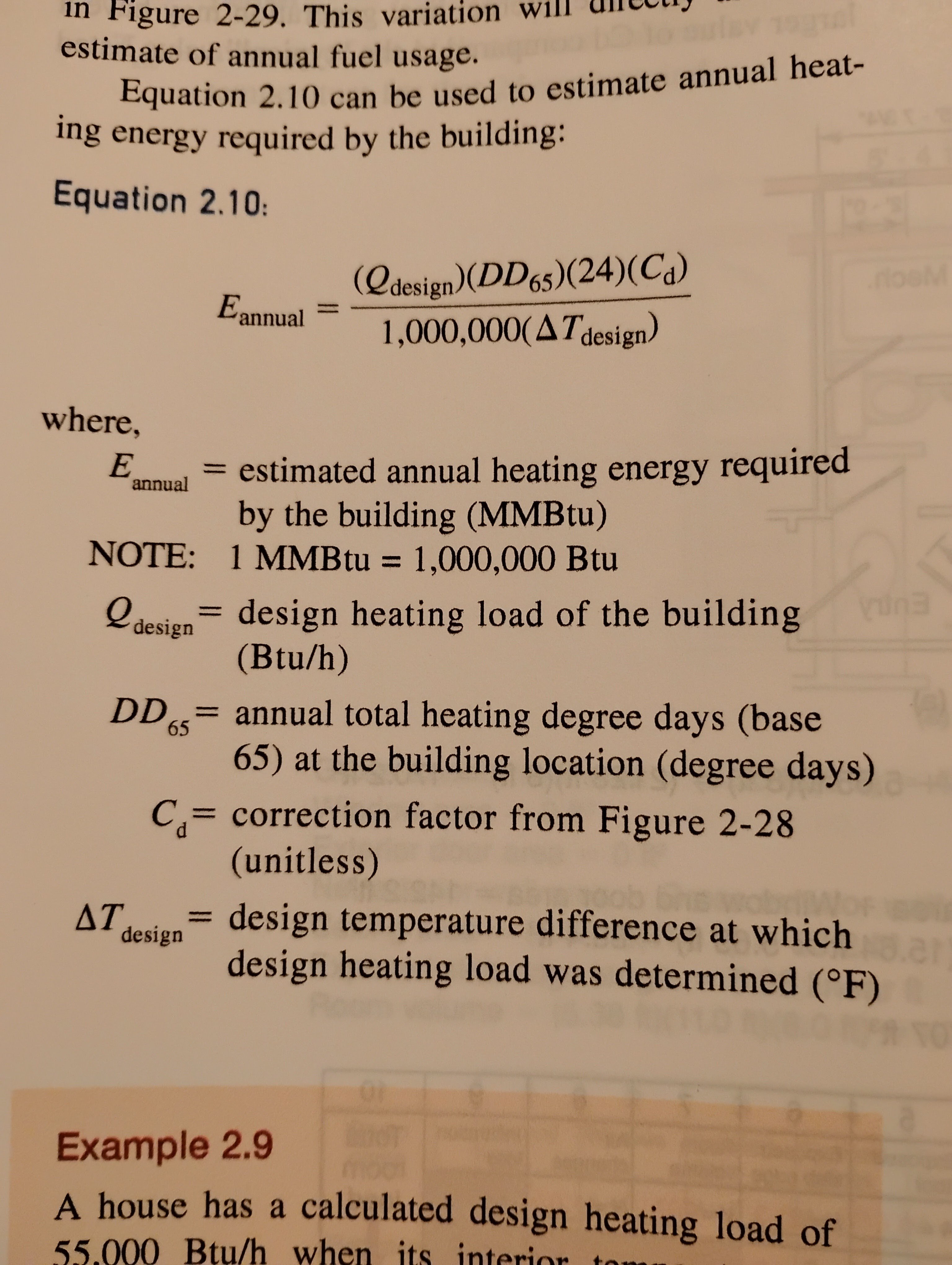
This is the equation Siegenthaler gives for using Cd:
And this is the chart showing the range of Cd values based on local annual HDD's. In my case, Boston has 5,630 HDD's, so I used the corresponding Cd value of 0.61 taken from the chart:
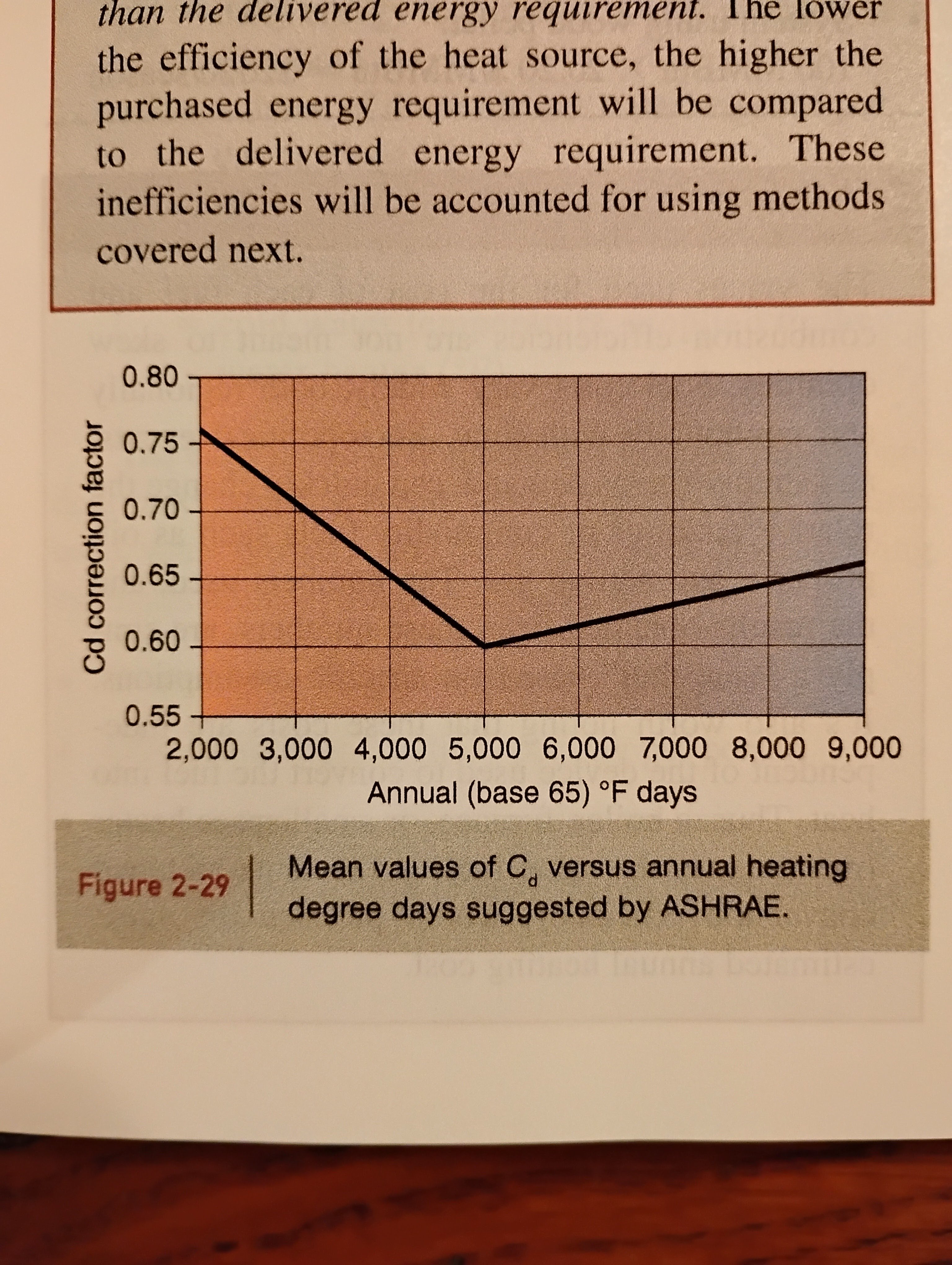
Our building has a known heating load of 100,000 BTU/hr at zero degrees outside temperature. Using 5,630 HDD's for Boston, a corresponding Cd of 0.61, and a delta T of 68 degrees, I get a predicted annual energy use of 121 million BTU's for our building.
In fact, we burn an average of 1200 gallons of oil per year for heating (DHW is from a separate gas fired water heater). Assuming 138,000 BTU/gal gives a BTU total of 166 million BTU's per year. However, that's assuming 100% efficiency. In reality, our overall system efficiency is probably around 65%-70% (cast iron non-condensing boilers). So in reality, the number of BTU's we extract in useful heat is around 108-116 million BTU's per year, vs. the 121 million BTU's predicted using Cd. That's a difference of only 4% to 11%, which is surprisingly good agreement.
Siegenthaler cautions that the actual Cd for a given building can vary quite significantly depending on design, insulation, solar gain, etc. But for an "average" building (ours is a 1924 masonry and wood framed house built in the Boston area with conventional double hung windows and average solar gain) our results show that you can get a very good prediction of annual energy use for heating using the above method.
Comments
-
Fascinating
Edward Young Retired
After you make that expensive repair and you still have the same problem, What will you check next?
0 -
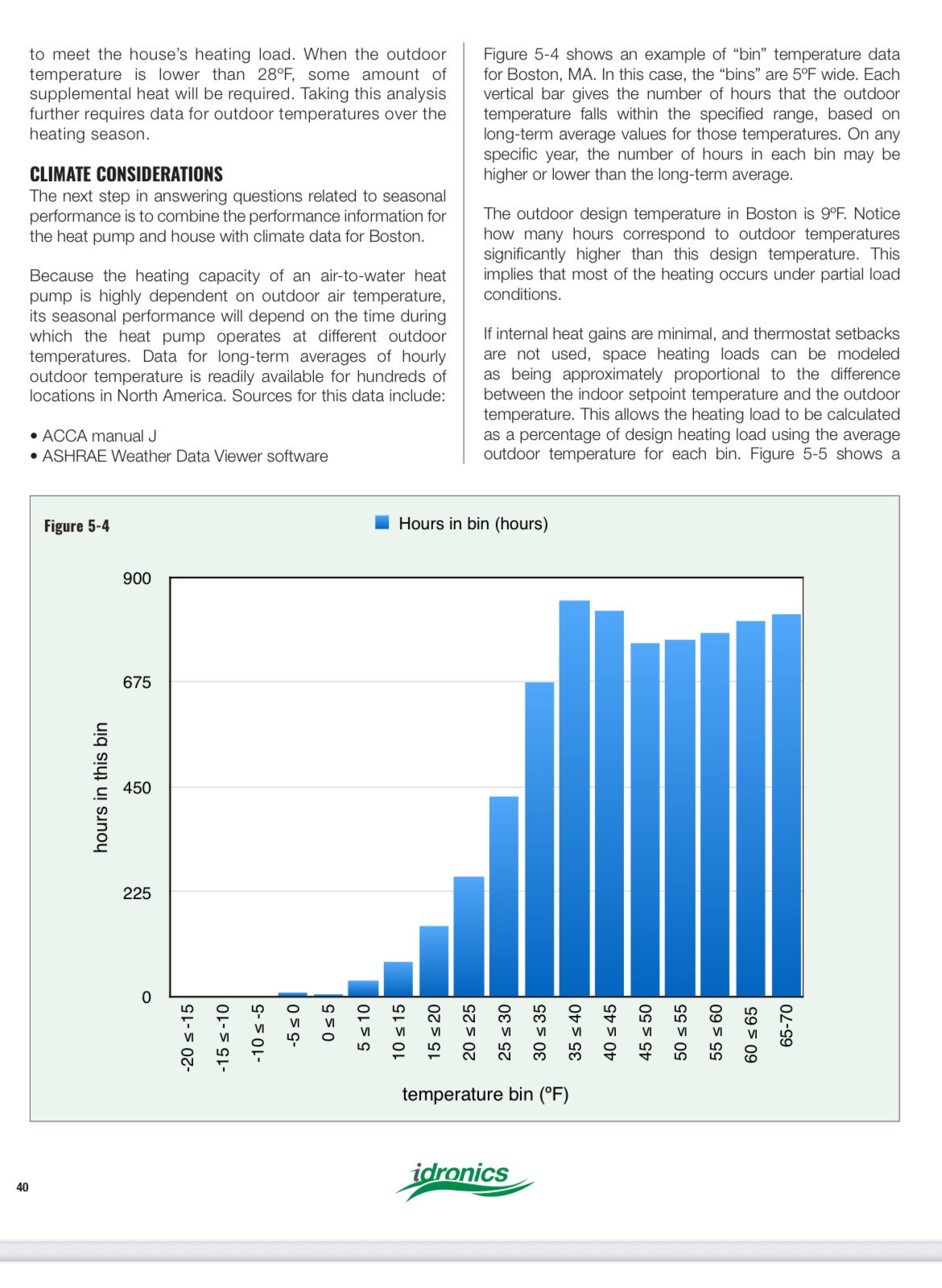
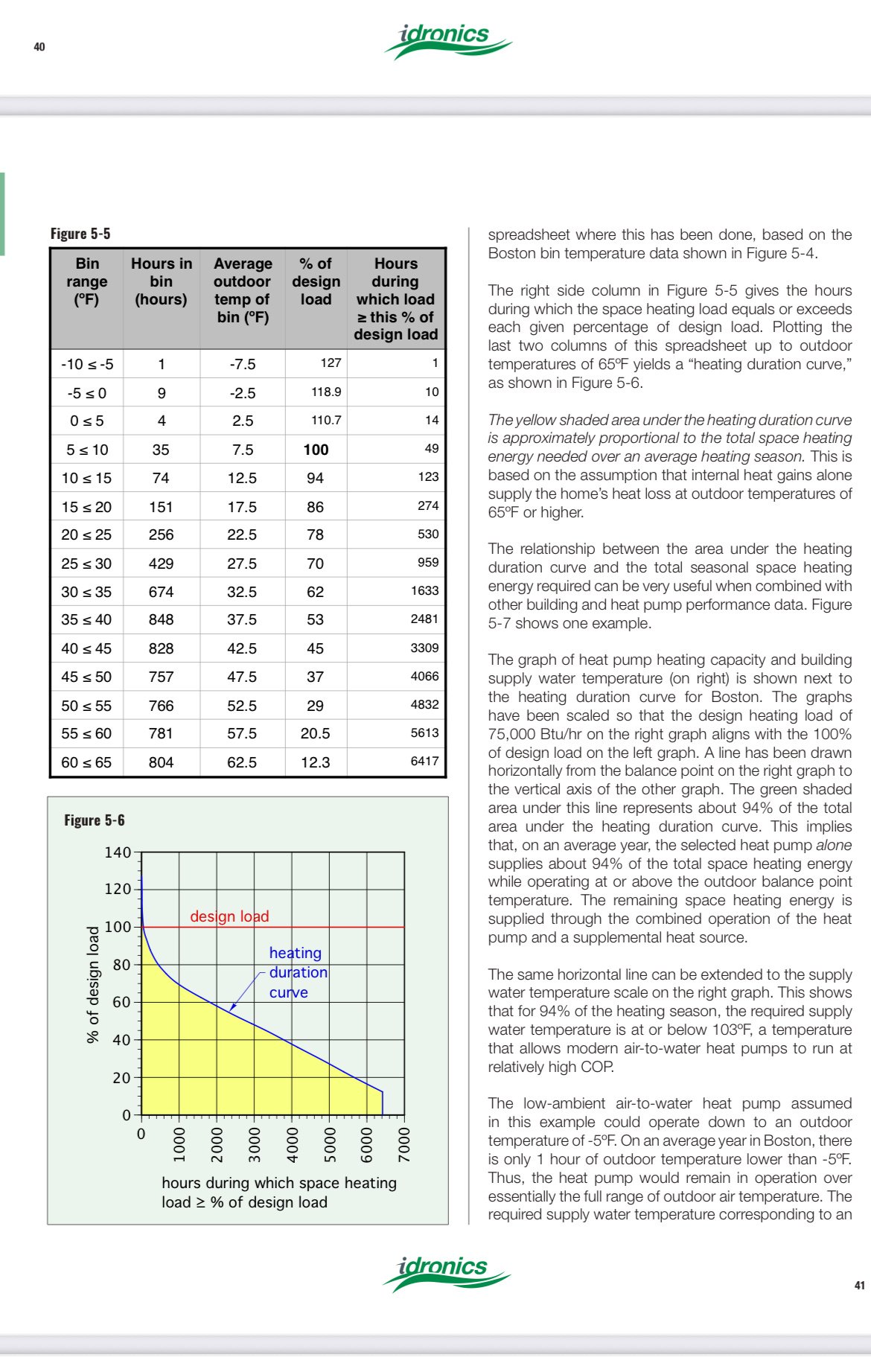
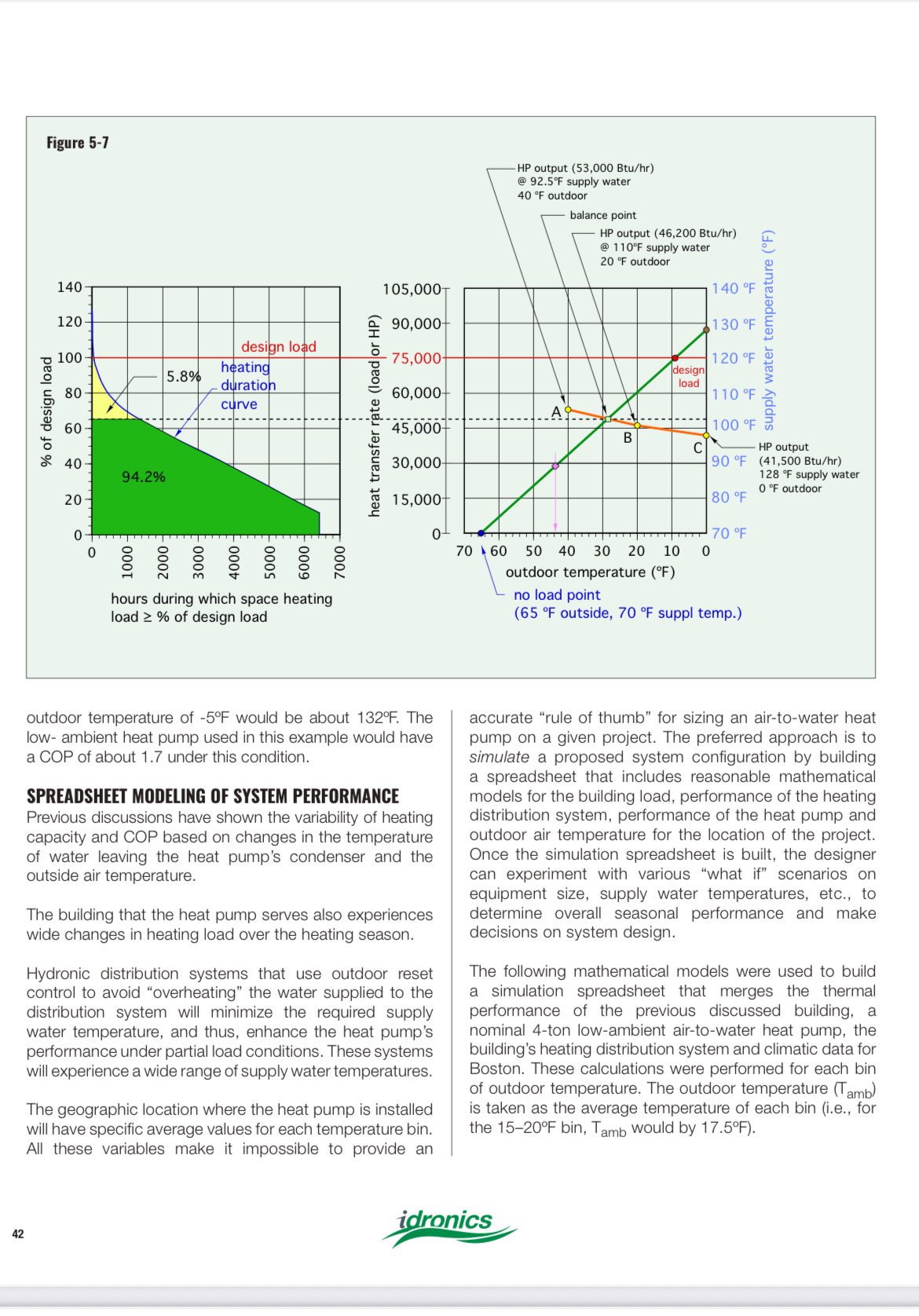
Siggy put these graphs together for Idronics, using Boston as the example
It shows how may hours you would typically be at or below design conditions
Which could give you an idea of how often a cast boiler could short cycle or run cold returns
 Bob "hot rod" Rohr
trainer for Caleffi NA
Living the hydronic dream1 -
Thanks, Bob. I don't know enough yet to make sense of the bin data, but I do know enough to know that our boilers are still oversized 100% of the time!
0 -
This is interesting! I hadn’t ever considered a significant correction factor. Is there data to support this?
0 -
My house definitely has lower HDD-normalized heat loss at warmer temperatures:
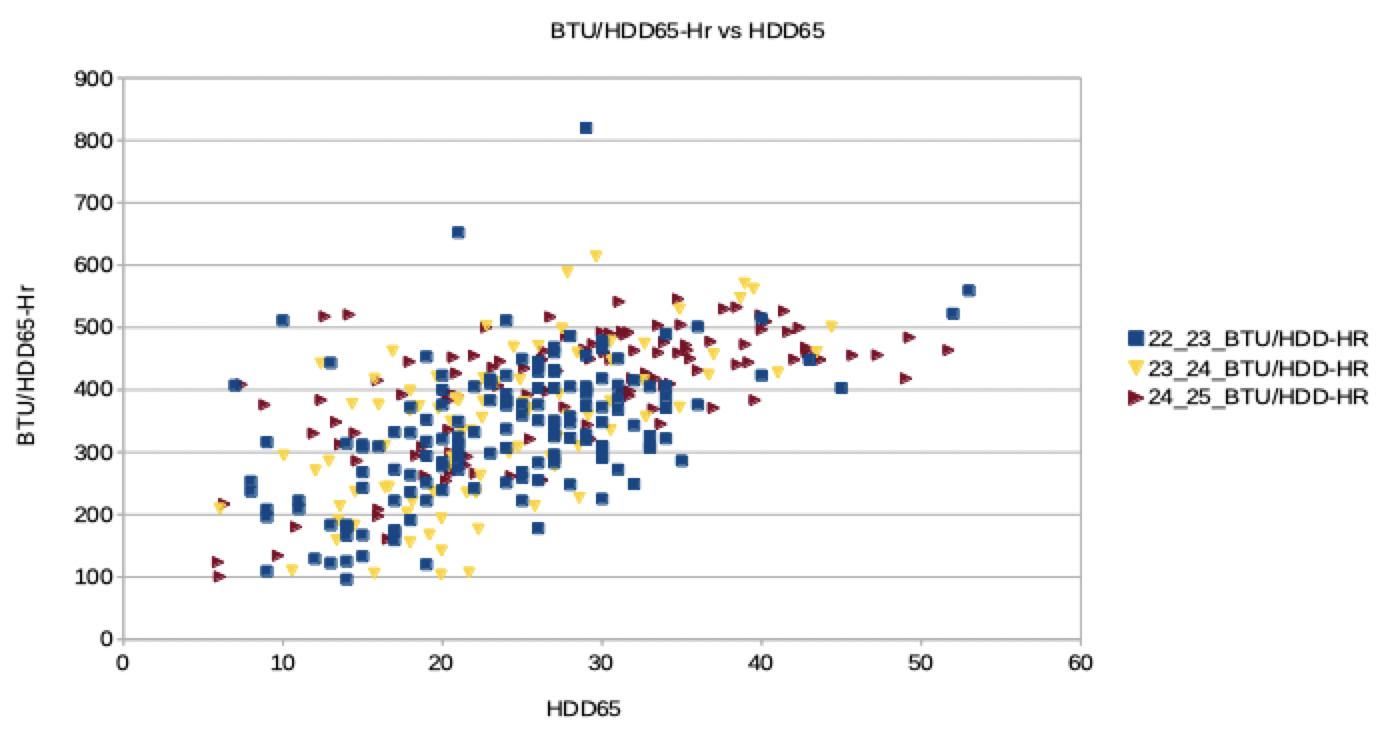
It's interesting that their correction factor is V-shaped vs total HDD, but I could imagine trying to back out a similar kind of correction factor for my location based on hourly temperature bin data.
0 -
I'm just learning about this myself, so I am not an authority. But I did find this paper from 1985 that discusses Cd and other related correction factors, and explains the basis for them. So apparently this is not a new concept. I have not yet found where ASHRAE got their data to construct that graph, but I'll keep looking.
Meanwhile the paragraph headed "The Modified Degree Day Method" at the top of page 2 does a good job of describing why the Cd factor is needed and what it accounts for.
0 -
I think this if for estimating fuel costs when you have no hard usage data.
What problem are you trying to solve in your building? You have the actual usage which you can compare to degree days.0 -
I have no problem to solve now, but that's because I spent the last few years learning from the pros here and doing the necessary measurements and calculations. But during that learning process, I never came across the Cd factor and its use. It would have been helpful to know about.
There are actually two ways the Cd factor can be useful. One is if you know or can calculate you building's heat loss, but you don't know the annual energy use (maybe it's a new house you just moved into, or you're running numbers for a customer who hasn't kept track of their annual energy use).
The other way Cd can be used is to back-calculate the design heating load from known annual energy use. Say I know I use 1200 gallons of oil per year at 70% overall system efficiency. That's 116 million useful BTU's, from which I could have back-calculated my design heating load of 100,000 BTU/hr. That would have been useful to know as one data point. I did use other methods to calculate design heating load, just not this one.
So since I haven't seen Cd mentioned here before in the few years I've been learning and posting, I thought it might be helpful to mention it in case anyone else finds it useful.
0 -
@fentonc what's the heating system? You've isolated the heat vs. all the other energy usage? I have the DHW and dryer that are skewing my low temp data, so the slope of my line is actually negative for BTUs/HDD.
0 -
@Hot_water_fan - CI boiler with 3-zone fin tube. I believe those numbers are just computed from daily boiler gas usage vs HDD65 as tracked by an outdoor thermostat. You're right that I have a HPWH next to the boiler, so the load from that is going up as the incoming water temperature drops throughout the season, which might skew things (I also don't have the basement zone turned on during the shoulder seasons.
0 -
This is a related post I did over at GBA:
While it's mostly about heat pumps, what is relevant is the technique for using data from NEEP.org to get the "bins" — the hours per year at each temperature — for your location.
Rather than just using a degree-day correction factor, it would be more accurate to estimate the energy usage at each temperature, then sum up hours per year at that temperature, and then sum up all the temperatures to get total energy usage for the year.
A simple assumption is often made that energy usage is directly proportional to the difference between inside and outside temperature. That assumption isn't correct, usage at mild temperatures tends to be less than that model would predict.
Note that using Manual J to try and predict energy usage is a misapplication of Manual J, because that's not what it is meant for. It's intent is to predict your maximum heating load so you have enough capacity.
1 -
@DCContrarian i don’t have hundreds of homes data, but from what I have examined:
”A simple assumption is often made that energy usage is directly proportional to the difference between inside and outside temperature. That assumption isn't correct, usage at mild temperatures tends to be less than that model would predict.”
doesn’t ring true to me. It is remarkably linear in the data I’ve seen.
I think the correction factor might be a way to compensate for manual Js that are inaccurate. We just fudge down the numbers instead of fudging up the number.0 -
Just to clarify what Cd is actually supposed to correct for, here's an excerpt from the NREL paper I posted above:
"The Cd factor is needed primarily because degree days are used to a 65 F base temperature, a value based on work done in the 1930's when the degree-day method was originally developed. For modern buildings, lower base temperatures should be used because of better insulation, higher internal gains, and lower thermostat settings. Because degree-day data were not available for lower base temperatures until recently, the Cd factor was introduced in the modified degree-day method. Cd is a multiplier, less than 1.0, which modifies HDD65 to a smaller number of degree days, thereby approximating the effect of a lower base temperature. Appropriate base temperatures are a function of building characteristics and use, and Equation 1 will be in error for buildings that do not match the Cd assumptions."
So, obviously, it's important to understand what factors Cd is attempting to correct for, and to understand your building envelope's characteristics and uses and where it may vary from "average" Cd. In our case of a conventional 1924 residential building in Boston, we are apparently "average" enough that a Cd based solely on the number of our local HDD65's predicts our annual energy use to within 10% or so, which is surprisingly good, I think. I doubt most heating pros would promise their clients better than 90% accuracy on their predictions for annual energy consumption on a new heating system install.
But yes, there will be cases like super-insulated passive houses where the use of Cd based on "average" building characteristics is not appropriate and will give incorrect results. The NREL paper above addresses that and introduces other correction factors to account for solar gain, etc, when necessary.
There is also the temperature "bin" method mentioned by @hot_rod and @DCContrarian above. I haven't needed to use it yet, but I understand why it would be useful for heat pumps which are highly dependent on outside air temps.
0




Categories
- All Categories
- 87.6K THE MAIN WALL
- 3.3K A-C, Heat Pumps & Refrigeration
- 59 Biomass
- 429 Carbon Monoxide Awareness
- 124 Chimneys & Flues
- 2.2K Domestic Hot Water
- 5.9K Gas Heating
- 119 Geothermal
- 168 Indoor-Air Quality
- 3.8K Oil Heating
- 78 Pipe Deterioration
- 1K Plumbing
- 6.6K Radiant Heating
- 394 Solar
- 16K Strictly Steam
- 3.5K Thermostats and Controls
- 56 Water Quality
- 51 Industry Classes
- 50 Job Opportunities
- 18 Recall Announcements