Let me try this again, this time with a 1" supply pipe. Surely that will cause trouble!
Comments
-
it isn't that the steam going through the trap equalizes the return, if steam were in the return after the air was out of the emitters and the pressure in the mains and returns was equal the system would perform just fine. the condensing steam in the emitters would pull more steam in to the emitter and it would heat just fine.
The problem with steam in the returns of a 2 pipe system is that it closes various traps from the return side before air has finished venting out of them from the mains in the crossover traps or main vents and from the emitters in the radiator traps as well as closing the vents on the return keeping the air from venting from the return.
0 -
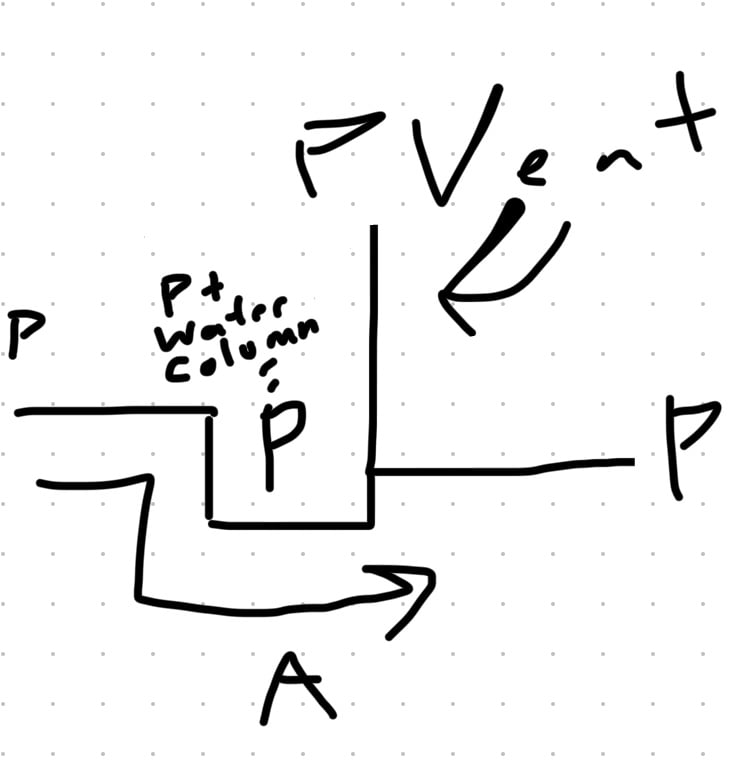
Diagram AAssuming there is small p pressure on the very left side, an application that this would involve would be an air handler that has negative pressure, there would need to be a vent on the lower pipe so that water could push its way out. The water column, about 3in, combined with that small pressure gives us enough pressure to push its way out. If the air vent were not there, the water could not push its way out effectively because there is a lower pressure on the very left side and higher pressure on the right side. The air vent essentially disables the lower pressure by introducing atmospheric pressure thus equalizing at the air vent and the right side outlet. Take a straw, fill with water, play with the water level because it’s fun to see how it works, put finger over top hole and tilt the straw enough so water drains out. You will see it drain slow, but it drains because there is still some pressure sneaking in. Now do the same thing but without putting your finger over the top hole. You will see the water fall out really quick.
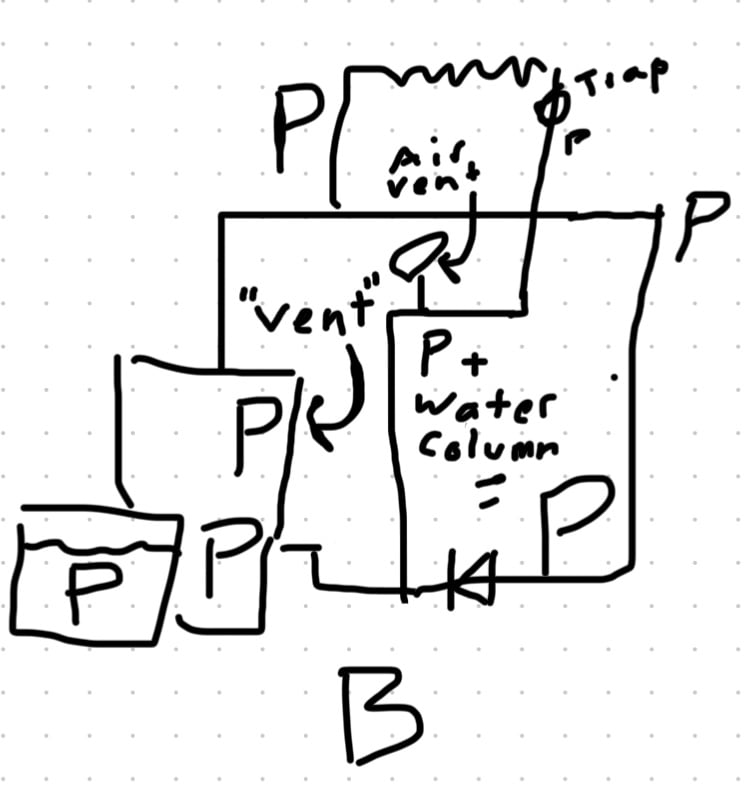
Diagram B
I want to start by saying most residential systems I work on do not have a big enough B dimension to achieve what I think you, Paul, are trying to get at with saying the equalizer does nothing. I do think that if there was a high enough B dimension and a properly placed air vent above the B dimension, that hopefully never sees steam and causes a horrible siphon, that one could achieve a two pipe system without an equalizer. This of course would mean everything is working properly and set up correctly to do so. But even if you did get it working, I think the water would drain really slow if at all (please correct me if I am wrong in thinking this). Water falling creates a vacuum, which is why the air vent would break that vacuum, but you would need a big vent and one that is functioning. Relying on a vent is scary as they can fail. I can easily rely on an equalizer as I don’t have to worry it would stop working on me. This is what the equalizer does, it breaks the vacuum. This is what the vent does on a p trap, it breaks the vacuum. If you’ve ever worked on a p trap, like the one I described above, you could plug the vent and watch the trap not work anymore. You need vents on your house plumbing or things wouldn’t work correctly and your house would smell like crap. Fun fact, the guy who improved the p trap design is named Thomas Crapper. Just like you Paul, I would love to see a test of a two pipe system without an equalizer to end this debate. From my experience, I don’t think it will work the way you want it to. I’ll do what people smarter than me do, install equalizers because they work.
 1
1 -
I would think if all the air was out and the pressures equalized, you would be building pressure quick and your boiler would turn off due to pressure. If steam went through the trap, and on to another one, I think it will cause either two problems, no flow or overheating radiator. There might even be a situation where a bad trap will cause water hammer and destroy other traps
0


Categories
- All Categories
- 87.5K THE MAIN WALL
- 3.3K A-C, Heat Pumps & Refrigeration
- 59 Biomass
- 429 Carbon Monoxide Awareness
- 124 Chimneys & Flues
- 2.2K Domestic Hot Water
- 5.9K Gas Heating
- 118 Geothermal
- 168 Indoor-Air Quality
- 3.8K Oil Heating
- 78 Pipe Deterioration
- 1K Plumbing
- 6.6K Radiant Heating
- 394 Solar
- 15.9K Strictly Steam
- 3.5K Thermostats and Controls
- 56 Water Quality
- 50 Industry Classes
- 50 Job Opportunities
- 18 Recall Announcements